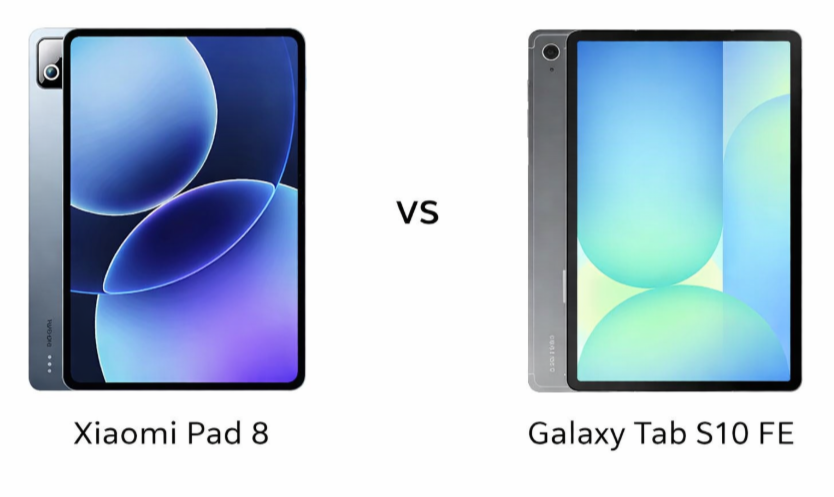
Choosing a budget tablet in 2026 isn’t as simple as picking the cheaper option anymore; it’s about getting flagship-like performance without overspending. The Xiaomi Pad 8 and Galaxy Tab S10 FE sit right in that sweet spot, offering powerful specs, premium designs, and productivity features at mid-range prices. But they take very different approaches; one focuses on raw power and display quality, while the other leans into ecosystem, durability, and usability. That’s exactly why this comparison matters.
The Xiaomi Pad 8 and Galaxy Tab S10 FE both bring premium aluminum builds, but they target slightly different priorities. Xiaomi focuses on slimness at just 5.8mm, making it feel more modern and ultra-light in the hand. Samsung, on the other hand, adds durability with IP68 water and dust resistance—something rare in this segment. The Tab S10 FE also includes SIM support for cellular use, which adds flexibility for on-the-go users. Xiaomi counters with a cleaner, minimalist design and slightly better weight balance.
Display & Multimedia
This is where Xiaomi clearly pushes ahead. The Pad 8 features a sharper 3:2 display with a 144Hz refresh rate, HDR10, Dolby Vision, and significantly higher brightness. It feels more flagship-like, especially for content consumption and gaming. Samsung’s 90Hz panel is good, but it looks dated next to Xiaomi’s smoother and more vibrant screen. However, Samsung still offers a more traditional 16:10 ratio, which some users may prefer for media apps.
Verdict
Xiaomi Pad 8 wins with a superior display and sleeker design, while Samsung stands out for durability and versatility.
2. Performance and Software
Processor & UI Smoothness
The Xiaomi Pad 8 is powered by the Snapdragon 8s Gen 4, which is in a completely different league compared to the Exynos 1580 on the Tab S10 FE. Daily performance, gaming, and heavy tasks feel significantly faster and smoother on Xiaomi. The 144Hz display further enhances the perception of speed, making animations and scrolling feel fluid. Samsung performs well for regular use, but it lacks that flagship-level punch when pushed.
Productivity & Multitasking
Samsung’s One UI 7 is better optimized for productivity with features like multi-window and a more mature tablet interface. It feels more refined for work use. Xiaomi’s HyperOS 3 is improving, but still feels more performance-focused rather than productivity-first. However, the stronger chipset on Xiaomi helps with heavy multitasking and demanding apps.
Verdict
Xiaomi dominates raw performance, but Samsung offers a more polished productivity experience. Power users will lean toward Xiaomi, while work-focused users may prefer Samsung.
3. Battery and Accessories
Battery Life
Xiaomi packs a larger 9200mAh battery compared to Samsung’s 8000mAh unit, which translates to longer screen time, especially for media and gaming. Both support 45W charging, but Xiaomi adds reverse wireless charging, making it more versatile. Samsung still delivers reliable all-day usage, but it doesn’t push boundaries here.
Stylus, Keyboard & Ecosystem
Samsung has a clear advantage in the ecosystem and accessories. The S Pen experience is more refined, and Samsung’s ecosystem integration with phones, laptops, and apps is stronger. Xiaomi supports stylus input, but its accessory ecosystem still feels less mature. However, Xiaomi’s faster hardware makes it better for creative apps that demand performance.
Verdict
Samsung wins for ecosystem and accessories, while Xiaomi takes the lead in battery capacity and versatility.
4. Camera & Media
Rear and Front Camera
Both tablets offer similar 13MP rear cameras, but tablets are rarely about photography. The key difference is the front camera, Samsung’s 12MP ultrawide is far more practical for video calls and meetings, keeping subjects in frame more naturally. Xiaomi’s 8MP front camera is decent but feels basic in comparison.
Video & Audio Quality
Both tablets support 4K recording, but Samsung’s front camera flexibility gives it an edge for content creators and remote work. Xiaomi, however, delivers a stronger multimedia experience with Dolby Atmos quad speakers, making movies and games feel more immersive. Audio quality is noticeably richer and louder on Xiaomi.
Verdict
Samsung is better for video calls and front-facing usage, while Xiaomi is clearly superior for media consumption and audio experience.
5. Pricing
Xiaomi Pad 8 is priced at around ₹34,000, while the Galaxy Tab S10 FE comes in at approximately ₹43,000. That price gap is significant. Xiaomi offers a flagship-level processor, better display, and bigger battery at a much lower cost, making it feel like a high-value performance tablet. Samsung justifies its higher price with durability, software optimization, and ecosystem benefits, but the hardware gap is hard to ignore.
Disclaimer: Prices are approximate and may vary based on country, region, and applicable taxes.
6. Conclusion
Xiaomi Pad 8 stands out with its Snapdragon 8s Gen 4 chip, 144Hz Dolby Vision display, and reverse wireless charging, features rarely seen at this price. Samsung counters with IP68 protection, S Pen refinement, better front camera, and a more polished software ecosystem.
Verdict
Xiaomi Pad 8 is the better overall value and performance tablet, making it the smarter choice for most buyers in 2026. The Galaxy Tab S10 FE still makes sense for users who prioritize ecosystem, durability, and productivity-focused features over raw power.
We use cookies on our website to give you the most relevant experience by remembering your preferences and repeat visits. By clicking “Accept”, you consent to the use of ALL the cookies.
This website uses cookies to improve your experience while you navigate through the website. Out of these, the cookies that are categorized as necessary are stored on your browser as they are essential for the working of basic functionalities of the website. We also use third-party cookies that help us analyze and understand how you use this website. These cookies will be stored in your browser only with your consent. You also have the option to opt-out of these cookies. But opting out of some of these cookies may affect your browsing experience.
Necessary cookies are absolutely essential for the website to function properly. This category only includes cookies that ensures basic functionalities and security features of the website. These cookies do not store any personal information.
Any cookies that may not be particularly necessary for the website to function and is used specifically to collect user personal data via analytics, ads, other embedded contents are termed as non-necessary cookies. It is mandatory to procure user consent prior to running these cookies on your website.




Comments