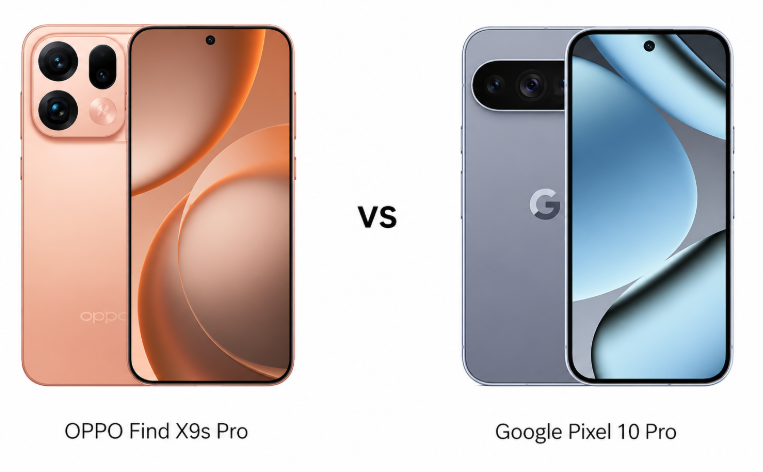
In a flagship space where hardware power and software intelligence are pulling in different directions, the OPPO Find X9s Pro and Pixel 10 Pro represent two very different ideas of what a premium smartphone should be. One pushes boundaries with massive battery, aggressive specs, and fast charging, while the other leans into AI, camera consistency, and long-term software support. This comparison matters because both target the same high-end buyer, but deliver completely different experiences.
Major Features:
Feature
OPPO Find X9s Pro
Google Pixel 10 Pro
Winner
Display Type
LTPO AMOLED, 144Hz, 1B colors
LTPO OLED, 120Hz, HDR10+
OPPO – higher refresh rate
Brightness
800 nits (typ), 1800 nits (peak)
2200 nits (HBM), 3300 nits (peak)
Pixel – much brighter
Resolution
1216 × 2640 (~460 ppi)
1280 × 2856 (~495 ppi)
Pixel – sharper
Chipset
Dimensity 9500 (3nm)
Tensor G5 (3nm)
Tie – both 3nm
RAM
12GB / 16GB
16GB
Pixel – higher base RAM
Storage
UFS 4.1
UFS 3.1 (128GB), UFS 4.0
OPPO – faster storage
Main Camera
200MP + 200MP + 50MP
50MP + 48MP + 48MP
OPPO – higher resolution sensors
Zoom
2.8x optical
5x optical
Pixel – better zoom
Video
8K, 4K@120fps, Dolby Vision
8K (cloud), 4K@60fps, 10-bit HDR
OPPO – higher frame rate
Selfie Camera
32MP
42MP (AF, ultrawide)
Pixel – higher res + autofocus
Battery
7025 mAh
4870 mAh
OPPO – much bigger battery
Charging (Wired)
80W
30W
OPPO – much faster
Charging (Wireless)
50W
15W
OPPO – much faster
Build Protection
IP66/IP68/IP69
IP68
OPPO – more protection
Software Support
Not specified
7 Android upgrades
Pixel – longer support
Connectivity
Bluetooth 6.1, IR blaster
Bluetooth 6.0, UWB, Satellite SOS
Pixel – more advanced features
Price
₹73,000
₹1,10,000
OPPO – far better value
Disclaimer: Specs are based on available data. Actual performance may vary. Verify details from official sources before buying.
The OPPO Find X9s Pro leans into durability with IP66/IP68/IP69 protection and a clean, minimal design that feels engineered for longevity. It skips premium material highlights but compensates with rugged resistance and practical usability. The Pixel 10 Pro, on the other hand, focuses on refinement with Gorilla Glass Victus 2 on both sides and an aluminum frame, delivering a more traditionally premium in-hand feel. It looks and feels more polished, especially for users who value craftsmanship over outright toughness.
Display Quality
OPPO offers a 144Hz LTPO AMOLED panel with vibrant colors and smooth responsiveness, making it ideal for gaming and fluid UI interactions. The Pixel 10 Pro counters with a brighter LTPO OLED panel, higher peak brightness, and HDR10+ support, resulting in better outdoor visibility and more accurate HDR playback. The higher pixel density also gives it a sharper visual edge.
Verdict
The Pixel 10 Pro feels more premium and visually refined, while the OPPO Find X9s Pro delivers smoother motion and stronger durability. The better choice depends on whether polish or practicality matters more.
2. Specifications Including Battery
Performance
The OPPO Find X9s Pro runs on the Dimensity 9500, paired with fast UFS 4.1 storage, making it a powerhouse for gaming and sustained performance. It feels tuned for speed and efficiency under load. The Pixel 10 Pro’s Tensor G5 focuses more on AI-driven tasks and optimization, delivering a smoother everyday experience with long-term software support. While not always the fastest in raw benchmarks, it often feels smarter in real-world use.
Battery and Charging
OPPO takes a massive lead with its 7025 mAh battery, easily pushing beyond a full day of heavy use. Charging is equally impressive with 80W wired and 50W wireless speeds. The Pixel 10 Pro’s 4870 mAh battery is more modest, and its 30W charging feels conservative in comparison, though it benefits from better efficiency and features like bypass charging.
Verdict
OPPO clearly dominates in battery and charging, making it ideal for power users. Pixel focuses more on efficiency and smart performance, which may suit users prioritizing consistency over raw power.
3. Camera
Main and Secondary Lenses
The OPPO Find X9s Pro pushes hardware boundaries with dual 200 MP sensors and Hasselblad tuning, delivering rich detail and versatile shooting modes. It’s built for those who enjoy experimenting with photography styles. The Pixel 10 Pro takes a different approach, relying on computational photography with a balanced triple-camera system and a strong 5x periscope zoom. Its results are consistently accurate, with better color science and reliable HDR processing.
Selfie Camera
OPPO’s 32 MP front camera performs well for standard shots, but the Pixel’s 42 MP ultrawide selfie camera stands out with sharper detail and autofocus, making it more versatile for group shots and video calls.
Verdict
OPPO offers more raw power and flexibility, while Pixel delivers consistency and smarter image processing. The Pixel 10 Pro feels more dependable, especially for point-and-shoot users.
4. Pricing
The OPPO Find X9s Pro is priced at approximately ₹73,000, while the Pixel 10 Pro sits significantly higher at around ₹1,10,000. This creates a clear gap between the two, positioning OPPO as the more accessible flagship option and Pixel as a premium-tier device.
Value for Money
OPPO delivers exceptional value with high-end specs, massive battery capacity, and fast charging at a relatively lower price. It feels like a performance-focused flagship without the premium tax. The Pixel 10 Pro justifies its higher price through long-term software support, advanced AI features, and a more refined camera experience. It appeals more to users who prioritize ecosystem, updates, and reliability over hardware specs alone.
Verdict
OPPO wins on value and hardware per rupee, while Pixel justifies its price through software longevity and smarter features.
Disclaimer: Prices are approximate and may vary based on country, region, launch timing, and applicable taxes. Always check whether the listed price is for a China unit or a global/international variant when purchasing.
5. Conclusion
OPPO Find X9s Pro stands out with its massive battery, ultra-fast charging, and high-resolution dual 200 MP camera system, making it a hardware-driven flagship. The Pixel 10 Pro differentiates itself with 7 years of Android updates, advanced AI features, satellite SOS, and a more refined imaging system that prioritizes consistency over specs.
Final Verdict
If one has to be chosen, the OPPO Find X9s Pro comes out as the better overall pick for most users. It delivers significantly better battery life, much faster charging, and stronger raw performance at a much lower price, making it the smarter value-driven flagship. The Pixel 10 Pro still stands out for its cleaner software, longer update support, and more consistent camera processing, but those advantages mainly justify its higher price for users who specifically prioritize software experience over hardware.
Disclaimer: This comparison is based on the specifications provided and is intended for general informational purposes. Actual performance, camera results, battery life, and overall experience may vary depending on real-world usage, software updates, and individual preferences.
We use cookies on our website to give you the most relevant experience by remembering your preferences and repeat visits. By clicking “Accept”, you consent to the use of ALL the cookies.
This website uses cookies to improve your experience while you navigate through the website. Out of these, the cookies that are categorized as necessary are stored on your browser as they are essential for the working of basic functionalities of the website. We also use third-party cookies that help us analyze and understand how you use this website. These cookies will be stored in your browser only with your consent. You also have the option to opt-out of these cookies. But opting out of some of these cookies may affect your browsing experience.
Necessary cookies are absolutely essential for the website to function properly. This category only includes cookies that ensures basic functionalities and security features of the website. These cookies do not store any personal information.
Any cookies that may not be particularly necessary for the website to function and is used specifically to collect user personal data via analytics, ads, other embedded contents are termed as non-necessary cookies. It is mandatory to procure user consent prior to running these cookies on your website.



Comments