Advertisement

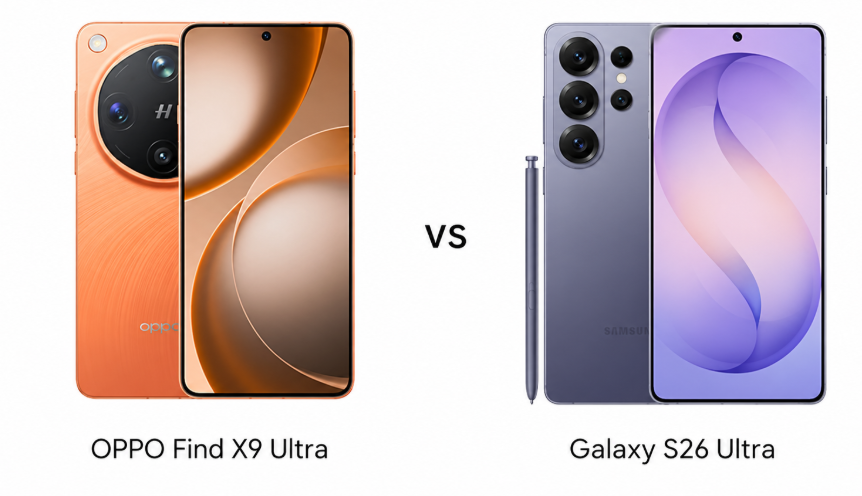
Ultra-flagships are no longer just about power; they’re about how differently brands define “the best.” The OPPO Find X9 Ultra and Samsung Galaxy S26 Ultra take two distinct paths: one pushes extreme hardware and charging innovation, while the other refines performance, software longevity, and ecosystem features. This comparison highlights which approach actually makes more sense, depending on how a flagship is used day to day.
Major Features:

FeatureOPPO Find X9 UltraSamsung Galaxy S26 UltraWinner
BuildGorilla Glass Victus 2, aluminum frame, glass / eco leather back, IP68/IP69Gorilla Armor 2 front, Victus 2 back, aluminum frame, IP68Samsung – Stronger front protection (Armor 2)
DisplayLTPO AMOLED, 144Hz, Dolby Vision, 3600 nits peakDynamic LTPO AMOLED 2X, 120Hz, HDR10+, 2600 nits peakOPPO – Higher refresh rate + much brighter
ChipsetSnapdragon 8 Elite Gen 5Snapdragon 8 Elite Gen 5Tie – Same chipset
CPU2×4.6 GHz + 6×3.62 GHz2×4.74 GHz + 6×3.62 GHzSamsung – Slightly higher clock speed
GPUAdreno 840Adreno 840 (1.3GHz)Samsung – Higher GPU frequency
RAM & StorageUp to 16GB / 1TB, UFS 4.1Up to 16GB / 1TB, UFS 4.XOPPO – Faster storage (UFS 4.1 stated)
Main Camera200MP (1/1.12″) + 200MP 3x + 50MP 10x + 50MP UW200MP (1/1.3″) + 10MP 3x + 50MP 5x + 50MP UWOPPO – More advanced zoom + dual 200MP
Video8K, 4K@120fps, Dolby Vision, 10-bit, O-Log28K, 4K@120fps, HDR10+OPPO – More video formats/features
Selfie Camera50MP12MPOPPO – Higher resolution
Battery7050 mAh5000 mAhOPPO – Much larger capacity
Charging (Wired)100W60WOPPO – Significantly faster
Wireless Charging50W25WOPPO – Faster wireless
Reverse Charging10W wireless + wired4.5W wirelessOPPO – More capable reverse charging
Bluetooth6.0 + aptX HD, Adaptive, LHDC 56.0OPPO – More codecs
PositioningGPS, BDS, GALILEO, QZSS, GLONASS, NavICGPS, GLONASS, BDS, GALILEO, QZSSOPPO – Adds NavIC
ExtrasInfrared portS Pen, DeX, UWBSamsung – More productivity features
Software Support5 major updates7 major updatesSamsung – Longer support
Price₹1,03,000₹1,40,000OPPO – Much lower price
Disclaimer: Specs are based on available data. Actual performance may vary. Verify details from official sources before buying.

1. Design and Display

Build and Feel

The OPPO Find X9 Ultra leans into a premium, camera-centric design with options like eco leather that add grip and character. It feels built for enthusiasts who appreciate both durability and a slightly bold aesthetic. The Samsung Galaxy S26 Ultra, on the other hand, sticks to a refined, industrial approach with its Armor frame and integrated stylus. It looks cleaner and more business-like, with tighter finishing and a more polished in-hand experience. The inclusion of the S Pen subtly adds functional value that goes beyond just design.

Display Quality

OPPO pushes ahead with a 144Hz LTPO AMOLED panel and extremely high peak brightness, making it more aggressive and fluid, especially for gaming and outdoor use. Samsung counters with a slightly larger panel, excellent anti-reflective coating, and a more color-accurate tuning. While OPPO feels more vibrant and dynamic, Samsung’s display appears more controlled and easier on the eyes during long sessions.

Verdict

OPPO feels more exciting and cutting-edge, while Samsung delivers a more refined and practical flagship experience.

2. Specifications Including Battery

Performance

Both devices run on the Snapdragon 8 Elite Gen 5, but Samsung edges ahead slightly with a higher clocked prime core and GPU tuning. In real-world use, both feel extremely fast, but Samsung may hold a slight advantage in sustained workloads and optimization. OPPO compensates with aggressive performance tuning that feels snappier in bursts, especially during gaming or multitasking. Software support is another key difference, with Samsung offering significantly longer update longevity, which adds long-term value.

Battery and Charging

This is where OPPO clearly dominates. The massive 7050mAh battery, combined with 100W wired and 50W wireless charging, makes it a powerhouse for heavy users. Samsung’s 5000mAh battery is reliable but feels conservative, and its charging speeds lag. OPPO simply reduces battery anxiety in a way Samsung does not fully match.

Verdict

Samsung offers better long-term polish and slightly stronger optimization, but OPPO wins decisively in battery and charging convenience.

3. Camera

Main and Secondary Lenses

OPPO takes a more ambitious approach with dual 200MP sensors and a versatile zoom system that includes both 3x and 10x optical options. This setup feels designed for flexibility and detail retention across all focal lengths. Samsung, while more traditional, delivers a highly refined camera system with strong computational photography and reliable consistency. Its 5x zoom is practical, but it lacks the extended reach and experimentation OPPO offers. OPPO feels more like a photography toolkit, while Samsung feels like a dependable point-and-shoot flagship.

Selfie Camera

The difference is clear here. OPPO’s 50MP front camera delivers sharper and more detailed selfies, especially in well-lit conditions. Samsung’s 12MP sensor is tuned for natural results and better consistency, but it lacks the raw resolution advantage.

Verdict

OPPO leads in hardware versatility and zoom capabilities, while Samsung remains more consistent and predictable in everyday shooting.

4. Pricing

OPPO Find X9 Ultra is priced at around ₹1,03,000, while the Samsung Galaxy S26 Ultra comes in significantly higher at approximately ₹1,40,000. This creates a noticeable gap in positioning, with OPPO offering flagship-level hardware at a more aggressive price point. Samsung justifies its premium with longer software support, brand value, and ecosystem features, but the difference is hard to ignore.

Is the price justified and value for money

OPPO feels like the better deal purely from a hardware perspective, especially considering its battery, charging, and camera system. Samsung, however, positions itself as a long-term investment with better software longevity and ecosystem integration. For users focused on raw specs and immediate value, OPPO stands out more clearly.

Verdict

OPPO delivers stronger value for money, while Samsung charges a premium for refinement and long-term reliability.

Disclaimer:
Prices are approximate and may vary based on country, region, launch timing, and applicable taxes. Always check whether the listed price is for a China unit or a global/international variant when purchasing.

5. Conclusion

OPPO stands out with its massive battery, ultra-fast charging, and highly experimental camera setup that pushes boundaries. It feels like a device built for users who want maximum hardware innovation. Samsung counters with features like the S Pen, DeX support, anti-reflective display, and extended software updates, making it a more productivity-focused flagship. These additions create a more complete ecosystem experience rather than just a hardware showcase.

Verdict

OPPO Find X9 Ultra is the better choice for users who prioritize battery life, fast charging, and camera versatility at a lower price. The Samsung Galaxy S26 Ultra, however, is more balanced, refined, and future-proof, making it a stronger pick for long-term usage and productivity-focused buyers.

Disclaimer: This comparison is based on the specifications provided and is intended for general informational purposes. Actual performance, camera results, battery life, and overall experience may vary depending on real-world usage, software updates, and individual preferences.

Read More:

Comments