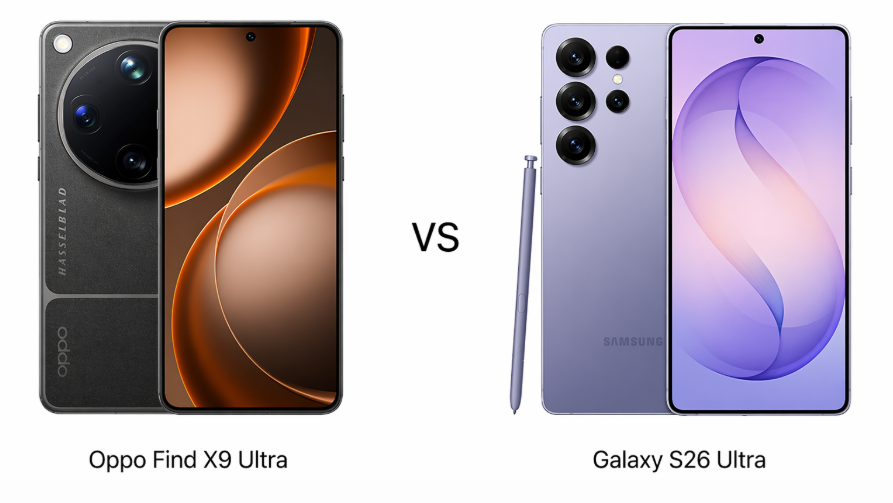
Oppo has just dropped the Find X9 Ultra, and it instantly turns the ultra-flagship space into a real fight instead of a predictable upgrade cycle. On one side is a phone built to push limits, with a bigger battery, bolder camera hardware, and faster charging. On the other hand is the Galaxy S26 Ultra, which plays the long game with refinement, ecosystem features, and consistency. This comparison isn’t just about specs, it’s about choosing between raw innovation and a polished, reliable flagship experience.
Major Features:
Feature
Oppo Find X9 Ultra
Samsung Galaxy S26 Ultra
Winner
Design & Build
Premium glass, bold camera module
Armor aluminum, Gorilla Armor 2, S Pen
Samsung – More refined & durable
Display
6.82″ AMOLED, QHD+, 120Hz, 1800 nits
6.9″ LTPO AMOLED, QHD+, 120Hz, 2600 nits
Samsung – Brighter & anti-reflective
Processor
Snapdragon 8 Elite Gen 5
Snapdragon 8 Elite Gen 5
Tie – Same flagship chip
RAM & Storage
Up to 16GB + 1TB (UFS 4.1)
Up to 16GB + 1TB (UFS 4.x)
Tie – Similar configs
Main Camera
200MP (OIS)
200MP (OIS)
Tie – Same resolution
Telephoto
200MP + 50MP periscope (10x)
50MP periscope (5x) + 10MP (3x)
Oppo – Better zoom hardware
Ultra-Wide
50MP
50MP
Tie – Similar
Selfie Camera
50MP
12MP
Oppo – Higher resolution
Video
8K, 4K 120fps, Dolby Vision
8K, 4K 120fps, HDR10+
Samsung – Better stabilization & consistency
Battery
7050mAh
5000mAh
Oppo – Much bigger battery
Charging
100W wired, 50W wireless
60W wired, 25W wireless
Oppo – Faster charging
OS & Updates
ColorOS 16 (Android 16)
One UI 8.5 (7 years updates)
Samsung – Longer support
Extra Features
Satellite messaging, Hasselblad tuning
S Pen, DeX, UWB
Samsung – More ecosystem features
Price (Base)
~$1050
~$1300
Oppo – Better value
Disclaimer: The specifications mentioned above are based on official announcements, early listings, and currently available information. Actual performance, features, and configurations may vary
The Oppo Find X9 Ultra leans into a bold flagship identity with its large camera module and premium finish, offering a more futuristic and slightly experimental aesthetic. The Samsung Galaxy S26 Ultra, on the other hand, sticks to a refined and minimalist design with its integrated camera layout and S Pen support, giving it a more professional appeal. Samsung’s Armor Aluminum frame and Gorilla Armor protection add durability and confidence, while Oppo focuses more on visual impact and innovation. The S26 Ultra feels more polished in hand, while the Find X9 Ultra feels more cutting-edge.
Display Quality
Both devices offer sharp QHD+ AMOLED panels with LTPO tech and 120Hz refresh rates, but Samsung pushes ahead with higher peak brightness and superior anti-reflective coating, making outdoor visibility noticeably better. Oppo counters with excellent color depth and immersive visuals that feel slightly more vibrant. Samsung’s display tuning feels more natural, while Oppo’s leans toward punchy visuals that stand out instantly.
Verdict
Samsung Galaxy S26 Ultra wins for its refined design and class-leading display usability, though Oppo impresses with bold styling.
2. Specifications Including Battery
Performance
Both phones are powered by the Snapdragon 8 Elite Gen 5, delivering flagship-level performance with smooth multitasking and top-tier gaming. Samsung’s software optimization and long-term update promise give it an edge in sustained performance and longevity. Oppo’s ColorOS feels fast and fluid, but Samsung’s ecosystem integration and stability feel more mature and consistent over time.
Battery and Charging
This is where Oppo clearly dominates. The 7,050mAh silicon-carbon battery is significantly larger, offering longer endurance for heavy users. Combined with 100W wired and 50W wireless charging, it feels built for power users. Samsung’s 5,000mAh battery is reliable and efficient, but charging speeds are comparatively conservative. Oppo’s approach feels more future-forward, especially for users who prioritize fast top-ups and all-day usage.
Verdict
Oppo Find X9 Ultra wins with a massive battery and faster charging, while Samsung stays strong with optimization and long-term reliability.
3. Camera
Main and Secondary Lenses
Both phones feature a 200MP primary camera, but their approaches differ. Oppo goes aggressive with dual 200MP sensors and extended zoom capabilities, offering more flexibility for long-range photography and creative shooting modes like Hasselblad tuning and XPAN. Samsung focuses on consistency, delivering balanced results across its quad-camera system with reliable color science and excellent video stabilization. Oppo feels more experimental and versatile, while Samsung feels more dependable in everyday use.
Selfie Camera
Oppo’s 50MP front camera delivers sharper and more detailed selfies, especially in good lighting. Samsung’s 12MP shooter prioritizes natural tones and consistent results, making it better for video calls and social-ready output. Oppo is clearly more spec-heavy, but Samsung maintains a more realistic look.
Verdict
Oppo Find X9 Ultra wins for camera hardware and zoom versatility, while Samsung excels in consistency and video reliability.
4. Pricing
The Oppo Find X9 Ultra starts at around $1,050 for the base variant and goes up to roughly $1,370 for the top-end configurations. The Samsung Galaxy S26 Ultra sits higher at around $1,300 for the base model. The gap isn’t massive, but Oppo clearly undercuts Samsung slightly while offering more aggressive hardware on paper.
Is the Price Justified?
Oppo feels like a better value on paper, delivering more raw specs for less money. The massive battery, faster charging, and advanced camera setup make it appealing for power users. Samsung justifies its higher price with software longevity, refined experience, and ecosystem features like DeX and S Pen. It feels less about specs and more about overall polish.
Verdict
Oppo Find X9 Ultra offers better value for hardware, while Samsung Galaxy S26 Ultra justifies its price through experience and longevity.
Disclaimer: Prices are approximate and may vary based on country, region, and applicable taxes.
5. Conclusion
The Oppo Find X9 Ultra stands out with its massive silicon-carbon battery, ultra-fast charging, and aggressive camera hardware, making it ideal for users who prioritize performance and innovation. Samsung Galaxy S26 Ultra differentiates itself with S Pen support, DeX productivity features, superior display tuning, and long-term software updates, making it more versatile for productivity and daily reliability. Oppo feels like a powerhouse built for enthusiasts, while Samsung feels like a complete ecosystem device designed for consistency.
Verdict
The choice depends on priorities: Oppo Find X9 Ultra is the better pick for raw power, battery, and camera versatility, while Samsung Galaxy S26 Ultra is the smarter choice for long-term usability, refined experience, and ecosystem integration.
Disclaimer: This comparison is based on the specifications provided and is intended for general informational purposes. Actual performance, camera results, battery life, and overall experience may vary depending on real-world usage, software updates, and individual preferences.
We use cookies on our website to give you the most relevant experience by remembering your preferences and repeat visits. By clicking “Accept”, you consent to the use of ALL the cookies.
This website uses cookies to improve your experience while you navigate through the website. Out of these, the cookies that are categorized as necessary are stored on your browser as they are essential for the working of basic functionalities of the website. We also use third-party cookies that help us analyze and understand how you use this website. These cookies will be stored in your browser only with your consent. You also have the option to opt-out of these cookies. But opting out of some of these cookies may affect your browsing experience.
Necessary cookies are absolutely essential for the website to function properly. This category only includes cookies that ensures basic functionalities and security features of the website. These cookies do not store any personal information.
Any cookies that may not be particularly necessary for the website to function and is used specifically to collect user personal data via analytics, ads, other embedded contents are termed as non-necessary cookies. It is mandatory to procure user consent prior to running these cookies on your website.



Comments