
Add GIZMOCHINA as Preferred Source on Google
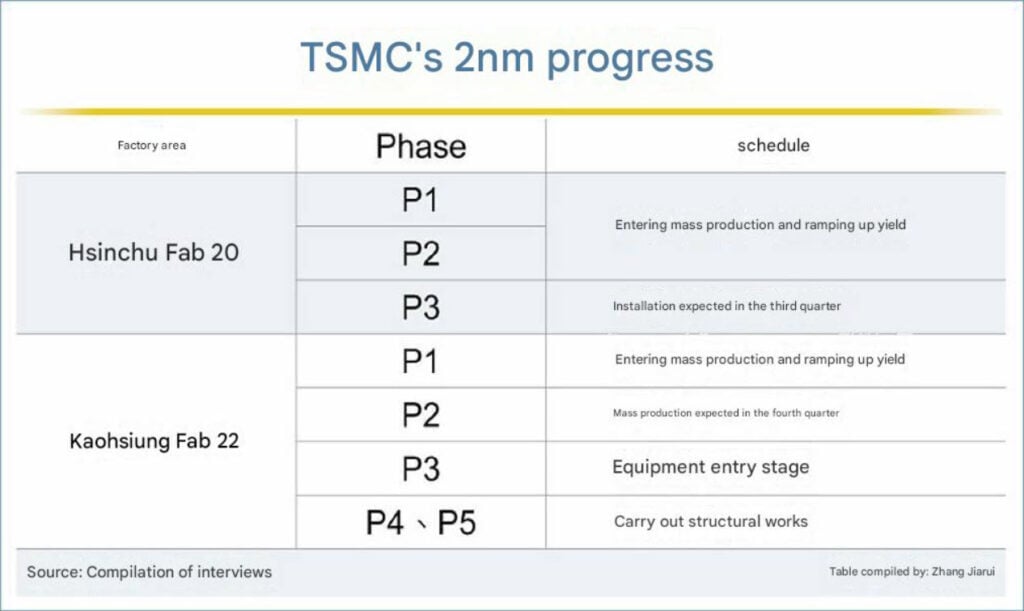
Chip giant TSMC is aggressively expanding its advanced 2nm production capacity to meet the unprecedented demand for artificial intelligence (AI) chips and high-performance computing (HPC). The company has set up five state-of-the-art fabrication plants, all entering the ramp-up phase this year, gearing towards the most aggressive expansion in the company’s history.
At TSMC’s 2026 Technology Symposium held in Silicon Valley recently, Hou Yung-ching, Senior Vice President, Deputy Co-COO, and Chief Information Security Officer, revealed that the company is pushing forward with its expansion plan at “twice the speed.” He added that the 2nm process has officially entered mass production and its yield learning curve is superior to that of the 3nm generation, even though the newer node uses a more complex nanosheet architecture, demonstrating TSMC’s leadership in advanced processes.
Even with higher production capacity, there will still be a shortage of high-performance chips due to explosive demand. To counter that, major players including NVIDIA, Apple, Qualcomm, and AMD have reportedly secured large allocations of N2 capacity. Apple alone is reported to have secured more than half of the initial N2 capacity from TSMC.
Also read:
1. TSMC pushes toward sub-1nm chips after 1.4nm breakthrough
2. TSMC hits 5GHz speeds on smartphone processors, leaving Huawei generations behind
Hou Yung-ching pointed out that multiple fabs simultaneously introducing new processes in the same year has never happened before. With the five 2nm fabs in operation, TSMC is expected to increase output capacity by up to 45% compared to the same period for 3nm fabs, a significant increase in capacity utilization. TSMC also plans to upgrade or install nine new factories along with capacity expansion projects each year to significantly ramp up its production capacity, effectively doubling the company’s historical expansion rate. The production is also being expanded at existing fabrication plants in Arizona, USA; Kumamoto, Japan; and Dresden, Germany.
Supported by strong demand, TSMC’s wafer shipments for AI accelerators are increasing by 11x, and demand for large-size chips featuring advanced packaging technologies is going up by 6x. And with continuous upgrades to 3D packaging technologies, TSMC has shortened the mass production time for SoIC chips by up to 75%, resulting in faster chip production. The overall advanced packaging capacity is estimated to grow by 80% in 2027.
TSMC is witnessing explosive demand for its high-performance node, pushing the company to expand its production capacity at a pace never seen before while simultaneously advancing large-scale future expansion plans. The company will continue to strengthen its leading advantage and domination in the semiconductor industry.
For the latest stories, visit the news section on Gizmochina regularly. Also, follow our Telegram channel to get the latest news as soon as we post them.




Comments