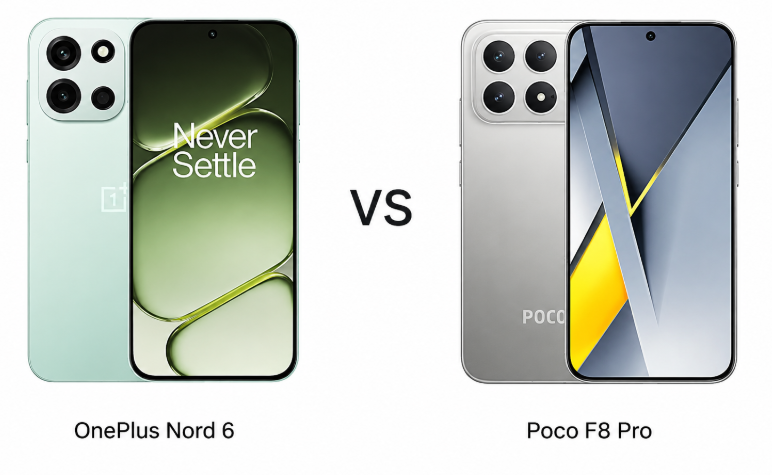
OnePlus Nord 6 and Poco F8 Pro take two very different approaches to the flagship killer formula. One focuses on massive battery life and ultra-smooth gaming, while the other pushes premium performance, cameras, and flagship-level refinement. With both phones offering powerful Snapdragon chips, advanced AMOLED displays, and aggressive pricing, this comparison breaks down which device actually delivers the better overall experience for the money.
Major Features:
Feature
OnePlus Nord 6
Poco F8 Pro
Winner
Build
Plastic frame, plastic back, Crystal Guard
Aluminum frame, glass back, Gorilla Glass 7i
Poco – More premium materials and flagship feel
Water Resistance
IP68/IP69K + MIL-STD-810H
IP68
OnePlus – Better durability and protection
Display
6.78-inch AMOLED, 165Hz, HDR10+, 3600 nits
6.59-inch AMOLED, 120Hz, Dolby Vision, 3500 nits
OnePlus – Higher refresh rate and brighter panel
Chipset
Snapdragon 8s Gen 4
Snapdragon 8 Elite
Poco – Significantly more powerful flagship chipset
GPU
Adreno 825
Adreno 830
Poco – Better graphics performance
RAM & Storage
Up to 512GB + 12GB RAM
Up to 512GB + 12GB RAM
Tie – Similar storage and memory options
Main Camera
50MP + 8MP ultrawide
50MP + 50MP telephoto + 8MP ultrawide
Poco – More versatile triple-camera setup
Video Recording
4K 60fps
8K 30fps
Poco – Higher-end video capabilities
Selfie Camera
32MP with 4K video
20MP with 1080p video
OnePlus – Sharper selfies and better front video
Speakers
Stereo speakers
Stereo speakers with Dolby Atmos, Bose tuning
Poco – Better multimedia audio setup
Bluetooth
Bluetooth 6.0
Bluetooth 5.4
OnePlus – Newer Bluetooth standard
Fingerprint Sensor
Optical in-display
Ultrasonic in-display
Poco – Faster and more premium sensor
Battery
7500mAh Global / 9000mAh India
6210mAh
OnePlus – Massive battery advantage
Charging
80W wired
100W wired
Poco – Faster charging speeds
Reverse Charging
6.5W / 27W India
22.5W
Poco – Better reverse charging output
Software
Android 16, OxygenOS 16
Android 16, HyperOS 3
Tie – Both ship with latest Android
Price
Approx ₹39,000 / $460
Approx ₹52,000 / $600
OnePlus – Much stronger value for money
Disclaimer: Specs are based on available data. Actual performance may vary. Verify details from official sources before buying.
The OnePlus Nord 6 focuses on durability and practicality with IP68/IP69K protection and MIL-STD-810H certification. Its plastic frame and back help keep the device comfortable during extended gaming or media sessions, though it does not feel as premium in hand. The Poco F8 Pro clearly targets a more flagship-style experience with its aluminum frame, glass back, and Gorilla Glass 7i protection. It feels more polished and refined, especially for users who care about premium materials.
Display Quality
OnePlus pushes harder on refresh rate and brightness with a 165Hz AMOLED panel and impressive peak brightness levels. Animations feel extremely smooth, and gaming responsiveness stands out immediately. Poco counters with Dolby Vision support, richer color depth, and a more balanced flagship-grade viewing experience. While the lower 120Hz refresh rate is noticeable on paper, the overall display tuning feels more cinematic and polished for streaming content.
Verdict
Poco F8 Pro feels more premium overall, while the OnePlus Nord 6 delivers a more aggressive gaming-focused display experience. Users prioritizing smoothness and durability may lean toward OnePlus, but Poco offers the more flagship-like finish.
2. Specifications Including Battery
Performance
The Poco F8 Pro takes a clear lead in raw performance thanks to the Snapdragon 8 Elite chipset and Adreno 830 GPU. Heavy gaming, multitasking, and AI-based processing feel effortless, placing it closer to ultra-premium Android flagships. The OnePlus Nord 6 still performs extremely well with the Snapdragon 8s Gen 4, offering smooth real-world usage and efficient thermal handling. It feels optimized for long gaming sessions rather than chasing benchmark numbers.
Battery and Charging
Battery life becomes the Nord 6’s biggest strength, especially with the massive 9000mAh India variant. It can comfortably stretch into two days for moderate users, something very few performance-focused phones can manage. The 80W charging is slower than Poco’s 100W system, but endurance matters more for many buyers. Poco charges significantly faster and still provides reliable all-day usage, though its smaller battery may feel less future-proof for power users.
Verdict
Poco F8 Pro wins outright for flagship-level performance, but the OnePlus Nord 6 stands out with unmatched battery endurance. The choice depends on whether raw power or long-lasting usage matters more.
3. Camera
Main and Secondary Lenses
The Poco F8 Pro delivers a more versatile camera setup with a dedicated 50MP telephoto lens, allowing cleaner portrait shots and better zoom quality. Its larger primary sensor also helps in low-light photography, producing more detailed and balanced images. Video recording is another major advantage, especially with 8K support and stronger slow-motion capabilities. The OnePlus Nord 6 keeps things simpler with a dual-camera setup focused on reliability rather than flexibility. Daylight shots remain sharp and vibrant, and the color tuning feels consistent across most conditions.
Selfie Camera
OnePlus gains an edge for selfie users with its 32MP front camera and 4K recording support. The sharper output and autofocus support help during video calls and social media recording. Poco’s 20MP front camera performs adequately but feels less impressive considering the price difference.
Verdict
Poco F8 Pro offers a stronger rear camera system and more professional versatility, while the OnePlus Nord 6 quietly becomes the better option for selfie-focused users and casual content creators.
4. Pricing
The OnePlus Nord 6 is priced at around ₹39,000, while the Poco F8 Pro reaches roughly ₹52,000. That gap changes the entire comparison because both devices target performance-focused buyers but approach value differently. OnePlus delivers flagship-grade gaming performance, a massive battery, advanced durability ratings, and a high-refresh-rate AMOLED display at a much lower price point. It feels aggressively positioned for buyers wanting maximum hardware without crossing premium flagship territory.
The Poco F8 Pro justifies its higher price through a better chipset, premium materials, stronger cameras, faster charging, and flagship-style finishing touches. It feels closer to ultra-premium Android devices rather than a typical value flagship. Buyers paying extra are clearly getting meaningful upgrades rather than small cosmetic improvements.
Verdict
OnePlus Nord 6 offers stronger value for money overall, especially for gamers and battery-focused users. Poco F8 Pro justifies its premium pricing better for users wanting flagship cameras, build quality, and top-tier performance.
Disclaimer: Prices are approximate and may vary based on country, region, launch timing, and applicable taxes. Always check whether the listed price is for a China unit or a global/international variant when purchasing.
5. Conclusion
The OnePlus Nord 6 stands out with its unusually massive battery, 165Hz AMOLED display, IP69K durability, and practical gaming-focused approach. It feels designed for buyers who want long endurance and consistently smooth performance without overspending. The Poco F8 Pro, meanwhile, pushes closer to flagship territory with the Snapdragon 8 Elite processor, premium glass-and-metal construction, telephoto camera, Dolby Vision support, and superior multimedia experience.
Both phones target power users, but their priorities are very different. OnePlus focuses on efficiency, endurance, and aggressive value, while Poco emphasizes flagship polish and maximum performance. That difference becomes noticeable in everyday usage rather than just specification sheets.
Verdict
OnePlus Nord 6 is the smarter value-driven choice for most buyers, especially gamers and heavy users who prioritize battery life. The Poco F8 Pro feels more complete and premium overall, making it the better option for users willing to spend extra for flagship-level refinement.
Disclaimer: This comparison is based on the specifications provided and is intended for general informational purposes. Actual performance, camera results, battery life, and overall experience may vary depending on real-world usage, software updates, and individual preferences.
We use cookies on our website to give you the most relevant experience by remembering your preferences and repeat visits. By clicking “Accept”, you consent to the use of ALL the cookies.
This website uses cookies to improve your experience while you navigate through the website. Out of these, the cookies that are categorized as necessary are stored on your browser as they are essential for the working of basic functionalities of the website. We also use third-party cookies that help us analyze and understand how you use this website. These cookies will be stored in your browser only with your consent. You also have the option to opt-out of these cookies. But opting out of some of these cookies may affect your browsing experience.
Necessary cookies are absolutely essential for the website to function properly. This category only includes cookies that ensures basic functionalities and security features of the website. These cookies do not store any personal information.
Any cookies that may not be particularly necessary for the website to function and is used specifically to collect user personal data via analytics, ads, other embedded contents are termed as non-necessary cookies. It is mandatory to procure user consent prior to running these cookies on your website.



Comments