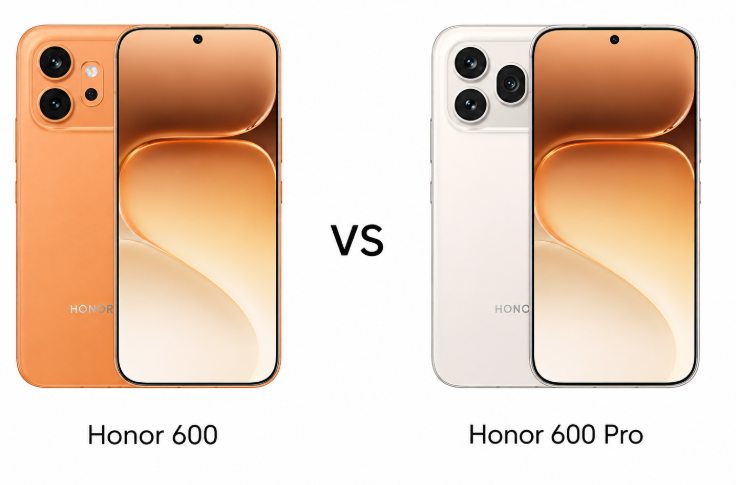
Honor 600 and Honor 600 Pro may look nearly identical on paper, but they target very different buyers. While both phones share the same premium display, massive battery, and 200MP main camera, the Pro model adds flagship-grade performance, a dedicated telephoto camera, and wireless charging. The question is whether these upgrades are worth the extra money. Here’s a closer look at the key differences to find out which Honor 600 series phone offers the better value in 2026.
Major Upgrades
Features:
Honor 600
Honor 600 Pro
Upgrades
Build Quality
Glass front, aluminum frame
Glass front, glass back, aluminum frame
More premium flagship-like design and feel
Chipset
Snapdragon 7 Gen 4
Snapdragon 8 Elite
Massive jump in CPU, GPU, AI, and gaming performance
The Honor 600 and Honor 600 Pro look remarkably similar at first glance, but the Pro model introduces a more premium construction with a glass back in addition to its glass front and aluminum frame. The standard Honor 600 uses an aluminum frame and glass front, which still delivers a premium feel, but the Pro has a slightly more flagship-like appearance and hand feel. Both devices offer IP68 and IP69K protection, making them equally capable when it comes to durability and water resistance.
The design difference is subtle rather than dramatic, which means buyers are paying for refinement rather than a complete redesign. The Pro feels more in line with premium flagship devices, while the Honor 600 maintains a cleaner value-focused approach.
Display Quality
There is virtually no difference between the displays. Both phones feature a 6.57-inch AMOLED panel with 120Hz refresh rate, 1 billion colors, HDR Vivid support, 3840Hz PWM dimming, and an impressive 8000-nit peak brightness. Resolution and sharpness are identical as well.
This is one of the rare cases where the cheaper model sacrifices nothing in display quality. Every day, viewing, gaming, HDR streaming, and outdoor visibility remain equally impressive on both devices.
Verdict
The Honor 600 Pro offers a slightly more premium build thanks to its glass back, but display quality is identical. Buyers focused on screen quality gain no real advantage by moving to the Pro model, making the Honor 600 the stronger value in this category.
2. Specifications Including Battery
Performance
The biggest upgrade in the entire comparison is performance. The Honor 600 uses the Snapdragon 7 Gen 4, a capable upper mid-range chipset that comfortably handles multitasking, gaming, and daily productivity. However, the Honor 600 Pro jumps to the Snapdragon 8 Elite, one of the fastest Android processors available.
This upgrade transforms the Pro into a true flagship performer. Heavy gaming, AI-powered tasks, advanced photo processing, and long-term software performance all benefit significantly. The Pro is built with far more headroom for future applications and demanding workloads.
Battery and Charging
Both devices feature the same 7000mAh silicon-carbon battery and identical 80W wired charging. Battery endurance should therefore be very similar in real-world use.
The major difference is wireless charging. The Honor 600 Pro adds 50W wireless charging, giving it far greater flexibility for premium users. Reverse wired charging is available on both devices.
Verdict
Performance alone makes the Honor 600 Pro a major upgrade. The battery experience remains similar, but the addition of flagship-level power and wireless charging gives the Pro a clear advantage for power users and long-term buyers.
3. Camera
Main and Secondary Lenses
The primary camera hardware is identical on both devices, featuring a 200MP sensor with OIS. Daylight photography, detail capture, dynamic range, and low-light performance should therefore remain very similar between the two models.
The difference comes from the secondary cameras. The Honor 600 uses a 12MP ultrawide camera alongside the main sensor. The Honor 600 Pro keeps the same ultrawide camera but adds a dedicated 50MP telephoto lens with OIS and 3.5x optical zoom.
This addition dramatically expands shooting versatility. Portrait photography, zoom shots, and distant subjects benefit significantly from the Pro’s dedicated telephoto hardware. It brings a true flagship camera experience that the standard model cannot fully match.
Selfie Camera
Both devices feature the same 50MP front camera capable of recording 4K video. Selfie quality, video calls, and social media content creation should deliver nearly identical results.
Verdict
The telephoto camera is the standout upgrade. While primary and selfie performance remain largely unchanged, the Honor 600 Pro offers a much more complete photography package and greater creative flexibility.
4. Pricing
The Honor 600 is priced around $500 (approximately ₹42,000), while the Honor 600 Pro is priced around $750 (approximately ₹65,000). This creates a substantial price gap of roughly $250 or ₹23,000.
The standard model delivers the same display, battery capacity, charging speed, durability rating, and main camera quality as its more expensive sibling. For many users, these similarities make the Honor 600 an attractive proposition.
However, the Pro model’s price increase is tied to meaningful upgrades rather than minor specification boosts. Buyers receive a flagship Snapdragon 8 Elite processor, a dedicated telephoto camera, wireless charging support, improved memory configurations, and a more premium construction.
Verdict
The Honor 600 wins on value, while the Honor 600 Pro wins on features. The right choice depends on whether flagship performance and advanced camera hardware are worth the additional investment.
Disclaimer: Prices are approximate and may vary based on country, region, launch timing, and applicable taxes. Always check whether the listed price is for a China unit or a global/international variant when purchasing.
5. Conclusion
The Honor 600 stands out by offering flagship-level display quality, excellent battery life, a high-resolution 200MP camera, and premium durability at a much lower price point. It avoids unnecessary compromises and focuses on delivering the essentials exceptionally well.
The Honor 600 Pro takes a different approach. Its Snapdragon 8 Elite processor places it among the most powerful Android smartphones available, while the dedicated 50MP telephoto camera and 50W wireless charging add genuine flagship convenience. These are meaningful upgrades that improve both performance and overall versatility.
The gap between the two phones is not about display quality or battery life. Instead, it is centered around processing power, zoom photography, and premium features.
Verdict
The Honor 600 is the smarter purchase for most buyers because it retains many of the Pro model’s headline features at a significantly lower price. The Honor 600 Pro is the better device overall, but the Honor 600 delivers the stronger value proposition.
Users who prioritize gaming, photography, and flagship performance will appreciate the Pro’s upgrades, while everyone else can confidently choose the standard model and save a considerable amount of money.
Disclaimer: This comparison is based on the specifications provided and is intended for general informational purposes. Actual performance, camera results, battery life, and overall experience may vary depending on real-world usage, software updates, and individual preferences.
We use cookies on our website to give you the most relevant experience by remembering your preferences and repeat visits. By clicking “Accept”, you consent to the use of ALL the cookies.
This website uses cookies to improve your experience while you navigate through the website. Out of these, the cookies that are categorized as necessary are stored on your browser as they are essential for the working of basic functionalities of the website. We also use third-party cookies that help us analyze and understand how you use this website. These cookies will be stored in your browser only with your consent. You also have the option to opt-out of these cookies. But opting out of some of these cookies may affect your browsing experience.
Necessary cookies are absolutely essential for the website to function properly. This category only includes cookies that ensures basic functionalities and security features of the website. These cookies do not store any personal information.
Any cookies that may not be particularly necessary for the website to function and is used specifically to collect user personal data via analytics, ads, other embedded contents are termed as non-necessary cookies. It is mandatory to procure user consent prior to running these cookies on your website.


Comments