Add GIZMOCHINA on Google:
For the past two years, Qualcomm has been the only real player to offer an ARM-based chip for Windows PCs. It started with the Snapdragon X Elite in 2024 which Qualcomm followed with the more powerful Snapdragon X2 series in late 2025.
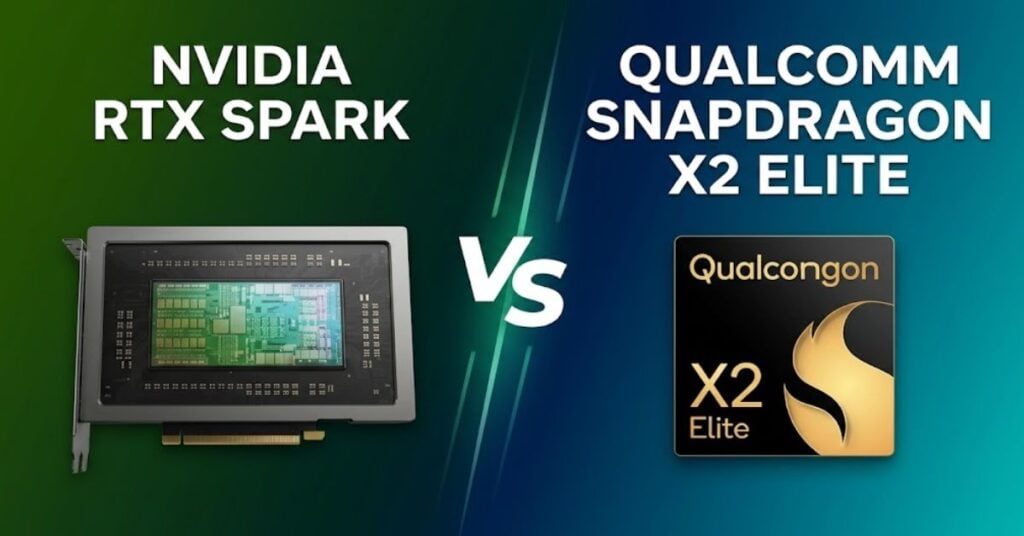
Qualcomm’s sole reign on the Windows-on-ARM (WoA) market is now officially over, all thanks to Nvidia. The latter announced its new ARM-based RTX Spark PC chips at Computex 2026, and Nvidia wants it to be the Apple Silicon moment for Windows.
The news sent Qualcomm’s stock tumbling more than 10% in premarket trading, wiping out over $10 billion in market value overnight. That reaction tells you a lot about how big a deal this really is.
So what exactly are these two chips, how do they compare, and who should you care about? Let’s break it down.
1. What Is the Nvidia RTX Spark?
RTX Spark is Nvidia’s answer to the growing wave of ARM-based, all-in-one chips, similar to what Apple’s been doing brilliantly with its M-series and Qualcomm has been working hard with the Snapdragon X lineup.
At its core, RTX Spark is based on the same GB10 Grace Blackwell Superchip that powers Nvidia’s DGX Spark developer workstation. The company just repackaged it for everyday Windows laptops. It combines a custom ARM-based CPU (developed with MediaTek), a Blackwell RTX GPU, and an AI accelerator all on one chip, built on TSMC’s 3nm process with 70 billion transistors.
And the headline numbers are impressive. RTX Spark can pack up to 20 CPU cores, a 6,144-core Blackwell GPU, and up to 128 GB of unified memory. Nvidia claims it delivers over 1 petaflop of FP4 AI compute, which in simple terms is enough to run massive AI and Large Language Model (LLM) models locally.
The CPU and GPU are connected together via Nvidia’s NVLink-C2C interconnect, which enables up to 600 GB/s of bandwidth between the two.
According to team green, devices powered by RTX Spark are set to arrive in autumn 2026 from major brands including ASUS, Dell, HP, Lenovo, and Microsoft Surface.
2. What Is the Snapdragon X2 Elite?
Qualcomm launched the Snapdragon X2 series at its annual Snapdragon Summit in September 2025. It is the direct follow-up to the original Snapdragon X Elite from 2024, and it brings a meaningful generational step forward, especially in CPU performance.
For how the current mobile lineup compares, our guide to best Snapdragon chipsets in 2026 breaks down where each chip stands.
The X2 family consists of three chips: the X2 Plus, the X2 Elite, and the top-of-the-line X2 Elite Extreme. All three are built on TSMC’s 3nm process and feature Qualcomm’s third-generation Oryon CPU cores, but the Extreme version is the one that gets the major attention.
3. The X2 Elite Extreme: Qualcomm’s Best Shot
The Snapdragon X2 Elite Extreme (model number X2E-96-100) is Qualcomm’s most powerful laptop chip ever made. It packs 18 Oryon cores versus 12 cores in the first-generation Snapdragon X Elite.
Those 18 cores are split into two groups: 12 fast “Prime” cores that can boost up to 5 GHz on two cores (and run at 4.4 GHz across all cores), and 6 “Performance” cores running at up to 3.6 GHz. Together, they share 53 MB of cache.
On the AI side, the X2 Elite Extreme includes an 80 TOPS NPU (Neural Processing Unit), which is Qualcomm’s dedicated AI engine. All three X2 Elite chips share this same NPU rating.
Benchmark numbers from Qualcomm’s own Snapdragon Summit testing were genuinely strong on the CPU side. In Cinebench 2024 and Geekbench 6.3 multi-core tests, the X2 Elite Extreme was able to match or beat Apple’s M4 Pro, scoring 1,964 and 23,693 points respectively.
Compared to the original Snapdragon X Elite, the X2 Elite Extreme offers roughly a 39% improvement in single-core performance and a 50% boost in multi-core performance. In gaming benchmarks, Qualcomm claims a 2.3x improvement over the previous generation.
The chip also supports up to 48 GB of LPDDR5x memory on a 192-bit bus (in the Extreme version), offers PCIe 5.0 storage, and handles up to three USB 4.0 ports. Laptops running the X2 Elite Extreme began arriving in the first half of 2026, including the ASUS Zenbook A16 which features the chip prominently.
4. GPU and Gaming: Qualcomm’s Weak Spot
Here is where things get complicated for Qualcomm. While the X2 Elite Extreme impresses on CPU tasks, the GPU side tells a different story.
In the demanding 3DMark Steel Nomad benchmark, the X2 Elite Extreme managed just 1,306 points at 13 frames per second. Apple M4 Pro, in comparison, manages around 1620 points in the same test.
The Solar Bay and Steel Nomad Light scores were more respectable, but the GPU improvement is not nearly as dramatic as the CPU gains. One reviewer from Tom’s Hardware found that professional tools like AutoCAD were unsupported, and some games crashed or showed graphical errors when running under emulation on Windows ARM.
5. RTX Spark vs Snapdragon X2: Head to Head
This is where Nvidia has a structural advantage that Qualcomm simply cannot match right now.
AI Performance: RTX Spark delivers over 100 TOPS of on-device AI computing power. The Snapdragon X2 Elite’s NPU sits at 80 TOPS.
GPU Power: The RTX Spark’s Blackwell GPU supports DLSS 4.5, Nvidia’s AI-powered graphics upscaling technology that makes games look better and run faster. No Snapdragon chip has anything comparable. For gaming and creative work like video editing or 3D rendering, RTX Spark is in a completely different league.
Memory: RTX Spark supports up to 128 GB of unified memory. The X2 Elite Extreme tops out at 48 GB. For heavy AI workloads and large language models running locally, this is a massive difference.
CPU: This is more even. The X2 Elite Extreme is a very strong CPU performer, matching Apple’s M4 Pro in many tests. RTX Spark’s 20-core CPU will be tested properly when devices launch in autumn 2026, but based on Nvidia’s track record, expectations are high.
Software Ecosystem: This may be the most important difference of all. Nvidia brings CUDA — its developer software platform — to RTX Spark. For 15-plus years, virtually every major AI model, AI framework, and GPU-accelerated app has been built on CUDA. Meanwhile, Qualcomm has no equivalent. Snapdragon X laptops have also faced ongoing issues with app compatibility, where x86 apps running through Microsoft’s Prism emulation layer sometimes behave poorly.
6. Why Qualcomm Is Still Relevant
Despite all of this, Qualcomm is not out of the race. The Snapdragon X2 series chips are available right now, while RTX Spark laptops won’t arrive until autumn 2026. For buyers who need a capable ARM-based Windows laptop today, the X2 Elite Extreme is genuinely impressive, especially for CPU-heavy work, everyday productivity, and battery life.
Moreover, Qualcomm is targeting a broader market just like its smartphone chips. In fact, the company recently unveiled a Snapdragon C platform for affordable AI powered laptops.
Meanwhile, RTX Spark is likely more aimed at creators, AI developers, and serious gamers willing to pay a premium. In fact, the starting price of the laptop could be around $1800.
7. The Bottom Line
Nvidia’s RTX Spark is a serious statement of intent. It takes the company’s unmatched software ecosystem, combines it with genuinely next-generation hardware, and packages it into a laptop chip that can go head-to-head with Snapdragon X2 platform and even Apple M5 chips.
Qualcomm’s X2 series is also not a bad chip. On CPU performance, it holds its own against the best in the business. But the GPU weakness, the software compatibility headaches, and the relatively modest NPU performance all become harder to defend once RTX Spark laptops start hitting store shelves.
For buyers looking at Windows laptops today, the Snapdragon X2 Elite Extreme is a strong choice, particularly in machines like the ASUS Zenbook A16. But if you can wait until late 2026, RTX Spark could be worth holding out for.
For more daily updates, please visit our News Section.
Tech enthusiast? Get the latest news first! Follow our Telegram channel and subscribe to our free newsletter for your daily tech fix! ⚡