
Add GIZMOCHINA as Preferred Source on Google
As an Amazon Associate, Gizmochina earns from qualifying purchases. Links on this page may earn us a commission at no extra cost to you.
E-ink phones are one of those categories that shouldn’t really work, and yet here we are, several years in, with more options than ever. E-ink phones are built around a display technology that powers your Kindle, shrink it down, wire it up to Android, and let people carry a phone that reads like paper, survives days without a charger, and doesn’t nuke your eyes at 11 PM. The screens are slow. They ghost. They can’t do video without looking like a fax machine having a bad day. And yet a small, stubborn, growing group of people keeps buying them anyway, because the tradeoffs are the point.
2026 has been a genuinely busy year for the category. Hisense just put out the A10, its first new e-ink phone in three years, and it does something clever with a magnetic detachable screen that we haven’t really seen anywhere else. Bigme also iterated with a newer model that’s a full dual-screen phone. Boox is still quietly making the best pocket e-reader money can buy, even if it insists on not calling it a “phone.” And if you just want to disappear from your group chats for a while, there’s a whole lineup of minimalist devices happy to help with that too.
Here’s where things stand right now, and which one to buy depending on what you actually want out of an e-ink screen.
1. Why anyone would want this in the first place
Let’s get the obvious question out of the way: why would you choose a screen that refreshes like it’s thinking really hard about it, over the OLED panel sitting in your pocket right now?
Three reasons, mostly. E-ink panels reflect ambient light instead of firing it directly into your eyes, so long reading sessions feel noticeably less tiring, especially at night. They only draw power when the image actually changes, which is why these phones can coast for days, sometimes weeks, on a single charge instead of dying by dinner. And they’re genuinely great outdoors. Direct sunlight, which washes out a normal phone screen into a useless mirror, is where e-ink looks its best.
The tradeoff is speed. Scrolling looks choppy. Video is mostly unwatchable. Games are a non-starter unless they’re turn-based. Almost nobody uses one of these as their only phone.
2. Bigme HiBreak Pro Color
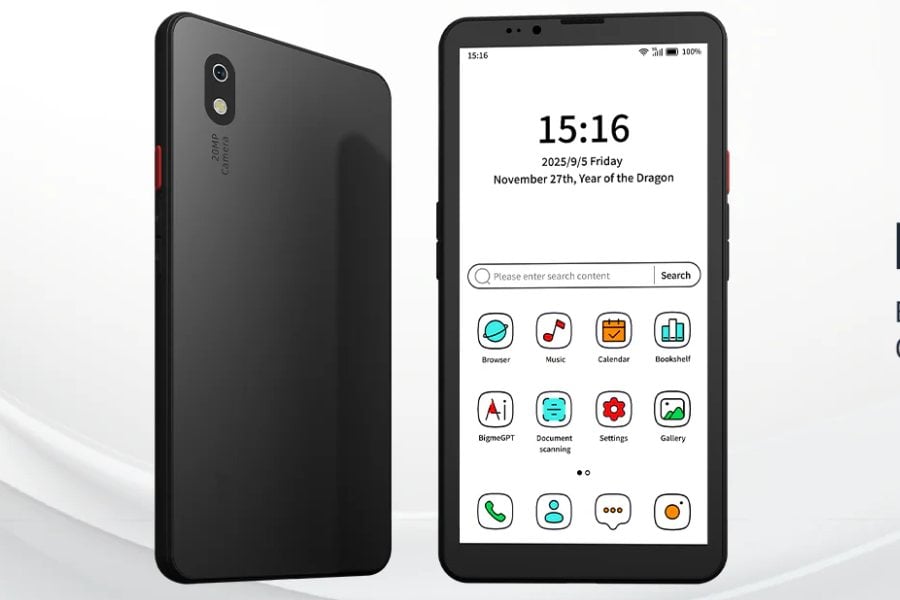
If you want something that functions like a real smartphone first and an e-reader second, this is still the pick. The HiBreak Pro Color runs Android 14 with the full Google Play Store, so nothing about your app situation changes — banking apps, Spotify, Google Maps, all of it works.
It supports 5G across dual SIMs, and under the hood it’s running a MediaTek Dimensity 1080 with 8GB of RAM and 256GB of storage.
The 6.13-inch Kaleido 3 display hits a crisp 300 PPI in black and white, and drops to around 150 PPI when it’s showing color. Bigme’s “SSS” fast-refresh mode also pushes the color panel to a smoother 30 FPS for regular navigation. It has a 4,500mAh battery, a 20MP camera with built-in OCR for scanning documents, NFC, and a fingerprint sensor to round it out.
It’s a long way from the original color HiBreak Bigme unveiled running Android 14, which felt more like a proof of concept than a daily driver. This one doesn’t feel like that anymore.
3. Hisense A10

Hisense went quiet on e-ink phones for three years after the A9, and it came back with something genuinely different: a 6.13-inch monochrome e-ink display on the front, and a color LCD panel on the back that snaps on and off magnetically. Want the paper-like screen for reading, note-taking, or studying? Leave the back panel off. Want to watch something or scroll Instagram without the e-ink lag? Snap the color screen on and use that side instead.
It’s a smarter solution than the fixed dual-screen approach Bigme takes with the HiBreak Dual, because you’re not carrying the weight and thickness of two permanently bonded displays — you just bring the color panel when you actually need it.
Under the hood, the A10 runs a 4nm octa-core Qualcomm chip, ships with Android 16 out of the box, and supports both 5G and Wi-Fi 6. Pricing isn’t official as we write this, but Hisense is expected to launch it around CNY 3,999, or roughly $590.
4. Boox Palma 2 and Palma 2 Pro
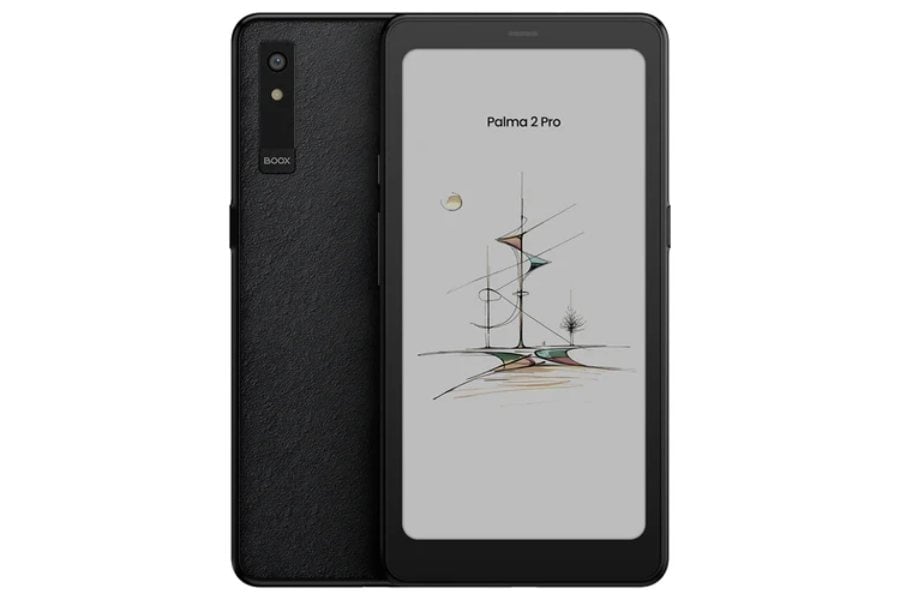
Boox will tell you the Palma 2 isn’t a phone, and technically that’s true — there’s no built-in cellular calling here. But it’s shaped like one, it runs full Android, and enough people use it as a phone-adjacent device that it belongs on this list anyway. The base Palma 2 has a 6.13-inch Carta 1200 display at 300 PPI, 6GB of RAM, 128GB of expandable storage, and a 3,950mAh battery that can genuinely last weeks if you’re just doing light reading.
The Palma 2 Pro steps things up with a color Kaleido 3 screen, Android 15, 8GB of RAM, stylus support, and — for the first time — mobile data. It’s still not making phone calls, but it’s inching closer to being a real standalone device rather than a companion gadget.
5. Minimal Phone
Not everyone wants a full Android experience with a paper-like screen bolted on. Some people want the opposite — as little phone as possible. The Minimal Phone leans hard into that idea with a 4.3-inch black-and-white E-Ink touchscreen and a physical QWERTY keyboard that makes the whole thing feel more like a 2009 messaging phone than anything modern.
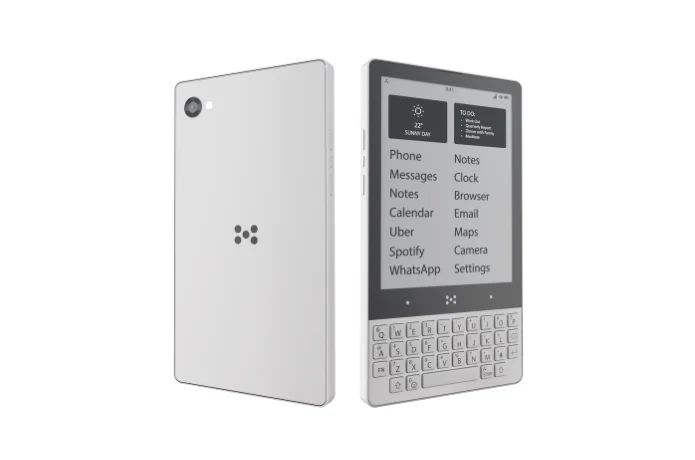
It still runs a trimmed-down Android 14 with Play Store access, so it’s not completely locked down, but the small screen and clicky keys create just enough friction to make doomscrolling genuinely annoying.
It runs on a MediaTek G99 chip, 6GB of RAM, and 128GB of expandable storage handle the basics, and the 3,000mAh battery lasts for days thanks to how little power the display needs.
6. Bigme HiBreak Dual 2
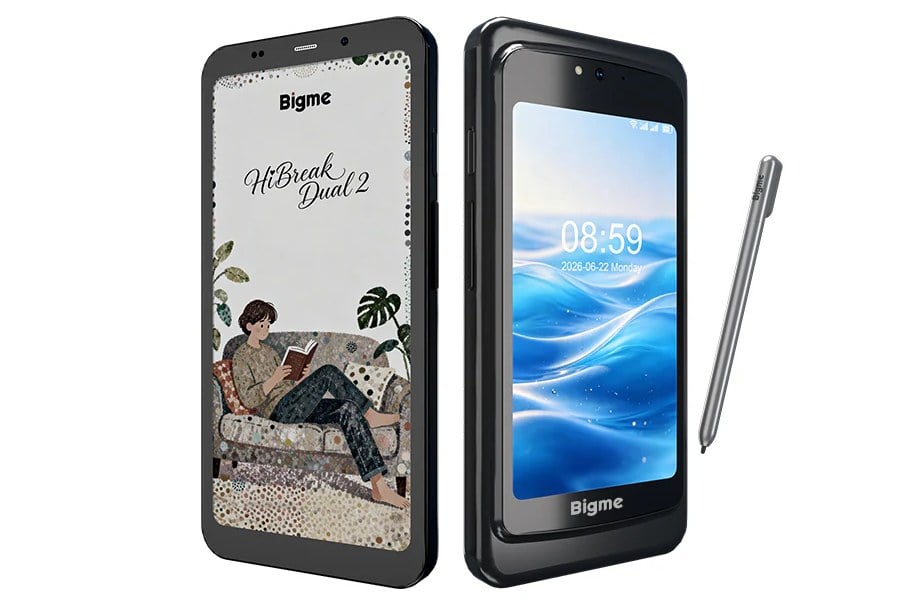
And then there’s the HiBreak Dual 2, which basically says: why choose? It puts a 6.13-inch color e-ink screen on the front for reading and note-taking, complete with stylus support carried over from the original HiBreak Dual, and a full 5-inch LCD on the back for video, photos, and anything else that actually needs motion and full color. It runs on a Dimensity 8300 with 5G and Android 16.
7. So which one should you actually buy?
It comes down to what you’re trying to get away from. If you want a real phone that happens to have an e-ink screen, get the Bigme HiBreak Pro Color. If you’re curious about the newest idea in the category and don’t mind an unofficial price tag for now, the Hisense A10’s detachable color panel is the most interesting hardware move anyone’s made this year.
If you want a pocket reader more than a phone, the Boox Palma 2 or Palma 2 Pro is still the class leader. If your actual goal is using your phone less, the Minimal Phone is built for exactly that. And if you can’t stand the idea of giving up color entirely, the HiBreak Dual 2 lets you have both, at a price.
None of these phones are trying to replace your iPhone or your Galaxy, and that’s sort of the point.
Don’t miss a thing! Join our Telegram community for instant updates.
For more daily updates, please visit our News Section.
