Advertisement

Redmi K100 Pro Max and iQOO Neo 11 Ultra take different approaches to the flagship smartphone formula. Redmi focuses on an all-round premium experience with a 200MP camera, 5x periscope zoom and wireless charging, while iQOO targets performance enthusiasts with a powerful Dimensity chipset and a lower price. Here’s how the two compare across design, performance, cameras, battery and value.
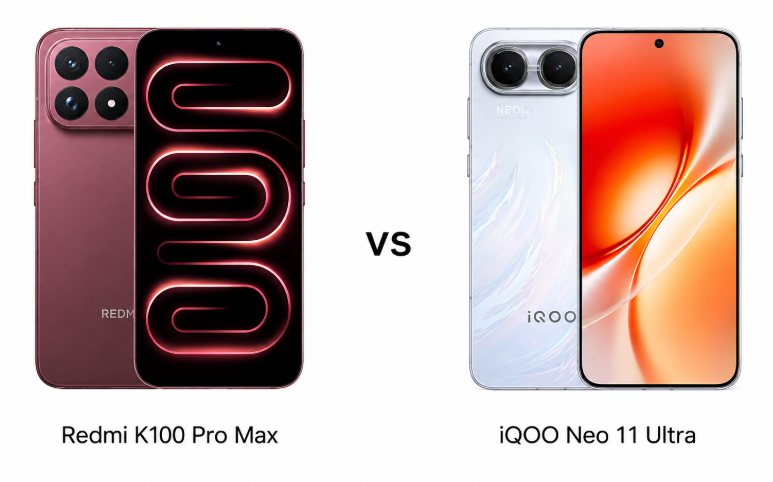
Major Features:

CategoryRedmi K100 Pro MaxiQOO Neo 11 UltraWinner
BuildGlass front, aluminum frame, IP68/IP69Glass front, aluminum frame, IP68/IP69Tie — Both offer premium, durable builds
Display6.9-inch AMOLED, 185Hz, Dolby Vision, HDR10+, 4500 nits peak6.83-inch AMOLED, 144Hz, 1440p, 4500 nits peakRedmi — Higher refresh rate and broader HDR support
PerformanceSnapdragon 8 Elite Gen 5, up to 16GB RAM, UFS 4.1Dimensity 9500M, up to 16GB RAM, UFS 4.1Redmi — Strong flagship performance and optimisation
StorageUp to 512GBUp to 512GBTie — Same maximum storage
Main Camera200MP wide with OIS50MP wide with OISRedmi — Higher-resolution primary camera
Telephoto50MP periscope, 5x optical zoom, OISNo dedicated telephotoRedmi — Much more versatile zoom capability
Ultrawide50MP, 102°8MPRedmi — Significantly stronger ultrawide
Selfie Camera32MP, 4K video16MP, 1080p videoRedmi — Higher resolution and 4K recording
Battery9070mAh9100mAhiQOO — Slightly larger capacity
Wired Charging100W100WTie — Same charging speed
Wireless Charging50WNot specifiedRedmi — Adds fast wireless charging
AudioBose-tuned 2.1 stereo, Dolby AtmosStereo speakersRedmi — More advanced audio system
ConnectivityWi-Fi 7, Bluetooth 6.0, NFC, IRWi-Fi 7, Bluetooth 5.4, NFC, IRRedmi — Newer Bluetooth standard
PricePriced around $700 / ₹63,000Priced around $500 / ₹50,000iQOO — Much lower price
Overall ValueMore features at a premiumFlagship hardware at a lower priceiQOO — Better value for performance-focused buyers
Disclaimer: Specs are based on available data. Actual performance may vary. Verify details from official sources before buying.

1. Design and Display

Build and Feel

The Redmi K100 Pro Max and iQOO Neo 11 Ultra both combine glass fronts with aluminum frames and offer IP68/IP69 protection, giving them a reassuring premium and durable character. Redmi adds Bose-tuned stereo audio, Dolby Atmos and a more elaborate 2.1 speaker system, making its multimedia experience particularly appealing. Both also feature ultrasonic in-display fingerprint scanners.

Display Quality

Redmi uses an AMOLED panel with 68 billion colors, a 185Hz refresh rate, Dolby Vision, HDR Vivid, HDR10+ and BT.2020 support. iQOO counters with a sharper 1440p AMOLED display, 1 billion colors, 2160Hz PWM dimming and similarly impressive peak brightness. The Redmi display feels more feature-rich for gaming and HDR content, while iQOO’s higher resolution makes text and fine details look cleaner.

Verdict

Redmi wins for its faster refresh rate, broader HDR features and superior speaker setup. iQOO offers higher resolution, but Redmi delivers the more complete entertainment-focused display package.

2. Specifications Including Battery

Performance

The Redmi K100 Pro Max is powered by the Snapdragon 8 Elite Gen 5, paired with UFS 4.1 storage and up to 16GB RAM. iQOO uses the Dimensity 9500M with the same UFS 4.1 storage and RAM ceiling. Both are flagship-grade platforms, but Redmi’s Snapdragon chip gives it a particularly strong appeal for demanding gaming, sustained performance and broad software optimisation.

Battery and Charging

Battery capacity is almost identical, with Redmi offering 9070mAh and iQOO 9100mAh. Both support 100W wired charging, but Redmi goes further with 50W wireless charging, 27W reverse wired charging and 22.5W reverse wireless charging. That makes Redmi considerably more flexible for users who rely on multiple charging methods and accessories.

Verdict

Redmi takes this round with a stronger overall performance proposition and significantly more versatile charging. iQOO has excellent endurance, but Redmi offers a more complete flagship hardware package.

3. Camera

Main and Secondary Lenses

Redmi has a major advantage in camera hardware, featuring a 200MP primary sensor with OIS alongside a 50MP periscope telephoto offering 5x optical zoom and OIS. Its 50MP ultrawide also provides substantially more flexibility than iQOO’s 8MP ultrawide. iQOO instead uses a 50MP main camera with OIS and a basic 8MP ultrawide, with no dedicated telephoto lens.

Selfie Camera

The difference continues on the front. Redmi’s 32MP selfie camera supports 4K video recording, while iQOO’s 16MP front camera is limited to 1080p at 30fps. Redmi is therefore better equipped for detailed selfies, video calls and creator-focused front-camera recording. iQOO’s simpler setup should still handle everyday photography, but it is clearly less ambitious.

Verdict

Redmi is the clear winner thanks to its 200MP main camera, dedicated 5x periscope telephoto, stronger ultrawide and higher-resolution 4K selfie camera. iQOO’s camera system feels notably less versatile.

4. Pricing

The Redmi K100 Pro Max is priced around $700 or ₹63,000, while the iQOO Neo 11 Ultra is priced around $500 or ₹50,000. That creates a sizeable price gap, with iQOO positioned as the more aggressive value-focused flagship. Redmi’s premium is easier to justify for buyers who specifically want advanced cameras, wireless charging and its broader multimedia package.

Is the Price Justified?

At around ₹50,000, the iQOO Neo 11 Ultra offers excellent value, particularly for users prioritising flagship-level performance, a high-resolution display and a large battery. Redmi demands considerably more, but the additional cost brings a much more capable camera system, wireless charging, better audio hardware and broader connectivity features.

Verdict

iQOO wins on pure value because its lower price delivers flagship performance and excellent battery life. Redmi is worth the premium for buyers who want stronger cameras and a more complete feature set.

Disclaimer:
Prices are approximate and may vary based on country, region, launch timing, and applicable taxes. Always check whether the listed price is for a China unit or a global/international variant when purchasing.

5. Conclusion

The Redmi K100 Pro Max stands out with its 200MP camera, 5x periscope telephoto, 50W wireless charging, Bose-tuned 2.1 stereo audio and exceptionally fast 185Hz AMOLED display. iQOO’s strengths are different: its sharper 1440p panel, 9100mAh battery and flagship Dimensity platform make it particularly attractive to performance-focused users. Both also provide IP68/IP69 protection and ultrasonic fingerprint scanners.

Verdict

Redmi is the more complete flagship, offering substantially stronger cameras, charging versatility and multimedia features. iQOO is the smarter value choice, delivering powerful hardware at a much lower price without major compromises in core performance.


FAQs

1. Which phone is better for gaming?
The Redmi K100 Pro Max has a slight edge with its Snapdragon 8 Elite Gen 5 chipset and 185Hz display.

2. Which has better camera zoom?
The Redmi K100 Pro Max is better, offering a dedicated 50MP periscope telephoto camera with 5x optical zoom.

3. Which phone has better battery life?
Both offer excellent endurance with around 9,000mAh batteries, making either suitable for heavy daily use.

4. Which offers better value for money?
The iQOO Neo 11 Ultra offers stronger value because it delivers flagship performance at a significantly lower price.

5. Which phone should you buy?
Choose Redmi for cameras and features; choose iQOO if lower cost and flagship performance matter most.

Disclaimer: Prices, specifications, and availability may vary by region and retailer. Recommendations in this article are based on editorial opinion, feature-based value, and market positioning at the time of writing. Readers are advised to do their own research before making a purchase.

Read More:

Comments