
Add GIZMOCHINA as Preferred Source on Google
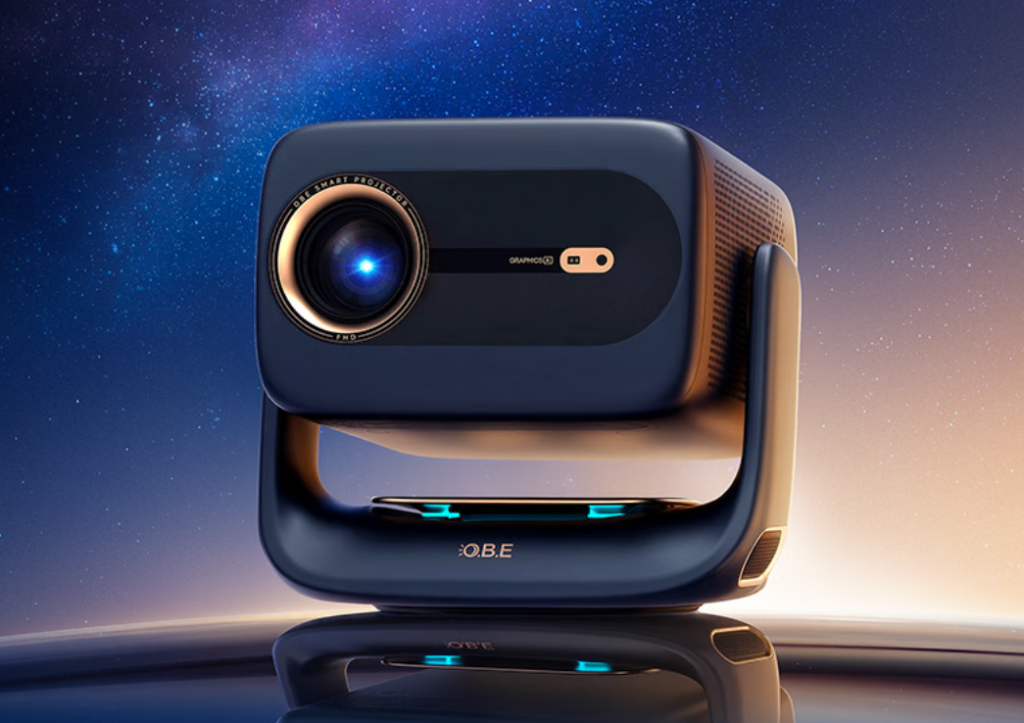
OBE has released a new home projector in China, the R3 Ultra Max. It is now listed on JD.com for 3,999 yuan ($596). Rather than focusing solely on pushing resolution limits, the company has built this 1080p model around physical flexibility and integrated audio, attempting to solve common setup issues for standard living rooms.
OBE R3 Ultra Max Specifications
The R3 Ultra Max features an integrated Z-shaped gimbal with 120-degree vertical tilt and 360-degree horizontal rotation. It supports ceiling projection, while the base-mounted speakers maintain their orientation regardless of the projection angle.
For the display itself, the projector includes a native 1080p LCD panel with 4K input support, 1,800 CVIA lumens of brightness, and a 40,000:1 dynamic contrast ratio. It uses a 5-inch TCL CSOT panel, supports 40 to 150-inch projection sizes, and has a 1.2:1 throw ratio. OBE also rates operating noise at below 26dB.

For audio, the R3 Ultra Max features a 2.1-channel speaker system with two 10W mid/high-frequency drivers and a dedicated 25W subwoofer. It comes with a large 1,070cc acoustic chamber and delivers bass frequencies as low as 43Hz. The setup is designed to offer fuller sound and stronger bass compared to the standard built-in speakers found on most projectors.
Internally, the projector runs on a MediaTek MT9681 processor, 4GB of RAM, and 64GB of storage. The port selection is standard for current-generation displays, featuring two HDMI 2.1 ports (one supporting eARC for external soundbars), a USB-A 3.0 port, and a 3.5mm audio jack. OBE says an input latency of 3ms, which makes it a viable option for casual gaming. Wireless connectivity includes dual-band Wi-Fi 6 and Bluetooth 5.2.

On the software side, it runs OBE’s Super AI OS 2.0. The interface includes standard wireless casting protocols like AirPlay and Miracast, and integrates Tencent’s Hunyuan large language model for voice searches and basic queries. To handle the actual screen calibration, the projector uses a ToF sensor and a CMOS camera to automate keystone correction, focus, screen alignment, and obstacle avoidance.
For more daily updates, please visit our News Section.
Stay ahead in tech! Join our Telegram community and sign up for our daily newsletter of top stories!
(JD)




Comments