
Add GIZMOCHINA on Google:
Xiaomi 18 Pro and Samsung Galaxy S26 target buyers who want flagship performance without moving to larger phones. However, they approach the premium experience differently. Xiaomi focuses on advanced camera hardware, a distinctive secondary display, and fast charging, while Samsung prioritizes a refined everyday experience, long-term software support, and a familiar flagship design. The choice ultimately comes down to whether superior hardware capabilities or a more balanced, long-lasting smartphone experience matters more.
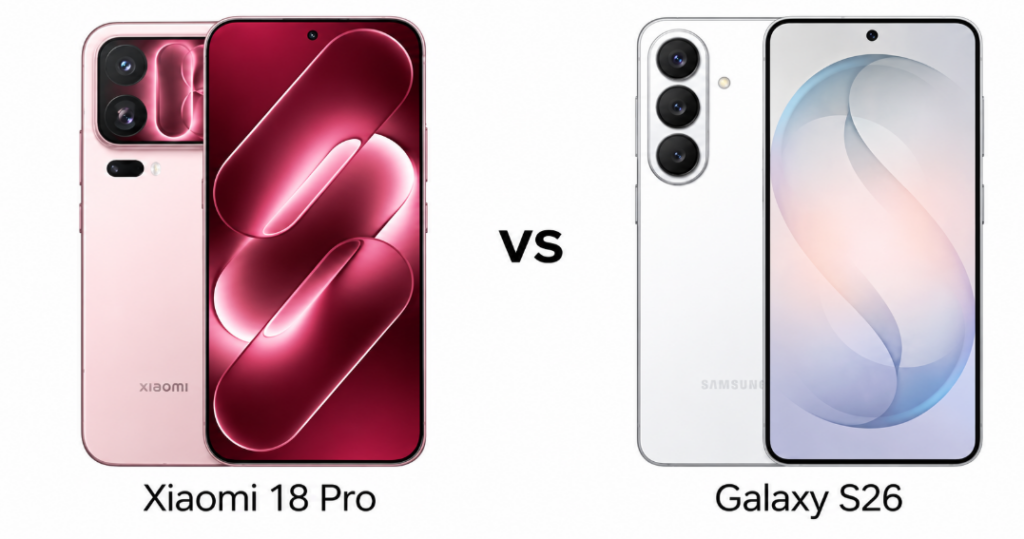
Major Features:
| Category | Xiaomi 18 Pro | Samsung Galaxy S26 | Winner |
|---|---|---|---|
| Build | Glass front, aluminum frame, Dragon Crystal Glass 3 | Gorilla Glass Victus 2 front and back, aluminum frame | Xiaomi — Dragon Crystal Glass 3 protection and distinctive rear display |
| Water Resistance | IP68, up to 6m for 30 minutes | IP68, up to 1.5m for 30 minutes | Xiaomi — Higher specified water immersion depth |
| Main Display | 6.4-inch LTPO AMOLED, 120Hz | 6.3-inch Dynamic LTPO AMOLED 2X, 120Hz | Xiaomi — Higher claimed peak brightness and Dolby Vision |
| Display Resolution | 1120 × 2436 pixels | 1080 × 2340 pixels | Xiaomi — Slightly higher resolution |
| Peak Brightness | 4,000 nits | 2,600 nits | Xiaomi — Higher claimed peak brightness |
| Secondary Display | 2.7-inch rear AMOLED display | No | Xiaomi — Additional screen for quick interactions |
| Operating System | Android 17, HyperOS 4 | Android 16, One UI 9; up to 7 major OS upgrades | Samsung — Longer stated software upgrade commitment |
| Processor | Snapdragon 8 Elite Gen 6, 2nm | Snapdragon 8 Elite Gen 5 or Exynos 2600, depending on region | Xiaomi — Newer-generation Snapdragon option |
| RAM | 12GB or 16GB | 12GB | Xiaomi — Offers a 16GB RAM configuration |
| Storage | 256GB, 512GB, 1TB | 128GB, 256GB, 512GB | Xiaomi — Higher maximum storage capacity |
| Storage Technology | UFS 4.1 | UFS 4.X | Xiaomi — Specifically listed UFS 4.1 storage |
| Rear Cameras | 200MP main, 200MP periscope telephoto, 50MP ultrawide | 50MP main, 10MP telephoto, 12MP ultrawide | Xiaomi — Higher-resolution camera system |
| Optical Zoom | 3.2x | 3x | Xiaomi — Slightly higher optical zoom |
| Selfie Camera | 50MP with autofocus | 12MP with autofocus | Xiaomi — Higher-resolution front camera |
| Rear Video Recording | Up to 8K at 30fps; 4K up to 120fps | Up to 8K at 30fps | Xiaomi — Supports 4K recording at up to 120fps |
| Stereo Speakers | Yes, Dolby Atmos | Yes | Xiaomi — Dolby Atmos support |
| Wi-Fi | Wi-Fi 7, dual-band | Wi-Fi 7, tri-band | Samsung — Tri-band Wi-Fi support |
| Bluetooth | Bluetooth 6.0 | Bluetooth 5.4 | Xiaomi — Newer Bluetooth version |
| USB | USB-C 3.2, DisplayPort, OTG | USB-C 3.2, DisplayPort 1.2, OTG | Tie — Both support DisplayPort output |
| Desktop Mode | No dedicated desktop mode listed | Samsung DeX and Wireless DeX | Samsung — Dedicated desktop experience |
| Battery | 7,000mAh silicon-carbon | 4,300mAh Li-Ion | Xiaomi — Much larger battery capacity |
| Wired Charging | 100W | 25W | Xiaomi — Faster wired charging |
| Wireless Charging | 50W | 15W Qi2 Ready | Xiaomi — Higher wireless charging speed |
| Reverse Wireless Charging | 27W | 4.5W | Xiaomi — Faster reverse wireless charging |
| Price / Value | Priced around $1,000 / ₹1,20,000 | Priced around $900 / ₹88,000 | Samsung — Lower stated price and extended software support |
| Overall Winner | Hardware-focused flagship | Software-focused flagship | Xiaomi — Stronger cameras, battery, charging, and display features |


Comments