
Advertisement

Add GIZMOCHINA on Google:

The battle between the Honor Win RT and OnePlus 15R highlights two different approaches to building a high-performance smartphone. One prioritizes extreme endurance and gaming-focused hardware, while the other combines next-generation processing, advanced video recording, and a polished software experience. Both promise flagship-class capabilities, but their differences extend beyond benchmark numbers and battery capacity. 

The real question is which phone delivers the better experience across everyday tasks, entertainment, photography, and demanding applications. With a considerable price gap between them, choosing the right device requires looking beyond individual specifications to determine which smartphone makes the more convincing overall investment.
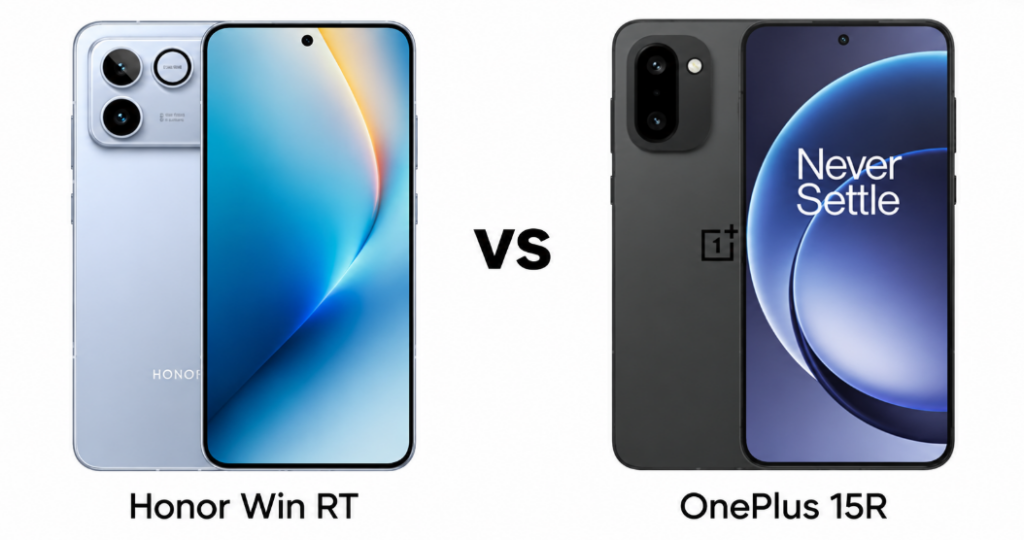
Major Features:

CategoryHonor Win RTOnePlus 15RWinner
Display6.83-inch AMOLED, 185Hz, 6000 nits peak6.83-inch AMOLED, 165Hz, 3600 nits peakHonor — Higher refresh rate and claimed peak brightness
Display ProtectionScratch/drop-resistant glassGorilla Glass 7iOnePlus — Specified glass protection
HDR SupportHDR Vivid, Ultra HDRDolby Vision, HDR10+, HDR Vivid, Ultra HDROnePlus — Broader HDR format support
ProcessorSnapdragon 8 EliteSnapdragon 8 Gen 5OnePlus — Newer-generation chipset
GraphicsAdreno 830Adreno 829Honor — Higher-tier GPU designation, though real-world performance varies
RAM12GB or 16GB12GB or 16GBTie — Both offer up to 16GB RAM
Storage256GB, 512GB, 1TB256GB, 512GBHonor — Offers a 1TB configuration
Storage TechnologyUFS 4.1UFS 4.1Tie — Same storage standard
Rear Camera50MP main with OIS, 12MP ultrawide with autofocus50MP main with OIS, 8MP ultrawideHonor — Higher-resolution ultrawide with autofocus
Rear VideoUp to 4K at 60fpsUp to 4K at 120fpsOnePlus — Supports higher-frame-rate 4K recording
Selfie Camera50MP32MP with autofocusHonor — Higher resolution and 4K 60fps selfie video
Battery10,000mAh silicon-carbon7,400mAh silicon-carbonHonor — Substantially larger capacity
Charging100W wired, 27W reverse wired80W wiredHonor — Faster charging and reverse charging
CoolingBuilt-in cooling fanNo built-in cooling fan listedHonor — Dedicated active cooling
Water ResistanceIP68/IP69KIP68/IP69KTie — Same stated protection rating
Operating SystemAndroid 16, MagicOS 10Android 16, OxygenOS 16OnePlus — Alternative for buyers preferring OxygenOS
ConnectivityWi-Fi 7, Bluetooth 6.0, NFC, IRWi-Fi 7, Bluetooth 6.0, NFC, IRTie — Broadly comparable connectivity
SIM SupportDual Nano-SIMDual Nano-SIM; eSIM on compatible variantsOnePlus — Additional eSIM flexibility
PricePriced around $380 / ₹35,000 (approximate Chinese launch-price conversion)Priced around $650 / ₹60,000 (approximate Indian retail pricing)Honor — Lower estimated entry cost
Value for MoneyGaming-focused hardware and larger batteryNewer chipset and advanced rear-video capabilitiesHonor — More hardware features for the money
Overall WinnerStrong battery life, gaming features, and affordabilityNewer chipset, HDR support, and advanced rear videoHonor — Stronger overall hardware value
Note: Prices are approximate. The Honor Win RT’s INR figure is a conversion of its Chinese launch price, not an official Indian retail price.

1. Design and Display

Build and Feel

The Honor Win RT adopts a distinctive performance-focused design, with an integrated cooling fan that actively assists heat dissipation during demanding gaming sessions. Its IP68/IP69K protection also provides substantial resistance against dust and water. The OnePlus 15R takes a more conventional premium approach, featuring Gorilla Glass 7i protection, an aluminum frame, and a choice of glass or reinforced plastic backing. Both phones offer strong durability credentials, but OnePlus feels better suited to buyers seeking a versatile daily companion rather than a device built around gaming first. Its eSIM support on compatible configurations is another practical advantage for travellers. Honor’s cooling hardware is undeniably impressive, although the OnePlus design feels more appropriate for users who want performance without emphasizing gaming-specific features.

Display Quality

Both smartphones feature 6.83-inch AMOLED displays with matching resolutions and sharp image reproduction. However, Honor pushes its refresh rate to 185Hz, compared with 165Hz on OnePlus, and claims substantially higher peak brightness. These advantages make the Honor particularly appealing for competitive gaming and outdoor use. The OnePlus 15R counters with Dolby Vision, HDR10+, and HDR Vivid support, giving it a strong entertainment-focused feature set. Its display remains exceptionally fluid while providing broader support for popular HDR formats. The difference between these refresh rates is unlikely to transform everyday scrolling, making the OnePlus display more than competitive for most users. Honor wins on headline display specifications, but OnePlus offers a more balanced multimedia experience.

Verdict

Honor wins on refresh rate and claimed peak brightness, but the OnePlus 15R delivers the more balanced everyday display experience with Dolby Vision and HDR10+ support.

2. Specifications Including Battery

Performance

The Honor Win RT uses Qualcomm’s Snapdragon 8 Elite, while the OnePlus 15R features the newer Snapdragon 8 Gen 5. Both are powerful 3nm platforms capable of handling demanding games, intensive applications, and multitasking. However, a newer chipset does not automatically guarantee higher performance in every workload; the Honor’s Snapdragon 8 Elite remains highly competitive, particularly in graphics-heavy tasks. OnePlus counters with a newer processing architecture and a forward-looking platform that makes it an appealing choice for buyers seeking the latest generation of hardware. Both devices offer up to 16GB of RAM and UFS 4.1 storage, so everyday responsiveness should be excellent. The OnePlus is the more compelling all-round platform, but Honor should not be dismissed as the slower phone simply because its processor carries an older name.

Battery and Charging

Honor’s 10,000mAh silicon-carbon battery is a major advantage over the OnePlus 15R’s 7,400mAh unit. Combined with 100W wired charging and 27W reverse wired charging, it makes the Honor an excellent choice for users who game for hours or frequently travel without access to a charger. OnePlus offers 80W wired charging, which remains fast, and its battery capacity should comfortably accommodate demanding daily use. The Honor is the clear choice for maximum endurance, but battery capacity alone does not determine overall usability. Charging habits, power management, screen brightness, and gaming workloads all affect real-world results. For most users, the OnePlus provides ample capacity without making battery size the defining feature of the phone. Honor wins endurance, while OnePlus maintains a strong balance.

Verdict

OnePlus wins narrowly for its newer processing platform and balanced daily performance, while Honor dominates battery endurance. The overall choice depends on whether longevity or versatility matters more.

3. Camera

Main and Secondary Lenses

Both smartphones use a 50MP primary camera with optical image stabilization, but their secondary cameras serve different priorities. The Honor Win RT pairs its main sensor with a 12MP ultrawide camera featuring autofocus, while OnePlus uses an 8MP ultrawide sensor. Honor therefore has the stronger hardware proposition for wide-angle photography, especially when capturing landscapes and group shots. OnePlus counters with a wider f/1.8 aperture on its primary camera and rear-video recording at up to 4K 120fps. That capability gives it a meaningful advantage for creators who want slow-motion flexibility and smoother high-frame-rate footage. Neither phone can be declared the photographic winner on megapixels alone, as image processing and consistency matter just as much. Nevertheless, OnePlus makes the more compelling choice for video enthusiasts, while Honor offers the more promising ultrawide hardware.

Selfie Camera

The Honor Win RT features a 50MP front camera capable of recording 4K video at up to 60fps. The OnePlus 15R uses a 32MP selfie camera with autofocus and supports 4K recording at 30fps. Honor’s higher resolution and faster front-video recording make it attractive for creators who frequently produce selfie videos or record themselves talking to the camera. However, OnePlus has an important practical advantage: autofocus can help maintain sharpness when the subject moves or changes distance from the phone. More megapixels do not automatically translate into better selfies, and processing, exposure, and skin-tone reproduction will influence the final results. Honor has the stronger specification sheet for front-camera resolution, but OnePlus offers a useful focusing feature. Buyers who prioritize selfie video should lean toward Honor, while those valuing autofocus may prefer OnePlus.

Verdict

OnePlus wins for creators who prioritize advanced rear-video recording, while Honor offers stronger ultrawide and selfie-camera specifications. Neither delivers an unquestionable photography victory.

4. Pricing

The Honor Win RT is priced around $380 (₹35,000), while the OnePlus 15R is priced around $650 (₹60,000). This considerable difference makes Honor the more aggressive hardware-value proposition, particularly for buyers who prioritize battery life, gaming, and charging speeds. 

OnePlus asks for a premium, but its newer Snapdragon platform, advanced rear-video capabilities, and OxygenOS 16 experience provide meaningful reasons to consider spending more. Both phones offer high-refresh-rate AMOLED displays, powerful processors, and fast storage, so neither is an obvious compromise in everyday performance. 

The Honor is difficult to beat on specifications per dollar, but value is not simply a matter of counting features. Buyers must also consider which capabilities they will actually use and whether the OnePlus experience better suits their daily routine.

Is the price justified?

The OnePlus 15R’s higher price is justified for buyers who value its newer chipset, advanced video recording, and OxygenOS experience. However, the premium is substantial, and Honor delivers more battery capacity and distinctive gaming hardware for considerably less. For budget-conscious gamers, Honor is the smarter purchase. For buyers seeking a balanced performance phone, OnePlus can justify the extra spending.

Verdict

Honor wins on affordability and raw hardware value. OnePlus remains the recommended overall purchase for buyers willing to pay more for its newer platform, multimedia capabilities, and everyday versatility.

Disclaimer: Prices shown in USD and INR are approximate currency conversions based on announced pricing and prevailing exchange rates. They may not reflect official local retail prices, import duties, taxes, shipping charges, or retailer markups. Actual prices may vary by region, storage configuration, and availability. The Honor Win RT’s INR price is a conversion of its Chinese launch price, not an official Indian retail price.

5. Conclusion

The Honor Win RT stands out with its integrated cooling fan, 10,000mAh battery, 185Hz display, and high-resolution front camera. These features make it an unusually compelling choice for mobile gamers, heavy users, and anyone who wants maximum endurance without spending a premium. Its 12MP autofocus ultrawide camera is another advantage over the OnePlus alternative. 

The OnePlus 15R counters with the Snapdragon 8 Gen 5, Dolby Vision support, 4K 120fps rear-video recording, and OxygenOS 16. Its eSIM support on compatible variants also improves flexibility for frequent travellers. 

OnePlus does not need to beat Honor in every specification to be the better all-round smartphone. Its strengths align with a broader range of everyday activities, from gaming and streaming to recording high-quality video. Honor offers more specialized hardware, but OnePlus delivers a more balanced package for users who want one phone to handle a little of everything.

Verdict

Honor Win RT is the clear overall winner for value-conscious performance enthusiasts. It delivers a 10,000mAh battery, 100W charging, an integrated cooling fan, a faster-refreshing display, and a capable camera setup at a substantially lower starting price. 

The OnePlus 15R counters with a newer chipset, Dolby Vision support, and 4K 120fps rear-video recording, but these advantages are not enough to outweigh Honor’s broader hardware advantages for most buyers. Honor Win RT delivers more for the money.


FAQs:

1. Which phone is better for gaming, Honor Win RT or OnePlus 15R?

The Honor Win RT is better suited to extended gaming sessions, thanks to its built-in cooling fan, 185Hz display, and larger battery.

2. Which phone has the better camera?

The OnePlus 15R supports 4K 120fps rear video, while Honor offers higher-resolution ultrawide and selfie cameras.

3. Is the OnePlus 15R faster than the Honor Win RT?

The OnePlus features a newer Snapdragon 8 Gen 5 chipset, but actual performance differences depend on the workload and thermal management.

4. Which phone offers better battery life?

The Honor Win RT’s 10,000mAh battery has a substantial capacity advantage over the OnePlus 15R’s 7,400mAh battery.

5. Which phone offers better value for money?

The Honor Win RT offers better hardware value at its lower approximate price, while OnePlus may suit buyers prioritizing its software experience.

Disclaimer: Prices, specifications, and availability may vary by region and retailer. Recommendations in this article are based on editorial opinion, feature-based value, and market positioning at the time of writing. Readers are advised to do their own research before making a purchase.

Read More:

Comments