
Add GIZMOCHINA on Google:
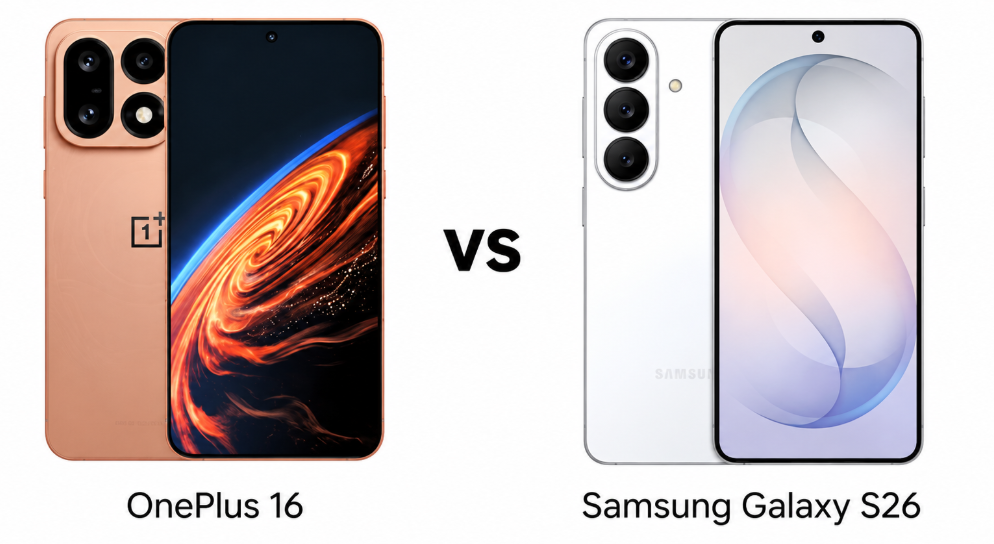
OnePlus 16 and Samsung Galaxy S26 appeal to different kinds of flagship buyers. OnePlus focuses on high-end hardware, gaming, battery endurance and charging speed, while Samsung prioritizes a compact design, refined everyday usability and long-term software support. At similar prices, neither phone is automatically the better choice. The real difference lies in whether you value maximum hardware capabilities or a more convenient, balanced smartphone experience.
1. Major Features:
| Category | OnePlus 16 | Samsung Galaxy S26 | Winner |
|---|---|---|---|
| Design and Build | Glass front, aluminum frame, glass or composite back | Gorilla Glass Victus 2, Armor Aluminum 2 frame | Samsung — More compact and easier to handle |
| Durability | IP68/IP69K protection | IP68 protection | OnePlus — Higher-rated water-jet protection |
| Display | 6.78-inch LTPO AMOLED, 185Hz | 6.3-inch Dynamic AMOLED 2X, 120Hz | OnePlus — Larger screen and higher refresh rate |
| Display Brightness | Up to 2,000 nits HBM | Up to 2,600 nits peak | Samsung — Higher claimed peak brightness |
| Resolution | 1272 × 2772 pixels | 1080 × 2340 pixels | OnePlus — Higher resolution and pixel density |
| Processor | Snapdragon 8 Elite Extreme Gen 6 | Snapdragon 8 Elite Gen 5 or Exynos 2600 | OnePlus — Newer Snapdragon generation |
| RAM | 12GB or 16GB | 12GB | OnePlus — Higher maximum memory |
| Storage | 256GB, 512GB or 1TB | 128GB, 256GB or 512GB | OnePlus — Higher maximum storage |
| Software | Android 17, OxygenOS 17 listed | Android 16, One UI 9 listed | Samsung — Longer stated OS upgrade commitment |
| Rear Main Camera | 200MP with OIS | 50MP with OIS | OnePlus — Higher-resolution main sensor |
| Telephoto Camera | 50MP, 3x optical zoom, OIS | 10MP, 3x optical zoom, OIS | OnePlus — Higher-resolution telephoto sensor |
| Ultrawide Camera | 50MP, 116-degree field of view | 12MP, 120-degree field of view | OnePlus — Higher sensor resolution |
| Selfie Camera | 50MP ultrawide with autofocus | 12MP with dual-pixel autofocus | OnePlus — Higher resolution and wider framing |
| Video Recording | Up to 8K at 30fps; 4K at 120fps | Up to 8K at 30fps; 4K at 60fps | OnePlus — Higher maximum 4K frame rate |
| Battery | 9,000mAh | 4,300mAh | OnePlus — Much larger battery capacity |
| Wired Charging | 100W | 25W | OnePlus — Faster wired charging |
| Wireless Charging | 50W | 15W | OnePlus — Faster wireless charging |
| Reverse Charging | Wireless and 5W wired | 4.5W wireless | OnePlus — More charging options |
| Connectivity | Wi-Fi 7, Bluetooth 6.0, USB-C 3.2 | Wi-Fi 7, Bluetooth 5.4, USB-C 3.2 with DisplayPort 1.2 | OnePlus — Newer Bluetooth version |
| Additional Features | Infrared port, bypass charging | Samsung DeX, Wireless DeX | Samsung — Desktop productivity features |
| Price and Value | Priced around $900 / ₹86,000 | Priced around $900 / ₹88,000 | OnePlus — More hardware for a similar price |
2. Design and Display
Build and Feel
The OnePlus 16 combines a glass front, an aluminum frame and a choice of glass or glass-fiber reinforced plastic for the rear panel. Its IP68/IP69K protection provides an advantage for users concerned about dust, water and demanding outdoor conditions. Samsung’s Galaxy S26 pairs Gorilla Glass Victus 2 with an Armor Aluminum 2 frame and IP68 protection. Its compact design makes one-handed operation and everyday handling more convenient. Both feel premium, but Samsung’s smaller form factor is more practical for users who dislike bulky phones, whereas OnePlus suits buyers who prefer a larger device for entertainment and gaming.
Display Quality
The OnePlus 16 features a 6.78-inch LTPO AMOLED display with a 185Hz refresh rate, Dolby Vision and HDR10+ support. Its expansive screen and exceptionally high refresh rate benefit gaming and fast-moving content. Samsung’s 6.3-inch Dynamic AMOLED 2X panel supports an adaptive 120Hz refresh rate and a claimed peak brightness of 2,600 nits. Samsung’s screen is more compact and emphasizes outdoor visibility, while OnePlus delivers smoother motion and a more immersive viewing experience. The better choice depends on whether screen size and gaming fluidity matter more than convenience.
Verdict
OnePlus wins on display size, refresh rate and water-resistance ratings. Samsung is the more comfortable everyday choice for compact-phone users who value easy handling.
3. Specifications Including Battery
Performance
The OnePlus 16 uses the Snapdragon 8 Elite Extreme Gen 6 chipset, with up to 16GB RAM and UFS 4.1 storage. Its newer processor and generous memory options make it attractive for demanding games, multitasking and intensive workloads.
The Galaxy S26 uses the Snapdragon 8 Elite Gen 5 in selected markets and the Exynos 2600 in others. Both configurations deliver flagship-class performance, while Samsung’s seven-generation OS upgrade commitment gives it a clear advantage for long-term ownership.
Battery and Charging
OnePlus takes a substantial lead with its 9,000mAh silicon-carbon battery, 100W wired charging and 50W wireless charging. Reverse wireless charging and bypass charging add useful flexibility for gamers and frequent travelers.
Samsung’s 4,300mAh battery supports 25W wired charging, 15W wireless charging and 4.5W reverse wireless charging. It is sufficient for many everyday routines, but OnePlus is better suited to heavy use and fewer charging interruptions.
Verdict
OnePlus wins on performance potential, battery endurance and charging versatility. Samsung counters with longer software support, making it attractive to buyers who keep their phones for years.
4. Camera
Main and Secondary Lenses
The OnePlus 16 features a 200MP main camera with optical image stabilization, a 50MP telephoto camera with 3x optical zoom and a 50MP ultrawide lens. Its high-resolution hardware offers greater flexibility for cropping, detailed scenes and wide-angle photography.
Samsung’s Galaxy S26 combines a 50MP stabilized main camera with a 10MP telephoto lens offering 3x optical zoom and a 12MP ultrawide camera. It also supports 8K video recording at 30fps, alongside 10-bit HDR and HDR10+ features. OnePlus offers more ambitious camera hardware, but Samsung’s image processing can be valuable for consistent everyday results.
Selfie Camera
The OnePlus 16 uses a 50MP ultrawide front camera with autofocus and 4K video recording at up to 60fps. Its wider field of view is useful for group selfies, travel photos and video calls.
The Galaxy S26 features a 12MP front camera with dual-pixel autofocus and HDR10+ video support. It also records 4K video at 60fps. Although OnePlus offers higher resolution, Samsung remains well equipped for selfies and social content. Actual image quality will depend on processing, lighting and skin-tone reproduction, not megapixels alone.
Verdict
OnePlus wins on camera hardware versatility and selfie resolution. Samsung remains a credible alternative for everyday photography, where processing and consistency matter as much as specifications.
5. Pricing
The OnePlus 16 is priced around $900 (₹86,000), while the Samsung Galaxy S26 is priced around $900 (₹88,000). These approximate figures put both phones in a similar flagship price bracket, although the actual cost depends on storage configuration, regional availability and retailer offers. OnePlus offers more aggressive hardware for the money, particularly in battery capacity, charging speed and camera resolution. Samsung’s pricing reflects its compact flagship design, software ecosystem and extended update commitment. Buyers in India should also verify local availability before purchasing the OnePlus 16, as its Chinese launch does not guarantee an official Indian release at the same price.
Is the price justified?
At similar prices, OnePlus is more compelling for buyers who prioritize battery life, gaming and hardware specifications. Its charging system and large battery offer practical advantages for demanding users. Samsung is easier to justify for those who prefer a compact phone, dependable everyday photography and seven major Android OS upgrades. Neither offers universal value for every buyer, but Samsung’s balanced experience may prove more useful to people who do not need extreme specifications.
Verdict
OnePlus delivers more hardware for the money, while Samsung offers stronger value for compact-phone users who prioritize software longevity and everyday convenience.
6. Conclusion
The OnePlus 16 stands out with its 185Hz display, 9,000mAh battery, 100W wired charging, 50W wireless charging and 200MP main camera. These features make it particularly appealing to gamers, heavy users and people who regularly record content. The Galaxy S26 takes a different approach with its compact design, adaptive 120Hz display, Samsung DeX desktop functionality and seven major OS upgrades. Its smaller form factor is easier to manage, and its software support makes it a sensible long-term purchase.
The camera comparison also deserves nuance: OnePlus offers more impressive sensor specifications, but those figures alone cannot establish which phone takes better photographs. Ultimately, the OnePlus 16 prioritizes hardware capability, while Samsung focuses on a more balanced flagship experience.
Verdict
Choose the OnePlus 16 for battery endurance, charging speed, gaming and camera hardware. Choose the Samsung Galaxy S26 for compact handling, everyday practicality and long-term software support. Neither is universally better; the right choice depends on your priorities.
Disclaimer: Prices, specifications, and availability may vary by region and retailer. Recommendations in this article are based on editorial opinion, feature-based value, and market positioning at the time of writing. Readers are advised to do their own research before making a purchase.
Read More:
- OnePlus 16 vs iPhone 17: The $900 Flagship Battle Is Closer Than You Think
- iPhone 18 Pro vs iPhone 15 Pro: Is It Finally Time to Upgrade?
- Honor Win RT vs Pixel 10a: Honor’s 10000mAh Battery vs Google’s Camera Magic



Comments