As an Amazon Associate, Gizmochina earns from qualifying purchases. Links on this page may earn us a commission at no extra cost to you.
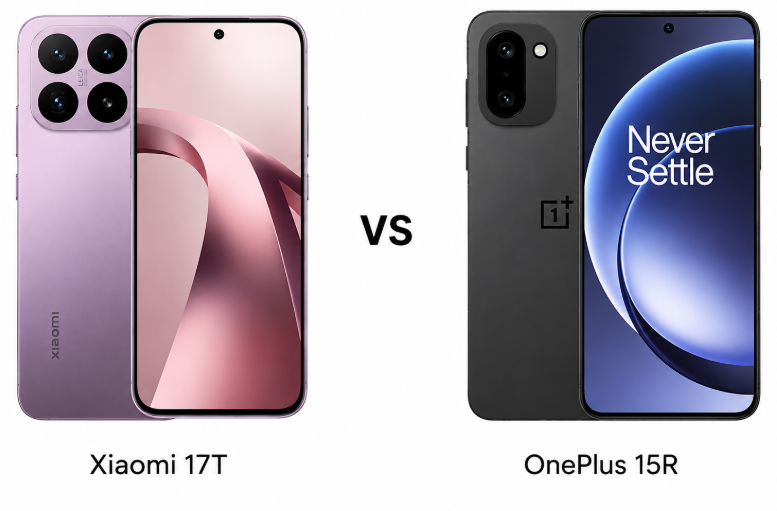
The premium smartphone segment is becoming increasingly competitive, and the Xiaomi 17T and OnePlus 15R are two devices that prove flagship-level features no longer require flagship prices. While both phones offer powerful hardware, large batteries, and premium AMOLED displays, they take very different approaches to winning over buyers. The Xiaomi 17T focuses heavily on camera performance with its Leica-backed imaging system, while the OnePlus 15R prioritizes raw power, battery life, and value. This comparison breaks down their design, performance, cameras, battery, and pricing to find out which phone offers the better overall experience in 2026.
Major Features:
Feature
Xiaomi 17T
OnePlus 15R
Winner
Build Quality
Glass front, reinforced plastic frame and back, IP68
The Xiaomi 17T and OnePlus 15R both target premium smartphone buyers, but they approach design differently. The Xiaomi 17T combines Gorilla Glass 7i protection with a glass-fiber reinforced plastic frame and back, creating a lighter and more practical feel. It also carries an IP68 rating, which remains more than sufficient for daily protection against water and dust.
The OnePlus 15R feels slightly more premium thanks to its aluminum frame and stronger IP68/IP69K certification. The additional durability against high-pressure water exposure may appeal to users who prioritize ruggedness. The ultrasonic fingerprint scanner is another small but meaningful upgrade that contributes to a more flagship-like experience.
Display Quality
Xiaomi equips the 17T with a sharp AMOLED panel featuring Dolby Vision, HDR10+, 120Hz refresh rate, and an impressive 3500-nit peak brightness. Colors look vibrant, and the compact display size may feel more comfortable for extended use.
The OnePlus 15R counters with a larger AMOLED display, 165Hz refresh rate, 1 billion colors, and support for HDR Vivid. The higher refresh rate delivers a smoother visual experience, particularly during gaming and scrolling.
Verdict
The OnePlus 15R offers the more premium build and superior display specifications. However, the Xiaomi 17T may feel easier to handle daily thanks to its slightly more compact form factor. For display enthusiasts, the OnePlus 15R takes a narrow win.
2. Specifications Including Battery
Performance
Performance is one of the biggest differences between these two devices. The Xiaomi 17T runs on the MediaTek Dimensity 8500 Ultra, which delivers flagship-level efficiency and excellent everyday responsiveness. Combined with UFS 4.1 storage and Android 16-based HyperOS 3, multitasking and app performance remain smooth.
The OnePlus 15R steps into a higher category with Qualcomm’s Snapdragon 8 Gen 5 chipset. Built on a more advanced 3nm process and paired with the Adreno 829 GPU, it is clearly designed for heavy gaming, demanding workloads, and long-term performance stability. Users interested in maximum processing power will immediately notice the advantage.
Battery and Charging
Battery life is impressive on both phones. The Xiaomi 17T packs a 6500mAh battery globally and supports 67W charging along with reverse wired charging. The OnePlus 15R pushes capacity further with a massive 7400mAh battery and faster 80W charging support.
The larger battery and quicker charging combination give the OnePlus a practical edge for power users.
Verdict
The OnePlus 15R is the stronger performer overall. Between the Snapdragon 8 Gen 5 and a larger battery, it delivers more raw power and endurance, making it the better choice for gamers and heavy users.
3. Camera
Main and Secondary Lenses
Camera hardware is where the Xiaomi 17T gains a major advantage. Its Leica-branded triple-camera setup includes a 50MP primary sensor, a dedicated 50MP periscope telephoto camera with 5x optical zoom, and a 12MP ultrawide lens. The inclusion of a true periscope lens significantly expands shooting flexibility, particularly for portraits and long-distance photography.
The OnePlus 15R uses a simpler dual-camera system consisting of a 50MP primary sensor and an 8MP ultrawide camera. While image quality should remain strong in daylight, the absence of a telephoto lens limits versatility. Video capabilities are impressive with support for 4K recording at up to 120fps, but photography enthusiasts may find the hardware less exciting.
Selfie Camera
Both devices feature 32MP selfie cameras capable of 4K video recording. The OnePlus gains a slight advantage with autofocus support, helping maintain sharpness during selfies and video calls.
Verdict
The Xiaomi 17T comfortably wins this category. The dedicated 5x periscope camera and Leica imaging system provide a far more complete photography package, making it the better option for users who value camera flexibility.
4. Pricing
Xiaomi 17T is priced around $700 (approximately ₹60,000), while the OnePlus 15R is priced around $650 (approximately ₹55,000). Despite being the more affordable device, the OnePlus 15R includes a flagship Snapdragon 8 Gen 5 processor, a larger battery, faster charging, an aluminum frame, and a higher-refresh-rate display.
Xiaomi 17T justifies its higher price through its camera-focused hardware. The addition of a 50MP periscope telephoto lens is uncommon in this segment and significantly increases photographic versatility. Buyers who frequently use zoom photography may find the premium worthwhile.
From a pure specifications perspective, the OnePlus offers more hardware for less money. The Xiaomi focuses on delivering a more balanced flagship experience with a stronger emphasis on imaging.
Verdict
For value-conscious buyers, the OnePlus 15R offers better hardware per dollar. The Xiaomi 17T remains competitively priced, but its value proposition depends heavily on how important the camera system is to the user.
Disclaimer: Prices are approximate and may vary based on country, region, launch timing, and applicable taxes. Always check whether the listed price is for a China unit or a global/international variant when purchasing.
5. Conclusion
The Xiaomi 17T stands out with its Leica-tuned camera system, dedicated 5x periscope telephoto lens, Dolby Atmos audio support, and strong photography-oriented feature set. It feels like a device built specifically for users who enjoy mobile photography and content creation.
The OnePlus 15R focuses on performance, endurance, and premium hardware. The Snapdragon 8 Gen 5 chipset, 7400mAh battery, 80W charging, IP69K protection, aluminum frame, ultrasonic fingerprint sensor, and 165Hz AMOLED display create a package that feels extremely competitive for its price.
Both smartphones successfully target different priorities. One emphasizes camera versatility, while the other pushes performance and battery life.
Verdict
Choose the Xiaomi 17T if camera quality and zoom photography are the top priorities. Choose the OnePlus 15R if gaming performance, battery life, charging speed, and overall value matter more. For most buyers, the OnePlus 15R delivers the stronger all-around package, while the Xiaomi 17T remains the better camera-focused option.
Disclaimer: This comparison is based on the specifications provided and is intended for general informational purposes. Actual performance, camera results, battery life, and overall experience may vary depending on real-world usage, software updates, and individual preferences.
We use cookies on our website to give you the most relevant experience by remembering your preferences and repeat visits. By clicking “Accept”, you consent to the use of ALL the cookies.
This website uses cookies to improve your experience while you navigate through the website. Out of these, the cookies that are categorized as necessary are stored on your browser as they are essential for the working of basic functionalities of the website. We also use third-party cookies that help us analyze and understand how you use this website. These cookies will be stored in your browser only with your consent. You also have the option to opt-out of these cookies. But opting out of some of these cookies may affect your browsing experience.
Necessary cookies are absolutely essential for the website to function properly. This category only includes cookies that ensures basic functionalities and security features of the website. These cookies do not store any personal information.
Any cookies that may not be particularly necessary for the website to function and is used specifically to collect user personal data via analytics, ads, other embedded contents are termed as non-necessary cookies. It is mandatory to procure user consent prior to running these cookies on your website.




Comments