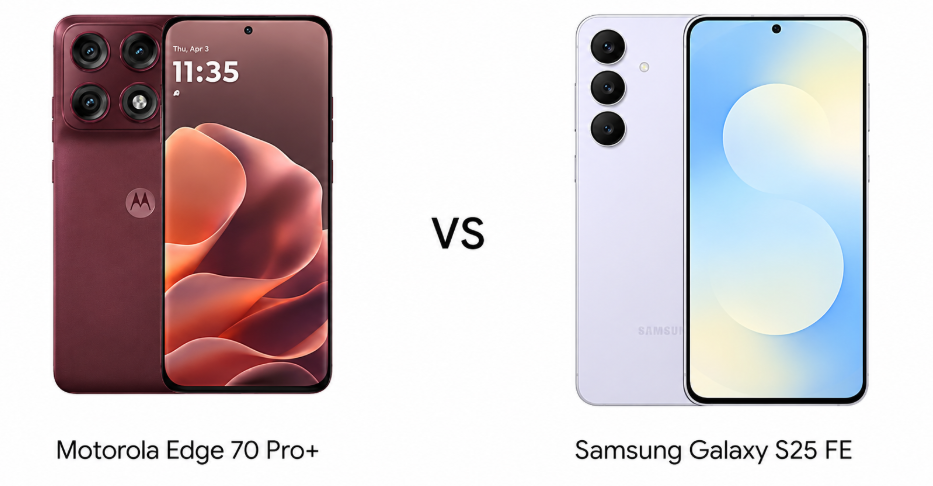
Motorola Edge 70 Pro+ and Samsung Galaxy S25 FE take two very different approaches to the premium smartphone segment. Motorola focuses on delivering top-tier hardware with a high-refresh-rate display, massive battery, and versatile camera system, while Samsung counters with flagship-grade performance, longer software support, and a polished ecosystem experience. With their prices sitting surprisingly close to each other, choosing between them is less about budget and more about deciding which strengths matter most. Here’s a detailed comparison to find out which smartphone offers the better overall package.
Major Features:
Category
Motorola Edge 70 Pro+
Samsung Galaxy S25 FE
Winner
Build Quality
Eco-leather back, plastic frame
Glass back, aluminum frame
Samsung – More premium materials
Display Technology
144Hz AMOLED
120Hz LTPO AMOLED 2X
Motorola – Higher refresh rate
Display Resolution
1272 × 2772
1080 × 2340
Motorola – Sharper panel
Peak Brightness
5200 nits
1900 nits
Motorola – Much brighter display
Processor
Dimensity 8500 Extreme
Exynos 2400
Samsung – Stronger flagship chipset
RAM
12GB
8GB
Motorola – Better multitasking
Storage Technology
UFS 4.1
UFS 4.0
Motorola – Faster storage standard
Software Support
3 Android upgrades
7 Android upgrades
Samsung – Longer update commitment
Main Camera
50MP OIS
50MP OIS
Samsung – Better image processing
Telephoto Camera
50MP Periscope, 3.5x
8MP, 3x
Motorola – Superior zoom hardware
Ultrawide Camera
50MP
12MP
Motorola – Higher-resolution sensor
Selfie Camera
50MP AF
12MP
Motorola – Sharper selfies with autofocus
Video Recording
4K up to 120fps
8K up to 30fps
Samsung – Supports 8K recording
Battery Capacity
6500mAh
4900mAh
Motorola – Larger battery
Wired Charging
90W
45W
Motorola – Faster charging speeds
Wireless Charging
15W
15W Qi2 Compatible
Samsung – Qi2 compatibility
USB Standard
USB 2.0
USB 3.2
Samsung – Faster data transfers
Connectivity
Wi-Fi 7
Wi-Fi 6E
Motorola – Newer wireless standard
Productivity Features
Smart Connect
DeX & Wireless DeX
Samsung – Better desktop experience
Price
Priced around ₹48,000
Priced around ₹50,000
Motorola – Better value for money
Disclaimer: Specs are based on available data. Actual performance may vary. Verify details from official sources before buying.
The Motorola Edge 70 Pro+ focuses on practicality with its eco-leather rear panel, Gorilla Glass 7i protection, IP68/IP69 certification, and MIL-STD-810H compliance. The textured finish offers a secure grip and tends to resist fingerprints better than glossy glass backs. The Samsung Galaxy S25 FE takes a more premium approach with Gorilla Glass Victus+ on both the front and rear, paired with an enhanced aluminum frame. It feels more flagship-like and carries a cleaner, more refined appearance. Samsung’s use of premium materials may appeal to buyers who prioritize a traditional high-end design.
Display Quality
Motorola gains a clear advantage in display specifications with its 144Hz AMOLED panel, higher resolution, and an impressive peak brightness rating. The screen feels exceptionally smooth and vibrant, particularly during gaming and fast scrolling. Samsung counters with a Dynamic LTPO AMOLED 2X panel that can intelligently adjust refresh rates for efficiency while delivering excellent color accuracy and HDR performance. The lower resolution is noticeable on paper but less so in daily use.
Verdict
The Galaxy S25 FE feels more premium, but the Edge 70 Pro+ delivers a more impressive display experience overall.
2. Specifications Including Battery
Performance
The Samsung Galaxy S25 FE is powered by the Exynos 2400, a flagship-grade chipset that offers stronger raw performance, better graphics capability, and enhanced AI processing. It is better suited for demanding multitasking, high-end gaming, and long-term performance consistency. The Motorola Edge 70 Pro+ uses the Dimensity 8500 Extreme, which remains highly capable and efficient for everyday use while providing smooth performance across apps and games. Motorola also includes 12GB RAM as standard, giving it an advantage in memory-intensive workloads.
Battery and Charging
Battery life is one of Motorola’s strongest advantages. Its large 6500mAh silicon-carbon battery comfortably exceeds the Galaxy S25 FE’s 4900mAh capacity, making it a better choice for heavy users. Charging is also significantly faster with 90W wired support, while Samsung relies on 45W charging. Both devices support wireless charging, though Samsung benefits from Qi2 compatibility and a more mature wireless ecosystem.
Verdict
Samsung wins on processing power and software longevity, while Motorola offers superior battery endurance and charging convenience.
3. Camera
Main and Secondary Lenses
Both smartphones feature capable 50MP primary cameras with optical image stabilization, delivering strong results in daylight and challenging lighting conditions. Samsung’s image processing generally produces more consistent colors, dynamic range, and video quality, while Motorola often delivers a slightly more natural look. The biggest hardware advantage belongs to Motorola, which includes a 50MP periscope telephoto camera and a 50MP ultrawide sensor. Samsung uses an 8MP telephoto and a 12MP ultrawide camera, making the overall camera hardware less impressive on paper. Motorola’s higher-resolution secondary sensors provide greater flexibility and detail retention.
Selfie Camera
Motorola again leads in specifications with a 50MP autofocus front camera capable of capturing sharper images and better group selfies. Samsung’s 12MP sensor produces reliable results and excellent video quality but lacks the same level of detail.
Verdict
Samsung delivers dependable image processing and video performance, but Motorola offers a more versatile and powerful overall camera setup.
4. Pricing
The Motorola Edge 70 Pro+ is priced around $600/ ₹48,000, while the Samsung Galaxy S25 FE is priced around $700 / ₹50,000. The difference is relatively small, making the comparison more about priorities than budget. Motorola provides a stronger hardware package with a higher-end display, larger battery, faster charging, more RAM, and superior secondary cameras. Samsung, however, justifies its pricing through its flagship-grade chipset, premium construction, One UI experience, and extended software support.
Is the Price Justified?
At its price, the Edge 70 Pro+ delivers exceptional value because it offers upgrades in several areas that directly impact daily use. The S25 FE is also reasonably priced, particularly for users who value software reliability and long-term updates. The extra investment feels worthwhile for buyers planning to keep their device for many years.
Verdict
Motorola offers better hardware value, while Samsung’s pricing is supported by software longevity and ecosystem advantages.
Disclaimer: Prices are approximate and may vary based on country, region, launch timing, and applicable taxes. Always check whether the listed price is for a China unit or a global/international variant when purchasing.
5. Conclusion
The Motorola Edge 70 Pro+ stands out with its 144Hz display, 6500mAh silicon-carbon battery, 90W charging, 50MP periscope telephoto camera, 50MP ultrawide camera, and 50MP autofocus selfie camera. These features create a specification sheet that is unusually strong for its price category. The Samsung Galaxy S25 FE counters with a flagship-class Exynos 2400 processor, premium glass-and-aluminum construction, Samsung DeX support, Qi2-compatible wireless charging, and an industry-leading commitment of seven major Android upgrades. Samsung’s ecosystem integration is also a major attraction for users who already own other Galaxy products.
Verdict
For buyers seeking the best hardware package and maximum value, the Motorola Edge 70 Pro+ is the stronger overall choice. For those prioritizing software support, ecosystem features, and flagship-grade processing power, the Samsung Galaxy S25 FE remains an excellent alternative.
Overall, the Edge 70 Pro+ delivers more for the money, while the S25 FE focuses on long-term ownership and refinement.
Disclaimer: This comparison is based on the specifications provided and is intended for general informational purposes. Actual performance, camera results, battery life, and overall experience may vary depending on real-world usage, software updates, and individual preferences.
We use cookies on our website to give you the most relevant experience by remembering your preferences and repeat visits. By clicking “Accept”, you consent to the use of ALL the cookies.
This website uses cookies to improve your experience while you navigate through the website. Out of these, the cookies that are categorized as necessary are stored on your browser as they are essential for the working of basic functionalities of the website. We also use third-party cookies that help us analyze and understand how you use this website. These cookies will be stored in your browser only with your consent. You also have the option to opt-out of these cookies. But opting out of some of these cookies may affect your browsing experience.
Necessary cookies are absolutely essential for the website to function properly. This category only includes cookies that ensures basic functionalities and security features of the website. These cookies do not store any personal information.
Any cookies that may not be particularly necessary for the website to function and is used specifically to collect user personal data via analytics, ads, other embedded contents are termed as non-necessary cookies. It is mandatory to procure user consent prior to running these cookies on your website.



Comments