Advertisement

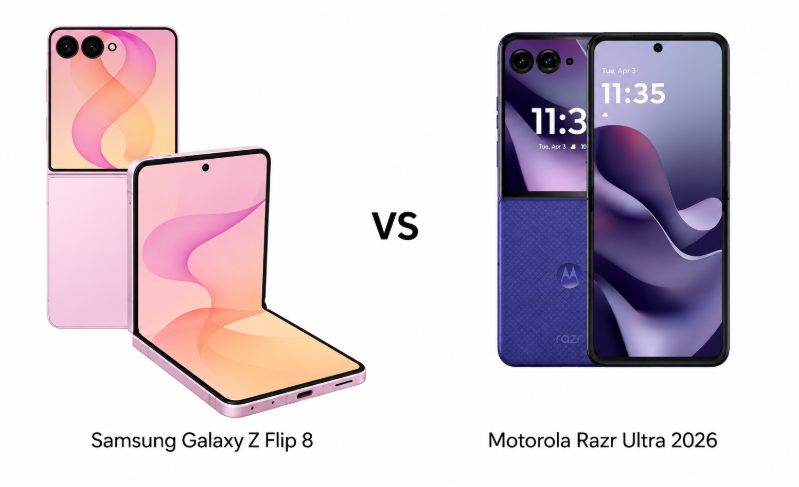
The battle for the best premium flip phone is more competitive than ever. The Samsung Galaxy Z Flip 8 brings next-generation performance, long-term software support, and Samsung’s polished foldable experience, while the Motorola Razr Ultra 2026 fights back with a stunning display, flagship cameras, and class-leading battery life. Here’s a closer look at how these two premium foldables compare to find out which one truly deserves a place in your pocket. 
Major Features:

CategorySamsung Galaxy Z Flip 8Motorola Razr Ultra 2026Winner
Build & DurabilityArmor Aluminum frame, Gorilla Glass Victus 2, IP48, Samsung DeXGorilla Glass Ceramic, Aluminum frame, IP48Samsung – Better durability and DeX support
Main Display6.9-inch Dynamic LTPO AMOLED 2X, 120Hz, HDR10+, 2,600 nits7-inch LTPO AMOLED, 165Hz, Dolby Vision, HDR10+, 5,000 nitsMotorola – Brighter, smoother, and more immersive display
Cover Display4.1-inch Super AMOLED, 120Hz4-inch LTPO AMOLED, 165HzSamsung – Larger and more practical cover screen
ProcessorSnapdragon 8 Elite Gen 5 / Exynos 2600Snapdragon 8 EliteSamsung – Newer flagship chipset
RAM & Storage12GB RAM, 256GB/512GB UFS 4.x16GB RAM, 512GB UFS 4.0Motorola – More RAM as standard
SoftwareAndroid 17, One UI 9, 7 major Android upgradesAndroid 16Samsung – Much longer software support
Rear Cameras50MP Wide + 12MP Ultrawide50MP Wide + 50MP UltrawideMotorola – Better secondary camera
Selfie Camera10MP50MPMotorola – Higher-resolution selfies
Video Recording4K@60fps, HDR10+8K@30fps, 4K@120fps, Dolby VisionMotorola – More advanced video capabilities
Battery4,300mAh5,000mAhMotorola – Larger battery capacity
Charging25W wired, 15W wireless, 4.5W reverse wireless68W wired, 30W wireless, 5W reverse wiredMotorola – Significantly faster charging
ConnectivityWi-Fi 7, Bluetooth 5.4, USB-C 3.2, DeXWi-Fi 7, Bluetooth 5.4, USB-C 2.0Samsung – Faster USB and DeX support
Price / ValuePriced around $1,200 / ₹125,000Priced around $1,500 / ₹143,000Samsung – Better value for money
Overall WinnerExcellent software, value, and longevitySuperior display, battery, cameras, and chargingMotorola – Better flagship hardware overall; Samsung offers the better value.

1. Design and Display

Build and Feel

The Samsung Galaxy Z Flip 8 and Motorola Razr Ultra 2026 both represent the latest generation of premium flip phones, but they approach design differently. Samsung focuses on durability with an Armor Aluminum frame, Gorilla Glass Victus 2 protection on the cover display, and IP48 dust and water resistance. It also supports Samsung DeX, adding extra versatility beyond the foldable experience. Motorola matches the IP48 rating but uses Gorilla Glass Ceramic on the outer display and delivers a slightly more luxurious feel with Dolby Atmos integration. Samsung’s cleaner software support and long-term durability promise make it feel like a device built for years of ownership, while Motorola prioritises premium entertainment features.

Display Quality

Samsung offers a 6.9-inch Dynamic LTPO AMOLED 2X display with a smooth 120Hz refresh rate and a bright 2,600-nit peak brightness. Its 4.1-inch cover display is larger and more practical for daily tasks. Motorola counters with a stunning 7-inch LTPO AMOLED panel featuring a 165Hz refresh rate, Dolby Vision support, one billion colours, and an incredible 5,000-nit peak brightness. The external display is equally impressive with a 165Hz refresh rate and 3,000 nits of brightness. Motorola’s display simply feels more immersive and visually striking, especially for media consumption.

Verdict

Samsung wins for software longevity and practical usability, but Motorola delivers the more premium display experience with brighter panels, higher refresh rates, and richer visual technologies.

2. Specifications Including Battery

Performance

Samsung equips the Galaxy Z Flip 8 with either the Snapdragon 8 Elite Gen 5 or Exynos 2600 depending on the market, paired with 12GB RAM and fast UFS 4.x storage. It launches with Android 17 and promises seven major Android upgrades, making it one of the most future-proof foldables available. Motorola uses the Snapdragon 8 Elite with a generous 16GB RAM and UFS 4.0 storage. Everyday performance is outstanding on both phones, but Samsung’s newer chipset in supported regions and unmatched software commitment make it a stronger long-term investment. Motorola’s extra RAM, however, gives demanding multitasking a noticeable edge.

Battery and Charging

Samsung includes a 4,300mAh battery with 25W wired, 15W wireless, and reverse wireless charging. Motorola steps ahead with a much larger 5,000mAh battery alongside significantly faster 68W wired and 30W wireless charging. The larger battery combined with quicker charging makes Motorola much more convenient for heavy users who spend long hours away from a charger.

Verdict

Samsung leads in software longevity and platform support, while Motorola clearly dominates battery capacity, RAM, and charging speed, making it the stronger overall hardware package.

3. Camera

Main and Secondary Lenses

Samsung features a 50MP primary camera alongside a 12MP ultrawide sensor capable of detailed daylight photography, reliable colour reproduction, and HDR10+ video recording. Motorola also uses a 50MP main sensor but pairs it with a much higher-resolution 50MP ultrawide camera, offering greater detail and flexibility. Video recording is another major advantage, supporting up to 8K recording along with Dolby Vision and 4K at 120fps. Samsung continues to produce dependable and consistent results, particularly with image processing, but Motorola delivers a more feature-rich camera system for enthusiasts looking to capture both photos and cinematic videos.

Selfie Camera

Samsung uses a 10MP front camera that performs well for video calls and occasional selfies. Motorola upgrades this significantly with a 50MP selfie camera capable of detailed images and 4K recording. Although most users will rely on the rear cameras while folded, Motorola still offers noticeably stronger front-camera hardware.

Verdict

Samsung delivers dependable image processing and consistency, but Motorola offers the more complete camera system with higher-resolution sensors, advanced video capabilities, and a superior selfie camera.

4. Pricing

Price Comparison

The Samsung Galaxy Z Flip 8 is priced around $1,200 (₹125,000), making it the more affordable flagship flip phone. The Motorola Razr Ultra 2026 is priced around $1,500 (₹143,000), placing it firmly in the ultra-premium category. The price difference reflects Motorola’s brighter displays, larger battery, faster charging, additional RAM, and stronger camera hardware. Samsung, however, delivers outstanding software support with seven years of Android upgrades, which adds meaningful long-term value that many buyers will appreciate. Those planning to keep their device for several years may find Samsung’s pricing easier to justify despite offering slightly fewer premium hardware features.

Verdict

Samsung provides better overall value thanks to its lower asking price and industry-leading software support. Motorola justifies its premium pricing with flagship hardware, but the higher cost makes it a better fit for buyers seeking the very best specifications regardless of budget.

5. Conclusion

Samsung’s biggest strengths lie in its seven years of Android upgrades, Samsung DeX support, practical cover display, and polished One UI experience. These features create a foldable that remains useful well beyond its launch year. Motorola answers with arguably the most impressive hardware package in the flip-phone market, featuring an exceptional 165Hz Dolby Vision display, 5,000mAh battery, 68W charging, 16GB RAM, and versatile cameras capable of 8K video recording. Samsung focuses on long-term ownership, while Motorola aims to impress immediately with premium specifications. Both strategies are successful, but they appeal to different buyers.

Verdict

Choose the Samsung Galaxy Z Flip 8 for software longevity, productivity features, and better overall value. Choose the Motorola Razr Ultra 2026 if display quality, camera performance, battery life, and top-tier hardware matter more than long-term software updates. 

Samsung offers the smarter long-term purchase, while Motorola delivers the more exciting flagship experience today.

Disclaimer: This comparison is based on the specifications provided and is intended for general informational purposes. Actual performance, camera results, battery life, and overall experience may vary depending on real-world usage, software updates, and individual preferences.

Read More:

Comments