Advertisement

As an Amazon Associate, Gizmochina earns from qualifying purchases. Links on this page may earn us a commission at no extra cost to you.

Motorola Moto G Max and Redmi Note 17 Pro take very different approaches to the mid-range smartphone battle. Both are powered by the Snapdragon 6s Gen 4, but the Redmi pushes further with an AMOLED display, faster charging, stronger protection and more advanced camera features. The Moto G Max counters with a huge battery, expandable storage and a much lower price. So, which phone offers the better overall package? 

Note: The Redmi Note 17 Pro Global has not yet been officially announced, so its listed global specifications and pricing should be treated as provisional.
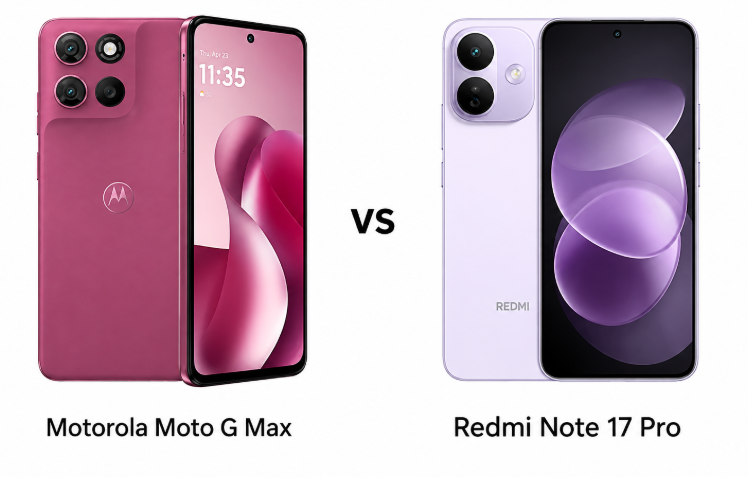
Major Features:

CategoryMotorola Moto G MaxRedmi Note 17 ProWinner
Display6.72-inch 120Hz IPS LCD, 1050 nits6.83-inch 120Hz AMOLED, Dolby Vision, 3500 nits peakRedmi — AMOLED and higher brightness
ProtectionGorilla Glass 7i, IP64, MIL-STD-810HGorilla Glass Victus 2, IP68/IP69KRedmi — stronger protection
PerformanceSnapdragon 6s Gen 4, up to 6GB RAMSnapdragon 6s Gen 4, up to 12GB RAMRedmi — more memory
StorageUp to 256GB, microSD supportUp to 512GB, no microSDRedmi — higher capacity
Main Camera50MP + 8MP ultrawide50MP OIS + 8MP ultrawideRedmi — OIS
VideoUp to 1440pUp to 4KRedmi — 4K recording
Selfie Camera32MP16MPMotorola — higher resolution
Battery7000mAh8340mAhRedmi — larger capacity
Charging30W67WRedmi — faster charging
AudioStereo speakers, 3.5mm jackStereo speakers, no 3.5mm jackMotorola — headphone jack
ConnectivityWi-Fi 5, Bluetooth 5.1, no NFCWi-Fi 6, Bluetooth 5.4, NFC, IRRedmi — broader connectivity
Price/ValuePriced around $290 / ₹23,000Priced around $500 / ₹46,000Motorola — much lower price
OverallStrong battery and practical featuresMore advanced display, camera and hardwareRedmi — stronger overall package
Disclaimer: Redmi Note 17 Pro specifications and pricing are based on rumors and leaks and may change upon official launch.

1. Design and Display

Build and Feel

The Motorola Moto G Max uses a glass front with Gorilla Glass 7i, a plastic frame, IP64 protection, and MIL-STD-810H compliance. The Redmi Note 17 Pro takes a more premium approach with Gorilla Glass Victus 2, IP68/IP69K protection, enhanced water resistance and protection against drops of up to 2.5m. The Redmi looks better equipped for demanding everyday use.

Display Quality

The Moto G Max features a 120Hz IPS LCD reaching 1050 nits in high-brightness mode. The Redmi Note 17 Pro steps up to a 120Hz AMOLED panel with HDR10+, Dolby Vision, 3840Hz PWM and up to 3500 nits peak brightness. Its higher resolution, deeper blacks and stronger HDR support should make movies, games and photos considerably more immersive.

Verdict

Redmi wins comfortably with its AMOLED panel, superior brightness, richer contrast and substantially stronger protection. Motorola remains perfectly adequate for everyday viewing, but the Redmi offers a much more premium display experience.

2. Specifications Including Battery

Performance

Both smartphones use the Snapdragon 6s Gen 4, built on a 4nm process with four Cortex-A78 performance cores and four Cortex-A55 efficiency cores. The Moto G Max comes with up to 6GB RAM and 256GB storage, while the Redmi Note 17 Pro can reach 12GB RAM and 512GB storage. The Redmi therefore has greater headroom for multitasking and demanding apps.

Battery and Charging

Motorola gives the Moto G Max a substantial 7000mAh battery with 30W wired charging. The Redmi goes further with an 8340mAh cell, 67W charging, and 22.5W reverse wired charging. That combination should provide excellent endurance while also reducing charging downtime. The larger capacity particularly suits users who spend long hours away from a charger.

Verdict

Redmi takes the win despite both phones sharing the same chipset. Its larger battery, faster charging, and significantly higher memory ceiling create a more complete hardware package for demanding users.

3. Camera

Main and Secondary Lenses

The Moto G Max pairs a 50MP main camera with an 8MP ultrawide lens. The primary camera supports PDAF and video recording up to 1440p, but lacks optical stabilization. The Redmi Note 17 Pro also features 50MP and 8MP cameras, but adds OIS, gyro-EIS and 4K video recording. Those additions should make the Redmi more dependable for handheld photography and video.

Selfie Camera

Motorola has the advantage on paper with a 32MP front camera capable of 1080p video. The Redmi uses a 16MP selfie camera, although it supports 1080p recording at both 30fps and 60fps. Higher megapixels do not automatically guarantee better selfies, but Motorola’s specification will appeal to users who frequently shoot with the front camera.

Verdict

Redmi is the stronger camera phone overall thanks to OIS, 4K recording and better stabilization. Motorola retains an interesting advantage for selfie enthusiasts with its higher-resolution front camera.

4. Pricing

The Motorola Moto G Max is priced around $290, or approximately ₹23,000, based on the supplied pricing. The Redmi Note 17 Pro Global is expected to be priced around $500, or approximately ₹46,000. Since the global launch and final pricing are still pending, that figure could change. The higher international price can also reflect import duties, local taxes, distribution expenses and regional marketing costs.

Is the Price Justified?

The Redmi costs substantially more, but it also brings a stronger display, larger battery, faster charging, better protection, OIS, 4K recording and higher memory configurations. Even so, the shared Snapdragon 6s Gen 4 makes the price gap harder to justify for performance-focused buyers. The Moto G Max offers considerably stronger value for straightforward everyday use.

Verdict

Motorola wins on value because it delivers comparable core performance at a much lower price. Redmi justifies its premium mainly through its display, camera, battery, durability, and broader feature set.

5. Conclusion

The Moto G Max focuses on practicality with its 7000mAh battery, microSD card support, 3.5mm headphone jack, 32MP selfie camera and stereo speakers with Dolby Atmos. The Redmi Note 17 Pro counters with a more feature-rich package, including an AMOLED display, Dolby Vision, IP68/IP69K protection, OIS, 4K video, NFC, an infrared port, up to 12GB RAM and an 8340mAh battery.

Verdict

Redmi is the more advanced smartphone, offering meaningful upgrades across the display, camera, charging, durability and memory. Motorola remains the smarter budget choice for users prioritizing battery life, expandable storage and everyday practicality.


FAQs

1. Which phone has the better camera?
The Redmi Note 17 Pro offers the more versatile camera setup, particularly for stabilized photography and higher-resolution video.

2. Which phone is faster for everyday use?
Both use the Snapdragon 6s Gen 4, so everyday performance should be broadly similar.

3. Which phone offers better battery life?
The Redmi Note 17 Pro has the larger battery, giving it the edge for extended usage between charges.

4. Is the Redmi Note 17 Pro worth the extra money?
It can be, especially for buyers who prioritize the display, camera system, faster charging and premium features.

5. Which phone is the better overall buy?
The Redmi Note 17 Pro is the stronger all-rounder, while the Moto G Max offers better value at its lower price.

Disclaimer: The information in this comparison is based on specifications and pricing available at the time of writing. While the Motorola Moto G Max specifications are based on available product information, details for the Redmi Note 17 Pro Global are yet to receive official confirmation and may change before launch. Pricing and availability may also vary depending on the market. 

Read More:

Comments