
Add GIZMOCHINA as Preferred Source on Google
The new Tensor G6 chipset is out, and many of you may be wondering how it compares with Qualcomm’s high-end Snapdragon chips. We recently compared it to the latest Snapdragon 8 Elite Gen 5, and the latter was significantly ahead in raw performance. So, we decided to give it another shot, but this time with the Snapdragon 8 Elite.
The Tensor G6 brings significant upgrades to on-device AI processing efficiency, computational photography, and core power management. The CPU gets a unique 7-core architecture featuring newer ARM cores, and the switch to the 3nm node delivers much better power efficiency.
In short, the Tensor G6 isn’t a yearly release with incremental upgrades, but it actually brings significant changes. But the real question here is: can it beat the Snapdragon 8 Elite? Let’s find out.
Let’s begin with the spec sheet.
| Tensor G6 | Snapdragon 8 Elite | |
|---|---|---|
| Announced | August 2026 | October 2024 |
| Process node | 3nm (TSMC) | 3nm (TSMC) |
| CPU | 1 x 4.11 GHz (C1-Ultra) 4 x 3.38 GHz (C1-Pro) 2 x 2.65 GHz (C1-Pro) | 2 x 4.32 GHz (Oryon 2nd Gen) 6 x 3.53 GHz (Oryon 2nd Gen) |
| GPU | PowerVR CXTP-48-1536 | Adreno 830 Ray tracing support |
| NPU | 5th-gen Tensor Processing Unit (TPU) | Qualcomm Hexagon NPU |
| Memory | LPDDR5X up to 4.2 GHz | LPDDR5X up to 5.3 GHz |
| Storage | UFS 4.0, UFS 4.1 | UFS 4.0, UFS 4.1 |
| Camera | up to 200MP single camera 4K portrait video support up to 8K video recording at 30fps up to 4K video recording at 120fps 120x Pro Zoom support real-time semantic segmentation | Quacomm Spectra ISP (Triple AI-ISPs, 18-bit) up to 320MP single camera up to 8K video recording at 60fps up to 4K video recording at 120fps real-time semantic segmentation (limitless) |
| Connectivity | MediaTek M90 5G modem (mmWave, sub-6 GHz) download speed: 12 Gbps (max) Wi-Fi 7 Bluetooth 6.0 | Snapdragon X80 5G modem (mmWave, sub-6 GHz) download speed: 10 Gbps (max) upload speed: 3.5 Gbps (max) Wi-Fi 7 (max speed: 5.8 Gbps) Bluetooth 6.0 |
Tensor G6 vs Snapdragon 8 Elite: Benchmark scores
Geekbench score
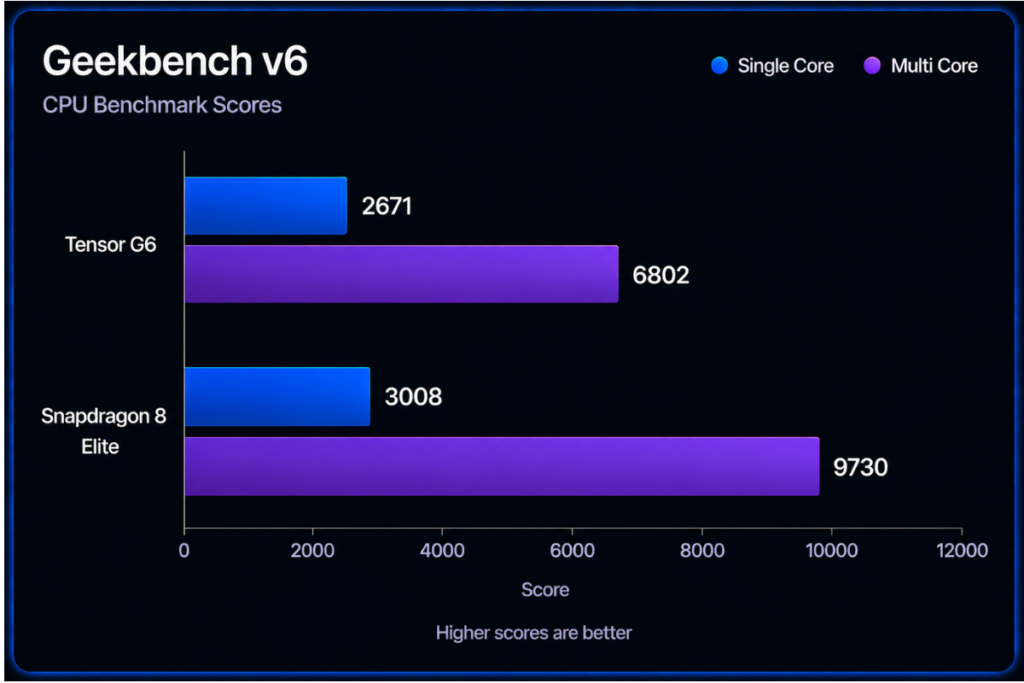
On Geekbench 6, the Pixel 11 Pro XL, powered by Tensor G6, achieves a 2,671 score in the single-core test and 6,802 in the multi-core test. In comparison, the Snapdragon 8 Elite-powered Galaxy S25 Plus gets 3008 single-core points, a 12% increase, but the gap becomes a lot wider in the multi-core performance.
The Snapdragon chip gets 9730 multi-core points, a massive 43% higher score than Tensor G6. This means devices powered by the Snapdragon 8 Elite should perform much better during heavy workloads, such as processing complex data and handling multiple apps, compared to Tensor G6-powered Pixel 11 series.
| Tensor G6 | Snapdragon 8 Elite | |
| Single core | 2671 | 3008 |
| Multi core | 6802 | 9730 |
AnTuTu score
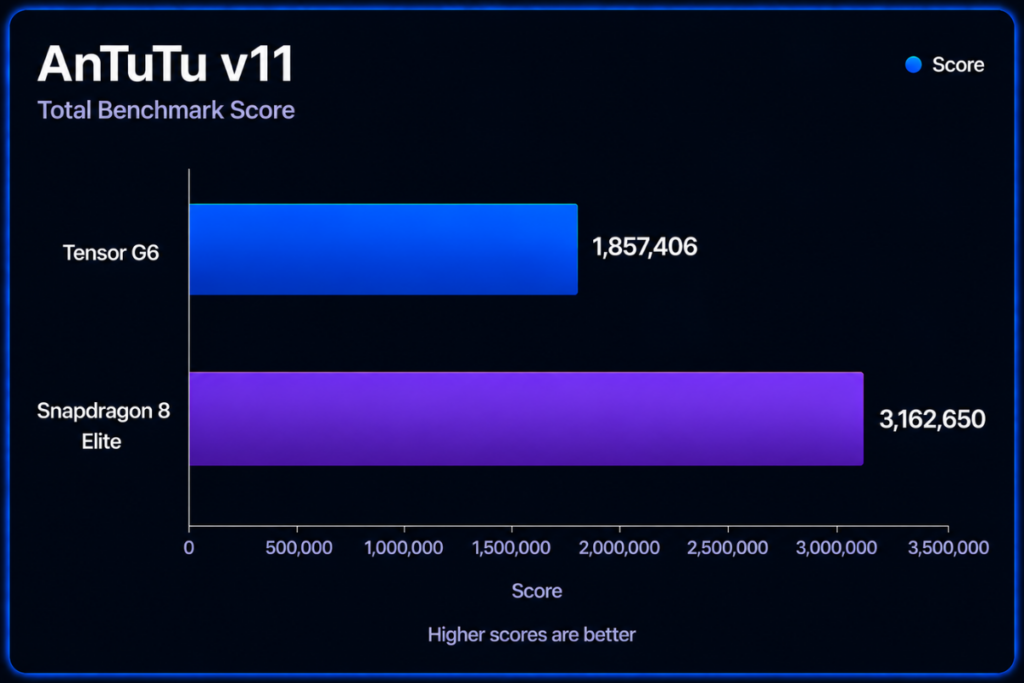
The AnTuTu benchmark (v11) also shows much stronger numbers for the Snapdragon 8 Elite compared to Tensor G6. The total score is up by over 70% (3.16 million vs 1.85 million). Its breakdown reveals a clearer, more interesting picture.
| Tensor G6 | Snapdragon 8 Elite | |
| AnTuTu score | 1,857,406 | 3,162,650 |
| CPU | 787,728 | 967,505 |
| GPU | 432,908 | 1,200,291 |
| Memory | 279,312 | 381,416 |
| UX | 357,458 | 613,438 |
The Snapdragon 8 Elite gets a 22% higher CPU score, but the GPU score is up by a massive 177% compared to the Tensor G6. That makes one thing absolutely clear: the Snapdragon 8 Elite is a far superior choice for high-end gaming than Tensor G6. The 3DMark test also proves this.
The chip also benefits from 36% higher memory performance and 71% better UX performance, as suggested by the AnTuTu benchmark.
3DMark score
Wild Life Extreme Stress Test
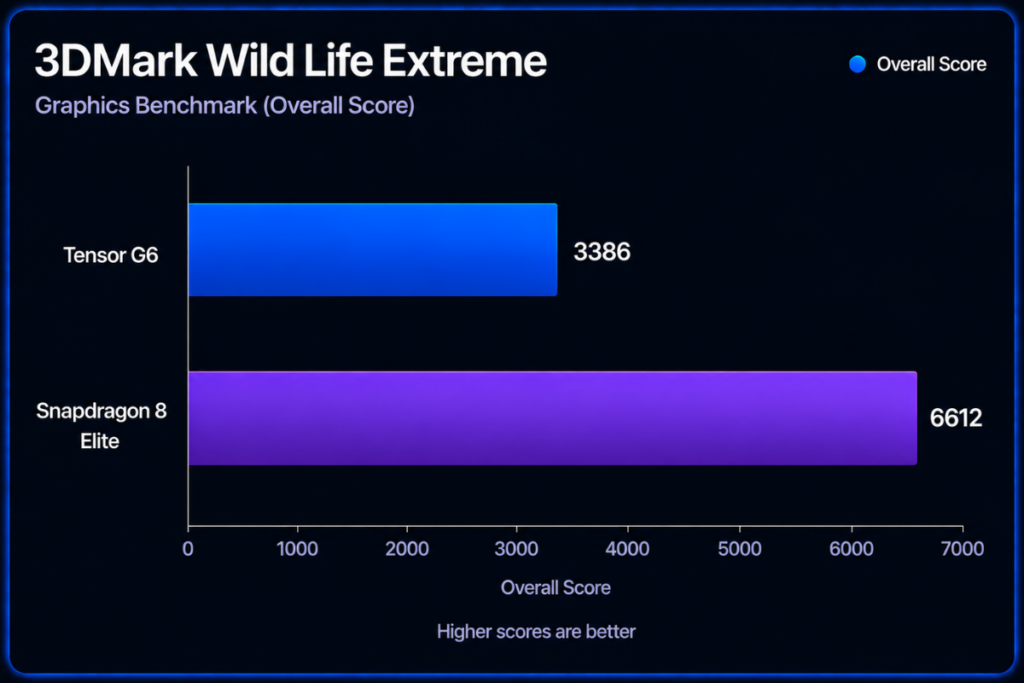
The test measures how well a device maintains its graphical performance and manages heat over an extensive period of demanding 3D sequences. This is a much more precise gaming test than AnTuTu’s GPU test.
On the benchmark, the Tensor G6 achieves an overall score of 3386, while the Snapdragon 8 Elite is far ahead with a score of 6612. That’s a 95% difference, which is massive. The Snapdragon chip also delivers a much higher average FPS (39.48 vs 20.31).
| Tensor G6 | Snapdragon 8 Elite | |
| Overall score | 3386 | 6612 |
| Average FPS | 20.31 | 39.48 |
The Snapdragon 8 Elite absolutely outclasses the Tensor G6 across multiple benchmarks. That highlights fundamentally different design philosophies between Google and Qualcomm.
The Snapdragon 8 Elite prioritizes peak performance, heavy sustained loads, and long gaming sessions at a high frame rate. On the other hand, Tensor chips, including the Tensor G4, use a conservative CPU/GPU configuration to keep thermal output and power draw low, and allocate silicon area and power budgets to TPU and ISP for on-device AI workloads and real-time computational photography.
Tensor G6 vs Snapdragon 8 Elite: Differences that matter
One of the major changes to Tensor G6 is the switch to a 7-core CPU. All previous tensor chips have an 8-core CPU. While this may sound like a CPU downgrade, it actually isn’t. The latest chip uses ARM’s newer C1-Ultra and C1-Pro series, which deliver better performance and power efficiency. Plus, increased clock speeds help the Tensor G6 achieve 20% faster web browsing and 15% faster app launches than the Tensor G5.
Despite the increased performance, the Snapdragon 8 Elite still remains a superior choice in CPU performance. It has an 8-core CPU featuring custom Oryon cores running at higher clock speeds.
Google hasn’t commented on why the Tensor G6 has a 7-core CPU. However, industry experts believe it was done to accommodate the massive fifth-generation TPU, which powers the upgraded Gemini Nano on-device AI models on the Pixel 11 series. The Snapdragon 8 Elite relies on a Hexagon NPU, which enables multimodal Gen AI capabilities.
The Tensor G6 features a PowerVR CXTP-48-1536 GPU, which isn’t as powerful as the Adreno 840 on the Snapdragon 8 Elite. The Adreno GPU also utilizes various software enhancements and gaming optimizations to deliver a far superior gaming experience.
Both chips come with a modern, future-proof connectivity stack to offer reliable connectivity, even in crowded areas. In terms of peak 5G download speed, the Tensor G6 is slightly ahead. It offers up to 12 Gbps of peak speed (vs. 10 Gbps on the Snapdragon 8 Elite).
Tensor G6 vs Snapdragon 8 Elite: Which is better for you?
The choice is pretty straightforward.
- Choose Snapdragon 8 Elite: if you prioritize raw power and top-tier gaming performance at higher frame rates.
- Choose Tensor G6: if you prioritize personal AI agents, and Google’s AI-powered features like Magic Eraser, real-time Live Translate, and Google’s computational photography magic.
Best Tensor G6 phones:
Best Snapdragon 8 Elite phones:



Comments