
Add GIZMOCHINA as Preferred Source on Google
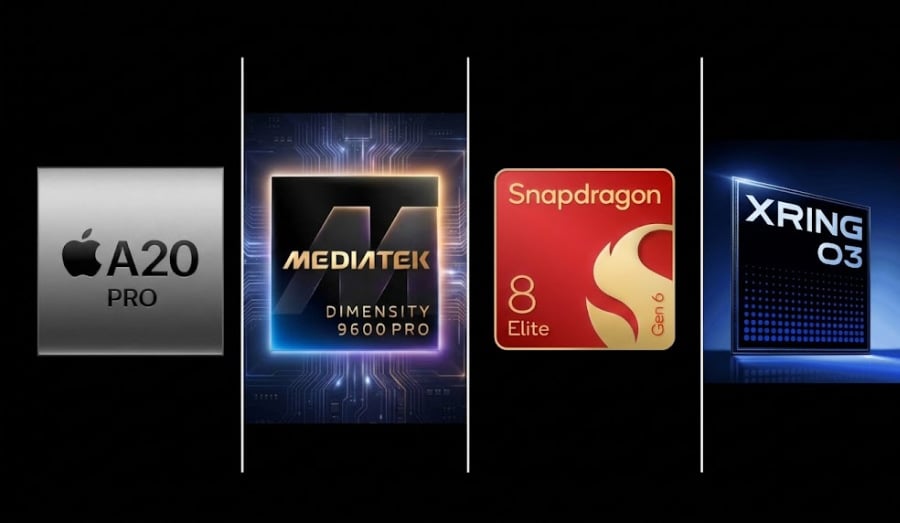
Digital Chat Station has shared two charts comparing this year’s flagship mobile chips, bringing together the latest silicon from Qualcomm, MediaTek, Apple and Xiaomi.
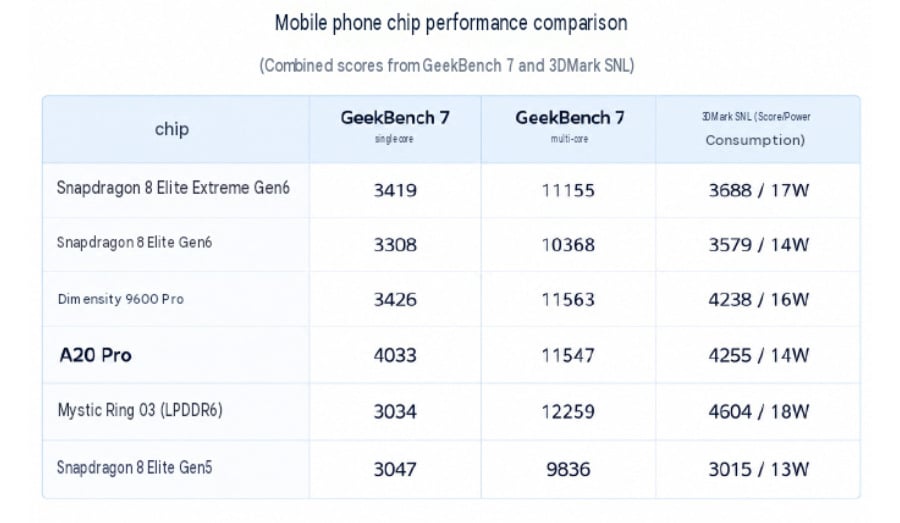
The comparison includes the Snapdragon 8 Elite Extreme Gen 6, Snapdragon 8 Elite Gen 6, Dimensity 9600 Pro, Apple A20 Pro and Xiaomi XRING O3. Last year’s Snapdragon 8 Elite Gen 5 is also included as a reference point. The first chart covers Geekbench 7 and 3DMark Steel Nomad Light (SNL), while the second looks at performance in three games.
CPU: A20 Pro leads single-core, XRING O3 tops multi-core
The Apple A20 Pro takes the lead in Geekbench 7 single-core testing with a score of 4,033. That’s about 18% higher than the Dimensity 9600 Pro, which comes next with 3,426.
The Snapdragon 8 Elite Extreme Gen 6 is close behind at 3,419, followed by the Snapdragon 8 Elite Gen 6 at 3,308. The Snapdragon 8 Elite Gen 5 scores 3,047, while the Xiaomi XRING O3 comes in at 3,034.
The multi-core results look different. Xiaomi’s XRING O3 takes the top spot with 12,259 points, followed by the Dimensity 9600 Pro at 11,563 and the A20 Pro at 11,547. The Snapdragon 8 Elite Extreme Gen 6 scores 11,155, while the Snapdragon 8 Elite Gen 6 and Snapdragon 8 Elite Gen 5 score 10,368 and 9,836, respectively.
The XRING O3 uses a 10-core CPU and is built on a 3nm process, while the new Qualcomm, MediaTek, and Apple chips are all based on 2nm manufacturing. The chart also notes that the XRING O3 was tested with LPDDR6 memory. Our earlier comparison between the XRING O3 and Snapdragon 8 Elite Gen 5 has more details about Xiaomi’s chip.
Compared with the Snapdragon 8 Elite Gen 5, the Snapdragon 8 Elite Extreme Gen 6 is about 12% faster in single-core and 13% faster in multi-core testing. That is close to the 13% CPU improvement Qualcomm quoted in its Snapdragon 8 Elite Extreme Gen 6 launch details.
The standard Snapdragon 8 Elite Gen 6 scores about 3% lower than the Extreme version in single-core and around 7% lower in multi-core testing.
Graphics: XRING O3 has the highest score, while A20 Pro uses the least power
The XRING O3 also records the highest score in 3DMark Steel Nomad Light, reaching 4,604 points. It draws 18W during the test, however, which is the highest power consumption among the chips in the chart.
The A20 Pro and Dimensity 9600 Pro are close behind, scoring 4,255 and 4,238 points while using 14W and 16W, respectively. The Snapdragon 8 Elite Extreme Gen 6 scores 3,688 at 17W, while the Snapdragon 8 Elite Gen 6 reaches 3,579 at 14W. The older Snapdragon 8 Elite Gen 5 scores 3,015 at 13W.
Looking at performance per watt changes the order. The A20 Pro delivers roughly 304 points per watt, followed by the Dimensity 9600 Pro at around 265 points per watt. The XRING O3 and Snapdragon 8 Elite Gen 6 are both near 256 points per watt.
The Snapdragon 8 Elite Extreme Gen 6 works out to about 217 points per watt, which is lower than the Snapdragon 8 Elite Gen 5 at around 232 points per watt. Based on the raw SNL scores, the three Snapdragon chips sit behind the A20 Pro, Dimensity 9600 Pro and XRING O3.
Gaming: frame rates are close, but power and temperatures differ
The second chart compares four chips in Honor of Kings, Genshin Impact and Wuthering Waves. It includes the Snapdragon 8 Elite Extreme Gen 6, Snapdragon 8 Elite Gen 6, Dimensity 9600 Pro, and Snapdragon 8 Elite Gen 5. The A20 Pro and XRING O3 are not included in the gaming tests.
In Honor of Kings, all four chips stay around 120fps, with results ranging from 119.7 to 120.1fps. Power consumption varies more, with the Snapdragon 8 Elite Gen 6 using 2.7W, followed by the Snapdragon 8 Elite Extreme Gen 6 at 3.0W, Dimensity 9600 Pro at 3.2W, and Snapdragon 8 Elite Gen 5 at 3.4W. The chart does not include temperature figures for this game.
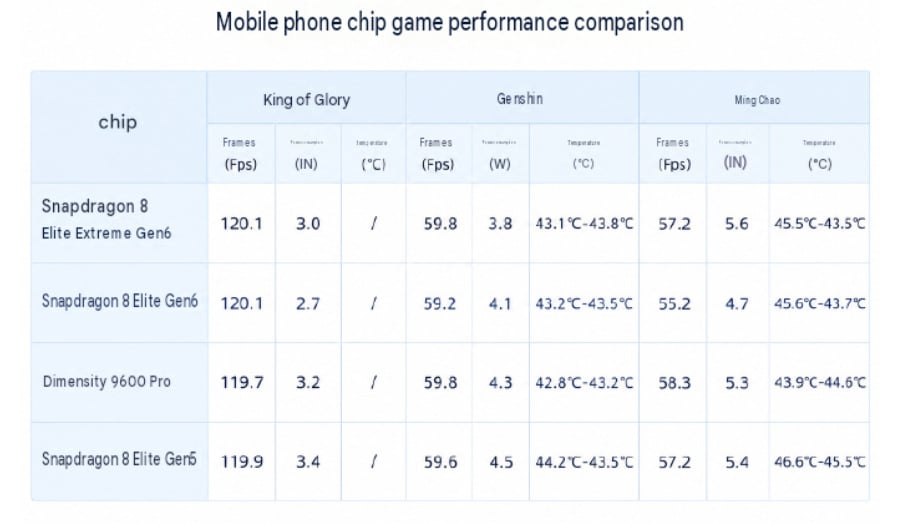
Genshin Impact produces similarly close frame rates, with all four chips landing between 59.2 and 59.8fps. The Snapdragon 8 Elite Extreme Gen 6 uses the least power at 3.8W. The Dimensity 9600 Pro records the lowest temperature, ranging from 42.8°C to 43.2°C, while the Snapdragon 8 Elite Gen 5 is the warmest and uses 4.5W.
Wuthering Waves shows a larger gap between the chips. The Dimensity 9600 Pro records the highest frame rate at 58.3fps while using 5.3W. The Snapdragon 8 Elite Extreme Gen 6 reaches 57.2fps at 5.6W, while the Snapdragon 8 Elite Gen 5 delivers the same 57.2fps at 5.4W.
The Snapdragon 8 Elite Gen 6 records 55.2fps at 4.7W, the lowest power consumption but also the lowest frame rate in this test. The Snapdragon 8 Elite Gen 5 reaches the highest temperature in Wuthering Waves, with the chart listing a range of 46.6°C to 45.5°C.
What to keep in mind
Digital Chat Station hasn’t said which phones ran these tests. Cooling design, power limits, and software tuning all change results from one phone to the next, so treat these numbers as a rough guide and wait for reviews of shipping phones before you decide. Several phones with the Snapdragon 8 Elite Extreme Gen 6 are already confirmed, and you can check the full list of upcoming phones with the chip to see what’s coming.
For more daily updates, please visit our News Section.
Stay ahead in tech! Join our Telegram community and sign up for our daily newsletter of top stories!



Comments