Advertisement

Add GIZMOCHINA as Preferred Source on Google

Vivo X500 Pro Max and Samsung Galaxy S26 Ultra take different approaches to the premium smartphone formula. Vivo pushes a huge battery, fast charging, a high-resolution display, and an aggressive Zeiss camera setup, while Samsung focuses on long-term software support, S Pen functionality, a versatile quad-camera system, and productivity features. This comparison looks at where each flagship has the stronger overall package.
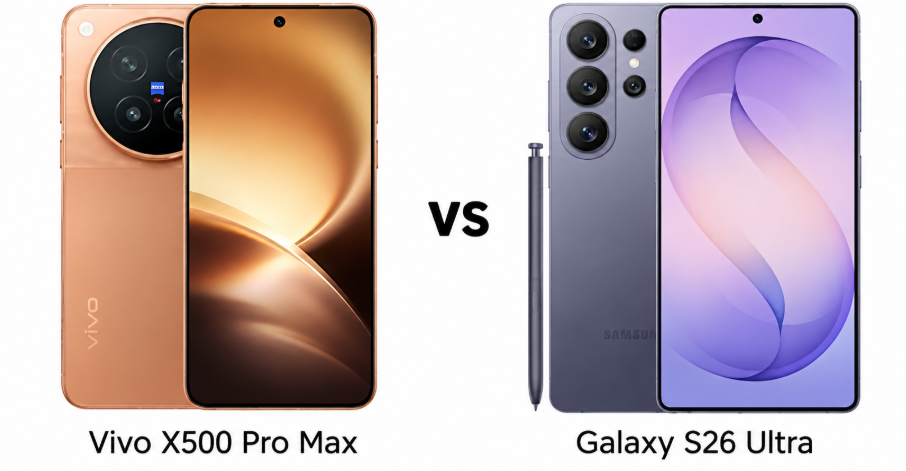
Major Features:

CategoryVivo X500 Pro MaxSamsung Galaxy S26 UltraWinner
Design & BuildGlass or glass-fiber reinforced plastic back, aluminum frame, IP68/IP69Gorilla Armor 2 front, Gorilla Glass Victus 2 back, Armor Aluminum 2, IP68, S PenSamsung — More premium materials and S Pen support
Display6.85-inch LTPO AMOLED, 144Hz, HDR10+, Dolby Vision, 4,400 nits peak6.9-inch Dynamic AMOLED 2X, 120Hz, HDR10+, 2,600 nits peak, anti-reflective coating, Privacy DisplayVivo — Higher refresh rate, Dolby Vision and stronger peak brightness
PerformanceDimensity 9600 Pro, up to 16GB RAM, UFS 4.1Snapdragon 8 Elite Gen 5, up to 16GB RAM, UFS 4.XSamsung — Stronger flagship performance and mature optimization
SoftwareAndroid 17, OriginOS 7, up to 5 major OS updatesAndroid 16, One UI 9, up to 7 major OS updatesSamsung — Longer software support
Main Camera50MP main, 200MP 3.5x periscope, 50MP ultrawide200MP main, 10MP 3x telephoto, 50MP 5x periscope, 50MP ultrawideSamsung — More versatile quad-camera setup
Selfie Camera50MP autofocus, 4K video12MP autofocus, 4K videoVivo — Higher-resolution autofocus selfie camera
Battery8,000mAh, 90W wired, 40W wireless5,000mAh, 60W wired, 25W wirelessVivo — Much larger battery and faster charging
Connectivity & ExtrasWi-Fi 7, NFC, IR blaster, USB 3.2, satellite support on select variantWi-Fi 7, NFC, UWB, Samsung DeX, Wireless DeX, USB 3.2 DisplayPortSamsung — Broader productivity and connectivity features
Price / ValuePriced around $1,000 / ₹100,000Priced around $1,300 / ₹140,000Vivo — More aggressive hardware at a lower price
Disclaimer: Specs are based on available data. Actual performance may vary. Verify details from official sources before buying.

1. Design and Display

Build and Feel

The Vivo X500 Pro Max combines a glass or glass-fiber reinforced plastic back with an aluminum frame, IP68/IP69 protection and an ultrasonic fingerprint sensor. It also adds stereo speakers and an infrared port. Samsung uses Armor Aluminum 2, Gorilla Armor 2 protection, Gorilla Glass Victus 2 and IP68 certification, while retaining the S Pen. Samsung’s construction feels more productivity-focused, whereas Vivo’s IP69 rating adds useful protection against high-pressure water jets.

Display Quality

Vivo gets a 6.85-inch LTPO AMOLED panel with 144Hz refresh rate, Dolby Vision, HDR10+ and up to 4,400 nits peak brightness. Samsung counters with a 6.9-inch Dynamic AMOLED 2X panel, 120Hz refresh rate, HDR10+, 2,600-nit peak brightness and an anti-reflective coating. Vivo’s higher refresh rate and Dolby Vision are appealing for media, but Samsung’s anti-reflective treatment and Privacy Display make the Galaxy more versatile.

Verdict

Samsung offers the more complete design package thanks to S Pen support, Armor Aluminum 2 and anti-reflective display technology, while Vivo stands out with IP69 protection and a faster 144Hz panel.

2. Specifications Including Battery

Performance

The Vivo X500 Pro Max uses the 2nm Dimensity 9600 Pro with up to 16GB RAM and UFS 4.1 storage, while the Galaxy S26 Ultra uses the 3nm Snapdragon 8 Elite Gen 5 with up to 16GB RAM and UFS 4.X storage. Both are built for demanding workloads, but Samsung adds DeX and Wireless DeX for desktop-style productivity. Vivo’s newer 2nm platform and larger memory options make it especially interesting for performance-focused users.

Battery and Charging

Vivo has a major hardware advantage with its 8,000mAh silicon-carbon battery, 90W wired charging and 40W wireless charging. Samsung uses a 5,000mAh battery with 60W wired charging and 25W Qi2.2 wireless charging. The X500 Pro Max is clearly designed around endurance and rapid top-ups, while Samsung prioritizes a more established ecosystem. For heavy daily use, Vivo’s battery capacity is considerably more compelling.

Verdict

Vivo wins the hardware battle with its 8,000mAh battery, 90W charging, and 2nm chipset, while Samsung remains stronger for desktop productivity through DeX and its mature software ecosystem.

3. Camera

Main and Secondary Lenses

Vivo pairs a 50MP main camera with a large 200MP periscope telephoto offering 3.5x optical zoom and a 50MP ultrawide with autofocus. Zeiss optics, T* coating, laser autofocus and advanced Log video features further strengthen its imaging credentials. Samsung uses a 200MP main camera alongside 3x and 5x telephoto cameras plus a 50MP ultrawide. Samsung therefore offers greater native zoom flexibility, while Vivo’s 200MP periscope looks particularly ambitious.

Selfie Camera

Vivo equips the X500 Pro Max with a 50MP autofocus selfie camera capable of 4K video recording. Samsung uses a 12MP autofocus front camera with 4K recording and HDR10+ support. On paper, Vivo has the stronger selfie hardware and should appeal more to users who frequently shoot detailed portraits or video from the front camera. Samsung’s lower-resolution sensor remains sufficient for everyday calls and social content.

Verdict

Vivo gets the edge for selfie hardware and specialized imaging features, while Samsung offers the more versatile rear-camera system through its dedicated 3x and 5x telephoto cameras.

4. Pricing

The Vivo X500 Pro Max is priced around $1,000 / ₹100,000, placing it below the Samsung Galaxy S26 Ultra at approximately $1,300 / ₹140,000. That creates a meaningful price gap between two phones aimed at the same premium flagship segment. Vivo therefore brings substantially more battery capacity and faster charging without reaching Samsung’s pricing level.

Is the price justified? 

The Galaxy S26 Ultra’s premium is easier to justify for users who value seven major OS updates, S Pen functionality, DeX, UWB and Samsung’s broader productivity ecosystem. Vivo counters with 8,000mAh battery capacity, 90W charging, a 144Hz display and an ambitious camera setup. For hardware-focused buyers, the X500 Pro Max appears to deliver more flagship specifications for the money.

Verdict

Vivo offers stronger value based on the supplied pricing, combining a huge battery, fast charging, high-end cameras and a 144Hz display at a notably lower price.

5. Conclusion

The Vivo X500 Pro Max differentiates itself with an 8,000mAh silicon-carbon battery, 90W wired charging, 144Hz LTPO AMOLED display, Zeiss camera technology and a 200MP 3.5x periscope camera. Samsung answers with the S Pen, Privacy Display, DeX, Wireless DeX, UWB and seven major Android updates. These features reveal two very different flagship philosophies: Vivo emphasizes hardware and endurance, while Samsung emphasizes productivity, software longevity and ecosystem integration.

Verdict

Vivo X500 Pro Max is the overall winner for its combination of battery endurance, charging speed, display hardware, camera capabilities, and lower price. Galaxy S26 Ultra remains the better fit for S Pen productivity and long-term software support.


FAQs

1. Which phone has the better camera zoom?
The Galaxy S26 Ultra offers more versatile zoom with dedicated 3x and 5x telephoto cameras.

2. Which phone is faster for gaming?
Both deliver flagship performance, but the Dimensity 9600 Pro gives the Vivo X500 Pro Max a strong performance-focused profile.

3. Which phone charges faster?
The Vivo X500 Pro Max supports 90W wired charging, compared with 60W on the Galaxy S26 Ultra.

4. Which phone offers better value for money?
The Vivo X500 Pro Max offers more hardware for its lower price, particularly in battery capacity and charging speed.

5. Which phone is better for long-term software support?
The Galaxy S26 Ultra supports up to seven major OS updates, exceeding Vivo’s five-update commitment.

Disclaimer: Prices, specifications, and availability may vary by region and retailer. Recommendations in this article are based on editorial opinion, feature-based value, and market positioning at the time of writing. Readers are advised to do their own research before making a purchase.

Read More:

Comments