
Add GIZMOCHINA on Google:
The flagship smartphone battle is becoming increasingly competitive, with Vivo and Xiaomi taking different approaches to premium hardware. The Vivo X500 Pro Max promises an impressive display, a massive battery and versatile Zeiss cameras, while the Xiaomi 17 Ultra focuses on advanced imaging, powerful processing and Leica-tuned photography. Both target demanding users, but their differences in camera technology, battery capacity, display quality and pricing make this comparison particularly interesting.
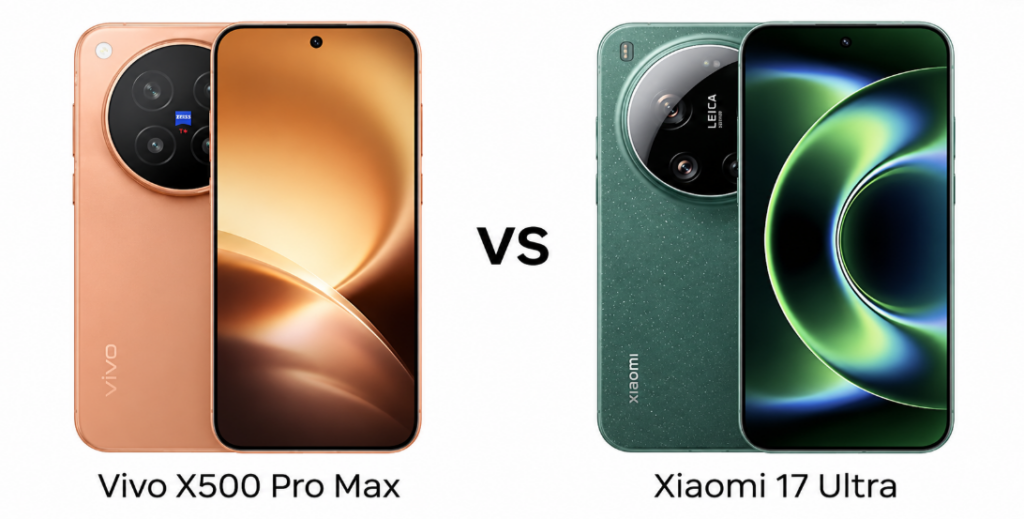
1. Major Features:
| Category | Vivo X500 Pro Max | Xiaomi 17 Ultra | Winner |
|---|---|---|---|
| Build | Armor Glass, aluminium frame, glass or glass-fiber back | Glass front, aluminium frame, glass-fiber or silicone polymer back | Xiaomi – Aerospace-grade glass fiber construction |
| Water Resistance | IP68/IP69, up to 1.5m for 30 minutes | IP68/IP69, up to 6m for 30 minutes | Xiaomi – Better water resistance |
| Display | 6.85-inch LTPO AMOLED, 144Hz | 6.9-inch LTPO AMOLED, 120Hz | Vivo – Faster refresh rate |
| Resolution | 1440 x 3168 pixels | 1200 x 2608 pixels | Vivo – Higher resolution and pixel density |
| Peak Brightness | 4,400 nits | 3,500 nits | Vivo – Higher advertised peak brightness |
| Protection | Armor Glass | Xiaomi Shield Glass 3.0 | Vivo – Premium Armor Glass protection |
| Operating System | Android 17, OriginOS 7 | Android 16, HyperOS 3 | Vivo – Newer Android version |
| Software Updates | Up to 5 major OS updates | Not specified | Vivo – Explicit five-update commitment |
| Processor | Dimensity 9600 Pro (2nm) | Snapdragon 8 Elite Gen 5 (3nm) | Tie – Both are flagship-grade chipsets |
| GPU | Mali-G2-Ultra-NX | Adreno 840 | Xiaomi – Strong flagship GPU platform |
| RAM | Up to 16GB | Up to 16GB | Tie – Same maximum RAM |
| Storage | Up to 1TB, UFS 4.1 | Up to 1TB, UFS 4.1 | Tie – Same storage technology and capacity |
| Main Camera | 50MP, 1/1.28-inch, OIS | 50MP, 1-inch-type, OIS | Xiaomi – Larger main camera sensor |
| Telephoto Camera | 200MP periscope, 3.5x optical zoom | 200MP periscope, 3.2–4.3x continuous optical zoom | Xiaomi – Continuous optical zoom |
| Ultrawide Camera | 50MP, 119-degree FOV, AF | 50MP, 115-degree FOV, AF | Vivo – Wider field of view |
| Camera Features | Zeiss optics, T* coating, laser AF | Leica lenses, zoom ring, TOF 3D sensor | Xiaomi – More specialised imaging hardware |
| Video Recording | Up to 8K@30fps, 4K@240fps | Up to 8K@30fps, 4K@120fps | Vivo – Higher maximum 4K frame rate |
| Selfie Camera | 50MP, AF | 50MP, AF | Tie – Similar front-camera hardware |
| Selfie Video | 4K@60fps | 4K@60fps | Tie – Same maximum resolution and frame rate |
| Battery | 7,800mAh (Global) | 6,000mAh | Vivo – Significantly larger battery |
| Wired Charging | 90W | 90W | Tie – Same charging wattage |
| Wireless Charging | 40W | 50W | Xiaomi – Faster wireless charging |
| Reverse Charging | Reverse wireless and wired | 10W wireless, 22.5W wired | Vivo – More flexible reverse charging |
| Connectivity | Wi-Fi 7, Bluetooth 5.4/6.0 | Wi-Fi 7, Bluetooth 6.0 | Tie – Comparable connectivity |
| USB | USB-C 3.2 | USB-C 3.2 Gen 2, DisplayPort | Xiaomi – DisplayPort support |
| Price / Value | Priced around $1,000 / ₹1,00,000 | Priced around $1,300 / ₹1,30,000 | Vivo – Lower price and stronger overall value |
| Overall Winner | Better display, battery and value | Better main camera and optical zoom | Vivo – More balanced flagship package |
2. Design and Display
Build and Feel
The Vivo X500 Pro Max features a premium construction with Armor Glass protection, an aluminum frame and a choice of glass or glass-fiber reinforced plastic on the rear. Its IP68/IP69 certification provides protection against dust and water. The Xiaomi 17 Ultra also delivers a sophisticated design, combining an aluminum frame with a glass front and either a glass-fiber reinforced plastic or silicone polymer back. Its aerospace-grade glass fiber adds another premium touch, while its IP68/IP69 rating supports immersion up to 6 metres. Both phones offer flagship-grade durability, although Xiaomi provides better water resistance on paper. Vivo’s Armor Glass construction, however, gives it a distinctive appeal.
Display Quality
The Vivo X500 Pro Max features a 6.85-inch LTPO AMOLED display with a 144Hz refresh rate, 1440p resolution, Dolby Vision and HDR10+ support. Its advertised 4,400-nit peak brightness also promises excellent outdoor visibility. The Xiaomi 17 Ultra counters with a larger 6.9-inch LTPO AMOLED panel, 68 billion colours, Dolby Vision and HDR10+, alongside 3,500-nit peak brightness. However, its 120Hz refresh rate and 1200p resolution put it behind Vivo in sharpness and smoothness.
Verdict
The Vivo X500 Pro Max wins the display category with its sharper resolution, faster refresh rate and higher advertised peak brightness. Xiaomi remains an excellent alternative.
3. Specifications Including Battery
Performance
The Vivo X500 Pro Max runs on the 2nm MediaTek Dimensity 9600 Pro, featuring an octa-core CPU and Mali-G2-Ultra-NX GPU. It offers up to 16GB RAM and 1TB storage with UFS 4.1 technology. The Xiaomi 17 Ultra uses Qualcomm’s Snapdragon 8 Elite Gen 5, paired with the Adreno 840 GPU, up to 16GB RAM and 1TB UFS 4.1 storage. Both processors belong to the flagship performance category, promising strong gaming, multitasking and AI capabilities. Xiaomi’s Snapdragon platform offers an established high-performance ecosystem, while Vivo’s newer 2nm chipset could deliver efficiency advantages. Software support also differs, with Vivo promising five major Android updates.
Battery and Charging
Battery capacity is another major difference. The Vivo X500 Pro Max packs a 7,800mAh battery in its global version, supported by 90W wired and 40W wireless charging. It also supports reverse wireless and wired charging. The Xiaomi 17 Ultra features a smaller 6,000mAh battery with 90W wired and 50W wireless charging, alongside reverse wired and wireless charging. Vivo clearly has the advantage for users prioritising endurance, while Xiaomi offers faster wireless charging. The larger battery makes Vivo particularly appealing for heavy users who spend extended periods gaming, streaming or travelling without convenient access to a charger.
Verdict
The Vivo X500 Pro Max takes the lead with its larger battery, newer manufacturing process and longer stated software support. Xiaomi offers stronger wireless charging flexibility.
4. Camera
Main and Secondary Lenses
The Vivo X500 Pro Max features a 50MP main camera with OIS, a 200MP periscope telephoto camera offering 3.5x optical zoom and a 50MP ultrawide lens. Zeiss optics, T* lens coating, laser autofocus and advanced video recording capabilities strengthen its photography package. The Xiaomi 17 Ultra also features a 50MP main camera, but its larger 1-inch-type sensor gives it a notable hardware advantage. Its 200MP periscope camera supports continuous optical zoom between 3.2x and 4.3x, while the 50MP ultrawide camera includes autofocus. Leica lenses, a dedicated zoom ring and a TOF 3D sensor further distinguish its camera system. Xiaomi looks particularly promising for photography enthusiasts seeking greater optical flexibility and sensor versatility.
Selfie Camera
Both smartphones feature 50MP autofocus selfie cameras with 4K video recording, making them well-equipped for video calls, social media content and high-resolution portraits. The Vivo X500 Pro Max offers an f/2.0 aperture and 20mm focal length, while the Xiaomi 17 Ultra uses an f/2.2 aperture and 21mm focal length. Vivo supports HDR, whereas Xiaomi additionally includes panorama and gyro-EIS for improved video stability. Neither phone makes a dramatic departure from the other in front-camera hardware. However, Xiaomi’s additional stabilisation features make it slightly more versatile for users who frequently record themselves. Vivo’s wider aperture could also prove useful in challenging lighting conditions.
Verdict
The Xiaomi 17 Ultra gets the camera advantage with its larger main sensor, continuous optical zoom and Leica imaging system. Vivo remains a strong alternative for versatile photography.
5. Pricing
The Vivo X500 Pro Max is priced around $1,000 (₹1,00,000), positioning it as a slightly more affordable flagship. The Xiaomi 17 Ultra is priced around $1,300 (₹1,30,000), placing it considerably higher in the premium smartphone segment. The difference is approximately $300 (₹30,000), which is significant for buyers comparing two high-end devices.
Vivo offers an attractive combination of display technology, battery capacity and camera hardware at a lower asking price. Xiaomi, meanwhile, commands a premium for its photography-focused hardware, larger main camera sensor and Leica collaboration. Both target enthusiasts, but their pricing creates distinctly different value propositions.
Verdict
The Vivo X500 Pro Max wins the pricing category with its lower asking price, larger battery, and excellent display. Xiaomi justifies its premium mainly through photography.
Disclaimer:
Prices are approximate and may vary based on country, region, launch timing, and applicable taxes. Always check whether the listed price is for a China unit or a global/international variant when purchasing.
6. Conclusion
The Vivo X500 Pro Max stands out with its 144Hz 1440p display, 7,800mAh global battery, 200MP periscope camera and 90W charging. Its 2nm Dimensity chipset and five major Android updates also strengthen its long-term appeal. The Xiaomi 17 Ultra counters with a 1-inch-type main camera sensor, continuous optical zoom, Leica lenses, a dedicated zoom ring and 50W wireless charging. Its aerospace-grade glass-fiber construction and enhanced water resistance add further distinction.
These unique features make the two phones appealing for different reasons. Xiaomi is clearly positioned as the more photography-centric flagship, while Vivo focuses on delivering a more balanced premium smartphone experience with fewer obvious compromises for everyday users.
Verdict
The Vivo X500 Pro Max is the overall winner for its superior display, significantly larger battery, competitive camera hardware, and lower price. The Xiaomi 17 Ultra remains the better choice for dedicated mobile photographers who prioritise its larger main sensor and Leica imaging capabilities. However, Vivo offers the more complete package for most flagship buyers, combining performance, endurance, display quality and value without compromising significantly on camera versatility.
Disclaimer: Prices, specifications, and availability may vary by region and retailer. Recommendations in this article are based on editorial opinion, feature-based value, and market positioning at the time of writing. Readers are advised to do their own research before making a purchase.
Read More:
- Redmi K80 Pro vs OnePlus Ace 7 Pro: Is the Newer Flagship Worth the Extra Money?
- RedMagic 12 Pro+ vs OnePlus 16: Dedicated Gaming Fan vs 200MP Camera
- OnePlus 16 vs OPPO Find X10: Snapdragon Power or 200MP Camera?

Comments