
Add GIZMOCHINA on Google:
As an Amazon Associate, Gizmochina earns from qualifying purchases. Links on this page may earn us a commission at no extra cost to you.
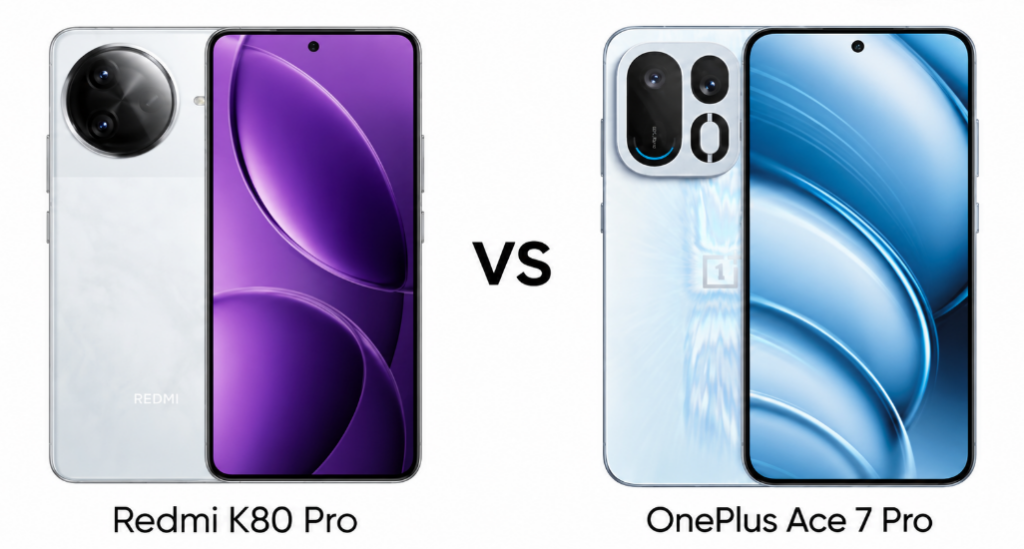
Redmi K80 Pro and OnePlus Ace 7 Pro present an interesting comparison between an older flagship and a much newer performance-focused smartphone. Launched in November 2024, the Redmi is now almost two years old, while the OnePlus brings 2026 flagship hardware. With a considerable difference in their prices, the question is whether the newer OnePlus offers enough improvements to justify an upgrade.
1. Major Features:
| Category | Redmi K80 Pro | OnePlus Ace 7 Pro | Winner |
|---|---|---|---|
| Launch Date | November 2024 | October 2026 | OnePlus – Newer generation |
| Build | Glass front and back, aluminium frame | Crystal Shield Glass, aluminium frame | OnePlus – Stronger protection |
| Water Resistance | IP68 | IP68/IP69K | OnePlus – Better water and dust protection |
| Display Type | OLED | LTPO AMOLED | OnePlus – Adaptive refresh technology |
| Display Size | 6.67 inches | 6.78 inches | OnePlus – Larger display |
| Resolution | 1440 × 3200 pixels | 1272 × 2772 pixels | Redmi – Sharper resolution |
| Refresh Rate | 120Hz | 185Hz | OnePlus – Smoother refresh rate |
| Peak Brightness | 3,200 nits | 2,000 nits | Redmi – Higher advertised brightness |
| Display Protection | Longjing Glass 2 | Crystal Shield Glass | OnePlus – Newer protection technology |
| Processor | Snapdragon 8 Elite | Snapdragon 8 Elite Gen 5 | OnePlus – Newer and more powerful chipset |
| GPU | Adreno 830 | Adreno 840 | OnePlus – Newer graphics hardware |
| Cooling | Conventional cooling | Built-in bi-directional cooling fan | OnePlus – Active cooling |
| RAM | 12GB / 16GB | 12GB / 16GB | Tie – Same maximum RAM |
| Storage | 256GB / 512GB / 1TB | 256GB / 512GB / 1TB | OnePlus – UFS 4.1 storage |
| Main Camera | 50MP with OIS | 200MP with OIS | OnePlus – Higher resolution |
| Telephoto Camera | 50MP, 2.5x optical zoom | 50MP periscope, 3.5x optical zoom | OnePlus – Longer optical zoom |
| Ultrawide Camera | 32MP | Not available | Redmi – Dedicated ultrawide lens |
| Selfie Camera | 20MP | 16MP | Redmi – Higher resolution and HDR |
| Rear Video | 8K@24fps, 4K@60fps | 8K@30fps, 4K@120fps | OnePlus – Higher video frame rates |
| Front Video | 1080p@60fps | 1080p@30fps | Redmi – Higher frame rate |
| Speakers | Stereo speakers | Stereo speakers | Tie – Stereo audio |
| Battery | 6,000mAh | 9,000mAh | OnePlus – Larger capacity |
| Wired Charging | 120W | 100W | Redmi – Faster charging |
| Wireless Charging | 50W | Not available | Redmi – Wireless charging support |
| Special Charging | Standard fast charging | Bypass charging | OnePlus – Gaming-friendly power delivery |
| Operating System | Android 15, HyperOS 2 | Android 17, ColorOS 17 | OnePlus – Newer software version |
| Connectivity | Wi-Fi 7, Bluetooth 6.0 | Wi-Fi 7, Bluetooth 5.4 | Redmi – Newer Bluetooth standard |
| Fingerprint Sensor | Ultrasonic under-display | Ultrasonic under-display | Tie – Same fingerprint technology |
| Price | Around $500 (₹45,000) | Around $770 (₹69,000) | Redmi – More affordable |
| Overall | Better display, camera versatility, and value | Better performance, gaming, and battery | OnePlus – Stronger overall hardware |
2. Design and Display
Build and Feel
The Redmi K80 Pro features a premium glass-and-metal construction with IP68 dust and water resistance. Its understated design, ultrasonic fingerprint sensor, and stereo speakers deliver a conventional flagship experience. Despite being an older model, its build quality remains competitive. The OnePlus Ace 7 Pro takes a more specialised approach with Crystal Shield Glass, an aluminium frame, and IP68/IP69K protection.
OnePlus also incorporates a built-in bi-directional cooling fan, giving the phone a distinctive gaming-oriented identity. Both devices offer premium construction, but the OnePlus provides better water-resistance certification and additional cooling hardware. Redmi, meanwhile, feels more like a traditional all-round flagship. The OnePlus is more appealing to gaming enthusiasts, although its specialised design may not matter much to everyday users.
Display Quality
The Redmi K80 Pro features a 6.67-inch OLED display with 2K resolution, a 120Hz refresh rate, Dolby Vision, and HDR10+ support. Its advertised peak brightness reaches 3,200 nits, giving it an advantage for outdoor visibility and HDR content. The OnePlus Ace 7 Pro features a larger 6.78-inch LTPO AMOLED panel with 1.5K resolution and an impressive 185Hz refresh rate.
OnePlus also supports HDR10+, HDR Vivid, and 3840Hz PWM dimming. Its adaptive refresh technology offers smoother visuals and better refresh-rate flexibility, particularly during gaming. However, Redmi delivers sharper images and higher advertised peak brightness. The OnePlus display is better suited to competitive gaming, but Redmi remains the stronger option for video streaming and overall visual clarity.
Verdict
Redmi wins on resolution, brightness, and HDR viewing, while OnePlus offers a faster adaptive display. Redmi delivers better overall display quality despite its older hardware.
3. Specifications Including Battery
Performance
The Redmi K80 Pro runs on Qualcomm’s Snapdragon 8 Elite, paired with the Adreno 830 GPU and UFS 4.0 storage. Although almost two years old, this combination remains capable of handling demanding applications, multitasking, and modern mobile games. However, the OnePlus Ace 7 Pro features the newer Snapdragon 8 Elite Gen 5, Adreno 840 GPU, and faster UFS 4.1 storage.
The newer chipset gives OnePlus a clear advantage in processing power and graphics performance. It also features a built-in bi-directional cooling fan designed to manage temperatures during extended gaming sessions. Redmi remains sufficiently powerful for everyday flagship usage, but its older platform cannot match the OnePlus hardware advantage. For users who prioritise demanding games, sustained performance, and longer-term hardware relevance, OnePlus is the more compelling choice.
Battery and Charging
The OnePlus Ace 7 Pro features a massive 9,000mAh silicon-carbon battery, considerably larger than the Redmi K80 Pro’s 6,000mAh unit. This gives OnePlus a substantial advantage for extended gaming, streaming, and heavy daily usage. It supports 100W wired charging, alongside bypass charging, which helps reduce battery stress during supported gaming sessions by supplying power directly to the phone.
Redmi counters with faster 120W wired charging, reaching a full charge in approximately 28 minutes, and adds 50W wireless charging. This makes it more flexible for users who prefer convenient charging options. However, the OnePlus combination of a much larger battery and bypass charging is particularly attractive for heavy users. Redmi charges faster and offers wireless charging, but OnePlus delivers better battery endurance.
Verdict
OnePlus wins with its larger battery, newer chipset, and bypass charging. Redmi offers faster wired and wireless charging, but OnePlus is better suited to heavy users and gamers.
4. Camera
Main and Secondary Lenses
The Redmi K80 Pro features a triple-camera setup with a 50MP main sensor with OIS, a 50MP telephoto camera offering 2.5x optical zoom, and a 32MP ultrawide lens. This combination provides greater flexibility for portraits, landscapes, and everyday photography. The OnePlus Ace 7 Pro uses a 200MP primary camera with OIS and a 50MP periscope telephoto lens offering 3.5x optical zoom.
The OnePlus offers higher primary-camera resolution and longer optical zoom, potentially benefiting detailed photography and distant subjects. However, the absence of a dedicated ultrawide camera is a significant compromise. Redmi provides a more complete camera system, particularly for users who frequently switch between different photography styles. While OnePlus has impressive individual camera specifications, Redmi offers greater versatility for everyday photography.
Selfie Camera
For selfies, the Redmi K80 Pro features a 20MP front camera with HDR support, while the OnePlus Ace 7 Pro uses a 16MP sensor with panorama functionality. Redmi also supports 1080p video recording at 60fps, compared with the OnePlus camera’s 30fps limit. These differences give Redmi an advantage in front-camera specifications.
Neither smartphone offers particularly advanced selfie hardware compared with dedicated camera-focused flagships. However, Redmi’s higher-resolution sensor and HDR support make it more appealing for casual selfies, video calls, and social media content. OnePlus concentrates more of its camera hardware on the rear setup, particularly its high-resolution primary sensor and periscope zoom. For users who regularly use the front camera, Redmi is the more practical option.
Verdict
Redmi wins the camera category with its dedicated ultrawide lens, versatile telephoto setup, and better selfie specifications. OnePlus offers impressive zoom capabilities but sacrifices overall versatility.
5. Pricing
The Redmi K80 Pro is priced around $500 (approximately ₹45,000), reflecting its older generation and revised market positioning. Originally launched in China on November 27, 2024, it is now almost two years old. The OnePlus Ace 7 Pro is priced around $770 (approximately ₹69,000), based on its estimated Chinese-market pricing and approximate conversion.
This creates a price difference of approximately $270 (₹24,000). Redmi offers a considerably more affordable entry into flagship hardware, with a high-resolution display, versatile cameras, and wireless charging. OnePlus commands a premium through its newer processor, gaming-focused cooling system, larger battery, and advanced charging features. The price difference is significant, particularly for buyers who do not need the latest performance hardware.
Verdict
Redmi offers better affordability and value for everyday users, while OnePlus justifies its premium with newer hardware. The choice depends on performance requirements and budget.
Disclaimer:
Prices are approximate and may vary based on country, region, launch timing, and applicable taxes. Always check whether the listed price is for a China unit or a global/international variant when purchasing.
6. Conclusion
The Redmi K80 Pro retains several advantages despite its age. Its 2K OLED display, Dolby Vision support, dedicated ultrawide camera, 50W wireless charging, and ultrasonic fingerprint sensor make it a well-rounded flagship. The OnePlus Ace 7 Pro, however, introduces more specialised hardware, including the Snapdragon 8 Elite Gen 5, 185Hz LTPO AMOLED display, built-in cooling fan, 9,000mAh battery, and bypass charging.
These differences highlight the generational gap between the two smartphones. Redmi remains attractive for photography, entertainment, and buyers seeking premium features at a lower price. OnePlus is better equipped for demanding games, extended usage, and users who want newer flagship hardware. Although the older Redmi still competes in several categories, the OnePlus offers more meaningful improvements in performance and endurance.
Verdict
OnePlus Ace 7 Pro is the overall winner. Its newer processor, dedicated cooling system, larger battery, and gaming capabilities make it the stronger smartphone in 2026. However, the Redmi K80 Pro remains a sensible alternative for budget-conscious buyers who value camera versatility, display quality, and wireless charging.
At a significantly lower price, Redmi still delivers an impressive flagship experience, but OnePlus is the better choice for those willing to pay extra for newer hardware and stronger long-term performance.
Disclaimer: Prices, specifications, and availability may vary by region and retailer. Recommendations in this article are based on editorial opinion, feature-based value, and market positioning at the time of writing. Readers are advised to do their own research before making a purchase.
Read More:
- RedMagic 12 Pro+ vs OnePlus 16: Dedicated Gaming Fan vs 200MP Camera
- OnePlus Ace 7 vs Ace 7 Pro: Should You Spend More for the Pro?
- RedMagic 12 Pro+ vs iPhone 18 Pro Max: Is Apple’s Premium Worth It?


Comments