
Add GIZMOCHINA on Google:
OnePlus Ace 7 and Ace 7 Pro share much of their hardware, including the display, battery capacity and primary camera. However, the Pro model introduces two important upgrades: a more powerful chipset and a dedicated periscope telephoto camera. With a relatively small price difference, the real question is whether these additions justify choosing the Pro or whether the standard Ace 7 already delivers everything most users need.
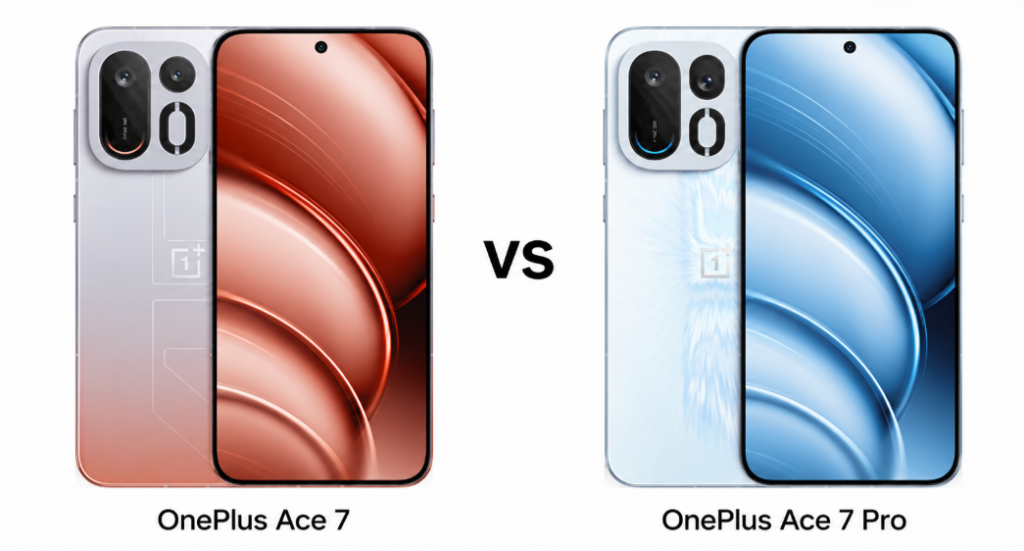
1. Major Features:
| Category | OnePlus Ace 7 | OnePlus Ace 7 Pro | Upgrades |
|---|---|---|---|
| Build | Glass front and back, aluminum frame | Glass front and back, aluminum frame | No major change |
| Water Resistance | IP68/IP69K | IP68/IP69K | No change |
| Cooling System | Built-in cooling fan | Built-in bi-directional cooling fan | Improved cooling system |
| Display | 6.78-inch LTPO AMOLED, 185Hz | 6.78-inch LTPO AMOLED, 185Hz | No change |
| Resolution | 1272 x 2772 pixels | 1272 x 2772 pixels | No change |
| Processor | Snapdragon 8 Elite Gen 5 V Series | Snapdragon 8 Elite Gen 5 | Upgraded chipset |
| GPU | Adreno 840 | Adreno 840 | No change |
| RAM | Up to 16GB | Up to 16GB | No change |
| Storage | Up to 512GB, UFS 4.1 | Up to 1TB, UFS 4.1 | Additional 1TB storage option |
| Main Camera | 200MP with OIS | 200MP with OIS | No change |
| Secondary Camera | 8MP ultrawide | 50MP periscope telephoto, 3.5x optical zoom, OIS | Upgraded telephoto camera, but ultrawide removed |
| Selfie Camera | 16MP | 16MP | No change |
| Video Recording | Up to 8K at 30fps | Up to 8K at 30fps | No change |
| Battery | 9,000mAh | 9,000mAh | No change |
| Charging | 100W wired | 100W wired | 60% vs 58% in 30 minutes |
| Connectivity | Wi-Fi 7, Bluetooth 5.4, NFC, IR | Wi-Fi 7, Bluetooth 5.4, NFC, IR | No change |
| Price | Around $660 (₹63,000) | Around $720 (₹69,000) | $60 higher for Pro |
2. Design and Display
Build and Feel
The OnePlus Ace 7 and Ace 7 Pro follow an almost identical design approach, featuring glass backs, aluminum frames and Crystal Shield Glass protection. Both also carry IP68/IP69K ratings, offering strong protection against dust and water. The overall construction and durability experience should therefore be very similar, with neither phone having a significant advantage in everyday handling.
The main difference comes from their cooling systems. The Ace 7 features a built-in cooling fan, while the Ace 7 Pro upgrades to a bi-directional cooling fan. This should help the Pro model manage heat more effectively during demanding gaming sessions. For users who frequently play graphics-intensive games, the upgraded cooling solution is a meaningful improvement rather than just a cosmetic specification.
Display Quality
Both smartphones feature a 6.78-inch LTPO AMOLED display with a 185Hz refresh rate, HDR10+, HDR Vivid and up to 2,000 nits of peak brightness. The 1272 x 2772 resolution also delivers similar sharpness, while 3840Hz PWM dimming provides additional comfort for users sensitive to screen flickering. Neither model offers a meaningful display upgrade over the other.
This means buyers do not need to choose the Pro simply for a better viewing experience. Gaming, scrolling, streaming and everyday navigation should feel equally impressive on both devices. The high refresh rate is particularly attractive for competitive gaming, although compatible content and games are necessary to take full advantage of it.
Verdict
The Pro’s bi-directional cooling fan is the meaningful design upgrade, but the display remains unchanged. Both offer essentially the same premium viewing and durability experience.
3. Specifications Including Battery
Performance
The OnePlus Ace 7 runs on the Snapdragon 8 Elite Gen 5 V Series chipset, while the Ace 7 Pro upgrades to the standard Snapdragon 8 Elite Gen 5. Both use Adreno 840 graphics and offer up to 16GB RAM, with UFS 4.1 storage. Although their CPU configurations are identical on paper, the Pro’s chipset variant offers a different performance positioning.
For everyday applications, multitasking and most demanding games, both smartphones should deliver flagship-level performance. However, the standard Snapdragon 8 Elite Gen 5 gives the Pro an advantage for buyers prioritising maximum processing capability. Combined with its bi-directional cooling fan, the Pro is also better positioned for sustained gaming workloads. The upgrade makes more sense for enthusiasts than ordinary users.
Battery and Charging
Battery capacity remains identical at 9,000mAh on both smartphones, making this one area where the Pro does not introduce a major upgrade. Both support 100W wired charging, along with UFCS, PPS and PD/QC charging standards. Bypass charging is also available, allowing users to power demanding gaming sessions without relying entirely on the battery.
The difference appears in the charging speed, with the Ace 7 reaching 58% in 30 minutes and the Ace 7 Pro reaching 60% in the same period. This is a relatively small improvement and unlikely to influence purchasing decisions. Both phones offer exceptional battery capacity, while the Pro’s cooling hardware adds more value for extended gaming sessions.
Verdict
The Ace 7 Pro has the stronger chipset and upgraded cooling, but battery capacity and charging remain nearly identical. The performance upgrade matters more to serious gamers.
4. Camera
Main and Secondary Lenses
Both smartphones feature a 200MP primary camera with optical image stabilisation, PDAF and support for 8K video recording. This gives the standard Ace 7 a strong foundation for detailed photography, everyday shooting and high-resolution video. However, the secondary camera setup creates the biggest difference between these devices.
The Ace 7 uses an 8MP ultrawide camera, whereas the Ace 7 Pro replaces it with a 50MP periscope telephoto camera offering 3.5x optical zoom and OIS. This is a substantial change in photographic versatility. The Pro is better suited to distant subjects, portraits and zoom photography, while the standard model retains the advantage of dedicated ultrawide shooting. Buyers should consider their photography habits carefully because these cameras serve different purposes.
Selfie Camera
There is no upgrade on the front of either smartphone. Both feature a 16MP selfie camera with an f/2.4 aperture, panorama support and 1080p video recording at 30fps with gyro-EIS. Consequently, users can expect broadly similar hardware capabilities for selfies, video calls and casual front-camera recording.
For everyday social media photography, neither phone has a clear specification advantage. The absence of a higher-resolution selfie sensor or improved video recording capabilities also means the Pro upgrade is primarily focused on rear-camera versatility. Users who frequently record vlogs or prioritise front-camera photography may find the unchanged hardware less exciting than the Pro branding suggests.
Verdict
The Ace 7 Pro is the more versatile camera phone, thanks to its 50MP periscope lens. However, the standard Ace 7 retains an ultrawide camera that the Pro lacks.
5. Pricing
The OnePlus Ace 7 is priced around $660 (approximately ₹63,000), while the OnePlus Ace 7 Pro is priced around $720 (approximately ₹69,000). This creates a $60 difference, or roughly ₹6,000, between the two smartphones. Considering how closely matched their core specifications are, the price gap is relatively modest.
However, the additional spending does not bring a complete hardware overhaul. Both phones retain the same display, battery capacity, primary camera, selfie camera and charging capabilities. The Pro primarily justifies its higher price through the standard Snapdragon 8 Elite Gen 5 chipset, bi-directional cooling and dedicated periscope telephoto camera. These are targeted upgrades rather than improvements across every category.
Verdict
The Ace 7 offers better value for everyday users, while the Ace 7 Pro justifies its premium through specialised gaming and photography upgrades.
Disclaimer:
Prices are approximate and may vary based on country, region, launch timing, and applicable taxes. Always check whether the listed price is for a China unit or a global/international variant when purchasing.
6. Conclusion
The OnePlus Ace 7 and Ace 7 Pro are closely related smartphones, but their differences target two specific audiences. The standard Ace 7 combines a 200MP primary camera, 8MP ultrawide lens, built-in cooling fan and a powerful Snapdragon chipset. It already delivers an attractive package for users seeking flagship-level performance and excellent battery endurance without paying extra for specialised features.
The Ace 7 Pro takes a more enthusiast-focused approach. Its standard Snapdragon 8 Elite Gen 5 chipset, bi-directional cooling fan and 50MP periscope telephoto camera make it better equipped for sustained gaming and zoom photography. However, replacing the ultrawide camera with a telephoto lens involves a genuine trade-off. Buyers should also remember that both phones share the same display, 9,000mAh battery and 100W charging.
Verdict
The OnePlus Ace 7 Pro is the overall winner, offering more meaningful upgrades for just $60 extra. Its superior cooling, stronger chipset and optical zoom make it the better enthusiast phone. However, the standard Ace 7 remains the smarter value purchase for everyday users who do not need those specialised upgrades.
OnePlus Ace 7 vs Ace 7 Pro: 5 Major Differences
1. Processor: The Ace 7 uses the Snapdragon 8 Elite Gen 5 V Series, while the Ace 7 Pro upgrades to the standard Snapdragon 8 Elite Gen 5 for stronger flagship performance.
2. Cooling System: The Ace 7 has a built-in cooling fan, whereas the Ace 7 Pro features a bi-directional cooling fan for improved heat management during extended gaming sessions.
3. Rear Cameras: The Ace 7 features a 200MP main camera and an 8MP ultrawide lens. The Ace 7 Pro replaces the ultrawide camera with a 50MP periscope telephoto lens offering 3.5x optical zoom and OIS.
4. Charging Speed: Both have a 9,000mAh battery and 100W wired charging, but the Ace 7 reaches 58% in 30 minutes, compared to 60% on the Pro.
5. Price: The Ace 7 is priced around $660 (₹63,000), while the Ace 7 Pro costs around $720 (₹69,000), making the Pro approximately $60 more expensive.
Disclaimer: Prices, specifications, and availability may vary by region and retailer. Recommendations in this article are based on editorial opinion, feature-based value, and market positioning at the time of writing. Readers are advised to do their own research before making a purchase.
Read More:
- OnePlus 16 vs OPPO Find X10: Snapdragon Power or 200MP Camera?
- RedMagic 12 Pro+ vs iPhone 18 Pro Max: Is Apple’s Premium Worth It?
- OnePlus 16 vs iPhone 17: The $900 Flagship Battle Is Closer Than You Think



Comments