
Add GIZMOCHINA on Google:
OnePlus 16 and Vivo X500 Pro target different kinds of flagship buyers. One prioritizes raw performance, gaming, and exceptional battery endurance, while the other focuses on premium photography and a more compact everyday experience. Both offer advanced displays, fast charging, and powerful hardware, but their differences could make one a considerably better fit depending on your priorities.
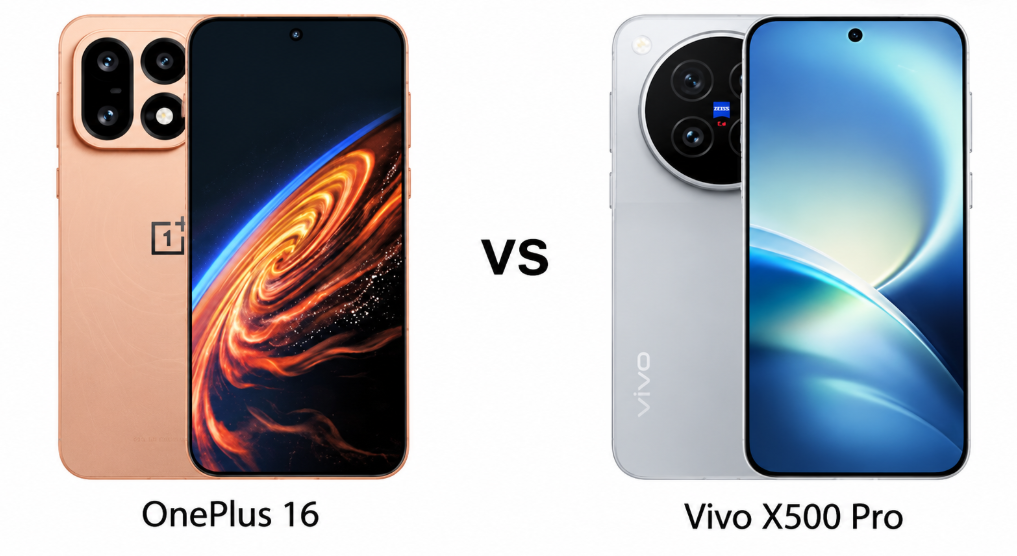
1. Major Features:
| Category | OnePlus 16 | Vivo X500 Pro | Winner |
|---|---|---|---|
| Build | Glass front and back, aluminum frame | Glass front and back, aluminum frame | OnePlus — IP68/IP69K protection |
| Display | 6.78-inch LTPO AMOLED, 185Hz | 6.36-inch LTPO AMOLED, 144Hz | OnePlus — Larger screen and higher refresh rate |
| Resolution | 1272 × 2772 pixels | 1216 × 2660 pixels | Vivo — Higher pixel density |
| Peak brightness | 2000 nits HBM | 4500 nits peak | Vivo — Higher claimed peak brightness |
| Processor | Snapdragon 8 Elite Extreme Gen 6 | MediaTek Dimensity 9600 Pro | OnePlus — Stronger gaming-oriented hardware |
| Process technology | 2nm | 2nm | Tie — Both use 2nm chips |
| RAM | Up to 16GB | Up to 12GB | OnePlus — Higher maximum RAM |
| Storage | Up to 1TB, UFS 4.1 | Up to 1TB, UFS 4.1 | Tie — Same maximum storage capacity |
| Main camera | 200MP, OIS | 50MP, larger 1/1.28-inch sensor, OIS | Vivo — Larger sensor and photography-focused hardware |
| Telephoto camera | 50MP, 3x optical zoom | 64MP periscope, 3.5x optical zoom | Vivo — Longer optical zoom and periscope lens |
| Ultrawide camera | 50MP, 116° field of view | 50MP, 119° field of view, autofocus | Vivo — Wider field of view |
| Rear video | Up to 8K at 30fps, 4K at 120fps | Up to 8K at 30fps, 4K at 240fps | Vivo — Higher maximum 4K frame rate |
| Selfie camera | 50MP, autofocus, ultrawide | 50MP, autofocus | OnePlus — Ultrawide selfie perspective |
| Battery | 9000mAh | 6510mAh | OnePlus — Larger battery capacity |
| Wired charging | 100W | 90W | OnePlus — Faster wired charging |
| Wireless charging | 50W | 40W | OnePlus — Faster wireless charging |
| Reverse charging | Wireless and 5W wired | Wireless and wired | OnePlus — Explicit 5W reverse wired charging |
| Operating system | Android 17, OxygenOS 17 | Android 17, OriginOS 7 | Tie — Both run Android 17 |
| Software support | Not specified | Up to 5 major OS updates | Vivo — Explicitly stated update commitment |
| Connectivity | Wi-Fi 7, Bluetooth 6.0, NFC, infrared | Wi-Fi 7, Bluetooth 5.4/6.0, NFC, infrared | OnePlus — Newer Bluetooth specification listed |
| Price / Value | Priced around $900 / ₹86,000 | Priced around $950 / ₹93,000 | OnePlus — Lower price and stronger battery value |
| Overall | Performance, gaming, and endurance | Photography, zoom, and compact usability | OnePlus — Better all-round flagship value |
2. Design and Display
Build and Feel
The OnePlus 16 combines a glass front and back with an aluminum frame, offering a familiar premium flagship design. Its Crystal Shield Glass protection adds durability, while the choice of a glass-fiber reinforced plastic back on select variants provides an alternative finish. IP68/IP69K certification also offers stronger water protection, including resistance to high-pressure water jets. The Vivo X500 Pro features a glass front, an aluminum frame, and either a glass or glass-fiber reinforced plastic back. Its IP68/IP69 rating provides substantial protection against dust and water, although its immersion rating is slightly less demanding. The Vivo’s more compact design makes it particularly appealing for one-handed use, while the OnePlus suits buyers who prefer a larger handset.
Display Quality
The OnePlus 16 features a 6.78-inch LTPO AMOLED display with a 185Hz refresh rate, Dolby Vision, HDR10+, and 3840Hz PWM dimming. Its high refresh rate makes scrolling and gaming exceptionally fluid. The Vivo X500 Pro counters with a 6.36-inch LTPO AMOLED panel, a 144Hz refresh rate, Dolby Vision, HDR10+, and a claimed peak brightness of 4500 nits. Its higher peak brightness could benefit outdoor visibility, although peak figures do not represent sustained full-screen brightness. Both screens support Ultra HDR imagery, but the OnePlus offers more room for immersive gaming and multimedia.
Verdict
The OnePlus 16 wins for screen size, refresh rate, and water resistance. However, the Vivo X500 Pro is the better choice for compact-phone enthusiasts seeking a bright, premium display.
3. Specifications Including Battery
Performance
The OnePlus 16 is powered by Qualcomm’s Snapdragon 8 Elite Extreme Gen 6, a 2nm chipset paired with an Adreno 850 GPU. Its powerful CPU configuration and gaming-focused graphics make it the stronger candidate for demanding games, intensive multitasking, and sustained high-performance workloads. The Vivo X500 Pro uses MediaTek’s Dimensity 9600 Pro, also built on a 2nm process, with a Mali-G2-Ultra-NX GPU. It promises flagship-class performance and should handle demanding applications comfortably. Both phones offer UFS 4.1 storage, but their memory configurations differ. The OnePlus provides up to 16GB of RAM, whereas the Vivo lists up to 12GB. The OnePlus therefore has an advantage for users who frequently run resource-intensive applications or play graphics-heavy games.
Battery and Charging
Battery endurance is a major advantage for the OnePlus 16. Its 9000mAh silicon-carbon battery substantially exceeds the Vivo X500 Pro’s 6510mAh capacity, giving it greater potential for extended gaming, navigation, and heavy daily use. The OnePlus also supports 100W wired charging and 50W wireless charging, alongside reverse wireless charging, 5W reverse wired charging, and bypass charging. The Vivo offers 90W wired and 40W wireless charging, providing respectable convenience despite its smaller battery. Bypass charging makes the OnePlus particularly attractive to gamers who play while plugged in, as power can be directed to the system instead of primarily charging the battery. Actual endurance will still depend on usage and software optimisation.
Verdict
The OnePlus 16 wins decisively with its larger battery, faster charging, and gaming-friendly bypass feature. The Vivo remains capable, but the OnePlus is better suited to heavy users.
4. Camera
Main and Secondary Lenses
The OnePlus 16 features a 200MP main camera with optical image stabilisation, a 50MP telephoto camera with 3x optical zoom, and a 50MP ultrawide camera with autofocus. This versatile combination promises detailed photographs across different focal lengths. The Vivo X500 Pro takes a different approach with a 50MP main sensor featuring a larger 1/1.28-inch sensor format, a 64MP periscope telephoto camera offering 3.5x optical zoom, and a 50MP ultrawide camera with autofocus. Zeiss optics, T* lens coating, and a colour spectrum sensor strengthen its photography credentials. Although the OnePlus offers substantially higher main-camera resolution, megapixels alone do not determine image quality. The Vivo’s larger main sensor and longer optical zoom give it a compelling advantage for low-light photography and distant subjects. Both support 8K recording, while the Vivo adds advanced 10-bit Log and APV recording options.
Selfie Camera
The OnePlus 16 features a 50MP ultrawide front camera with autofocus, making it suitable for group selfies, video calls, and recording yourself while moving. Its support for 4K video recording at up to 60fps and electronic stabilisation further improves its versatility for content creators. The Vivo X500 Pro also offers a 50MP autofocus selfie camera, but its wider standard perspective is better suited to natural-looking individual portraits and everyday video calls. It records 4K video at up to 60fps, although the listed specifications do not include the OnePlus’s explicit gyro-EIS and HDR support for front-camera video. Both deliver high-resolution selfie hardware, but the OnePlus has a more clearly specified stabilisation feature set. The Vivo, meanwhile, complements its front camera with extensive rear-camera video tools, including Dolby Vision HDR and professional Log recording.
Verdict
The Vivo X500 Pro takes the camera category with its larger main sensor, 3.5x periscope zoom, Zeiss optics, and advanced video tools. The OnePlus remains versatile, especially for selfies.
5. Pricing
The OnePlus 16 is priced around $900 (₹86,000), while the Vivo X500 Pro is priced around $950 (₹93,000). This puts the Vivo at a noticeable premium, despite its smaller display and battery. The OnePlus offers a Snapdragon flagship chipset, a 9000mAh battery, a faster 185Hz display, and higher wired and wireless charging speeds.
The Vivo justifies its higher asking price through its photography-focused hardware, including the larger main camera sensor, periscope telephoto lens, Zeiss optical enhancements, and more extensive professional video capabilities. Both occupy the premium flagship segment, but they allocate their hardware budgets differently.
Buyers should prioritise the features they use most rather than assuming that the more expensive phone automatically delivers the better overall experience.
Verdict
The OnePlus 16 is the better value for most users, offering more battery capacity, stronger gaming credentials, and a larger high-refresh-rate display at a lower price.
Disclaimer:
Prices are approximate and may vary based on country, region, launch timing, and applicable taxes. Always check whether the listed price is for a China unit or a global/international variant when purchasing.
6. Conclusion
The OnePlus 16 distinguishes itself with its 185Hz LTPO AMOLED display, Snapdragon 8 Elite Extreme Gen 6 processor, enormous 9000mAh battery, and 100W wired charging. Its bypass charging and 50W wireless charging also make it especially attractive to gamers and users who spend long hours away from a power outlet.
The Vivo X500 Pro counters with a more photography-focused package, featuring Zeiss-enhanced optics, a larger 50MP main sensor, 3.5x periscope zoom, and advanced professional video recording. Its compact display and body also appeal to buyers who find large flagships cumbersome.
Both phones offer premium construction, ultrasonic fingerprint readers, stereo speakers, and IP-rated protection. The deciding factor is whether performance and endurance matter more than camera versatility and portability. The Vivo is the more specialised imaging device, while the OnePlus offers a broader set of advantages for everyday flagship use.
Verdict
Winner: OnePlus 16. Its superior battery capacity, faster charging, higher refresh rate, stronger gaming-oriented hardware, and lower price make it the better all-round flagship. Choose the Vivo X500 Pro instead if photography, optical zoom, professional video recording, and a compact design are your highest priorities.
FAQs:
1. Which phone is better for gaming, OnePlus 16 or Vivo X500 Pro?
The OnePlus 16 is the better gaming choice, with its Snapdragon chipset, Adreno GPU, 185Hz display, and bypass charging.
2. Which phone takes better photos, OnePlus 16 or Vivo X500 Pro?
The Vivo X500 Pro is better suited to photography, thanks to its larger main sensor, Zeiss optics, and 3.5x periscope zoom.
3. Which phone has better battery life?
The OnePlus 16 has a 9000mAh battery compared with the Vivo X500 Pro’s 6510mAh, giving it greater potential endurance.
4. Is the Vivo X500 Pro worth more than the OnePlus 16?
Yes, for photography enthusiasts who value advanced zoom and professional video features. Otherwise, the OnePlus 16 offers better overall value.
5. Which phone should you buy for everyday use?
Choose the OnePlus 16 for gaming and endurance, or the Vivo X500 Pro for compact handling and photography versatility.
Disclaimer: Prices, specifications, and availability may vary by region and retailer. Recommendations in this article are based on editorial opinion, feature-based value, and market positioning at the time of writing. Readers are advised to do their own research before making a purchase.
Read More:
- RedMagic 12 Pro+ vs Galaxy S26 Ultra: Is Samsung Worth $300 More?
- OnePlus 16 vs Galaxy S26: Bigger Battery or Smarter Flagship?
- OnePlus 16 vs iPhone 17: The $900 Flagship Battle Is Closer Than You Think


Comments