
Add GIZMOCHINA on Google:
As an Amazon Associate, Gizmochina earns from qualifying purchases. Links on this page may earn us a commission at no extra cost to you.
OnePlus 16 and Google Pixel 11 appeal to different flagship buyers. One prioritizes high-end performance, an exceptionally fast display, and massive battery capacity, while the other focuses on Google’s software experience, computational photography, and long-term updates. Both are priced around the $900 mark, making the choice less about affordability and more about which features deliver the greatest everyday benefits.
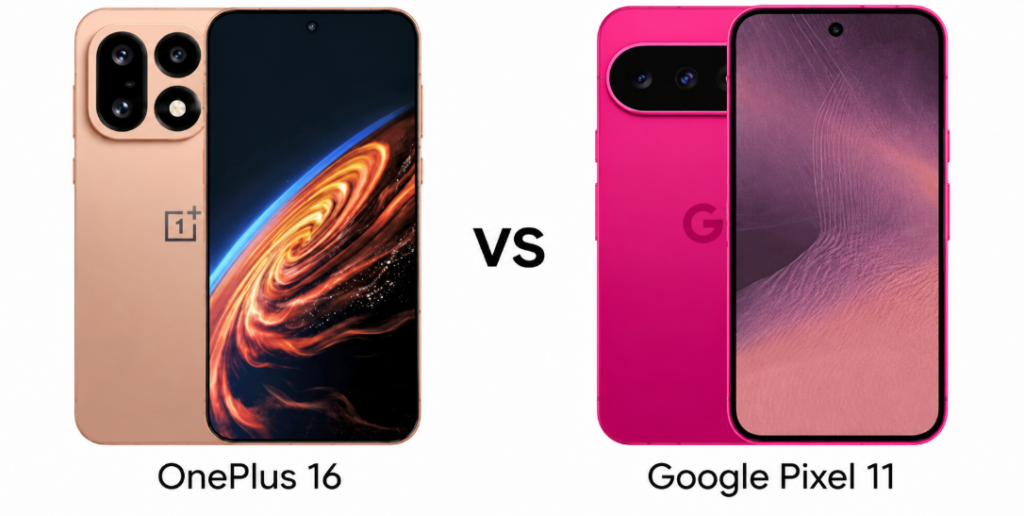
1. Major Features:
| Category | OnePlus 16 | Google Pixel 11 | Winner |
|---|---|---|---|
| Build | Crystal Shield Glass, aluminum frame, IP68/IP69K | Gorilla Glass Victus 2, aluminum frame, IP68 | OnePlus – Better water and dust protection |
| Display | 6.78-inch LTPO AMOLED, 185Hz | 6.3-inch OLED, 120Hz | OnePlus – Higher refresh rate and advanced display technology |
| Peak Brightness | 2,000 nits HBM | 3,000 nits peak | Google – Higher quoted peak brightness |
| Processor | Snapdragon 8 Elite Extreme Gen 6, 2nm | Google Tensor G6, 3nm | OnePlus – Stronger performance-oriented hardware |
| Operating System | Android 17, OxygenOS 17 | Android 17, up to 7 major OS updates | Google – Clear long-term software support commitment |
| RAM | 12GB, 16GB | 12GB | OnePlus – Offers a 16GB RAM option |
| Storage | 256GB, 512GB, 1TB | 256GB, 512GB | OnePlus – Higher maximum storage capacity |
| Main Camera | 200MP, OIS | 48MP, OIS | OnePlus – Higher-resolution primary sensor |
| Telephoto Camera | 50MP, 3x optical zoom, OIS | 10.8MP, 5x optical zoom, OIS | OnePlus – Higher resolution; Google offers longer optical zoom |
| Ultrawide Camera | 50MP, 116° | 13MP, 120° | OnePlus – Higher-resolution ultrawide sensor |
| Video Recording | Up to 8K at 30fps, 4K at 120fps | Up to 4K at 60fps | OnePlus – Higher video resolution and frame-rate flexibility |
| Selfie Camera | 50MP, autofocus, 4K at 60fps | 10.5MP, autofocus, 4K at 60fps | OnePlus – Higher-resolution front camera |
| Battery | 9,000mAh | 4,985mAh | OnePlus – Much larger battery capacity |
| Wired Charging | 100W | 30W | OnePlus – Significantly faster wired charging |
| Wireless Charging | 50W | 25W magnetic, Qi2.2 | OnePlus – Higher quoted charging power |
| Special Features | Infrared port, bypass charging, reverse wireless charging | Satellite SOS, magnetic wireless charging | Google – Satellite SOS adds an emergency communication feature |
| Price/Value | Priced around $900 / ₹86,000 | Priced around $900 / ₹90,000 | OnePlus – Lower approximate INR price and stronger hardware value |
| Overall Winner | Performance-focused flagship | Software-focused flagship | OnePlus – Better overall hardware package for power users |
2. Design and Display
Build and Feel
The OnePlus 16 combines Crystal Shield Glass, an aluminum frame, and a choice of glass or glass-fiber reinforced plastic for its rear panel. Its IP68/IP69K rating provides stronger protection against dust and demanding water exposure than the Pixel’s IP68 certification. The Google Pixel 11 uses Gorilla Glass Victus 2 on both sides, paired with an aluminum frame for a familiar premium finish. Both offer ultrasonic fingerprint sensors, but OnePlus provides greater flexibility with physical SIM configurations and eSIM support on compatible variants. The Pixel’s more compact design makes it appealing to buyers who prefer comfortable everyday handling.
Display Quality
The OnePlus 16 features a 6.78-inch LTPO AMOLED panel with a 185Hz refresh rate, Dolby Vision, HDR10+, and Ultra HDR support. Its higher refresh rate makes it particularly attractive for competitive gaming and exceptionally fluid scrolling. The Pixel 11 counters with a 6.3-inch OLED display, a 120Hz refresh rate, HDR10+, and a higher quoted peak brightness of 3,000 nits. Both screens should deliver vibrant colours, but OnePlus offers more advanced display capabilities, while Google prioritizes brightness and manageable screen size.
Verdict
The OnePlus 16 wins for display technology, refresh rate, and water resistance. The Pixel 11 is better suited to buyers who prefer a smaller screen.
3. Specifications Including Battery
Performance
The OnePlus 16 uses Qualcomm’s Snapdragon 8 Elite Extreme Gen 6, built on a 2nm process, paired with an Adreno 850 GPU. Its flagship-oriented hardware, UFS 4.1 storage, and configurations offering up to 16GB of RAM make it the stronger candidate for demanding games, intensive multitasking, and sustained performance workloads. The Google Pixel 11 relies on Google’s Tensor G6 chipset, manufactured using a 3nm process, alongside an IMG graphics processor and up to 12GB of RAM. Tensor’s strengths centre on Google’s AI features and software integration rather than outright gaming performance. Both run Android 17, but Google’s promise of seven major OS updates gives the Pixel a clearly defined long-term support advantage.
Battery and Charging
The OnePlus 16 packs a substantial 9,000mAh silicon-carbon battery, supported by 100W wired and 50W wireless charging. It also offers reverse wireless charging, reverse wired charging, and bypass charging for supported gaming scenarios. The Pixel 11 has a 4,985mAh battery, 30W wired charging, and 25W magnetic wireless charging with Qi2.2 support. OnePlus is considerably better equipped for extended gaming, heavy workloads, and buyers who dislike frequent charging. Google’s magnetic charging ecosystem is convenient, but its slower wired charging and smaller battery make the OnePlus the more compelling option for endurance.
Verdict
The OnePlus 16 wins decisively with its faster chipset, greater memory flexibility, and substantially larger battery. The Pixel 11 stands out for its seven-update commitment.
4. Camera
Main and Secondary Lenses
The OnePlus 16 features a 200MP main camera with optical image stabilisation, a 50MP telephoto camera offering 3x optical zoom, and a 50MP ultrawide camera. Its versatile setup supports 8K recording, 4K video at up to 120fps, Dolby Vision, and LUT previews, giving enthusiasts greater flexibility for photography and video creation. The Google Pixel 11 combines a 48MP stabilised main camera with a 10.8MP telephoto lens offering 5x optical zoom and a 13MP ultrawide camera. Google’s computational photography tools, including Best Take and Pixel Shift, help produce polished images with minimal editing. OnePlus offers more versatile video capabilities and higher-resolution sensors, while the Pixel’s longer optical zoom provides an advantage for distant subjects.
Selfie Camera
The OnePlus 16 features a 50MP ultrawide front camera with autofocus, HDR, and 4K recording at up to 60fps. Its wider framing is particularly useful for group selfies, travel photography, and creators who record themselves regularly. The Pixel 11 uses a 10.5MP ultrawide selfie camera with autofocus and 4K recording at up to 60fps. Although its resolution is lower, Google’s image processing can help maintain natural-looking skin tones, balanced exposure, and consistent results across different lighting conditions. OnePlus offers more hardware flexibility, but Google’s processing remains attractive for users who prefer ready-to-share photos without extensive adjustments.
Verdict
The OnePlus 16 wins for camera hardware, selfie resolution, and video flexibility. The Pixel 11 remains appealing for computational photography and its 5x optical zoom.
5. Pricing
The OnePlus 16 is priced around $900 (₹86,000), while the Google Pixel 11 is priced around $900 (₹90,000). These approximate prices place both smartphones in the premium flagship segment, where buyers expect strong performance, capable cameras, and dependable everyday usability. The OnePlus 16 offers configurations with up to 16GB of RAM and 1TB of storage, providing more flexibility for users who manage large games, media libraries, or demanding applications. The Pixel 11 offers up to 12GB of RAM and 512GB of storage. Actual retail prices will vary by market, configuration, taxes, and availability, so regional pricing should be checked before purchasing.
Verdict
The OnePlus 16 offers better overall value at its lower approximate INR price, particularly for performance-focused buyers. The Pixel 11 suits those prioritising software support.
Disclaimer:
Prices are approximate and may vary based on country, region, launch timing, and applicable taxes. Always check whether the listed price is for a China unit or a global/international variant when purchasing.
6. Conclusion
The OnePlus 16 distinguishes itself with a 185Hz LTPO AMOLED display, Snapdragon 8 Elite Extreme Gen 6 processor, 9,000mAh silicon-carbon battery, and 100W wired charging. Its 200MP primary camera, 3x optical telephoto lens, and extensive video recording options also make it a strong choice for power users and content creators.
The Google Pixel 11 takes a different approach, combining Google’s Tensor G6 platform with computational photography features, a 5x optical telephoto camera, magnetic Qi2.2 wireless charging, and seven major Android OS updates. Its more compact screen may also suit buyers who prefer a phone that feels less cumbersome during everyday use.
Both deliver premium features, but their priorities differ considerably. OnePlus focuses on raw hardware capability and charging convenience, whereas Google places greater emphasis on software intelligence, photography processing, and long-term support. The deciding factor is whether immediate hardware advantages or sustained software support matters more.
Verdict
The OnePlus 16 is the overall winner for its superior performance potential, expansive battery capacity, faster charging, more advanced display, and versatile camera hardware. The Google Pixel 11 is the better alternative for buyers who prioritise Google’s photography processing, a compact design, and seven major OS updates. At similar prices, OnePlus delivers the more comprehensive hardware package for most power users.
1. Is the OnePlus 16 better than the Google Pixel 11?
Yes, the OnePlus 16 offers stronger hardware, faster charging, and a more advanced display for demanding users.
2. Which phone takes better photos, OnePlus 16 or Pixel 11?
The Pixel 11 excels in computational photography, while the OnePlus 16 offers higher-resolution sensors and more versatile video recording.
3. Which phone is faster for gaming?
The OnePlus 16 is better suited to gaming, thanks to its flagship Snapdragon chipset, Adreno GPU, and 185Hz display.
4. Which phone has better battery life and charging?
The OnePlus 16 has a 9,000mAh battery and 100W wired charging, giving it a substantial advantage in endurance and charging speed.
5. Which phone offers better value for money?
The OnePlus 16 offers better hardware value, while the Pixel 11 appeals to buyers prioritising software support and Google’s photography features.
Disclaimer: Prices, specifications, and availability may vary by region and retailer. Recommendations in this article are based on editorial opinion, feature-based value, and market positioning at the time of writing. Readers are advised to do their own research before making a purchase.
Read More:
- OnePlus 16 vs Vivo X500 Pro: 9000mAh Battery vs Zeiss Cameras
- OnePlus 16 vs iPhone 17: The $900 Flagship Battle Is Closer Than You Think
- OnePlus 16 vs Galaxy S26: Bigger Battery or Smarter Flagship?

Comments