
Add GIZMOCHINA on Google:
The battle between the Honor Win RT and OnePlus 15R highlights two different approaches to building a high-performance smartphone. One prioritizes extreme endurance and gaming-focused hardware, while the other combines next-generation processing, advanced video recording, and a polished software experience. Both promise flagship-class capabilities, but their differences extend beyond benchmark numbers and battery capacity.
The real question is which phone delivers the better experience across everyday tasks, entertainment, photography, and demanding applications. With a considerable price gap between them, choosing the right device requires looking beyond individual specifications to determine which smartphone makes the more convincing overall investment.
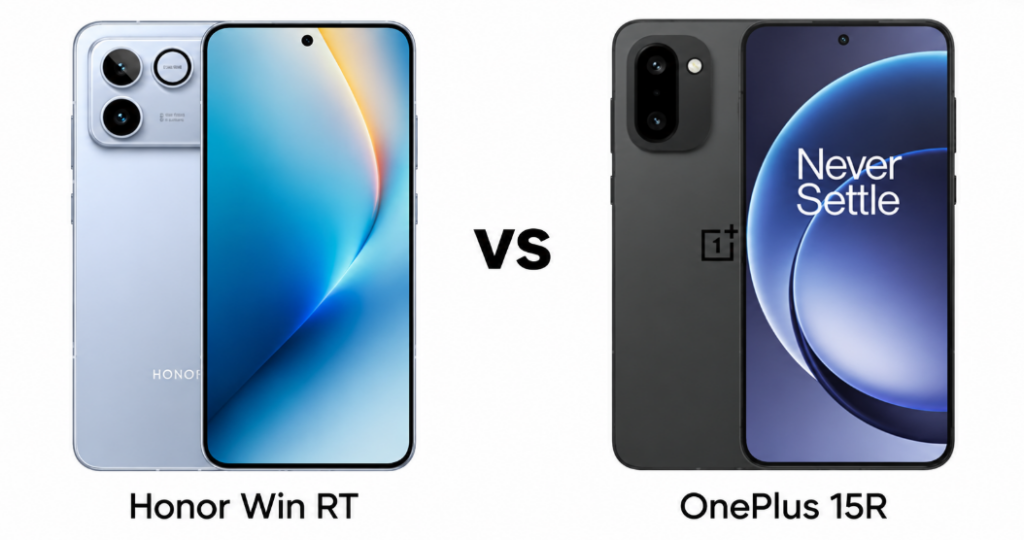
Major Features:
| Category | Honor Win RT | OnePlus 15R | Winner |
|---|---|---|---|
| Display | 6.83-inch AMOLED, 185Hz, 6000 nits peak | 6.83-inch AMOLED, 165Hz, 3600 nits peak | Honor — Higher refresh rate and claimed peak brightness |
| Display Protection | Scratch/drop-resistant glass | Gorilla Glass 7i | OnePlus — Specified glass protection |
| HDR Support | HDR Vivid, Ultra HDR | Dolby Vision, HDR10+, HDR Vivid, Ultra HDR | OnePlus — Broader HDR format support |
| Processor | Snapdragon 8 Elite | Snapdragon 8 Gen 5 | OnePlus — Newer-generation chipset |
| Graphics | Adreno 830 | Adreno 829 | Honor — Higher-tier GPU designation, though real-world performance varies |
| RAM | 12GB or 16GB | 12GB or 16GB | Tie — Both offer up to 16GB RAM |
| Storage | 256GB, 512GB, 1TB | 256GB, 512GB | Honor — Offers a 1TB configuration |
| Storage Technology | UFS 4.1 | UFS 4.1 | Tie — Same storage standard |
| Rear Camera | 50MP main with OIS, 12MP ultrawide with autofocus | 50MP main with OIS, 8MP ultrawide | Honor — Higher-resolution ultrawide with autofocus |
| Rear Video | Up to 4K at 60fps | Up to 4K at 120fps | OnePlus — Supports higher-frame-rate 4K recording |
| Selfie Camera | 50MP | 32MP with autofocus | Honor — Higher resolution and 4K 60fps selfie video |
| Battery | 10,000mAh silicon-carbon | 7,400mAh silicon-carbon | Honor — Substantially larger capacity |
| Charging | 100W wired, 27W reverse wired | 80W wired | Honor — Faster charging and reverse charging |
| Cooling | Built-in cooling fan | No built-in cooling fan listed | Honor — Dedicated active cooling |
| Water Resistance | IP68/IP69K | IP68/IP69K | Tie — Same stated protection rating |
| Operating System | Android 16, MagicOS 10 | Android 16, OxygenOS 16 | OnePlus — Alternative for buyers preferring OxygenOS |
| Connectivity | Wi-Fi 7, Bluetooth 6.0, NFC, IR | Wi-Fi 7, Bluetooth 6.0, NFC, IR | Tie — Broadly comparable connectivity |
| SIM Support | Dual Nano-SIM | Dual Nano-SIM; eSIM on compatible variants | OnePlus — Additional eSIM flexibility |
| Price | Priced around $380 / ₹35,000 (approximate Chinese launch-price conversion) | Priced around $650 / ₹60,000 (approximate Indian retail pricing) | Honor — Lower estimated entry cost |
| Value for Money | Gaming-focused hardware and larger battery | Newer chipset and advanced rear-video capabilities | Honor — More hardware features for the money |
| Overall Winner | Strong battery life, gaming features, and affordability | Newer chipset, HDR support, and advanced rear video | Honor — Stronger overall hardware value |




Comments