
Add GIZMOCHINA on Google:
As an Amazon Associate, Gizmochina earns from qualifying purchases. Links on this page may earn us a commission at no extra cost to you.
Redmi is set to launch the Redmi K100 smartphone in China on October 27, two months after the company announced the Redmi K100 and K100 Pro Max. The latter two phones got rebranded as the Poco F9 Pro and F9 Ultra globally.
The Xiaomi sub-brand is finally ready to unveil the vanilla model, and in the lead-up to launch, the company has confirmed key specs of the device. Here’s everything we know about the Redmi K100 ahead of its launch, along with how it compares with the K100 Pro and K100 Pro Max.
Redmi will launch the Redmi K100 in China on October 27 at 7 PM local time, with pre-orders already open. The Redmi Clip Neo open-ear earbuds will also debut at the event.
1. Display and gaming hardware
The Redmi K100 has a flat 6.83-inch AMOLED display with a 165Hz refresh rate and a peak brightness of 3,500 nits. Redmi confirmed the screen specifications last week, which also include a 480Hz multi-finger touch reporting rate and 3,500Hz instant touch sampling.
The company also claims that more than 40 games support native 165fps gameplay, while Xiaomi Green Mountain Eye Protection 4.0 handles the display’s eye-care features.
The screen is smaller and has a lower refresh rate than the 6.9-inch, 185Hz panel on the Redmi K100 Pro Max. Both Pro models also have the higher refresh rate, giving them an advantage in this area.
Redmi has also equipped the standard K100 with a D2 gaming chip, a first for a standard model in the K series. The chip handles hardware-level image upscaling and frame interpolation in supported games, helping improve visual quality and frame rates.
2. Chipset and software
The Redmi K100 uses the Snapdragon 8 Elite, Qualcomm’s 3nm flagship chipset from 2024. This is the same chip as last year’s Redmi K90, so the new phone does not bring a generational chipset upgrade over its predecessor. The K100 Pro and K100 Pro Max, meanwhile, use the newer Snapdragon 8 Elite Gen 5 platform, with the Pro getting the V Series variant.
Xiaomi president Lu Weibing has previously noted that many 2026 flagship phones will use previous-generation chips. He has also said he expects the K100 series to deliver strong value, although the standard model’s final pricing will determine how it compares with the competition.
The software is newer on the standard K100. It ships with HyperOS 4 based on Android 17, while the K100 Pro and Pro Max launched with HyperOS 3.0 based on Android 16. The update brings a glass-style interface and an upgraded Xiaoai assistant powered by Xiaomi’s MiMo model.
3. Battery and charging
Battery capacity is one of the Redmi K100’s biggest advantages on paper. Its 10,000mAh battery is larger than the 9,070mAh cell in the K100 Pro Max and the 8,580mAh battery in the K100 Pro. Speaking of which, it’s the biggest battery phone in the entire Xiaomi, Redmi, or Poco line.
Likewise, the phone likely supports 100W wired charging. A Xiaomi device carrying the model number M786BC, identified by tipster Digital Chat Station as the standard Redmi K100, passed 3C certification on October 12 with a 100W charging adapter.
Redmi has not confirmed wireless charging support for the standard model. Both the K100 Pro and K100 Pro Max support 50W wireless charging, so this remains one of the unanswered questions ahead of launch.
4. Design and colors
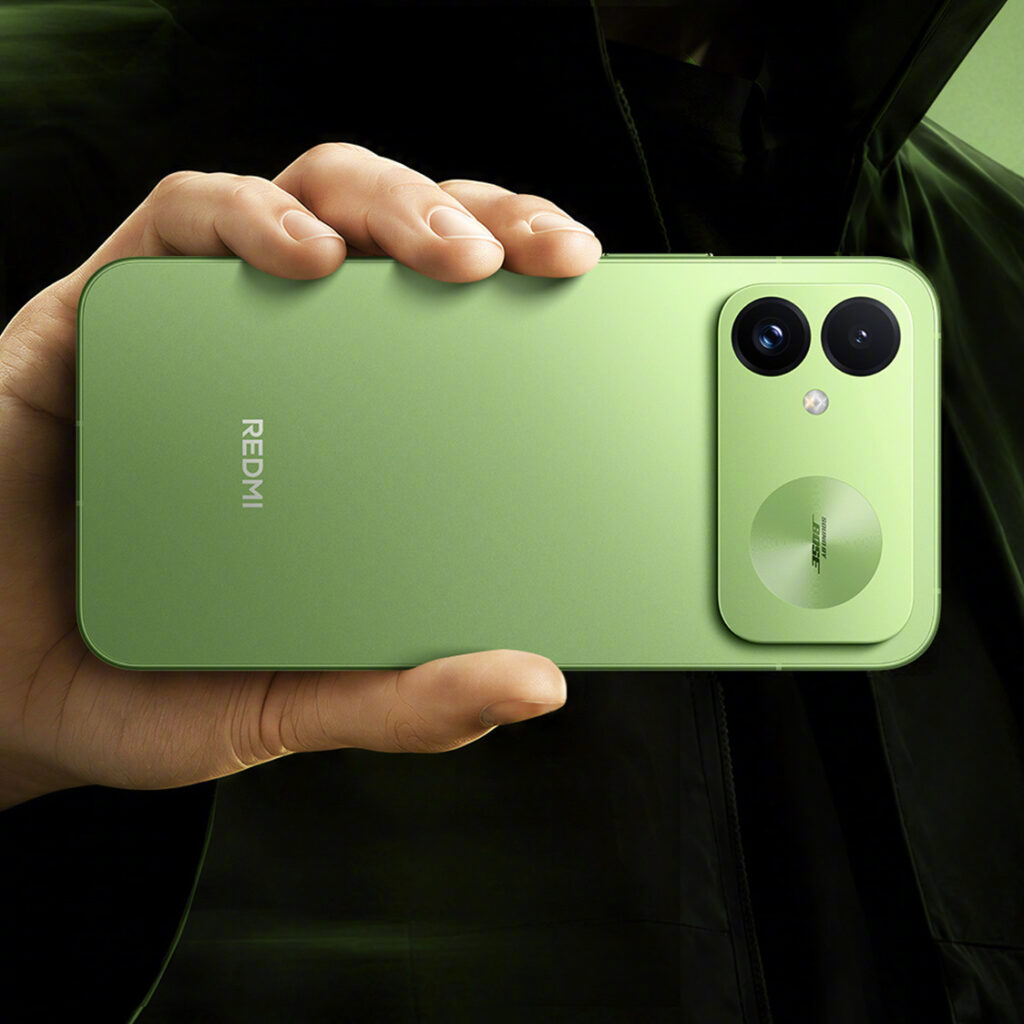
Redmi’s promotional images show a flat rear panel, a metal mid-frame, and a horizontal camera module. The power button sits on the right side, while the back carries Sound by Bose branding. On the front, the phone has a flat display with a centered punch-hole cutout for the selfie camera.
The company teased the Firefly Green color with a light, translucent finish.
5. Price, cameras, and other unconfirmed details
Redmi has yet to announce the K100’s price, camera specifications, or memory configurations. On the other hand, tipster Digital Chat Station suggests a starting price of around 3,500 yuan, or roughly $490.
The promotional images show two rear cameras and an LED flash, but Redmi has not confirmed the sensors. According to reports, it could feature a 200MP main camera, an IP68 rating, and an ultrasonic fingerprint sensor.
There is another model still missing from the wider lineup. Redmi said during the August launch of the Pro series that the K100 family would include a gaming flagship, but the company has not introduced that device yet.
6. Redmi K100 vs. K100 Pro vs. K100 Pro Max
The standard Redmi K100 has a larger battery than either Pro model, but it uses an older chipset and a slower display. The K100 Pro and Pro Max launched in China on August 11, with the latter offering the most advanced camera system in the lineup.
Here’s how the three phones compare based on announced specifications.
| Specification | Redmi K100 | Redmi K100 Pro | Redmi K100 Pro Max |
|---|---|---|---|
| China launch | October 27 | August 11 | August 11 |
| Display | 6.83-inch flat AMOLED, 165Hz | About 6.6-inch OLED, 185Hz | 6.9-inch OLED, 185Hz |
| Chipset | Snapdragon 8 Elite | Snapdragon 8 Elite Gen 5 V Series | Snapdragon 8 Elite Gen 5 |
| Battery | 10,000mAh | 8,580mAh | 9,070mAh |
| Wired charging | 100W | 100W | 100W |
| Wireless charging | Not announced | 50W | 50W |
| Main camera | Not announced | 200MP | 200MP with OIS |
| Telephoto camera | Not announced | 50MP | 50MP periscope |
| Ultrawide camera | Not announced | 8MP | 50MP |
| Software | HyperOS 4 (Android 17) | HyperOS 3.0 (Android 16) | HyperOS 3.0 (Android 16) |
| Starting price in China | Not announced | 3,699 yuan | 4,499 yuan |
7. Which Redmi K100 should you pick?
The standard Redmi K100’s price and camera specifications are still unknown, so the choice will depend partly on what Redmi announces on October 27. The confirmed hardware already gives each model a different set of advantages.
Best for battery life
The Redmi K100 has the largest battery in the lineup at 10,000mAh, along with a 165Hz display and a dedicated D2 gaming chip. Its Snapdragon 8 Elite is older than the Gen 5 processors in the Pro models, but the newer HyperOS 4 software is another advantage.
Best for a smaller flagship
The Redmi K100 Pro has a smaller display than the Pro Max, while retaining a 185Hz refresh rate and a 200MP main camera. Its 8,580mAh battery is smaller than those of the other two models, but it still has a substantial capacity.
Starting at 3,699 yuan in China, the phone uses the Snapdragon 8 Elite Gen 5 V Series, which has one fewer GPU slice than the standard Snapdragon 8 Elite Gen 5. It is the middle option for buyers who want the newer chipset and faster display without paying for the Pro Max.
Best for camera
The Redmi K100 Pro Max has the most advanced camera hardware in the lineup, with a 200MP main camera featuring optical image stabilization, a 50MP periscope telephoto camera, and a 50MP ultrawide camera. It also packs the full Snapdragon 8 Elite Gen 5 chipset and a 6.9-inch 185Hz display.
Its 9,070mAh battery is smaller than the standard K100’s, but the phone also supports 100W wired and 50W wireless charging. A 6,300-square-millimeter vapor chamber handles cooling without an active fan. Prices in China start at 4,499 yuan.
8. Will the Redmi K100 launch globally?
Redmi has not confirmed a global release for the standard K100. Its K-series phones often reach international markets under Poco branding, and the Pro models followed the same pattern this year.
After Poco confirmed its global launch date, the Poco F9 Pro and Poco F9 Ultra launched on September 1 as global versions of the Redmi K100 Pro and K100 Pro Max, respectively. Both global models have smaller batteries than their Chinese counterparts: 6,330mAh for the Poco F9 Pro and 8,050mAh for the Poco F9 Ultra. The 12GB/256GB versions start at $699 and $799, respectively.
The standard Redmi K100 could follow a similar route and arrive in international markets under a different name. However, neither the global model’s name nor its launch date has been confirmed.
Read more
- Redmi Book 2027 series launches next week with a 72Wh battery and third-gen Intel Core chips.
- Here are our hands-on impressions of the Redmi K100 Pro and K100 Pro Max
- Top 5 alternatives to the Redmi K100 Pro Max in 2026
For daily updates, please visit our News Section.
Stay ahead in tech! Join our Telegram community and sign up for our daily newsletter of top stories.