
Add GIZMOCHINA on Google:
As an Amazon Associate, Gizmochina earns from qualifying purchases. Links on this page may earn us a commission at no extra cost to you.
The iQOO Neo 12 and OnePlus Ace 7 have a lot in common, perhaps more than you’d expect from two competing gaming phones. Both come with a Snapdragon 8 Elite Gen 5 chip, a built-in cooling fan, a 9,000mAh battery, 100W charging, and a display that can reach 185Hz. They also launched just a day apart, making a comparison between the two almost inevitable.
But the similarities start to break down once you look beyond those headline specifications. The iQOO Neo 12 has a sharper 2K display and a 1TB storage option, while the OnePlus Ace 7 gets a 200MP main camera and an LTPO panel. Their cooling systems are also different, and there are some interesting differences in weight, water resistance, and gaming features.
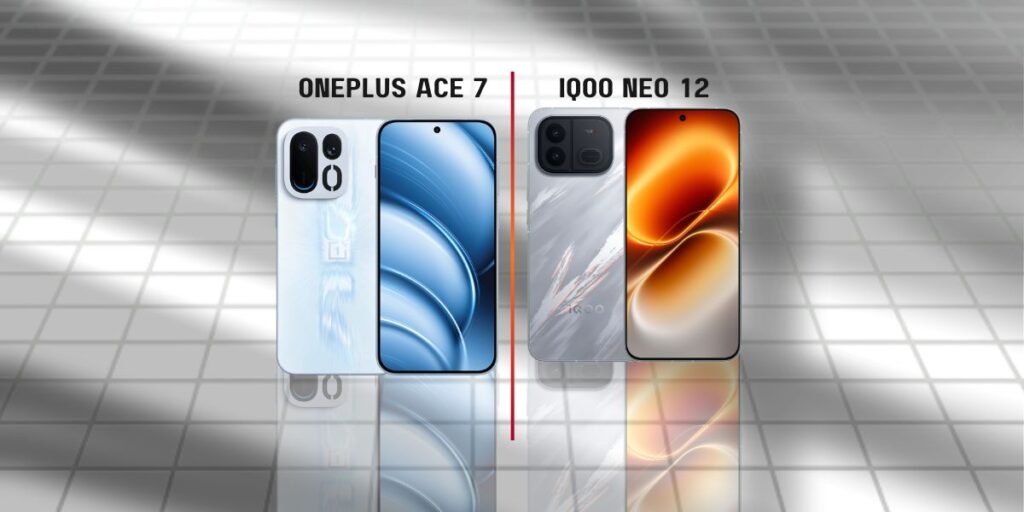
So, which one actually gives you more for your money? The iQOO Neo 12 launched in China on October 28, followed by the OnePlus Ace 7 on October 29. Here’s how the two compare, from their displays and performance to battery life, cameras, and everything in between.
1. The two phones are closer in size than you might expect
Neither phone is particularly small, but their dimensions are surprisingly close. The iQOO Neo 12 measures 163.42 x 75.89mm, while the OnePlus Ace 7 comes in at 162.30 x 77.37mm. The OnePlus is a little shorter but around 1.5mm wider.
Depending on the color, the Neo 12 measures somewhere between 8.50mm and 8.67mm, while the OnePlus comes in at 8.50mm to 8.59mm. Likewise, the iQOO Neo 12 weighs between 225g and 229g, compared with 217g to 223g for the OnePlus Ace 7.
The finishes are a little more interesting. OnePlus has an aluminum frame and Oppo Crystal Shield glass on the front. Midnight Black and Glossy White have fiberglass backs, while Tempered Fire gets a glass back with a sandblasted finish and a gradient metal frame.
iQOO has gone with Shadow Black, Frostblade Blue, and Contender. The Contender version has a light effect that changes as you tilt the phone, giving it a different look depending on the viewing angle.
OnePlus has the longer list of water-resistance ratings. The Ace 7 carries IP66, IP68, IP69, and IP69K certifications, while the Neo 12 has IP68 and IP69 ratings. iQOO also says the cooling fan assembly has passed IPX8 and IPX9 tests.
2. Display: 2K resolution or LTPO?
Here’s one of the bigger differences between the two phones. The iQOO Neo 12 has a 6.83-inch AMOLED display with a 3200 x 1440 resolution and 514 PPI. That’s noticeably sharper than the 2772 x 1272 panel on the OnePlus Ace 7, which measures 6.78 inches and has a pixel density of 450 PPI.
In terms of total pixels, the difference is roughly 4.6 million versus 3.5 million. Both panels can reach 185Hz, so neither phone has an advantage in the maximum refresh rate for supported games.
OnePlus does have something iQOO hasn’t confirmed: LTPO technology. The Ace 7’s display can drop to 1Hz and reach 165Hz during regular use, with 185Hz available in games. That gives it more flexibility when the screen doesn’t need to refresh so frequently.
Brightness figures are fairly close, too. iQOO claims 2,200 nits of full-screen peak brightness, while OnePlus lists a 2,000-nit peak and a 1,000-nit default maximum. The OnePlus panel also supports 3840Hz PWM dimming and has TÜV Rheinland Smart Eye Comfort 6.0 certification.
iQOO hasn’t left out eye-care features. The Neo 12 has circularly polarized light 2.0, TÜV Rheinland eye-protection certifications, and a 1-nit sleep screen. The company hasn’t confirmed whether the display supports LTPO, though, so we can’t make a direct comparison of how efficiently the two panels handle lower refresh rates.
If screen sharpness is your priority, the iQOO has the advantage. The OnePlus has a more flexible refresh-rate range, which could help with power consumption during everyday use.
3. Performance and gaming
Both phones have Qualcomm’s Snapdragon 8 Elite Gen 5, a 3nm chip with two cores clocked at around 4.6GHz and six performance cores. An Adreno 840 GPU handles graphics, while LPDDR5X Ultra memory and UFS 4.1 storage take care of RAM and internal storage.
There’s a small catch with the OnePlus, though. The Ace 7 has the Snapdragon 8 Elite Gen 5 V Series (SM8850-1-AB), rather than the standard version found in the iQOO Neo 12. OnePlus says both chips share the same architecture. Reports about other phones have described the V Series as a binned version with a smaller GPU, but OnePlus lists the same Adreno 840 name and a 1.2GHz clock.
The gaming chips are another point of difference. iQOO has its Q3 chip, which handles ray tracing, super resolution, and frame interpolation. The company says the Neo 12 can run supported games at 2K resolution and 185fps with all three features enabled.
OnePlus has split those jobs across three chips: the T3 touch chip, G3 network chip and P4 display chip. The T3 reportedly improves touch accuracy by 24%.
The touch sampling numbers make for an interesting comparison. iQOO lists a 5,000Hz instantaneous touch sampling rate and a 500Hz multi-finger rate. OnePlus doesn’t share an instantaneous figure, but its multi-finger rate reaches 520Hz. The Ace 7 also has an 800Hz gyroscope sampling rate in game mode, compared with 500Hz on the Neo 12.
Game support is another area where the two brands are making similar promises. iQOO says more than 50 titles support native 185fps gameplay on the Neo 12, while OnePlus lists nearly 40.
Both companies have also published results from hour-long gaming sessions. OnePlus says the Ace 7 averaged around 184 to 185fps in Delta Force over an hour. iQOO claims the Neo 12 maintained an average of 185fps in Call of Duty: Mobile over the same period.
Those results look good on paper, but the games and testing conditions aren’t identical. We’ll need to see how both phones perform in the same games before drawing any conclusions about which one handles sustained gaming better.
4. Cooling systems
A built-in fan is already a fairly unusual feature on a smartphone, and both companies have put considerable effort into the hardware surrounding it. The two systems aren’t identical, though.
The iQOO Neo 12 has a 17 x 17mm fan with three modes: low noise, intelligent, and high speed. At its highest setting, it can move up to 9,770 cm³ of air per minute. A 3D vapor chamber handles additional heat, with iQOO claiming a 15% improvement in heat dissipation over the Neo 11.
OnePlus has a more complicated arrangement called the Dual-Path Glacier Air-Cooling System. It has two separate airflow paths, with one directing air across a 14-layer fin stack positioned against the chip. The heat exchange area measures 1,264 mm².
The other path sends cool air toward the back cover, so the part of the phone you actually hold doesn’t get as hot. OnePlus says its backward-curved fan blades deliver 40% more airflow at the same noise level. There’s also a 6K vapor chamber, which the company claims improves heat dissipation by another 40%.
Dust is another concern with a fan inside a phone. OnePlus says the Ace 7 has a dust-resistant fan structure that passed a 24-hour test, three times the standard eight-hour test.
The company also claims the chip area stays up to 10 degrees Celsius cooler after an hour of gaming at 185fps with the fan switched on. iQOO hasn’t shared a similar temperature comparison, although it says the Neo 12’s cooling system keeps performance stable under heavy loads.
It’s difficult to say which arrangement works better without testing both phones. OnePlus has shared more details about its cooling hardware, but that doesn’t automatically mean it performs better than iQOO’s setup.
5. Battery and charging
Both phones have a typical battery capacity of 9,000mAh, which is a lot even by current gaming phone standards. The rated capacities are slightly different, though. The iQOO Neo 12 has an 8,820mAh battery rated at 32.90Wh, while the OnePlus Ace 7 has an 8,775mAh battery rated at 32.74Wh.
That’s a small difference, so battery life will probably depend more on the display, software, and cooling system than those extra 45mAh.
The battery technology isn’t the same, either. iQOO has fifth-generation silicon anode technology and claims the battery retains at least 80% of its capacity after 1,150 charging cycles. OnePlus has gone with a silicon-carbon battery with an energy density of 929Wh/L.
As for battery life, the companies have shared some impressive numbers, but their tests aren’t directly comparable. iQOO claims up to 29.9 hours of short-video playback and around 10 hours of gaming at 185fps. OnePlus reports up to 23.98 hours of video playback at 120Hz and 6.82 hours of Peacekeeper Elite at 185fps.
Both support 100W wired charging. OnePlus says its included charger can take the Ace 7 to 58% in 30 minutes, with the fan running and the screen switched off. iQOO hasn’t shared an equivalent charging time.
Bypass charging is available on both phones, so you can play games while connected to a charger without continuously charging the battery. OnePlus also has a dedicated charging chip, which the company says keeps performance steady when the battery level gets low.
The iQOO Neo 12 has one extra charging feature: OTG reverse charging. OnePlus doesn’t list reverse charging for the Ace 7. Neither phone supports wireless charging.
6. Cameras
The OnePlus Ace 7 has the bigger number on its camera specification sheet. Its 200MP main camera has a 1/1.56-inch sensor, an f/1.8 aperture, and OIS. There’s also an 8MP ultra-wide camera with a 112-degree field of view.
The main camera supports 1x, 2x, and 4x zoom, along with up to 20x digital zoom. Video recording goes up to 4K at 120fps or 8K at 30fps, and RAW photo support is included.
The iQOO Neo 12 has a 50MP Sony IMX921 main camera with a 1/1.56-inch sensor, an f/1.88 aperture, and OIS. Its secondary camera is also an 8MP ultra-wide shooter.
The iQOO can record 8K video and has portrait modes at 23mm, 35mm, and 50mm. Both phones have 16MP selfie cameras, with an f/2.45 aperture on the iQOO and f/2.4 on the OnePlus.
Neither phone has a dedicated telephoto camera, so the zoom options rely on the main sensor. The OnePlus Ace 7 Pro does have a telephoto camera, but that’s a separate model.
The 200MP sensor gives OnePlus a resolution advantage, but megapixels alone don’t tell us which phone takes better pictures. Sensor processing and image quality will need a proper camera comparison.
7. Software and connectivity
The iQOO Neo 12 runs OriginOS 7 based on Android 17, while the OnePlus Ace 7 ships with ColorOS 17. Both have their own software extras, although some are more interesting than others.
iQOO has included a PC game emulator that works with its G1 gamepad. The controller is sold separately, but it gives the Neo 12 another option for people who want to play PC games on their phone.
OnePlus has a different kind of extra. The Ace 7 supports connections with Apple devices, including iPhone call and message relay and Apple Watch connectivity through OPPO’s apps. That’s a useful addition if you carry an iPhone or Apple Watch alongside your Android phone.
The rest of the connectivity hardware is largely the same. Both phones have Wi-Fi 7, Bluetooth 5.4, NFC, an infrared blaster, dual speakers, and an ultrasonic fingerprint reader. The iQOO Neo 12 also supports face unlock.
Bluetooth audio support is slightly different. iQOO lists LDAC, aptX Lossless, and LHDC 5.0, while OnePlus lists BLE Audio.
8. Memory, storage and price
Both phones start with 12GB of RAM and have a 16GB option, but iQOO gives buyers more storage choices.
The Neo 12 comes in 256GB, 512GB and 1TB configurations. OnePlus has four options: 12GB+256GB, 16GB+256GB, 12GB+512GB and 16GB+512GB. There’s no 1TB version of the Ace 7.
iQOO has also announced the Neo 12’s Chinese pricing. The 12GB+256GB model starts at 4,399 yuan, while the 16GB+256GB version costs 4,799 yuan. The 12GB+512GB model is priced at 5,099 yuan, and the 16GB+512GB version costs 5,499 yuan. The top-end 16GB+1TB model will set buyers back 6,499 yuan.
OnePlus hasn’t included the Ace 7’s pricing in its official specification sheet, so we don’t yet know how the two compare on price.
9. iQOO Neo 12 vs OnePlus Ace 7: Specs compared
| iQOO Neo 12 | OnePlus Ace 7 | |
| Chip | Snapdragon 8 Elite Gen 5 | Snapdragon 8 Elite Gen 5 V Series |
| Gaming chips | iQOO Q3 | T3 touch, G3 network, P4 display |
| Cooling | Fan + 3D vapor chamber | Dual-path fan + 14-layer fin stack + 6K vapor chamber |
| Display | 6.83-inch AMOLED, 3200 x 1440, 185Hz | 6.78-inch LTPO OLED, 2772 x 1272, 1–165Hz (185Hz in games) |
| Peak brightness (claimed) | 2,200 nits full-screen | 2,000 nits |
| Battery | 9,000mAh (8,820mAh rated) | 9,000mAh (8,775mAh rated) |
| Charging | 100W wired, OTG reverse | 100W wired, 58% in 30 minutes (claimed) |
| Main camera | 50MP Sony IMX921, f/1.88, OIS | 200MP, f/1.8, OIS |
| Ultra-wide | 8MP | 8MP, 112° |
| Front camera | 16MP, f/2.45 | 16MP, f/2.4 |
| Storage | 256GB / 512GB / 1TB | 256GB / 512GB |
| Water rating | IP68 / IP69 | IP66 / IP68 / IP69 / IP69K |
| Size and weight | 163.42 x 75.89 x 8.50–8.67mm, 225–229g | 162.30 x 77.37 x 8.50–8.59mm, 217–223g |
| Software | OriginOS 7 (Android 17) | ColorOS 17 |
| Starting price | 4,399 yuan | Not listed |
10. Which one should you buy?
The iQOO Neo 12 and OnePlus Ace 7 are close enough that there’s no obvious winner based on their headline specifications. The iQOO has a sharper 2K display, a higher claimed full-screen brightness, a 5,000Hz instantaneous touch sampling rate, and a 1TB storage option. It also has the standard Snapdragon 8 Elite Gen 5 rather than the V Series version.
The OnePlus Ace 7 is lighter, has a 200MP main camera with 4K 120fps recording, an LTPO display, and more water-resistance ratings. Its Apple device connectivity features are another small advantage if you already own an iPhone or Apple Watch.
Cooling and battery life could make the comparison more interesting, but we’ll have to test both phones before deciding which one handles long gaming sessions better. Price will also matter, especially since OnePlus hasn’t announced the Ace 7’s cost.
For now, the iQOO Neo 12 has the edge in display resolution and storage, while the OnePlus Ace 7 offers a higher-resolution main camera, a lighter body, and extra connectivity features.
For daily updates, please visit our News Section.
Stay ahead in tech! Join our Telegram community and sign up for our daily newsletter of top stories!