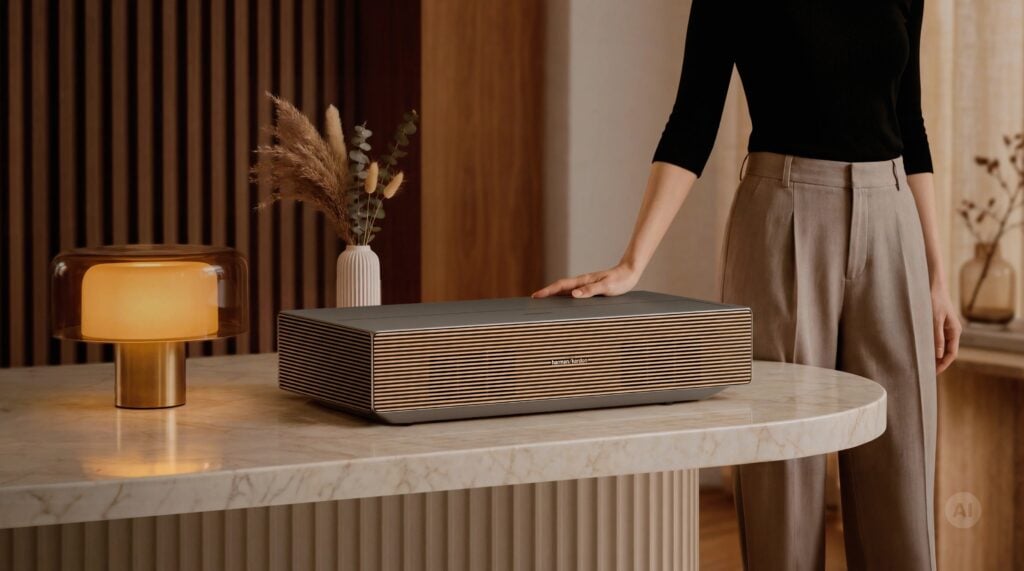
Ultra-short-throw (UST) projectors have become a practical alternative to massive televisions over the last few years. Instead of dealing with ceiling mounts, running cables through drywall, or worrying about someone walking in front of the projection beam, you can just place a console-sized box on your media cabinet. Push it a few inches from the wall, and you get a 120-inch display.
Xgimi has been a consistent presence in this category, and their latest lineup, the Aura 3 series, updates their offerings with some modern hardware. The company is releasing two versions: the Aura 3 Max and the Aura 3 Pro.
At first glance, these two projectors look identical. They share the same physical design, the same underlying processing technology, and the same goal of replacing a standard living room TV. However, if you look at the specification sheet and the pricing, there is a clear distinction between the two.
Here is a breakdown of how the Xgimi Aura 3 Max compares to the Aura 3 Pro, and how to decide which one makes sense for your space.
Before getting into the differences, it is helpful to look at what both of these projectors have in common, as Xgimi has kept the core feature set largely the same across both models.
First is the light engine. Both the Max and the Pro use an RGB Triple Laser setup. This means they rely on dedicated red, green, and blue lasers, which allows them to cover 110% of the BT.2020 color space. In practical terms, this translates to accurate and saturated colors for movies and games.
Speaking of gaming, the Aura 3 series includes support for 4K resolution at a 120Hz refresh rate. Powered by dual Texas Instruments DLPC controllers, this feature is particularly relevant if you own a PlayStation 5 or an Xbox Series X.
Alongside the higher refresh rate, both models support Variable Refresh Rate (VRR), Auto Low Latency Mode (ALLM), and AMD FreeSync Premium, while offering a 1ms response time. This makes either projector a viable option for playing fast-paced games on a large screen.
On the optical side, both projectors feature a dual-iris system. An iris physically adjusts the amount of light passing through the lens frame by frame. This helps improve black levels and shadow detail in darker scenes without relying entirely on digital processing, which can sometimes wash out the image.
They also share a 19-element optical glass system with a 0.163:1 throw ratio, meaning you only need to place the projector about eight inches away from the wall to achieve a 120-inch image.
The everyday usability features are also identical. Both come with an 80W Harman Kardon 2.0 channel sound system that supports Dolby Atmos. They also have Google TV built-in, which includes native support for apps like Netflix, YouTube, and Prime Video, so you don’t necessarily need to plug in a separate streaming stick. Setup is handled by Xgimi’s automated tools, including auto keystone, auto focus, and wall color adaptation.
2. Main Differences: Brightness, Contrast and Price
If the two models share so many features, the decision really comes down to how much ambient light you have in your viewing room.
The Aura 3 Max is the higher-end model designed for bright living rooms and larger screen sizes. It outputs 5,700 ISO lumens. If you have a living room with large windows and you want to watch TV during the day without drawing the curtains, this model is built to handle that environment. It also has a higher native contrast ratio of 8,000:1, which helps maintain deeper black levels even with the higher brightness output.
The Aura 3 Pro is designed for more typical viewing environments. It has a lower light output of 4,100 ISO lumens and a native contrast ratio of 7,000:1. To be clear, 4,100 ISO lumens is still quite bright for a home projector and will comfortably handle a moderately lit room. However, if you are projecting onto a wall that gets direct, harsh sunlight, the Pro will show more image washout than the Max.
Then there is the pricing structure. The Aura 3 Max has an MSRP of $4,999 (with an early Kickstarter price of $2,199). The Aura 3 Pro is priced lower, with an MSRP of $3,999 (and an early Kickstarter price of $1,999).
3. Specs Comparison
Feature
Xgimi Aura 3 Max
Xgimi Aura 3 Pro
Brightness
5,700 ISO Lumens
4,100 ISO Lumens
Native Contrast
8,000:1
7,000:1
Light Source
RGB Triple Laser
RGB Triple Laser
Resolution & Refresh Rate
4K UHD @ 120Hz
4K UHD @ 120Hz
Throw Ratio
0.163:1
0.163:1
HDR Support
Dolby Vision, IMAX Enhanced, HDR10, HLG
Dolby Vision, IMAX Enhanced, HDR10, HLG
Audio
80W Harman Kardon (Dolby Atmos)
80W Harman Kardon (Dolby Atmos)
Smart OS
Google TV (Native Netflix)
Google TV (Native Netflix)
Gaming Features
VRR, ALLM, 1ms Input Lag, FreeSync
VRR, ALLM, 1ms Input Lag, FreeSync
Weight
9.4 kg
8.9 kg
MSRP
$4,999
$3,999
Super Early Bird Price
$2,199
$1,999
4. Making Your Decision
Choosing between the Aura 3 Max and the Aura 3 Pro is fairly straightforward because Xgimi didn’t restrict software or processing features to the more expensive model. You get the same 4K 120Hz gaming support, the same Google TV interface, and the same audio system regardless of which one you pick.
Your choice should be based on your room’s lighting and your budget. If you are setting up the projector in a basement, a dedicated media room, or a living room where you can easily close the blinds to control ambient light, the Aura 3 Pro is a very practical choice. It saves you money while delivering the same core features.
On the other hand, if you are replacing a TV in a bright, open-concept space and want the best possible daytime visibility, the Aura 3 Max is the better fit. The additional 1,600 ISO lumens will make a noticeable difference in keeping the image clear and visible during the day.
For more daily updates, please visit our News Section.
We use cookies on our website to give you the most relevant experience by remembering your preferences and repeat visits. By clicking “Accept”, you consent to the use of ALL the cookies.
This website uses cookies to improve your experience while you navigate through the website. Out of these, the cookies that are categorized as necessary are stored on your browser as they are essential for the working of basic functionalities of the website. We also use third-party cookies that help us analyze and understand how you use this website. These cookies will be stored in your browser only with your consent. You also have the option to opt-out of these cookies. But opting out of some of these cookies may affect your browsing experience.
Necessary cookies are absolutely essential for the website to function properly. This category only includes cookies that ensures basic functionalities and security features of the website. These cookies do not store any personal information.
Any cookies that may not be particularly necessary for the website to function and is used specifically to collect user personal data via analytics, ads, other embedded contents are termed as non-necessary cookies. It is mandatory to procure user consent prior to running these cookies on your website.