
As an Amazon Associate, Gizmochina earns from qualifying purchases. Links on this page may earn us a commission at no extra cost to you.
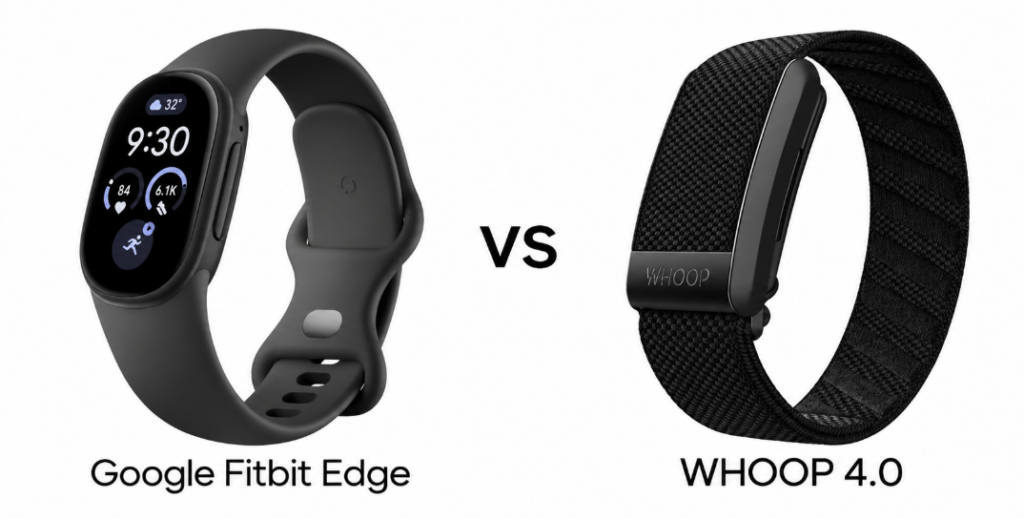
Google Fitbit Edge and WHOOP 4.0 approach fitness tracking from two very different perspectives. Fitbit Edge is a feature-rich fitness band that combines health monitoring, workout tracking, built-in GPS, and smartwatch-like conveniences, making it suitable for both exercise and everyday use. WHOOP 4.0, on the other hand, is primarily a continuous health, sleep, and recovery tracker designed to monitor physiological data with minimal distractions. This distinction directly affects the user experience: Fitbit offers more on-wrist functionality, while WHOOP prioritizes understanding the body’s response to training, sleep, and daily activity.
1. Major Features
| Category | Google Fitbit Edge | WHOOP 4.0 | Winner |
| Design | Aluminum housing, conventional fitness band | Compact screenless sensor | Fitbit – Display-equipped design |
| Housing | 100% recycled aluminum | Compact sensor construction | Fitbit – Aluminum housing |
| Display | 1.3-inch AMOLED | No display | Fitbit – AMOLED screen |
| Display Protection | Gorilla Glass 3 | No display | Fitbit – Screen protection |
| Weight | 17.7g without band | Not confirmed | Fitbit – Lightweight confirmed design |
| Heart Rate | Continuous tracking | Continuous optical tracking | Tie – 24/7 heart rate |
| HRV | – | Yes | WHOOP – HRV insights |
| Resting Heart Rate | Yes | Yes | Tie – Resting heart rate |
| Blood Oxygen | SpO₂ | SpO₂ | Tie – Blood oxygen tracking |
| Skin Temperature | Ambient-compensated skin temperature | Skin temperature tracking | Fitbit – Ambient compensation |
| Sleep Tracking | Advanced sleep tracking | Sleep stages, performance, insights | WHOOP – Sleep analysis |
| Recovery | Readiness, Cardio Load | Recovery metrics and insights | WHOOP – Recovery-focused analytics |
| GPS | Built-in GPS, Galileo, Dynamic GPS | Connected phone GPS | Fitbit – Built-in GPS |
| Navigation | Google Maps turn-by-turn | No on-device navigation | Fitbit – Wrist-based navigation |
| Workout Modes | 50+ exercise modes | Activity and workout tracking | Fitbit – More exercise modes |
| Training Metrics | VO2 Max, pace, distance, Active Zone Minutes | Strain, heart rate zones, physiological effort | Fitbit – More workout metrics |
| Smart Features | Notifications, quick replies, media controls, Maps | Haptic alarm, app-based insights | Fitbit – Everyday smart features |
| Battery Life | Up to 7 days | Up to 5 days | Fitbit – Longer battery life |
| Charging | USB-C fast charging cable | Wireless Battery Pack 4.0 | Fitbit – Faster conventional charging |
| Water Resistance | 5 ATM, IP68 | IP68 | Tie – IP68 protection |
| Compatibility | Android 11+, iOS 16.4+ | Android and iOS | Tie – Cross-platform support |
| Subscription | Google Health features, some advanced features require Premium | Membership required | Fitbit – More standalone flexibility |
| Price | Approx. $200 / ₹23,000 | Approx. $200 / ₹19,000* | WHOOP – Lower estimated entry price |
Disclaimer: Specs are based on available data. Actual performance may vary. Verify details from official sources before buying.
2. Design & Build
Fitbit Edge features a conventional fitness-band design with an aluminum housing, silicone Active Band, and a compact profile suited to continuous wear. Its tracker weighs 17.7g without the band and 32g with it, with small and large band sizes included in the box. WHOOP 4.0 takes a more discreet approach with its screenless sensor, SuperKnit band, and Fast Link slider mechanism. It is 33% smaller than WHOOP 3.0 and can be worn on the wrist or with compatible WHOOP Body apparel through Any-Wear technology, allowing users to track their activity beyond the wrist.
Winner: Fitbit – Lightweight aluminum construction and a more conventional fitness-band design.
3. Display & Interaction
The display is one of the most significant differences between these wearables. Fitbit Edge features a 1.3-inch AMOLED color display with always-on functionality, adjustable brightness, backlighting, and Gorilla Glass 3 protection. Users can check workout metrics, notifications, time, and other information directly from their wrist. WHOOP 4.0 has no display, deliberately keeping the device focused on uninterrupted tracking rather than on-wrist interaction. Its health statistics, workout information, sleep analysis, and recovery insights are accessed through the WHOOP smartphone app, making it more dependent on the phone for reviewing data.
Winner: Fitbit – Offers a full AMOLED display and convenient on-wrist access to information.
4. Battery Life & Charging
Fitbit Edge provides up to seven days of battery life from its 65mAh rechargeable lithium-ion battery, making it better suited to users who want fewer charging interruptions. It charges to 100% in approximately 90 minutes, while a five-minute charge can provide up to a day of use. WHOOP 4.0 offers up to five days of battery life and uses a wireless Battery Pack 4.0 that can recharge the tracker while it is being worn. This allows users to charge the device without interrupting sleep or activity tracking, which is particularly useful for people who want continuous health data collection.
Winner: Fitbit – Longer battery life and faster conventional charging.
5. Health Tracking
Both fitness bands monitor important health indicators, including heart rate, blood oxygen, sleep, and temperature-related metrics, but their approach to health analysis differs. Fitbit Edge combines continuous heart rate tracking with resting heart rate, ECG, AFib detection, irregular heart rate notifications, and high and low heart rate alerts. It also tracks skin temperature while accounting for ambient temperature changes. WHOOP 4.0 focuses on HRV, resting heart rate, respiratory rate, sleep stages, and recovery patterns, helping users understand changes in their body and how lifestyle and exercise affect their recovery.
Winner: Fitbit – More dedicated heart-health monitoring and alerts.
6. GPS & Navigation
Fitbit Edge has built-in GPS and Galileo positioning, allowing users to record outdoor running, walking, hiking, and cycling routes without carrying their phones. It can also use Dynamic GPS to select the appropriate GPS source. WHOOP 4.0 lacks onboard GPS and instead relies on a connected smartphone to record routes, pace, and distance during GPS-enabled workouts. This means WHOOP users need to carry their phones when they want mapped outdoor activity records. Fitbit also offers Google Maps turn-by-turn navigation on the wrist when connected to a phone.
Winner: Fitbit – Independent GPS tracking and wrist-based navigation.
7. Sports & Training Features
Fitbit Edge offers more than 50 exercise modes, live workout metrics, automatic activity recognition, cardio load, readiness, VO2 Max, Active Zone Minutes, elevation tracking, and real-time coaching cues. Its workout-focused interface makes it practical for following exercise sessions and monitoring progress in real time. WHOOP 4.0 concentrates on training strain, heart rate zones, cardiovascular effort, and recovery, helping users understand how demanding their workouts are and whether their body is prepared for additional exercise. Its approach is particularly useful for balancing hard training sessions with rest and recovery.
Winner: Fitbit – More exercise modes and practical on-device workout guidance.
8. Smart Features & Everyday Use
Fitbit Edge functions as a more versatile everyday wearable with mobile notifications, quick replies, media controls, alarms, timers, Google Maps, weather, customizable watch faces, and direct access to health and activity information. These features reduce the need to frequently reach for a phone. WHOOP 4.0 keeps interaction minimal, offering a haptic motor, smart wake alarm, and app-based access to health information. It is designed to stay in the background throughout the day rather than function as a notification-focused wearable, making it better suited to users who prefer a distraction-free experience.
Winner: Fitbit – More everyday functionality and convenient on-wrist controls.
9. Durability & Water Resistance
Fitbit Edge combines an aluminum housing, Gorilla Glass 3 display protection, and 5 ATM and IP68 water-resistance ratings. This makes it suited to everyday wear, workouts, and exposure to water while offering additional protection for its screen. WHOOP 4.0 features IP68 protection and is designed for continuous wear during daily activities and workouts. Its compact, screenless construction removes the risk of display damage, although its interchangeable band remains an important part of its overall wearability. Both devices are designed for users who want to keep their fitness tracker on throughout the day and night.
Winner: Tie – Both offer IP68-rated protection for everyday wear.
10. Which One Should You Buy?
Fitbit Edge is the better option for users who want a fitness band that combines health tracking with practical workout tools, GPS, navigation, notifications, and a display. It works well for everyday activity monitoring, outdoor workouts, and users who want information directly on their wrist.
WHOOP 4.0 is more appropriate for fitness enthusiasts who prioritize sleep, recovery, HRV, resting heart rate, training strain, and long-term health patterns. Its screenless design suits people who want to wear a tracker continuously without the distractions of a smartwatch-style interface.
Final Verdict
Google Fitbit Edge is the better everyday choice if you want a screen, built-in GPS, and lower long-term cost without a mandatory subscription, as its core health and workout tracking work indefinitely after a one-time purchase. However, WHOOP 4.0 is better for serious athletic training and recovery, offering deeper strain analytics (including muscular load for weightlifting), faster 1-second heart rate sampling for high-intensity workouts, a 5-day battery that charges right on your wrist via a wireless PowerPack, a lifetime hardware warranty, and a screenless design you can wear on your bicep or alongside a regular watch.
Overall Winner: Fitbit – More complete hardware, fitness tracking, GPS, and everyday features.
Disclaimer: Prices, specifications, and availability may vary by region and retailer. Recommendations in this article are based on editorial opinion, feature-based value, and market positioning at the time of writing. Readers are advised to do their own research before making a purchase.
11. FAQs
1. Which is better for health tracking, Fitbit Edge or WHOOP 4.0?
Fitbit Edge offers ECG-related features and heart alerts, while WHOOP focuses more on recovery, HRV, sleep, and physiological trends.
2. Does Fitbit Edge have GPS without a phone?
Yes. Fitbit Edge has built-in GPS, allowing it to track outdoor routes without your smartphone.
3. Can WHOOP 4.0 track running without a phone?
No. WHOOP 4.0 relies on your phone’s GPS for route tracking during compatible outdoor workouts.
4. Which fitness band offers better battery life?
Fitbit Edge lasts up to seven days, compared with up to five days for WHOOP 4.0.
5. Is WHOOP 4.0 worth buying for gym users?
Yes, particularly if you value workout strain, sleep analysis, recovery tracking, HRV, and training-load insights.
Read More:
- Vivo Buds Clip vs Huawei FreeClip 2: Which Open-Ear Clip-On Earbuds Should You Buy?
- iPad Mini 8 vs RedMagic Astra 2: Which Compact Tablet Is the Better Buy?
- Redmi Band 4 vs Huawei Band 11: Which Fitness Band Is Better?
FREE DAILY NEWSLETTER
Joel Explains
What matters in phones and gadgets, before it reaches you. From Gizmochina’s editor-in-chief, every morning.
Join 1,500+ readers. One email a day, unsubscribe in one click.


Comments