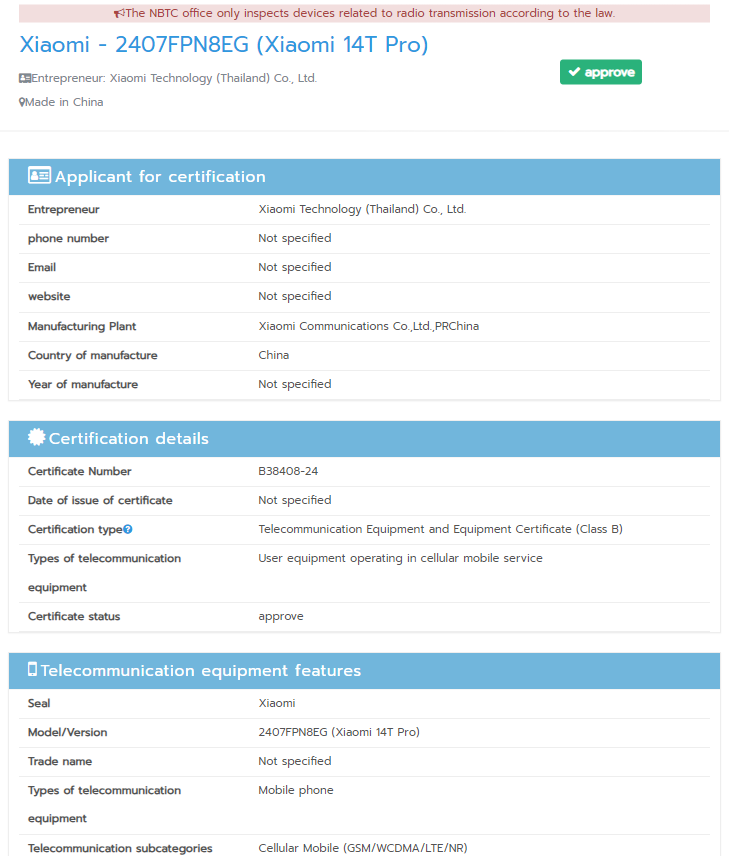
Last week, the Xiaomi 14T bearing the 2407FPN8EG model number was approved by Thailand’s NBTC authority. Now the same certification platform has approved the Xiaomi 14T Pro, indicating that the 14T series will be launching soon in Thailand.
Xiaomi 14T Pro NBTC certified
Xiaomi 14T Pro NBTC listing
As shown in the image above, the NBTC has certified the Xiaomi 14T Pro, model number 2407FPN8EG. While the listing does not provide detailed specifications for the device, it strongly indicates that the launch of the Xiaomi 14T Pro could be imminent.
To recall, the Xiaomi 13T received approval from the NBTC authority by the end of July last year, followed by the 13T Pro in early August. Both devices were subsequently announced for the global market by late September. The NBTC’s approval of the Xiaomi 14T and 14T Pro nearly a month earlier than their predecessors suggests that the 14T series will likely launch sooner, possibly by late August or early September.
Xiaomi 14T Pro specifications (rumored)
The Xiaomi 14T Pro is said to be a tweaked version of the Redmi K70 Ultra, which is expected to launch later this month in China. It is speculated that the 14T Pro will come equipped with better cameras than the K70 Ultra. The Camera FV-5 listing of the 14T Pro suggests it could be equipped with a 50-megapixel primary camera on the back and a 32-megapixel camera on the front.
The 14T Pro’s OLED panel may offer a 1.5K resolution and a 144Hz refresh rate. Under the hood, it may feature the Dimensity 9300+ chipset and a 5,500mAh battery with 120W fast charging support. Like its predecessor, the 14T Pro may offer up to 16 GB of LPDDR5x RAM and up to 1 TB of UFS 4.0 storage. In addition, it is expected to feature a metallic frame and an IP68-rated chassis.
So this time we got the latest TECNO Spark 20 Pro 5G. Before the pricing got truly revealed, some rummers suggested that the phone is at flagship-level pricing. While we’re not convinced that TECNO was going to be this radical with the Spark Series, the design and look shown in its leaked images, however, left me not entirely sure if it’s a budget model. But now
Now all information is public. TECNO is still TECNO. Tecno Spark 20 Pro 5G doesn’t betray this popular series. Let’s do a quick unboxing and see how it looks, then we will talk about the camera and performance.
Unbox
The Spark 20 Pro 5G also comes in the iconic orange box, open the box and you will find the warranty card and manual for the phone, inside the package there is also a clear case, a 33W charger and an A to C cable.
What surprised me was a pair of earphones with Type-C connector. I tried them out, it was comfortable to wear and the sound quality was better than I expected.
Desgin
We got both the green and white versions, and there are some differences between these two in visual and touch. The green one has an Alcantara-like back cover with a surrounding gold edge for the camera island.
The white version on the other hand, is designed with a special texture on the inside.
It’s hard for me to say which one looks better, but if I were to choose, I’d definitely go for the green version as it’s virtually fingerprint-free.
If you take a closer look at the phone, you’ll notice that the frame almost completely wraps around the phone, and I I think that’s the best looking angle of the phone.
The design of the camera module has become more rounded, and if you look closely you can see that there is a textured ring around it. Compared to its predecessor, this 5G version is clearly more design-oriented. Of course, just like the frame, the glossy trim around the camera is also made of plastic.
Going back to the front of the phone, it uses a FHD+ LCD screen with 120Hz support, which is a nice display. To my surprise, although it uses a LCD panel, the brightness is also not bad.
Another highlight of this phone, in terms of audio and video experience is that, it supports Dolby Atmos, there is a speaker test at the end of the video so you can compare between them carefully.
The Spark 20 Pro 5G weighs about 202g, SO, when I hold it in my hand I feel he weight is more moderate, combined with the rounded curves on the screen and the frame, it feels very nice in the hand.
Obviously, the phone is larger in size, which for me is a very good size. For users with small hands, it can be a bit difficult to use this phone with one hand.
I have also summarized some other highlights, you can pause and check them out in detail.
Performance
The new Spark 20 Pro 5G uses a 5G Soc, the MediaTek 6080, this is the right choice in budget phone, as MediaTek’s SOC is better than Qualcomm in this range. I did some tests which you can pause and take a closer look.
In terms of gaming, mainstream games are not much of a problem and it can run them smoothly at 60fps. For some graphically demanding games such as Genshin Imapct, you can also get good frame rates after lowering the graphical settings.
Carmer
The Spark 20 Pro 5G uses the same main camera as the Spark 20 Pro, I have shot some samples you can pause and take a look.
In real life, the HDR performance is good and the white balance is more accurate, you can take very clear and sharp photos when there is enough light. As a budget 5G model, the samples shot here is pretty impressive.
In terms of video recording, the main camera supports 2K 30fps and 1080p 60fps, while the selfie camera gets a bit of a boost with support for up to 2K 30 fps. I also took some samples with the selfie camera here. The nature tone feature brings a wonderful representation for portrait shooting. This is probably something you’d hardly experience on other brands’ budget phones.
Battery & Charging
This phone also uses a 5000mAh battery. For daily uses, it can last for about 9-10 hours.
The phone supports 33W charging and it takes about 75 minutes to fully charge the battery. This performance is certainly quite enough for daily use.
Conclusion
So, This is a quick review of SPARK 20 Pro 5G, I think it will be a strong contender in the budget 5G phone market. The single comment that keep poping into my head may be appropriate to conclude the quick review: It doesn’t look like a ‘Entre level’.
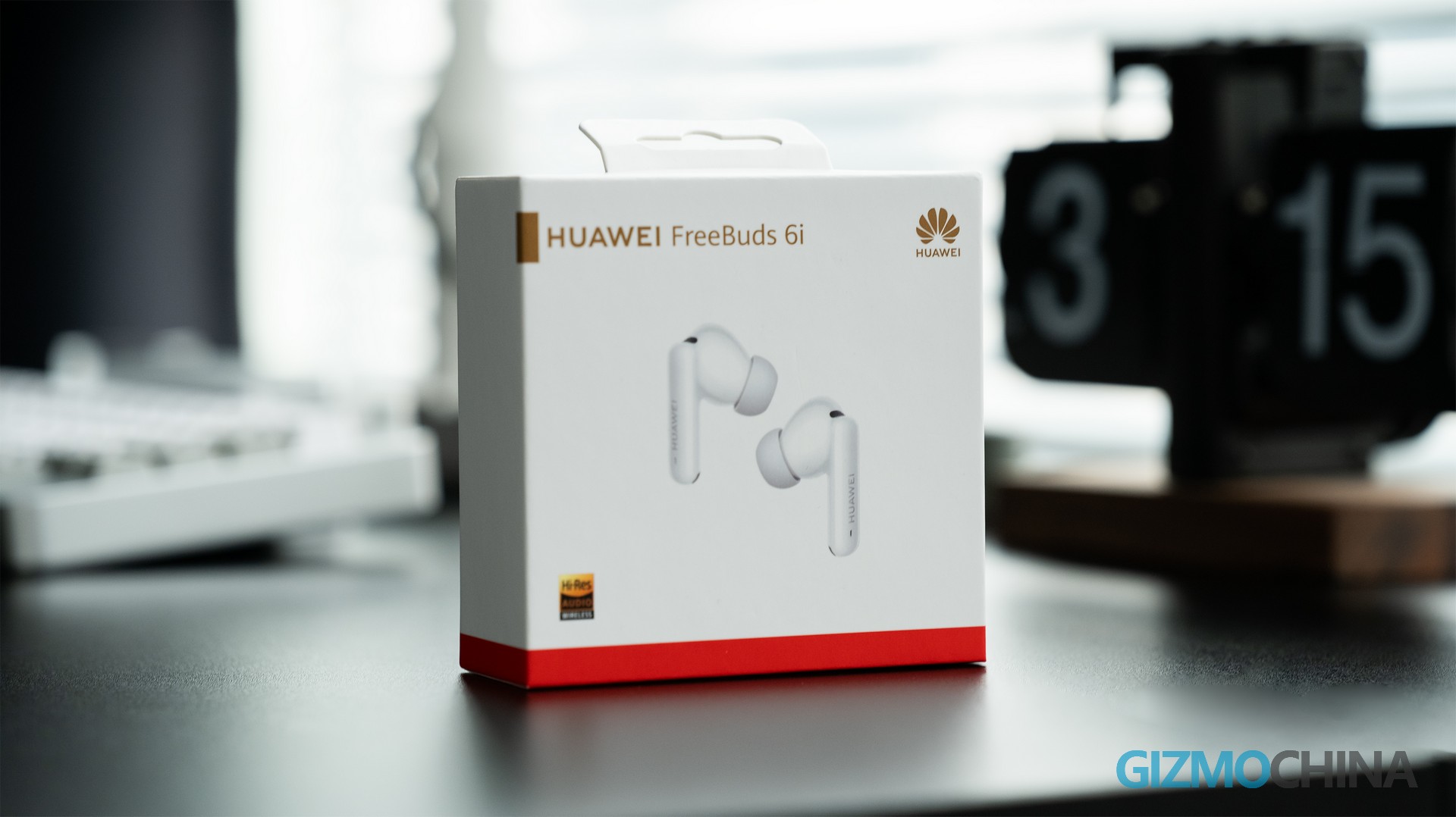
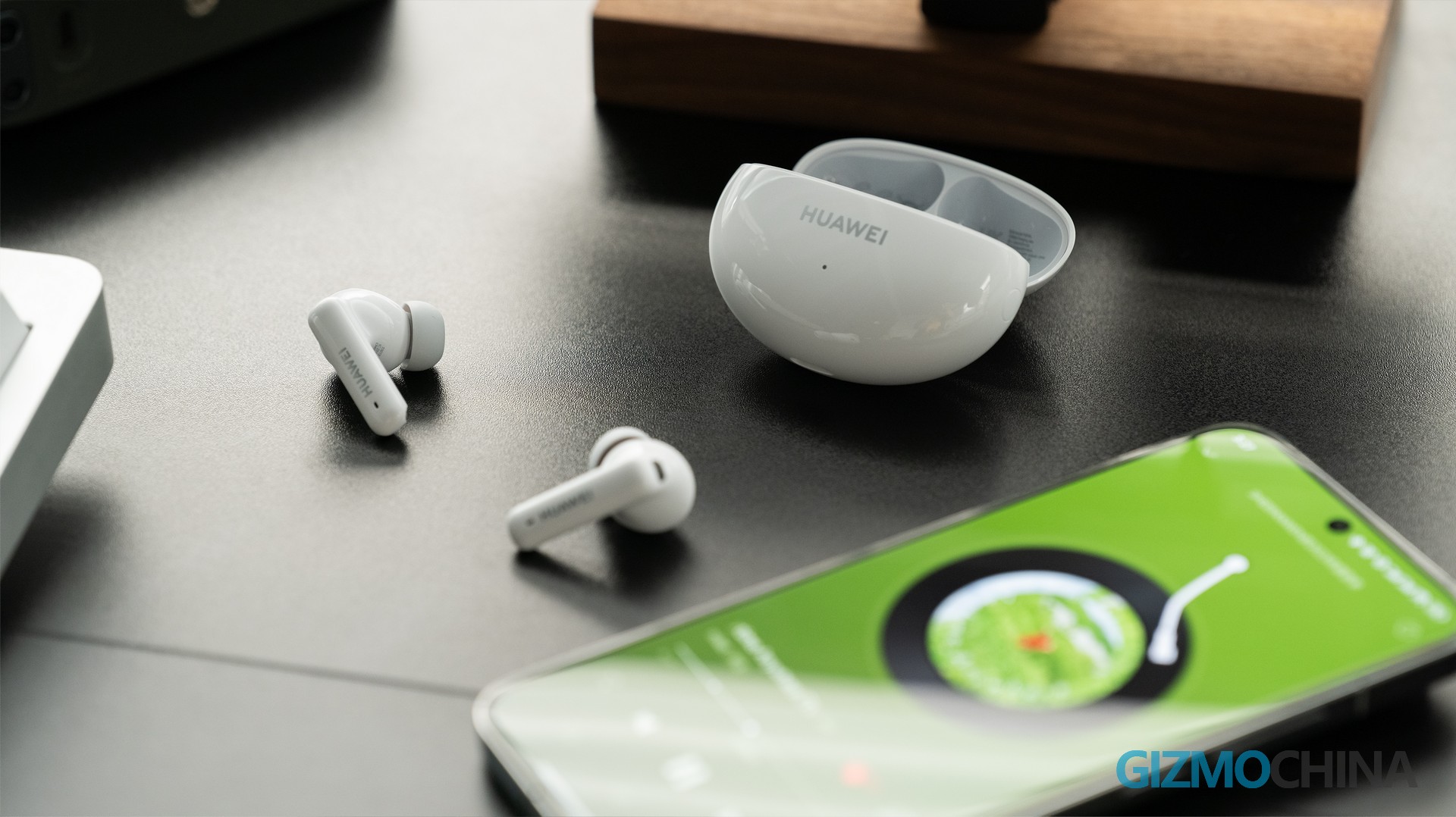
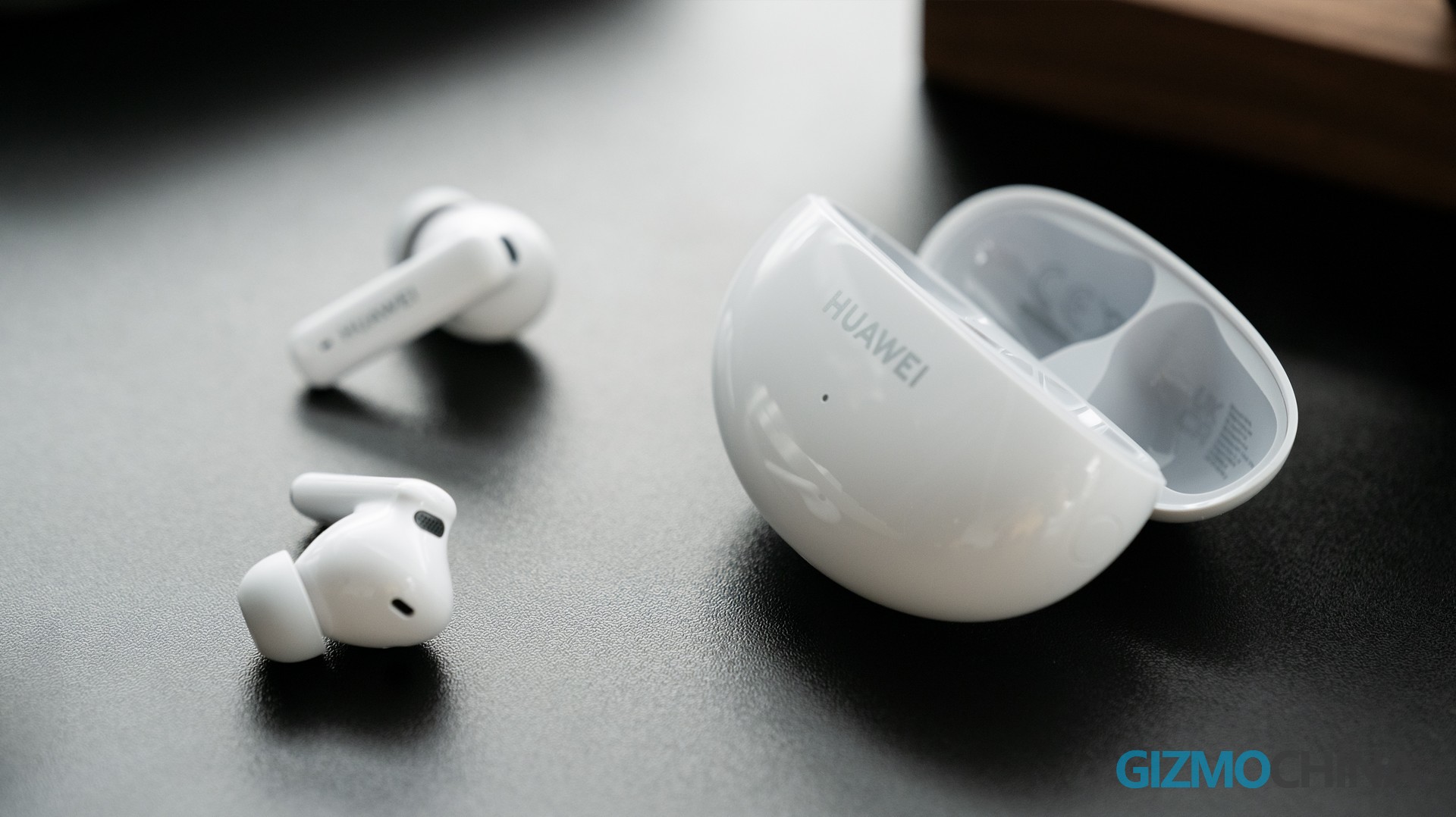
The FreeBuds series has always been one of HUAWEI’s most popular product lines. The FreeBuds i Series even is more affordable and has features that will fit well with most people’s daily use. The FreeBuds i Series have also recently been updated to the sixth generation. Let’s take a quick look at what the FreeBuds 6i has to offer and what has been upgraded.
Design & Wearing Comfort
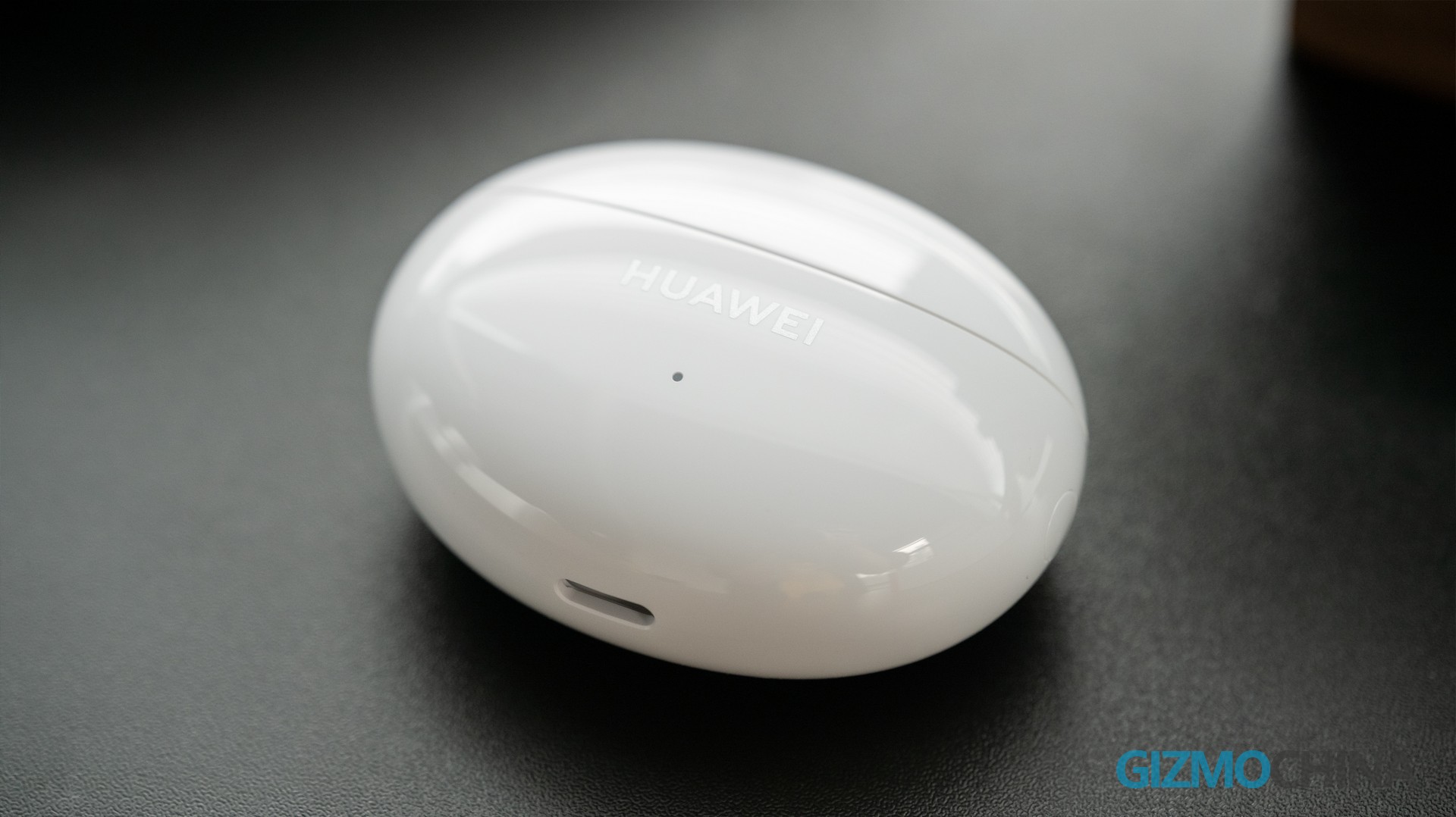
This time around, the FreeBuds 6i still comes in three colorways: black, white, and purple. whereas the FreeBuds 5i’s purple would be more like blue, the 6i’s purple is the real deal. But unfortunately we only get our hands on the white version. The surface is free of speckles and resembles a pebble – Never go wrong with a glossy design.
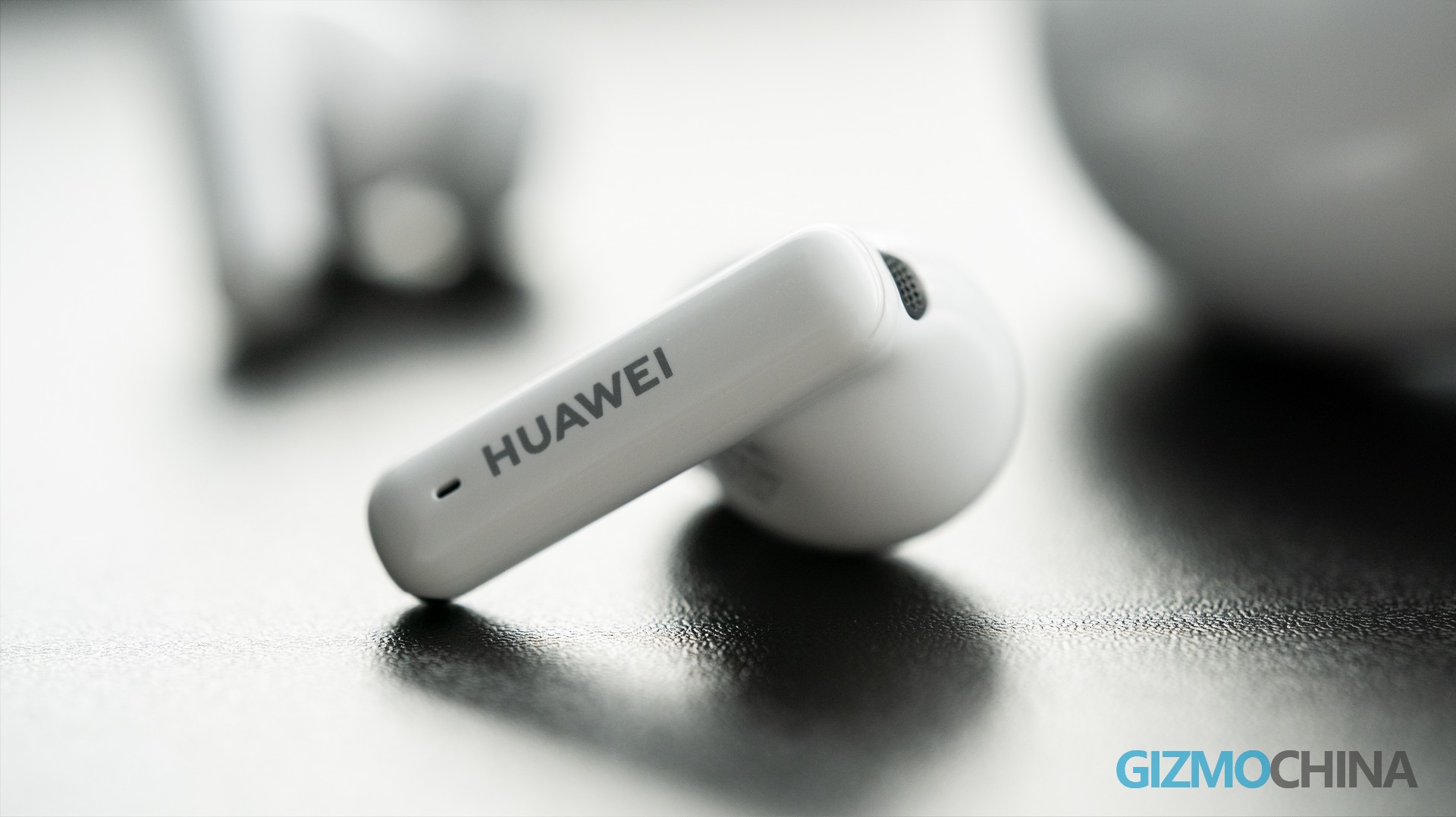
The changes to the earbuds themselves are much smaller than the changes to the earbud case. the FreeBuds 6i is almost indistinguishable from the 5i. It still has the HUAWEI logo printed in the most noticeable place. The weight will be 0.5g heavier than the 5i, but it’s hard to notice when wearing it. After many iterations, the comfort of the FreeBuds doesn’t need to be wondered about anymore. I don’t have any problems wearing them for long periods of time anyway.
Sound Quality
The driver of the Huawei FreeBuds 6i has gotten a bit bigger than its predecessor. It comes with an 11mm Quad-magnet Dynamic Driver, which makes the low-frequency performance more surging and powerful, and the mid- and high-frequency more crispy and detailed. According to the website, the 11 mm quad-magnet dynamic drivers are 50% more powerful and Hi-Res certified, producing as low as 14 Hz of punchy bass.
This design is not only suitable for bass lovers but also satisfies users with high demands for vocal and instrumental details. In addition, FreeBuds 6i has Hi-Res AUDIO WIRELESS certification, which is able to restore more details of the music so that every note can be reproduced realistically. For actual listening, it handles well with various music types and reproduces them with good sound stage, which obviously far exceeds my expectation for a pair of budget wireless earbuds.
Noise Cancellation
Noise cancellation is one of the highlights of the FreeBuds 6i. The earphones are equipped with Huawei’s latest active noise cancellation technology, which is designed to effectively cancel out external noises through a dual-microphone feed-forward and feedback design. They call it Intelligent Dynamic ANC 3.0. Average full-range noise cancellation is 27 dB, with ultra-wide ANC frequency up to 5kHz. At least now based on my wearing experience, I would say the gap between the i series and the Pro series has been narrowed quite well.
After using it for a while, this mid-size eartips meet my needs very well. It’s worth noting that the FreeBuds 6i also features a well-done transparent mode for noting ambient sounds. Simply long press on the earbuds to switch to the Transparent Mode. Ambient sound can be heard clearly in this mode, which is much better than a similar budget earbuds, the Redmi Buds 5 Pro.
Operation & Connections
The FreeBuds 6i operates with the most common touch controls. A long press to switch the noise canceling mode, a double-tap to play or pause the music, and a swipe up or down to control the volume. This is a common way to operate wireless earbuds. Although it’s also pretty easy to maneuver, the squeeze control would be something we’d prefer to see. After all, tapping earbuds is not the most comfortable way for listening, and it’s easy to cause misoperations.
The FreeBuds 6i uses BlueTooth V5.3, which supports Pop-up Pair and dual-device connectivity. Other than the Bluetooth version upgrade, the connection is not much different from the 5i. After all, the 5i already has pretty stable connectivity with good latency.
Battery Life
With ANC on it keeps playing music for 5 hours, which will be an hour shorter than the battery life of the 5i. But with ANC OFF, the 6i will last another half hour longer than the 5i, at 8 hours. If you add up with the case of the earbuds, the overall battery life of the 6i is much longer, up to 35 hours of continuous music playback. Indeed, for daily use, the battery life is very impressive.
Charging the FreeBuds 6i is much faster, taking only 40 minutes to fully charge the earbuds and only 1 hour to fully charge the case. So you have the need to use earbuds for a long time, choosing the 6i will be much better than the 5i.
Verdict
The FreeBuds 6i is a competent successor. It improves in almost every aspect. Intelligent Dynamic ANC 3.0, in particular, is the best noise-canceling earbuds of any mid-range earbuds I’ve ever used. Because the Freebuds Pro doesn’t get updated every year, the FreeBuds 6i is supposed to be the newest, and probably the best, In- ear headphone for now.
Xiaomi is expected to announce the Xiaomi Mix Fold 4 and Mix Flip foldable phones in August in China. Well before the official announcement, prominent leaker Evan Blass released a leaked render of the Mix Fold 4 to reveal it for the first time. In addition, the tipster also shared the key specifications of the device.
Xiaomi Mix Fold 4 design
Xiaomi Mix Fold 4 leaked image by Evan Blass
The above image shows that the Xiaomi Mix Fold 4’s back panel may have a faux leather finish. At the top, there is a raised rectangular module that houses four cameras, an LED flash on the left and Leica branding on the right. Blass claimed that the thickness of the device would be less than 10mm. Additionally, it will offer IPX8-rated water resistance.
The overall design of the Mix Fold 4 looks more premium than its predecessor. It should be noted that the described imagery is labelled “work product” and may not represent the final design.
Xiaomi Mix Fold 4 specifications (rumored)
According to Blass, the Xiaomi Mix Fold 4 will feature the Snapdragon 8 Gen 3 processor. This indicates that it will rival other SD8G3 foldables, such as the Vivo X Fold 3 Pro and the Honor Magic V3.
The rear camera system will comprise a 50-megapixel main camera equipped with Leica Summilux lenses. The device is expected to have a battery capacity exceeding 5,000mAh with support for wireless charging.
The 3C certification of the Mix Fold 4, which was spotted last month, revealed that it may arrive with support for satellite connectivity. As per a previous report, the quad camera setup of the device will comprise an OIS-enabled 50-megapixel primary camera with a 1/1.55-inch sensor size, a 12-megapixel ultrawide lens, an OmniVision OV60A telephoto camera with 2x optical zoom, and a 10-megapixel periscope telephoto camera with 5x optical zoom. The other details of Mix Fold 4 are yet to be revealed.
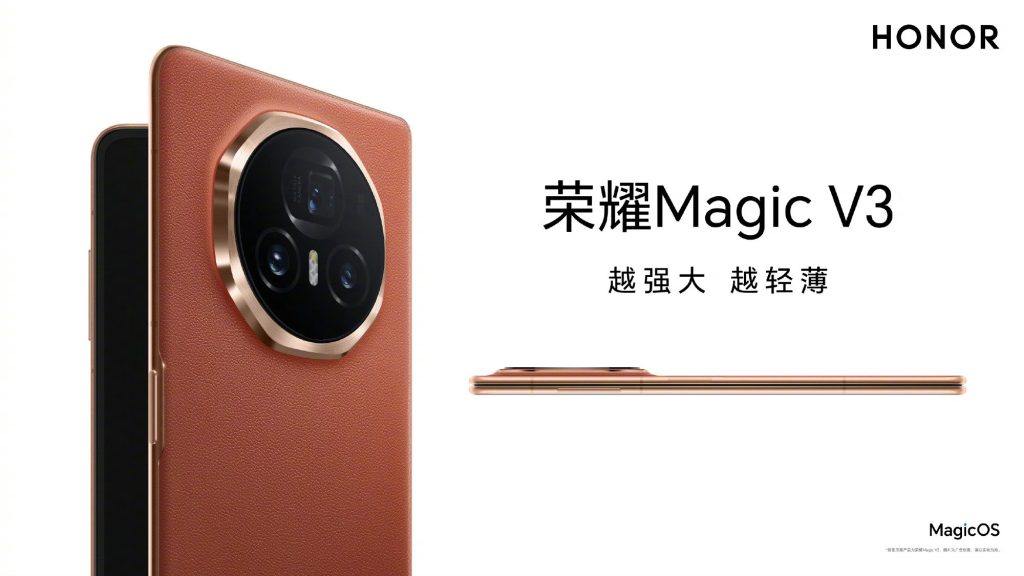
Honor recently announced that it will unveil the Honor Magic V3 on July 12 in China. This new model will succeed the Magic V2, renowned as the slimmest foldable phone from last year. Today, the brand released an image of the Magic V3, showcasing its design for the first time.
Honor Magic V3 poster released
Honor Magic V3
The above image reveals that the Honor Magic V3’s back panel has a leather finish, providing a premium feel and enhanced grip. It has a large round camera module surrounded by an octagonal metallic gold border. It includes a vertically positioned LED flash and three camera sensors, including a periscope telephoto sensor.
The sides of the phone are slim and likely made of metal, adding to the overall durability and high-end aesthetic. It continues to feature a side-facing fingerprint scanner, like the Magic V2. The company has also hinted at the slimness of the phone, claiming it to be thinner than its predecessor. All in all, the Magic V3 has a premium look.
According to reports, the camera module of the Magic V3 includes a 50-megapixel primary camera, and its periscope telephoto camera supports up to 3.5x optical zoom. Under the hood, the Magic V3 will feature the Snapdragon 8 Gen 3 chipset. It is also expected to support 66W fast charging and offer satellite connectivity. The rest of the specs of the V3 are yet to be revealed.
Honor will also announce the Honor Magic Vs3 alongside the Magic V3. The Vs3 could be an affordable offering equipped with the Snapdragon 8 Gen 2 chipset. Apart from the new foldables, Honor will unveil the Honor MagicPad 2 tablet equipped with a 12.3-inch display and the Honor MagicBook Art 14 notebook.
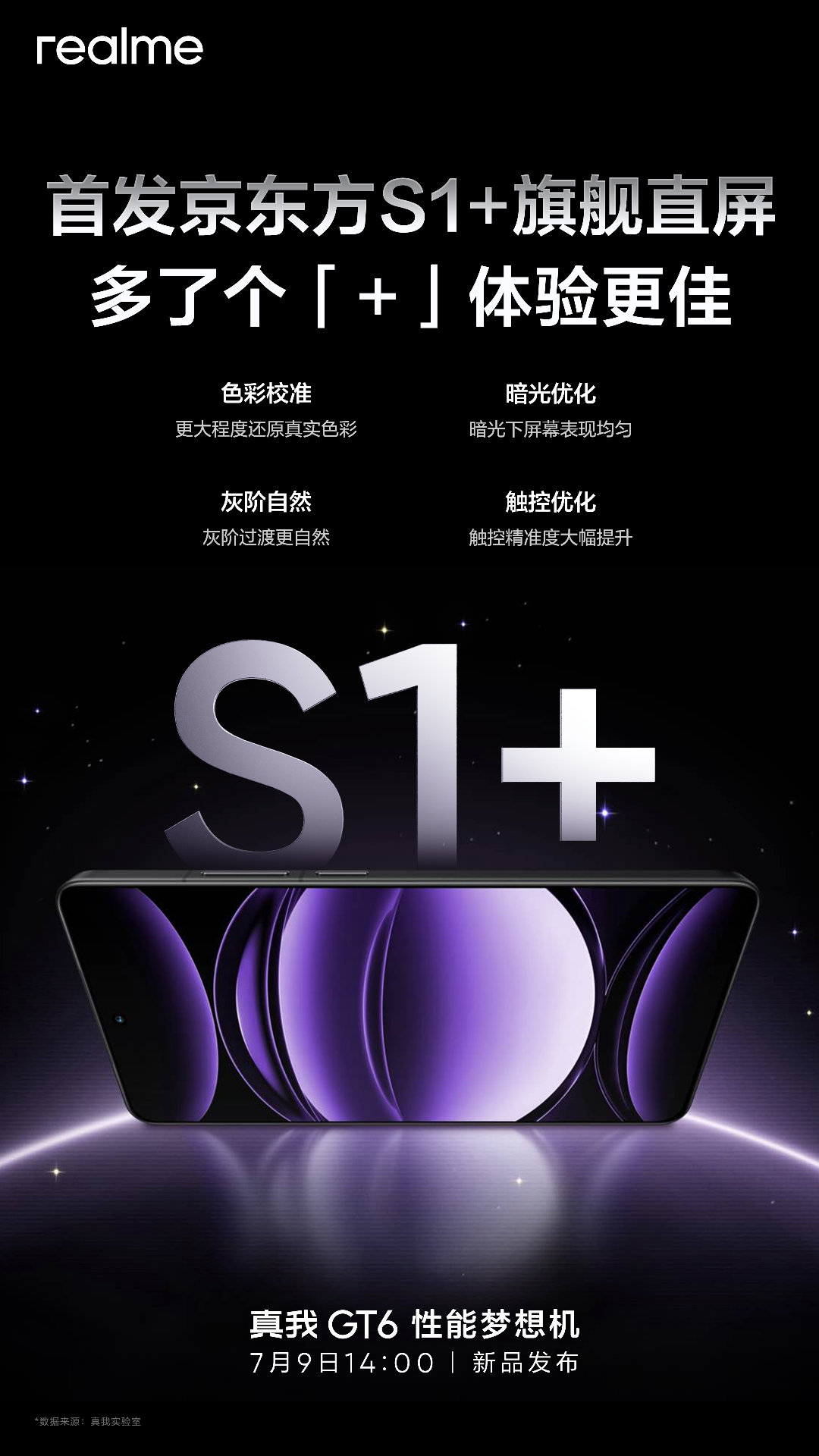
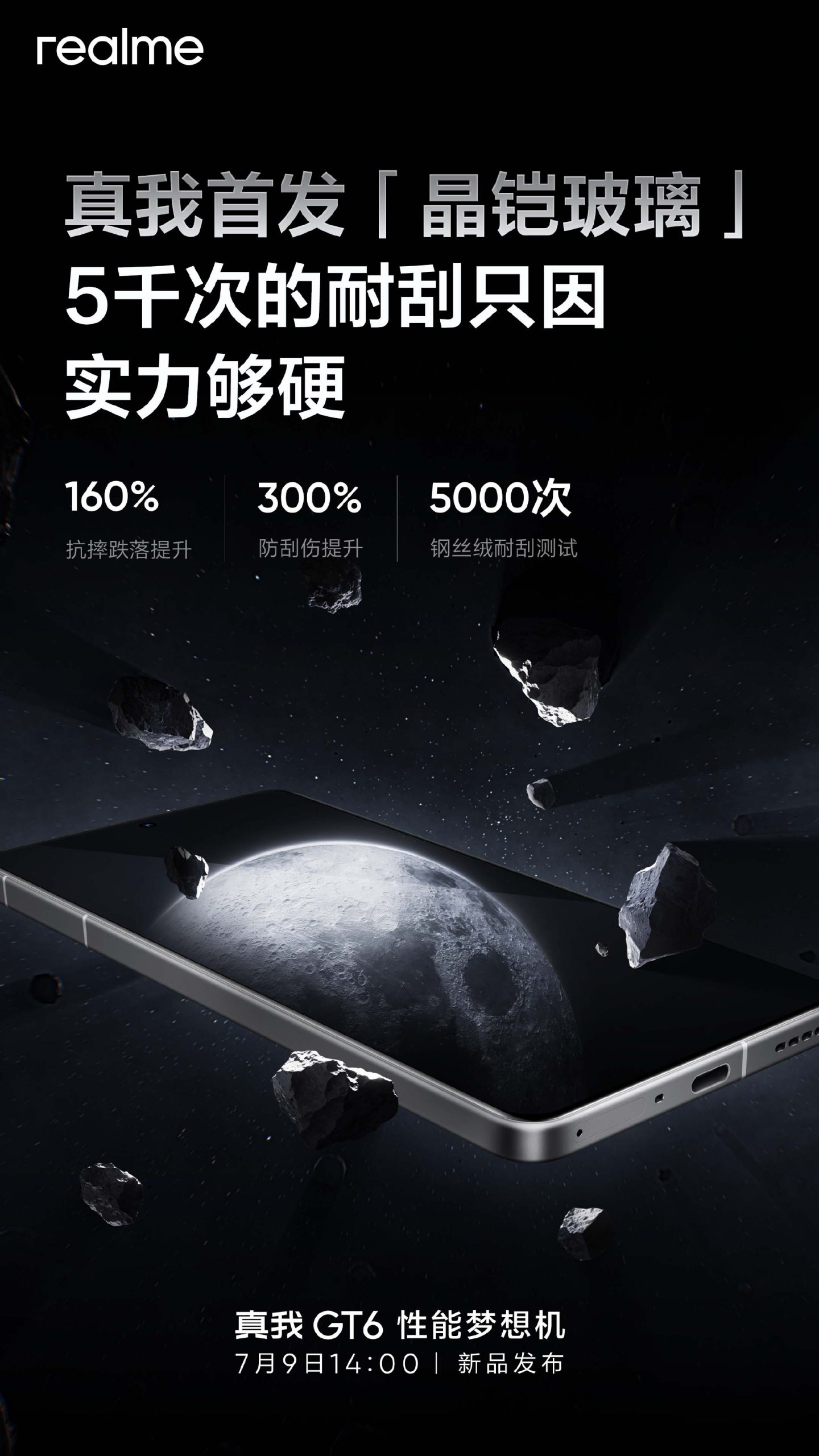
On July 9, Realme will unveil the Realme GT 6 in China. In the lead-up to the launch, the brand has been actively confirming key device features. Today, Realme released two posters highlighting the phone’s screen and display protection.
Realme GT 6 to be world’s first phone with BOE S1+ screen
According to Realme, the upcoming Realme GT 6 will be the world’s first smartphone to feature the BOE S1+ display, which has a flat design. The screen comes with improvements in departments, such as natural color calibration, dark light optimization, natural grayscale, and touch optimization.
The brand is yet to confirm the display size of the device. The screen is said to support a 1.5K resolution, a refresh rate of 144Hz, and a peak brightness of up to 6,000 nits.
Realme also confirmed that the GT 6 will come equipped with “Crystal Armor Glass” protection for the GT 6’s screen. It offers a 160 percent increase in drop resistance and a 300 percent increase in scratch resistance. This glass has undergone rigorous testing, including 5,000 steel wool scratch resistance tests, proving its durability and robustness against everyday wear and tear. For enhanced durability, the GT 6 is already confirmed to feature a metal middle frame.
Under the hood, the Realme GT 6 will feature the Snapdragon 8 Gen 3 chipset. The other details of the GT 6 are yet to be officially confirmed.
According to reports, the Realme GT 6 will feature up to 24 GB of LPDDR5x RAM, up to 1 TB of UFS 4.0 storage, and a 5,800mAh battery with 100W fast charging. On the back, it will have an OIS-enabled 50-megapixel + 8-megapixel + 2-megapixel triple camera unit.
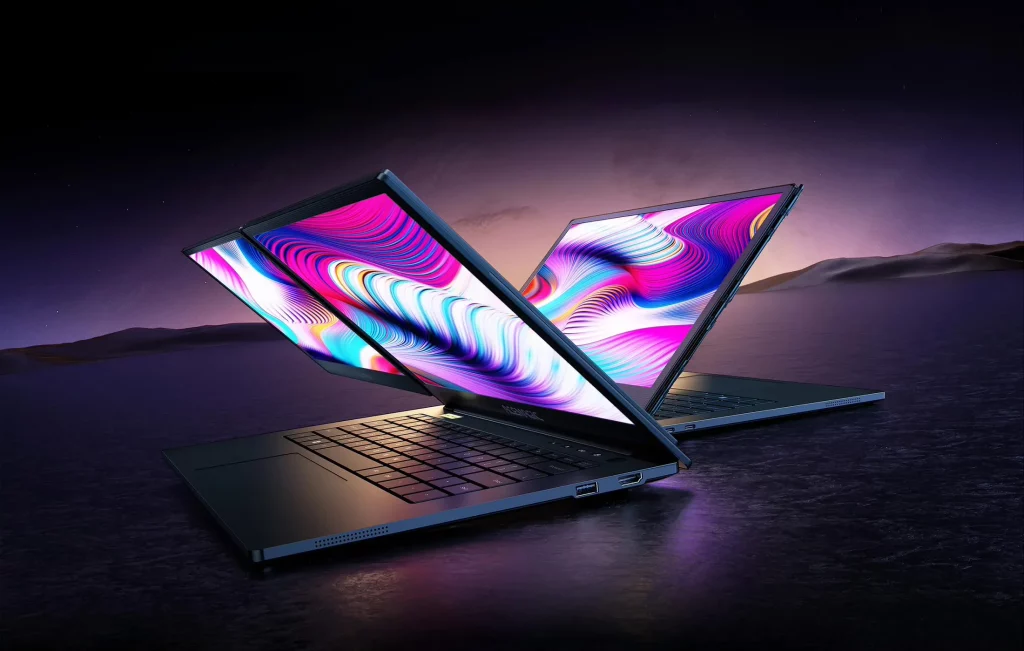
Acemagic unveiled their latest laptop, the Acemagic X1 dual-screen business notebook, following a showcase of their Z1A concept at the Taipei Computer Show. This unique laptop boasts two 14-inch Full HD displays arranged in a horizontal layout. The secondary screen offers impressive flexibility with its 360° rotation. Users can unfold it for extended workspace or even reverse it completely to the back.
The laptop has 16GB of DDR4 memory coupled with a 1TB SSD
For connectivity, the Acemagic X1 features two USB Type-C ports on the left side. One is dedicated to charging, while the other offers data transfer speeds of 5Gbps and video output capabilities. The right side complements these with a 5Gbps USB 3.0 port and an HDMI 2.0 interface.
Powering the device is a Core i7-1255U processor (2 Performance-cores + 8 Efficient-cores) paired with 16GB of DDR4 memory. Storage is handled by a 1TB PCIe 3.0 solid-state drive.
While pricing and specific release dates haven’t been announced yet, the Acemagic X1 promises to be a decent option for business professionals looking for a versatile dual-screen laptop.
Sabrent has launched a new line of microSDXC memory cards called the Rocket V60, designed with videographers in mind. Available in 128GB, 256GB, and 512GB capacities, these cards boast V60, UHS-II, and A1 performance standards for smooth recording and fast app performance.
The cards are great for recording even high-res 8K videos
The Rocket V60 guarantees a minimum write speed of 60MB/s, ensuring seamless recording even for high-resolution 8K videos. It also meets the A1 standard, signifying its ability to deliver fast random read and write speeds, ideal for running apps stored on the card.
An UHS-II interface allows for high-speed data transfer, though Sabrent hasn’t specified the exact maximum read speeds. The UHS-II technology potentially offers backward compatibility with UHS-I devices, but performance will be limited to UHS-I speeds in such cases. The theoretical maximum transmission speed for UHS-II is 312MB/s.
Pricing for the Sabrent Rocket V60 microSDXC memory cards varies depending on capacity:
Chinese space launch company Oriental Space successfully conducted a critical test for their Gravity-1 rocket. This test involved transporting the rocket in a vertical state over 1700 kilometers by sea in China, simulating a real launch scenario.
The journey included assembly, embarkation, transportation, disassembly, and disembarkation
The test aimed to ensure the rocket’s ability to withstand harsh sea conditions and verify safety measures during long-distance maritime transport. The 920 nautical mile journey from Dandong to Lianyungang included assembly, roll-on/roll-off embarkation, transportation, disassembly, and disembarkation.
The test also addressed logistical challenges by successfully separating and reattaching the satellite cover assembly at a port stop. This innovation allows for more convenient docking procedures at launch sites.
This successful test paves the way for Oriental Space’s “front shop and back factory” model, with their newly completed Assembly, Integration and Testing Center serving as the core.
The Gravity-1 rocket itself boasts impressive capabilities. As China’s (and the world’s) first all-solid bundled medium-sized launch vehicle, it is designed for rapid response and large-scale deployment of small and medium satellites in low Earth orbit. It offers a flexible configuration with a core stage, boosters, and switchable engine options for varying payloads.
Samsung continues to offer affordable products. Recently, Android Headlines spotted a Galaxy A16’s 5G version. Now, Gizmochina has spotted the Galaxy A16’s LTE variant in the IMEI database. The new Galaxy A series is highly anticipated. So what will these smartphones offer us? We will see this over time.
Galaxy A16 4G revealed
Samsung’s Galaxy A series continues to expand with new models. The Galaxy A16 4G is expected to offer much better features than the predecessor Galaxy A15 4G. The differences between the Galaxy A14 and Galaxy A15 was surprised us. We expect Samsung to launch the new Galaxy A16 4G with amazing features. Galaxy A16 4G appeared in the IMEI database with the model number “SM-A165F“.
Galaxy A16 4G SM-A165F
Galaxy A15 4G comes with a 6.5-inch Super AMOLED display. This display has high-end features such as 90Hz refresh rate and 800 nits brightness. The device is powered by the Mediatek Helio G99 chipset. Up to 8GB of RAM and up to 256GB of storage options are available. In terms of camera features, the device comes with a triple camera setup on the back. The 50MP main camera, 5MP ultra wide-angle camera, and 2MP macro camera. On the front, there is a selfie camera with a resolution of 13MP.
In addition, the Galaxy A15 4G draws attention with a huge 5000mAh battery. The battery offers 25W fast charging support. The device comes out of the box with the Android 14 operating system with One UI 6 interface. Samsung also guarantees software updates for 4 years for this device. In addition, the fact that it will receive security updates for 5 years provides an important advantage for users.
More details about Samsung’s Galaxy A16 4G are expected to emerge soon. The curiosity is how this new model will meet the expectations of users. We will see what effect the Galaxy A16 series will have on the market. Of course, it should be noted that the Galaxy A16 series will be introduced between November and December. The previous Galaxy A15 series was launched in December 2023.
Samsung is preparing to introduce new foldable smartphones. The Galaxy W25 and W25 Flip have passed the 3C certification and some claims have been made about the smartphones. MySmartPrice said that the Galaxy W25 will be the Chinese version of the Z Fold 6. But things are not as expected.
Many websites published false information about it. Here’s the real thing: the Galaxy W25 will be a rebranded version of the Z Fold 6 Slim or Z Fold 6 Ultra (the name is not certain) with the internal model number Q6A. When I contacted Ross Young, he had already confirmed this. I’m going to bring this information out again with our database, both on Android Headlines and now on Gizmochina.
Galaxy W25 is a rebranded version of the device have the internal codename Q6A
We told you that the Galaxy Z Fold 6 Ultra will be sold in more countries. I have already spotted that the Galaxy W25’s model number is SM-W9025. This model number was revealed with the internal codename Q6A. Q6A belongs to a special foldable device that is expected to be the Z Fold 6 Ultra or Z Fold 6 Slim.
Ross Young said that he has a device with the internal codename Q6A and in addition, Young said that the new device is thinner than the Z Fold 6. That’s why everyone thought the device had the name Z Fold 6 Slim. Anyway, even if it has either the Ultra or Slim name, that’s not really the point.
Everyone on the internet is saying that the Galaxy W25 will be a rebranded version of the Z Fold6. This is completely wrong. The Galaxy W25 will have the same specifications as the Z Fold 6 Slim, not the Z Fold 6. The model number SM-W9025 belongs to the foldable smartphone with the internal codename Q6A. For some reason, no one pays much attention to the articles, I don’t understand this.
Also in this article, we confirm that the Galaxy W25 Flip is a rebranded Galaxy Z Flip 6. In the IMEI Database, we saw a smartphone called Galaxy Z Flip6 with model number SM-W7025. Actually, this model is the W25 Flip, as you can tell from the model number. But the point here is that the Galaxy W25 Flip will be a rebranded version of the Z Flip 6. Therefore, the market name seems to be Galaxy Z Flip 6. But this does not apply to the Galaxy W25.
In addition, it should be noted that. Galaxy Z Fold 6 Slim is asked why it is not sold all over the world. The reason for this is cost. Developing a screen is extremely costly and this directly affects the price of the device. Considering that even the Z Fold 6 will be very expensive, we can accept it is normal that the Z Fold 6 Slim is not coming. Galaxy Z Fold 6 Slim will only be sold in Korea and China. Anyway, I will end this article with two equations that you should keep in mind:
Galaxy Z Fold 6 Slim or Z Fold 6 Ultra (name uncertain)=SM-F958N=Q6A=SM-W9025=Galaxy W25
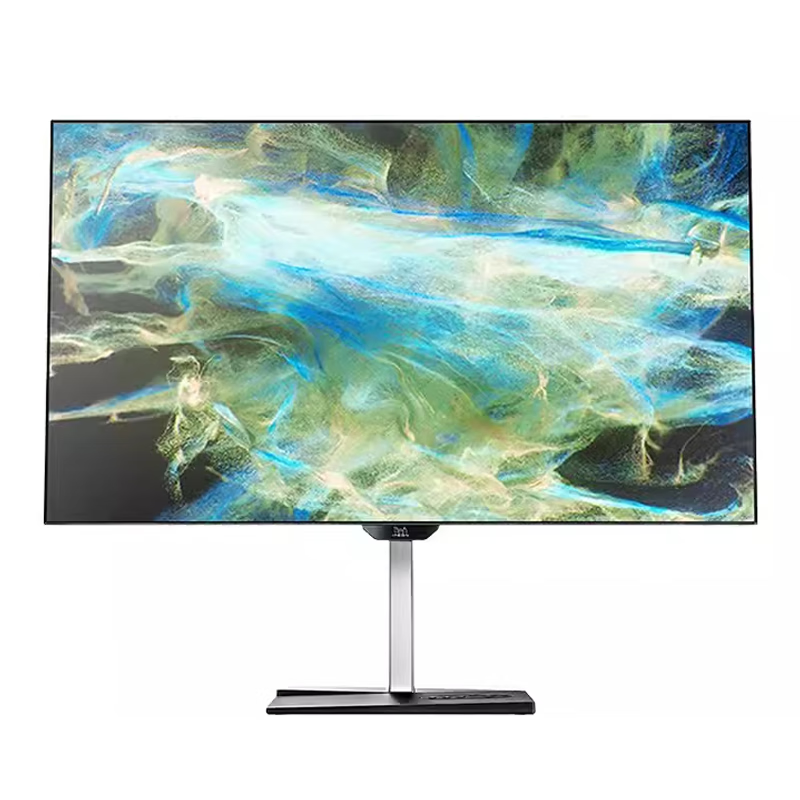
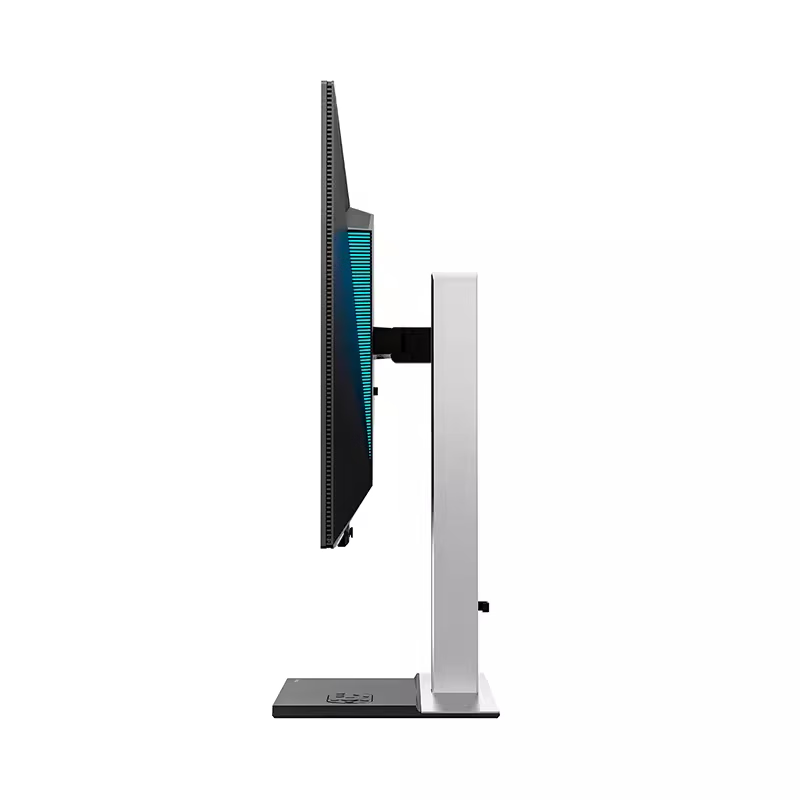
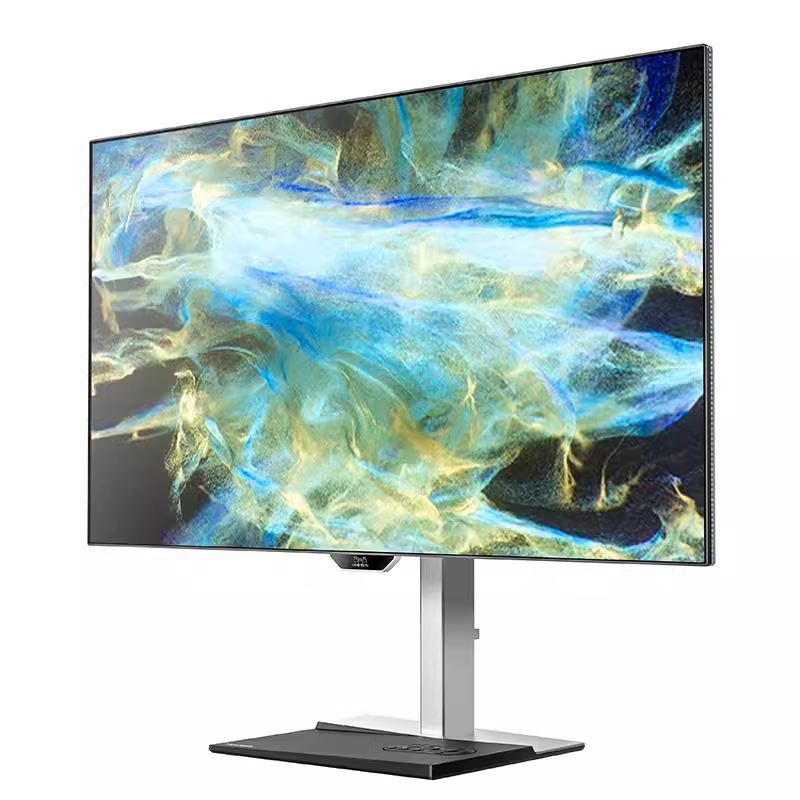
ViewSonic has launched its latest high-end gaming monitor, the XG323-4K-OLED2, in China. The 31.5-inch monitor is priced at 10,999 yuan (approximately $1,512) and it is now available on JD.com. Let’s check out its key specs.
ViewSonic XG323-4K-OLED2 Specifications:
The gaming monitor features a 31.5-inch LG OLED panel with a 3840 x 2160 resolution. It features a dual mode switch, enabling users to toggle between 4K 240Hz and FHD 480Hz refresh rates, catering to different gaming needs. The monitor boasts an impressive 0.03ms GTG response time, ensuring smooth and clear high-speed action scenes.
It delivers a peak brightness of 450 nits at 25% APL, reaching a staggering 1300 nits in HDR mode, meeting the VESA DisplayHDR True Black 400 standard. This translates to deep blacks, vivid colors, and an incredibly realistic viewing experience.
The OLED panel also offers a native 10-bit color depth, resulting in over 1.07 billion colors, far exceeding the human eye’s capacity. Additionally, the 98.5% DCI-P3 color gamut coverage ensures vibrant and accurate colors, ideal for creative professionals working on photos, videos, or animation.
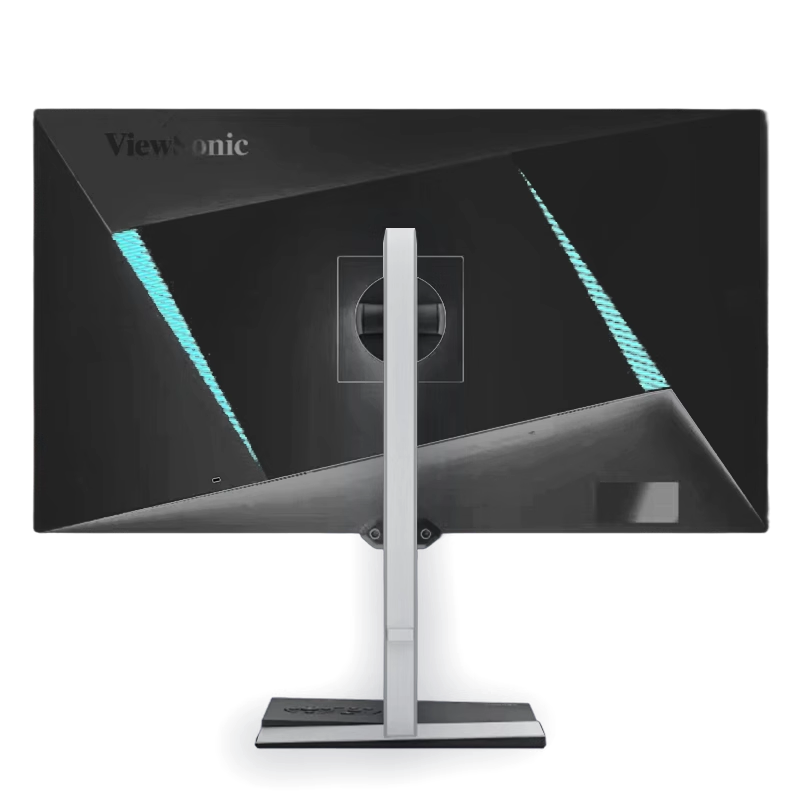
The ViewSonic monitor comes equipped with two HDMI 2.1 ports, two full-featured DisplayPort 2.1 ports with UHBR20 support for uncompressed high refresh rates, and a USB Type-C port with a whopping 140W Power Delivery (PD) for charging your laptop while connected to the monitor.
The monitor supports adaptive sync technology, including AMD FreeSync via HDMI and DP, to prevent screen tearing and stuttering for a smoother gaming experience.
The monitor includes a remote control for easy operation from a distance and a multi-functional lifting base that allows for adjustments in height, tilt, swivel, and rotation. For audio, the monitor comes with two 5W surround stereo speakers that eliminate the need for external speakers.
OnePlus is rolling out the new OxygenOS 14.0.0.805 update for users in India. This update includes the June 2024 security patch, fixes various user interface bugs, and addresses the issue of excessive storage consumption by system data.
The update is currently available for both the OnePlus 11R and OnePlus Pad Go, it is still in the rollout phase. If the new update hasn’t appeared on your device yet, please be patient as it will be gradually released. OnePlus 11R update comes with the version number CPH2487_14.0.0.805(EX01).
OnePlus 11R OxygenOS 14.0.0.805 changelog
Touch control
App icons on the Home screen now respond faster to your taps.
Improves touch control responsiveness when opening and closing apps.
Optimizes animations when opening and closing multiple apps.
Adds a transition animation when pulling down Quick Settings.
Optimizes animations when dragging app icons on the Home screen.
Animation upgrade
Adds a transition animation when opening and closing Home screen widgets.
Adds a transition animation for clock widgets when the screen is turned off.
Improves how Home screen widgets are displayed.
Security
The permissions for Calendar are now granted at a minimum level to provide the maximum security for your information.
Improves the Clipboard privacy info protection function, which automatically detects privacy information on the clipboard and prevents unauthorized access by apps without your consent to minimize the risk of privacy leaks.
Games
Improves gaming stability.
Fixes an issue where the screen might turn black while playing a game.
System
You can now choose not to show the track when drawing the Lock screen pattern to unlock your device.
Music controls can now be displayed in Live Alerts.
Integrates the June 2024 Android security patch to enhance system security.
Fixes an issue where the volume slider in Quick Settings and the one triggered by pressing the physical volume button might appear at the same time.
OnePlus Pad Go has received the OxygenOS 14.0.0.805 update with two different version numbers: OPD2304_14.0.0.805(EX01) and OPD2305_14.0.0.805(EX01).
OnePlus Pad Go OxygenOS 14.0.0.805 changelog
System
You can now choose not to show the track when drawing the Lock screen pattern to unlock your device.
Integrates the June 2024 Android security patch to enhance system security.
Improves how Home screen widgets are displayed.
Fixes an issue where system data takes up too much storage space.
Fixes an issue where birthdays from Contacts might not be synced in Calendar events.
Games
Improves gaming stability.
Fixes an issue where the screen might turn black while playing a game.
You can check the official OnePlus Community if you have questions about the update for OnePlus 11R and OnePlus Pad Go from the given links.
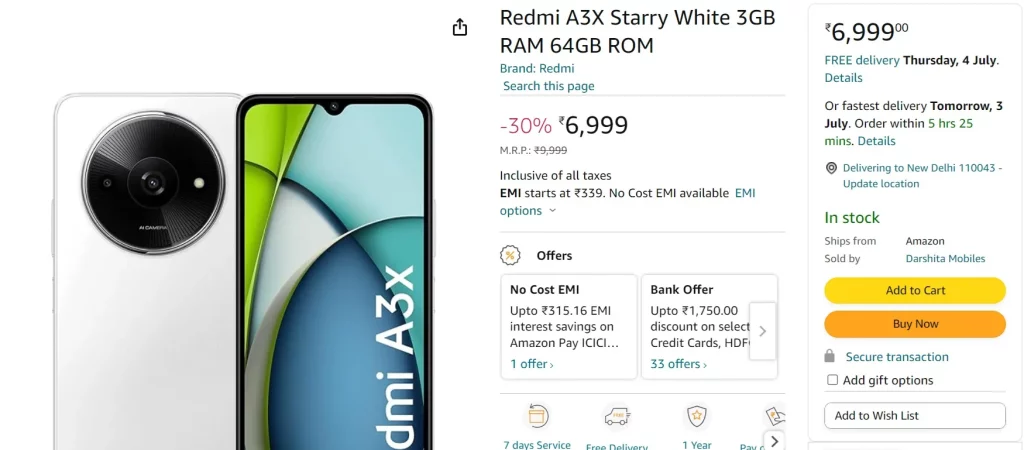
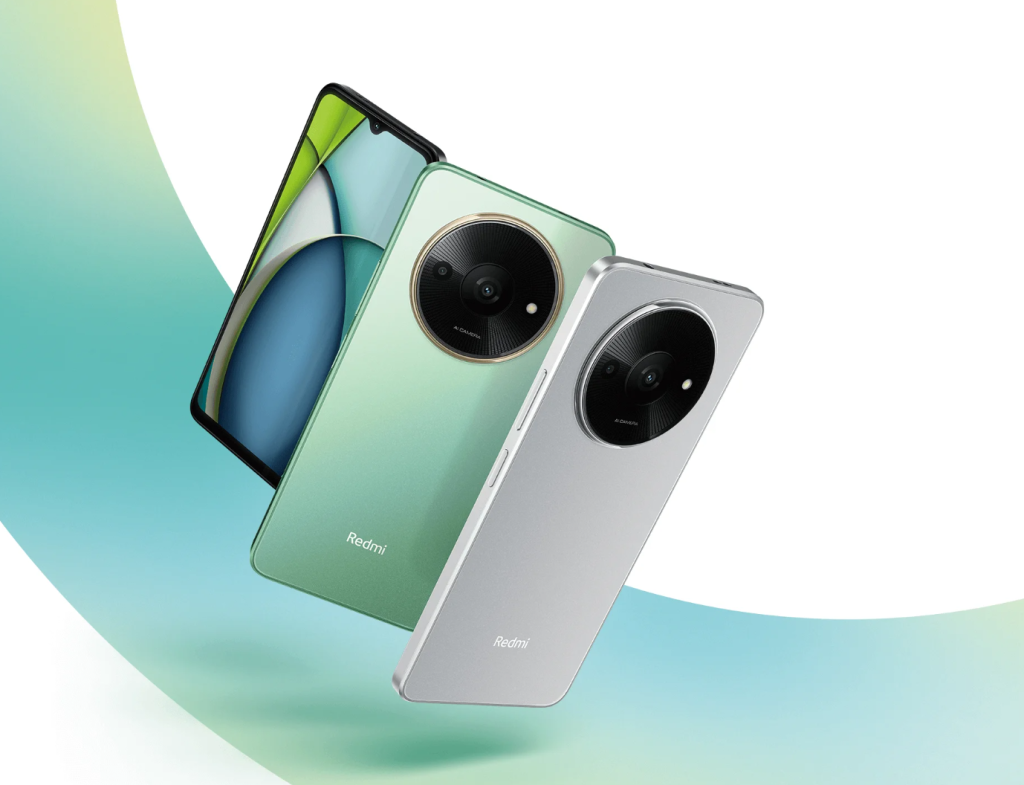
Last month, Redmi unveiled its new A3x smartphone in the global market. While the brand has yet to make an official announcement about its launch in India, an Amazon listing of the device was spotted by folks at SmartPrix, revealing some of its details including pricing.
As per the Amazon India listing, the Redmi A3x will have a 3 GB RAM + 64 GB storage variant in India which will cost Rs 6,999. From the global launch earlier, we know that the device also has a 4 GB RAM and 128 GB storage model. The model spotted on Amazon India is the Starry White color variant. We can expect more colors such as Midnight Black, Ocean Green, and Olive Green at the official launch.
Redmi A3X specs:
The Redmi A3x has a 6.71-inch screen with a 1650 x 720 resolution and a 90 Hz refresh rate. It runs on a Unisoc Tiger T603 processor with two ARM Cortex-A75 cores at 1.8 GHz and six Cortex-A55 cores at 1.6 GHz.
It comes with 3 GB or 4 GB of LPDDR4X RAM and 64 GB or 128 GB of eMMC 5.1 storage, expandable up to 1 TB via MicroSD. The phone has a 5,000 mAh battery with 10 W charging through USB Type-C.
The device features an 8 MP main camera, a QVGA lens, and a 5 MP front camera. It includes a 3.5 mm headphone jack, dual SIM capability, and a side-mounted fingerprint sensor. The Redmi A3x runs on Android 14 and will receive two major Android updates and security updates through 2027.
In related news, Xiaomi is also preparing to launch the affordable Redmi Pad SE 8.7 4G tablet in India. As the name suggests, this device will come with LTE connectivity, allowing users to connect to the Internet and also make calls. Since the device has already cleared the Bureau of Indian Standards certification, we can expect to hear more about it from the brand in the coming weeks.
Last week, Vivo unveiled the Y28s 5G smartphone through its official website on the global stage. Today, it has silently launched the smartphone in the Indian offline market.
Vivo Y28s specs:
The Vivo Y28s 5G features a 6.5-inch LCD display with a waterdrop notch, thick bottom chin, HD+ resolution, 90Hz refresh rate, and 840 nits peak brightness. It has a side-mounted fingerprint scanner integrated into the power button and a rectangular rear camera module. The phone is IP64 water-resistant.
The device includes a dual-rear camera setup with a 50MP main sensor and a 2MP secondary lens, along with an 8MP front camera. Camera features include Night Mode and built-in filters.
Powered by a MediaTek Dimensity 6300 processor, the Vivo Y28s 5G comes with 8 GB of RAM and up to 128 GB of storage in India, expandable up to 1 TB via a microSD card. It has a 5,000mAh battery with 15W charging support. In some markets (Europe, Malaysia, Taiwan, Thailand), the phone won’t come with a bundled charger. It runs on Funtouch OS 14 based on Android 14. Connectivity options include dual-band WiFi, Bluetooth, 5G, a USB-C port, and a 3.5mm jack.
Pricing and availability
As per 91mobiles Hindi, Vivo has brought the Y28s 5G smartphones in three configurations in the Indian offline market:
4 GB RAM + 128 GB model for Rs 13,999
6 GB RAM + 128 GB model for Rs 15,499
8 GB RAM + 128 GB model for Rs 16,999
That said, the 8 GB + 128 GB model will be available on store shelves a few weeks later. As for color options, the device will be sold in Purple and Blue colors.
Everyone loves and uses the AI features offered in Google‘s Pixel phones. Recently, Google introduced Gemini alongside Google Assistant on Android phones. Now, Google is preparing to roll out a feature similar to Microsoft’s Recall.
Microsoft’s Recall AI feature takes continuous screenshots as you use your computer, storing the information locally. This feature is available exclusively on “Copilot PCs.” While it may seem like a privacy risk, it allows users to access past information easily. For example, you can ask Microsoft Recall about a file you were working on, even if the specific application is not running. It can retain data as the software continuously saving what you do on your computer.
Google’s new AI features
According to recent news shared by ITHome, Google might introduce a similar feature. Among the new AI features Google plans to unveil are “Screenshots” and “Studio.” Both features are new. While the exact functionality of the “Screenshots” feature isn’t clear yet, the description suggests you’ll be able to retrieve information from previously saved screenshots (Find the info you need from your screenshots). Unlike Microsoft Recall, which automatically captures screenshots, Google’s approach may only gather information the screenshots you took on your own.
This feature will allow you to gather information from previously saved screenshots. For instance, if you took a screenshot of a place on Google Maps two weeks ago and can’t remember the name, you can ask Google’s AI, Gemini, “What places did I look at on Google Maps before?” This will save you from digging through your gallery for the thing you look for.
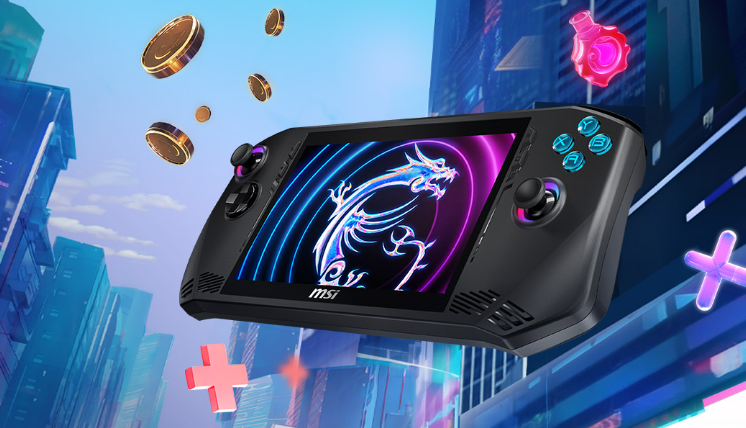
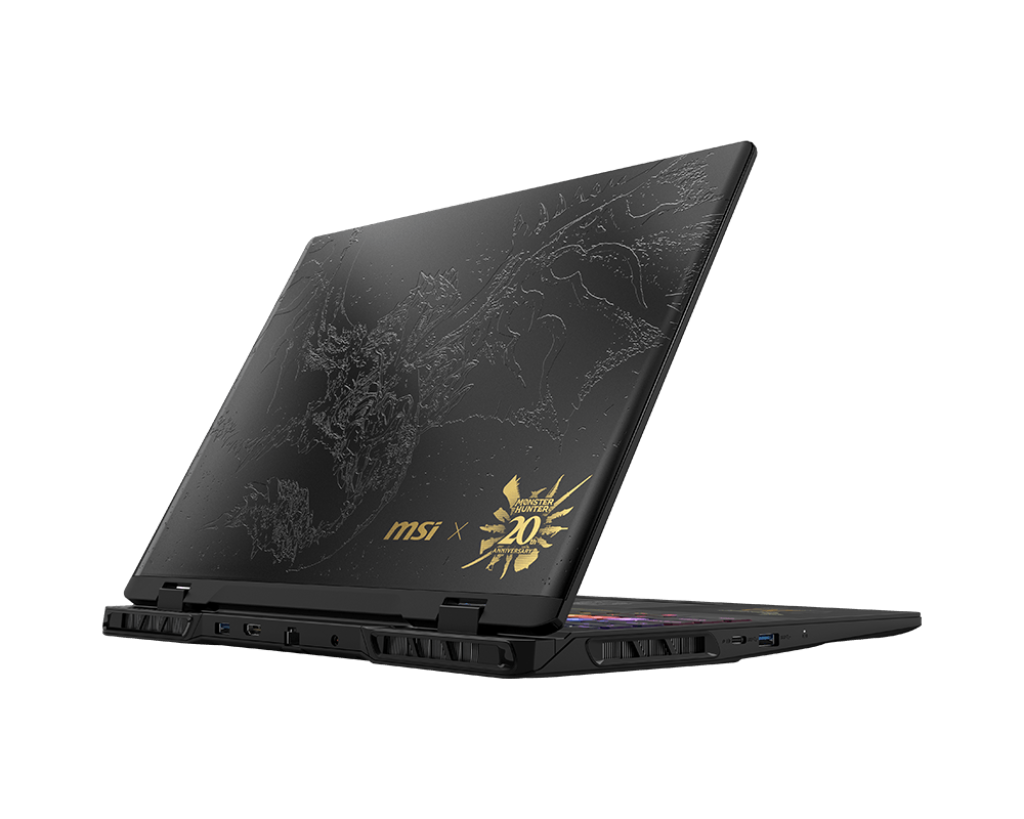
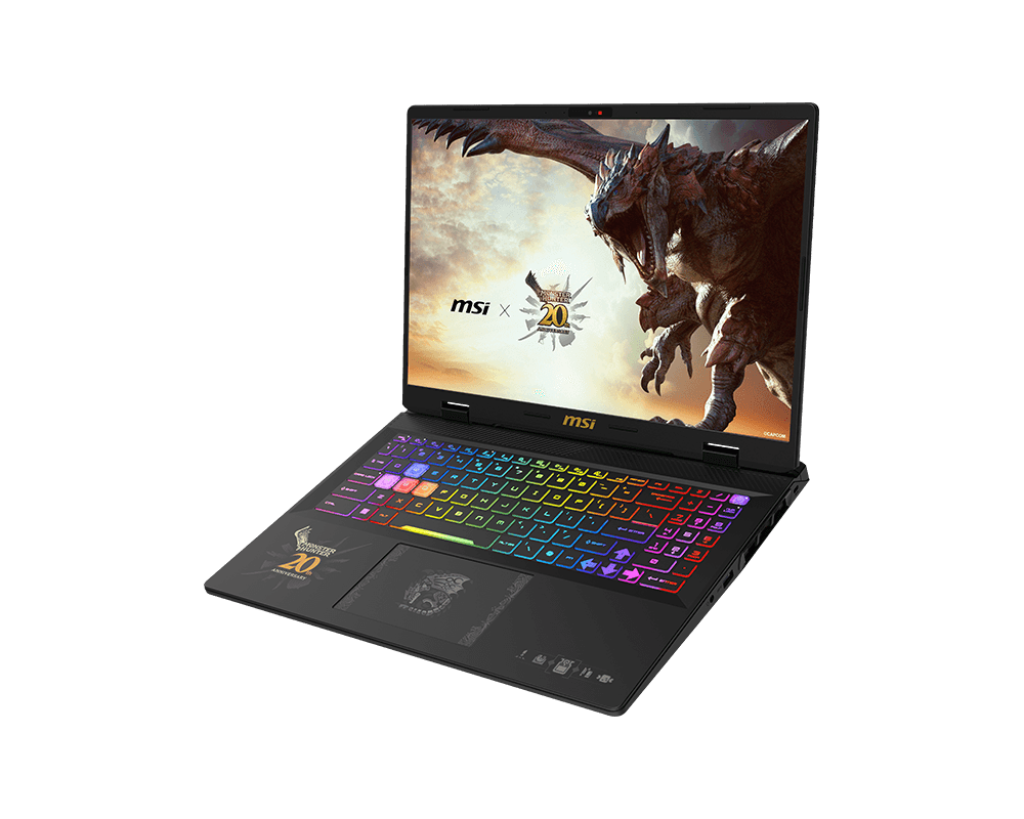
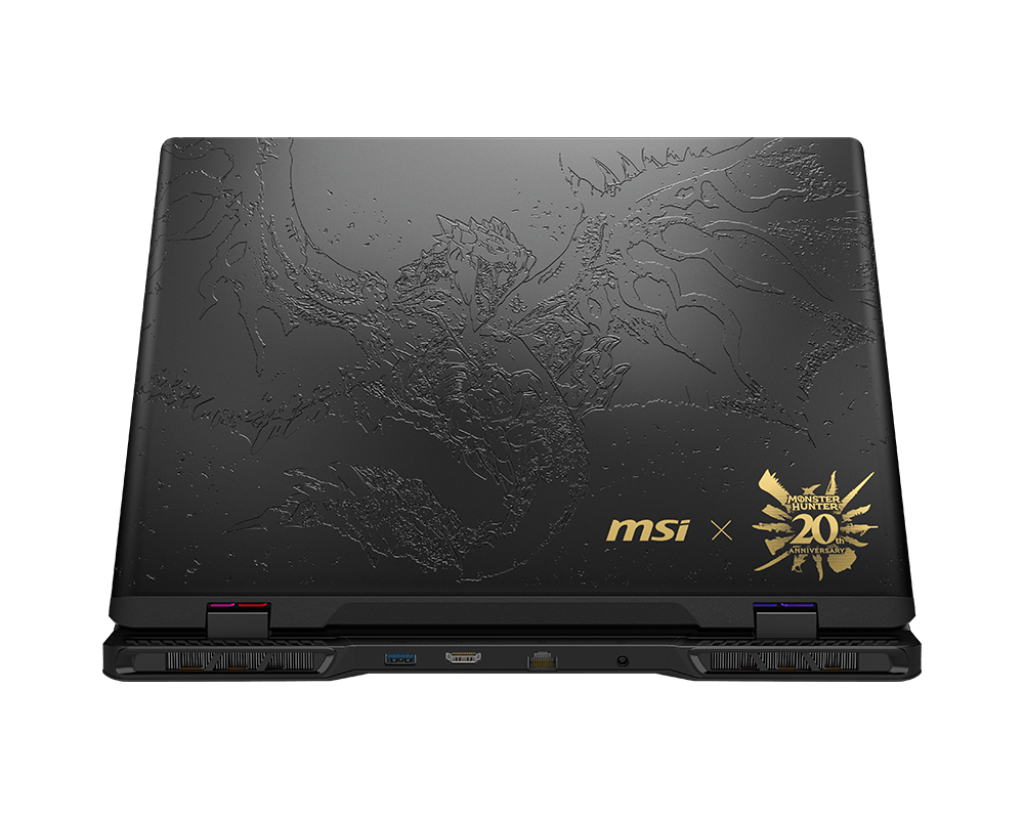
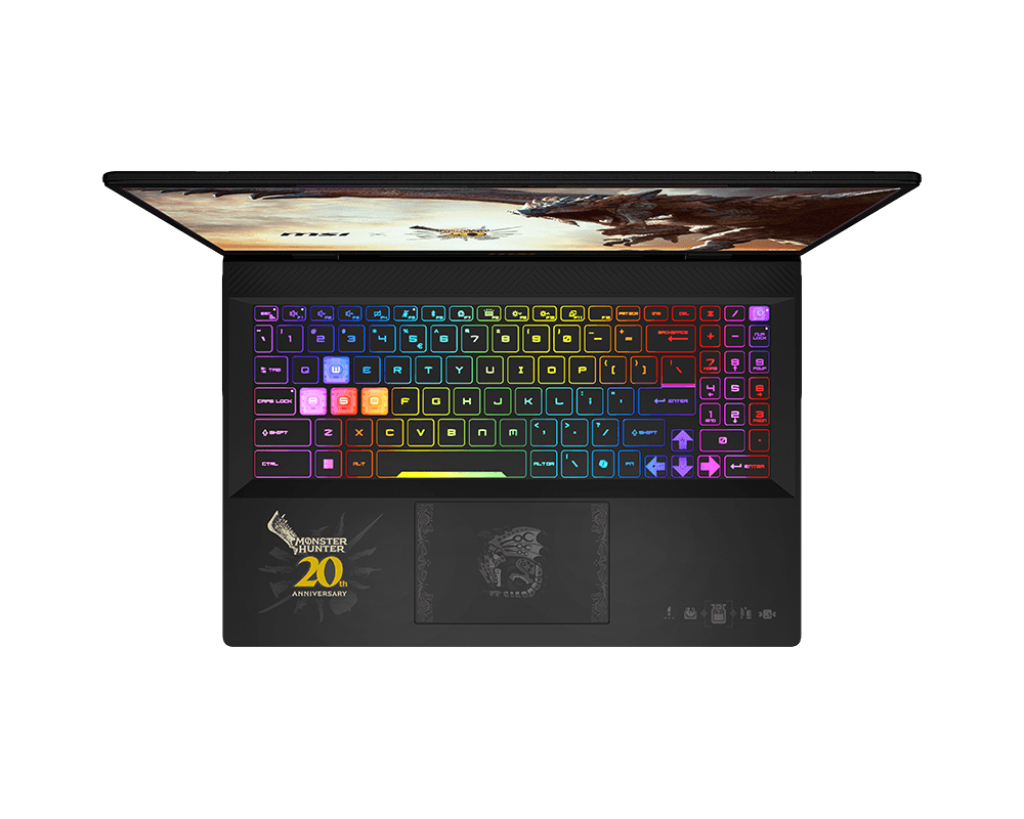
MSI has introduced two new gaming products in India: the MSI Claw gaming handheld and the MSI Crosshair 16 HX Monster Hunter Edition gaming laptop.
MSI Claw: Handheld Gaming Device
The MSI Claw is powered by the Intel Core Ultra processor with an integrated Intel Arc GPU. It has a 7-inch Full HD touchscreen display with a 120Hz refresh rate and 100% sRGB coverage for vibrant colors and smooth gameplay.
Customization is available through the MSI Center M software. The Claw also features an ergonomic design and RGB light rings around the analog sticks and buttons.
Pricing:
Ultra 5 model with 512GB SSD: Rs. 78,990 (limited offer: Rs. 68,990)
Ultra 7 model with 512GB SSD: Rs. 86,990 (limited offer: Rs. 76,990)
Ultra 7 model with 1TB SSD: Rs. 89,990 (limited offer: Rs. 79,990)
In collaboration with CAPCOM, MSI has released the Crosshair 16 HX Monster Hunter Edition laptop. This limited edition laptop features Rathalos artwork on the cover and a dragon totem on the touchpad.
Specifications include:
Processor: Intel Core i7-14700HX
Operating System: Windows 11 Home
Memory and Storage: Up to 96GB DDR5 RAM, dual NVMe M.2 SSD slots
SERES, a user-centralized E-Powertrain technology development & Manufacturing company, has announced that it will spend 2.5 billion yuan to acquire the “Wenjie” series of trademarks and related assets from Huawei and its affiliates. According to a report, Huawei has responded that it will transfer the “Wenjie” series of trademarks to SERES and will continue supporting SERES in using its technologies under this trademark.
Huawei’s smart car technologies to enrich the market through its partners
The smartphone maker has always insisted on not making cars, but developing technologies to continue to help car companies to offer good cars to people. Back in 2020, Ren Zhengfei, the CEO of Huawei, stated the company does not plan on making its own cars.
However, rumors were looming regarding Huawei possibly working on a smart car of its own. Since then, the brand has launched various systems that were featured on smart cars from other firms. The company will continue to work with car companies to create and implement excellent smart car technologies and uplift the user experience.
The company reportedly already has transferred some trademarks related to its smart car technologies to companies such as Chery and BAIC. Transferring the trademarks to car manufacturers reflects Huawei’s strategy of gradually offering its smart car technologies to a large number of users. it will not only increase Huawei’s contribution in the field but also improve the connected vehicle technology.
With the transfer of trademarks such as “Intelligent World”, “Enjoy World” and “Wenjie” (translated from Chinese) Huawei’s contribution to smart car technologies is becoming increasingly clear.
SERES said with the acquisition of the “Wenjie” trademark, they will further deepen their partnership with Huawei. The company also noted that it will also use the new technologies outside of China.
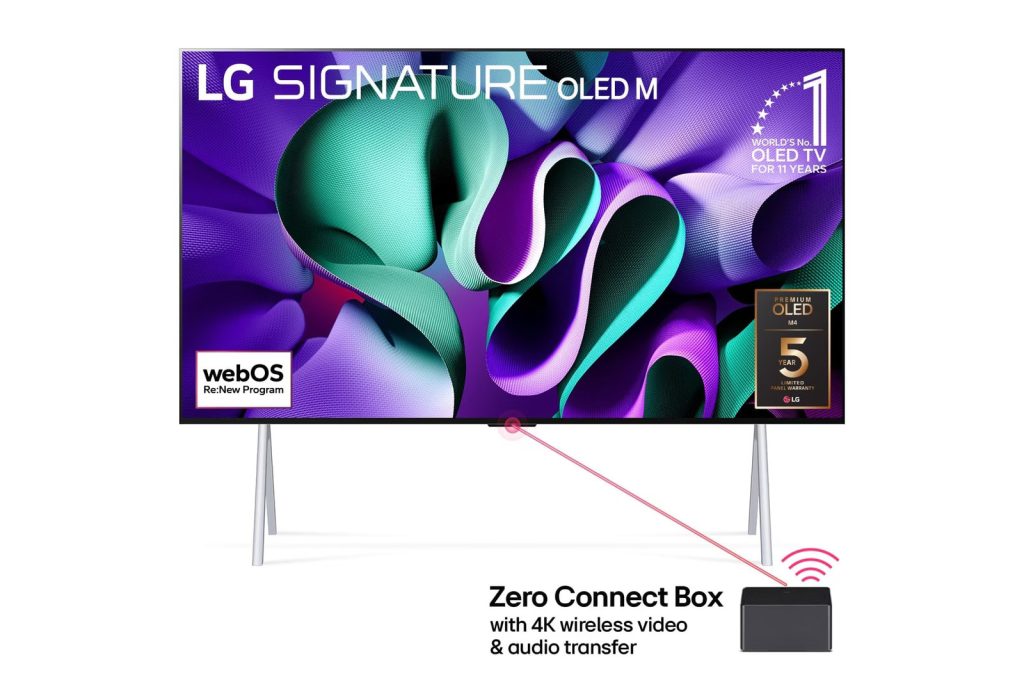
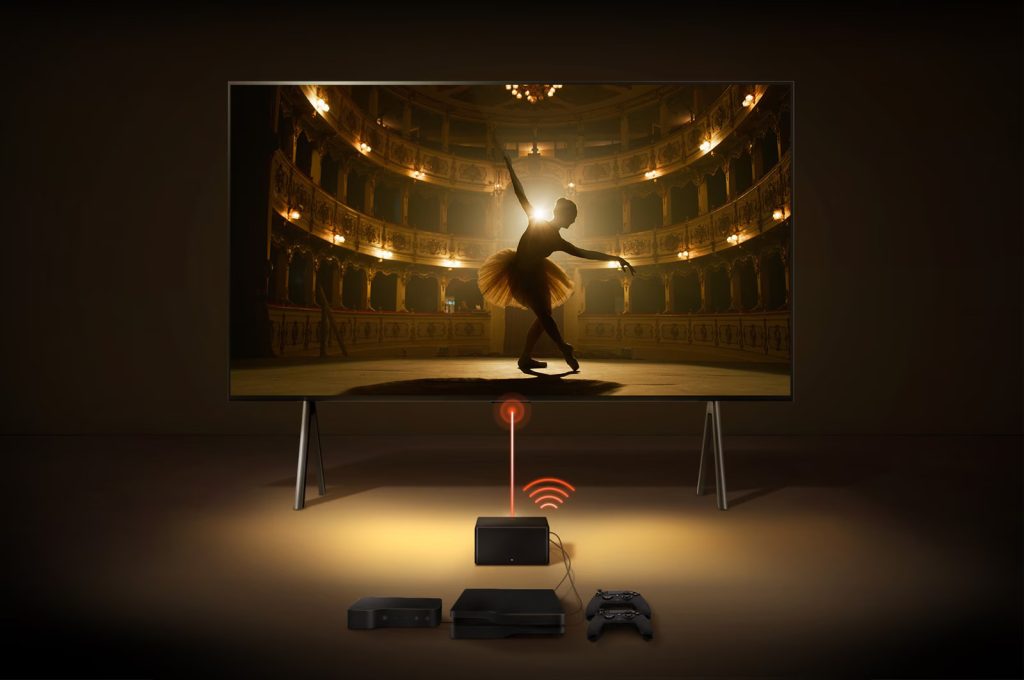
LG Electronics has launched its latest OLED evo M4 series TV globally. This new series, first unveiled at CES 2024, features a Zero Connect Box, which allows for seamless wireless connectivity between the TV and its receiver.
As mentioned above, the key feature is the Zero Connect Box. This box sends 4K video and sound wirelessly to the OLED screen, ditching messy cables and giving you more freedom with placement.
Behind the scenes, the alpha (α) 11 AI Processor delivers sharp visuals. The 4K OLED display has a high 144Hz refresh rate (120Hz native) for smooth motion, along with Dolby Vision and HDR for excellent picture quality. Gamers get features like VRR, ALLM, FreeSync, and G-Sync compatibility for tear-free, responsive gameplay. The TV is available in various sizes like 65″, 77″, 83″, and 97″.
Running on LG’s webOS 24 platform, the M4 series offers a user-friendly smart TV experience. The 60W audio system with Dolby Atmos provides immersive sound. For connectivity, the TV comes with Wi-Fi 6, Bluetooth v5.1, x3 HDMI, x2 USB, x1 SPDIF, and Ethernet.
Pricing & availability
The LG OLED evo M4 series starts at HKD 44,980 (USD 5,757) and is now available in multiple regions. Here are the prices for each model:
65″: HKD 44,980 (USD 5,757 approx.)
77″: HKD 89,980 (USD 11,517 approx.)
83″: HKD 109,980 (USD 14,077 approx.)
97″: HKD 299,980 (USD 38,398 approx.)
In related news, if you are looking to color code your workspace, LG has also recently launched its MyView Smart Monitor in a soft Pink color, bundles with a matching keyboard and mouse. This IPS monitor measures 27 inches and has a resolution of 1920×1080. As the name suggests, it can also function as a smart TV since it has built-in webOS and 5W speakers to provide quality audio output.
OnePlus Nord CE 5G was released in June 2021 and quickly became a popular choice among buyers. It was one the best mid-range phones at that time. However, smartphone brands have released many devices with better specs at a similar price point since its launch.
If you’re thinking of buying the OnePlus Nord CE 5G, make sure to check out these 7 best alternatives that offer more value for the money to make a better purchase decision.
The OnePlus Nord CE 5G is currently selling at Rs. 24,999 for the 8GB RAM variant, while the 12GB RAM option has a price tag of Rs. 25,990. It features a large Fluid AMOLED, Snapdragon 750G 5G processor, and 64MP triple rear cameras. Here’s the spec sheet for a quick overview:
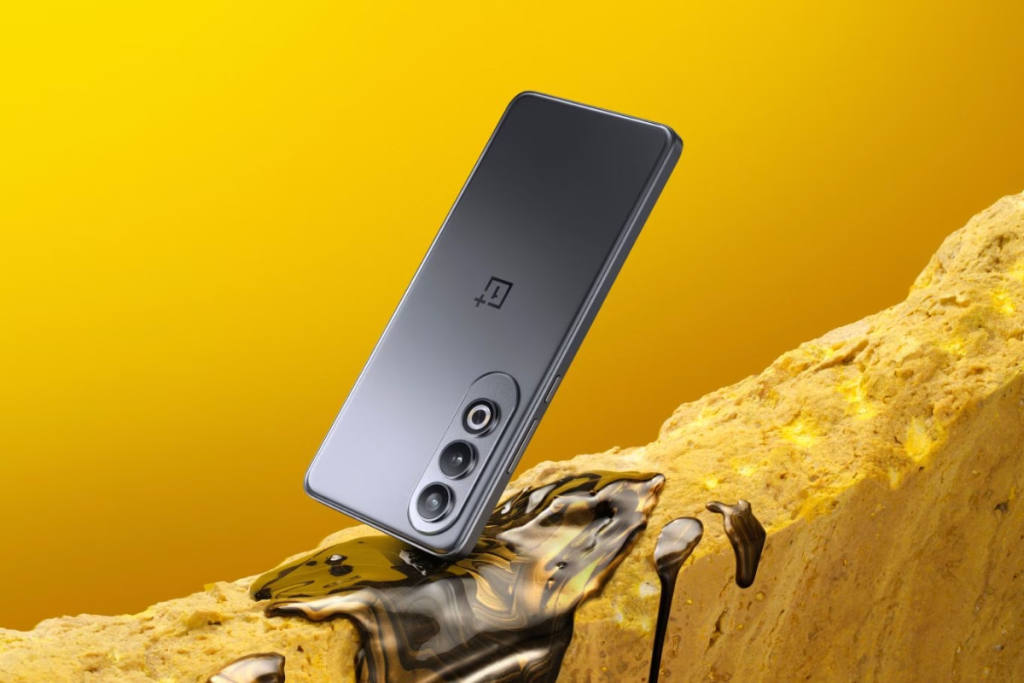
OnePlus Nord CE 4 5G is probably the best alternative to the Nord CE 5G if you’re a loyal OnePlus fan. This phone has a Snapdragon 7 Gen 3 chipset, which has faster and more efficient cores than those in the Snapdragon 750 5G chip in the Nord CE 5G. Not just that, the 7 Gen 3 is fabricated using TSMC’s 4nm possess node, resulting in better power efficiency.
It is not just the CPU; the GPU is also more capable — Adreno 720 (vs. Adreno 619 in the Nord CE 5G). So, there’s a big performance gap between the two devices, with the Nord CE 4 5G leading the race.
The display is also bigger and better on the Nord CE 4 5G. You get a 120Hz refresh rate for smoother scrolling and 1100nits of peak brightness for better outdoor visibility.
There are also big differences on the camera front. The primary camera on the Nord CE 4 5G has OIS for better stabilization in photos and videos, which isn’t present in the Nord CE 5G. There’s also an 8MP ultrawide sensor but no depth sensor, which doesn’t make a big impact. For selfies, there’s a 16MP sensor on both smartphones.
Both the OnePlus Nord CE 5G and Nord CE 4 5G can record 4K videos. The latter has a 5,500 mAh battery with 100W fast charging support, more battery capacity, and faster charging than the Nord CE 5G. On the connectivity front, the Nord CE 4 5G has Wi-Fi support, USB type-C (no 3.5mm headphone jack), and Bluetooth 5.4.
One of the best benefits of purchasing newer models is that they come with the latest version of Android OS and receive longer software updates. Android 14 was the last OS upgrade for the Nord CE 5G, while the Nord CE 4 5G will receive OS updates until Android 16 at least.
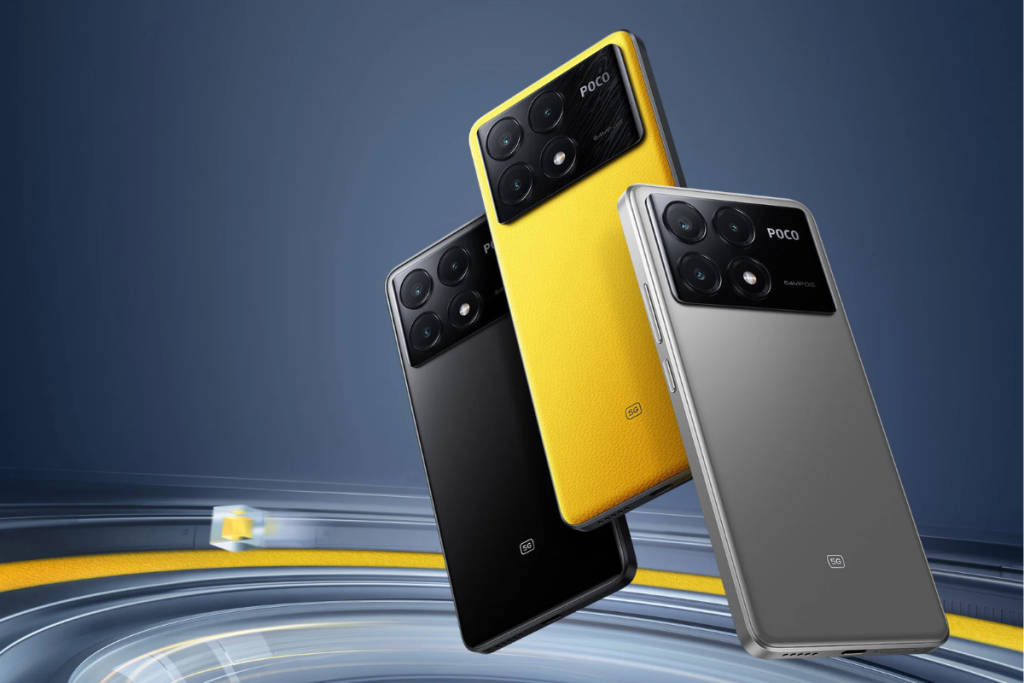
Poco X6 Pro is another great alternative to the OnePlus Nord CE 5G. It packs a powerful Dimensity 8300 Ultra chipset, much more powerful than the Snapdragon 750 5G in Nord CE 5G. The performance is great on the Poco X6 Pro, which is what Poco phones are known for.
The display on Poco is slightly bigger with HDR10+, Dolby Vision, and high refresh rate support. Also, the peak brightness is higher for better outdoor visibility.
This Poco phone has a similar camera configuration on the rear side — 64MP + 8MP + 2MP. However, the major difference is OIS, which the Nord CE 5G doesn’t have. It also has better speakers and supports a newer Bluetooth standard.
The Poco X6 Pro‘s battery has a 5,000 mAh capacity (vs. 4,500 mAh in the Nord CE 5G) and supports a faster charging of 67W (vs. 30W in the Nord CE 5G). Like the Nord CE 4 5G, the Poco X6 Pro also lacks a 3.5mm headphone jack. The Poco phone has all the necessary connectivity features. However, the Wi-Fi and Bluetooth standards are better than the OnePlus Nord CE 5G.
3. Samsung Galaxy F55 5G
Galaxy F55 5G
Display
6.7 inches Super AMOLED+ 1080 x 2400 px resolution 120Hz, 1000 nits (peak)
Rear Camera
50MP (OIS) – Primary 8MP – Ultrawide 2MP – Macro
Front Camera
50MP
Video Recording
4K @ 30fps, 1080p @ 30/60fps
Chip
Snapdragon 7 Gen 1 (4nm) Adreno 644
RAM/Storage
8GB/128GB, 8GB/256GB, 12GB/256GB Up to 1TB (MicroSD)
Battery
5,000 mAh battery 45W charging
OS
Android 14, One UI 6.1
Connectivity
5G, Wi-Fi 6, Bluetooth 5.2, NFC
Galaxy F55 5G Price:
8GB + 128GB: Rs. 26,200
8GB + 256GB: Rs. 29,999
12GB + 256GB: Rs. 32,999
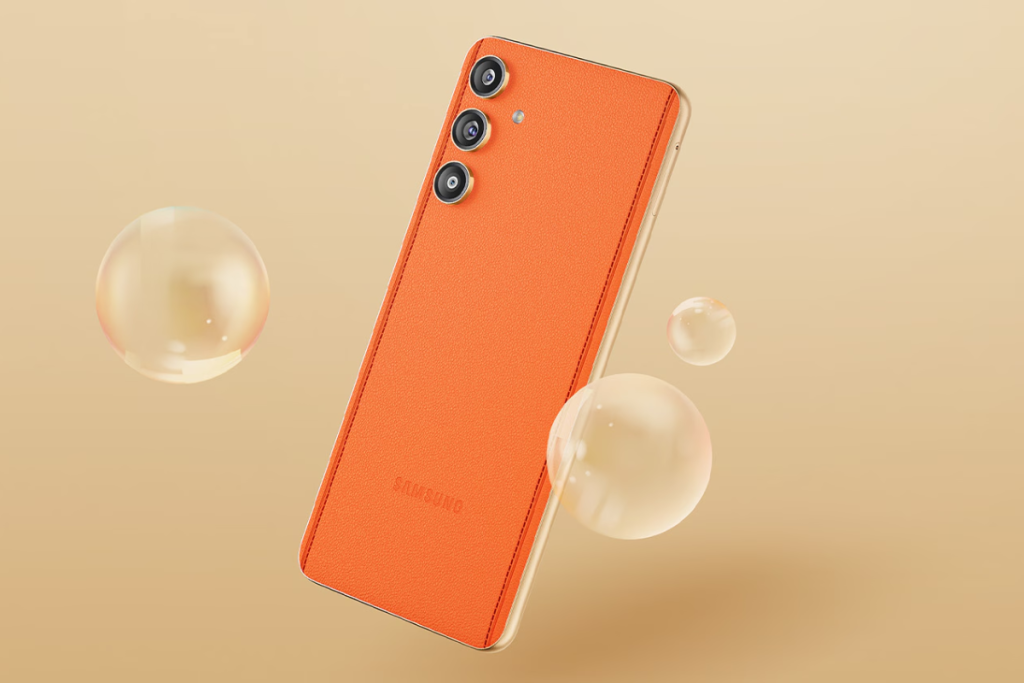
The Galaxy F55 5G was launched in May. It’s the best Galaxy F-series phone to date and one of the best in the 20-30K segment. It has a slightly bigger display than the Nord CE 5G with a higher refresh rate and a peak brightness of 1000nits. The Galaxy F55 ships with Android 14 out of the box and should get at least two years of OS updates.
The Samsung smartphone is powered by a powerful Snapdragon 7 Gen 1 chipset with an integrated Adreno 644 GPU. The CPU and GPU performance of this chip is much faster and more efficient than the Snapdragon 750G 5G in the Nord CE 5G.
The OnePlus Nord CE 5G lacks OIS, which is offered in the Galaxy F55 5G for its primary camera on the rear side. The front camera is also a 50MP sensor. Both phones can record 4K videos with their rear camera setup, but the Galaxy F55 5G can record 4K videos with its front camera as well.
The Galaxy device supports newer Wi-Fi and Bluetooth standards for better connectivity. The battery is also bigger and has faster charging support compared to the OnePlus Nord CE 5G.
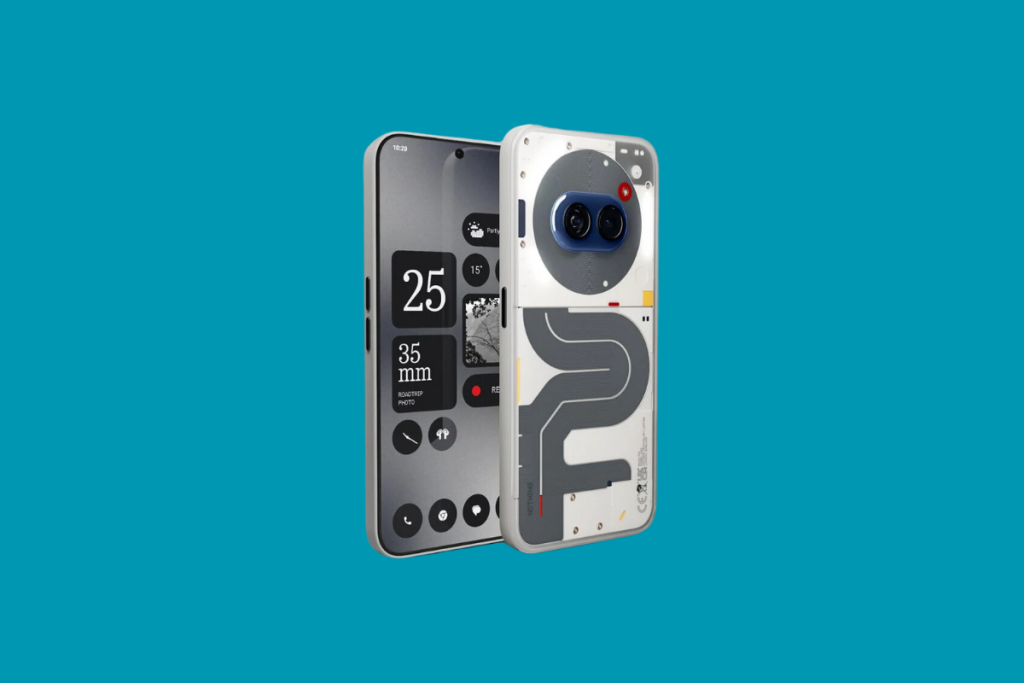
Nothing Phone 2a is the company’s latest smartphone and a strong contender for the 20-30K price range. It has a 6.7-inch AMOLED screen with 1080p resolution, 120Hz refresh rate, and a peak brightness of 1300nits. It’s bigger and better than the OnePlus Nord CE 5G’s display with the added protection of Gorilla Glass 5.
The Nothing phone ships with Android 14 out of the box and is promised three years of Android updates. It’s powered by the Dimensity 7200 Pro chipset, a 4 nm chip with faster and more efficient cores and better GPU performance than the Snapdragon 750 5G in Nord CE 5G.
The Nothing Phone 2a features a dual rear camera setup—a 50MP primary sensor with OIS and another 50MP sensor for ultrawide shots. It has a 32MP sensor for selfies and video calling. The Nothing phone has OIS for better stability in images and videos and has better imaging capabilities overall compared to the Nord CE 5G.
There’s no 3.5mm headphone jack, but supports newer Wi-Fi and Bluetooth standards for better connectivity. The Nothing phone has got a bigger battery with faster charging support.
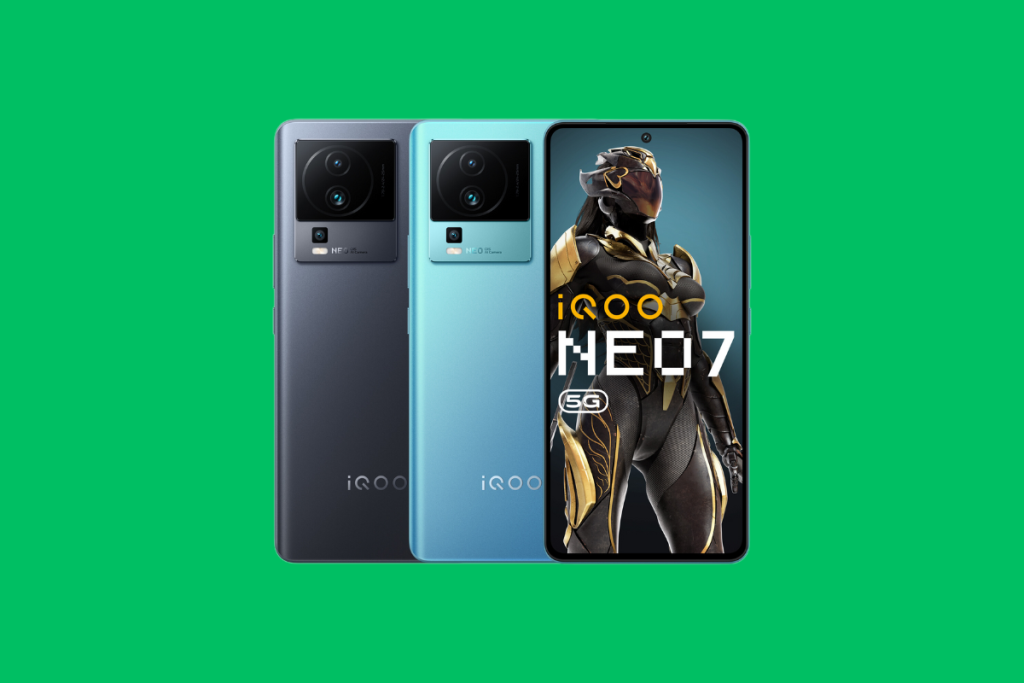
This iQOO phone was released last year with Android 13 out of the box. It has a bigger display than the OnePlus Nord CE 5G, with a 120Hz refresh rate and a higher peak brightness for smooth scrolling and better outdoor visibility.
The device gets its power from a 4nm Dimensity 8200 chip. It’s much faster and power efficient than the Snapdragon 750G 5G chip in the Nord CE 5G. Although both smartphones support up to 256GB storage, the Neo 7 has a faster UFS 3.1 storage, resulting in better performance.
The primary camera on the iQOO Neo 7 has the same resolution as in Nord CE 5G, but it’s the OIS support in the Neo 7 that makes the difference. The iQOO phone lacks an ultrawide camera but has two 2MP sensors for depth and macro.
Both the OnePlus Nord CE 5G and iQOO Neo 7 have similar connectivity features. However, the latter supports a newer Bluetooth standard but lacks a 3.5mm headphone jack. The Neo 7 has a bigger battery of 5,000 mAh capacity with 120W fast charging support.
There’s also an iQOO Neo 7 Pro with a more powerful chipset and better camera capabilities, but you’ll have to spend some extra bucks.
6. OnePlus Nord 3 5G
OnePlus Nord 3 5G
Display
6.74 inches Super Fluid AMOLED 1240 x 2772 px resolution 120Hz, HDR10+, 1450 nits (peak)
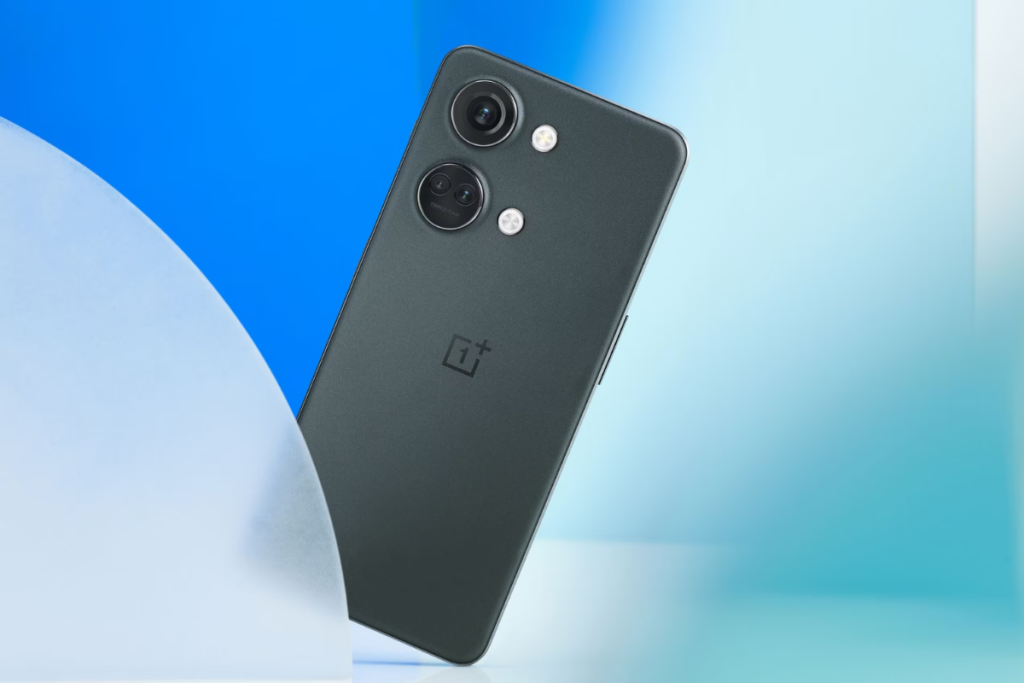
OnePlus Nord 3 5G is another solid upgrade over the Nord CE 5G. It has a bigger display with 1B colors, 120Hz refresh rate, high screen resolution, and a higher peak brightness. It runs OxygenOS 13 out of the box, based on Android 13.
There’s a MediaTek Dimensity 9000 chipset inside the Nord 3 5G, much more powerful and power efficient than the Snapdragon 750 5G in the Nord CE 5G. On top of this, the device has faster storage — UFS 3.1 (vs. UFS 2.1 in the Nord CE 5G). From your day-to-day tasks to gaming, the chip can handle them smoothly.
The camera specs are pretty similar to those of the Nord CE 5G, but the primary sensor has OIS support in the Nord 3 5G, which makes a significant difference. You also get a 5,000 mAh battery with 80W fast charging support. The connectivity is also better on the Nord 3 5G.
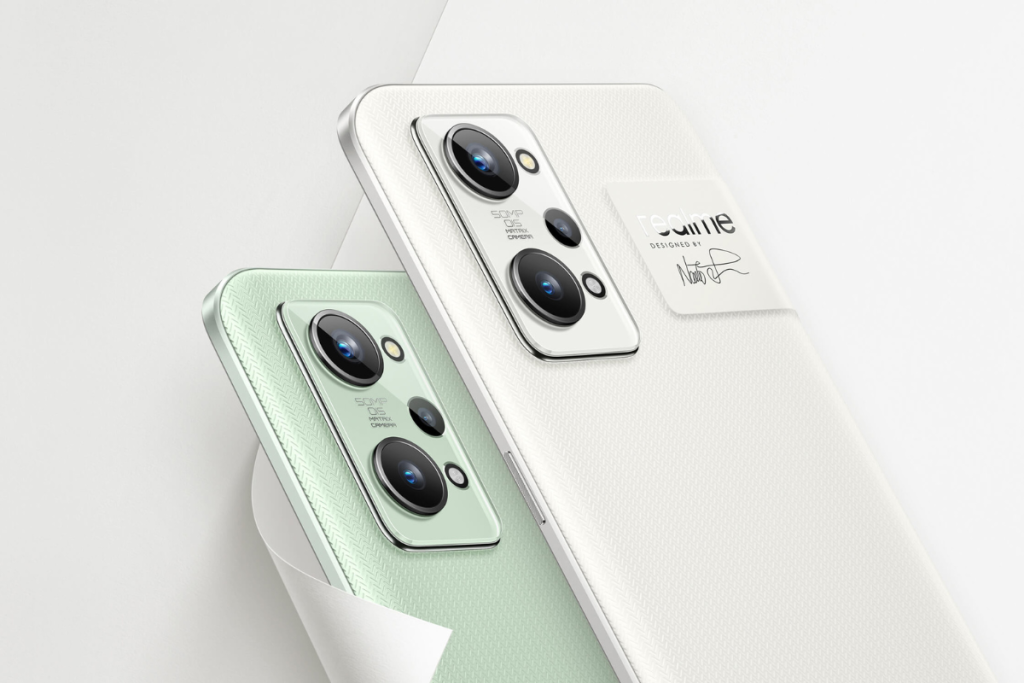
Realme GT 2 5G was launched in 2022 as a flagship phone with a starting price of Rs. 34,999. However, it’s now available at a much lower price, making it a strong choice in the under-30K segment.
Compared to the OnePlus Nord CE 5G, the Realme GT 2 5G has a bigger display with a higher screen refresh rate and peak brightness. The display is protected by Gorilla Glass 5.
The Realme phone runs Android 13 out of the box. It has a Snapdragon 888 5G at the helm, which offers better CPU and GPU performance compared to the Snapdragon 750G 5G chip inside the Nord CE 5G. The Realme GT 2 5G also has faster storage.
Instead of 64MP, the GT 2 5G has a 50MP primary camera, but with OIS support for better image and video stability. There’s also an 8MP ultrawide sensor and a 2MP macro shooter. On the front, you get a 16MP selfie shooter.
As with every other phone on this page, you get newer Wi-Fi and Bluetooth standards for better connectivity. There’s no 3.5mm headphone jack, though. The battery inside the Realme GT 2 5G has a 5,000 mAh capacity and supports 65W fast charging. That means a bigger battery and lesser charging time compared to the OnePlus Nord CE 5G.
So, these are the 7 best alternatives to the OnePlus Nord CE 5G. Which of these is a solid choice over the Nord CE 5G, in your opinion? Let us know your thoughts in the comments below.
We use cookies on our website to give you the most relevant experience by remembering your preferences and repeat visits. By clicking “Accept”, you consent to the use of ALL the cookies.
This website uses cookies to improve your experience while you navigate through the website. Out of these, the cookies that are categorized as necessary are stored on your browser as they are essential for the working of basic functionalities of the website. We also use third-party cookies that help us analyze and understand how you use this website. These cookies will be stored in your browser only with your consent. You also have the option to opt-out of these cookies. But opting out of some of these cookies may affect your browsing experience.
Necessary cookies are absolutely essential for the website to function properly. This category only includes cookies that ensures basic functionalities and security features of the website. These cookies do not store any personal information.
Any cookies that may not be particularly necessary for the website to function and is used specifically to collect user personal data via analytics, ads, other embedded contents are termed as non-necessary cookies. It is mandatory to procure user consent prior to running these cookies on your website.