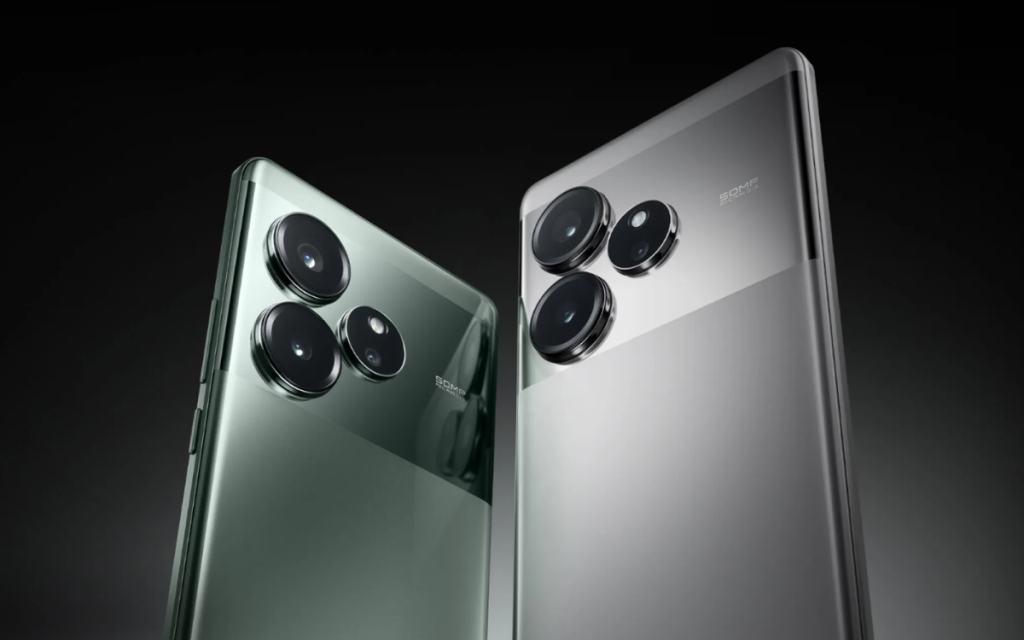
A recent report revealed the existence of a Mysterious Nothing smartphone codenamed “Tetris,” with model number A015. This device is believed to be the upcoming Nothing Phone (3).
Now, a new Android Headlines report has revealed the launch timeline of the Nothing Phone (3). As per the report, the Phone (3) is expected to debut sometime in the second quarter of 2024, likely in July. That being said, the report has not mentioned a source, so it’s best to take this launch timeline with a pinch of salt till further conformations.
It is worth mentioning that the Nothing Phone (2) also made its debut in July 2023. So it is likely that the brand could launch its successor at the same time this year. As for the specifications, the Nothing Phone (3) could feature a Snapdragon 8s Gen 3, which is an upgrade over the Snapdragon 8+ Gen 1 processor found on the Phone (2).
This new processor is a cut-down version of the flagship Snapdragon 8 Gen 3 processor and is designed for mid-range and flagship killer devices. It has a peak clock speed of 3GHz and is capable of reaching north of 1.5 million points on AnTuTu. Additionally, it also has the Qualcomm AI engine for tasks like on-device image generation.
Other than the processor, we also expect improvements in other areas like the battery life and fast charging. More details are expected to emerge as we get closer to the alleged launch window, so stay tuned.
Samsung Galaxy phones, like many other phones, run the Android operating system, but its own skin – One UI – adds plenty of useful hidden features that are hard to find and lesser known to most Galaxy users.
No matter how well-versed you are with your Galaxy smartphone, we bet there’s at least one hidden feature waiting to surprise you. So, here are the top 20 hidden features to make the most of your Samsung Galaxy phone.
Samsung Galaxy phones have advanced Wi-Fi options hidden inside the Connectivity Labs. It shows you the Wi-Fi data usage and connection time. You can also see the received and transmitted data for a particular Wi-Fi connection.
The Connectivity Labs also shows the Wi-Fi usage time for connected Wi-Fi bands such as 2.4G and 5G, and Wi-Fi standards such as Wi-Fi 4, Wi-Fi 5, and Wi-Fi 6.
From the Customize Wi-Fi list settings, you can choose to show less or more Wi-Fi networks and band information.
To find Connectivity Labs, go to Settings > Connections > Wi-Fi > tap three dots in the upper-right corner > Intelligent Wi-Fi and tap a few times on the Intelligent Wi-Fi option at the bottom to unhide Connectivity Labs.
2. Good Lock
If you like customizing your Galaxy phone and haven’t used Good Lock yet, you’re missing out on the advanced level of customization. Good Lock opens a new world of customization to your lock screen, themes, home screen, edge lighting, and more.
With Good Lock, you can do so many things, such as:
Add/remove widgets to the lock screen.
Create a theme with your choice of colors.
Add motion effects to background images.
Add particle effects to wallpapers.
Create your own keyboard by adding, deleting, rearranging keys, and applying various styles.
Customize the navigation bar icons.
Change existing navigation bar options.
Display recent apps in various styles.
Create various clock styles.
Decorate clocks on the AOD screen.
Customize the status bar.
The above list highlights several important Good Lock customizations. There’s a lot more you can do with it.
Download Good Lock from the Galaxy Store and customize your Samsung Galaxy.
3. Call Background
With the Call Background feature, you can select a picture or video that will show up when you make or receive calls. It adds visual elements and provides a more personalized and dynamic experience.
Open the Phone app > tap three vertical dots > Settings > Call background > Background > select the background and tap Set as call background. Tap the “+” icon at the top to use photos or videos from the Gallery.
4. Edge Panels
Edge Panels give you an easy shortcut to access your favorite apps. This feature can be incredibly helpful if you frequently switch between a few apps.
To enable Edge Panels, go to Settings > Display and toggle on Edge panels. A small Edge Panel handle will appear on the upper-right side of your screen. You need to swipe it towards the center to open Edge Panels.
You can hold and drag the Edge Panel handle to change its location. Also, the Edge Panel can be customized to see selected apps, people, features, tasks, weather, reminders, and clipboard content.
5. Cool Notification Pop-Up Styles
Samsung Galaxy phones let you choose between different notification pop-up styles to make them look visually exciting.
Open the Settings app, tap Notifications, and select Notification pop-up style. Tap Edge lighting style and choose from a range of styles.
This doesn’t work with the Detailed notification style. So, make sure to choose the Brief style for the pop-up notifications.
6. Lift to Wake Your Phone Screen
You can save a few minutes every day using the Lift to Wake option. When enabled, the screen will automatically wake up as soon as you lift the device from your desk or take it out of your pocket.
It can be a productive feature if you unlock the device hundreds of times every single day, like me.
To enable this feature, open the Settings app, tap Advanced features, click Motion and gestures, and enable Lift to wake.
7. Battery Protection
You can extend the lifespan of your battery by limiting the maximum charge.

In One UI 6, go to Settings > Battery and toggle on Protect battery. This will limit the maximum charging to 85%.
In One UI 6.1, go to Settings > Battery and enable the Battery protection feature. Use the Adaptive mode or Maximum mode for better protection.
The Adaptive mode pauses charging while you are asleep and finishes charging the device just before you wake up. The Maximum mode limits the charging to 80% for maximum battery protection.
8. Adjust Sound Quality and Effects
By default, Dolby Atmos is not enabled on Samsung Galaxy devices. Enabling it can improve the surround sound experience and offer an immersive listening experience.
To enable Dolby Atmos (on supported devices), go to Settings > Sounds and vibration > Sound quality and effects and toggle on Dolby Atmos.
You can also adjust the Equaliser and use UHQ upscaler for a better experience.
Samsung Galaxy phones also have an excellent Adapt sound feature that personalizes the sound experience to your hearing. You can take a hearing test to create a custom sound profile or choose from presets that adjust the sound based on typical hearing loss that occurs with age.
9. Modes and Routines
You might have already seen the Modes and Routines feature in the Settings app, but most Galaxy users aren’t aware of the good things it can do.
For example, when you arrive at the gym, the routine can play your workout playlist and enable Do Not Disturb (DND). You can create a routine to disable Bluetooth, location services, and reduce the screen refresh rate when your battery goes below a certain percentage.
You can do a lot with Modes and Routines to automate things on your Galaxy device.
10. Secure Folder
Samsung Galaxy phones have a Secure Folder to keep your secret apps and files.
You can protect the Secure Folder with a strong password, which people around you can’t easily guess.
To enable Secure Folder, go to Settings > Security and privacy > More security settings and tap on Secure Folder. Now, set it up and store your secret files and apps.
11. Side Button Customization
You can customize the side button on your Samsung Galaxy to open a specific app when you double-press it. If your day revolves around a particular app, you know how helpful this feature can be.
Open the Settings app, tap Advanced features, and click Side button. Tap Open app and choose the app.
This feature works on any screen, including the lock screen.
12. Flash Notifications
You can set your Samsung Galaxy to flash the camera light or the screen when you receive notifications.
Even some keypad phones can flash the camera light for incoming calls and notifications. Samsung does it better by letting you choose apps, so you pick up your phone only when something important happens.
Go to Settings > Accessibility > Advanced settings > Flash notification and enable Camera flash notification, Screen flash notification, or both.
Tapping on Camera flash notification lets you choose the apps. In addition to the app selection, the Screen flash notification lets you choose the color by tapping on it.
13. Music Share
The Music Share feature on Samsung Galaxy phones lets others play music through your speaker without them needing to pair their phone with your speaker. The reverse is also true.
You can find the Music Share feature by navigating to Settings > Connection > Bluetooth > tap three vertical dots > Advanced settings.
14. Link to Windows
Samsung Galaxy phones offer more Link to Windows features than many other smartphone brands because of the close ties between the two companies.
You can use Link to Windows to run Android apps directly on your Windows. It also offers drag-and-drop functionality and advanced calling features to make and receive calls using your PC.
Link to Windows shows your phone’s notifications on the PC and lets you copy-paste from one device to another.
15. Notification History
The Notification History feature records your notifications. It can be helpful when you accidentally dismiss all notifications.
It’s a handy feature that allows you to see deleted WhatsApp messages.
Notification history must be enabled before you can see them. To enable it, go to Settings > Notifications > Advanced settings > Notification history and toggle it on.
16. Video Call Effects
Although video calling apps like Meet and Zoom have built-in video call effects, Samsung has it natively. Customize the options and see them in action during video calls on supported apps.
To activate this feature, go to Settings > Advanced features and toggle on Video call effects. Now, tap on Video call effects (not the toggle) and play with the customizations.
17. Say “Cheese” to Take a Photo
There are a lot of times when you may find it hard to press the shutter button, such as while taking group selfies or placing your phone at a distance. Forget all the trouble and simply say “cheese” to instantly take a photo.
You can also show your palm to the camera to take a photo.
To activate these camera tricks, launch the Camera app and tap the Settings icon in the top-left corner. Now, tap on Shooting methods and enable Voice commands and Show palm.
18. Multi Window
Multi-window or split screen is an excellent productivity feature for using multiple apps on a single screen. For example, you can play a YouTube video on one side of the screen and take notes on the other. Also, you can watch a movie on one side and chat with your friends on the other.
To enable this feature, go to Settings > Advanced feature > Multi window and toggle on Swipe for split screen. Enable Full screen in Split screen view to hide the status bar in the split screen mode.
Now, launch one of the split screen apps and swipe up from the bottom of the screen with two fingers. Now, choose the second app for the split screen.
19. One-Handed Mode
Samsung Galaxy smartphones are getting bigger and bigger. While this is great for content consumption and many other tasks, sometimes we find it hard to operate with one hand. It becomes more difficult for people with small hands. One-handed mode is there to help by reducing the screen size. It even reduces the keyboard size for a compatible one-handed typing experience.
To enable this feature, go to Settings > Advanced features and enable One-handed mode. Now, tap on One-handed mode (the text part) and choose the Gesture or Button activation method.
The Gesture method requires users to swipe down from the Home button, while the Button method requires tapping the Home button two times in quick succession.
That’s it for this post. We hope now you know at least one new feature of your Samsung Galaxy. Which one is your favorite from the list? Do let us know in the comments below.
In a move to cater to the growing demand for international travel, Airtel, a leading Indian telecom provider, has announced a revamped international roaming offering. The new plans prioritize affordability and convenience, aiming to eliminate the hassle of managing multiple packs for various destinations.
One Pack for Global Connectivity
Airtel’s revamped international roaming packs address a key pain point for frequent travelers. Customers can now choose a single plan based on travel duration, offering seamless connectivity across 184 countries. This eliminates the need to subscribe to separate packs for different destinations, simplifying the pre-travel process.
The new packs start at a competitive price point of Rs. 133 ($1.60) per day (based on Rs. 3,999 plan), making them a potentially more affordable option compared to purchasing local SIM cards in certain countries. This can be particularly beneficial for short trips or for those who don’t anticipate high data usage.
According to the company’s official “Thanks App,” plans start at Rs. 649 ($7.78) for a single day of travel, offering 500MB data and 100 minutes of free outgoing and incoming calls. Higher tiers offer increased data allowances, voice call minutes, and even in-flight benefits.
Airtel’s new packs include additional features like in-flight connectivity, auto-activation on landing, and 24×7 contact center support for a smoother travel experience.
Airtel also introduces an optional auto-renewal feature for frequent travelers through the “thanks app.” This feature automatically renews the international roaming pack upon its expiry, ensuring uninterrupted connectivity during subsequent trips abroad.
Airtel’s Director of Customer Experience and Marketing, Amit Tripathi, highlighted the company’s commitment to solving customer problems and providing greater convenience. He stated that the new packs offer “greater value with enhanced benefits that are economical when compared to local in-country sims across many countries.”
A new Vivo smartphone from its mid range Y series might be launching soon. The Vivo Y38 was previously spotted in various certifications, and now, it has surfaced in two new databases. This includes the NCC and IMDA platforms, so here are all the details.
Vivo Y38 launch imminent
The Chinese brand’s Y38 model was previously spotted on the Bluetooth SIG and CQC certifications carrying the V2343 model number. This same model has now surfaced on the NCC and IMDA listings as well. These offer us a look at the smartphone’s design. It features a flat edge design with a punch hole cutout on the display. The rear has a circular camera module with dual cameras and LED flash.
Other notable features include a side mounted fingerprint scanner, a 3.5mm headphone jack, and a USB Type-C port. Meanwhile, the NCC listing confirmed that a massive 6,000mAh battery pack that supports 44W wired fast charging. This was confirmed thanks to the BA45 battery pack and V4440L0A0-US charger model numbers. The earlier certification sighting also included the GeekBench platform, which revealed its synthetic performance and some key specs.
The Vivo Y38 was seen with the Qualcomm Snapdragon 4 Gen 2 SoC that is paired with 8GB of RAM. Although, we can likely expect other RAM configurations as well. It also runs on the Android 14 OS out of the box. It is worth noting that no official word regarding its launch has been shared at the moment, so take this news with a pinch of salt for now.
Xiaomi is due to release a new fitness band in its Xiaomi Smart Band series called the Xiaomi Smart Band 9. The previous-gen Smart Band 8 debuted in China in April 2023 and made its way to the global market in September 2023.
That being said, the global launch could happen sooner than last time as the Smart Band 9 has cleared multiple certifications that greenlit its imminent launch in global regions. The latest are the United Arab Emirates TDRA and Indonesia Telecom certifications.
Xiaomi Smart Band 9 TDRA certification
Xiaomi Smart Band 9 Indonesia Telecom certification
Both of these certifications have revealed that the upcoming smart band from Xiaomi will carry the model number M2345B1. Previous reports claim that there will be two variants of the Smart Band 9. The only difference between these two variants will likely be NFC support. Details on the specifications of the Smart Band 9 are currently scarce. However, we can take a look at its predecessor to get an idea of what to expect.
Xiaomi Smart Band 8 specs:
The Xiaomi Smart Band 8 has a sleek design with a 1.6-inch AMOLED screen, along with features like Always-On Display. Plus, it’s water-resistant up to 50 meters, adding to its durability. Xiaomi has made a bunch of strap options available with different materials and styles.
In terms of functionality, the Smart Band 8 provides comprehensive health monitoring, tracking heart rate, blood oxygen levels, sleep patterns, and stress levels, with a focus on female health. It also offers a variety of sports modes and built-in games for entertainment. It has an impressive battery life lasting up to 16 days on a single charge (excluding the Always-On Display).
In a recent interview, NVIDIA CEO Jensen Huang shared his vision for the future, predicting that humanoid robots will soon become mainstream products, revolutionizing various industries.
Huang emphasized that manufacturing costs for humanoid robots will be surprisingly low, comparable to the price range of cheap cars. He proposed a price range of $10,000 to $20,000 for these robots, making them accessible to a wide range of consumers.
Drawing parallels with the automotive industry, Huang highlighted the potential flexibility and versatility of robots in certain man-made environments. He suggested that these robots could handle dangerous, repetitive, or tedious tasks, enhancing efficiency and safety in workplaces.
source: NVIDIA
Supporting Huang’s vision, Tesla CEO Elon Musk has also indicated that the manufacturing cost of the humanoid robot Optimus is only half that of Tesla electric cars. Musk envisioned an initial pricing for Optimus between $25,000 and $30,000, with expected decreases over time.
In alignment with their vision, NVIDIA unveiled Project GR00T, a foundation model for humanoid robots, and introduced Jetson Thor, a powerful computer system designed specifically for these robots. Jetson Thor, based on the NVIDIA Thor system-on-a-chip (SoC), offers advanced performance, power efficiency, and compact size, further driving the advancement of humanoid robotics.
Additionally, NVIDIA’s partnerships with leading humanoid robot companies like 1X Technologies, Agility Robotics, and Boston Dynamics demonstrate a collaborative effort to develop comprehensive AI platforms for robotics.
NVIDIA’s updates to the Isaac platform further empower developers to create and deploy sophisticated robots in various environments. Tools like Isaac Lab for reinforcement learning and OSMO for compute orchestration enable the rapid development of robotic capabilities, while offerings like Isaac Manipulator and Isaac Perceptor provide pre-trained models and advanced functionalities for robotic arms and autonomous mobile robots.
Huang’s foresight, coupled with NVIDIA’s technological advancements, indicates a future where humanoid robots seamlessly integrate into our daily lives, transforming industries and enhancing human capabilities.
Apple has long been pleased with iPhone sales in China, and the Asian market, which has been quite beneficial for Apple’s growth, is now failing to meet Apple’s expectations due to the recent success of Chinese smartphone manufacturers and the regulations imposed by the Chinese government.
According to IDC, a research firm, despite a 8% increase in global smartphone sales in the first quarter of the year, iPhone sales saw a 10% decline. The ban imposed by China against foreign brands also contributed to the decline in Apple’s sales.
According to Bloomberg, the problem behind Apple’s declining sales is actually Apple devices themselves, as existing users do not want to use a new device and Apple needs more people to join the Apple ecosystem. In short, Apple is not providing consumers with enough incentives to upgrade to new devices.
People need a “better iPhone SE”
Apple’s iPhone lineup receives minor improvements every year, leading many users to believe that upgrading is not just worth it. Apple’s solution to this should be introducing new product lineups. Apple recently introduced the Vision Pro, but due to its high price and the very long time it will take for people to adapt, it doesn’t seem to significantly increase Apple’s revenue in the short term.
iPhone SE – 2022
The best thing Apple can do right now is to introduce a budget iPhone. Although Apple managed to introduce phones at half the price of standard and Pro iPhones with the iPhone SE models, the design of the phone was quite outdated. While other phone manufacturers introduced powerful cameras and large screens in the $400 price range, Apple chose to offer a single camera module with the iPhone SE.
So, Apple might be a bit behind its competition in AI right now, but they’re working on on-device large language model that’ll live right on your iPhone. No need to send your data to the cloud because it’s all going down on your device, so this will be better for Apple to maintain privacy.
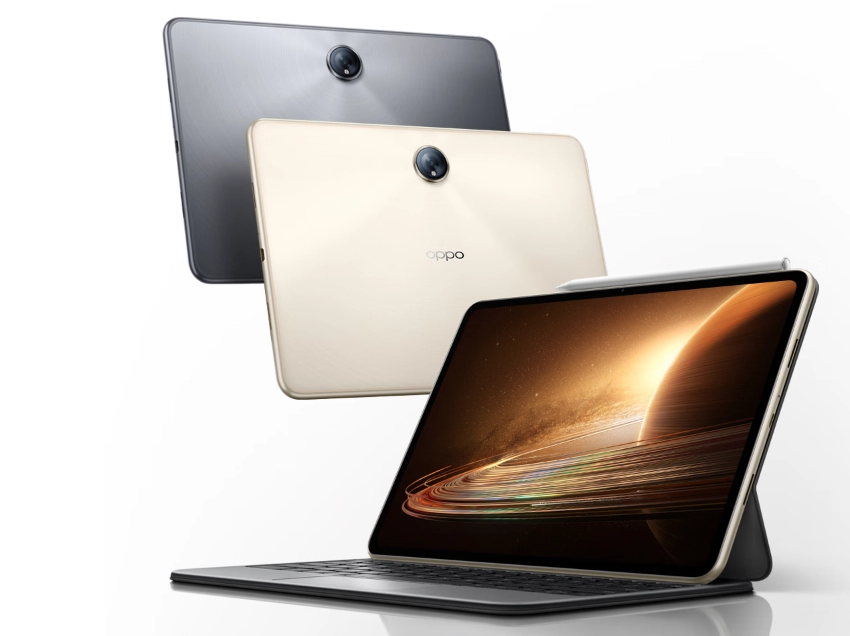
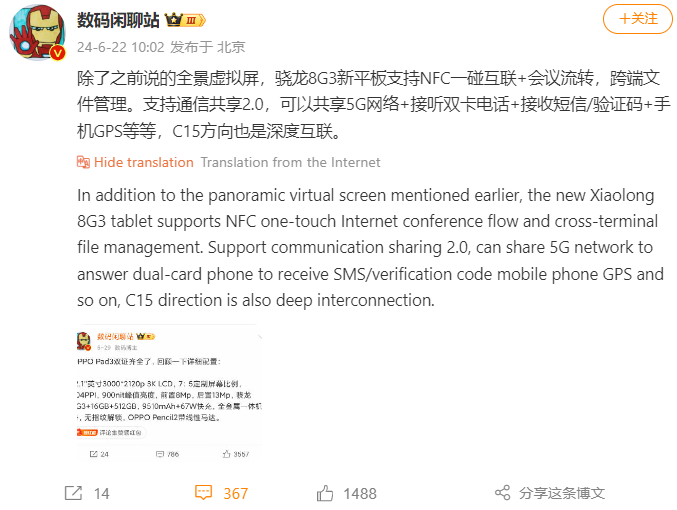
OPPO is reportedly working on the successor to the last year’s OPPO Pad 2. Earlier this month, Digital Chat Station revealed the processor powering the OPPO Pad 3 along with its tentative launch timeline. Now, the reputable tipster has revealed more details about the upcoming tablet on the microblogging platform Weibo. These are regarding its design, RAM capacity, and display resolution.
OPPO Pad 3 more details leak
Digital Chat Station says that the OPPO Pad 3 will boast an all-metal unibody. The exact screen size remains unclear but the tipster mentions it as a conventional large-screen tablet. Additionally, it will bear a screen resolution of 3K pixels. The device will likely offer a Panoramic Virtual Screen that is found on the Find N3 (review). It will create an illusion of a larger display when viewed up close.
As per DCS, the OPPO Pad 3 will be powered by a Snapdragon 8 Gen 3 processor. It will be coupled with 16GB RAM for powerful performance and seamless multitasking. We can expect more RAM and storage configurations at launch. If the report indeed turns out to be true, the upcoming Pad 3 could pack significant upgrades compared to its predecessor.
The OPPO Pad 3 is expected to arrive in this quarter i.e. between April to June per DCS. It will launch first in China, The device is also rumoured to launch as a rebadged OnePlus Pad 2 in the global markets in the second quarter of this year.
Today marks a significant milestone for Tesla in China as the company celebrates the 10th anniversary of delivering its first-ever Model S cars to Chinese customers. Since those early days in 2014, Tesla has seen remarkable growth in China’s electric vehicle market.
To commemorate this anniversary, Tesla Asia reposted a celebratory message, highlighting the Model S’s safety achievements and the company’s ongoing commitment to advancing electric vehicle technology.
With over 1.7 million Tesla owners in China alone and a global community exceeding 6 million, Tesla’s impact on the automotive landscape is undeniable. China’s dedication to embracing new energy vehicles (NEVs) is also equally evident, with NEV ownership surpassing the 20 million mark.
Important moments in Tesla’s China journey include delivering Model S keys to the first Chinese owners, including notable figures like Xiaomi founder Lei Jun and Li Auto founder Li Xiang. The opening of the Shanghai Gigafactory in late 2019 also marked a significant shift for Tesla in China. With an annual capacity of over 950,000 vehicles, it is now Tesla’s largest facility globally.
Tesla’s Model S has been celebrated for its safety achievements, earning a maximum 5-star safety rating from both Euro NCAP and U.S. NHTSA in every NHTSA subcategory in 2014. Its active safety system, including features like Autopilot hardware and Lane Departure Warning, underscores Tesla’s commitment to innovation and safety.
In the face of increasing competition, Tesla recently implemented a price reduction across all models, further enhancing its appeal in the Chinese market. Yesterday’s announcement saw prices reduced by 14,000 yuan ($1,930), making Tesla vehicles even more accessible to consumers.
The company’s upcoming Spark 20 Pro 5G was spotted on the FCC and TDRA databases carrying the KJ8 model number. On FCC, the moniker of this device as well as its battery size and charging capacity were confirmed. The new Tecno Spark 20 Pro will be powered by a large 4,900mAh battery pack that supports 33W wired fast charging. Even the storage configuration was confirmed with 8GB of RAM and 256GB of internal storage.
A notable aspect revealed on the website was the design. The Spark 20 Pro 5G model features a square camera module in the rear that houses three image sensors and an LED flash, which looks similar to the iPhone 15 Pro. This design is also similar to the 4G variant of the Spark 20 Pro. Unfortunately, the TDRA listing does not reveal any finer details regarding this device like its specs or features.
To recall, the Spark 20 Pro 4G is equipped with the Helio G99 SoC under the hood. The front sports a 6.78-inch LCD screen, while the rear packs a 108-megapixel triple camera setup. A large 5,000mAh battery pack powers this device, which supports 33W wired fast charging as well. So, the new 5G model would likely come with a 5G enabled processor.
Teclast has launched the T65 Max, a new tablet boasting a large 13-inch display and the MediaTek Helio G99 chipset. The tablet is priced at 1299 yuan (around $179) and is now available on JD.com. Let’s check out its key specs.
Teclast T65 Max Specifications:
The centerpiece of the T65 Max is its expansive 13-inch IPS screen with a 1920 x 1200 resolution. Teclast claims this display offers a 65% increase in viewable area compared to a standard 10.1-inch tablet, making it ideal for watching movies, gaming, or working on documents. The display boasts a 300 nits typical brightness and a 16:10 aspect ratio.
Under the hood, the tablet is powered by the MediaTek Helio G99 chipset, featuring two high-performance A76 cores and six A55 efficiency cores. This combination promises smooth performance for everyday tasks, multitasking, and even casual gaming. The tablet comes with 8GB of LPDDR4X RAM and offers expandable virtual memory up to 12GB for a total of 20GB. Storage-wise, the T65 Max boasts 256GB of internal storage with the option to expand further using a microSD card up to 1TB.
The T65 Max runs the latest Android 14 operating system, offering a clean and user-friendly interface with improved privacy controls and customization options. Teclast has further optimized the UI for landscape mode, allowing users to run certain apps in parallel windows for a more productive workflow.
For photography, the T65 Max features a 13-megapixel rear camera with autofocus and an 8-megapixel front camera for video calls. The rear camera also includes a fill light for capturing clearer images in low-light environments.
Connectivity options include dual-SIM dual standby with support for 4G networks and VoLTE calls, ac dual-band Wi-Fi, Bluetooth 5.2 with LDAC audio codec support, and BeiDou, GPS, GLONASS, and GALILEO satellite positioning systems.
The T65 Max boasts a large 10000mAh battery for long-lasting power and supports 18W USB-PD fast charging. The tablet also features a quad-speaker sound system with a 3W high-power amplifier and AI noise-cancellation technology for clearer voice calls.
Apple’s annual Worldwide Developer Conference (WWDC) is nearly a month and a half way from today. The event usually focuses on the next-generation software across various products. This year, the iOS 18 is widely anticipated to be the centre of the event. Multiple rumours in the past have reported the upcoming software version to be loaded with AI features. This is because the Cupertino-based tech giant is lagging behind its competitors in the Gen AI space. Now, according to Bloomberg’s Mark Gurman, Apple is working on its own LLM to power on-device gen AI features on iPhones.
Apple working on its own LLM for on-device AI features
The main advantage of a large language model (LLM) is that the AI features run entirely locally on the device. Thus they don’t have to depend on cloud services to carry out the tasks. Additionally, the data also stays on the device. The processor along with a dedicated NPU powering the iPhones are capable of running LLMs. Due to this, the on-device gen AI features will offer faster response times and enhanced privacy compared to cloud-based solutions. The features can also work with a low network or none at all.
Previously, it was rumoured that Apple is working on its own large language model codenamed Ajax. The AI features are expected to be deeply integrated with apps like Health, Messages, Shortcuts, and more.
Gurman also reiterated past reports that Apple’s in-house LLM model may be limited to cloud-based LLM’s like ChatGPT and Gemini. The Cupertino-based giant might license the technology from third parties. The analyst previously stated that Apple is in talks with Google to license the latter’s Gemini AI on iPhones.
A new iQOO Z series smartphone could be launching in the global market soon. A fresh certification sighting of the iQOO Z9x was recently spotted in Thailand. The device is currently set to launch in China later this week. So here are all the details.
iQOO Z9x visits NBTC
The Chinese brand’s upcoming Z9x model was spotted on the NBTC certification. This model was spotted carrying the I2219 model number. Unfortunately, finer details regarding this device like its specs and features were not revealed in the online database. However, a leak from back in February revealed some of its key features. The Z9x is expected to be equipped with the Qualcomm Snapdragon 6 Gen 1 SoC and will be powered by a massive 6,000mAh battery pack.
It will even support 44W wired fast charging. On the front, it will sport an LCD panel that offers a 120Hz refresh rate and 1000nits of peak brightness. Meanwhile, the rear features a 50-megapixel dual camera setup. Another report revealed the storage configuration of the iQOO Z9x, which includes an 8GB RAM + 256GB storage option and a 12GB RAM + 256GB storage variant.
The NBTC listing basically hints that a global launch is imminent. With the Chinese announcement being right around the corner, the wider release will likely follow soon. So stick around for more as we will be providing updates when additional information is available regarding this device.
Realme has finally started the sale of the base Realme P1 in India. The smartphone was announced last week in the region. Now, it has officially gone on sale, bringing capable specs and an ultra slim design all for a budget price tag. So here’s everything you need to know.
Realme P1: Pricing & Offers
The Chinese brand has launched the vanilla P1 model in the Indian market, while the P1 Pro is set to go on sale on 30th April 2024. Realme P1 arrives in two color options, namely Peacock Green and Phoenix Red. It is currently available for purchase via Flipkart and Realme’s official store. The device has a starting price tag of 15,999 INR for its 6GB + 128GB option, while the 8GB + 256GB variant costs 18,999 INR. Realme is even offering an instant discount of 1,000 INR for the 6GB option and a 2,000 INR discount on the 8GB version to HDFC, SBI, and ICICI bank transactions.
The Realme P1 sports a tall 6.67-inch AMOLED display that offers an FHD+ resolution and a 120Hz refresh rate. Under the hood, it is equipped with the MediaTek Dimensity 7050 SoC. This model features a 50-megapixel dual camera setup on the rear, while the front offers a 16-megapixel selfie shooter. A large 5,000mAh battery pack powers this device, which supports 45W wired fast charging.
Other notable features include an in-display fingerprint scanner, stereo speakers, Hi-Res Audio, a 3.5mm headphone jack, and an ultra thin 7.97mm body. For those interested in this device, you can check out our comparison between the Realme P1 and POCO X6 as well as our first impressions of the Realme P1.
Sapphire Technology has launched the NITRO+ B650I WIFI super platinum motherboard for 1,689 Yuan (~$233). This is the successor of the NITRO+ B550I motherboard launched in 2021. So let’s take a look at what this new product has to offer.
NITRO+ B650I WIFI comes with an 8-layer PCB, 8-phase digital power supply design, boasts Infineon XDPE 192C3B PWM solution, and Power Stage 70A Dr.MOS. In addition, it equips the AMD AM5 base and supports AMD Ryzen 7000 series processors.
For memory, it equips 2 x DDR5 6000 MHz memory (the maximum capacity is 96GB) with support for overclocking. The predecessor Sapphire NITRO+ B550I supported DDR4 memory with a maximum speed of 4600 MHz. For storage, this motherboard offers 2 Gen4 x 4 M.2 interfaces and 4 SATA 3 interfaces. This motherboard also supports Wi-Fi 6 and Bluetooth. There’s also a USB 3.2 Gen 1 interface for the front.
To deal with the heat, the power supply MOS and The M.2 slot is covered with armored heat dissipation. This motherboard offers two 4 pin interfaces for the CPU fan and the system fan. For RGB it equips a 12V 4 pin and an additional 5V 3 pin interfaces. The RGB can be controlled through the Sapphire TriXX software.
Sapphire officially stated on the WeChat platform (via ITHome) that it will make certain changes in non-graphics card product lines this year.
However, the update doesn’t feature the latest Android 14 but instead runs on Android 13. For the Mi 10, the update bears the firmware version 1.0.3.0.TJACNXM and has an installation package size of 4.1GB.
The updates for the Mi 11 Pro and Ultra come with firmware versions 1.0.3.0.TJACNXM/1.0.2.0.TJJCNXM and weigh in at 4.2GB. Additionally, the update includes the March security patch.
Here’s the complete changelog of the Xiaomi HyperOS update for Mi 10 series (translated from Chinese):
Low-level refactoring:
The bottom layer of Xiaomi's ThePaper OS has been reconstructed to bring out excellent hardware performance;
Key task identification and dyeing technology dynamically controls resource allocation based on task importance, with stronger performance and lower power consumption;
Ultra-low-power rendering framework improves battery life and provides smoother animation effects;
SOC integrated frequency modulation connects the hardware resources of the whole machine in series to respond to changes in computing power requirements faster, with fewer frame drops and smoother performance;
Refresh storage technology to reduce storage fragmentation, allowing you to use it as new for a long time;
The intelligent network selection capability has been upgraded, making the network in weak network environments smoother;
Intelligent signal selection engine dynamically adjusts antenna strategies to improve signal stability.
Cross-terminal intelligent connection
Xiaomi HyperConnect cross-device interconnection framework allows devices to be efficiently connected and achieve ultimate collaboration;
The new integrated device center enables dynamic real-time networking of all devices, and you can view and control surrounding devices in the control center;
The cross-device experience has been fully upgraded, supporting cross-device calls to multiple hardware capabilities such as cameras, screens, and communications;
Applications, audio and video, clipboard and other data and services support free flow between multiple devices and are fully secure;
Security and privacy architecture for device interconnection. Devices verify mutual security through TEE, and data transmission is encrypted at the hardware level;
Cross-end privacy system, including Internet permission management, Internet behavior reminders and Internet behavior records.
Global security
Security and privacy architecture for device interconnection;
Devices verify mutual security through TEE, and data transmission is encrypted at the hardware level;
Cross-end privacy system, including Internet permission management, Internet behavior reminders and Internet behavior records.
Aesthetics of life
The life-sense aesthetics facing globalization creates delicate and comfortable visuals and light and coherent dynamic effects. The diverse fusion of expressions brings a new systematic aesthetic experience;
The new motion language brings a light and coherent global motion experience;
Vitality color system, natural colors full of life, refresh the interface; unified system fonts, designed for the world;
New weather design and real-time weather engine create a surreal visual experience;
The global focus notification system dynamically displays changes in key information and a new artistic lock screen, turning each of your photos into a poster. It also has dynamic glass material, making the screen look exquisite the moment it turns on;
The desktop icon design has been upgraded, and the color and shape have been completely renewed and reconstructed;
Multi-task window management, unified interaction, efficient and easy to use.
To get the latest firmware, users can navigate to Device Settings > About > Software Update > Check for Update. Also, before proceeding with the upgrade, make sure that your smartphone has enough storage space and battery life to avoid potential issues or data corruption. And to be safe from any data loss, its advisable to take a backup of important documents or files.
Redmi 13C 5G will soon be available in a new blue color option, reveals tipster Sudhanshu Ambhore. He has also shared the leaked renders of the new color variant. Probably, Xiaomi may officially confirm its arrival in the next few days.
Redmi 13C 5G coming soon in blue option
The Redmi 13C 5G, which debuted in December 2023 in India, has been available in three colors: Starlight Black, Startrail Green, and Startail Silver. The blue variant will be the fourth-color variant of the device. The 13C is currently available in three options, such as 4GB+128GB, 6GB+128GB, and 8GB+256GB, in the country. These variants are priced at Rs 10,499 (~$125), Rs 11,999 (~$145), and Rs 13,999 (~$168), respectively.
Redmi 13C 5G specifications
The Redmi 13C 5G has a 6.74-inch IPS LCD panel with a waterdrop notch design. It offers an HD+ resolution, a 90Hz refresh rate, 600 nits of brightness, and Gorilla Glass protection. The device will run on the MIUI 14-based Android 13. For security, it has a side-facing fingerprint scanner.
The Dimensity 6100 Plus chipset powers the handset. As mentioned above, the device comes with 6 GB / 8 GB of LPDDR4x RAM and 128 GB / 256 GB of UFS 2.2 storage. It has a dedicated slot for adding a microSD card for extra storage. It packs a 5,000mAh battery with 18W fast charging support. The phone comes preloaded with Android 13 with a layer of MIUI 13 on top.
The 13C comes with a side-facing fingerprint scanner for security. In addition, it offers other specs, such as dual SIM, 5G, Wi-Fi, Bluetooth 5.2, GPS, a USB-C port, and a 3.5mm audio jack.
Last weekend started off with Samsung extending its display replacement program to the Galaxy S21 and S22 models in India.
Source: Samsung Community
Over the past few months, we have been hearing frequent cases of green lines on Super AMOLED displays on Samsung flagships. It was not just Samsung though, even OnePlus flagships were affected by this issue, which is why even OnePlus was offering free replacements for affected screens last year.
Initially, the one-time screen replacement program was limited to the Samsung Galaxy S20 and Note 20 series. But as newer Samsung smartphones have also started facing the same issue, Samsung has now extended the program to cover the Galaxy S21 and S22 series too.
But there’s a catch, you have to book an appointment for the free replacements at a Samsung Service Center by April 30th, 2024 in India. If you miss this deadline, you might end up having to pay for repairs yourself.
Source: Huawei Teardown Video SS
As we revealed in our own hands-on video, the Huawei Pura 70 comes with one of the fanciest cameras in the market, that features a large 1-inch sensor with a retractable lens.
There are two major benefits of a retractable camera design.
Even though the lens is so large, since it goes inside, it is protected from unwanted scratches.
Huawei can install a really large camera sensor in a compact space without the camera module poking out of the phone like an external accessory.
The retraction mechanism uses stepper motors and is also IP68 dustproof and waterproof certified. It’s a first for mass-produced phones to feature such an innovative camera design.
The Chinese audio brand iFlytek has released an interesting AI powered hearing aid that offers real time subtitles of the conversations happening around you, right on your smartphone.
The hearing aid comes in a special variant called the StarFire Edition, which utilizes real-time voice-to-text conversion, displaying conversations on a smartphone app, ensuring important information is never missed.
This could be a game changer for people with partial hearing loss. More details on the device are in our story here.
Are you wondering how the new Kirin 9010 stacks up against the Snapdragon 8 Gen 3 model?
We decided to compare the two flagship chips based on the data we got from our hands on and external sources. According to benchmark comparisons, the Snapdragon 8 Gen 3 seems to be overpowering the Huawei’s Kirin 9010 in most departments. However, we would want to test the device for a longer period to decide whether there’s any difference in real life performance.
If you want to see how these two chips compare in benchmarks, more details are in our comparison story here.
Xiaomi has a new 100-inch Redmi Max TV in China and brings upgrades as compared to the previous generation model. If you remember, when the TV was launched in 2020, it was an instant hit among customers, selling over 1660 units in a single day.
That’s pretty impressive given how each unit is over $1200.
The 2025 edition comes with a refresh rate of 144Hz and support for variable refresh rate (VRR) technology. The TV also comes with 120 Hz MEMC motion compensation. Notably, there’s a competitive mode that pushes the refresh rate to an even higher 240Hz.
Google is set to release the Pixel 9 series later this year, reportedly featuring three devices: the Pixel 9, a more powerful but compact Pixel 9 Pro, and a larger flagship, the Pixel 9 Pro XL.
We have seen the renders of all three devices, and now real-life images of the Pixel 9 Pro have popped up online. The images, shared by a Russian website named Rozetked, supposedly showcase the Pixel 9 Pro’s design alongside some potential specs.
it seems Samsung is also working on an FE smartphone within the Galaxy S24 series. Though specifics about this smartphone are currently scarce, GalaxyClub, a trusted source for Samsung leaks, spilled the beans that Samsung is cooking up a new smartphone codenamed R12.
These accessories were launched last September as part of Apple’s commitment to sustainability and were claimed to be a durable alternative to leather. However, it appears the company’s durability claims haven’t held up over time.
Vivo is reportedly developing a new X-series of smartphones for the Chinese market. The lineup is expected to comprise three models: the Vivo X100s, X100s Pro, and X100 Ultra. According to a report by the Chinese publication Jiemian News, the X100 Ultra will be the company’s first smartphone to feature its self-developed imaging brand, BlueImage.
Honor has recently hinted at a new pink color variant of its Honor Magic 6 RSR Porsche Design for the global market. This announcement comes after the smartphone was launched in Malaysia last month in two colors: Agate Gray and Frozen Berry Pink. Interestingly, the pink model has already been available in its home country, China, since the device’s debut there.
The Huawei Pura 70 series was launched in China on April 18. The series reportedly offers a new 5nm chipset which is capable enough to support a couple of AI features such as AI photo retouching, article summarization, handwriting removal, table extraction, dialect recognition, and more.
Huawei Pura 70 series offers a couple of AI features
One of the key features of the AI photo retouching function is the removal of “disharmonious” elements from an image such as people in the background. The feature understands image semantics, removes distractions with one swipe, and fills the areas based on the surroundings with generative AI, just like some other flagships on the market. It also supports a cloud-based image enhancement feature that enhances image quality of a variety of images.
Another similar feature of the Pura 70 series powered by generative AI called “Xiaoyi Skin Care Q&A” where users can take a picture of a skincare product including the ingredients and share it with the Xiaoyi Assistant. The assistant will perform ingredient analysis and share the suitable skin type for the product and its efficacy details.
As mentioned before, the Xiaoyi Assistant can summarize articles and other documents. It can also translate the text in different languages.
Another feature of the Pura 70 series is “Smart vision” which can scan documents, remove handwriting, extract text and tables, etc.
The Huawei Pura 70 series comprises four models: the Huawei Pura 70, Pura 70 Pro, Pura 70 Pro+, and Pura 70 Ultra. While the Pura 70 Pro and Pura 70 Ultra have been available for sale since the launch day, the same wasn’t true for the Pura 70 and Pura 70 Pro+, which have now hit the shelves today.
iQOO is all set to unveil its Z9 series in China this Wednesday — April 24th. The lineup is expected to include the iQOO Z9x, Z9, and Z9 Turbo.
Leading up to the launch, iQOO has been teasing the specifications of these smartphones for a while now. Now, just before the big reveal, real-life images of the iQOO Z9 and Z9 have popped up on Weibo, a popular Chinese social media platform.
The images show the iQOO Z9 and Z9 Turbo with a similar design. Both smartphones feature a flat OLED display on the front and a squircle-shaped camera module on the back housing a dual-camera system. The Z9x, however, is expected to have a unique rear design compared to its siblings.
We can also see the specifications of both smartphones revealed from the settings page. The iQOO Z9 can be seen powered with the Snapdragon 7 Gen 3 chipset, paired with 12GB of RAM and 12GB of virtual RAM. Storage comes in at 512GB.
The Z9 Turbo, on the other hand, will feature a Snapdragon 8s Gen 3 chipset, 16GB of RAM (with 16GB of virtual RAM), and 512GB of storage. Additionally, there are speculations that the Z9 Turbo might include a dedicated graphics chip for handling demanding tasks.
Both the Z9 and Z9 Turbo are equipped with a substantial 6,000mAh battery. On the software front, they will run on OriginOS 4, based on Android 14.
Moreover, in an official poster today, iQOO confirmed that all three phones will come with an IP64 rating for protection against dust and water.
We use cookies on our website to give you the most relevant experience by remembering your preferences and repeat visits. By clicking “Accept”, you consent to the use of ALL the cookies.
This website uses cookies to improve your experience while you navigate through the website. Out of these, the cookies that are categorized as necessary are stored on your browser as they are essential for the working of basic functionalities of the website. We also use third-party cookies that help us analyze and understand how you use this website. These cookies will be stored in your browser only with your consent. You also have the option to opt-out of these cookies. But opting out of some of these cookies may affect your browsing experience.
Necessary cookies are absolutely essential for the website to function properly. This category only includes cookies that ensures basic functionalities and security features of the website. These cookies do not store any personal information.
Any cookies that may not be particularly necessary for the website to function and is used specifically to collect user personal data via analytics, ads, other embedded contents are termed as non-necessary cookies. It is mandatory to procure user consent prior to running these cookies on your website.