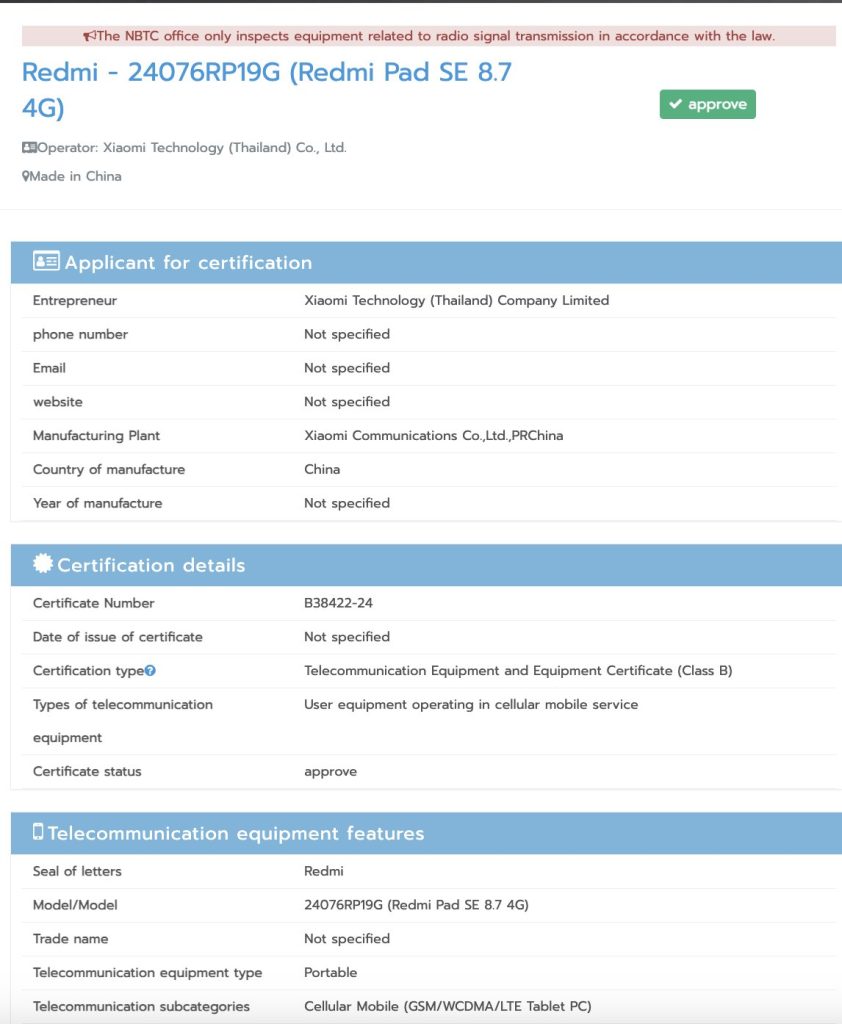
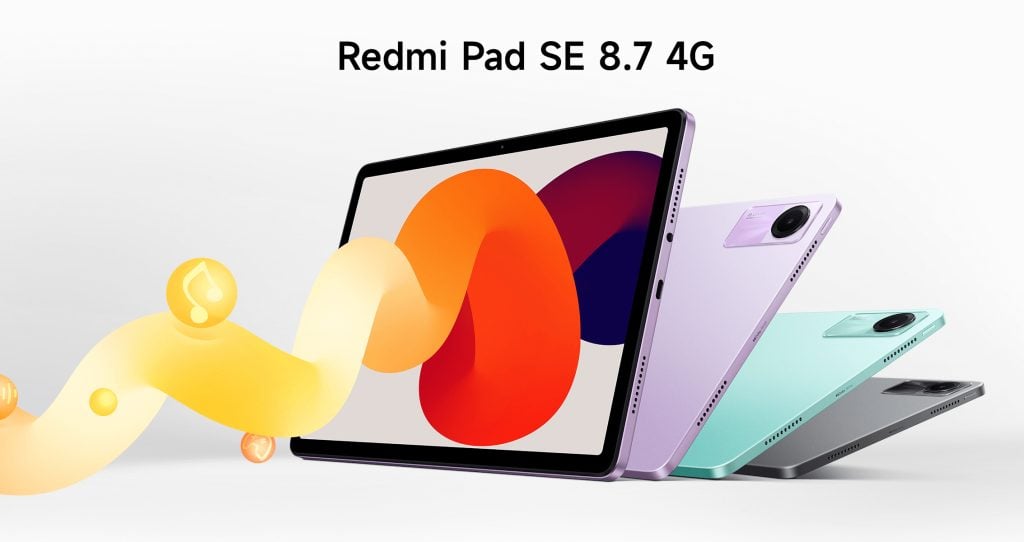
Earlier this month, we learned that Xiaomi is developing a new tablet called the Redmi Pad SE 8.7 4G. We recently shared a live image of the tablet, and now it has appeared on the NBTC certification website with the model number 24076RP19G.
The certification confirms the Redmi Pad SE 8.7 4G name and indicates that it is headed to Thailand. Previously, this tablet also appeared on the Bureau of Indian Standards website with the model number 24076RP19I. While the certification itself does not confirm any specifications, previous FCC listing reveals that it will feature Xiaomi’s Hyper OS 1.0 operating system, support dual-band Wi-Fi, Bluetooth, GPS, 4G LTE, and include an FM receiver.
This tablet will likely be a smaller version of the existing Xiaomi Pad SE, which comes with an 11″ display. We can take a look at the Redmi Pad SE’s specs to get an idea of what to expect from the upcoming Pad SE 8.7 4G model.
Redmi Pad SE specs:
The Redmi Pad SE features an 11-inch 8-bit LCD screen with a resolution of 1920 x 1200 pixels, a 90Hz refresh rate, a 180Hz touch sampling rate, and a peak brightness of 400 nits.
Under the hood, it has a Snapdragon 680 processor with three RAM options: 4 GB, 6 GB, or 8 GB of LPDDR4X RAM and 128 GB of eMMC 5.1 storage. Additionally, it includes a microSD card slot that supports memory expansion up to 1TB.
The tablet draws power from an 8,000mAh battery, providing over 28 hours of video playback and supports 10W charging through a USB Type-C port. It also includes a 3.5mm audio jack and a quad-speaker setup with Dolby Atmos tuning and Hi-Res audio support.
The tablet runs on Android 13-based MIUI for Pad and features AI face unlock. It comes with an 8MP rear camera and a 5MP front camera. For connectivity, it offers dual-band Wi-Fi (2.4GHz and 5GHz) and Bluetooth 5.0.
Last month, OnePlus launched a major update for its OnePlus 12 smartphone called the OxygenOS 14.0.0.802. This update introduced a bunch of new features, quality-of-life improvements, and bug fixes. The company has now launched another significant update called OxygenOS 14.0.0.810, which further polishes the animations and touch controls, fixes a few issues, and upgrades the security to June 2024 level.
The update is currently being pushed for Indian users only, with firmware version CPH2573_14.0.0.810(EX01). It has a total size of 1.06GB. Check out the full changelog below.
OnePlus 12 OxygenOS 14.0.0.810 update changelog:
Touch control
App icons on the Home screen now respond faster to your taps.
Improves touch control responsiveness when opening and closing apps.
Optimizes animations when opening and closing multiple apps.
Adds a transition animation when pulling down Quick Settings.
Optimizes animations when dragging app icons on the Home screen.
Animation upgrade
Adds Gaussian blur effects when opening and closing app icons on the Home screen.
Adds a transition animation when opening and closing Home screen widgets.
Adds a transition animation for clock widgets when the screen is turned off.
Improves how Home screen widgets are displayed.
Games
Improves gaming stability.
Fixes an issue where the screen might turn black while playing a game.
System
You can now choose not to show the track when drawing the Lock screen pattern to unlock your device.
Music controls can now be displayed in Fluid Cloud.
Fixes an issue where the volume slider in Quick Settings and the one triggered by pressing the physical volume button might appear at the same time.
Integrates the June 2024 Android security patch to enhance system security.
The OTA update will be rolled out incrementally. Initially, it will reach a small percentage of users today, with a broader rollout starting in a few days. Users can manually check for the update by navigating to Settings > About Device > OxygenOS > Check for Update.
Before Xiaomi announced the MIX Flip and Redmi K70 Ultra, an interesting development happened. Some system apps for both smartphones have been leaked. We checked the validity of the apps and found out that the apps were really leaked. Leaking the apps before the launch means that we are very close to the devices. Xiaomi is expected to announce new products in the first week of July.
Xiaomi MIX Flip and Redmi K70 Ultra’s leaked system apps at a look
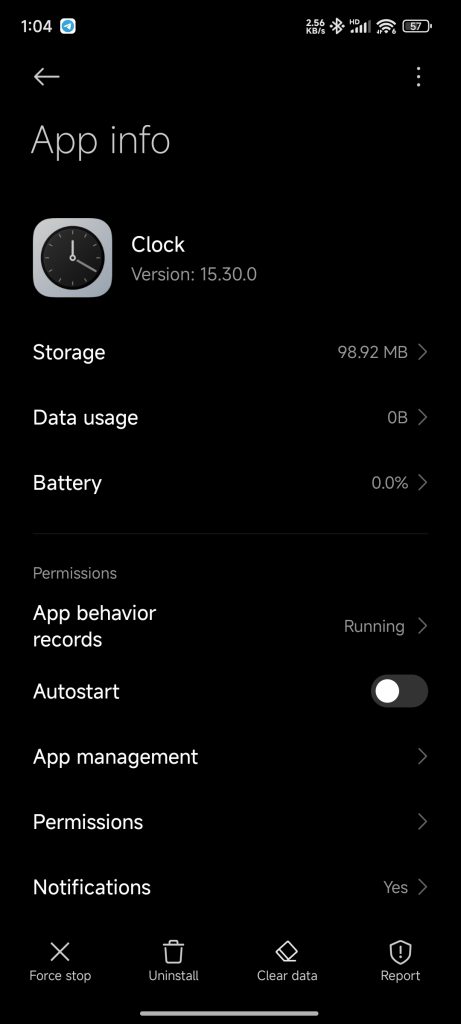
In this article, we take a deep look at the leaked system apps of the Xiaomi MIX Flip and Redmi K70 Ultra. The Xiaomi Clock app for the MIX Flip has leaked, while the Xiaomi AI Translate app for the Redmi K70 Ultra has been revealed. We have examined the code lines of both apps in detail and confirm that the apps belong to the smartphones specified.
Xiaomi Clock AppXiaomi Clock App
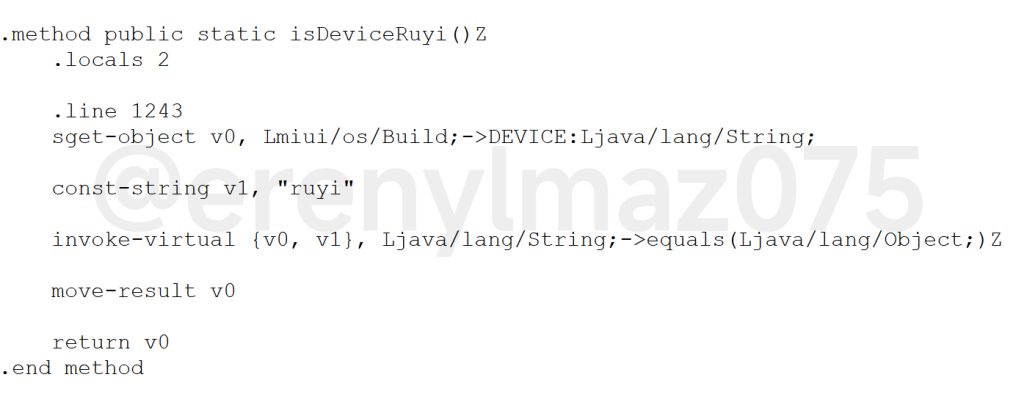
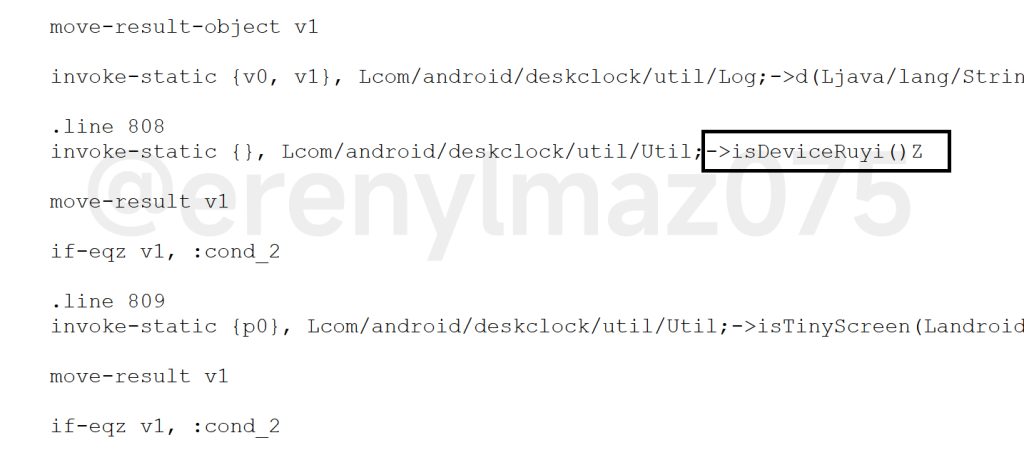
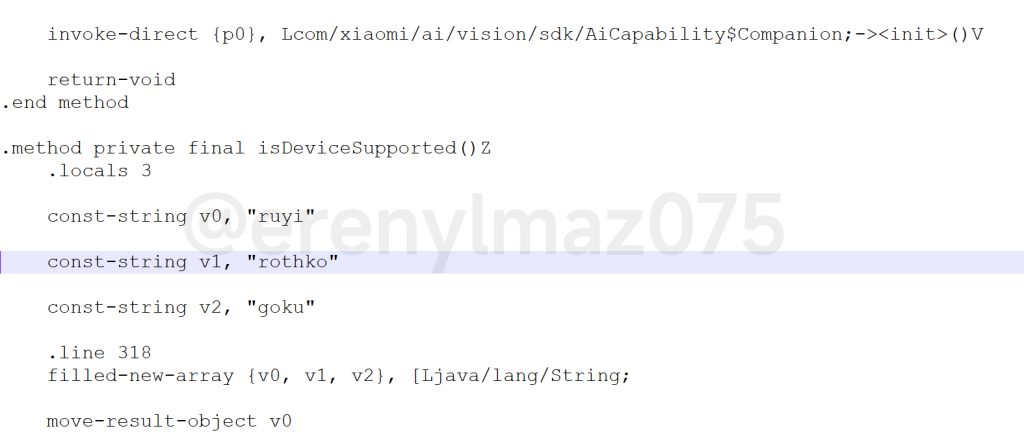
We have spotted that a special device codenamed “ruyi” has been added to the Xiaomi Clock app. The “ruyi” codename is known to belong to the MIX Flip. Compared to the previous Xiaomi Clock app, the new app has many lines of code related to the MIX Flip. We make this comparison by examining versions 15.26.0 and 15.30.0 of the app. The clock app for MIX Flip has version number 15.30.0. These lines of code were written by Xiaomi to make the app run smoothly on the foldable device.
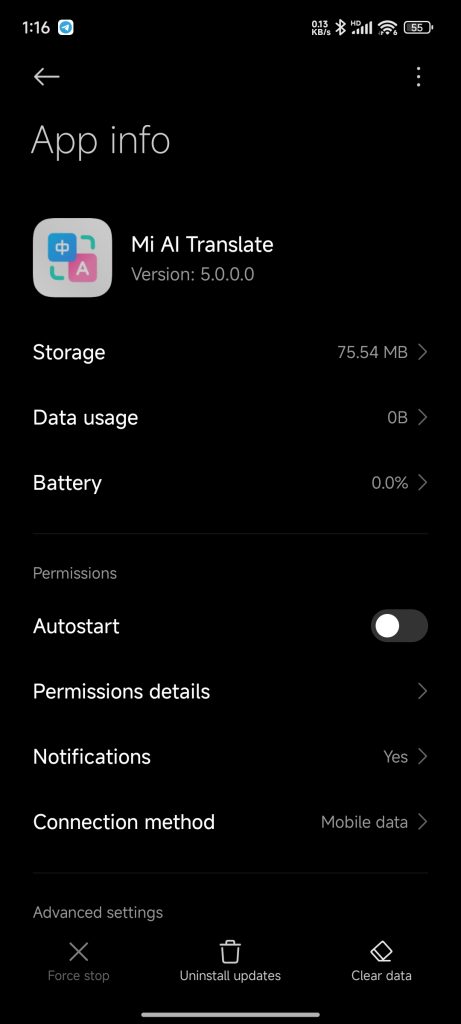
Also, a Xiaomi AI Translate app for the Redmi K70 Ultra has been leaked. This app is used for instant subtitle translations and has special features for flagship devices. The Xiaomi AI Translate app not only shows us the Redmi K70 Ultra, but also some tweaks for the MIX Flip and MIX FOLD 4.
Xiaomi AI Translate App
As you can see above, there are 3 smartphones with the codenames “rothko”, “ruyi” and “goku”. These are the Redmi K70 Ultra, MIX Flip and MIX FOLD 4 respectively. All this is a proof that the launch of the devices is quite a short time away. We are comparing to apps with versions 4.9.3 and 5.0.0.0.
Apart from these, there is nothing else to say. The features of the devices have already been leaked. The Redmi K70 Ultra will feature the Dimensity 9300 SOC, while the MIX Flip and FOLD 4 will be powered by Snapdragon 8 Gen 3. Both chips are extremely powerful and we’re looking forward to the new smartphones.
Xiaomi has started rolling out a new update, we can call the HyperOS 1.5, for flagship smartphones. Why do we call this update HyperOS 1.5? Because Xiaomi is rolling out an important update that brings new features and improvements to many devices. This is actually an important indicator that Xiaomi is finished with HyperOS 1.0 and is preparing for HyperOS 2.0 to be introduced in the near future.
Xiaomi says goodbye to the “old couplet” and prepares for HyperOS 2.0
Xiaomi announced that it would say goodbye to “old boring changelogs” and improve HyperOS updates with new testing methods. Today, Xiaomi 14, Xiaomi 14 Pro, Xiaomi 14 Ultra and Redmi K60 Ultra received a surprising new HyperOS update. The new HyperOS update released had a very detailed changelog. This confirms Xiaomi’s previous announcement and shows that the first steps are being taken for HyperOS 2.0.
We refer to the new update as HyperOS 1.5. Xiaomi often adds long changelogs to important UI updates. This update for the 4 flagship smartphones also had a very detailed changelog. Considering the brand’s traditional update release policy, this update is actually HyperOS 1.5. Of course, Xiaomi does not specify that this update is HyperOS 1.5.
[System]
Optimize the number of apps preloaded to improve the app launching speed.
Optimize the startup animation to reduce the application startup selection.
Optimize system resource collection during application switching to improve application flow.
Optimize memory usage.
Fixed the problem of system reboot caused by cleaning.
[Notes]
Fix the problem of cloud synchronization failure when the number of attachments exceeds 20MB.
[Widgets]
New travel assistant function, intelligent reminders for train and plane trips, making travel more convenient (after you need to open the intelligent assistant app in the Xiaomi App Store to version 512.2 and above, upgrade SMS to version 15/0.2.24 and above, and upgrade MAI engine to version 22 and above to support it)
Repair the problem of zoom abnormality when clicking the music widget
Repair the problem of display abnormality when adding clock widget with a low consumption rate.
[Lock screen]
Optimize the lock screen trigger section when clicking on the lock screen to enter the editor, to reduce the mis-touch.
[Clock]
Fixed the problem that the clock can’t be closed by pressing the button after ringing.
[Calculator]
Optimize the sensitivity of calculator keys
[Albums]
Optimize the video synchronization measurement to improve the smoothness of the broadcasting screen.
Fix the problem of long loading time of album preview when a large number of pictures are generated in a short time.
Repair the problem of losing the time of photos during cloud synchronization, resulting in the date of silver class.
Repair the problem of photos reappearing after deleting photos in cloud synchronization.
Repair the problem that time card can’t be played in some models
Repair the problem of album preview when taking a lot of photos in a row.
[File Manager]
Optimize the loading speed of File Manager
[Status bar, notification bar]
Fix the problem that notification icons are not fully displayed.
Fix the problem that blank notifications only show icons
Repair the problem of incomplete display of the 5G phase after switching the font size of status bar and switching three-way font.
You can see that the changelog is extremely long. This shows why what we call “HyperOS 1.5” is accurate. It’s not known whether the new update will be limited to China. But first, it’s worth noting that the update has been released in China. At the moment, Xiaomi is preparing for the launch of foldable smartphones such as the new MIX Flip and MIX FOLD 4, while at the same time developing HyperOS 2.0. The new interface will be officially announced in October.
Motorola launched the Moto S50 Neo earlier this week in China. Now the phone is on sale in the country. The pricing of the variants are listed below:
8GB + 256GB – 1,399 (~$192)
12GB + 256GB – 1,599 (~$220)
12GB + 512GB – 1,899 (~$261)
The phone adopts a PANTONE-validated camera system with OIS. The collaboration with PANTONE suggests natural and life-like colors in images and videos.
The S50 Neo comes in three color options: Gray, Olivine, and Surf. The latter two are made of are both made of high-tech nano-leather. It shows a lambskin-like texture, which offers a soft touch feel.
On the front, the phone equips a micro-curved P-OLED screen that reaches a peak brightness of 1600 nits. This display supports a 120Hz refresh rate, HDR 10+, and DCI-P3 wide color gamut. The phone comes with narrow bezels and offers a screen-to-body ratio of 91.6%. For protection, the phone adopts Corning Gorilla Glass. The display also comes with SGS eye protection certification and DC dimming, which is considered to be beneficial for long-term use cases, especially in low-light conditions.
On the back, the phone houses a 50MP + 8MP dual camera system. The main camera uses the Sony IMX882 sensor and also comes with OIS. On the front, there is a 32MP centered punch-hole selfie camera.
Speaking of the in-hand experience, the phone comes with slightly rounded edges. The display and the back panel are also curved on the sides. Besides being comfortable to hold, the phone is also lightweight and weighs only 171 g or 173 g based on different materials (plastic or eco-leather) on the back. The phone is measured at 7.6mm in thickness.
The Moto S50 Neo runs on the 6nm processed Snapdragon 6s Gen 3 chipset and comes in the following memory and storage configurations – 256GB 8GB RAM, 256GB 12GB RAM, and 512GB 12GB RAM. The phone packs a 5000mAh battery and supports 30W wired charging.
Mivi has unveiled the SuperPods Duetoi TWS earbuds in India. These earbuds, developed at Mivi Design Studios, have attractive features, such as dual-driver technology, 3D Soundstage, and dual-device connectivity. Here is a look at its specifications, features, and price.
Mivi SuperPods Dueto specifications and features
Mivi SuperPods Dueto
The SuperPods Dueto is equipped with Hi-lo Dual Drivers, which enhance sound quality across all frequencies. A dedicated 13mm woofer improves bass output, delivering a deep, rich audio experience, while a 6mm tweeter enhances mid to high frequencies, ensuring balanced treble and clean vocals. The 3D Soundstage technology further elevates the audio experience by offering advanced instrument separation for detailed sound clarity, claims the company.
The SuperPods Dueto comes with support for multi-device connectivity for seamless multitasking, Bluetooth v5.3 for stable connections up to 10 meters, and IPX4 water resistance for intense workouts. The earbuds offer AI voice assistant integration and AI-enabled environmental noise cancellation for clear calls.
Mivi SuperPods Dueto
The Dueto promises a 50-hour total playtime with 8.5 hours on a single charge. For gamers, it has a dedicated gaming mode that ensures ultra-low latency. Additionally, the earbuds’ sleek dual-tone design is available in five unique colors to match individual styles.
Mivi SuperPods Dueto price in India
The SuperPods Dueto is priced at Rs 1,999 in India. It can be purchased through Mivi’s website and Flipkart. Buyers can choose from shades like Lavender, Comet Blue, Triton Gold, Meteor black and Callisto Peach.
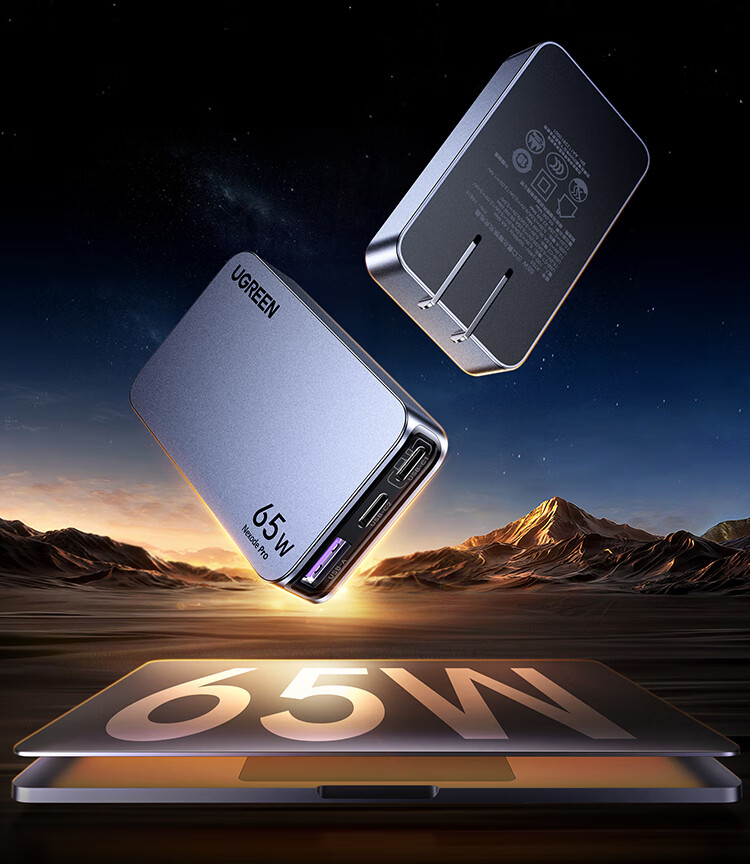
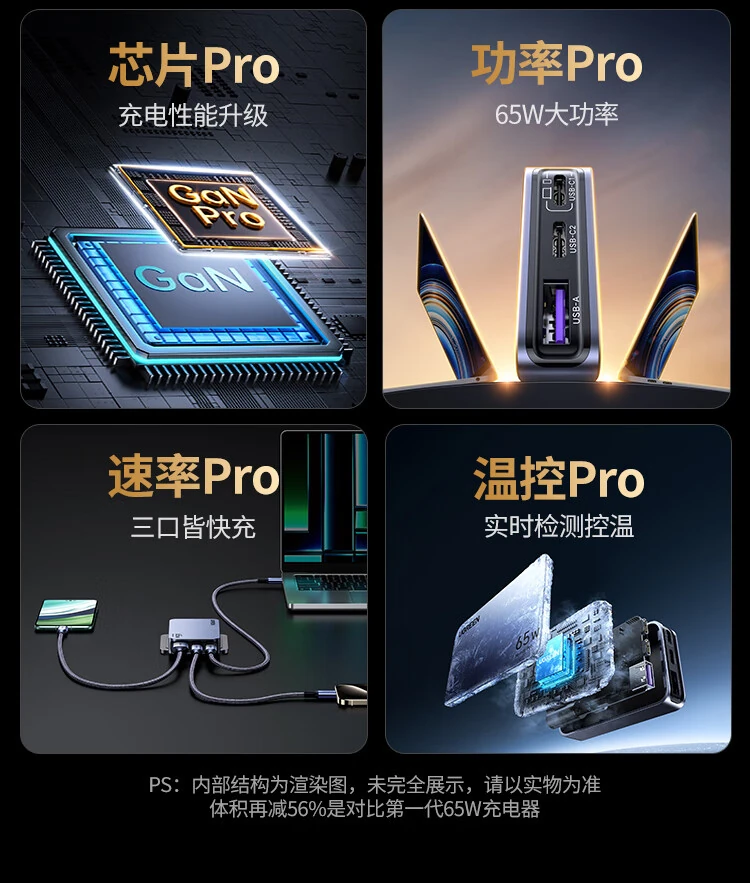
UGREEN has officially announced its new ultra-thin biscuit version 65W gallium nitride charger. This announcement was conveyed via the brand’s official Weibo account and it is now available in the market with a 179 yuan ($25) price tag.
This charger is lightweight, weighing 122 grams, and thin, with a thickness of 14.5 mm. It has a flat body partly due to the reduced size of the major components of the charger. The plug implements a foldable design, which makes it easy to carry around inside your pocket.
The new UGREEN 65W gallium nitride charger is equipped with three ports, all of which come with fast charging capabilities according to UGREEN. It is claimed that the charger can charge within 30 minutes, and recharge a 16-inch MacBook Pro to 35%, 60% for an iPhone 15 Plus, and 58% for a Samsung Galaxy S23 Ultra.
The ports of the 65W gallium nitride charger are USB-C1, USB-C2, and USB-A. The USB-C1 interface can output 65W power, while the USB-C2 interface can output 30W power, and the USB-A interface outputs 22.5W power. The charger supports power self-adaptation and multiple fast charging protocols such as PD 3.0/2.0/QC4.0+/3.0/2.0, SCP, FCP, UFCS, and AFC. It is suitable for use with several models including laptops, mobile phones, and camera equipment.
Pricing & Availability
The UGREEN ultra-thin biscuit version 65W gallium nitride charger is available for purchase from retail platforms in China such as JD.com for 179 yuan ($25). Global availability information on the model is lacking at this time.
The Meizu PANDAER Ice Energy Cooling Back Clip has been released and is now on sale in China. The PANDAER Ice Energy Cooling Back Clip offers 24W power and delivers vertical airflow in both the up and down directions. The vertical air outlet design of the Meizu PANDAER Ice Energy Cooling Back Clip allows airflow up or down for maximum cooling.
The Meizu PANDAER Ice Energy Cooling Back Clip has model number PRA01 and is made from ABS, aluminum alloy, and silica gel. The dimensions of the cooling back clip are 82 x 54.8 x 41.5 mm and it has Chinese implementation standards certification with number GB4943.1-2022. The cooling clip also comes with a real-time temperature digital display.
The new cooling back clip utilizes an ultra-high 7-blade fan that has a speed rating of 5,800 rpm. It is claimed that the device is capable of reducing the temperature from 31ºC to -5ºC. It allows the mobile phone to deliver stable and continuous performance. The frame rate of long-term games remains stable. The gadget supports three levels of power adjustment and also features RGB lighting effects. It uses a 1,500-square-millimeter TEC refrigeration chip that can effectively control the temperature of an attached mobile phone. It is compatible with mobile phones of all sizes.
The PANDAER Ice Energy Cooling Back Clip uses a motherboard separation and motherboard glue waterproofing to prevent the formation of internal condensation water. The product is available from retail platforms in China including JD.com at an introductory price of 99 yuan ($14). The package includes the back clip and a user manual.
GoPro is celebrating a major milestone: selling over 50 million cameras worldwide since the launch of its iconic HERO camera in 2009. This translates to an average of roughly 3.33 million cameras sold each year for the past 15 years.
The company’s overall revenue shows an 8% decline compared to 2023
The company has capitalized on the action camera market, launching 20 different camera models that have each surpassed 1 million units in sales. This includes not just traditional action cameras but also 360-degree cameras, catering to a wider range of content creators.
However, GoPro’s financial performance paints a less rosy picture. Despite a 6% year-over-year increase in camera sales for 2023, reaching 3 million units, the company’s overall revenue of $1 billion (approximately 7.285 billion Yuan) represents an 8% decline compared to the previous year.
Adding to the concern is a net loss of $53 million (approximately 386 million Yuan) for 2023, a reversal from the net profit of $29 million recorded in 2022. This translates to a loss of $0.35 per share compared to a profit of $0.18 per share in the previous year.
A silver lining can be found in GoPro’s subscription and service revenue, which grew 18% year-over-year to reach $97 million (approximately 707 million Yuan) in 2023. This is an indicator of a potential growth area for the company as it seeks to diversify its revenue streams.
Qualcomm announced the Snapdragon 8s Gen 3 and Snapdragon 7+ Gen 3 mobile chipsets in the same month, March 2024. The interesting part is that both chipsets have the same cores and core cluster. In fact, their camera capabilities and many other parameters are also similar.
Too many similarities between these two chipsets have made it a little difficult for many people to pick the right one. If you’re in the same boat, don’t worry. In this post, we’ll compare the Snapdragon 8s Gen 3 and Snapdragon 7+ Gen 3 to see how they stack up against each other.
Let’s quickly review the spec sheet for an overview:
SD 8s Gen 3
SD 7+ Gen 3
Release Date
March 2024
March 2024
Model number
SM8635
SM7675
Process node
4nm TSMC
4nm TSMC
CPU
1 x Cortex-X4 @ 3.0 GHz 4 x Cortex-A720 @ 2.8 GHz 3 x Cortex-A520 @ 2.0 GHz
1 x Cortex-X4 @ 2.8 GHz 4 x Cortex-A720 @ 2.6 GHz 3 x Cortex-A520 @ 1.9 GHz
GPU
Adreno 735
Adreno 732
GAMING
Snapdragon Elite Gaming Hardware-Accelerated Ray Tracing Game Post Processing Accelerators Qualcomm Adreno Frame Motion Engine 2.0
Snapdragon Elite Gaming Game Post Processing Accelerators Qualcomm Adreno Frame Motion Engine 2.0
NPU
Qualcomm Hexagon NPU
Qualcomm Hexagon NPU
Memory
Up to 24GB LPDDR5X RAM 4200 MHz (frequency)
Up to 24GB LPDDR5X RAM 4200 MHz (frequency)
Storage
UFS 4.0
UFS 4.0
Camera
Qualcomm Spectra 18-bit Triple ISPs 200 MP single camera 108 MP (MFNR, ZSL) single camera 64+36 MP (MFNR, ZSL) dual cameras 36+36+36 MP (MFNR, ZSL) triple cameras
Qualcomm Spectra 18-bit Triple ISPs 200 MP single camera 108 MP (MFNR, ZSL) single camera 64+36 MP (MFNR, ZSL) dual cameras 36+36+36 MP (MFNR, ZSL) triple cameras
Video recording
4K @ 60 fps 1080p slow-mo @ 240 fps
4K @ 60 fps 1080p slow-mo @ 240 fps
Display
QHD+ @ 144 Hz, 4K Ultra HD @ 60 Hz 10-bit color depth, HDR10, HDR10+, HDR Vivid
QHD+ @ 144 Hz, 4K Ultra HD @ 60 Hz 10-bit color depth, HDR10, HDR10+, HDR Vivid
The Snapdragon 8s Gen 3 and 7+ Gen 3 chips have one Cortex-X4 prime core, three Cortex-A720 performance cores, and four Cortex-A520 power-efficient cores, but those in SD 8s Gen 3 run at a higher clock speed, giving some additional performance boost.
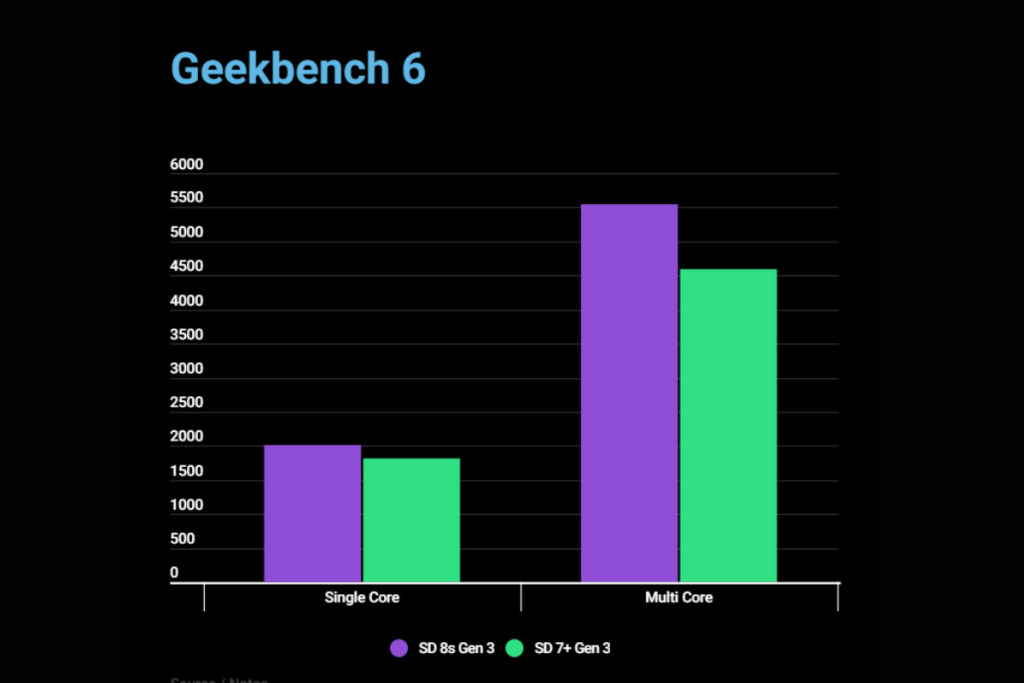
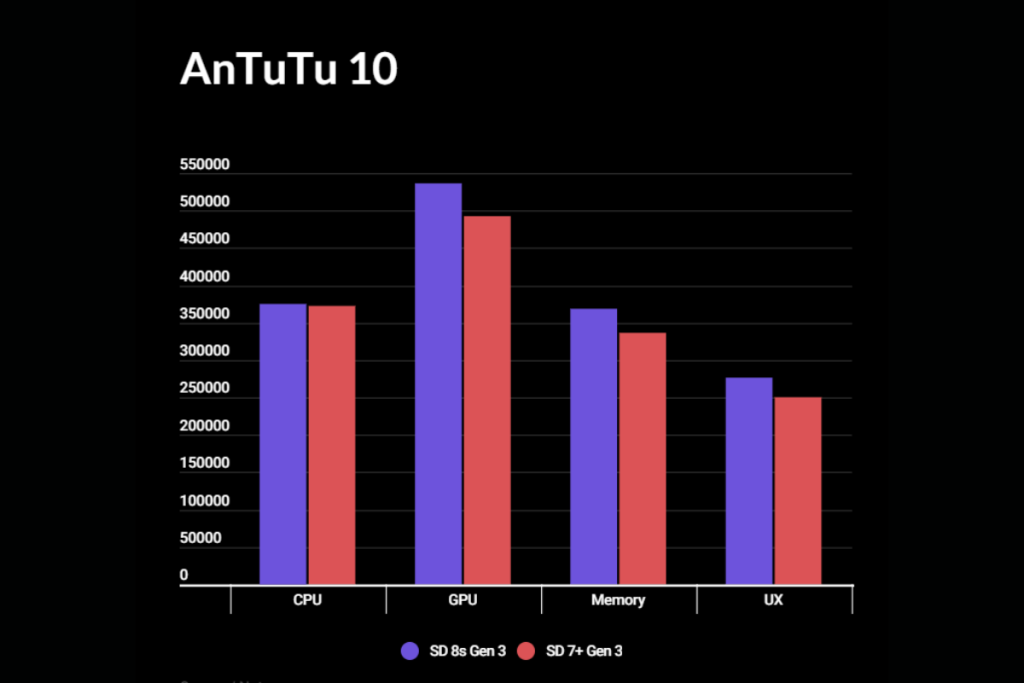
The Snapdragon 8s Gen 3 has better CPU performance than the 7+ Gen 3. Geekbench and AnTuTu scores also tell the same thing.
Geekbench results show a small margin in the single-core results, but the difference between multi-core scores is high, with the 8s Gen 3 leading the race. This means tasks requiring multi-cores, such as gaming and video editing, will likely do better on Snapdragon 8s Gen 3-powered devices.
The Snapdragon 7+ Gen 3 has an Adreno 732 for handling graphic needs, whereas the Snapdragon 8s Gen 3 is equipped with an improved Adreno 735 GPU. The GPU scores in AnTuTu tests also prefer the Snapdragon 8s Gen 3 over 7+ Gen 3.
In 3D Mark Wild Life benchmarking tests for graphics, the Snapdragon 8s Gen 3 attains an average of 72 fps (vs. 62 fps on Snapdragon 7+ Gen 3).
Camera Capabilities
There are no differences in the camera capabilities of these two chipsets. Both support up to 200-megapixel single camera, up to 108-megapixel single camera with zero-shutter lag (ZSL), 64-megapixel + 36-megapixel dual cameras with ZSL, 36-megapixel + 36-megapixel + 36-megapixel triple cameras with ZSL.
The chips support 4K video recording at 30 frames per second (fps) and 1080p slow-motion video recording at 240 fps.
Connectivity
Snapdragon 8s Gen 3 and 7+ Gen 3 chipsets support necessary connectivity features such as Wi-Fi 7, Bluetooth 5.4, NFC, and satellite systems (QZSS, Galileo, Beidou, GLONASS, NavIC, GPS). However, they do differ in terms of modems.
The Snapdragon 8s Gen 3 uses the Snapdragon X70 5G modem that offers peak download and upload speeds of 6.5 Gbps and 3.5 Gbps, respectively. The Snapdragon 7+ Gen 3, on the other hand, is equipped with a Snapdragon X63 5G modem that has a slightly lower peak download speed of 5 Gbps but supports the same upload speed.
Miscellaneous
Both chips support up to 24 GB LPDDR5x RAM at 4200 MHz. They also support the same display on-device screen resolutions (QHD+ @ 144 Hz, 4K Ultra HD @ 60 Hz). However, there’s a slight difference in the video playback.
Both Snapdragon chips can play 4K videos, but the 8s Gen 3 supports 120 fps, which is limited to 60 fps in the 7+ Gen 3. Among the same capabilities also includes Qualcomm Quick Charge 5 support.
Snapdragon 8s Gen 3 vs Snapdragon 7+ Gen 3: Which is Better?
Both Qualcomm chips — the Snapdragon 8s Gen 3 and Snapdragon 7+ Gen 3 — are high-performance chips and can handle the processing needs of most people. However, the Snapdragon 8s Gen 3 has a slight edge over the 7+ Gen 3 in terms of CPU and GPU performance.
The Snapdragon 8s Gen 3 also offers a higher peak download speed because of a newer 5G modem and supports video playback at a higher fps.
The battery efficiency is one area where the Snapdragon 7+ Gen 3 leaves the 8s Gen 3 behind. It’s because CPU cores in the 8s Gen 3 chip run at a higher clock speed than those in the 7+ Gen 3, resulting in higher battery usage.
Both are capable chips. But the Snapdragon 8s Gen 3 seems a better choice overall. However, if you’re not a performance-heavy user and care a lot about battery efficiency, the Snapdragon 7+ Gen 3 might be a good choice.
Samsung’s Galaxy Unpacked event is set to take place on July 10 in Paris. It will see the arrival of the sixth-generation Galaxy Z foldables, Galaxy Watch 7, Galaxy Watch Ultra, and the Galaxy Ring. Now, ahead of the launch, the South Korean brand has started the pre-reservations of the upcoming offerings except the Galaxy Ring in the Indian market. There are various benefits for customers who are interested in purchasing the devices.
Samsung starts taking pre-reservations of upcoming devices in India
Interested customers can pre-reserve the upcoming devices from Samsung on the company’s official website and exclusive stores, Amazon, Flipkart, and leading retail stores across the country. Those pre-reserving have to buy a VIP pass of Rs 1,999. It will be sent to your registered email and mobile number.
Samsung is offering benefits up to Rs 7,000 on pre-reserving. They can get the upcoming devices in special colors that are only available on the company’s website. The brand is also assuring 70 percent buyback value at the time of redemption. If you pre-reserve, you will be the first to have access to the products when they go on sale in the country. Interested customers in Z Fold 6 will be eligible for an e-voucher for Rs 7,000 whereas it is Rs 3,999 on the Z Flip 6. There are e-vouchers up to Rs 6,499 and Rs 2,299 on the forthcoming Galaxy Watch and Buds 3 series respectively.
Samsung will send a welcome mail with details about the pre-reservation e-voucher code. The token amount is refundable if the user does not use the voucher during the pre-booking period. Meanwhile, the VIP pass amount will be adjusted in the purchase price of the device at the time of checkout.
Samsung has a lot in store for next month – new foldable, smartwatches, a smart ring, earbuds, and maybe more. We’ve already seen renders of the Galaxy Z Flip 6 and Z Fold 6, and now it’s time to turn our attention to the upcoming Galaxy Watch lineup and Galaxy Buds.
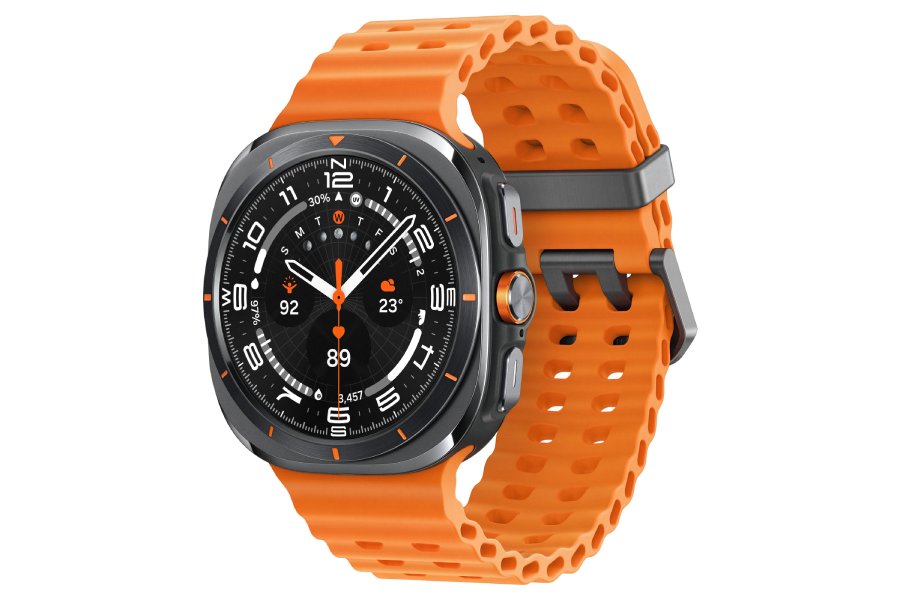
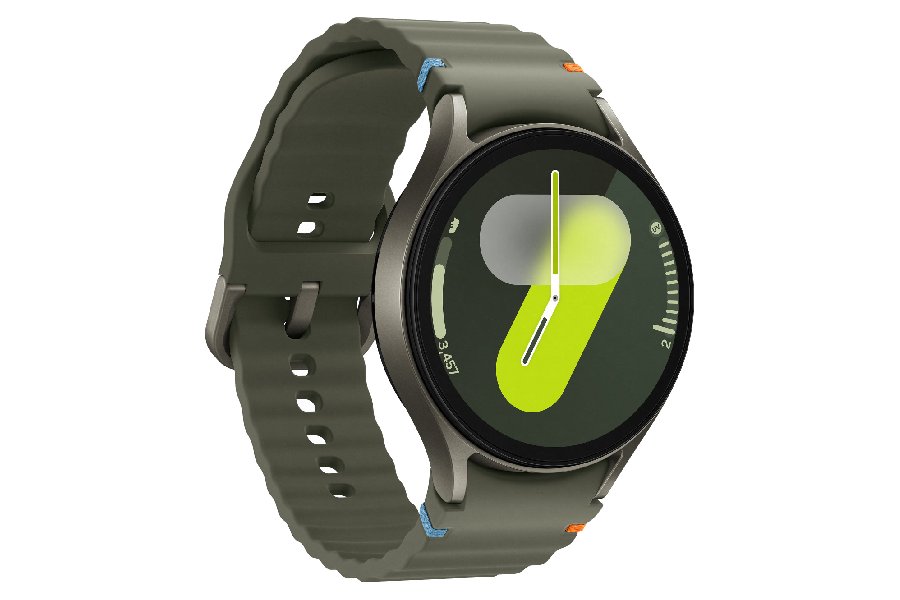
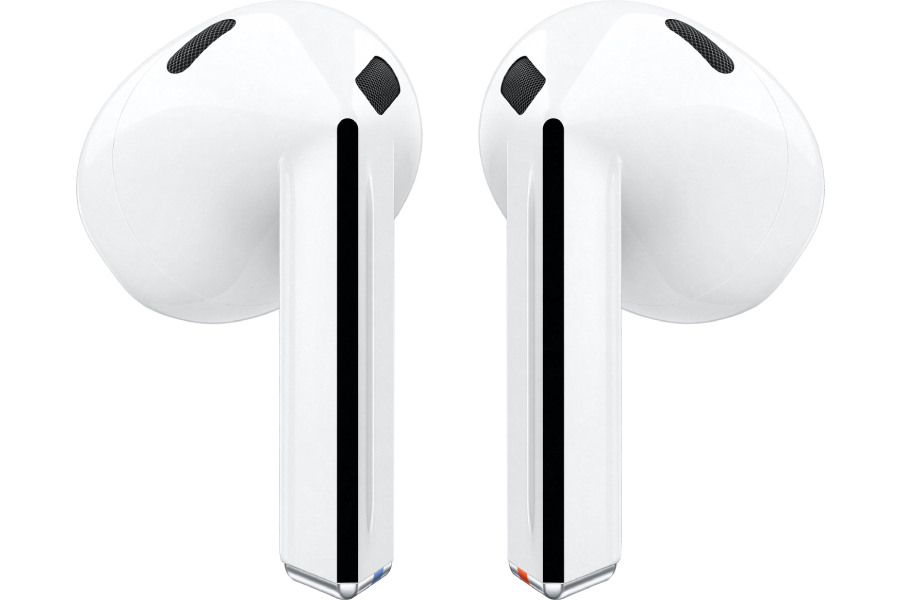
Evan Blass, a reputable source for tech leaks, has shared the official marketing images of the Galaxy Watch Ultra, Watch 7, Galaxy Buds 3 Pro, and standard Galaxy Buds 3.
The centerpiece of the leak is undoubtedly the Galaxy Watch Ultra, Samsung’s first Ultra smartwatch. It can be seen with a rugged orange band tucked in its unique square case with a circular display nestled on top.
Interestingly, the proprietary band connection system looks eerily similar to the Apple Watch. Samsung has long favored spring pin bands for its smartwatches, which offer wider compatibility with third-party straps. However, it appears that Samsung is now aiming to make its new Ultra watch more akin to the Apple Watch in this regard.
The leak also offers a look at the standard Galaxy Watch 7. It retains the design of its predecessor, the Watch 6, and has a green band.
Shifting the focus to audio, Blass dropped images of the Galaxy Buds 3 and Galaxy Buds 3 Pro. Both models sport a sleek, stemmed design like the Apple AirPods.
Although the buds have a sharper edge compared to Apple’s AirPods, there’s a clear resemblance, especially noticeable with the white Galaxy Buds 3. Notably, this model will come without silicone tips.
The Galaxy Buds 3 Pro stands out with its dark gray finish and a transparent case lid. The Pro model will retain the comfortable silicone tips from earlier Galaxy Buds models.
With the Unpacked event just around the corner, anticipation is building for the official unveiling of these wearables and earbuds. Rumors also hint at the debut of the first-ever Galaxy Ring at the event. We’ll be sure to keep you updated as more details emerge.
Recently, CMF teased a removable screw on the back panel of the Phone 1. The device is set to launch on July 8 alongside the Buds Pro 2 and Watch Pro 2. Now, the Nothing sub-brand has confirmed the processor and RAM capacity of the upcoming smartphone. The AnTuTu benchmark testing scores have also been revealed. Additionally, YouTuber TechnicalGuruji has also teased the pricing of the CMF Phone 1. Read on to know all the details below.
CMF Phone 1 processor, RAM, and pricing teased
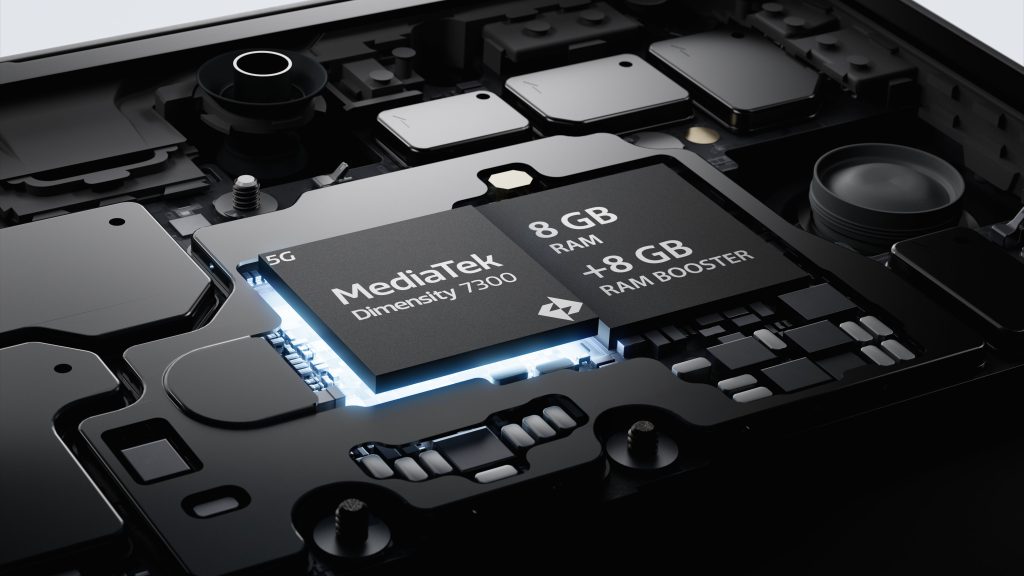
CMF has confirmed that its first-ever smartphone will be powered by MediaTek’s Dimensity 7300 5G processor. It was announced last month. The chipset comprises of eight cores with four performance cores clocked at 2.5GHz. The Dimensity 7300 5G beats many other processors including Snapdragon 782G, Dimensity 7050 5G, and Snapdragon 6 Gen 1 in AnTuTu benchmarking test. It scores 673,000 points.
The CMF Phone 1 will pack 8GB RAM along with 8GB virtual RAM. It is also expected to be available in 6GB RAM variant. On Day 2 of Building the CMF Phone 1, JerryRigEverything shared a short teardown video of the device revealing an SK Hynix module. On Day 3, YouTuber TechnicalGuruji confirmed that it will be priced under the Rs 20,000 segment.
The CMF Phone 1 is already confirmed to come with a 6.67-inch sAMOLED display with a centre-aligned punch-hole cutout. It will feature an FHD+ resolution, a 120Hz refresh rate, 2,000 nits peak brightness, and support HDR10+.
Other known details about the CMF Phone 1 include a rotating dial at the bottom right corner of the back panel. It will come in a leather textured Orange and matte Black color options. The smartphone is expected to be backed by a 5,000mAh battery with support for 33W charging.
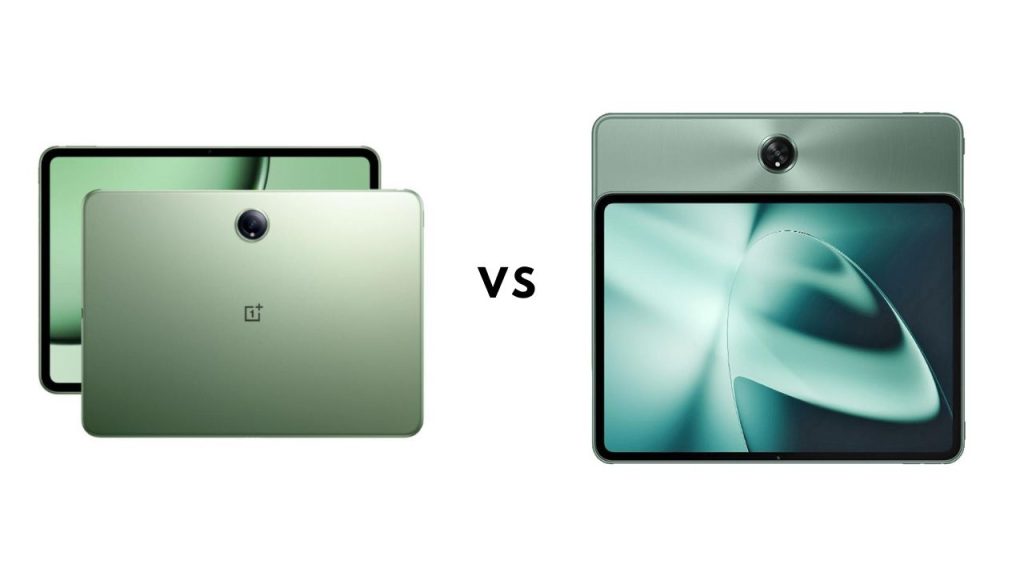
4. OnePlus Pad Pro vs OnePlus Pad: Taller & Brighter Display
The original OnePlus Pad was first announced with an 11.61-inch IPS LCD panel with 2000 x 2800 resolution, HDR10+ resolution, 144Hz refresh rate, Dolby Vision, and 500 nits of peak brightness. In our review, we praised the OnePlus Pad for being great for content consumption.
Now, it appears that the brand is doubling down on this aspect with the OnePlus Pad Pro. It sports a taller 12.61-inch display, which doesn’t make the move to OLED, but brings certain upgrades. The tablet offers a higher 2120 x 3000 pixel resolution so there is a higher ppi density. Dolby Vision, a 144Hz refresh rate, and HDR10+ make a return, but the peak brightness has been bumped to 900 nits.
3. Flagship grade performance
While the MediaTek Dimensity 9000 SoC on the OnePlus Pad wasn’t slow by any means, it wasn’t the top-of-the-line chipset of its time. But the newer Pro model can take on other flagship models. The OnePlus Pad Pro is equipped with the Qualcomm Snapdragon 8 Gen 3 chipset, which is paired with up to 16GB of RAM and 512GB of internal storage. Meanwhile, the base variant came with up to 12GB of RAM and 256GB of internal storage. So the newer tablet is better for intensive uses like graphically intensive mobile games.
2. Battery, Camera, & more have remained the same
OnePlus hasn’t enhanced every aspect of the Pro. Some of its specs are identical to the base model. Right off the bat, the design is practically identical but there’s no real complaint considering you still get the all-metal body. The battery pack and charging rate haven’t changed either, with both tablets packing a massive 9,510mAh battery pack that supports 67W wired fast charging. Lastly, there is the camera setup on the front and back. The duo packs a 13-megapixel shooter on the rear and an 8-megapixel sensor for selfies and video calls on the front.
1. Pricing
Back in 2023, the OnePlus Pad was officially announced for a starting price tag of 399 Euros in Europe and 479 US Dollars in the US. On the other hand, the OnePlus Pad Pro has only been announced in the brand’s home market of China. At the moment, there is no word regarding its global availability, but it should be released in overseas markets in the coming weeks or months. In China, the OnePlus Pad Pro was announced for a starting price tag of 2,799 Yuan (roughly 385 US Dollars). So we can expect its global pricing to be around the 500 US Dollar mark. If it has a price tag near the original OnePlus Pad, the Pro variant is easily a worthy successor.
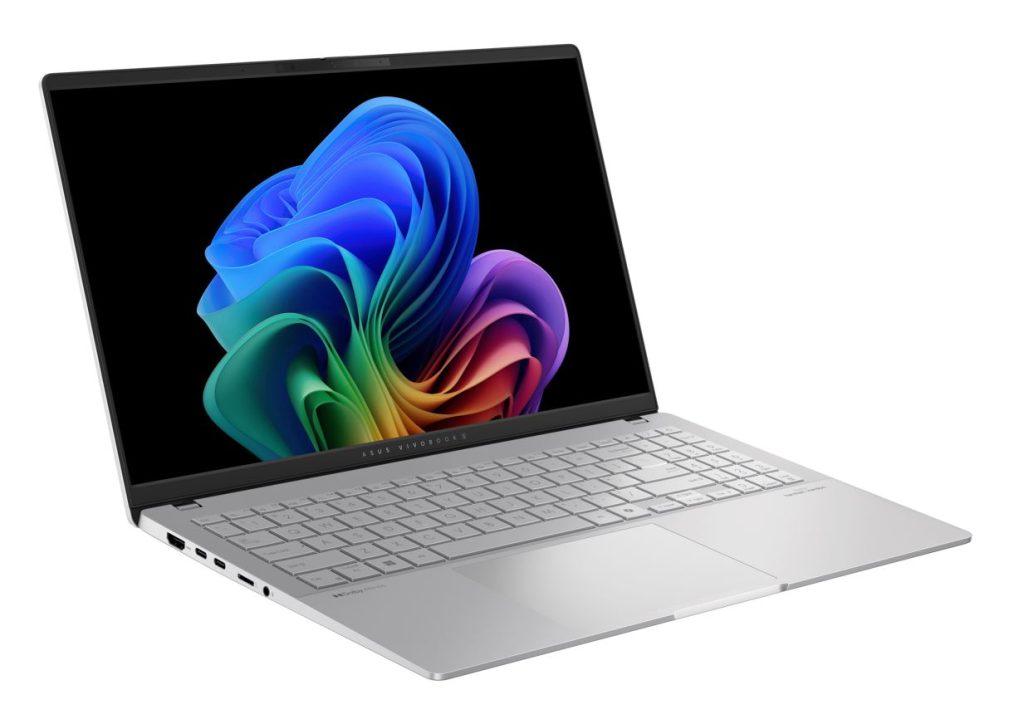
Back in May, Asus unveiled the Vivobook S 15 laptops powered by the new Snapdragon X Elite chipset. The laptop also comes integrated with Microsoft’s Copilot+ AI, featuring a dedicated Copilot+ button. A month after the global launch, Asus has now brought the Vivobook S 15 S5507 laptop over to the Indian market, kicking off pre-orders from July 2 on Flipkart.
The pre-order window will be open from July 2 to July 8, 2024. Customers who pre-order the ASUS Vivobook S 15 (S5507) will receive benefits worth up to Rs. 21,389 for just Rs. 1. These benefits include free earbuds, an additional two-year warranty, and three years of accidental damage protection. The pre-order process involves four steps:
Pre-book the ASUS Vivobook S 15 on Flipkart between July 2 and July 8.
Generate a unique coupon code on the ASUS website during the same period.
Receive the exclusive coupon code via email.
Redeem the offer at asuspromo.in for Rs. 1 within 15 days after purchasing the laptop.
Asus Vivobook S 15 (S5507) specs:
The ASUS Vivobook S 15 (S5507) is powered by the Qualcomm Snapdragon X Elite X1E 78 100 processor, paired with 32GB LPDDR5X RAM and a 1TB M.2 NVMe PCIe 4.0 SSD. The device runs on Windows 11 Home. It has a 15.6-inch ASUS Lumina OLED display with a 3k resolution, a 120Hz refresh rate, 600 nits peak brightness, 100% DCI-P3 color gamut, and a 16:9 aspect ratio.
The laptop features a Qualcomm Adreno GPU and Qualcomm Hexagon NPU 45TOPS for high performance and efficiency. Its 70Wh battery offers up to 18 hours of battery life, and fast-charging technology can charge the device up to 60% in 49 minutes.
The Vivobook S 15 includes a backlit chiclet keyboard with a num key, 1.7mm key travel, a precision touchpad, and a dedicated Copilot key. It also features an FHD camera with an IR function and a privacy shutter for enhanced security and usability.
Connectivity options for the Vivobook S 15 include two USB 3.2 Gen 1 Type-A ports, two USB 4.0 Gen 3 Type-C ports, an HDMI 2.1 TMDS port, a 3.5mm combo audio jack, a micro SD card reader, Wi-Fi 7, and Bluetooth 5.4. The device meets US MIL-STD 810H military-grade standards and includes features such as AI noise canceling, built-in speakers, Smart Amp technology, and more.
Falcon Laser, a leading name in advanced laser technology, concluded a highly successful showcase at the 2024 Rapid + TCT Exhibition, held from June 25th to 27th at the Los Angeles Convention Center. Stationed at booth #2909, Falcon Laser captivated attendees with their latest innovation, the Falcon2 Pro 60W laser cutter and engraver.
The 2024 Rapid + TCT Exhibition brought together industry professionals, enthusiasts, and innovators in the fields of 3D printing, additive manufacturing, and laser technology. Falcon Laser, a subsidiary of Creality, made a significant impact with their advanced laser solutions, emphasizing precision, versatility, and reliability.
Falcon2 Pro laser cutter and engraver
The highlight of Falcon Laser’s showcase was the Falcon2 Pro 60W laser cutter and engraver. This state-of-the-art product boasts three power modes—20W, 40W, and 60W—allowing users to tailor the device to various materials such as metals, leather, wood, and acrylic. The Falcon2 Pro is designed for both intricate design handling and robust industrial applications, making it a versatile tool for creators and professionals alike.
Throughout the event, Falcon Laser conducted live demonstrations of the Falcon2 Pro, showcasing its ability to handle intricate designs with ease and precision. These demonstrations impressed both amateur crafters and professional creators, highlighting the seamless operation and professional-grade outcomes of the laser cutter. The demonstrations sparked numerous discussions about the creative and industrial potential of the Falcon2 Pro.
The response from attendees was positive, with significant interest generated around the Falcon2 Pro. Holly Liu, Director at Falcon Laser, expressed excitement over the reception and the valuable connections made during the exhibition. “We are thrilled with the positive feedback and the meaningful discussions we had with peers and enthusiasts. It’s encouraging to see such strong interest in our technology,” Liu stated.
Giveaway and Promotional Offers
Falcon Laser further engaged visitors with a popular giveaway and exclusive promotional deals, attracting a large number of participants. These initiatives provided attendees with insights into the practical aspects of laser technology and highlighted the potential for lucrative business ventures using Falcon Laser products.
Falcon Laser also invites everyone to join their community, a dynamic hub for sharing ideas, updates, and creations. Members of the Falcon Laser community can interact with real users, explore creations by other enthusiasts, and enjoy exclusive community discounts.
OnePlus is working on a new pair of affordable truly wireless earbuds from its popular Nord series. The model in question is the Nord Buds 3r. It was recently spotted in a Canadian certification platform. So here’s everything we know about these earbuds.
OnePlus Nord Buds 3r visits REL certification
OnePlus Nord Buds 2r
The upcoming Nord Buds 3r surfaced on the REL database (via 91Mobiles) carrying the E511A model number. Unfortunately, the certification only reveals the firmware version V0.2.6, and no other finer details like its specs and features were revealed. Just last month, the Nord Buds 3r visited the FCC database with the E511A model number. This confirmed that it is powered by a 58mAh battery pack, which is much larger than the Nord Buds 2r’s 36mAh cell.
Furthermore, the charging case packs a 440mAh battery pack, which is slightly smaller than the previous gen model. The battery on the earbuds has a 112570 model number and the charging case has the 761832-B1 model number. In other words, we can expect a better battery life on the earbuds, which means a longer audio playback. OnePlus launched the Nord Buds 2r back in July 2023, so we can expect the Nord Buds 3r to have a similar launch timeline.
These hearables likely have a similar price tag as its predecessor as well. The Nord Buds 2r is priced at 2,199 INR, so we can expect the Buds 3r to likely cost under 3,000 INR. Last year’s model launched with Dolby Atmos and Dirac Audio tuner, along with ENC for clear calls and Bluetooth 5.3 support. It housed a 12.4mm titanium coated dynamic driver and an IP55 rating for water and dust resistance. So stick around for more as we will be providing more details when additional information is available regarding this matter.
HMD Global, the company behind the current Nokia-branded phones, seems to be reviving the Lumia name in spirit with its upcoming Skyline series.
Earlier this month, leaks revealed that HMD is working on a new phone called the Skyline. The renders we’ve seen so far suggest that the Skyline will have a design reminiscent of the classic Nokia Lumia line. Now, it appears there might be more to the Skyline story than we initially thought.
Reliable leaker @smashx_60, known for HMD-related leaks, has revealed that HMD is working on a second Skyline device, called the HMD Skyline G2.
It’s unclear whether this is a direct successor to the first Skyline or a separate device altogether. Regardless, since the first Skyline hasn’t been officially announced yet, the launch of the G2 seems to be quite far off.
Similar to the first Skyline, the G2 is rumored to sport a triple-camera system on the back. While the exact camera setup remains uncertain, the tipster has shared four possible configurations, one of which even includes a 200MP main camera.
Not yet concluded for Skyline G2, And we still have a long time to create this model but the one thing that we can confirm is HMD want to present Skyline-Series to be an attractive option for photographers. pic.twitter.com/VGGrpvm3TE
All the setups also include telephoto, ultrawide, and Time of Flight (ToF) sensors and that is because HMD will reportedly be targeting the G2 towards mobile photography enthusiasts.
The most notable difference between the two Skylines appears to be the bezels. The initial leak showed a phone with a prominent chin and relatively thin bezels on the sides and top. In contrast, the G2 is said to have thick bezels on both the top and bottom, giving it a more dated look.
Unlike the original Skyline leak, which included specifications and pricing information, details about the G2 are scarcer. We’ll need to wait for further leaks or official announcements to learn more about the hardware, software, and release date of the HMD Skyline G2.
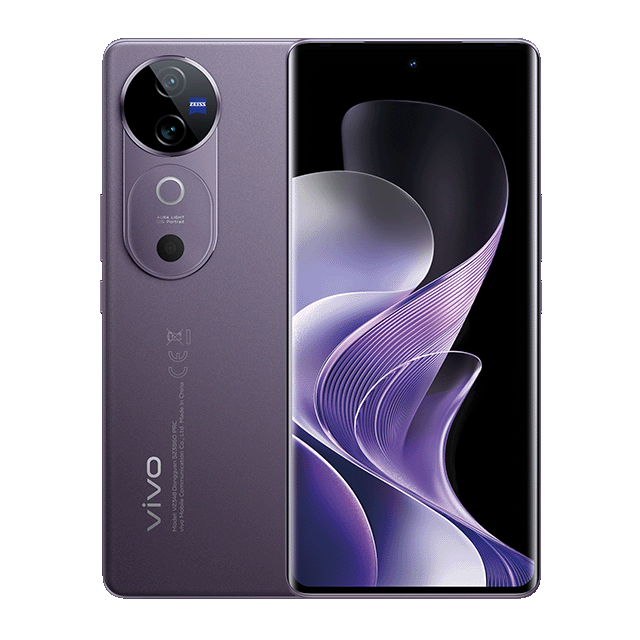
Vivo is preparing to launch its latest smartphone, the Vivo V40, in the Indian market. Following its global release, which surprised many by omitting a charger in the box, the Indian version appears to follow the same trend. The model number “V2348,” linked to Vivo, has been spotted on the Indian BIS certification website, with approval granted on June 21, 2024.
Vivo V40 (global) specs:
The Indian version of the Vivo V40 is expected to carry the same specifications as the global model. The phone features a 6.78-inch AMOLED display with a 120 Hz refresh rate and a 1.5K resolution (2800 x 1260). It comes in two colors: Stella Silver and Nebula Purple.
The Vivo V40 sports a dual-camera setup, including a 50MP f/1.9 main camera and a 50MP f/2.0 ultra-wide-angle camera, promising high-quality photos and videos. Powered by the Snapdragon 7 Gen 3 chipset, the phone ensures robust performance. It is available in two configurations: 8GB of LPDDR4X RAM with 256GB of UFS 2.2 storage, and 12GB of LPDDR4X RAM with 512GB of UFS 2.2 storage. The device has a 5500 mAh battery paired with 80W fast charging.
In related news, Vivo has recently launched the Vivo Pad 3 tablet in China, offering a massive 12.05-inch LCD screen with a 2.8K resolution and a 144Hz refresh rate. It houses the Snapdragon 8s Gen 3 chipset, which draws power from a 10,000 mAh battery that supports 44W fast charging. Currently, the brand is silent on a global launch date.
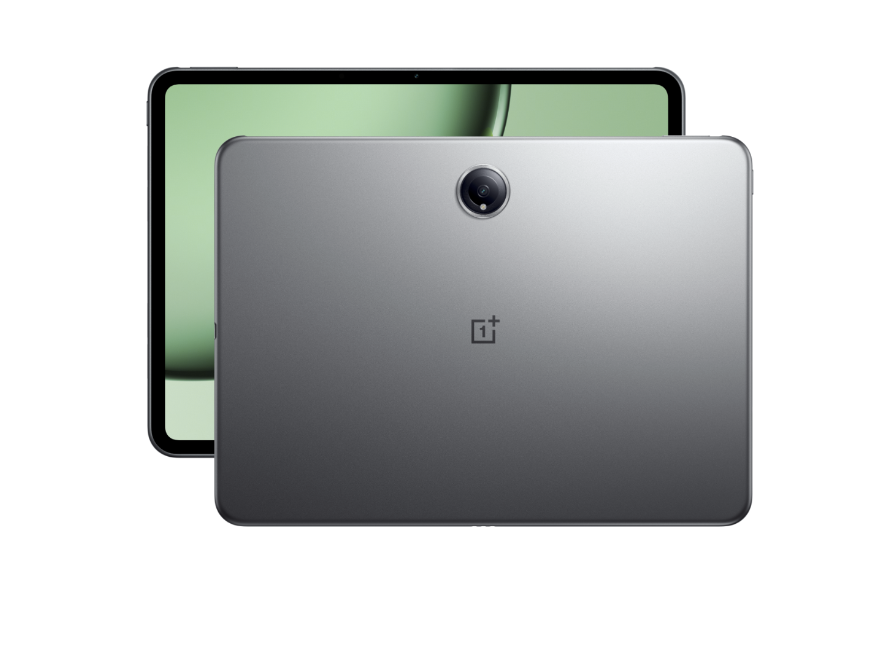
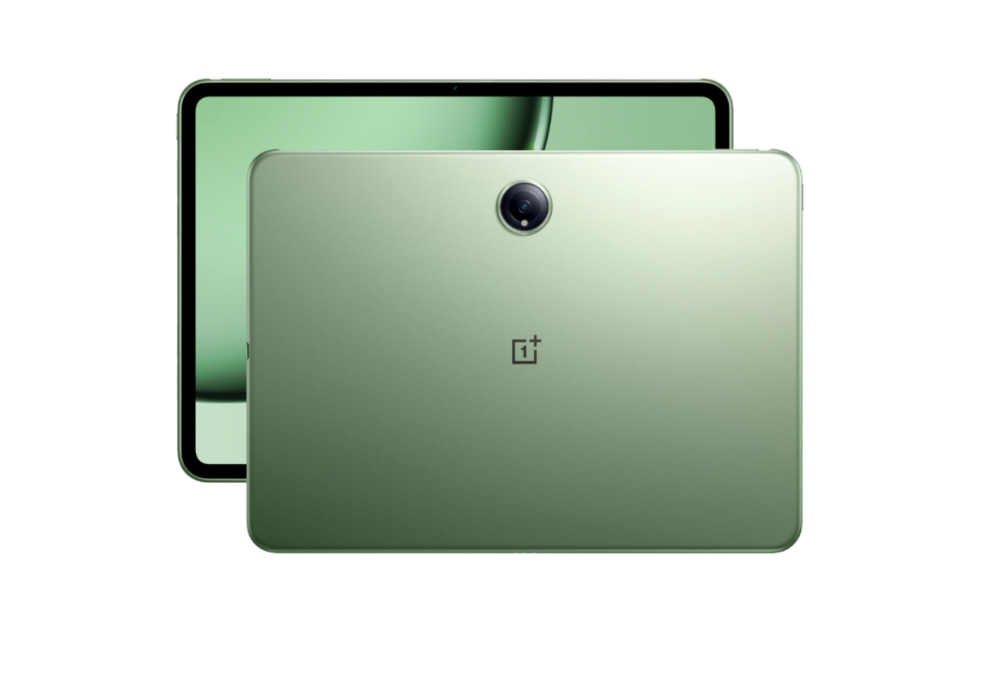
The OnePlus Pad Pro is a high-performance tablet designed to meet the needs of tech enthusiasts and professionals on the go. Available in grey and green color options, you can buy the Pad Pro for $499 only at Giztop.
The device boasts a 12.1-inch IPS LCD display with a stunning 3K resolution of 3000 x 2120 pixels. The 144Hz refresh rate ensures smooth visuals, making it perfect for gaming and multimedia consumption. The display supports 10-bit colors and has an 88 percent screen-to-body ratio, providing an immersive viewing experience.
Powering the OnePlus Pad Pro is the Qualcomm Snapdragon 8 Gen 3 processor, ensuring lightning-fast performance and efficient multitasking. Users can choose between 8GB or 12GB of LPDDR 5 RAM, paired with 256GB or 512GB of UFS storage, allowing ample space for apps, media, and files.
The tablet is equipped with an 8MP front camera featuring a 105° wide-angle lens, ideal for high-definition video calls and selfies. The 13MP rear camera captures clear and detailed photos, enhancing the overall photography experience.
Battery life is another highlight of the OnePlus Pad Pro. It packs a robust 9510mAh battery that supports 67W SuperVOOC charging, ensuring quick and efficient power replenishment. This long-lasting battery life ensures that users can stay productive throughout the day without worrying about frequent charging.
The OnePlus Pad Pro runs on Color OS, based on the Android operating system, providing a smooth and user-friendly interface. It supports multiple languages, including English and Chinese, making it accessible to a diverse user base.
For connectivity, the tablet features Bluetooth 5.3, allowing seamless wireless transfer of photos, music, and other media. It also supports dual-band Wi-Fi (2.4GHz/5.0GHz) with 802.11a/b/g/n/ac compatibility, ensuring reliable internet connectivity.
A key feature of the OnePlus Pad Pro is its multi-layered graphite and silicone heat dissipation system. This system offers a large heat dissipation area of 27,413mm², ensuring the device remains cool and performs optimally during extended use.
Audio quality is enhanced by four Dolby Atmos Quad Speakers, delivering rich and immersive sound. The speakers are Hi-Res audio certified, providing a superior listening experience for music, movies, and games.
Additionally, the OnePlus Pad Pro includes several productivity-enhancing features such as four-finger pinch, two-finger split-screen, parallel windows, and multi-device cross-screen collaboration. These features allow users to multitask efficiently and improve their workflow.
OnePlus Pad Pro is a powerful and versatile tablet that offers an exceptional display, top-notch performance, long battery life, and advanced connectivity options. Its range of features and user-friendly interface make it a valuable tool for both work and entertainment.
We use cookies on our website to give you the most relevant experience by remembering your preferences and repeat visits. By clicking “Accept”, you consent to the use of ALL the cookies.
This website uses cookies to improve your experience while you navigate through the website. Out of these, the cookies that are categorized as necessary are stored on your browser as they are essential for the working of basic functionalities of the website. We also use third-party cookies that help us analyze and understand how you use this website. These cookies will be stored in your browser only with your consent. You also have the option to opt-out of these cookies. But opting out of some of these cookies may affect your browsing experience.
Necessary cookies are absolutely essential for the website to function properly. This category only includes cookies that ensures basic functionalities and security features of the website. These cookies do not store any personal information.
Any cookies that may not be particularly necessary for the website to function and is used specifically to collect user personal data via analytics, ads, other embedded contents are termed as non-necessary cookies. It is mandatory to procure user consent prior to running these cookies on your website.