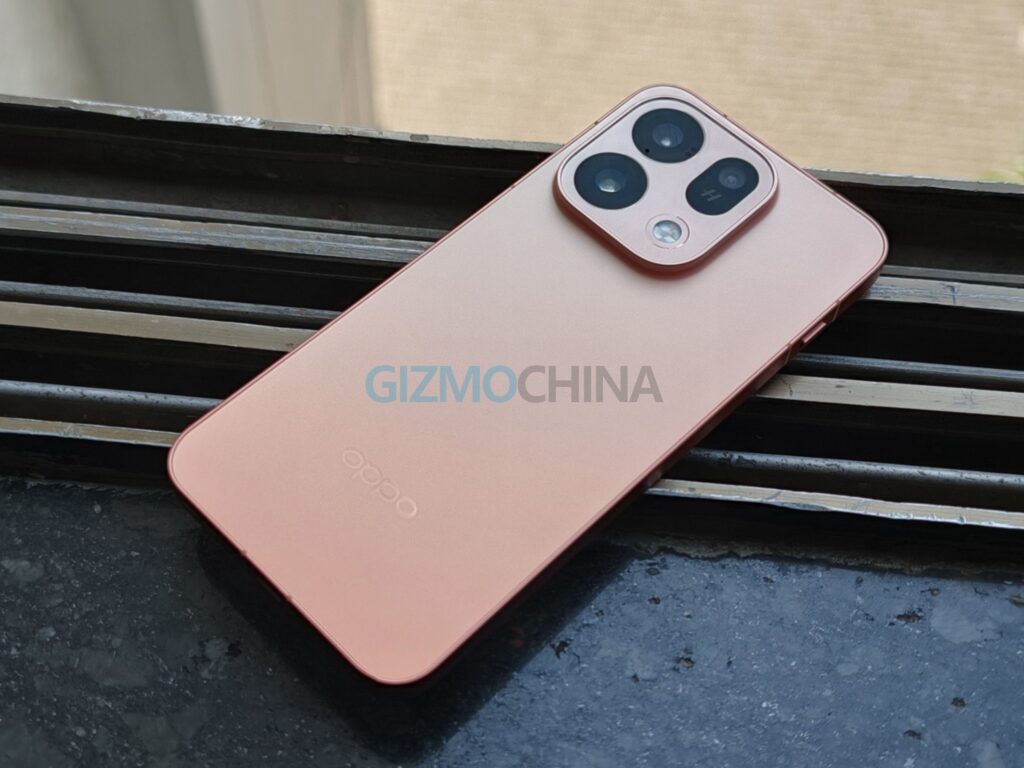
In Malaysia, the recently unveiled Oppo Find X9s is positioned lower than the existing Find X9. The reason behind it is that the X9s packs slightly inferior specs. However, when it debuted in India, it was positioned higher than the X9, which was a bit surprising. Finally, the brand restructured the X9’s price in India, and it now costs more than the X9s.
Oppo Find X9 price revised in India
Oppo Find X9s
Oppo has reportedly increased the pricing of the Find X9 in India by Rs 10,000 across both storage variants. According to details shared by tipster Abhishek Yadav on X, retailers have already started receiving updated pricing information, while some retail platforms have also begun reflecting the revised rates online.
The 12GB+256GB variant is now said to cost Rs 84,999 instead of Rs 74,999. Similarly, the 16GB+512GB edition has reportedly moved from Rs 84,999 to Rs 94,999. In comparison, the 12GB+256GB and 12GB+512GB versions of the Find X9s are priced at Rs 79,999 and Rs 89,999, respectively.
It should be noted that the Find X9 is currently available for Oppo’s online store, Flipkart, Amazon, and other retailer sites. So, the price hike could be in the offline market, and it may take some time to reflect online. If the X9 is still available at a store with its original pricing, it would be the best time to purchase it.
The move changes the positioning of the Find X9 in Oppo’s flagship lineup. When the Find X9s launched in India recently, it arrived with a higher starting price than the Find X9 despite carrying slightly toned-down hardware in certain areas. With the revised pricing now in place, the hierarchy between the two devices appears more aligned.
Industry observers believe rising memory and component costs could be one of the major reasons behind the price increase. Smartphone brands across segments have started adjusting pricing in recent months as manufacturing, logistics, and supply chain expenses continue to rise globally. Similar price revisions have also been seen from other brands, including OnePlus.
Why the Find X9 still stands out
Even with the higher pricing, the Oppo Find X9 remains one of the more balanced premium smartphones currently available. The device features Hasselblad-tuned cameras, a 7,000mAh battery, flagship-grade performance, and a relatively compact 6.59-inch display compared to many large-screen rivals in the segment. However, availability has also become limited lately, especially for the 16GB RAM version, which has gone out of stock on several platforms.
For more daily updates, please visit our News Section.
Some of the most exciting phones in the world right now are ones you simply cannot walk into a store and buy, not if you live in the United States, anyway. While Americans are busy debating iPhone versus Pixel, a whole other tier of smartphones is being sold in China, Europe, and parts of Asia that would make your current device feel embarrassingly ordinary.
These phones push cameras, screens, and designs further than anything available at your local carrier store. You just can’t have them. Well, not easily.
To be clear, this isn’t a list of what’s coming soon or what might launch in the US someday. These are phones you can buy right now, just not in the US. Some are blocked due to trade restrictions. Others never made the trip because the manufacturers decided the market wasn’t worth the trouble. A few exist in a legal grey area that makes importing them genuinely complicated. Whatever the reason, they’re out there, and they’re good. Really good.
So if you’re curious what the rest of the world is using. Or if you’re the kind of person who’s already Googling import guides, here’s what you’re missing.
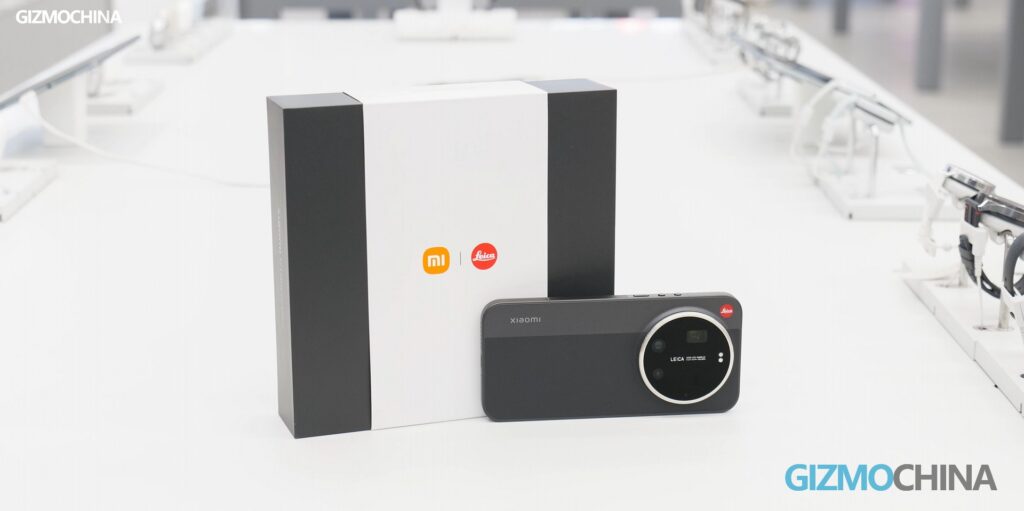
Xiaomi has been building its partnership with Leica for a few years, and the 17 Ultra is where that work really pays off. The main camera sits on a one-inch sensor, and we called it one of the most ambitious smartphones of the year after getting hands-on time with it at launch.
What sets it apart from the usual flagship camera race is the Leica Essential mode, which gives photos their emotions back. Rather than chasing sharpness and perfect accuracy, it pulls back highlights, lets shadows breathe, and adds a subtle grain that makes images feel like they were taken with a real camera rather than optimised by a computer. It’s a genuinely different philosophy, and it works.
The battery is the biggest in any Xiaomi Ultra device yet, and the phone is rated for dust and water resistance at three separate ingress protection levels. It starts at around €1,249 in Europe.
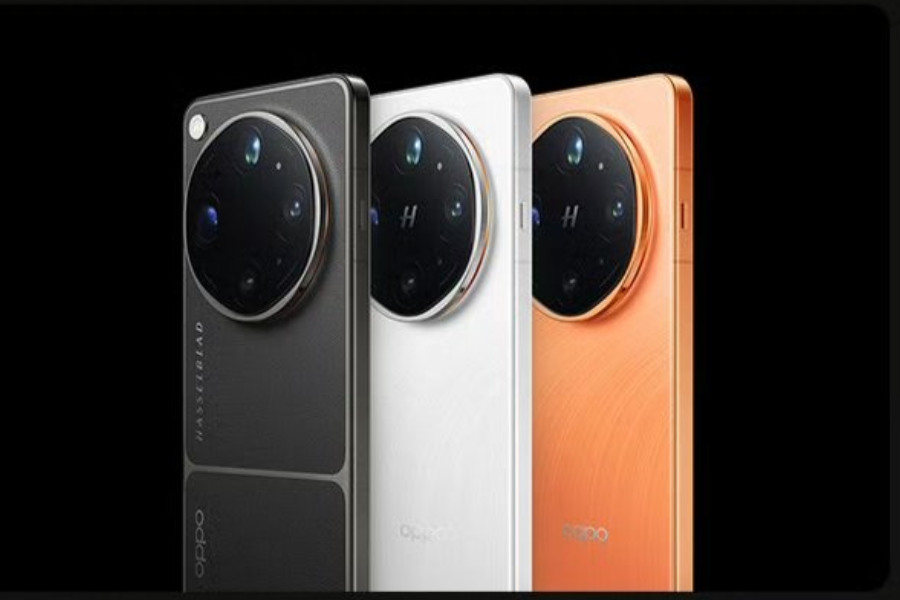
The Find X9 Ultra is Oppo’s most powerful phone yet, and it comes with a camera setup that looks borderline excessive on paper. Two 200-megapixel sensors, a third 50-megapixel periscope, and a 50-megapixel ultrawide.
So as you might guess, the Find X9 Ultra targets the ultra-premium segment, competing directly with the Xiaomi 17 Ultra and Vivo X300 Ultra as one of the most camera-forward phones on the market.
The Hasselblad tuning on the camera gives the results a more natural, less processed quality that’s different from what Samsung or Google serve up. The Find X9 Ultra leans into a more expressive design with eco-leather options that give a tactile, character-driven feel.
It starts at Rs 169,999 in India, or about $1,776 at current exchange rates. Not cheap, but then again, you’re getting four cameras, with two of them shooting at 200 megapixels.
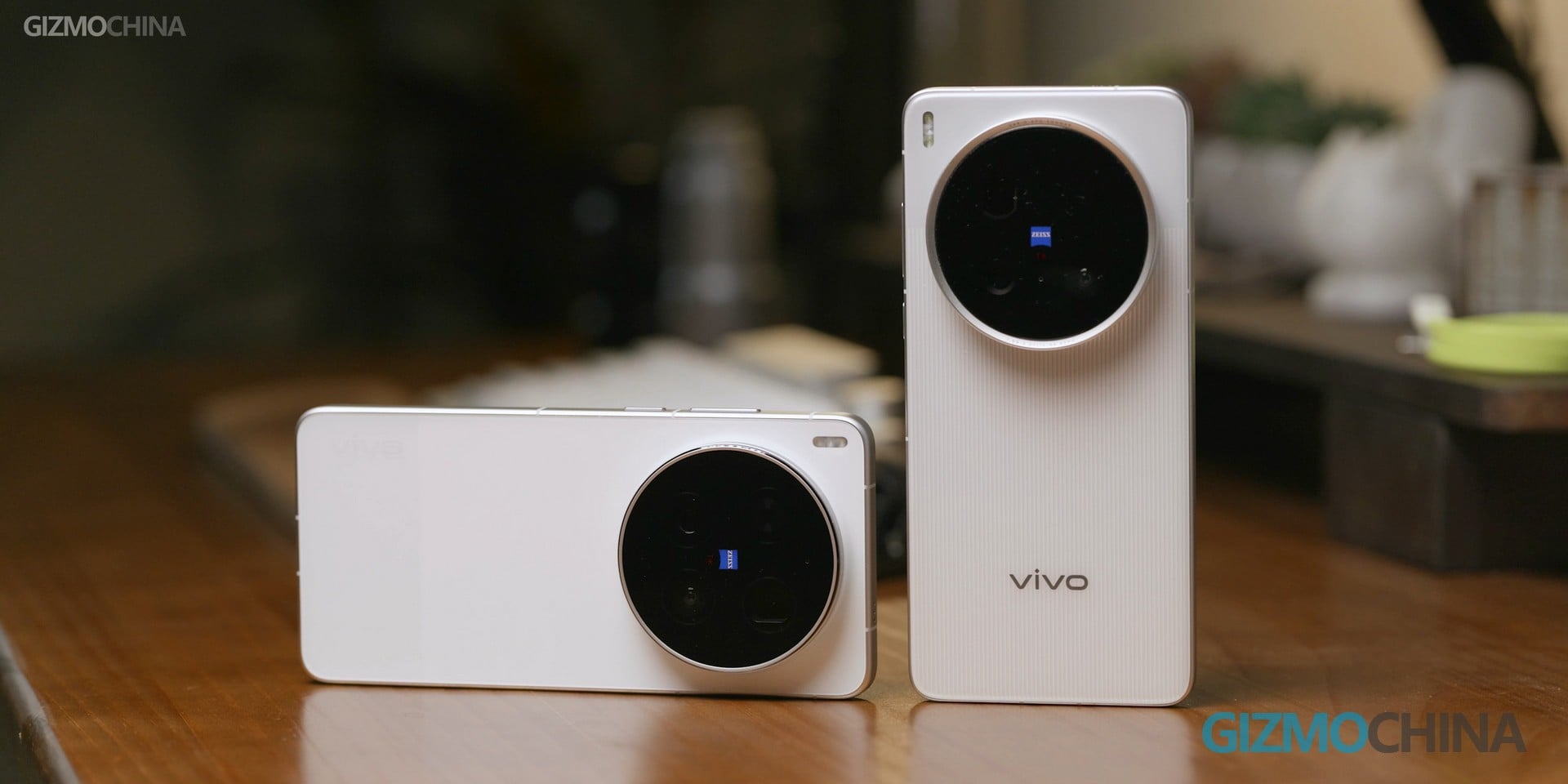
Vivo has been making some of the most interesting camera phones in the world for a couple of years now, and the X300 Ultra continues that streak. Though the upgrades this year are just too incremental.
Our first impression of the phone was that it might as well be called the X200s Ultra. Not to say the improvements aren’t noticeable, but modest compared to the generational leap of its predecessor.
That said, what it does well, it does exceptionally. For instance, the “Raw Lighting” mode dials back the computational processing to produce images that look more like they came from a professional camera than a phone. Saturation is reduced, sharpening is toned down, and the fine details come out more naturally. It’s the kind of feature that’s far more useful day-to-day than any flashy filter.
The main camera uses a Sony LYTIA 901 sensor, and Zeiss handles the colour calibration. The telephoto is a genuine upgrade over last year’s, though we found a noticeable difference only in low light. In good lighting, the gap between the X300 Ultra and X200 Ultra is minimal.
The 6,600mAh cell and 100W wired charging run everything. Available from around €1,999.
Huawei is the most complicated name on this list. US trade restrictions have essentially cut the company off from American markets, and using one here comes with real trade-offs — no Google services, limited app support, and software that takes some patience to work around.
With all of that said, the Pura 90 Pro Max’s camera system is genuinely worth knowing about. The Pro Max is the top of the lineup this time, and it leads with a 200-megapixel periscope telephoto camera, a first for any Huawei flagship. The phone also supports up to 20x telephoto video recording using that same lens, putting it in rarefied company on the zoom front.
The main camera uses a variable aperture that physically adjusts like a real camera — ranging from f/1.4 to f/4.0 — which gives you more control over depth of field than any fixed-lens phone can match. Huawei calls this its second-generation Red Maple Image technology, designed to maintain natural colours in complex lighting situations like sunsets or firelight, where other phones tend to go strange.
We compared the phone against the Vivo X300 Ultra, and while it delivers a more elegant and refined experience, it sits a step behind on raw display quality and outright performance. At around $1,199, it’s the most affordable phone on this list. Imported that is.
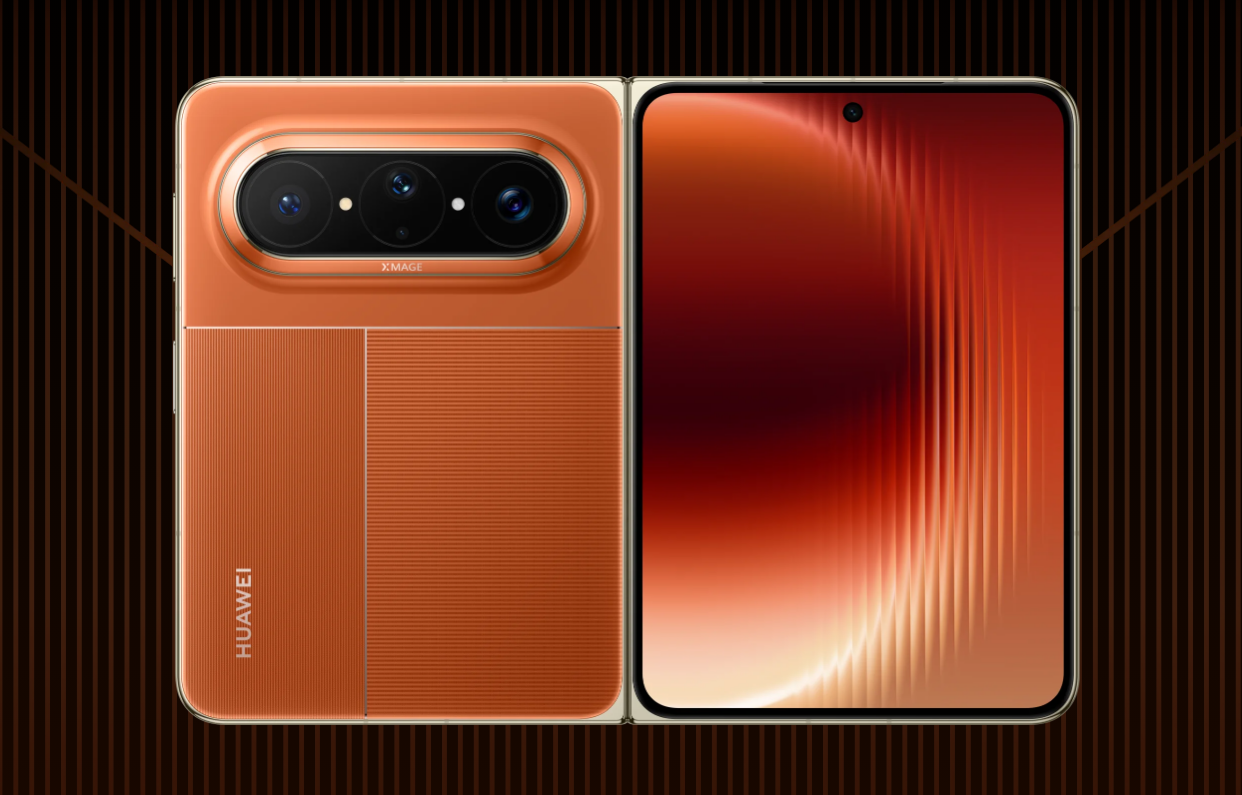
5. Huawei Pura X Max
Display 7.7-inch inner OLED (4:3 ratio) + 5.4-inch outer display, 120Hz Chip Kirin 9030 Pro Cameras 50MP main with variable aperture + 50MP periscope telephoto +12.5MP ultrawide Battery 5300mAh— 66W wired Build 5.2mm thin unfolded, 11.2mm folded, 229g Durability IP58/IP59
Most foldable phones fold to be taller and narrower, or they flip to be compact. The Pura X Max does something different. It folds horizontally to create a screen that’s wider rather than taller, closer in shape to a compact iPad than a regular phone. It is the industry’s first horizontally wide foldable with a 7.7-inch inner display and a near 4:3 aspect ratio.
Such a design has a real upside. Watching video, reading, multitasking, editing photos, or anything you’d normally do on a small tablet is much more comfortable on a display shaped like this. The 5.4-inch outer screen is wide enough to handle messages and calls without unfolding. And despite the large displays, Huawei kept the weight to a reasonable 229 grams and the unfolded thickness to just 5.2mm.
The same Google services caveats that apply to the Pura 90 Pro Max apply here, too. And the water resistance rating of IP58/IP59 is a step below what Honor manages on the Magic V6. But as a piece of hardware, thinking differently about the foldable form factor, there’s nothing quite like it.
6. Honor Magic V6
Display 7.95-inch inner LTPO 2.0 AMOLED, 2172×2352, 120Hz + 6.52-inch outer AMOLED Chip Snapdragon 8 Elite Gen 5 Cameras 50MP main + 64MP periscope telephoto + 50MP ultrawide Battery 6,660mAh (global) or 7,150mAh (China) — 80W wired, 66W wireless Durability IP68/IP69 — first foldable to achieve both ratings
Folding phones have always come with compromises you had to accept in exchange for the novelty. The Magic V6, which debuted at MWC 2026, is the clearest sign yet that Honor has figured out how to close that gap.
Our impression of the foldable was that the crease on the inner display is remarkably shallow, even after a week of heavy use. Honor’s new Super Steel design, rated for 500,000 folds, also feels solid and smooth throughout. It measures 8.75mm folded and just 4mm when open.
Where Honor brings real improvement is ingress protection. The Magic V6 is the first foldable phone in the world to earn both IP68 and IP69 ratings. Getting caught in the rain with a foldable has always been a mild source of anxiety. Not anymore, at least with this one.
The Magic V6 also offers an exceptional camera experience for a foldable. The main is a 50MP sensor that captures an incredible amount of detail, even after significant cropping during post-processing. The periscope telephoto lens supports 3x and 6x optical zoom, though, at 6x, AI processing is quite prominent.
7. What you should know before importing
Importing any of these phones is possible, but not always simple. You’ll want to research band compatibility carefully; not all models support the same 5G and LTE frequencies used in the US, which means you might end up with slower data speeds or limited coverage.
The Huawei devices in particular require workarounds for apps that rely on Google services. And warranty support? You’re largely on your own. But if you’ve ever looked at what’s available at your carrier and thought this is it? Now you know there’s a lot more out there. Just not here.
For more daily updates, please visit our News Section.
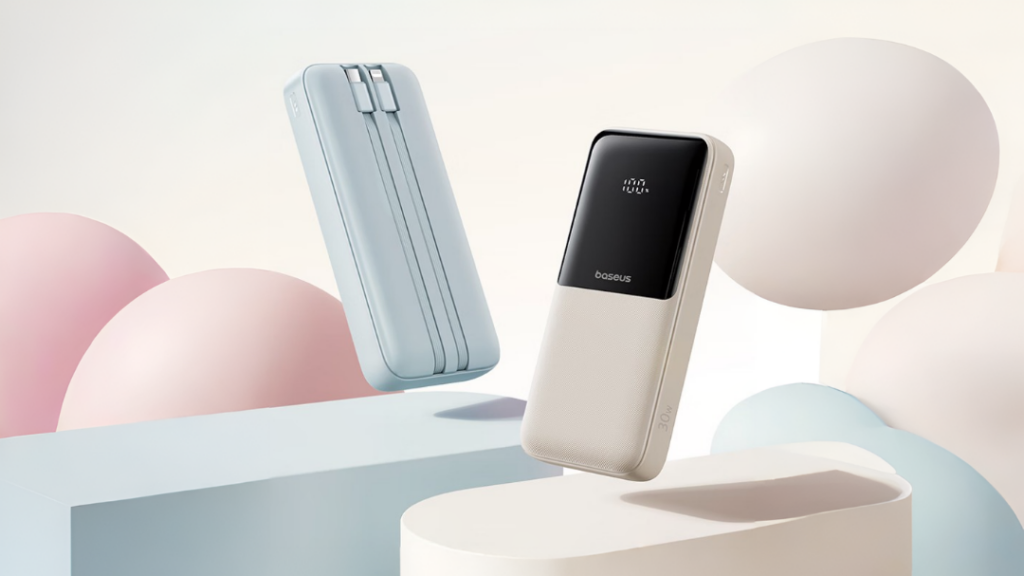
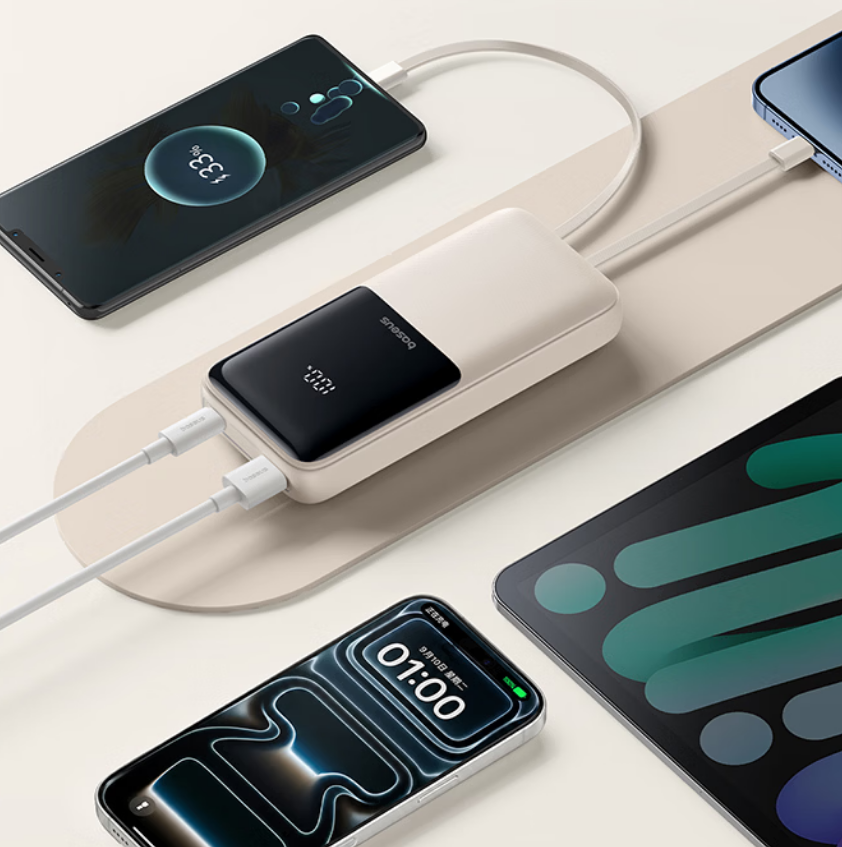
Baseus has released a new 30W, 20,000mAh power bank in China, and its main selling point is straightforward: you don’t have to remember to pack your charging cables. It is priced at 99 yuan ($14) and is now listed on JD.com.
Baseus 30W Power Bank Specifications
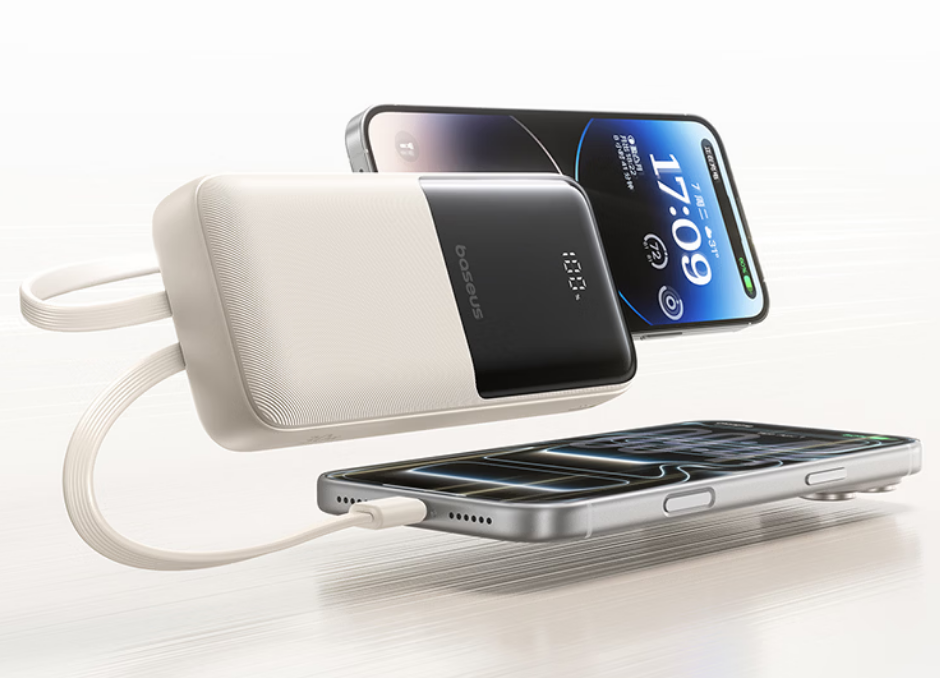
The power bank is built around a 2C+1A+1 Lightning configuration. Tucked neatly into the side of the chassis are two built-in cables. The USB-C cable handles up to 30W bidirectional fast charging, meaning you can use it to charge your phone or plug it into a wall adapter to recharge the power bank itself. The second built-in cable is a Lightning connector that outputs up to 20W, which is a useful inclusion for anyone still using older Apple hardware.
If you need to plug in additional devices, the top edge of the power bank houses two standard ports: a 30W USB-C port and a 22.5W USB-A port. When fully utilized, the device can charge up to four gadgets simultaneously, though charging speeds will naturally split across the active ports.
From a design perspective, the power bank measures 152.2 by 69.6 by 30.7mm and weighs 435 grams. It is a dense piece of hardware, but Baseus gave it rounded edges to make it easier to grip with one hand. The exterior has a textured finish to resist fingerprints and surface wear, and the front panel features a large, easy-to-read LED display that shows the exact battery percentage remaining. It is currently available in Light Brown and Light Blue.
Inside, the device packs a 20,000mAh lithium-ion battery with a rated energy of 74Wh, keeping it safely under the standard airline carry-on limit. Baseus estimates this capacity is enough to charge an iPhone 17 about 3.8 times, a Huawei Mate 80 around 2.5 times, and a Xiaomi 17 Pro twice.
Device compatibility covers the standard bases, with support for fast-charging protocols like PD 3.0, PPS, and QC 3.0. It also carries China’s 3C certification and includes an internal smart chip to manage standard safety protections against overcharging, short circuits, and temperature spikes.
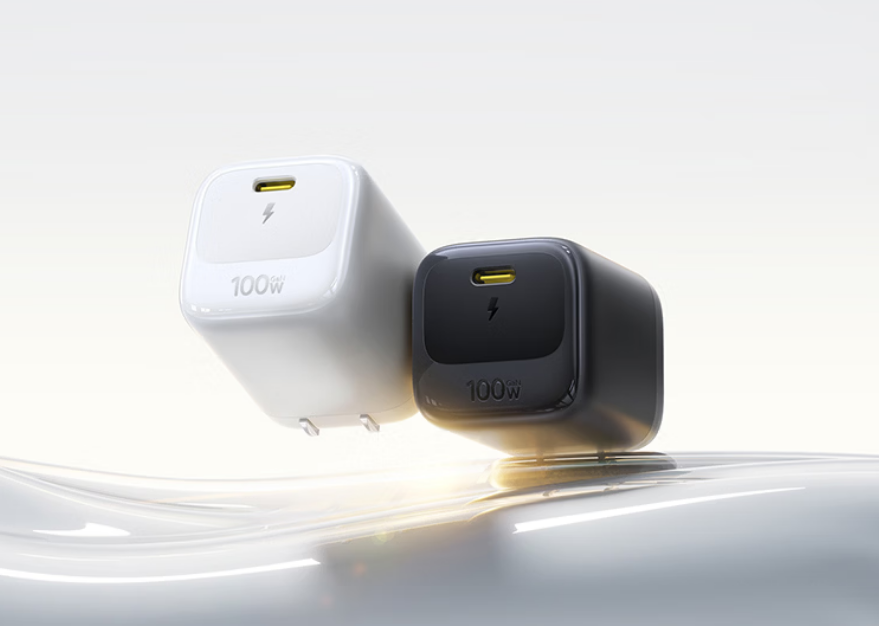
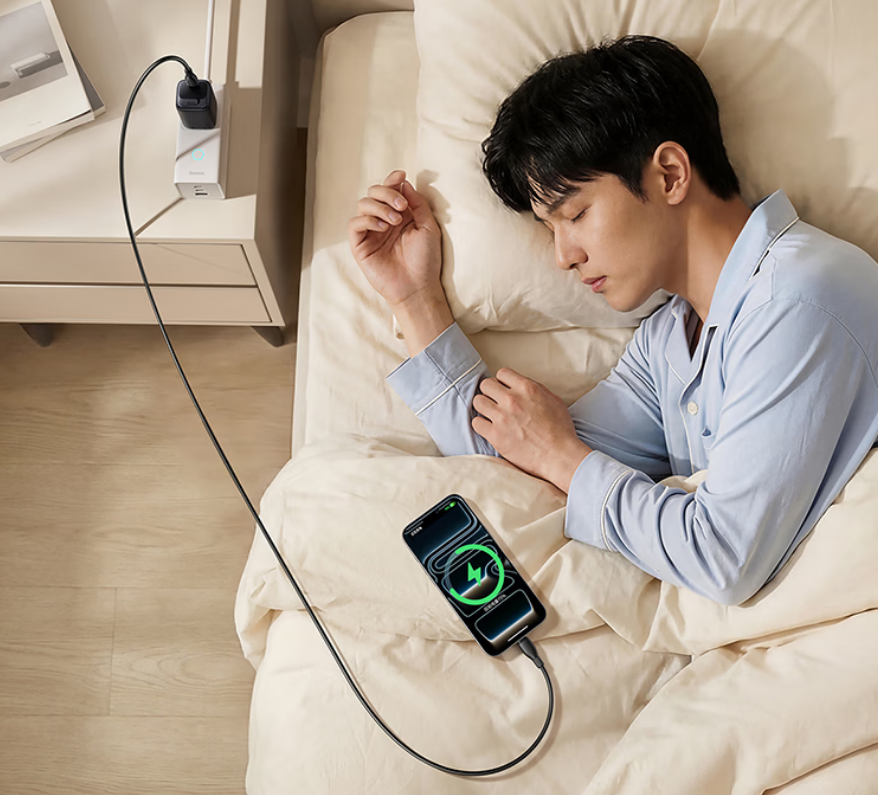
Baseus has added a new 100W USB-C charger to its lineup on JD.com, and it is a good example of how standard power adapters are steadily getting smaller and easier to carry. The new charger, officially named the Baseus EnerFill FH22, is priced at 89 yuan (around $13) and comes in basic black and white options.
Baseus EnerFill FH22 Specifications
The adapter measures 36.5 by 36.5 by 48mm and weighs about 104.5 grams. According to Baseus, the internal stacked layout makes it roughly 65% smaller than a standard 96W laptop power brick.
It features a rounded design with a mix of matte and glossy finishes. More practically, it includes foldable prongs, which makes it easier to throw into a backpack without worrying about the metal pins scratching your laptop or tablet.
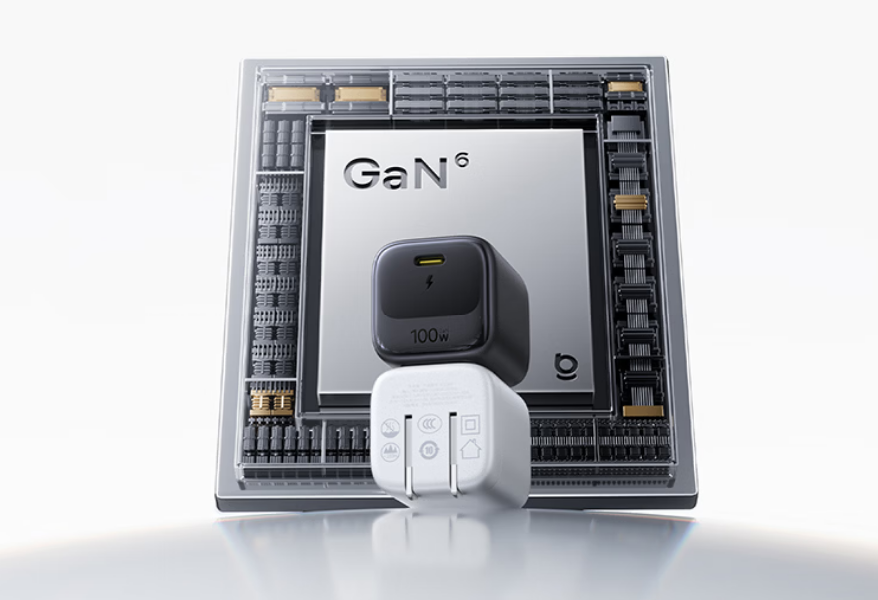
Inside, the charger uses sixth-generation gallium nitride (GaN) technology to output up to 100W from its single front-facing USB-C port. It supports a wide range of common fast-charging standards, including PD 3.0, QC 5.0, PPS, and the newer UFCS protocol.
In everyday use, this means it can provide reliable charging for a variety of hardware, from modern laptops to phones from Apple, Samsung, Xiaomi, OnePlus, and others.
Packing 100W into a small chassis usually generates a lot of heat, so Baseus has included a few specific thermal management features. The charger uses a copper foil layer and aerogel insulation to help manage temperatures and keep the plastic casing from getting too hot to the touch.
It also has a built-in temperature monitor and an automatic trickle-charging mode that slows down the power delivery when your device hits 80% battery, which helps preserve the battery’s long-term health. Safety features like overvoltage and short-circuit protection are also standard here.
There is one important technical detail to keep in mind, especially for international buyers: the charger is rated for an input range of 200-240V. This means it is designed for regions like Europe and Asia, and it will not work on the 110V power grids used in North America.
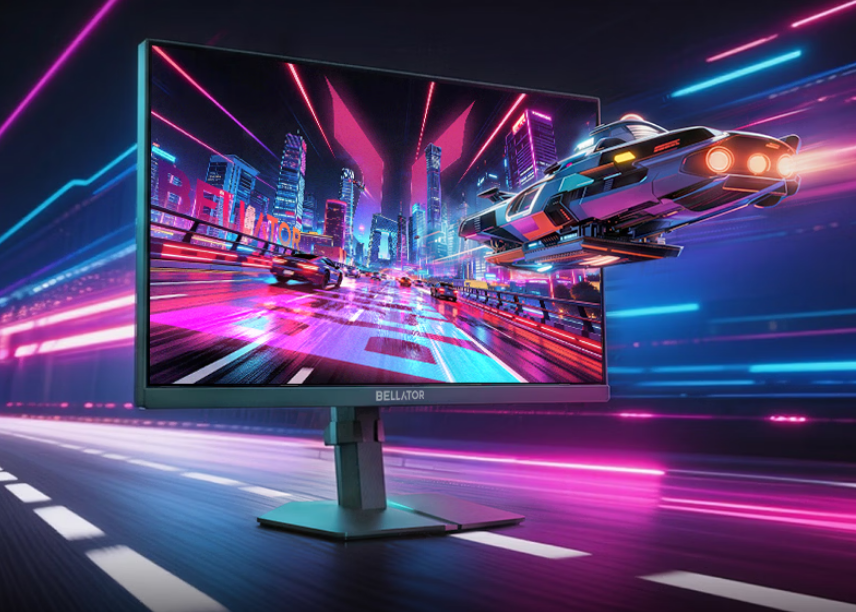
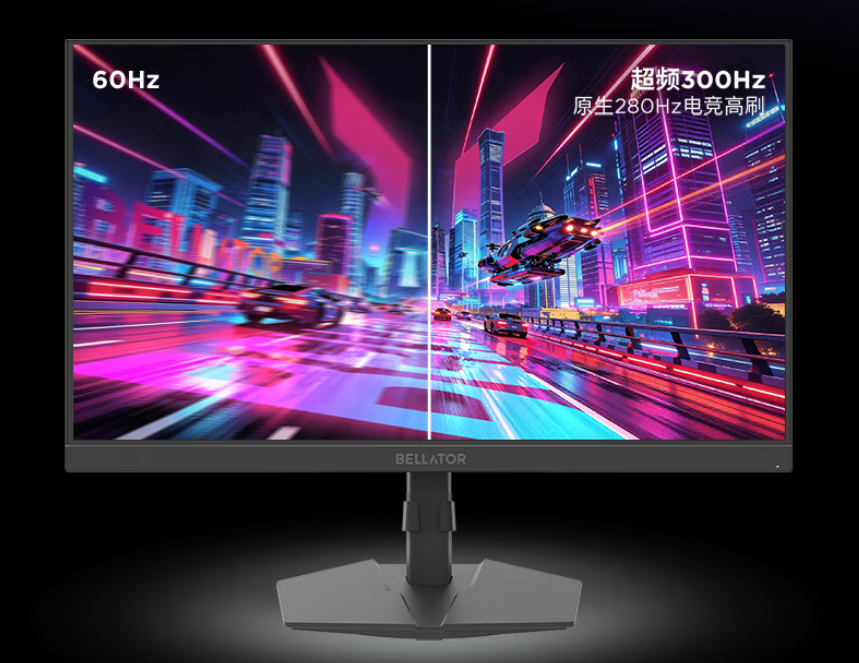
Lenovo has introduced a new gaming monitor under its Lecoo Bellator brand in China. The Zhan 25Q is a 24.5-inch display that combines a 1440p resolution with a high refresh rate. It is launching with a pre-sale price of 899 yuan ($132). Lenovo is targeting esports players who prefer a smaller screen size without compromising on resolution or speed.
Lenovo Lecoo Bellator Zhan 25Q Specifications
The monitor uses a 24.5-inch IPS panel with a 2560 x 1440 QHD resolution and a standard 16:9 aspect ratio. Because 1440p is more commonly found on 27-inch monitors, the 24.5-inch size results in a higher pixel density of 119.89 PPI. The display has a native refresh rate of 280Hz, which can be overclocked to 300Hz.
For motion handling, Lenovo lists a 1ms gray-to-gray (GTG) response time and a 0.5ms Moving Picture Response Time (MPRT). It also supports Variable Refresh Rate (VRR) technology to help prevent screen tearing and stuttering during gameplay.
Regarding color accuracy, the Zhan 25Q covers 99% of the sRGB color gamut and 95% of the DCI-P3 color space. It uses 8-bit + FRC technology to support a 10-bit color depth, allowing the panel to display 1.07 billion colors. The monitor includes HDR support, with a peak brightness of 400 nits when HDR mode is enabled.
Additionally, it features TÜV Rheinland-certified hardware-level low blue light technology. This hardware approach is intended to reduce blue light exposure without causing the yellow tint often seen with software-based filters.
The physical design features thin bezels on three sides. The included stand offers standard ergonomic adjustments: users can change the height by up to 130mm, tilt the screen from -6 to 21.5 degrees, and pivot it 90 degrees for vertical use.
The base has a compact footprint designed to save desk space. For users who prefer their own mounting solutions, the monitor is compatible with 100 x 100mm VESA mounts.
The port selection includes two HDMI 2.1 FRL ports that support 48Gbps bandwidth, one DisplayPort 1.4 connection, a USB 2.0 port, and a standard 3.5mm audio jack. Audio is handled by two built-in 3W stereo speakers.
In related news, TCL has recently introduced a new 300Hz 1080p gaming monitor with an aggressive sub-$90 price tag.
For more daily updates, please visit our News Section.
In an ideal smartphone world, brands first launch the Chinese models and the global variants follow a few weeks or months later. But Honor flipped the script with the new Honor 600 Pro. The company first launched the Honor 600 series globally in April, and the Chinese version made their debut just recently.
At first glance, the two devices look almost identical. They share the same 6.57-inch OLED display, the same 200-megapixel main camera, and the same fast charging setup. However, there are some interesting changes, especially around performance, battery life, and design.
The biggest surprise? The Chinese model actually downgrades the chipset while upgrading the battery.
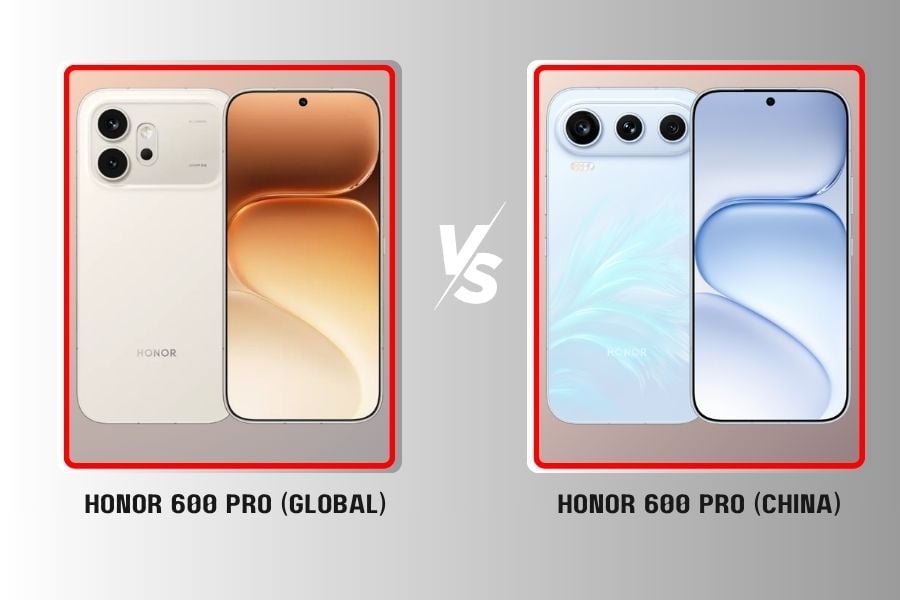
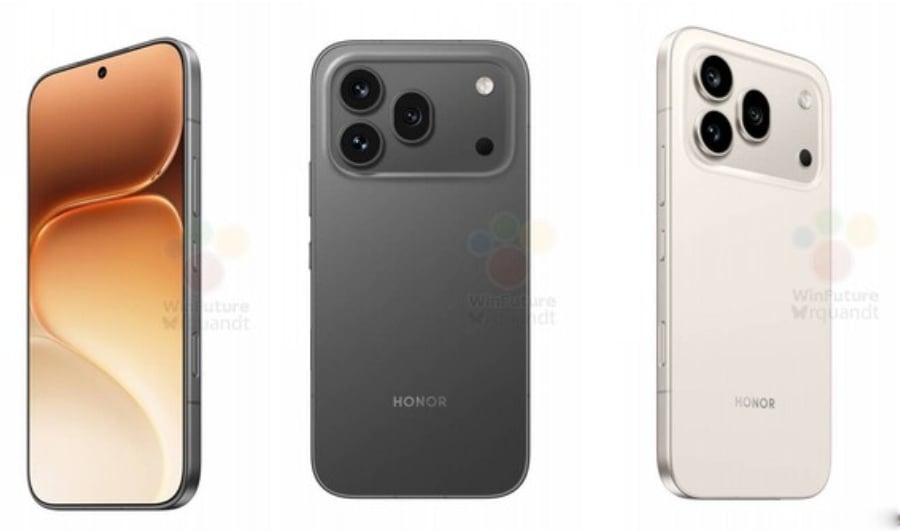
The global and Chinese versions of the Honor 600 Pro definitely have similarities, but not in terms of design.
The global model has a rectangular camera island that feels heavily inspired by recent iPhones. In fact, the resemblance is hard to ignore, especially with the triangular triple-camera arrangement and flash placement.
Honor 600 Pro (Global)
The Chinese version changes things up a bit with a pill-shaped horizontal camera bar. You could again say it’s iPhone Air-inspired, but it looks a bit different nonetheless.
Both phones use glass and aluminum in their construction, and both carry IP68 and IP69K ratings for dust and water resistance.
Size differences are also minimal. The global version measures 156 x 74.7 x 7.8mm, while the Chinese unit comes in at 156.1 x 74.8 x 7.9mm. The Chinese model is also slightly heavier at 202 grams, likely because of its much larger battery.
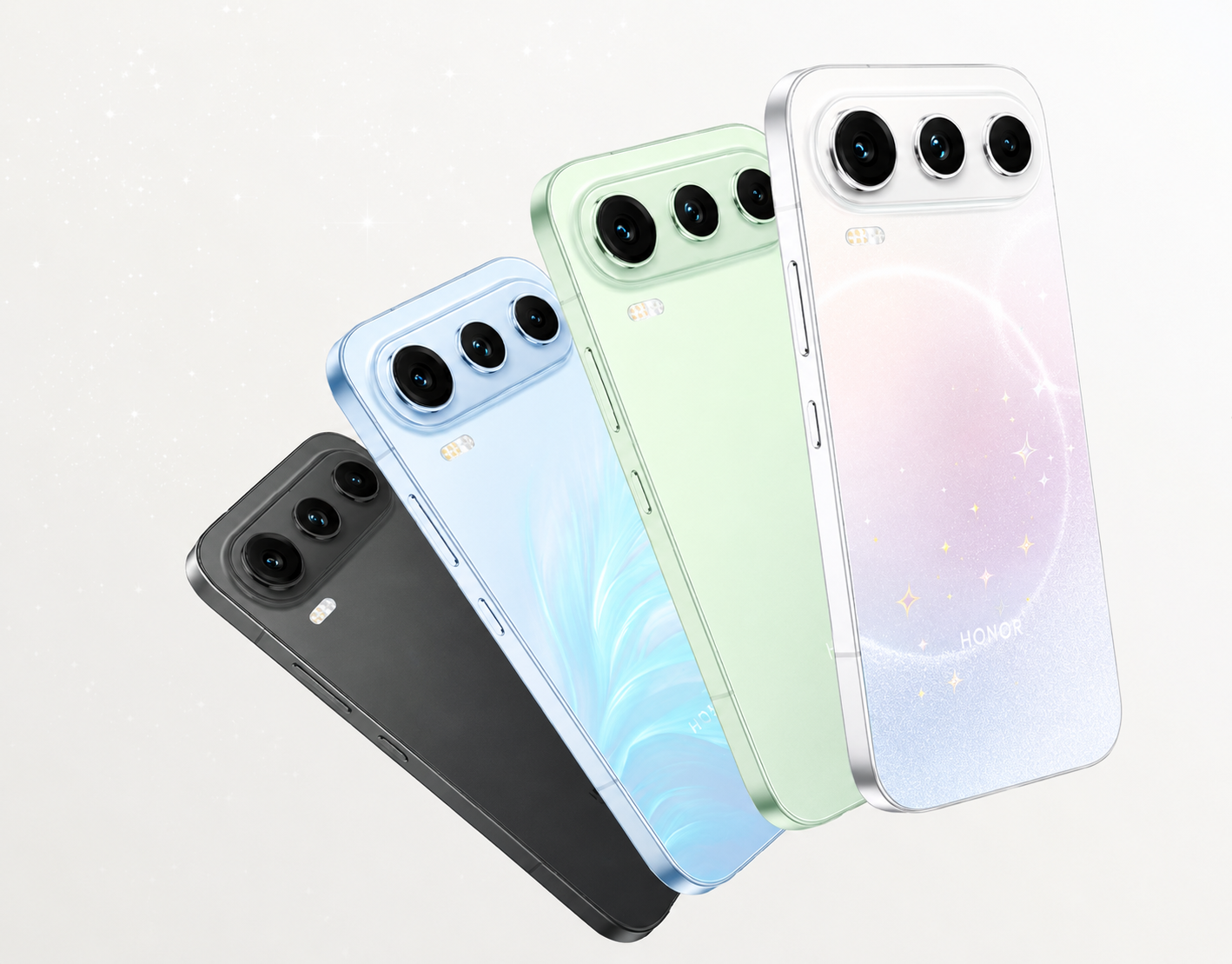
Moreover, the global model comes in Golden White, Black, and Orange, while China gets Black, Green, Blue, and Purple.
2. Display
There’s almost no difference between the displays on the two phones, and that’s a good thing. Both versions of the Honor 600 Pro use a 6.57-inch AMOLED panel with a 120Hz refresh rate, 3840Hz PWM dimming, and HDR Vivid support. Resolution sits at 1264 x 2728, which works out to around 458 pixels per inch.
Honor also claims up to 8,000 nits of peak brightness on both models, though the Chinese version lists a more realistic 800 nits typical brightness and 1,800 nits in high brightness mode.
These aren’t giant displays by modern flagship standards, but the smaller footprint could actually make the phones more appealing to people tired of carrying around massive 6.8-inch slabs.
The global model uses Mohs level 4 protection, while the Chinese version switches to aluminosilicate glass. Neither phone uses Gorilla Glass branding, but both should survive everyday scratches without much trouble.
3. Performance
Things are significantly different in terms of performance.
The global Honor 600 Pro runs on Qualcomm’s Snapdragon 8 Elite, which is one of the most powerful Android chips currently available. It’s paired with the Adreno 830 GPU and comes in configurations with up to 16GB of RAM and 1TB of storage.
The Chinese model, meanwhile, drops down to the MediaTek Dimensity 8550 Elite. That’s not necessarily a bad chip, but it’s definitely a step below the Snapdragon 8 Elite in raw performance. The global version should have a noticeable advantage in gaming, sustained performance, and AI-heavy workloads.
It’s an unusual difference because Chinese variants are often the more powerful ones. However, Honor seems to be prioritizing battery life over outright speed for the domestic market. Both phones ship with Android 16 and MagicOS 10.
4. Cameras
Moving on to cameras, each version uses a 200-megapixel main camera with optical image stabilization, paired with a 12-megapixel ultrawide camera. It also has a 50-megapixel telephoto lens with 3.5x optical zoom and OIS.
On the front, both phones use a 50-megapixel selfie camera capable of recording 4K video. Rear video recording support tops out at 4K on both models, with gyro-EIS and OIS helping stabilize footage.
5. Battery and charging
The Chinese Honor 600 Pro packs a huge 8,000mAh silicon-carbon battery, while the global version settles for 7,000mAh internationally and 6,400mAh in Europe.
That’s still big by flagship standards, but China’s version is on another level entirely. It’s part of a growing trend where Chinese manufacturers are using silicon-carbon battery tech to push capacities far beyond what most global phones currently offer.
Even gaming phones rarely cross the 7,000mAh mark globally, so seeing 8,000mAh in a relatively slim flagship is impressive.
Charging speeds stay the same across both devices. You get 80W wired charging, 50W wireless charging, and 27W reverse wired charging. The Chinese version also adds reverse wireless charging.
6. Connectivity and extras
As for connectivity, the global model supports Wi-Fi 7, while the Chinese version tops out at Wi-Fi 6. Both include Bluetooth 6.0, NFC, infrared blasters, stereo speakers, and under-display fingerprint scanners.
Interestingly, the fingerprint hardware differs, too. The global model uses an optical sensor, while the Chinese variant upgrades to a faster and more reliable ultrasonic scanner.
7. Same phone, different priorities
The two versions of the Honor 600 Pro ultimately feel like phones designed for different audiences.
The global model focuses on flagship-level performance with Qualcomm’s best chipset, longer software support, and slightly better connectivity. The Chinese version, meanwhile, trades some of that power for an enormous battery and a refreshed design.
What’s interesting is that neither model is clearly “better.” If you care about gaming and peak performance, the global version probably makes more sense. But if battery life is your top priority, the Chinese model looks incredibly tempting.
For more daily updates, please visit our News Section.
Baseus has announced a new 10,000mAh portable power bank, the PicoGo AR11, which features two integrated charging cables. The device is currently available for pre-order in China for 219 yuan ($32) and is scheduled to go on sale on May 27th.
Baseus PicoGo AR11 Power Bank Specifications
The primary draw of the power bank is its integrated cable management. Baseus has built two separate cables directly into the device. The first is a 72cm retractable cable utilizing a constant force shaft mechanism, which the company says has been tested for 20,000 pulls and bends.
The second is a shorter, 20cm detachable fast-charging cable that doubles as a lanyard-style carrying strap. You can choose to configure the power bank with either a USB-C and Lightning cable combination or a dual USB-C setup.
Despite the integrated hardware, the power bank maintains a relatively compact footprint. It measures 83 x 56.5 x 38.5mm and weighs approximately 230 grams. Baseus attributes the size to a stacked internal architecture that houses the dual 5,000mAh lithium-ion cells.
For power delivery, the PicoGo AR11 supports a maximum output of 45W via its USB-C port and the built-in USB-C cable. This is enough wattage to fast-charge most modern smartphones, tablets, and some lightweight laptops.
The device also includes an additional USB-A port capable of up to 33W output. However, as is standard for batteries in this class, using multiple ports at the same time drops the total combined output to 15W. The power bank supports 30W input charging, which allows it to recharge from zero to full in about two hours.
Baseus has also integrated an NFC-based monitoring feature. By tapping a compatible smartphone against the battery, users can view real-time data regarding the power bank’s battery health, total charge cycles, and current temperature.
This software feature is paired with a hardware thermal management system that uses a dedicated chip to monitor heat levels 50 times per second, alongside aerogel and graphene layers to dissipate heat during 45W charging sessions.
The PicoGo AR11 features a digital display to show the remaining battery percentage and is available in Apple White, Titanium Silver, and Sky Blue. It is 3C certified and meets standard airline carry-on requirements.
In related news, Baseus has recently introduced a new 3-in-1 67W power bank that combines a charger, built-in cables, and a portable battery into a single device.
For more daily updates, please visit our News Section.
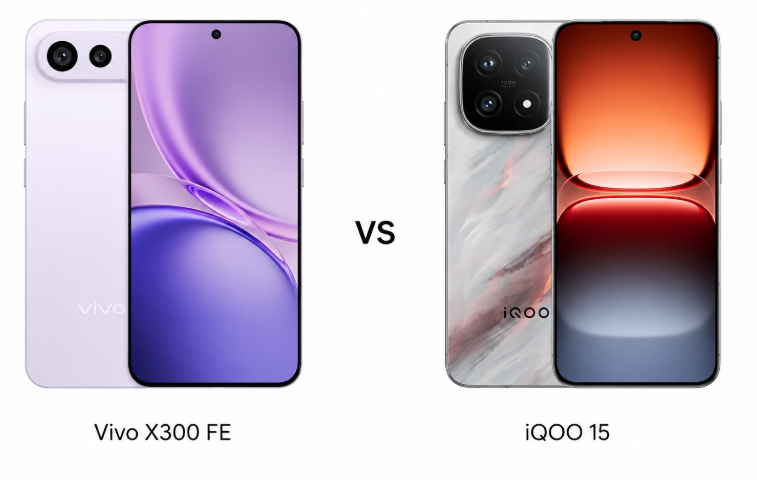
Vivo X300 FE and iQOO 15 take two very different approaches to the flagship smartphone experience. The Vivo focuses on premium design, compact usability, and camera refinement, while the iQOO 15 delivers aggressive performance, a larger battery, and stronger value for money. Here’s a detailed comparison of their design, performance, cameras, battery life, and pricing to see which flagship stands out.
Major Features:
Feature
Vivo X300 FE
iQOO 15
Winner
Design
Compact premium glass-metal design
Larger aggressive flagship design
Vivo – More comfortable and refined for daily use
Build Quality
Glass back, aluminum frame, IP68/IP69
Glass/fiber back, aluminum frame, IP68/IP69
Tie – Both offer flagship-grade durability
Display
6.31-inch LTPO AMOLED, 120Hz, 5000 nits
6.85-inch LTPO AMOLED, 144Hz, 6000 nits
iQOO – Sharper, smoother, and more immersive
Processor
Snapdragon 8 Gen 5
Snapdragon 8 Elite Gen 5
iQOO – Faster flagship performance
GPU
Adreno 829
Adreno 840
iQOO – Better gaming and graphics power
RAM & Storage
Up to 12GB + 512GB
Up to 16GB + 1TB
iQOO – More high-end memory options
Software Support
Android 16, 5 upgrades
Android 16, 5 upgrades
Tie – Same long-term update promise
Main Camera
50MP with Zeiss optics
50MP main sensor
Vivo – Better image tuning and camera refinement
Telephoto Camera
50MP periscope with Zeiss tuning
50MP periscope
Vivo – More polished zoom photography
Ultrawide Camera
8MP ultrawide
50MP ultrawide
iQOO – Significantly stronger ultrawide hardware
Selfie Camera
50MP AF selfie camera
32MP selfie camera
Vivo – Sharper selfies with autofocus
Video Recording
8K, 4K 120fps, OIS
8K, 4K 60fps
Vivo – Better high-frame-rate video options
Battery
6500mAh
7000mAh
iQOO – Longer endurance potential
Wired Charging
90W
100W
iQOO – Slightly faster charging
Wireless Charging
40W wireless
40W wireless
Tie – Same wireless charging speed
Audio
Stereo speakers
Stereo speakers with Hi-Res audio
iQOO – Better audio certifications and codec support
Connectivity
Wi-Fi 7, Bluetooth 5.4
Wi-Fi 7, Bluetooth 6.0
iQOO – Newer wireless standards
Special Features
Zeiss optics, optional zoom lens
Color-changing rear panel
Vivo – More useful photography-focused extras
Approx Price
Priced around ₹80,000
Priced around ₹73,000
iQOO – Better flagship value for money
Overall Value
Premium compact flagship
Performance-focused flagship
iQOO – Delivers stronger specs at a lower price
Disclaimer: Specs are based on available data. Actual performance may vary. Verify details from official sources before buying.
The Vivo X300 FE focuses on a more compact flagship experience with a premium glass-and-metal construction that feels easier to handle during long usage sessions. Its cleaner proportions make one-handed use noticeably more comfortable, especially for users moving from smaller premium phones. The iQOO 15, meanwhile, takes a more aggressive flagship approach with a larger chassis, sharper styling, and even a color-changing rear panel option that gives it a more futuristic personality. Both devices offer IP68/IP69 protection and premium materials, but the Vivo feels more refined while the iQOO leans toward performance-centric styling.
Display Quality
Vivo equips the X300 FE with a bright LTPO AMOLED panel featuring 5000 nits peak brightness and excellent HDR tuning. The display looks vibrant without appearing overly saturated. The iQOO 15 counters with a sharper 2K LTPO AMOLED panel, a smoother 144Hz refresh rate, and stronger multimedia support through Dolby Vision and HDR Vivid. Gaming and video playback feel more immersive on the iQOO, while the Vivo offers a slightly more balanced and eye-friendly viewing experience.
Verdict
The Vivo X300 FE feels more practical and premium for daily comfort, but the iQOO 15 delivers a more impressive display experience overall.
2. Specifications Including Battery
Performance
The Vivo X300 FE runs on the Snapdragon 8 Gen 5 chipset paired with UFS 4.1 storage, delivering flagship-grade speed for gaming, multitasking, and AI-heavy features. Performance remains smooth and efficient, especially for users who prefer sustained thermal control over extreme benchmark numbers. The iQOO 15 pushes things further with the Snapdragon 8 Elite Gen 5 and a more aggressive CPU configuration. It is clearly built for maximum performance and high-refresh gaming, making it one of the faster Android phones in this segment. The additional RAM and 1TB storage option also give it more flexibility for power users.
Battery and Charging
Battery life is strong on both phones, but the iQOO 15 gains an advantage with its larger 7000mAh battery and faster 100W charging support. Heavy gamers and long-session users will appreciate the extra endurance. The Vivo X300 FE still performs impressively with its 6500mAh battery, 90W wired charging, wireless charging, and reverse charging features. Its charging speeds feel more than fast enough in daily use.
Verdict
The iQOO 15 wins on raw power and battery endurance, while the Vivo X300 FE feels more balanced and thermally controlled for everyday flagship usage.
3. Camera
Main and Secondary Lenses
The Vivo X300 FE places heavy focus on camera quality with Zeiss optics, refined image processing, and a versatile triple-camera setup. Its 50MP primary sensor captures natural colors with strong dynamic range, while the periscope telephoto lens produces detailed zoom shots with excellent stabilization. The optional Zeiss zoom accessory also adds a unique photography advantage rarely seen in mainstream flagships. Even the ultrawide camera maintains decent consistency in color science.
The iQOO 15 takes a more balanced hardware-first approach with three 50MP sensors, including a stronger ultrawide camera compared to the Vivo. Photos look sharp and punchy, and the phone handles video recording extremely well. However, the image tuning feels slightly more aggressive, especially in saturated lighting conditions.
Selfie Camera
The Vivo X300 FE clearly leads in selfie hardware with a 50MP autofocus front camera capable of sharper detail and more natural portrait separation. The iQOO 15’s 32MP selfie shooter performs well for casual use and video calls, but lacks the flagship-level refinement seen on the Vivo.
Verdict
The Vivo X300 FE delivers a better overall camera experience thanks to stronger tuning, Zeiss optimization, and a superior selfie system, while the iQOO 15 focuses more on consistency and versatility.
4. Pricing
The Vivo X300 FE is priced around $950 / ₹80,000, placing it firmly in the premium compact flagship category. Its pricing reflects the Zeiss camera partnership, premium build quality, wireless charging support, and refined software-camera optimization. It feels targeted toward buyers who prioritize camera quality and flagship polish over outright benchmark performance.
The iQOO 15 is priced around $600 / ₹73,000, making it surprisingly competitive considering the Snapdragon 8 Elite Gen 5 chipset, 2K 144Hz display, massive battery, and flagship-grade charging capabilities. It undercuts many premium rivals while still offering true ultra-flagship hardware. The pricing strategy makes the iQOO feel far more aggressive in terms of value.
Verdict
The Vivo X300 FE justifies its pricing through camera refinement and premium usability, but the iQOO 15 offers significantly stronger value for users focused on performance and specifications.
Disclaimer: Prices are approximate and may vary based on country, region, launch timing, and applicable taxes. Always check whether the listed price is for a China unit or a global/international variant when purchasing.
5. Conclusion
The Vivo X300 FE stands out as a compact premium flagship that prioritizes photography, balanced usability, and refined day-to-day comfort. Its Zeiss camera tuning, autofocus selfie camera, wireless charging support, and manageable form factor make it feel more polished for users who value the overall experience rather than pure specifications. The software and camera optimization also give it a more mature flagship personality.
The iQOO 15, on the other hand, feels built for enthusiasts who want maximum hardware for the price. The Snapdragon 8 Elite Gen 5 processor, larger battery, sharper 144Hz display, faster connectivity standards, and aggressive pricing create a package that is extremely difficult to ignore. It feels more ambitious and performance-driven throughout.
Verdict
Vivo X300 FE is the better choice for camera-focused users wanting a refined compact flagship experience. iQOO 15 is the smarter pick for gamers, power users, and buyers seeking flagship-level hardware with stronger overall value.
Disclaimer: This comparison is based on the specifications provided and is intended for general informational purposes. Actual performance, camera results, battery life, and overall experience may vary depending on real-world usage, software updates, and individual preferences.
After a series of production delays, Trump Mobile announced this week that its T1 smartphone is finally shipping to customers who preordered it. The device, which reports indicate is a modified T-Mobile REVVL 7 Pro 5G, was originally slated for an August 2025 release before facing testing and quality assurance hurdles. Now, the custom device maker Caviar is offering an alternative for those looking for similar branding but with high-end hardware.
Caviar has introduced the T-Great, a customized version of Apple’s iPhone 17 Pro Max. While the official T1 is a mid-range Android phone, Caviar’s model uses Apple’s current flagship as its base, specifically locking the device to the highest 1TB storage configuration.
The company, known for its expensive smartphone modifications, has replaced the standard glass and titanium exterior of the iPhone 17 Pro Max with a jewelry alloy body. The back of the device features double 24-karat gold plating and is centered around a raised, dimensional letter “T.”
Below the letter is a US flag, which Caviar says is crafted using a traditional cloisonne enamel technique, complete with colored enamel and gold dividers representing the 50 stars and 13 stripes.
The packaging follows a similar design language. The phone ships in an interactive premium case that includes a 24-karat gold-coated key required to open the box.
Of course, this level of customization comes with a massive premium. The phone is priced at $10,500. Caviar is also offering a service where customers can send in their existing iPhone 17 Pro Max to be customized, though the company hasn’t publicly listed the price for the modification-only route.
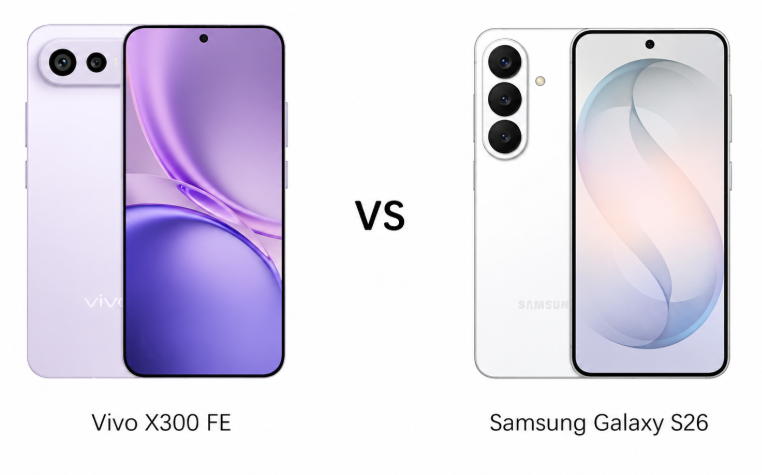
Vivo X300 FE and Samsung Galaxy S26 take two very different approaches to the compact flagship formula. Vivo focuses on aggressive hardware with a huge battery, ultra-fast charging, and Zeiss-powered cameras, while Samsung leans toward refinement, software longevity, and a polished premium ecosystem. This comparison breaks down which flagship actually delivers the better overall experience for performance, photography, battery life, and long-term value.
Major Features:
Feature
Vivo X300 FE
Samsung Galaxy S26
Winner
Design
Glass back with aluminum frame, IP68/IP69
Gorilla Glass Victus 2, Armor Aluminum 2, IP68
Samsung – More refined and premium build quality
Display
6.31-inch LTPO AMOLED, 1.5K, 5000 nits
6.3-inch Dynamic LTPO AMOLED 2X, FHD+, 2600 nits
Vivo – Sharper panel and significantly brighter display
Refresh Rate
120Hz LTPO
120Hz LTPO
Tie – Both deliver smooth flagship-level scrolling
Protection
Mohs level 4
Gorilla Glass Victus 2, Mohs level 5
Samsung – Better durability and glass protection
Processor
Snapdragon 8 Gen 5
Snapdragon 8 Elite Gen 5 / Exynos 2600
Samsung – Slightly stronger flagship performance
Software Support
5 Android upgrades
7 Android upgrades
Samsung – Longer software longevity
RAM & Storage
Up to 12GB + 512GB, UFS 4.1
Up to 12GB + 512GB, UFS 4.X
Tie – Similar flagship memory setup
Main Camera
50MP + 50MP periscope + 8MP ultrawide
50MP + 10MP telephoto + 12MP ultrawide
Vivo – Better zoom hardware and stronger camera setup
Zoom Camera
50MP periscope with Zeiss optics
10MP 3x telephoto
Vivo – Superior telephoto hardware
Selfie Camera
50MP AF
12MP Dual Pixel AF
Vivo – Higher resolution and more detailed selfies
Video Recording
8K, 4K 120fps
8K, HDR10+, advanced stabilization
Samsung – More polished video processing
Battery
6500mAh
4300mAh
Vivo – Much larger battery capacity
Charging
90W wired, 40W wireless
25W wired, 15W wireless
Vivo – Faster wired and wireless charging
Wireless Features
Reverse wireless and bypass charging
Reverse wireless
Vivo – More advanced charging features
Audio
Stereo speakers
Stereo speakers with high-bitrate audio
Samsung – Better premium audio experience
USB
USB Type-C 2.0
USB Type-C 3.2 with DisplayPort
Samsung – Faster data transfer and DeX support
Extra Features
Infrared port, Zeiss optics
Samsung DeX, Wireless DeX
Samsung – Stronger productivity ecosystem
Starting Price
Priced around ₹80,000
Priced around ₹88,000
Vivo – Better hardware value for the price
Overall Value
Hardware-focused flagship
Refined ecosystem flagship
Vivo – More aggressive flagship package overall
Disclaimer: Specs are based on available data. Actual performance may vary. Verify details from official sources before buying.
The Vivo X300 FE and Samsung Galaxy S26 both target premium compact flagship buyers, but they approach design differently. The Vivo X300 FE focuses on a more camera-centric and feature-heavy experience with IP68/IP69 protection, Zeiss branding, and a slightly bolder premium look. The aluminum frame and glass finish feel flagship-grade, while the larger battery inside gives the phone a more substantial hand feel.
The Samsung Galaxy S26 takes a cleaner and lighter approach with Gorilla Glass Victus 2 protection and Armor Aluminum 2 construction. Samsung’s design language feels more polished and minimalist, especially for users who prefer a slimmer flagship that is easier to carry daily. The S26 also benefits from Samsung’s software refinement, which complements the premium hardware well.
Display Quality
The Vivo X300 FE offers a sharper 1.5K LTPO AMOLED panel with extremely high peak brightness and advanced PWM dimming, making it more impressive for multimedia and outdoor visibility. Samsung’s Dynamic LTPO AMOLED 2X panel remains excellent with strong color tuning and smooth animations, but the lower resolution slightly reduces the wow factor beside Vivo’s display.
Verdict
The Vivo X300 FE feels more ambitious with its brighter and sharper display, while the Galaxy S26 delivers a more refined and compact flagship experience. Users focused on multimedia will likely prefer Vivo, whereas Samsung feels more balanced for everyday premium usage.
2. Specifications Including Battery
Performance
Both phones deliver flagship-grade power, but the Samsung Galaxy S26 pushes slightly ahead in raw processing with Snapdragon 8 Elite Gen 5 or Exynos 2600 variants, depending on region. One UI 8.5 also remains among the most optimized Android skins, particularly for multitasking and long-term smoothness. Samsung’s promise of seven major Android upgrades further strengthens long-term usability.
The Vivo X300 FE, however, still offers elite-level performance through the Snapdragon 8 Gen 5 chipset paired with UFS 4.1 storage. Gaming performance should remain extremely strong, and OriginOS 6 appears highly fluid. Vivo also includes features like bypass charging, which serious gamers will appreciate during longer sessions.
Battery and Charging
Battery life is where the Vivo X300 FE gains a major advantage. The 6500mAh battery, combined with 90W wired and 40W wireless charging, clearly outclasses Samsung’s smaller 4300mAh battery and slower charging speeds. The difference becomes noticeable for power users and heavy travelers.
Samsung still delivers dependable battery optimization, but Vivo feels more future-ready in charging convenience and endurance.
Verdict
Samsung offers stronger long-term software support and slightly more refined flagship performance, but Vivo dominates battery life and charging. For gaming and heavy usage, the X300 FE feels more practical and less restrictive.
3. Camera
Main and Secondary Lenses
The Vivo X300 FE delivers a more aggressive camera setup with dual 50MP sensors, Zeiss optics, and an advanced periscope telephoto lens. The optional external zoom lens system also adds a unique photography-focused appeal rarely seen in mainstream flagships. Its 8K recording, strong stabilization, and better telephoto hardware make it particularly attractive for photography enthusiasts.
Samsung’s Galaxy S26 continues the brand’s reliable flagship camera approach with balanced image processing, dependable HDR, and polished video tuning. The ultrawide camera appears stronger than Vivo’s on paper, while Samsung’s software consistency often produces more social-media-ready photos instantly. Features like Best Face and Horizon Lock also improve usability for casual users.
Selfie Camera
The Vivo X300 FE gains a noticeable edge with its 50MP autofocus selfie camera and Zeiss tuning. Selfies should appear sharper and more detailed, especially in daylight and video calls.
Samsung’s 12MP front camera still delivers reliable skin tones and excellent video quality, but it feels comparatively conservative beside Vivo’s more advanced hardware.
Verdict
The Vivo X300 FE feels like the more camera-focused device overall, especially for zoom photography and selfies. Samsung remains safer for users who prefer consistent processing and effortless point-and-shoot performance.
4. Pricing
The Vivo X300 FE is priced around $950 or ₹80,000, while the Samsung Galaxy S26 is priced around $900 or ₹88,000, depending on the market and storage configuration. Despite being slightly more expensive globally, Vivo actually appears more aggressive in the Indian market because of its larger battery, faster charging system, and stronger camera hardware.
Samsung, however, carries stronger brand value in the premium segment along with better resale potential and longer software support. Buyers who prioritize ecosystem features like Samsung DeX, polished software updates, and reliability over several years may still find the Galaxy S26 worth the higher pricing in India.
The Vivo X300 FE feels like a flagship designed to maximize specifications for the price, while Samsung positions the S26 as a more refined lifestyle flagship experience.
Verdict
The Vivo X300 FE offers better hardware value overall, especially for battery and camera-focused buyers. The Galaxy S26 justifies its pricing through software longevity, ecosystem integration, and a cleaner flagship experience.
Disclaimer: Prices are approximate and may vary based on country, region, launch timing, and applicable taxes. Always check whether the listed price is for a China unit or a global/international variant when purchasing.
5. Conclusion
The Vivo X300 FE stands out with its massive battery, ultra-fast charging, Zeiss-enhanced camera system, and sharper LTPO display. It feels designed for enthusiasts who want flagship performance without compromising endurance or camera flexibility. Features like bypass charging and optional zoom lenses also help it feel more experimental and feature-packed.
The Samsung Galaxy S26 focuses more on refinement and long-term ownership. Seven years of Android updates, Samsung DeX support, lighter design philosophy, and One UI optimization create a polished flagship experience that appeals to mainstream premium users. Samsung’s ecosystem integration also remains difficult to match for users already invested in Galaxy devices.
Both phones succeed in different ways. Vivo pushes hardware aggressively, while Samsung emphasizes consistency and longevity.
Verdict
Vivo X300 FE is the stronger choice for users prioritizing battery life, charging speed, and camera versatility. The Samsung Galaxy S26 feels better suited for buyers wanting cleaner software, extended software support, and a more mature flagship ecosystem experience.
Disclaimer: This comparison is based on the specifications provided and is intended for general informational purposes. Actual performance, camera results, battery life, and overall experience may vary depending on real-world usage, software updates, and individual preferences.
The Trump Mobile T1 phone has finally gone through benchmark testing, and the results don’t exactly match the hype surrounding its delayed launch. Courtesy of CNET, the phone ran a series of standard industry benchmarks, and it doesn’t exactly scream flagship.
On paper, the T1 runs on a Qualcomm Snapdragon 7 series chip, most likely the Snapdragon 7 Gen 3. And in real-world performance tests, CNET found that the numbers land closer to Android flagships from around five years ago.
Trump’s T1 phone in real-life. Image Source: CNET
In some cases, the benchmark results even resemble older HTC devices so closely that the report suggests the phone may be based on an HTC U24 Pro 5G design with a new exterior.
The Trump T1 handles basic tasks fine, and just that
As for everyday chores, the report claims the phone is just about fine for basic tasks like web browsing and video streaming, but it struggles to keep up with current mid-range phones in 2026.
The single-core and multi-core performance trails behind newer devices from Google, Samsung, and Apple, and graphics performance is even further behind. Below are the benchmark scores against several new and old phones.
Geekbench v6
Device
Single-core
Multi-core
T1 Trump Mobile Phone (2026)
1,195
3,443
HTC U24 Pro 5G (2024)
1,141
3,213
Google Pixel 10A (2025)
1,664
3,984
Samsung Galaxy S25 FE (2025)
2,118
6,819
Apple iPhone 17E (2025)
3,320
8,531
Samsung Galaxy Z Fold 2 (2020)
1,184
3,256
OnePlus 10 Pro (2022)
1,300
3,483
Source: CNET
3DMark Wild Life Extreme
Device
Score
T1 Trump Mobile Phone (2026)
1,581
OnePlus 9 Pro (2021)
1,525
Google Pixel 10A (2025)
2,579
Samsung Galaxy S25 FE (2025)
4,078
Apple iPhone 17E (2025)
3,936
Source: CNET
Design-wise, the T1 comes in a gold-colored body with a US flag-inspired back. Although, oddly, it only features 11 stripes instead of the standard 13. The software side is handled by Android 15 with minimal extra apps or heavy customization.
The back of the phone includes a triple rear setup led by a 50MP main sensor, 2x optical zoom, and up to 30x digital zoom. It has a 5000mAh battery with 30W charging support.
For more daily updates, please visit our News Section.
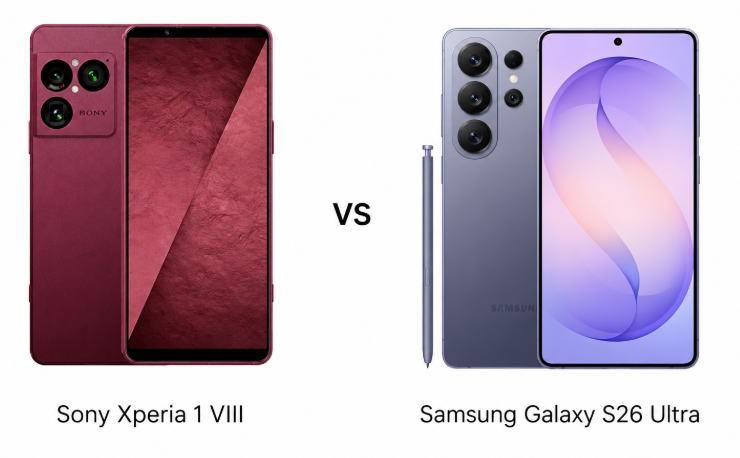
Sony Xperia 1 VIII and Samsung Galaxy S26 Ultra take two completely different approaches to the premium flagship experience. Sony focuses on creator-centric features, professional camera tools, and practical hardware additions, while Samsung pushes toward an all-in-one ultra-premium smartphone with cutting-edge display technology, AI features, and versatile cameras. This comparison breaks down which flagship truly delivers the better experience for photography enthusiasts, power users, and everyday premium buyers.
Major Features:
Feature
Sony Xperia 1 VIII
Samsung Galaxy S26 Ultra
Winner
Design
Minimalist aluminum and glass design with creator-focused styling
Premium ultra-flagship design with integrated S Pen
Samsung – Feels more futuristic and premium overall
Display
6.5-inch LTPO OLED, 120Hz
6.9-inch Dynamic LTPO AMOLED 2X, 120Hz
Samsung – Sharper, brighter, and more immersive
Resolution
1080 x 2340 pixels
1440 x 3120 pixels
Samsung – Higher pixel density improves clarity
Protection
Gorilla Glass Victus 2
Gorilla Armor 2 with anti-reflective coating
Samsung – Better durability and outdoor visibility
The Sony Xperia 1 VIII follows Sony’s signature minimalist design language with a slim profile, flat edges, and practical additions like a dedicated microSD card slot and a 3.5mm headphone jack. The aluminum frame and Gorilla Glass protection give it a premium in-hand feel while still focusing on utility. Samsung Galaxy S26 Ultra feels more futuristic with its curved premium styling, integrated S Pen, and stronger Gorilla Armor 2 protection. Samsung’s anti-reflective coating also makes daily outdoor use noticeably more comfortable.
Sony’s approach feels more enthusiast-focused, especially for users who prefer expandable storage and wired audio. Samsung, meanwhile, feels more polished and luxurious for mainstream flagship buyers.
Display Quality
Samsung clearly pushes ahead in display technology with its larger Dynamic LTPO AMOLED 2X panel, sharper 1440p resolution, and extremely high peak brightness. HDR10+ support and the anti-reflective layer improve media viewing significantly. Sony’s LTPO OLED display still delivers excellent color accuracy and smooth 120Hz performance, especially for creators who appreciate Sony’s natural color tuning.
Verdict
The Xperia 1 VIII feels practical and creator-oriented, while the Galaxy S26 Ultra delivers the more visually impressive flagship experience overall. Samsung wins this round because its display feels more immersive and premium in everyday use.
2. Specifications Including Battery
Performance
Both smartphones use Snapdragon 8 Elite Gen 5 chipsets paired with Adreno 840 graphics, making them among the fastest Android phones available. Samsung’s version carries slightly higher clock speeds, which may provide marginally better benchmark performance and sustained gaming output. The Galaxy S26 Ultra also benefits from Samsung’s software optimization and a seven-year Android update commitment.
Sony counters with cleaner software and features aimed at power users, including native Sony Alpha camera integration and bypass charging for gaming sessions. The dedicated microSD slot also adds flexibility that most premium phones no longer offer.
Battery and Charging
Both devices include 5000mAh batteries, but Samsung takes a major lead in charging speeds with 60W wired and 25W wireless charging. The Xperia 1 VIII’s 30W charging feels slower at this price level, though Sony’s battery management and bypass charging can help maintain long-term battery health. Samsung simply feels more convenient for fast top-ups during busy days.
Verdict
Performance differences are small, but Samsung offers a more complete flagship package thanks to faster charging, longer software support, and stronger optimization. Sony still appeals more to enthusiasts who prioritize flexibility and creator-focused features.
3. Camera
Main and Secondary Lenses
Sony equips the Xperia 1 VIII with a triple 48MP camera setup featuring Zeiss optics, advanced eye tracking, and strong manual camera controls. The imaging style leans toward natural colors and professional-grade tuning rather than aggressive processing. The telephoto sensor with close focusing abilities also adds versatility for creative photography.
Samsung Galaxy S26 Ultra goes for outright hardware dominance with its massive 200MP main camera, dual telephoto system, and advanced computational photography features. The 5x periscope zoom and high-resolution ultrawide camera give Samsung more flexibility across different shooting conditions. Samsung’s video capabilities, including 8K recording and advanced stabilization, also feel more consumer-friendly and polished.
Sony’s camera experience feels more rewarding for photography enthusiasts who enjoy manual control. Samsung, however, consistently produces more dramatic and instantly shareable images.
Selfie Camera
Both phones feature 12MP selfie cameras capable of 4K recording, but Samsung adds HDR10+ support and stronger image processing. Selfies from the S26 Ultra tend to appear brighter and more social-media-ready, while Sony maintains a more natural appearance.
Verdict
Sony offers a refined creator-focused camera system, but Samsung delivers the more versatile and dependable flagship camera experience overall. The Galaxy S26 Ultra is better suited for most users, especially those who prioritize zoom, video, and quick image processing.
4. Pricing
The Sony Xperia 1 VIII is priced around $1600 / ₹140000, while the Samsung Galaxy S26 Ultra is priced around $1300 / ₹140000. Despite the similar Indian pricing, Samsung undercuts Sony significantly in global markets while offering stronger charging speeds, a larger and brighter display, longer software support, and more versatile camera hardware.
Sony justifies its premium positioning through enthusiast-oriented features such as expandable storage, a headphone jack, Alpha camera integration, and a cleaner, professional-style experience. These additions are becoming increasingly rare in flagship smartphones, which gives Xperia a unique identity. However, many mainstream buyers may still find Samsung’s broader feature set more compelling for the money.
Samsung feels like the safer value choice because it balances premium hardware with practical everyday advantages. Sony appeals more to a niche audience that specifically values creative freedom and hardware flexibility.
Verdict
The Galaxy S26 Ultra delivers stronger overall value for most flagship buyers. The Xperia 1 VIII justifies its price mainly for photography enthusiasts, creators, and users who still prefer classic premium smartphone features.
Disclaimer: Prices are approximate and may vary based on country, region, launch timing, and applicable taxes. Always check whether the listed price is for a China unit or a global/international variant when purchasing.
5. Conclusion
The Sony Xperia 1 VIII stands out because it refuses to follow modern flagship trends completely. Features like the headphone jack, microSD expansion, manual photography tools, and Sony Alpha integration make it feel like a true enthusiast smartphone. It is clearly designed for creators who want precision and control rather than automated processing.
The Samsung Galaxy S26 Ultra focuses on delivering the ultimate all-around flagship experience. The brighter display, integrated S Pen, stronger software support, faster charging, advanced AI features, and versatile camera system make it feel more future-proof. Samsung also delivers a smoother balance between productivity, entertainment, and casual photography.
Sony’s uniqueness gives it a distinct charm, especially for users tired of identical flagship experiences. Samsung, however, simply covers more areas successfully and feels easier to recommend universally.
Verdict
The Sony Xperia 1 VIII is the better choice for creators, audio enthusiasts, and users who value flexibility. The Samsung Galaxy S26 Ultra is the superior overall flagship for most buyers thanks to its balanced performance, display quality, charging, software support, and camera versatility.
Disclaimer: This comparison is based on the specifications provided and is intended for general informational purposes. Actual performance, camera results, battery life, and overall experience may vary depending on real-world usage, software updates, and individual preferences.
Xiaomi today officially confirmed that a new version of its HyperOS is on the way with a big change under the hood. The announcement came during Xiaomi’s Q1 2026 earnings call, where the company shared strong financial results.
Xiaomi reported total revenue of 99.1 billion yuan and an adjusted net profit of 6.1 billion yuan. The company also said that it is among the top three smartphone brands globally for 23 straight quarters in terms of shipments.
According to Xiaomi, its smartphone business is also moving further into the premium segment. The global average selling price of its smartphones increased by 8.2% year-on-year to reach a new record high. And in mainland China, high-end smartphones now account for 23.5% of Xiaomi’s total smartphone sales.
AI is a big part of HyperOS 4
During the earnings call, Lu Weibing, President of Xiaomi, said that Xiaomi will continue its high-end and global expansion strategies. He also touts artificial intelligence as a major focus for the company’s future smartphone plans.
Lu says AI is the biggest growth opportunity for the smartphone industry, and Xiaomi is determined to reshape its phone business around it. He also mentions that the merger of “AI” and “miclaw” this year will be an important milestone for the company.
miclaw is Xiaomi’s autonomous AI assistant for smartphones. It can carry out tasks across apps and system features.
More importantly for users, Lu confirms that Xiaomi will release a “new generation” of operating system in either July or August this year. While he did not directly mention the name, it’s safe to assume it’s the HyperOS 4.
According to earlier information, Xiaomi’s next-generation system may replace parts of its current framework with a self-developed native architecture. At the same time, Xiaomi is expected to keep native Android services for now to avoid app compatibility problems.
For more daily updates, please visit our News Section.
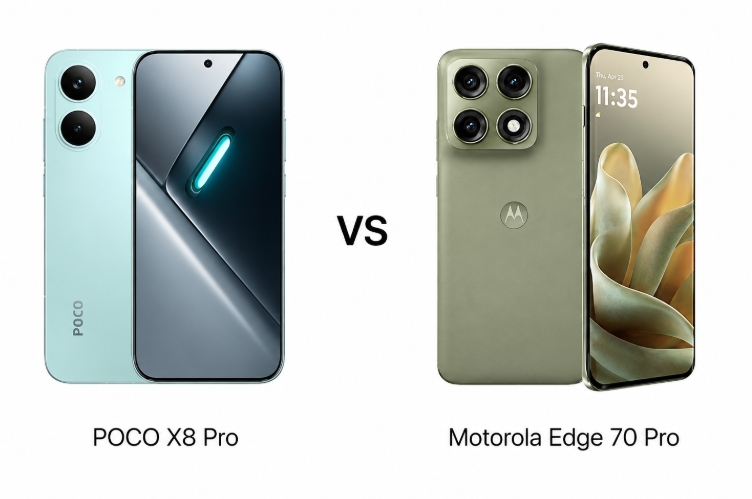
POCO X8 Pro and Motorola Edge 70 Pro take two very different approaches to the premium mid-range market. One focuses heavily on raw performance and ultra-fast charging, while the other pushes a more refined flagship-style experience with stronger cameras and cleaner software. With both phones offering powerful Dimensity chipsets, large batteries, and premium AMOLED displays, this comparison becomes less about specifications alone and more about which experience feels better in daily use.
The POCO X8 Pro focuses on a more performance-oriented flagship style with an aluminum frame, Gorilla Glass 7i protection, and IP68/IP69K durability. It feels sturdy and practical, especially for users who prefer a solid in-hand experience. The flat-frame approach also gives it a sharper and more gaming-focused personality.
The Motorola Edge 70 Pro takes a more premium lifestyle approach with its eco-leather finish and curved styling. It looks cleaner and more elegant in daily use, while the MIL-STD-810H certification adds extra confidence for durability. Motorola’s cleaner software experience also complements the refined hardware design well.
Display Quality
POCO offers a 6.59-inch AMOLED display with Dolby Vision, HDR10+, and extremely high PWM dimming support, making it comfortable for long viewing sessions. Colors feel vibrant, especially while gaming or streaming.
Motorola counters with a larger 6.78-inch AMOLED panel featuring a 144Hz refresh rate and an impressive 5200 nits peak brightness. The smoother animations and brighter outdoor visibility give it a more flagship-like display experience overall.
Verdict
The POCO X8 Pro feels more performance-centric and durable, while the Motorola Edge 70 Pro delivers a more polished, premium design with a superior display experience. Users focused on media consumption and visual smoothness may naturally lean toward Motorola.
2. Specifications Including Battery
Performance
Both smartphones are powered by MediaTek’s Dimensity 8500-series chipsets paired with UFS 4.1 storage, so everyday speed remains flagship-grade on both devices. The POCO X8 Pro appears slightly more aggressive in optimization, especially for gaming and sustained workloads. HyperOS 3 also adds several performance-focused tweaks that make the phone feel very fast under pressure.
The Motorola Edge 70 Pro focuses more on balanced performance and smooth software refinement. Android 16 with guaranteed major upgrades makes it attractive for long-term users who prioritize consistency over aggressive tuning. Motorola’s cleaner interface often feels lighter and less cluttered during regular use.
Battery and Charging
Both devices pack large 6500mAh silicon-carbon batteries, which is excellent for heavy users. The POCO X8 Pro clearly wins in charging speed with 100W wired charging that can fully charge the device in under an hour. Reverse wired charging is another useful addition for accessories.
Motorola offers 90W wired charging, but adds wireless and reverse wireless charging support, which brings more flagship convenience.
Verdict
The POCO X8 Pro is the stronger choice for raw gaming performance and ultra-fast charging, while the Motorola Edge 70 Pro feels more balanced and future-ready thanks to cleaner software and wireless charging support.
3. Camera
Main and Secondary Lenses
The POCO X8 Pro keeps things simple with a 50MP main camera and an 8MP ultrawide lens. The primary sensor performs well in daylight with strong contrast and vibrant colors, especially for social-media-ready shots. OIS support also helps improve low-light stability. However, the secondary ultrawide camera feels more functional than flagship-grade.
Motorola takes a significantly more ambitious approach with a triple 50MP camera setup that includes a periscope telephoto lens with 3.5x optical zoom. This instantly gives it more versatility for portraits, zoom shots, and travel photography. Pantone-validated colors also help produce more natural skin tones and balanced images. The ultrawide camera doubles as a stronger macro shooter as well.
Selfie Camera
POCO’s 20MP front camera is reliable for casual selfies and video calls, though it remains fairly standard in this segment.
Motorola’s 50MP autofocus selfie camera delivers sharper detail and better flexibility for creators and vlog-style recording. Support for 4K selfie video also adds extra appeal.
Verdict
The Motorola Edge 70 Pro comfortably wins the camera battle thanks to its versatile triple-camera system, stronger zoom capabilities, and significantly better selfie hardware. The POCO X8 Pro remains good for casual photography but clearly prioritizes performance over camera versatility.
4. Pricing
The POCO X8 Pro is priced around ₹35,000, while the Motorola Edge 70 Pro is priced around ₹39,000. The difference is not massive, but the value proposition changes depending on user priorities.
POCO delivers excellent hardware value with flagship-level charging speeds, strong gaming performance, premium durability, and a vibrant AMOLED panel at a slightly lower price. For users focused mainly on gaming, battery life, and raw speed, the pricing feels extremely competitive.
The Motorola Edge 70 Pro justifies its higher price through a more complete flagship experience. Features like the periscope camera, wireless charging, cleaner Android software, brighter display, and better selfie hardware make the extra cost easier to understand. The overall experience feels more polished and balanced rather than aggressively performance-focused.
Verdict
The POCO X8 Pro offers stronger value for performance-focused buyers, while the Motorola Edge 70 Pro feels worth the premium for users who want a more refined all-around flagship experience with better cameras and premium features.
Disclaimer: Prices are approximate and may vary based on country, region, launch timing, and applicable taxes. Always check whether the listed price is for a China unit or a global/international variant when purchasing.
5. Conclusion
The POCO X8 Pro stands out with its 100W charging, gaming-focused optimization, durable aluminum-frame construction, and highly competitive pricing. It feels like a smartphone designed specifically for users who prioritize speed, battery endurance, and long gaming sessions without spending flagship-level money.
The Motorola Edge 70 Pro differentiates itself through its cleaner, premium identity. The 144Hz display, wireless charging support, periscope zoom camera, Pantone color tuning, and refined Android experience make it feel more complete as a lifestyle flagship. The camera hardware especially creates a noticeable gap between the two devices in real-world versatility.
Verdict
POCO X8 Pro is the smarter choice for gamers and power users looking for maximum performance value. The Motorola Edge 70 Pro, however, emerges as the better overall smartphone for users who want stronger cameras, cleaner software, and a more premium flagship-style experience.
Disclaimer: This comparison is based on the specifications provided and is intended for general informational purposes. Actual performance, camera results, battery life, and overall experience may vary depending on real-world usage, software updates, and individual preferences.
MediaTek has completely transformed its Dimensity lineup, and the new Dimensity 9500 proves it. The latest Dimensity flagship goes toe-to-toe with the absolute best from Qualcomm and Apple. On the flip side, while Samsung’s Exynos line has historically struggled, the Exynos 2600 feels like a massive leap forward rather than just another boring annual refresh.
The Exynos 2600 is the company’s first smartphone processor to feature an “all-big” CPU design, allowing the chip to unlock higher performance. It’s also the world’s first smartphone chipset fabricated using a 2nm process, further adding to performance and efficiency. Historically, MediaTek chips have outperformed Exynos chips, but this time, the battle looks more intense.
Let’s compare them to see whether the advanced node and all-big CPU design can help the Exynos 2600 beat MediaTek’s rival, the Dimensity 9500.
Here’s the spec sheet to begin with:
Dimensity 9500
Exynos 2600
Announced
September 2025
December 2025
Process node
3nm (TSMC)
2nm (Samsung)
CPU cores
8-core
10-core
CPU configuration
1 x 4.21 GHz (C1-Ultra) 3 x 3.5 GHz (C1-Premium) 4 x 2.7 GHz (C1-Pro)
1 x 3.8 GHz (C1-Ultra) 3 x 3.25 GHz (C1-Pro) 6 x 2.75 GHz (C1-Pro)
GPU
Immortalis Mali-G1 Ultra MP12 ray tracing support MediaTek HyperEngine Gaming Technology
Exynos Xclipse 960 GPU ray tracing support Exynos Neural Super Sampling Heat Path Block (HPB)
NPU
MediaTek NPU 990
AI engine with 32K MAC NPU
Memory
LPDDR5X, up to 5.3 GHz
LPDDR5X
Storage
UFS 4.1
UFS 4.1
Camera
MediaTek Imagiq 1190 ISP up to 320MP single camera up to 8K video recording real-time semantic segmentation support
up to 320MP single camera up to 108MP single camera (30fps) up to 64MP+32MP dual cameras (30fps) up to 8K video recording real-time semantic segmentation support
Connectivity
integrated 5G modem (3GPP R17) download speed: up to 7.4 Gbps Wi-Fi 7 (peak speed: 7.3 Gbps) Bluetooth 6.0
Exynos 5410 modem download speed: up to 14.79 Gbps upload speed: up to 4.9 Gbps Wi-Fi 7 Bluetooth 6.0
Dimensity 9500 vs Exynos 2600: Benchmark numbers
Note: To obtain the benchmark results, the tests were performed using these devices: – Vivo X300 Pro (Dimensity 9500) – Galaxy S26 Plus (Exynos 2600)
Geekbench score
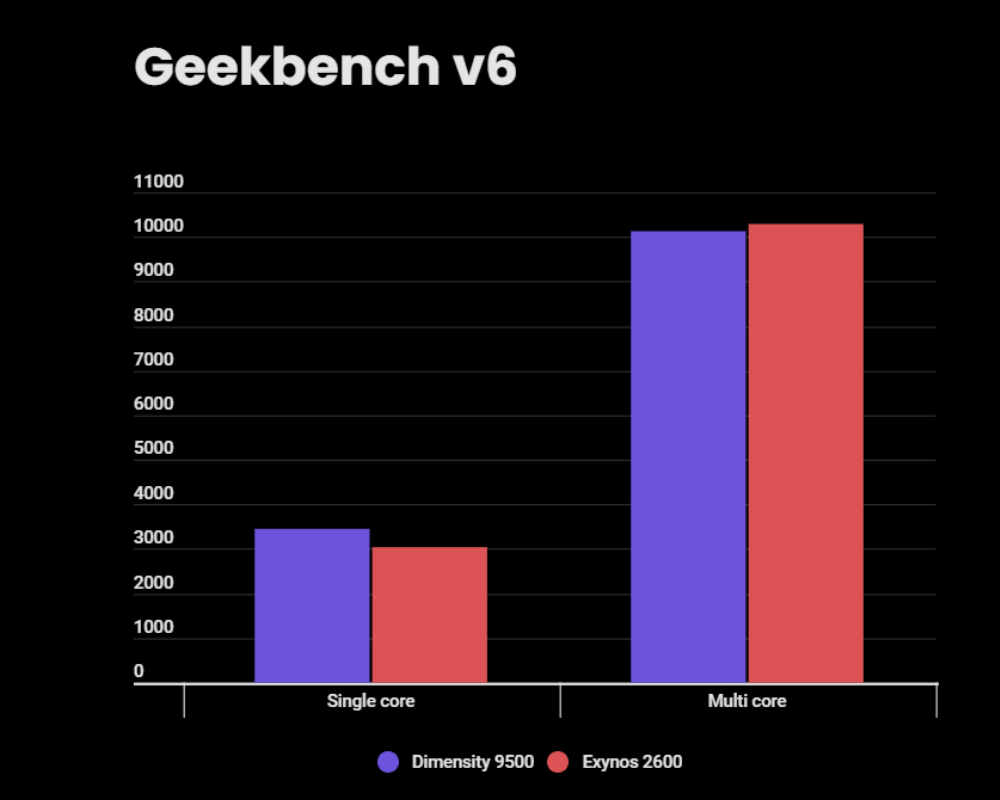
In the Geekbench 6 CPU test, the Dimensity 9500 achieves a 13% higher single-core score. In the multi-core test, however, the Exynos 2600 is ahead, but the gap is just too small to create a major difference.
Dimensity 9500
Exynos 2600
Single core
3,452
3,040
Multi core
10,128
10,290
AnTuTu score
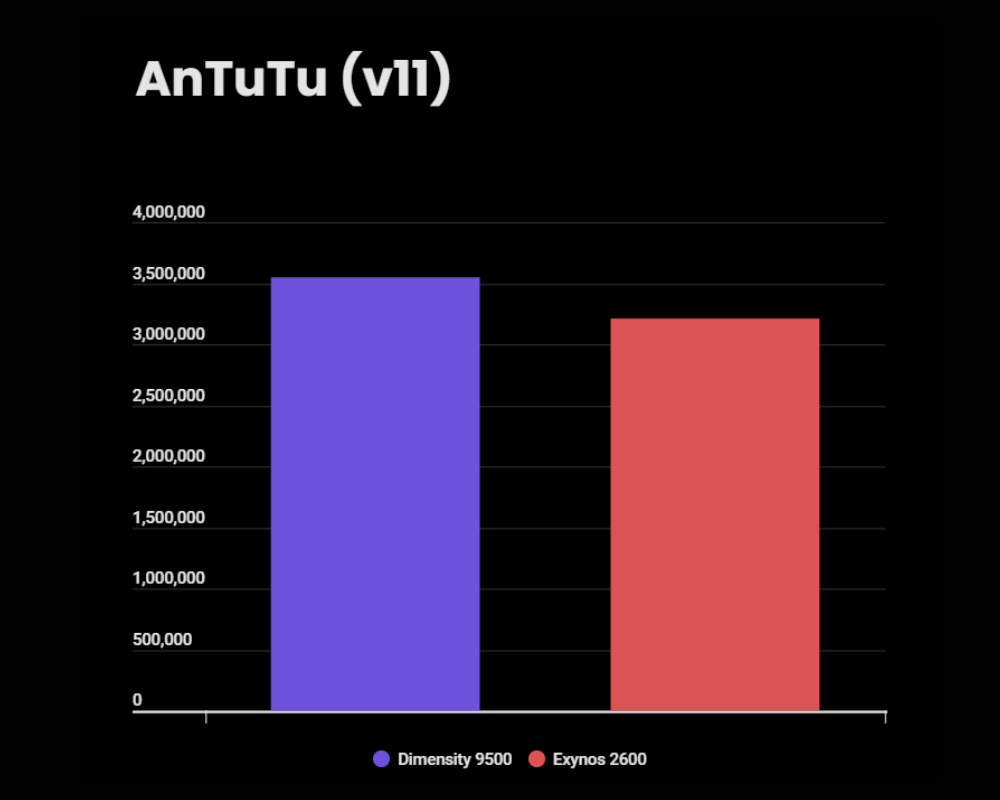
The Dimensity 9500 puts up a strong total on AnTuTu, scoring over 3.5 million points, whereas the Exynos 2600 scores 3.2 million points. While it shows the Dimensity chip is stronger, it’s the breakdown of the AnTuTu score that offers more clarity.
The all-big 10-core CPU on the Exynos chip gets about 3.6% higher AnTuTu score than the Dimensity 9500’s 8-core CPU. However, the latter bounces back strongly in the GPU test with a 16% higher score.
Dimensity 9500
Exynos 2600
AnTuTu score
3,548,426
3,210,573
CPU
1,028,694
1,065,772
GPU
1,413,659
1,212,568
Memory
385,723
413,700
UX
720,349
518,533
3DMark score
Wild Life Extreme Test
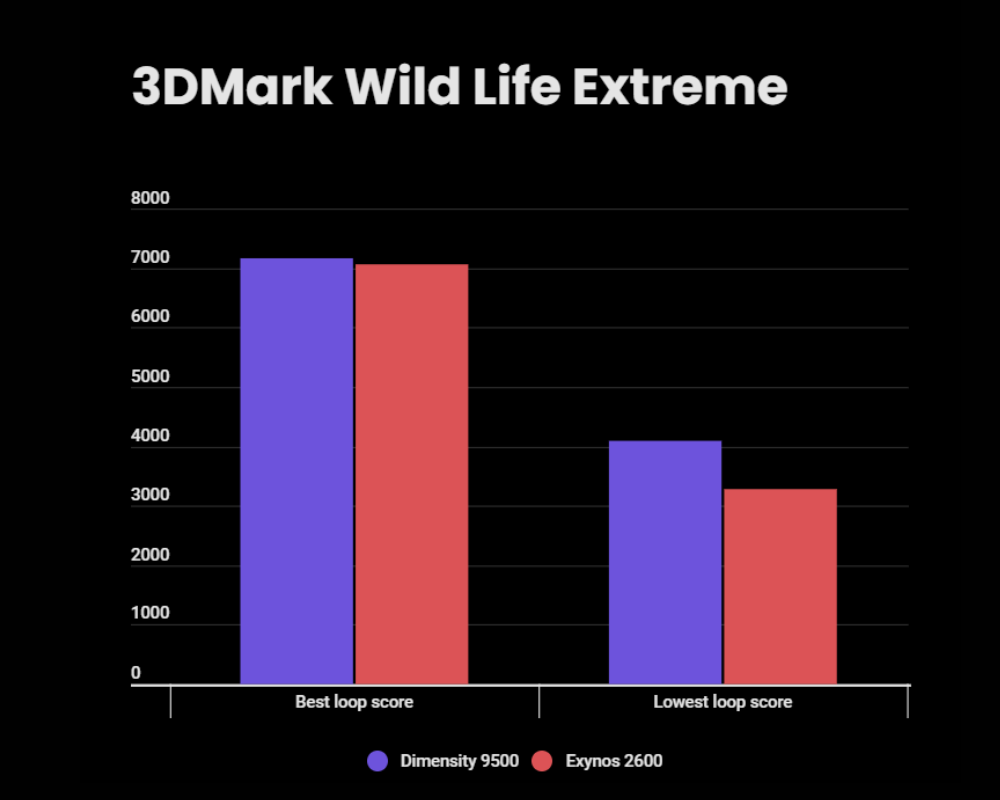
The 3DMark benchmark also confirms that the Dimensity 9500 has a more powerful GPU. There isn’t a big difference in the best loop score, but the Dimensity chip has a much better lowest loop score. This means higher gaming stability on the Dimensity 9500-powered smartphone.
Dimensity 9500
Exynos 2600
Best loop score
7,163
7,061
Lowest loop score
4,092
3,280
Stability
57%
46.4%
In all benchmark tests we’ve run so far, the Dimensity 9500 is more powerful than the Exynos 2600. But there’s more than just the performance. It’s also important to understand the differences in camera capabilities, connectivity, and other key aspects.
Dimensity 9500 vs Exynos 2600: Key differences that matter
Performance
CPU
The Dimensity 9500 utilizes TSMC’s cutting-edge 3nm node, whereas the Exynos 2600 is manufactured using Samsung’s 2nm process. Besides, their CPU configurations also differ. The Dimensity chip has an 8-core layout, featuring one C1-Ultra, three C1-Premium, and four C1-Pro cores.
In contrast, the Exynos 2600 has two additional CPU cores but skips the C1-Premium cores. The 10-core setup includes one C1-Ultra, three C1-Pro, and six C1-Pro cores.
Even with fewer CPU cores, the Dimensity 9500 outperforms the Exynos 2600 in some benchmark tests. That’s because of higher clock speeds and the performance-friendly C1-Premium cores.
GPU
The Dimensity 9500 features a 12-core Mali-G1 Ultra graphics unit, offering superior performance and stability compared to the Xclipse 960 GPU on the Exynos 2600. But when it comes to ray tracing performance, the Exynos chip shines.
The Dimensity chip is widely praised for cooler thermals. On the other hand, Exynos chips have faced major overheating issues, but the latest Exynos 2600 dramatically improves this by introducing the Heat Path Block (HPB). It’s a hardware component located directly over the hottest areas of the main processing unit.
Furthermore, the Dimensity 9500 offers a full suite of MediaTek HyperEngine Gaming Technology, improving latency, frame rates, and power consumption. The Exynos chip benefits from Samsung’s partnership with AMD, which focuses on optimizing game engines like Unity and Unreal for this architecture.
NPU
The Dimensity 9500 comes with an upgraded MediaTek NPU 990 with agentic AI capabilities. MediaTek says it’s twice as powerful as the previous generation, with 56% better power efficiency, and is designed to handle complex, multi-step tasks in the background. The new NPU can generate 4K images from text.
The Exynos 2600 also brings major NPU upgrades compared to the Exynos 2500, including 113% faster generative AI performance and significantly reduced power consumption and latency. The NPU also helps with resolution upscaling and frame generation.
Camera
Both chipsets boast high-end camera features, but there are several key things to note. The Dimensity 9500 integrates an NPU-assisted 30fps focus-tracking engine, ensuring a clear shot in every frame. It also has a powerful denoise technology for 200MP photo captures.
The Exynos 2600 focuses on real-time element recognition and severe low-light optimization, backed by its on-device AI enhancements. It integrates an AI-based Visual Perception System (VPS) that allows the ISP to recognize detailed elements within images and videos in real time.
The Exynos chip also features Deep Learning Video Noise Reduction (DVNR) to enhance clarity in low-light conditions and supports the Advanced Professional Video (APV) codec.
Connectivity
The Dimensity 9500 has an integrated 5G modem, whereas the Exynos 2600 relies on a separate, external component for connectivity. Both chips offer robust, modern connectivity features, but there’s a big difference in the download speed.
On a 5G connection, the Dimensity chip can reach up to 7.4Gbps of download speed, while the Exynos chip can reach 2X of that, up to 14.79Gbps. The Dimensity chip excels in peak Wi-Fi 7 speeds, offering up to 7.3Gbps (versus 4.9Gbps on the Exynos 2600).
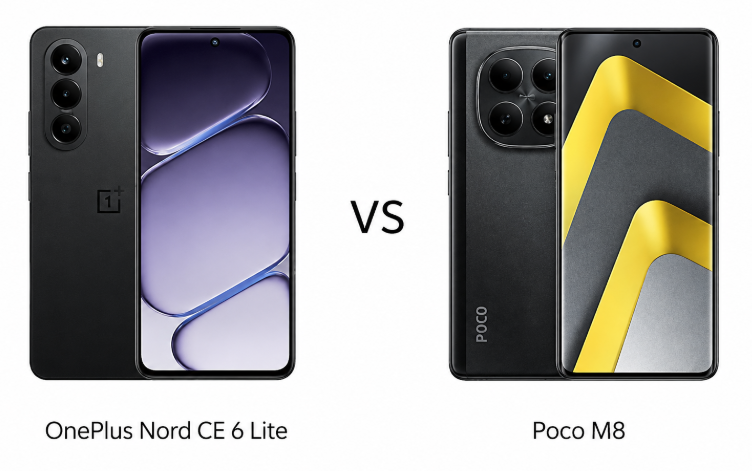
OnePlus Nord CE 6 Lite and Poco M8 target buyers looking for strong everyday performance without entering flagship pricing territory, but they take very different approaches to get there. One focuses heavily on battery life and raw endurance, while the other pushes premium display quality and overall value. From gaming and cameras to charging and software experience, this comparison highlights which phone actually delivers the smarter package for different kinds of users.
Major Features:
Feature
OnePlus Nord CE 6 Lite
Poco M8
Winner
Display
6.72-inch IPS LCD, 144Hz
6.77-inch AMOLED, 120Hz, HDR, 3200 nits
Poco – AMOLED panel delivers richer colors and deeper contrast
Brightness
1000 nits HBM
3200 nits peak
Poco – Much brighter outdoors and for HDR content
Chipset
MediaTek Dimensity 7400 Apex
Snapdragon 6 Gen 3
OnePlus – Slightly stronger overall performance
Storage Type
UFS 3.1
UFS 2.2
OnePlus – Faster app loading and multitasking
RAM & Storage Options
Up to 256GB + 8GB RAM
Up to 512GB + 8GB RAM
Poco – Higher storage option available
Software
Android 16
Android 15, 4 Android upgrades
Poco – Better long-term software support
Rear Camera
50MP dual camera
50MP dual camera
Tie – Similar primary camera hardware
Video Recording
4K, 1080p@120fps, gyro-EIS
4K, 1080p@60fps
OnePlus – Better stabilization and high-frame-rate recording
Selfie Camera
8MP
20MP
Poco – Sharper selfies and better video calls
Speakers
Stereo speakers
Stereo speakers with Dolby Atmos
Poco – Better multimedia tuning
Battery
7000mAh
5520mAh
OnePlus – Exceptional battery endurance
Charging
45W wired, bypass charging
45W wired
OnePlus – Bypass charging adds gaming convenience
Reverse Charging
10W reverse wired
18W reverse wired
Poco – Faster reverse charging
Durability
IP64, MIL-STD rated
IP66, drop resistance
Poco – Stronger water and drop protection
Connectivity
Bluetooth 5.4
NFC, Infrared port
Poco – More extra features overall
Price
Priced around ₹23,000
Priced around ₹17,000
Poco – Much stronger value for money
Overall
Battery-focused performance phone
Balanced all-rounder with premium display
Poco – Better overall package for most buyers
Disclaimer: Specs are based on available data. Actual performance may vary. Verify details from official sources before buying.
The OnePlus Nord CE 6 Lite focuses on practicality with its clean design, IP64 protection, and MIL-STD durability certification. It feels like a phone designed for long-term everyday use rather than pure visual flair. The large battery also gives it a slightly sturdier in-hand feel, which may appeal to users who prioritize endurance over slimness. Meanwhile, the Poco M8 takes a more modern approach with IP66 protection, drop resistance, and a sleeker body. The AMOLED panel immediately makes the device feel more premium, especially in darker themes and media-heavy usage. Poco’s slimmer and lighter profile also makes it easier to handle during long gaming or streaming sessions.
Display Quality
The Nord CE 6 Lite offers a 6.72-inch IPS LCD with a smooth 144Hz refresh rate. Scrolling and gaming feel fluid, and the panel is bright enough for outdoor visibility. However, the Poco M8 gains a noticeable advantage with its 6.77-inch AMOLED display, HDR support, and extremely high peak brightness. Colors appear richer, blacks look deeper, and content simply feels more vibrant. The 3840Hz PWM dimming also makes prolonged nighttime use more comfortable.
Verdict
The Poco M8 delivers a more premium multimedia experience thanks to its AMOLED panel and stronger durability ratings. The Nord CE 6 Lite still stands out for users who prefer ultra-smooth refresh rates and a rugged everyday design.
2. Specifications Including Battery
Performance
The OnePlus Nord CE 6 Lite runs on the MediaTek Dimensity 7400 Apex chipset paired with UFS 3.1 storage, which gives it a clear speed advantage in app loading, multitasking, and gaming responsiveness. The combination of Cortex-A78 cores and faster storage helps the phone feel snappier during heavy usage. It also ships with Android 16, giving it a slightly newer software foundation. The Poco M8 uses the Snapdragon 6 Gen 3 with UFS 2.2 storage. While overall performance remains solid for daily tasks and casual gaming, it leans more toward efficiency than outright speed. HyperOS 2 feels polished, and the promise of four major Android updates adds strong long-term value.
Battery and Charging
Battery life is where the Nord CE 6 Lite creates real separation. The massive 7000mAh battery is built for heavy users and can comfortably stretch well beyond a full day. Bypass charging is also a useful addition for gamers. The Poco M8’s 5520mAh silicon-carbon battery still performs impressively while keeping the phone slimmer and lighter. Both phones support 45W charging, but the larger OnePlus battery naturally takes longer to fully recharge.
Verdict
The Nord CE 6 Lite feels stronger for power users thanks to faster storage and exceptional battery capacity. The Poco M8 balances performance, efficiency, and software support better for mainstream users.
3. Camera
Main and Secondary Lenses
Both smartphones feature a 50MP primary rear camera with PDAF, and in daylight conditions, image quality remains fairly competitive between them. The Nord CE 6 Lite produces balanced colors with reliable sharpness, and its video setup is notably stronger with support for 4K recording plus 1080p at up to 120fps alongside gyro-EIS stabilization. This makes it more appealing for content creators and casual videographers. The Poco M8 focuses more on delivering vibrant images with punchier contrast, which many users may find visually pleasing for social media uploads. Dolby Atmos stereo speakers also improve the overall media capture experience.
Selfie Camera
The biggest difference appears on the front. The Poco M8 carries a 20MP selfie camera that captures noticeably sharper details and brighter skin tones compared to the Nord CE 6 Lite’s 8MP sensor. Video quality on the Poco also feels more polished for video calls and short-form content. The Nord’s selfie camera is functional, but it does not stand out in this segment.
Verdict
The Nord CE 6 Lite performs better for video recording and stabilization, while the Poco M8 delivers a more complete overall camera package because of its stronger selfie performance and punchier image processing.
4. Pricing
OnePlus Nord CE 6 Lite is priced around $275 / ₹23,000, while the Poco M8 is priced around $200 / ₹17,000. This creates a noticeable pricing gap between the two devices despite several overlapping features.
Is the Price Justified?
The Nord CE 6 Lite makes sense for buyers who specifically want battery life and faster overall responsiveness. However, the Poco M8 feels surprisingly complete for its segment and covers most daily needs without major compromises. The lower pricing makes its premium display and feature set even more attractive.
Verdict
The Poco M8 offers stronger value for money overall, while the Nord CE 6 Lite justifies its higher price mainly through battery endurance and faster storage performance.
Disclaimer: Prices are approximate and may vary based on country, region, launch timing, and applicable taxes. Always check whether the listed price is for a China unit or a global/international variant when purchasing.
5. Conclusion
The OnePlus Nord CE 6 Lite stands out because of its massive 7000mAh battery, UFS 3.1 storage, 144Hz display, and bypass charging support. These features make it particularly attractive for gamers, heavy multitaskers, and users who hate charging frequently. The software also feels slightly more future-ready with Android 16 out of the box. Meanwhile, the Poco M8 focuses on delivering a more balanced all-around experience. Its AMOLED panel, slimmer design, better selfie camera, Dolby Atmos speakers, IP66 protection, and longer software support make it feel more premium than its pricing suggests. The device manages to combine entertainment, durability, and efficiency in a very practical way.
Verdict
OnePlus Nord CE 6 Lite is the better choice for users who prioritize battery life, gaming endurance, and faster system responsiveness. However, the Poco M8 emerges as the smarter overall buy for most users because it delivers a richer display experience, a stronger selfie camera, and better value at a significantly lower price.
Disclaimer: This comparison is based on the specifications provided and is intended for general informational purposes. Actual performance, camera results, battery life, and overall experience may vary depending on real-world usage, software updates, and individual preferences.
Motorola has continued its growth in the Indian smartphone market and has now entered the country’s top five smartphone brands in Q1 2026. The company’s latest market performance reflects its steady expansion across both premium and mid-range segments, supported by a broader device portfolio, AI-focused features and lifestyle-oriented branding strategies.
Motorola’s market share and premium strategy
Motorola breaks into top 5 smartphone brands in India
According to IDC’s Quarterly Mobile Phone Tracker for Q1 2026, Motorola climbed from the ninth position in Q1 2024 to fifth place in just two years. During the same period, the brand’s market share reportedly increased from 4.6 percent to 8.9 percent. Motorola’s portfolio expansion across the Moto G series, Motorola Edge lineup, Razr foldables and the recently introduced Signature series has played a major role in this growth.
As per the brand, it has also been strengthening its premium positioning through collaborations and design-focused partnerships. Motorola smartphones have featured Pantone-curated colours and finishes, while the company has also highlighted DXOMARK-recognised camera systems on some of its devices. Partnerships involving Swarovski, Bose, and FIFA World Cup 2026 have further helped the brand build a more lifestyle-focused image in the market.
Motorola has additionally focused on AI-powered smartphone experiences through integrations with Google Gemini, Microsoft Copilot and Perplexity. These partnerships are aimed at offering more personalised productivity and AI assistant features across compatible devices. The company’s premium foldable segment has also expanded with newer Razr series models focused on AI features and advanced camera capabilities.
Apart from launching new products, Motorola’s retail and after-sales network expansion has also contributed to its market growth in India. The brand has continued strengthening partnerships across online platforms, offline retail stores and service centres to improve accessibility and ownership experience for customers across regions.
With its recent growth in the premium smartphone space and increasing AI focus, Motorola appears to be positioning itself more aggressively against established brands in India.
For more daily updates, please visit our News Section.
Just days after unveiling the high-end Mijia Cordless Vacuum Cleaner 4 Max, Xiaomi is back with another cleaning gadget. This time, the company has introduced the new Mijia Cordless Vacuum Cleaner 4 Pro in China. It offers many of the same smart cleaning features at a more accessible price point.
The new vacuum cleaner retails for 1,499 yuan (around $220), though buyers in China will be able to get it for as low as 1,219 yuan after national subsidies and trade-in discounts. Sales officially begin on June 10.
Xiaomi Mijia Cordless Vacuum Cleaner 4 Pro Specifications
Like the recently announced Vacuum Cleaner 4 Max, the new 4 Pro is about reducing manual maintenance. It uses Xiaomi’s dual-duct self-collecting dust system, which automatically transfers dust and debris from the vacuum into a 3-liter antibacterial dust bag inside the charging base. According to Xiaomi, the system can achieve a 99% dust collection rate and empty the dust cup in just 11 seconds.
The dust bag itself includes a silver-ion antibacterial coating, and Xiaomi claims users can go up to 100 days without needing to empty or replace it under typical use.
The Mijia Cordless Vacuum Cleaner 4 Pro is equipped with a 120,000 RPM high-speed brushless motor capable of delivering up to 230AW suction power and a maximum vacuum level of 25,000Pa. Xiaomi says that should be enough to handle common household debris like dust, pet hair, cat litter, and larger particles.
Like many of Xiaomi’s recent smart home products, the vacuum also comes with Xiaomi Smart Connect support, allowing remote device control and smart home integration through the company’s ecosystem.
One of the more interesting additions is the 180-degree wide-angle blue light dust detection system. Similar to the feature on the more expensive 4 Max, it helps illuminate fine dust particles hiding under beds, sofas, and other darker areas that are normally difficult to spot.
Xiaomi has also included a dual anti-tangling brush design to reduce hair wrapping around the rollers. The company claims the vacuum can handle up to 300 long hairs without major tangling issues. There is also a right-edge cleaning design meant to improve cleaning along walls and baseboards.
The vacuum packs a removable 2,600mAh battery setup with up to 90 minutes of runtime. And once cleaning is done, users can simply push the vacuum back into the base station, where it automatically starts charging.
The vacuum cleaner also features a five-layer precision filtration system with a claimed 99.99% filtration efficiency for particles as small as 0.3 microns.
For more daily updates, please visit our News Section.
Xiaomi and its sub-brand Redmi are planning to launch new phones in India in June. While the Xiaomi 17T is confirmed to debut on June 1, the launch date of the Redmi Turbo 5 is yet to be officially confirmed. According to a report by SmartPrix, the Redmi Turbo 5 could launch in the country on June 18. The report also claims that Redmi may announce another device called the Redmi 17 alongside the Turbo 5. Here’s a look at the leaked specifications of the device.
Redmi 17 specs leaked
Redmi 15 5G
As per the report, the Redmi 17 will feature an LCD panel with support for a high refresh rate. It remains to be seen whether the device will use the same 6.9-inch FHD+ LCD screen with a 144Hz refresh rate that was seen on the Redmi 15.
Under the hood, the Redmi 17 is said to feature a Snapdragon 4-series chipset. While the report does not reveal the exact processor name, there is a possibility that it could use the latest Snapdragon 4 Gen 5 chipset, which debuted last month.
Like recent Redmi smartphones, the Redmi 17 is expected to ship with HyperOS based on Android 16. For photography, the device may feature a 50-megapixel primary camera and an 8-megapixel front-facing camera.
The Redmi 17 is also tipped to house a massive 7,000mAh+ battery, although details regarding its fast charging support are still unknown.
The specifications of the Redmi Turbo 5 are already known, as the device launched earlier this year in China. It is also expected to arrive as a rebranded version of the Poco X8 Pro. The device is likely to feature a 6.58-inch 1.5K 120Hz display, a Dimensity 8500-Ultra chipset, a 7,560mAh battery with 100W charging support, a 50-megapixel + 8-megapixel dual rear camera setup, and a 20-megapixel front camera.
For more daily updates, please visit our News Section.
Infinix has launched its latest budget phone, the Hot 70, and the headline feature is not its processor or camera—it’s the back panel that changes color with temperature.
The company is using what it calls a Thermo Orange finish, which shifts its look depending on heat levels. At lower temperatures, the rear surface appears as a darker “Quiet Orange.” As the device warms up, it transitions into a brighter “Playful Orange.”
Alongside this main variant, the Hot 70 also comes in more traditional finishes: Green Texture, Quiet Violet, Dive Blue, Silver Dancer, and Night Pulse black. The design itself is fairly slim at 7.49mm, though the phone is not especially light at 195g, likely due to its large battery.
Infinix Hot 70 Specifications
The Hot 70 packs a 6000mAh cell with 45W wired charging support. It also includes 10W reverse charging, meaning it can act like a power bank for accessories such as earbuds or other small devices.
Under the hood, the device runs on the MediaTek Helio G100 Ultimate chipset, the same platform used in some of last year’s midrange Infinix devices. It’s paired with storage options ranging from 6GB+128GB up to 8GB+256GB, giving users some flexibility depending on price.
The display is a 6.78-inch IPS LCD with a resolution of 720 × 1576 and a 120Hz refresh rate. On paper, that means smooth scrolling, but not especially sharp visuals compared to higher-resolution panels. Camera hardware is also modest: a 50MP main rear sensor with an f/1.9 aperture, joined by a secondary depth sensor. On the front, there is an 8MP selfie camera.
Software is handled by Android 16, layered with Infinix XOS 16. The phone also has a dedicated hardware button on the side of the phone, which you can customize as a shortcut to apps or specific functions.
For more daily updates, please visit our News Section.
We use cookies on our website to give you the most relevant experience by remembering your preferences and repeat visits. By clicking “Accept”, you consent to the use of ALL the cookies.
This website uses cookies to improve your experience while you navigate through the website. Out of these, the cookies that are categorized as necessary are stored on your browser as they are essential for the working of basic functionalities of the website. We also use third-party cookies that help us analyze and understand how you use this website. These cookies will be stored in your browser only with your consent. You also have the option to opt-out of these cookies. But opting out of some of these cookies may affect your browsing experience.
Necessary cookies are absolutely essential for the website to function properly. This category only includes cookies that ensures basic functionalities and security features of the website. These cookies do not store any personal information.
Any cookies that may not be particularly necessary for the website to function and is used specifically to collect user personal data via analytics, ads, other embedded contents are termed as non-necessary cookies. It is mandatory to procure user consent prior to running these cookies on your website.