Compact smartphones took off this year with a rising trend of devices that are easier to hold and use with one hand. In particular, small premium phones were quite popular with various brands launching their own offerings. Earlier this year, we got the Vivo X200 FE that blended high end specs, capable cameras, and a massive battery in a compact form factor. Now with the release of the Vivo S50 Pro Mini, the successor might be even better. So here’s everything you need to know.
To recall, the Vivo S30 Pro Mini debuted in China in May 2025, with this model getting rebranded as the Vivo X200 FE model for the global market. Considering how the X200 Pro Mini didn’t see a wider release, this was the first taste of a premium compact phone from Vivo. So we expect the brand to make a similar move for the next gen model as well. The S50 Pro Mini just launched with a big design overhaul earlier this week.
Gone is the vertically stacked camera module and the contrasting frame. You now get an iPhone Air inspired horizontal camera island and a metallic frame that blends with the color panel. Meaning, the Vivo X200 FE is also getting a similar new look along with an IP68 + IP69 rating for water and dust resistance. The device could measure just 8.1mm thick and weigh around 192 grams.
Meanwhile, the X300 FE likely sports an identical 6.31-inch LTPO AMOLED display with a 1.5K resolution (2640 x 1216p), a 120Hz refresh rate, 5000 nits of peak brightness, 4320Hz PWM dimming, and an ultrasonic fingerprint scanner for security.
2. Faster Performance
The older Vivo X200 FE was a premium phone but packed an older MediaTek Dimensity 9300+ SoC, which was already a generation behind the Dimensity 9400 and Snapdragon 8 Elite. But its successor is bringing a notable upgrade in performance thanks to Qualcomm’s new Snapdragon 8 Gen 5. In terms of performance, this chip is on par with the Snapdragon 8 Elite. So you get a true flagship experience. The S50 Pro Mini paired the processor with up to 16GB of LPDDR5X Ultra RAM and 512GB of UFS 4.1 storage.
3. Impressive Battery Now Meets Wireless Charging
The Vivo X200 FE impressed with its massive 6,500mAh battery pack, which returned on the new S50 Pro Mini, and by extension, the X300 FE as well. Battery capacity and the 90W wired fast charging remain unchanged between the two generations. But this time around, Vivo included 40W wireless fast charging, which makes it in line with other premium compact phones in the market.
4. Zeiss Camera Tuning
Vivo barely made any changes in the camera department, bringing back the same 50MP triple cameras. Although, Zeiss could be the big game changer here. The one big difference between the S30 Pro Mini and X200 FE was the Zeiss branding on the rear and tuning on the camera system. So the brand may once again bring back the collaboration to make the Vivo X300 FE more in line with the flagship X300 series.
For more daily updates, please visit our News Section.
Lenovo isn’t a popular brand when it comes to software updates. However, it does offer major OS upgrades to many of its devices, albeit with some delay, and Android 16 is no exception.
Some Lenovo devices are already receiving the Android 16 update. For the remaining ones, we now have official confirmation (via) on the list of eligible devices and rollout schedule. Review the details below to find out when your Lenovo device will get the update.
Lenovo Android 16 update rollout schedule
2025
Lenovo Yoga Tab Plus – TB520FU
Lenovo Tab Plus – TB351FU
Lenovo Tab – TB311FU
Lenovo Idea Tab / Lenovo Tab K11 Gen 2 – TB336FU
Lenovo Idea Tab / Lenovo Tab K11 Gen 2 – TB336ZU
Lenovo Tab Extreme – TB570FU
Lenovo Idea Tab Pro – TB373FU
Lenovo Legion Tab (8.8″, 3) – TB321FU
Q1, 2026
Lenovo Tab K11 Gen 2 – TB336ZA
moto pad 60 pro – XT2571-1
Q2, 2026
moto pad 60 lite – XT2573-1
Q3, 2026
moto pad 60 neo WIFI – XT2575-1
moto pad 60 neo 5G – XT2575-3
Q4, 2026
Lenovo Idea Tab Plus / Lenovo Tab K12 – TB361FU
Lenovo Idea Tab Plus / Lenovo Tab K12 – TB361ZU
It doesn’t take long to realize that there are no smartphones on the list. Well, that’s because Lenovo hasn’t released phones in the last few years. It primarily focuses on tablets.
The above list doesn’t include Motorola smartphones, as we have a separate post for that. You can check Motorola’s Android 16 eligible devices on this page.
So, if you have a Lenovo or Moto tablet that’s on the list, it’s guaranteed to receive the Android 16 update. This major upgrade, however, doesn’t bring too many visual upgrades or groundbreaking changes. Still, there are some new features to look forward to, such as Live updates, Desktop Window, Group notifications, Embedded Photo Picker, APV codec support, New Emojis, Predictive Back upgrades, HDR screenshots, and Advanced Protection Mode.
You can visit the Lenovo section regularly for the latest updates. If you prefer your news instant and on-the-go, hop into our Telegram channel for the software updates and all the biggest tech headlines, and don’t forget to sign up for our daily newsletter of top stories.
Google is building Health Connect into something much bigger than a fitness tracker. As per a new report from Mishaal Rehman (via Android Authority), the company is adding medical records and symptom tracking in upcoming Android versions, trying to catch up to Apple Health’s ten-year head start.
Health Connect launched in 2022 to fix Android’s messy health data problem. Before this, fitness apps kept their own data, and users had to manage permissions separately for each one. Health Connect creates a single place where apps can read and write health data after users grant permission. It started with about 40 data types for fitness and wellness.
Google’s November Android Canary release show where Google is headed. Upcoming Android 16 versions will added support for medical records like allergies, vaccinations, and lab results. It also added yoga and meditation sessions. Android 16 QPR2 brought native step tracking. This is the first time Google collected health data directly instead of pulling it from other apps.
Google won’t share user numbers, but Health Connect now comes preinstalled on most phones running Android 14 or newer. Hundreds of apps have added support, including Fitbit, Samsung Health, Google Fit, Nike Run Club, MyFitnessPal, Oura, and Peloton. Developers like it because it cuts down their work and meets Android’s privacy rules.
The interface is getting simpler. As per findings by Rahman, Android Canary builds show a redesigned settings page that lists connected apps first instead of recent data access. Users can now grant or block entire categories of data instead of toggling each type individually. Google removed icons and separate browsing pages, putting everything on one screen.
Google is preparing to add alcohol tracking and a long list of symptoms: different pain types, digestive problems, breathing issues, sleep troubles, and heart symptoms. With medical record support already live, Health Connect is becoming a full health data system, not just a fitness tool.
Apple Health still leads by a wide margin. It’s been on every iPhone for over a decade and works closely with Apple Watch, hospitals, and insurance companies. Samsung Health and Fitbit are still popular, but both now use Health Connect to share data with other apps.
For more daily updates, please visit our News Section.
After details of the Realme 16 Pro surfaced recently, attention has now shifted to the higher-end Realme 16 Pro+. The smartphone, believed to be the Chinese variant of the Pro+ model, has appeared on the TENAA certification platform with model number RMX5130, revealing several of its key specifications ahead of an official announcement. While Realme has not yet confirmed launch timelines, the listing offers a clear look at what the Pro+ could bring in terms of hardware.
Realme 16 Pro+ specifications (rumored)
Realme 16 Pro+
As per the TENAA database, the Realme 16 Pro+ measures 162.45 x 76.27 x 8.49mm and weighs 203 grams, suggesting a slightly bulkier build compared to the standard Pro model. The device is listed with a 6.8-inch AMOLED display featuring a resolution of 2800 x 1280 pixels and a colour depth of over one billion colours. While the refresh rate is not specified, it is expected to be positioned as a high-refresh-rate panel, in line with the Pro+ branding.
On the imaging front, the Realme 16 Pro+ is shown to feature a quad camera setup. This includes a 200-megapixel primary sensor, an 8-megapixel ultra-wide camera, and an additional 50-megapixel sensor, alongside support for up to 3.5x optical zoom. The front camera is listed as a 50-megapixel shooter.
The smartphone is powered by an octa-core processor clocked at 2.8GHz, although the exact chipset name is not mentioned. As per a recent Geekbench listing, it is powered by a tweaked version of the Snapdragon 7 Gen 4.
It runs on Android 16, which is layered with Realme UI 7. Globally, it is expected to receive three OS upgrades and four security updates. Memory options listed on TENAA include 8GB, 12GB, 16GB, and 24GB RAM, paired with 128GB, 256GB, 512GB, and 1TB storage variants.
TENAA lists the Realme 16 Pro+ with a rated battery capacity of 6,850mAh, which could translate to a typical value close to 7,000mAh. As per other reports, it may support 80W fast charging. Other features revealed through the TENAA listing include an in-screen fingerprint scanner and an IR blaster.
For more daily updates, please visit our News Section.
Honor Win series has officially been locked in for launch later this month, with the brand confirming both the date and early design details. While Honor has stopped short of sharing full specifications, it has revealed enough to signal where the new lineup is headed. Apart from the launch date, the brand has also rolled out the images of the Win series.
Honor Win series launch timeline and design details
Honor Win series launch dateHonor Win color options
Honor has confirmed that the Win series will be unveiled on Dec. 26 at 14:30 (local time) in China. The launch will introduce two models named Honor Win and Honor Win RT, marking a dual flagship strategy for the lineup.
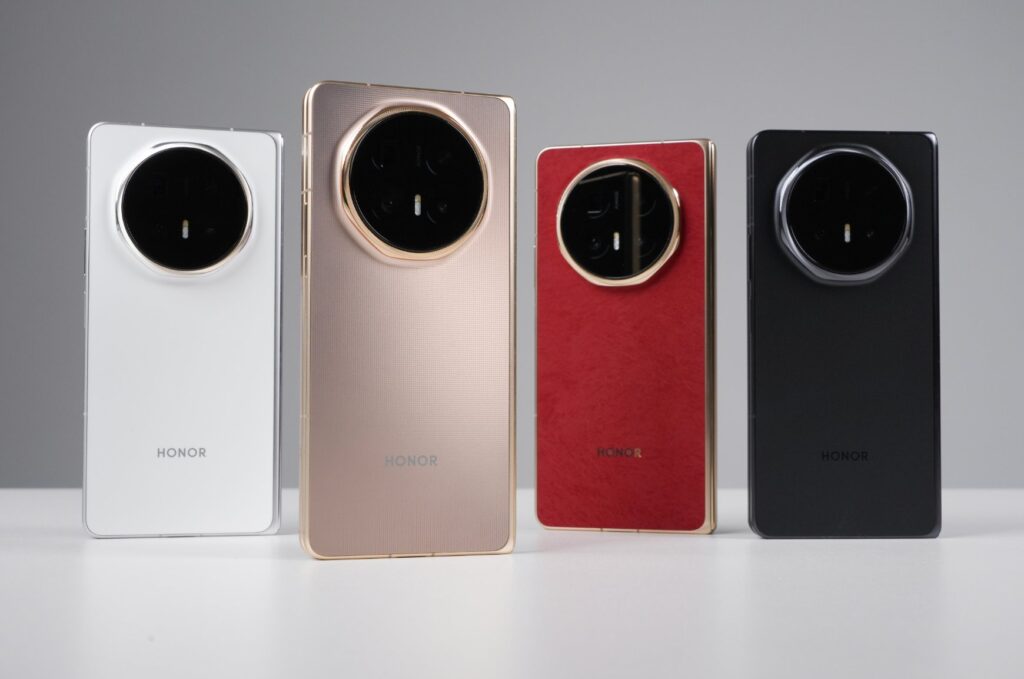
The Honor Win series has been revealed in three shades, such as black, white, and blue. There seems to be a beige color option as well, but that has not been officially confirmed yet. The rear panel features a matte texture that resists fingerprints and sweat, helping to maintain a secure grip during extended gaming sessions. The overall design looks similar to the Redmi K90 series.
Both phones follow Honor’s familiar design language, though there are visible differences between the two. The Honor Win is positioned as the higher-end variant and features a triple rear camera setup, while the Honor Win RT has a dual camera setup. Both phones have the Win-branding and an active cooling fan, reinforcing their gaming-centric approach.
Honor Win series expected specifications
According to reports, the Honor Win is expected to feature a 6.83-inch 1.5K LTPS flat display with a high refresh rate of up to 165Hz. It is said to be powered by the Snapdragon 8 Elite chipset, which is currently among the most powerful processors in the Android ecosystem. The phone is also tipped to include a 50-megapixel main camera, a metal frame, ultrasonic fingerprint sensor, and full-level water resistance.
Battery capacity is another major highlight, with reports pointing to a battery size of at least 8,500mAh, setting a new benchmark for performance-focused smartphones. Detailed specifications of the Honor Win RT remain under wraps and are expected to be revealed closer to launch. However, it is expected to similar specs as the standard model but is said to be powered by the Snapdragon 8 Elite Gen 5.
For more daily updates, please visit our News Section.
Dreame, best known for its robotic vacuum cleaners and home appliances, has entered another product category. The company has officially launched its first power bank, a magnetic model called the Air Power 17 / Air Power 17 Pro.
The move follows Dreame’s rapid expansion into new segments over the past few months. Since July, the brand has rolled out or teased products across a wide range of categories, including personal care devices, large home appliances, consumer electronics, and even automotive-related products. The power bank marks Dreame’s first step into mobile charging accessories.
The Air Power 17 series supports Qi2 magnetic wireless charging at up to 15W and is available in two capacity options: 5,000 mAh and 10,000 mAh. Both versions use an aluminum alloy frame paired with AG glass, giving them a relatively premium look for their price.
The 5,000mAh model measures 103 × 58.4 × 8mm, weighs around 125g, and is listed as being just 0.8cm thick. The larger 10,000mAh variant comes in at 103 × 58.4 × 12.8mm and weighs 189g. Both models include a built-in stand on the back with Dreame branding, along with an LED indicator and a USB-C port at the bottom.
In terms of output, the power banks offer 15W wireless charging and up to 20W wired charging via USB-C. They can also charge two devices at the same time, with one connected via cable and the other using wireless charging. Wireless output supports 5W, 7.5W, 10W, and 15W modes, with energy conversion efficiency rated above 60%.
With the Air Power 17 series, Dreame continues its push beyond cleaning products, adding a compact Qi2-compatible power bank to its growing lineup.
Pricing and availability:
The 5,000mAh version is priced at 219 yuan, while the 10,000mAh Pro model costs 259 yuan, with both already available in the company’s home market.
Xiaomi has Xiaomi has already announced the REDMI Note 15 series in China and recently in Poland. Now, one model is showing up for sale on Belgian carrier Telenet’s website. The listing reveals pricing and a full set of specifications ahead of any formal launch, confirming that the battery capacity and camera specifications differ from the Chinese variant.
REDMI Note 15 5G
The listing shows the phone priced at €280 for a single 6GB RAM and 128GB storage variant. Telenet is also offering a €30 discount for subscribers. No other memory options are currently listed, and Xiaomi has not commented on the device so far.
According to the carrier page, the REDMI Note 15 5G is powered by Qualcomm’s Snapdragon 6 Gen 3 chipset, which Xiaomi has previously confirmed for the series. The phone measures 164.0 × 75.4 × 7.35mm, weighs 178g, and includes a 5,520mAh battery with support for 45W fast charging. For context, the Chinese version came with a larger 5,800 mAh battery.
On the front, the European model is listed with a 6.77-inch OLED display with a resolution of 1,080 × 2,392 pixels and an in-display fingerprint scanner. Earlier reports mentioned a larger 6.83-inch panel, though it’s unclear which size will be used across regions.
Camera hardware includes a 108MP main sensor, an 8MP ultra-wide camera, and a 2MP secondary lens. That’s a noticeable change from a 50MP main camera for the Chinese variant. The front camera is listed at 20MP, with 4K video recording supported.
Other features include an IP65 rating, Bluetooth 5.3, NFC, eSIM support, and a nano-SIM slot. The phone is shown in Black and Blue, though only the Black model appears in images. An EU Energy Label is also included, hinting that an official announcement may not be far off.
Motorola has officially launched the Moto G Power (2026) in the US and Canada, refreshing its popular budget series. Let’s check out its key specs and pricing details.
Moto G Power (2026) Specifications
The phone features a 6.8-inch Full HD+ LCD screen with a 19.9:9 aspect ratio and 120Hz refresh rate. The panel hits up to 1000 nits of peak brightness, supports Display Color Boost and High Brightness Mode, and is protected by Corning Gorilla Glass 7i.
Under the hood, the Moto G Power (2026) runs on the 6nm MediaTek Dimensity 6300 chipset paired with a Mali G57 MC2 GPU. It ships with 8GB LPDDR4X RAM and 128GB UFS 2.2 storage, expandable up to 1TB via microSD, along with RAM Boost support for up to 16GB of virtual memory.
Out of the box, the phone runs Android 16 with Motorola’s My UX interface. It includes signature Motorola features such as Moto Secure, Moto Unplugged, ThinkShield, Family Space, and Hello UX. The device also supports Google’s Circle to Search and Gemini AI for smart interactions like contextual search, reminders, and more.
On the camera front, the Moto G Power (2026) includes a 50MP primary sensor with Quad Pixel technology and optical image stabilization (OIS). An 8MP ultra-wide lens supports macro vision. For selfies, it has a 32MP front-facing camera.
The device is backed by a 5200mAh battery that supports 30W TurboPower fast charging. Motorola claims it can last up to two days on a single charge and retain over 80% of its battery health even after 1000 charging cycles.
The Moto G Power (2026) includes IP68 and IP69 water and dust resistance ratings, as well as MIL-STD-810H military-grade durability certification. It supports dual SIM, a side-mounted fingerprint scanner, stereo speakers with Dolby Atmos, Hi-Res Audio, a 3.5mm headphone jack, NFC, and USB Type-C 2.0. The phone measures 166.62 x 77.10 x 8.72 mm and weighs 208g.
Pricing & Availability
The Moto G Power (2026) is priced at $299.99 in the US and will be available universally unlocked starting January 8 via Best Buy, Amazon.com, and Motorola’s official website. It will also roll out via Verizon on the same day, followed by carriers like Cricket Wireless, AT&T, Tracfone, Visible, and others in the coming months.
In Canada, it will be available on January 8 at motorola.ca for CAD 449.99. The phone comes in two Pantone-certified color options: Evening Blue and Pure Cashmere, with a soft vegan leather finish.
For more daily updates, please visit ourNews Section.
Adding much excitement for OnePlus fans and tech enthusiasts, the OnePlus Community Sale is live now. It brings some of the most significant discounts of the year across the flagship and popular Nord series, along with fantastic deals on audio accessories.
In case you are wondering, the sale is live on Amazon India and will last until the 18th of this month. Amazon is offering up to a ₹5,000 instant discount with supported credit cards and EMI. Read further to know the crazy savings that you can avail.
Offers on OnePlus 15 and 13 Series
The cutting-edge OnePlus 15 sees a substantial price drop, making premium flagship ownership more accessible than ever. With bank offers applied, you can take the OnePlus 15 starting at a price as low as ₹68,999. Similarly, the powerful OnePlus 13s is also part of the celebrations, starting from ₹49,999, including bank discounts.
OnePlus 15
Features: Snapdragon 8 Elite Gen 5, Triple 50MP Camera (OIS, Telephoto), 165Hz Display, massive 7,300mAh Battery.
The popular Nord series, known for delivering a great experience at an aggressive price point, is also on sale. Last but not least, the OnePlus Nord 5 and OnePlus Nord CE5 offer exceptional value.
OnePlus Nord 5
Features: Snapdragon 8s Gen 3, 6.8″ 144Hz AMOLED, 50MP OIS Camera, up to 6,800mAh Battery
For the audio aficionados, the noise-cancellation kings, OnePlus Bullets Z2 ANC, are available at an irresistible price. Originally priced at ₹2,999, you can grab them for an effective price of just ₹1,599 with bank discounts!
Bullets Z2 ANC
Features: 45 dB Hybrid ANC, 12.4 mm Dynamic Drivers, 28-Hour Battery Life, IP55 Rating
The major savings during this sale are being driven by significant bank offers, which drop the effective prices of these devices drastically. The general sale for other products is mostly starts at ₹23,249, so don’t forget to dive into the OnePlus Community Sale General Amazon Page for offers on other devices.
Looki has launched its new AI-powered wearable, the Looki L1, in the Chinese market. The device was introduced to global markets earlier this year. The company describes it as an ‘AI life manager’ designed to passively record everyday moments and automatically generate vlogs. It is priced at 1,499 yuan ($212) in China.
Looki L1 Specifications
The launch comes at a time when interest in AI-first hardware is growing, especially following reports about OpenAI’s upcoming hardware project. While details about OpenAI’s device remain limited, the Looki L1 gives an early look at what this new category of AI wearables could resemble. The product focuses on hands-free, always-on recording paired with AI-driven content organization, an approach that aligns closely with recent discussions around future AI companions.
According to Looki, the L1 automatically records daily life while prioritizing user privacy. All data is stored locally by default, and content is uploaded to the cloud only after the user grants permission. The device supports AI-generated vlogs, AI-powered smart search, and so-called personal life insights through Looki AI, which aim to help users better understand patterns in their daily routines over time.
In terms of design, the Looki L1 is compact and lightweight. It measures 50.53 × 16.84 × 48.02 mm and weighs just 32 grams, making it suitable for long hours of wear. Looki uses soft, skin-friendly materials to improve comfort and reduce fatigue during all-day use. The device also carries an IP67 rating for water and dust resistance, allowing it to handle daily outdoor conditions. It is available in black, white, and green color options.
Looki has equipped the device with a wide-angle camera featuring a 16mm-equivalent lens with an f/2.2 aperture and a 109-degree field of view. It supports 4K photo capture and 1080p video recording at 30 frames per second. The camera includes electronic image stabilization and HDR capabilities to handle varying lighting conditions.
The device features a triple-microphone array with intelligent noise reduction, which helps improve voice clarity and capture ambient sound more accurately. It also includes a 1W built-in speaker paired with a Smart PA system for voice feedback and AI-driven audio interactions.
In terms of storage and connectivity, the Looki L1 features 32GB of internal storage and saves data locally by default. It supports Bluetooth 5.0 and dual-band Wi-Fi (2.4GHz and 5GHz), and includes a six-axis gyroscope for motion sensing and scene detection.
The device runs on a 375mAh battery that charges fully in about 1.5 hours. Battery performance varies based on the recording mode. Looki claims up to 9 hours of use when recording 5 seconds per minute, 11 hours for 9 seconds every two minutes, and 13 hours for 11 seconds every three minutes.
DJI appears to be gearing up for another major update to its Ronin lineup, and early leaks suggest the upcoming RS 5 may bring more than just minor refinements. Based on newly surfaced details, DJI’s first fifth-generation Ronin gimbal could deliver meaningful improvements over both the RS 4 and the RS 4 Pro, especially in battery life and day-to-day usability.
The latest information comes from leaker Igor Bogdanov, who suggests the RS 5 is positioned firmly as a professional-grade device. If accurate, it would sit above the current RS 4 series and address some of the long-standing pain points filmmakers have had with power and setup efficiency. This lines up with DJI’s busy roadmap, with products like the Avata 360 and Osmo Pocket 4 also expected down the line.
The FCC listing for the RS 5 previously revealed a noticeably larger battery — nearly 60% bigger than the RS 4’s, and even over 10% larger than the RS 4 Pro’s. According to Bogdanov, this should result in around a 15% real-world boost in battery life, which could make a real difference during longer shoots. Fast charging also seems to be part of the package, with the gimbal reportedly able to fully recharge in about one hour.
DJI also appears to be refining the user experience. The RS 5 is said to include a new Z-axis indicator, a small but potentially useful addition that could make balancing faster and less fiddly. Despite the internal changes, the gimbal is still rated for a 3 kg payload, keeping it compatible with a wide range of camera mirrorless and cinema camera setups. There are also mentions of improved intelligent tracking and composition features, though DJI hasn’t shared any specifics yet.
As for launch timing, nothing is confirmed. If DJI sticks to its usual patterns, the RS 5 could debut sometime between late February and early April 2026.
Lenovo has launched a new lineup of Lecoo Cool 310 business desktop PCs in China. The systems are now available for purchase and come with three years of on-site warranty service. The Cool 310 series includes both Intel Core Ultra and AMD Ryzen configurations, targeting users who need compact yet capable systems for office and remote work.
The Intel-based models are powered by the Core Ultra 5 135H processor, paired with 16GB of RAM and either a 512GB or 1TB solid-state drive. The base configuration with a 512GB SSD is priced at 2,799 yuan (about $392), while the 1TB variant costs 2,999 yuan (about $420).
Lenovo also offers AMD Ryzen R5-3500U-based versions for more cost-sensitive buyers. The variant with 8GB RAM and a 512GB SSD is priced at 1,699 yuan (about $238). The higher-end option with 16GB RAM and the same storage is available for 1,799 yuan (about $252).
The Cool 310 desktop features a compact 6.8-liter chassis with a black exterior that blends into office environments. The system comes preinstalled with Windows 11 Home and includes a built-in wireless network card for easy connectivity.
Lenovo equips the system with dual-channel DDR5 memory, which improves performance in multitasking and light creative workloads. Storage options go up to 1TB PCIe SSD, offering faster boot times and quick file access.
The Cool 310 includes four front-facing USB 2.0 ports and four rear USB 3.0 ports. It also offers HDMI output, Gigabit Ethernet, and standard audio jacks. Lenovo uses an intelligent cooling system to keep noise and temperature levels under control.
For more daily updates, please visit ourNews Section.
Thunderobot has begun teasing a new gaming laptop ahead of CES 2026, and early details point to an unusual mix of high-end hardware and low weight. The upcoming model, called the Thunderobot Zero Air, is expected to be officially unveiled at the show next month.
According to the teaser, the Zero Air weighs around 1.6 kg, which is fairly light for a 16-inch gaming laptop. The laptop features a 16-inch display and includes a built-in number pad, suggesting it’s aimed at users who want a balance between gaming and productivity.
On the hardware side, Thunderobot appears to be targeting next-generation components. The Zero Air is expected to be among the first laptops to combine Nvidia’s GeForce RTX 50-series laptop GPUs with Intel’s Panther Lake processors. One configuration mentioned includes the Core Ultra 7 366H, with other Panther Lake variants such as the Core Ultra X7 358H also expected to be available for OEMs.
A short teaser video also reveals some of the laptop’s physical design and cooling approach. The Zero Air uses quad heat pipes and places most ports along the rear edge. Visible connectors include Ethernet, HDMI, USB Type-A, and USB Type-C, a layout commonly used to keep cables out of the way during gaming.
For now, Thunderobot hasn’t shared details on display specs, battery size, or final GPU options. Those are likely being saved for the full announcement at CES 2026. Still, the early preview suggests the Zero Air is positioned as a lightweight alternative to traditional gaming laptops, without fully stepping away from high-performance hardware.
Mechrevo has officially launched its new S500 office desktop in China. The system features Intel’s 14th-generation Core i5-14450HX processor and comes with 16GB of DDR5 memory and a 512GB/1TB PCIe 4.0 SSD. The official price starts at 2,499 yuan ($354) and is now up for pre-order.
Mechrevo S500 Specifications
The S500 targets users who need strong computing performance in a space-saving design. The desktop uses an 8-liter mini chassis that supports both vertical and horizontal placement. Mechrevo includes a tool-free disassembly design to make upgrades and maintenance easier.
The system uses a 10-core, 16-thread Intel Core i5-14450HX processor. It runs at a base frequency of 2.4GHz and reaches up to 4.8GHz on turbo. Compared to the previous i5-13420H, the new chip includes more cores, higher boost speeds, and a larger 20MB L3 cache. These improvements result in faster multitasking, better rendering, and smoother performance in demanding tasks.
Mechrevo pairs the processor with 16GB of DDR5 memory rated at 5600MT/s. This high-speed memory increases bandwidth and improves system responsiveness. For storage, the system includes a 512GB/1TB PCIe 4.0 SSD with an option to upgrade to 1TB. The desktop also supports up to four internal storage drives.
The built-in 200W multi-rail power supply delivers stable output for the processor and other components. Mechrevo equips the system with a dedicated cooling solution designed to keep temperatures low while maintaining quiet operation.
For connectivity, the PC includes Wi-Fi 6, Bluetooth 5.2, Ethernet, and dual-display support via HDMI and DisplayPort. The system features ten USB ports, including both USB 3.2 and USB 2.0, to accommodate a wide range of peripherals. The desktop comes with Windows 11 preinstalled.
In related news, Lenovo has recently launched a new mecha-inspired gaming PC powered by up to an Intel Core i5-13400F and an RTX 5060 GPU, while Asus has introduced the ExpertCenter P600 AiO as its first Copilot+ all-in-one PC.
For more daily updates, please visit ourNews Section.
Casio has reshaped the idea of a smart outdoor watch by focusing on reliability rather than chasing full smartwatch experiences. As brands like Apple, Samsung, and Garmin continue to expand connected features, Casio has doubled down on its strength in building dependable tools for outdoor use.
Its two flagship lines, G-Shock and Pro Trek, have added smarter capabilities while remaining grounded in distinct design philosophies. One favors brute toughness. The other leans into environmental awareness. Here’s a detailed breakdown of how their smartest features compare in 2026.
Casio has long split its outdoor-focused watches into two clear categories. G-Shock places absolute durability and everyday resilience at the center, with designs built to handle shock, vibration, water exposure, and rough use as part of their core identity.
This philosophy traces back to the brand’s origins in the 1980s, when G-Shock was created as a watch that could survive repeated drops. Over time, that foundation expanded to include advanced shock resistance, 200-meter water resistance, and strict durability standards that made G-Shock a common choice for military use, fieldwork, and extreme sports.
Pro Trek follows a different philosophy. It presents itself as a dedicated outdoor instrument, with sensor systems and interface decisions aimed at users who need more than toughness alone. The ABC sensor suite remains a defining feature in 2026, combining an altimeter, barometer, and digital compass, alongside temperature readings and activity tracking features such as step counting.
2. Smarter Sensing and Navigation
Pro Trek continues to hold an edge in this area. Its triple sensor system delivers real-time environmental readings directly on the wrist, without relying on a connected phone. Altitude tracking supports climbs, barometric data helps anticipate weather changes, and the digital compass assists with trail navigation. These functions cater to users who spend long stretches outdoors. Bluetooth connectivity further improves the experience by enabling detailed data logging and smoother syncing with trail and weather apps.
G-Shock remains close behind, particularly within the Master of G lineup. Models such as the Rangeman include altimeter, barometer, and compass sensors, with select variants also adding GPS, heart-rate monitoring, and activity tracking. The difference lies in presentation. G-Shock organizes these tools around a durability-first design, pairing rugged interfaces with a feature set that still supports serious outdoor use.
3. Power and Connectivity
Both lineups rely on Tough Solar charging. Casio’s high-efficiency solar cells allow the watches to run for months with minimal power drain, reducing concerns about battery life during long trips off-grid. Bluetooth smartphone syncing is now standard on many mid and high-end models in both series, enabling automatic time calibration, data logging, and notification alerts.
Where the two differ is in how they handle access to features. Pro Trek focuses on clear sensor readouts and quick access, often using dedicated buttons for the altimeter, barometer, and compass.
G-Shock, in contrast, sometimes places these functions deeper within its interface, requiring users to cycle through modes using a single button. This trade-off helps G-Shock models maintain better shock resistance or accommodate extra tools like tide graphs and moon phase indicators that cater to surfers and marine users.
4. Wearability and Everyday Use
The contrast is most visible in size and overall styling. Pro Trek watches usually appear slimmer and more refined, while G-Shock models favor a thicker, more rugged build. This distinction matters for people who want a watch that works in everyday urban settings as well as outdoors. Enthusiast discussions frequently point to this ergonomic difference. Pro Trek leans toward more wearable, daily-friendly dimensions, while G-Shock opts for a bold, statement-focused design.
5. Which Smart Features Matter More?
For pure outdoor tooling, quick access to precise environmental data, dedicated sensor buttons, and lighter wearability, Pro Trek still edges ahead for hikers, climbers, and nature explorers. Its sensor suite is intuitive and centered on exploration.
For all-around rugged tech, resilience that can handle construction sites, surf breaks, or a motorcycle crash as easily as a trail, plus a wide range of smart tools, G-Shock brings versatile features with equally compelling smarts. Master of G models especially blur the line between analog toughness and digital intelligence.
In 2026, both lines offer plenty for tech-savvy adventurers. Choosing between them comes down to whether you prefer the pure outdoor sensor focus of Pro Trek or the indestructible, tech-packed adaptability of G-Shock.
For more daily updates, please visit ourNews Section.
DDR5 memory prices have climbed sharply in recent months, raising concerns among PC builders and gamers. While many expect the situation to drag on for years, a senior figure from Sapphire believes the spike may not last as long as feared.
Speaking on The Hardware Unboxed Podcast, Sapphire PR manager Edward Crisler addressed the current DRAM situation and urged buyers not to panic. According to Crisler, some of the recent price increases appear to be driven by uncertainty rather than actual supply shortages.
Crisler said DDR5 prices are currently “unreasonable” and could discourage people from building or upgrading PCs altogether. He warned that sustained high memory costs don’t just affect RAM sales but can also hurt demand for other components, including motherboards, cases, and graphics cards.
Despite that, he struck a more optimistic tone on timing. Crisler suggested that prices could begin to stabilize in six to eight months, arguing that vendors are reacting defensively to market conditions. He compared the situation to past pricing reactions around US tariffs, where companies raised prices in anticipation of disruption, even when supply wasn’t immediately affected.
That outlook runs counter to many industry forecasts. Several analysts expect elevated memory prices to continue well beyond 2026, largely due to limited production expansion from major suppliers such as Samsung and SK Hynix, which are prioritizing higher-margin AI and data center demand.
Even if prices remain high, Crisler believes PC enthusiasts will adapt, as they have during previous shortages. He pointed to past periods where builders held onto older hardware longer or adjusted system specs rather than paying inflated prices.
For now, his advice is simple: avoid panic buying. Whether prices ease in months or stay elevated longer, the DDR5 market remains volatile, and buyers may be better off waiting for clearer signals before making major purchases.
Honor is all set to unveil the Honor Win series of smartphones later this month in China. It is speculated that the brand will announce the Honor Power 2 as a successor to the original Honor Power, which packed a massive 8,000mAh battery, by early 2026. Recent reports have revealed that the Power 2 will pack an even bigger battery. A new leak, courtesy of tipster Digital Chat Station, has revealed several other details about this phone, including its launch timeframe.
Honor Power 2 specifications (rumored)
Honor Power
According to the tipster, codenamed Saber, the Honor Power 2 will feature a 6.79-inch OLED LTPS screen with a flat design. It will offer a 1.5K resolution of 2640 x 1200 pixels, but there is no information about its refresh rate.
Under the hood, the Power 2 will feature the upcoming Dimensity 8500 chipset. While a previous leak revealed that it will feature a 10,000mAh battery, this new leak reveals the exact size as 10,080mAh. The device will support 80W wired charging and is expected to lack wireless charging support.
Moving on to the cameras, the Honor Power 2 is said to feature a 16-megapixel front camera and a 50-megapixel primary camera on the back. While it is not mentioned in the leak, the device is likely to ship with Magic OS 10 based on Android 16.
The leak further states that the Honor Power 2 will be sold in three shades, including Snow White, Midnight Black, and Sunrise Orange. As far as the release is concerned, DCS claims that the device is tentatively scheduled to launch before the upcoming Chinese Spring Festival, suggesting a January 2026 launch.
For more daily updates, please visit our News Section.
Back in November 2025, Thunderobot dropped a new company PC for gamers in China. The new Mix G2 Mini PC was dropped with cutting edge performance and Nvidia’s most powerful graphics card in a tiny form factor. But now, it appears that this small gaming rig is coming to the global market to take on ASUS’s latest ROG NUC 2025 model.
Thunderobot Mix G2 Mini PC Goes Global Soon
Following the initial Chinese launch, the company has now shared a new teaser, hitning at the international release of its powerful new gaming mini PC. This system isn’t alone, as Thunderobot will release it alongside the Zero Air gaming laptop. Based on what we know so far, the Mix G2 is a tiny system that is targeting gamers and creators alike. It brings high end desktop level powewr in a body that measures just 3.2 liters.
Thunderobot Mix G2 Mini Gaming PC
Under the hood, the Mix G2 is equipped with Intel’s latest Core Ultra 9 275HX processor, which brings 24 corse and 24 threads with a maximum clock speed of 5.4Ghz. It has a max TDP of 120W and even delivers 36 TOPS AI computing through its NPU. Coupled with this, you get Nvidia’s latest and greatest GeForce RTX 5090 GPU, which has a max TDP 175W, 24GB of GDDR7 memory, Blackwell architecture, 10,496 CUDA cores, and 1824 TOPS of AI performance.
Keep in mind that this is the top configuration as there were more affordable options like the RTX 5080. Thunderobot is set to showcase the Mix G2 mini gaming PC will be unveiled globally during the upcoming CES 2026 event, which is set to kick off on 6th January 2025.
For more daily updates, please visit our News Section.
Realme Narzo 90 series has officially been launched in India, expanding the company’s mid-range portfolio with two new smartphones, the Narzo 90 and Narzo 90x. The new lineup focuses on delivering large displays, long battery life, and modern software, while catering to different price segments. Continue reading ahead to know everything about the Narzo 90 lineup.
Realme Narzo 90 series specifications and features
Realme Narzo 90
The Realme Narzo 90 and Narzo 90x feature large screens, though the display technology differs between the two models. The Narzo 90 comes with a 6.57-inch Full HD+ AMOLED panel offering a 120Hz refresh rate, high-frequency PWM dimming, and enhanced colour coverage. In comparison, the Narzo 90x sports a larger 6.8-inch HD+ LCD display with a faster 144Hz refresh rate and high brightness mode, aimed at users who prioritise smooth scrolling.
Under the hood, the Narzo 90 is powered by the MediaTek Dimensity 6400 Max chipset, while the Narzo 90x runs on the Dimensity 6300 processor. Both phones support up to 8GB of RAM and 128GB of internal storage and ship with Android 15-based Realme UI 6.0. Realme has also confirmed extended software support for the Pro lineup, including three OS upgrades and four years of security updates.
Realme Narzo 90x
Camera capabilities are similar across both devices. Each phone features a 50-megapixel primary rear camera, while the Narzo 90 adds a 2-megapixel secondary sensor. On the front, the Narzo 90 is equipped with a 50-megapixel selfie camera, whereas the Narzo 90x houses an 8-megapixel front-facing sensor. Both phones support AI-powered camera features and video recording up to 1080p.
A major highlight of the Narzo 90 series is the 7,000mAh battery present on both smartphones, paired with 60W fast charging support and reverse wired charging. The Narzo 90 offers higher dust and water resistance ratings, while the Narzo 90x focuses on durability and louder audio output.
Realme Narzo 90 series price in India, availability
The Realme Narzo 90 series is available in multiple variants. The Narzo 90 is priced at Rs 16,999 for the 6GB + 128GB variant and Rs 18,499 for the 8GB + 128GB model, with bank offers bringing the effective prices down to Rs 15,999 and Rs 17,499 respectively.
The Narzo 90x starts at Rs 13,999 for the 6GB + 128GB version, while the 8GB + 128GB variant is priced at Rs 15,499, with bank discounts reducing the prices to Rs 11,999 and Rs 13,499. Both smartphones will be available for purchase via Amazon and Realme’s official website, with sales beginning from Dec. 23 onward.
For more daily updates, please visit our News Section.
MSI has unveiled a new and gorgeous MEG X870E GODLIKE X EDITION motherboard on the occasion of the 10th anniversary of the company’s GODLIKE series. And as the name suggests, this is not a mass-market product.
MSI says it will produce just 1,000 units worldwide, and each motherboard will feature a unique serial number along with a numbered gold nameplate.
The X imprint and gold accents on the board make it clear that this is a limited-edition release. The motherboard also features a 3.99-inch Dynamic Dashboard III display that plays a dedicated 10th-anniversary animation when powered on.
MSI is bundling the motherboard with several limited-edition accessories, such as a numbered M.2 Frost Armor matching the motherboard’s serial number, a custom display stand, and even a limited-edition black dragon plush toy.
MSI MEG X780E GODLIKE X EDITION Specifications
Under the hood, the MEG X870E GODLIKE X EDITION sticks closely to what you would expect from a no-compromise AM5 motherboard. The power delivery system uses a 24 (110A SPS) + 2 + 1 phase design, paired with dual 8-pin CPU power connectors and third-generation titanium inductors.
MSI says this setup is designed to provide stable power for AMD’s Ryzen 9000 series processors, including scenarios involving extreme overclocking.
Memory support includes four DDR5 slots in a dual-channel layout, with MSI claiming support for memory speeds of up to 9000+ MT/s. And for storage, the motherboard includes five onboard M.2 slots, and MSI bundles an M.2 XPANDER-Z SLIDER GEN5 expansion card.
Moreover, expansion options include two PCIe 5.0 x16 slots and one PCIe 4.0 x4 slot, enough for multi-GPU setups or specialized add-in cards.
To keep everything running reliably, MSI has designed an extensive cooling solution. This includes a second-generation magnetic M.2 Frost Armor system, dense finned heatsinks, cross-shaped heat pipes, and thermal coverage across the VRM, chipset, and storage areas.
MSI has also added several EZ DIY features, such as a graphics card quick-release button, tool-free M.2 clips, and an EZ Bridge interface.
As for connectivity, you get 10G and 5G Ethernet, Wi-Fi 7, and Bluetooth 5.4. Audio is handled by a fifth-generation esports audio module with 7.1-channel output, and you can tweak all the software settings through MSI Center.
The MEG X870E GODLIKE X EDITION is now available in China for 8,888 yuan. Whereas, MSI’s US store lists it at $1300.
For more daily updates, please visit our News Section.
We use cookies on our website to give you the most relevant experience by remembering your preferences and repeat visits. By clicking “Accept”, you consent to the use of ALL the cookies.
This website uses cookies to improve your experience while you navigate through the website. Out of these, the cookies that are categorized as necessary are stored on your browser as they are essential for the working of basic functionalities of the website. We also use third-party cookies that help us analyze and understand how you use this website. These cookies will be stored in your browser only with your consent. You also have the option to opt-out of these cookies. But opting out of some of these cookies may affect your browsing experience.
Necessary cookies are absolutely essential for the website to function properly. This category only includes cookies that ensures basic functionalities and security features of the website. These cookies do not store any personal information.
Any cookies that may not be particularly necessary for the website to function and is used specifically to collect user personal data via analytics, ads, other embedded contents are termed as non-necessary cookies. It is mandatory to procure user consent prior to running these cookies on your website.