HMD Global unveiled Nokia 2.4 alongside Nokia 3.4 in late September for the European market. Now, more than a month later, the former device is tipped to launch in India at the end of November.
The Nokia 2.4 is a budget smartphone from the house of HMD Global. It is the successor to last year’s Nokia 2.3. The device made its global debut in Europe and now, according to the sources of MySmartPrice, this handset will be released in India by November-end.
Talking about specs, the Nokia 2.4 is a modest smartphone powered by MediaTek helio P22 chipset paired with 2GB/3GB RAM and 32GB/64GB internal storage. The highlight of this phone is its large 6.5-inch HD+ LCD panel with 21:9 aspect ratio and dew-drop notch.
The device’s body is made of polycarbonate and comes in three unique finishes called Charcoal, Dusk, and Fjord. On the back, it houses a 13MP (wide) + 2MP (depth) vertically aligned dual-camera setup along with an LED flash and a fingerprint sensor below it.
Whereas, on the front, the phone sports a 5MP shooter for selfies and video calls. As for software, it runs Android 10 and is eligible for Android 11 update and maybe even Android 12 as it is part of Android One program.
Last but not least, the Nokia 2.4 comes with a microSD card slot, 3.5mm headphone jack, single-band WiFi 5, Bluetooth 5.0, NFC, dedicated Google Assistant key, and a 4,500mAh battery that charges via MicroUSB port.
Google is known to introduce a new version of Google Camera with the launch of every Pixel device. Likewise, it launched the Google Camera 8.0 with new UI buttons and features alongside the Pixel 5. Now, it looks like the company is pushing a new update of Google Camera 8.1 to older Pixel devices as well.
A Twitter user Kelvin Peralta(via Android Authority)says that the new update came with Play Store Version 8.1.008.341125824. Accordingly, he has shared a screenshot of the Google Camera 8.1 UI on his Pixel 4 XL. It shows a new ‘Cinematic Pan’ mode for Video. This is already present on the Camera 8.0 version on Google Pixel 5.
For the unware, Cinematic Pan is helpful in the stabilization of video while panning(swivel horizontally) for shots. Besides, on examining the APK version, 9to5Google’s team found that the latest Camera 8.1 is compatible with older pixels dating back to Pixel 2/2XL. That’s a great sign considering Google is restricting sideload of Camera Apps from Camera 8.0. Also, this is evident from another user who claims that he got the update on his Pixel 2 XL.
Further, Kelvin says that the new Play Store version jumped quite a bit from 7.5.108.332953030. It’s possible that Google decided to revamp the App directly with a new version. However, we aren’t sure if all the other features of Camera 8.0 like Night Sight portrait quick zoom and quick access toggle in Video are coming to Pixel 4 XL and other devices.
That said, the new Google Camera 8.1 App also doesn’t seem to support sideloading. And apparently, an error relating to verification pops up while trying to do it. Sideloading is basically downloading the APK from the other sources and installing it manually.
However, a user has replied on the thread saying that he was able to find a workaround for it. He says by uninstalling the Play Services update, and re-installing the APK after signing up for Play Services Beta seems to work. But we aren’t sure how well this method will work for older devices. Hence, we would suggest you wait for Google to push it from its side as it doesn’t seem that far now.
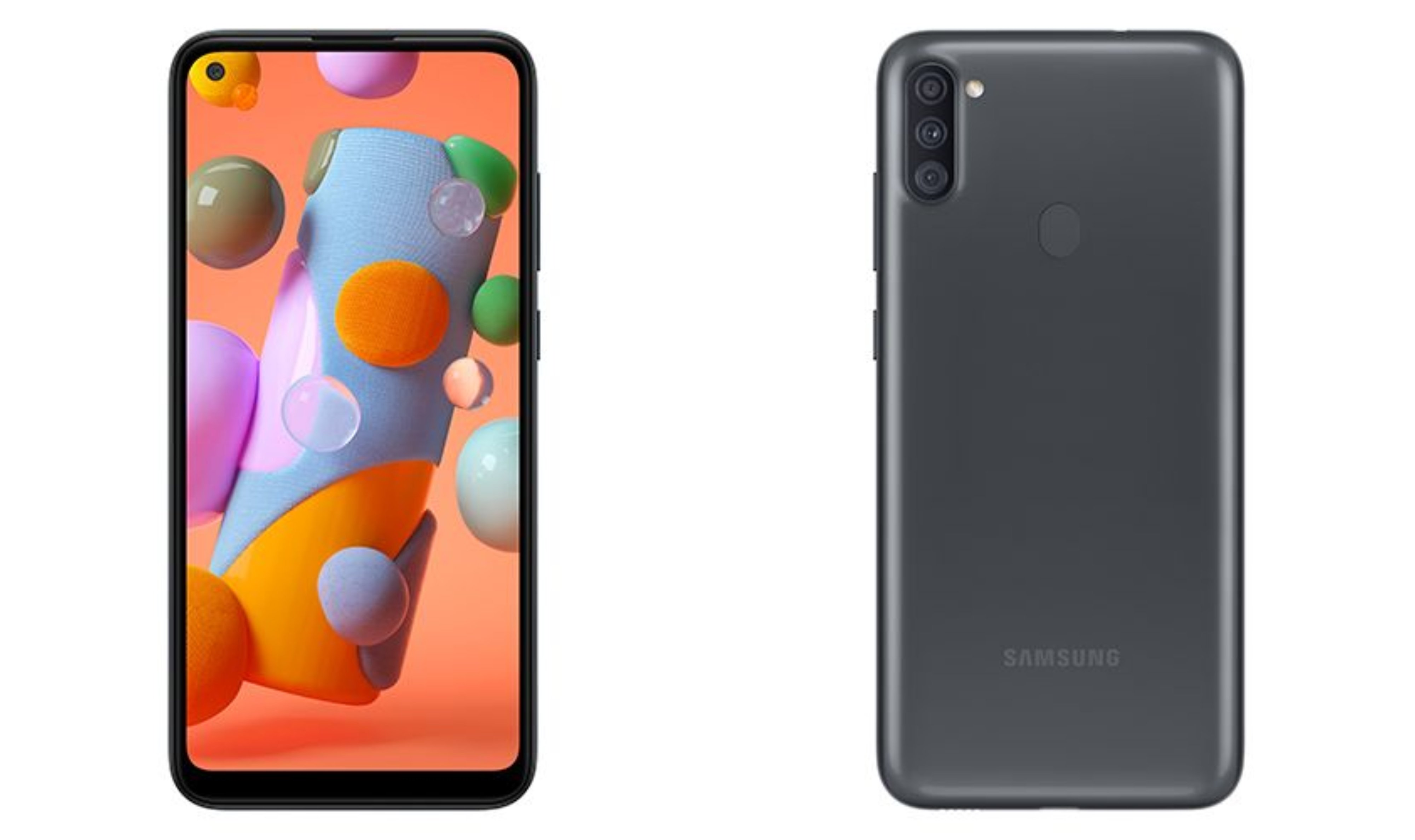
In late August, a report revealed Samsung to be working on Galaxy A12 budget smartphone with model number SM-A125F. This handset is said to arrive in 32GB and 64GB storage variants. Now, two and a half months later, this device gets spotted on Geekbench revealing its chipset, RAM, and software.
Samsung Galaxy A11
Samsung trademarked Galaxy A12 branding along with other Ax2 names in late 2019 ahead of the launch of Galaxy Ax1 generation of devices. Now, almost a year later, this device is finally about to launch.
Ahead of it, the phone has visited Geekbench benchmarking platform exposing some of its specs. According to the listing (via 91Mobiles), the forthcoming Galaxy A12 will be powered by MediaTek helio P35 chipset paired with 3GB RAM. For the unaware, its predecessor, the Galaxy A11 features Qualcomm Snapdragon 450.
As for software, it will run Android 10 operating even though Android 11 is already out. But since it is a budget smartphone, we can give it a pass. But it should get the update to the latest Android version after launch.
Apart from the above-mentioned parameters, nothing else is known about the upcoming Galaxy A12, except for microSD card support and colors – Black, White, Red & Blue.
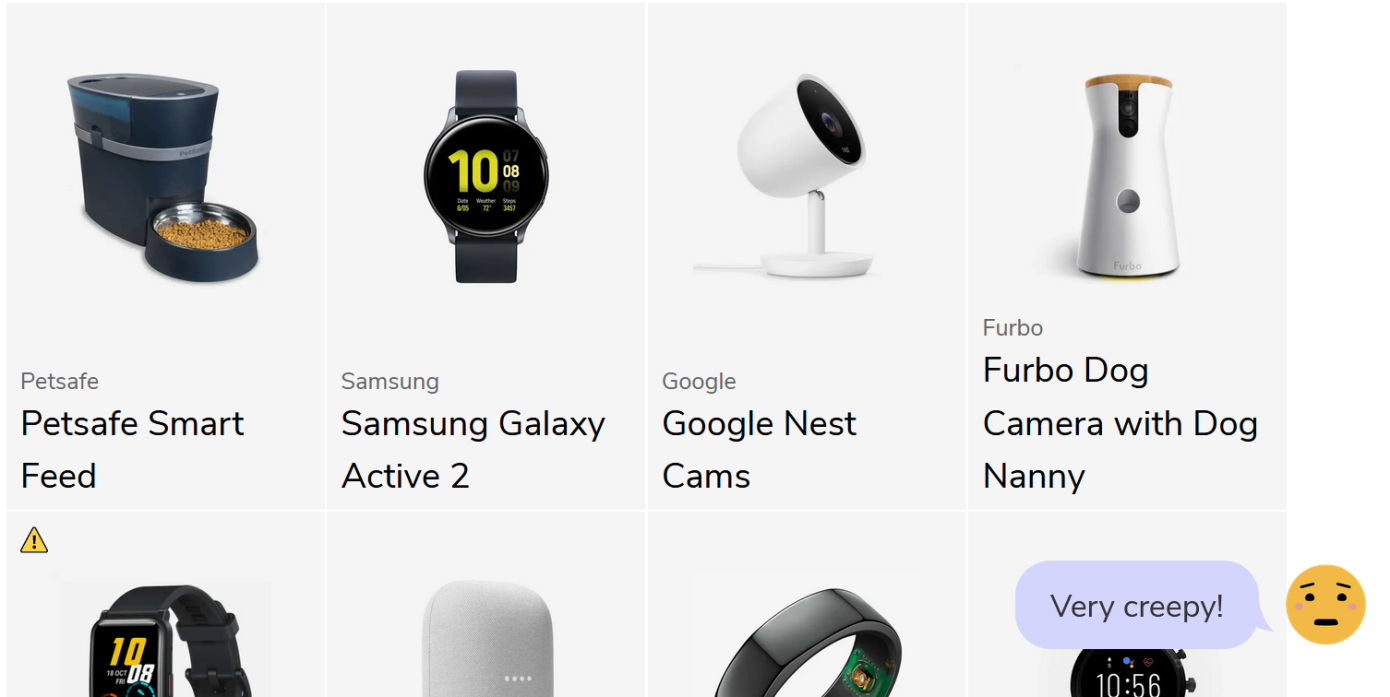
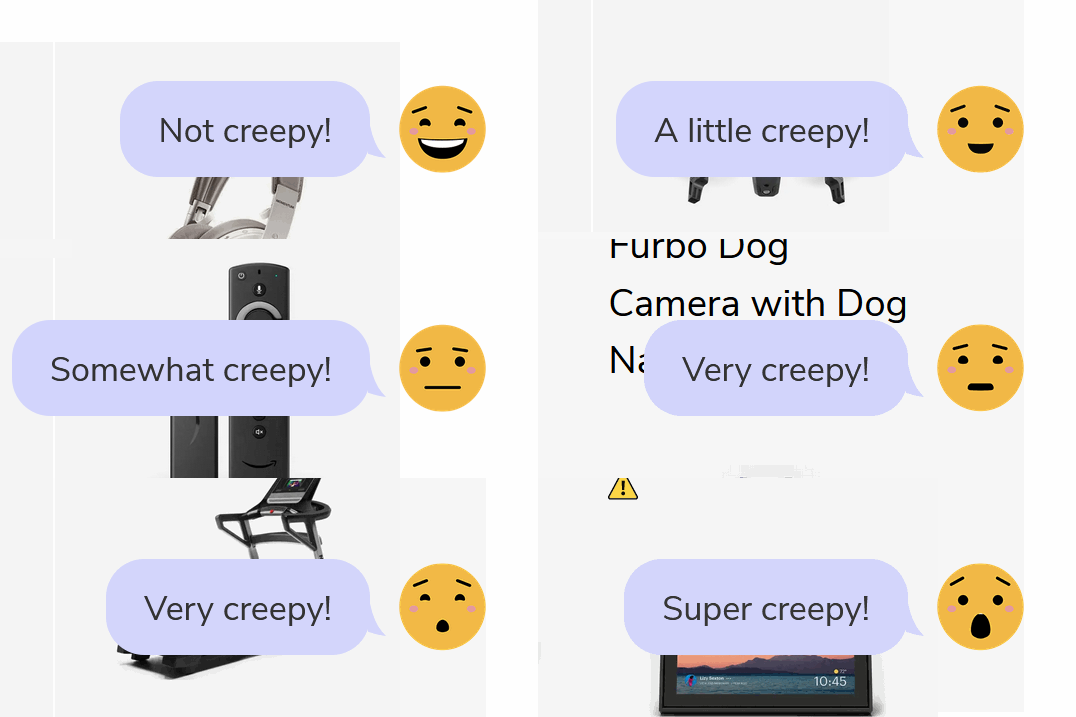
Gifting a loved one a gadget is a well-established tradition reflecting a token of our love. But times are indeed changing. These days it can be fraught with many previously unforeseen pitfalls as you may end up gifting your loved one a fitness tracker that can also track and record mood shifts, or a seemingly harmless doorbell that can also monitor police activity. Privacy watchdog, Mozilla has come out with a useful list of well-known gadgets with ratings on just how creepy they are.
While internet rights proponents continue to project “Privacy not included” mantra, this year 2020 has yielded a whole lot of quite creepy devices, which on their face value, seems to be wonderful gadgets worthy of being gifted to a loved one. Given the upsurge of “smart” speakers, security cameras, doorbells, and several other devices, caution and due diligence is needed before settling for a gift gadget.
It is suggested that Amazon is on the wrong end of this creepy spectrum, as virtually everything by company, with the exception of Kindle, sends huge amounts of data to Amazon, by design. However, Mozilla is of the view that Amazon has not earned its stripes and hence the trust to acquire such privacy data. Mozilla also placed Facebook on the wrong end of the creepy spectrum for a similar reason.
Devices that got creepy ratings are diverse. For example, a smart coffee maker and Moleskine smart notebook got unfavourable ratings because critical assurances about data protection and security were absent, which is unacceptable from any company that collects such information. This kind of behaviour – being silent on assurances on data security is prevalent with many smart gadgets. Indeed they may not be inherently creepy, but the company that produces these gadgets has the capacity to make them creepy at any time.
On the good end of the creepy spectrum is Withings (formerly Nokia Health). Withings got points for its range of smart devices with sufficiently acceptable privacy policies and data security. Some of the devices that got top marks were Withings’ Non-Ring smart doorbell and Garmin’s smartwatches.
These rankings by Mozilla (via) are informal, and could also be subjective. However they are based on the potential for abuse or breach of your data, and it does not necessarily imply that a device that is not “creepy” would keep your data perfectly safe or private. If you choose to buy any of these gadgets, it is advised to immediately scrutinize the settings and preferences and disable anything that seems invasive or creepy. This guides against putting your important privacy data in the open, because once your data is out there, it is almost impossible to retrieve it without damage.
Chinese brand realme launched India’s first 5G smartphone in the form of realme X50 Pro in the first quarter of 2020. Also, this handset happens to be the only 5G-enabled device from the brand in the country ever after months. But now, the company’s Indian CEO has confirmed to release more 5G smartphones in 2021.
Last week, a popular Indian tech influencer claimed that realme may debut its X7 series of 5G smartphones in India in December. Then, earlier this week, Anku Jain, the Managing Director (MD) of MediaTek India hinted at the launch of these devices.
Now, Madhav Sheth, the CEO of realme India himself has confirmed that the realme X7 series will launch in 2021. Also, he revealed the brand’s plan to ‘democratize 5G technology in 2021’. That means realme will be launching more 5G smartphones next year in India, instead of only one handset like it did this year.
Anyway, users of these phones will not be able to use 5G as there’s no 5G network in India. Above all, the government is yet to auction spectrum for the fifth-generation wireless network.
So one might be wondering why realme is bringing 5G handsets to India. The answer is simple: the brand wants to be a forerunner by readying the market even before 5G arrives as India is one of the three largest smartphone markets in the world.
Realme X7 (left) and Realme X7 Pro (right)
Another reason is that almost all Chinese brands have been only launching 5G smartphones in their home market since the beginning of 2020. This trend is expected to get stronger in the coming quarters. Hence, it does not make sense for the companies to invest in R&D for 4G phones.
The news was out this week that premium quality tech brand OnePlus is developing a fourth consumer-friendly smartphone called the OnePlus Nord SE. Subsequent events, however, point to the release of a fifth model soon. The OnePlus Nord 2 is expected to be out by the first quarter of 2021.
OnePlus Nord in Gray and Cyan
Smartphone buff and tipster Max Jambor, with a reputation for posting sometimes undecipherable and prophetic tweets on smartphone brands, just tweeted on the codename ‘Denniz.’
While Jambor did not specifically link OnePlus to the Denniz codename in the tweet, in subsequent communication with Phonearena, he clarified that ‘Denniz’ is the name OnePlus may have chosen for the second-generation smartphone from its stable.
For now, information is scanty on the features and specifications of this new model. However, possible upgrades may include an updated Qualcomm Snapdragon 700-series chipset, an OnePlus 8T-like camera module with more powerful sensors, and possibly a 120Hz Fluid AMOLED display to replace the existing 90Hz display.
The OnePlus Nord 2 is projected to be released in 2021 as a replacement for the original model, launched in July 2020. However, considering the early development milestones that may have been reached, an early announcement could be in the offing.
It is also speculated that the price of this new offering could be in-between that of the OnePlus 9 and the upcoming OnePlus Nord SE.
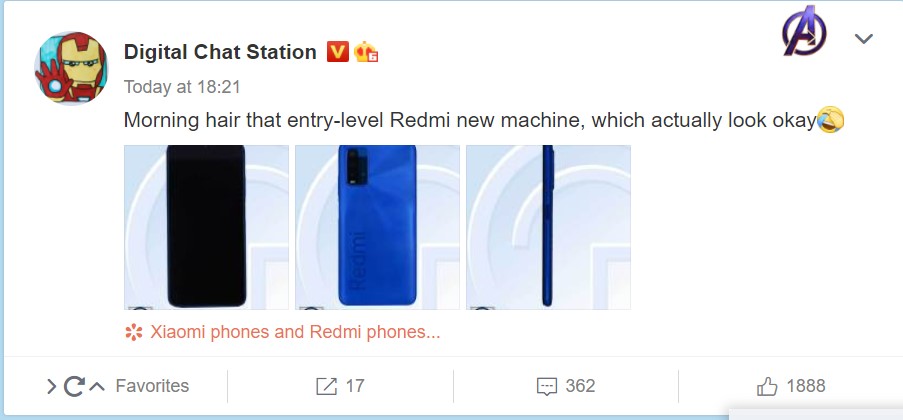
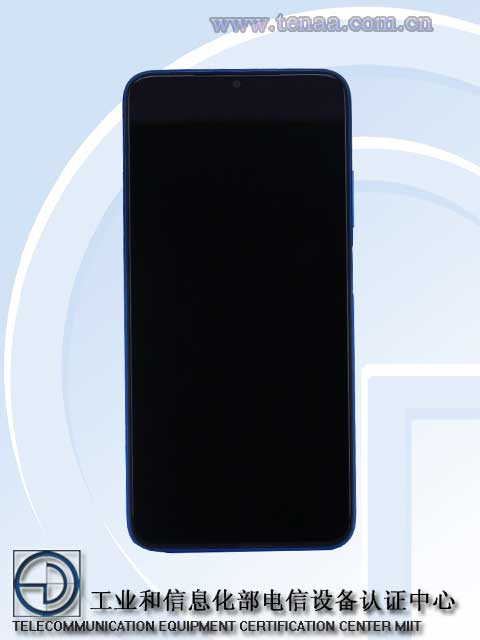
A few hours ago, we shared the specifications of an alleged Redmi Note 10 4G as listed on TENAA. Now, we have the renders of the device and it has a different rear panel design altogether.
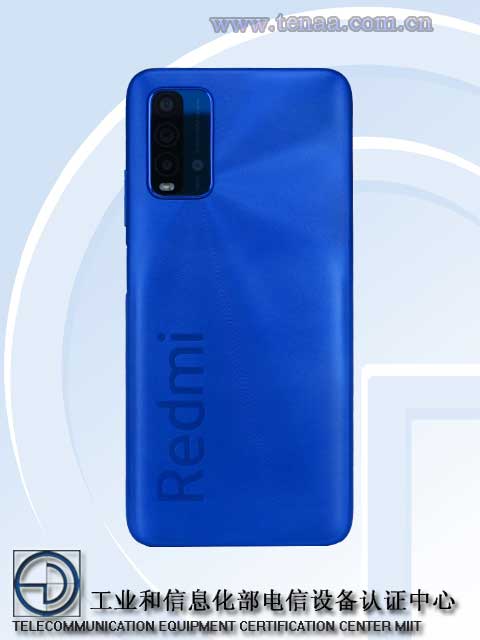
As tipped by Digital Chat Station on Weibo, the new images of M2010J19SC on China’s TENAA show a Redmi device in Dark Blue color. At the back, we see the cameras along with LED flash housed inside the Rectangle design with rounded corners. What’s interesting here is that this happens to be the first Redmi device to host a Rectangle design towards the left corner.
Earlier, the alleged Redmi Note 9 5G series for China got leaked on TENAA showing a circle design similar to Poco X3. Also, if we recall, predecessors like the Redmi Note 9, Note 9 Pro Globally have a square camera layout on the center of the back. However, this entry-level Redmi device seems have to an entirely new rear design.
1 of 3
Credit: TENAA Alleged Redmi Note 10 4G
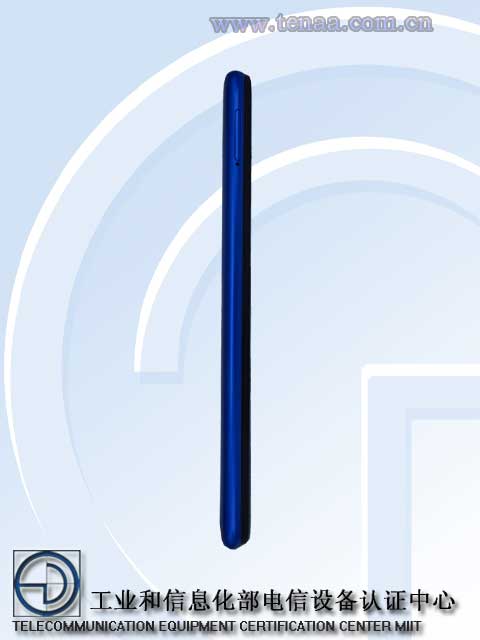
Coming back, we see a SIM-card tray to the left whereas Volume buttons and a power button with a built-in fingerprint sensor to the right. Upfront, there is a single sensor but it’s hard to figure out if that’s under punch-hole or a notch. At the back, there is a “Redmi” logo at the bottom left of the device along the lines of the camera layout. This reminds us of the many Honor, and Realme smartphones from the recent past.
Anyway, it’s unclear if the device will be called Redmi Note 9 4G or Redmi Number series device in China. Either way, it’s highly possible that it will accompany two other 5G Redmi Smartphones that will break cover soon. That said, the device is also rumored to be called the Redmi Note 10 4G elsewhere.
Talking about the specs, the TENAA listing shows the device will measure 162.29 x 77.24 x 9.6mm and weigh 196g. It will feature a 6.53-inch display but reports say that it will be an LCD screen with 2340×1080 resolution. Although the TENAA listing shows just a 2.0GHz CPU, a Geekebench listing(M2010J19SI) shows it could be a Snapdragon 662 SoC.
Other features are 4/6/8GB RAM, 64/128/256GB storage, Android 10, 4G LTE. And triple-rear cameras with a 48MP sensor, and an 8MP selfie shooter. All this will be backed up by a 6,000mAh battery with 22.5W fast charging. Let’s wait and see how Xiaomi prices these devices for China and Global markets.
Amazon has just launched a Twitch-like platform for Android users, called GameOn. Twitch is a leading video game streaming platform where gamers and other internet personalities can build up a fan base to watch and support them online, real-time during games. The platform was acquired by Amazon in 2014, and since then, the two brands have combined to offer more content and satisfaction to users.
In April 2020, Twitch Watch Parties was introduced, which allows gamers and their audience to watch Amazon Prime movies together live. The Twitch Watch Parties came at an auspicious time, as the world was still grappling with a perfect response for the Coronavirus pandemic, and total lockdowns were in force in most countries. Of course, movie theatres and all social engagements took a hit. The introduction of the party feature thus assuaged the feelings of moviegoers globally.
Amazon has now introduced a new platform, seemingly unrelated to Twitch, called GameOn, Amazon GameOn allows Android gamers to share their gaming moments with the GameOn community in the form of short video clips. For now, there is no live streaming of games, unlike Twitch.
The GameOn app is available on Google Play store, for Android users, and Amazon App store, for Amazon tablet users. The app allows the user to record gameplay videos in a similar manner to the screen recorder that is present in android phones. Simultaneously, the user can also record his reactions to the game being played, using the phone’s front camera, and this process is called “Facecam”. The duration of record clips is between 30 seconds and 5 minutes. The app is also capable of simple video editing, and lets users share their recordings with its community.
For interested gamers, weekly challenges pop up in the GameOn app, and hundreds of free mobile games on the Android operating system are well interfaced with it.
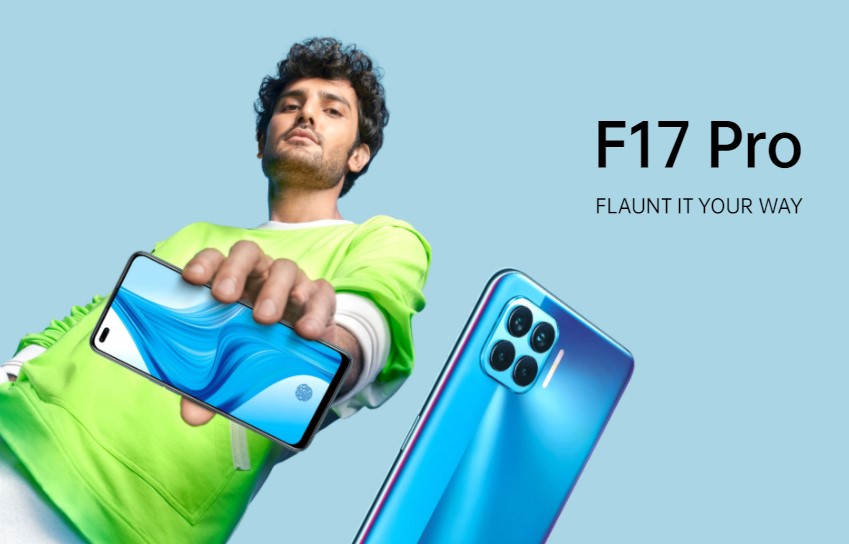
Last week, the OPPO Find X2 and OPPO Find X2 Pro became the first smartphones to receive ColorOS 11 stable update in open markets. Now, the company has begun to roll out the same update to OPPO F17 Pro in the same regions.
OPPO unveiled ColorOS 11 based on Android 11 as the latest version of its mobile software in September. At the launch event, the company also released an update roadmap for different regions.
Based on that, the OPPO F17 Pro entered beta testing on September 30. Now, after over a month, the handset has finally started receiving stable build. Currently, the update is said to be only available in India (via XDA Developers), which comes under open markets.
Users can head over to Settings > Software updates to check if the OTA update has arrived on their unit. If not, they will have to wait for a little while as the build is being rolled out in batches. Anyway, all users should get the update in the coming days, including those in other open markets other than India.
That said, in Europe, the ColorOS 11 beta testing will only begin later this month or in December. The Find X2 series will be the first to get the update.
As we get closer to Snapdragon 875 launch, Xiaomi’s Mi 11 has managed to hit the radar of leaks frequently. The device is expected to be the first Snapdragon 875 device in China. And now, it looks like the Mi 11 will likely feature a punch-hole screen with curved edges on all sides.
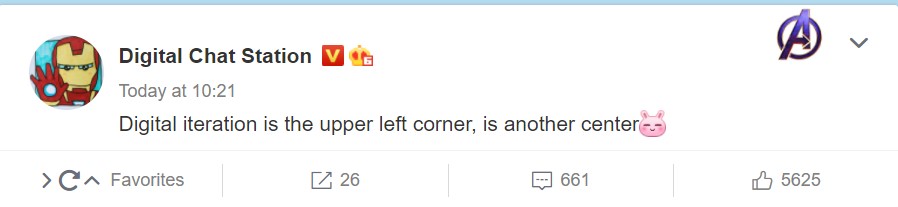
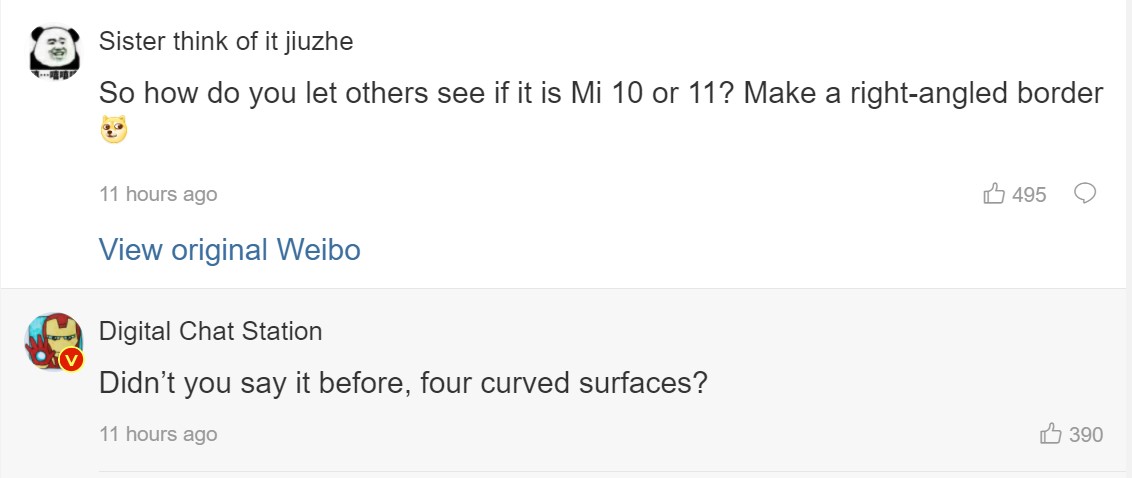
The latest tip comes from Digital Chat Station on Weibo who hints(via Sina Technology) that Xiaomi Mi 11 could sport a four-sided curved display and retain the punch-hole. Precisely, the Mi 11 is likely to feature the small punch-hole cutout at the top left corner of the screen. However, we aren’t aware of the front camera specs just yet.
1 of 2
If we recall, Xiaomi’s 2020’s flagships like Mi 10, Mi 10 Pro 5G, and Mi 10 Ultra all have dual-curved screens on the longer sides. On the contrary, rivals like Samsung, OnePlus have been moving away from curved screens due to various reasons. Besides, the curved screens might have some use-case scenarios like edge-edge content viewing, a more attractive look. And smooth swipes from the edges but there’s are a few Cons too.
That is, there is always the risk of durability, accidental palm touches, and a few others. Hence, it will be interesting to see how Xiaomi markets the all-curved display. That said, this tip pretty much shows that prior reports by a few were wrong as they mistook leaked images of the alleged Vivo X60 series for Mi 11.
Anyway, it looks like the Mi 11 will have a revamped design compared to the predecessor. Although we aren’t sure how many models the iteration will have, it is likely to have upgraded internals like Snapdragon 875 SoC, 48MP ultra-wide camera with 0.8μm pixel size, improved stabilization, and more.
So far, we don’t have an exact launch date but we feel that the device might break cover anytime soon. That is because Mi 10 recently went out of stock. And Xiaomi officially discontinued the Mi 10 Pro in China suggesting a new launch in the near future.
When you talk about digital printing, the first innovative company that comes to our mind here at Gizmochina is Selpic Tech. We reviewed the Selpic P1 earlier this year, their most stunning product, popular as the world’s smallest handheld printer. Following the debut of Selpic P1, the company is now launching the world’s most cost-effective 3D printer, Star A, on Kickstarter (early bird from only $99!).
Design
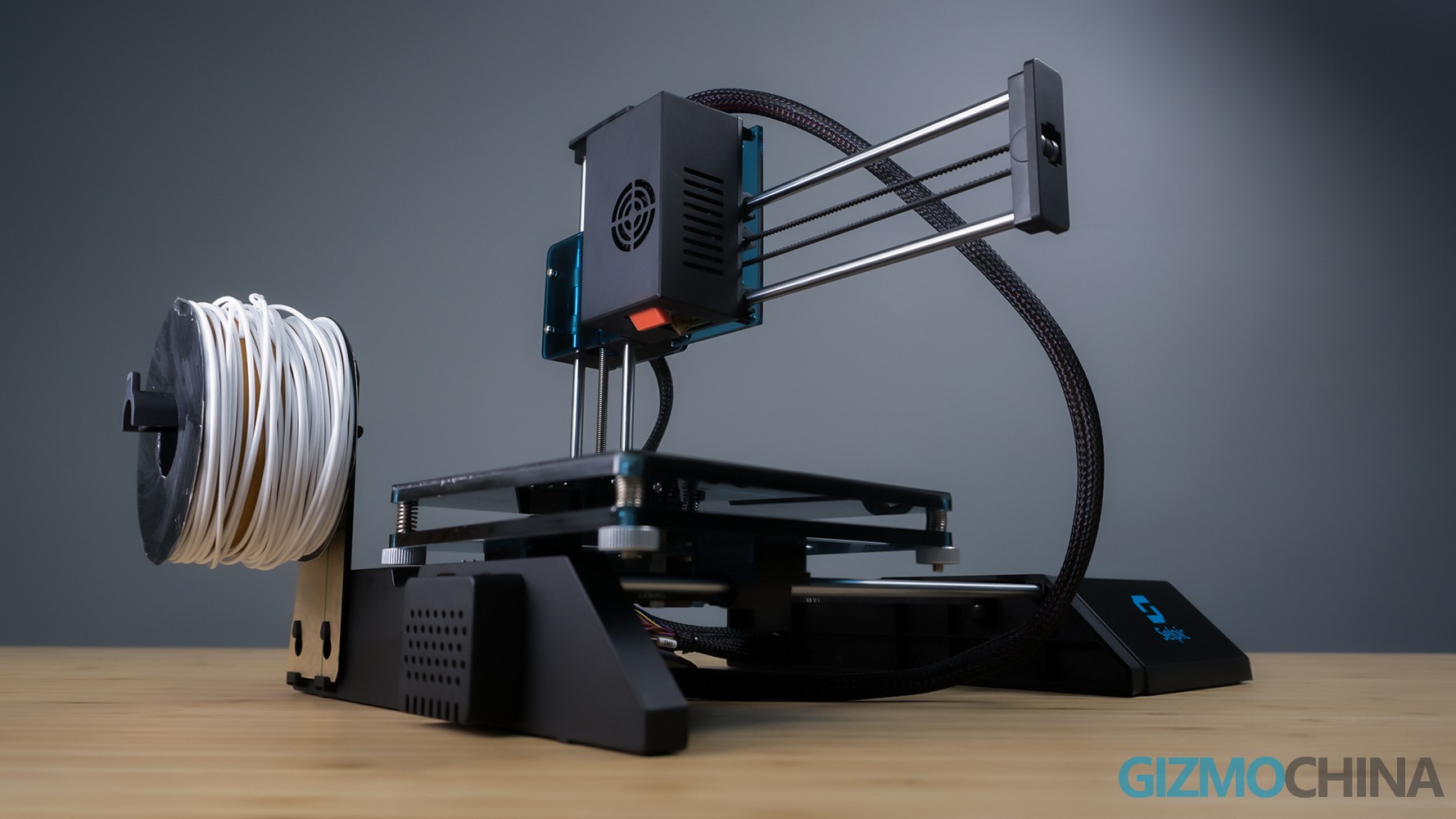
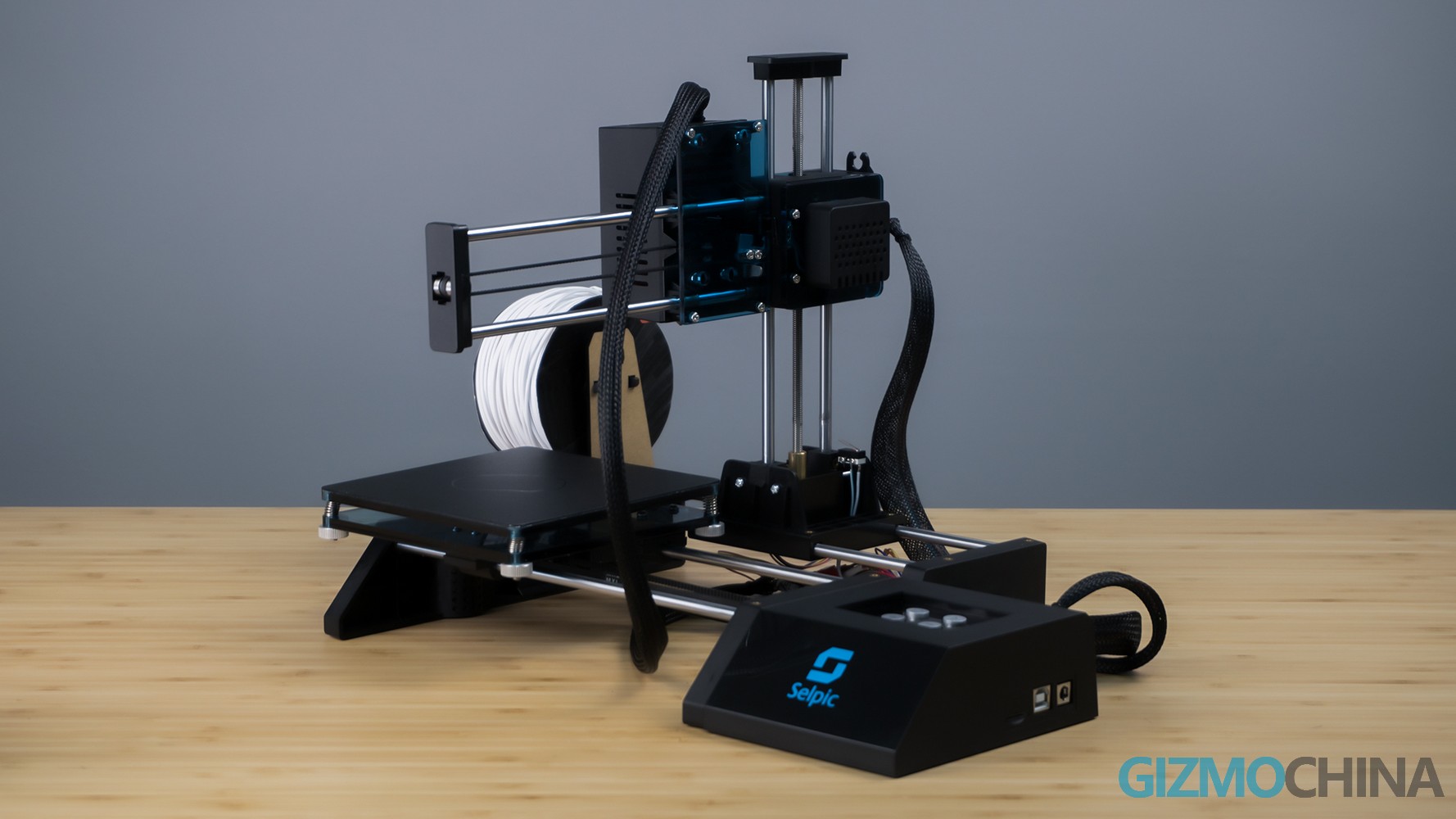
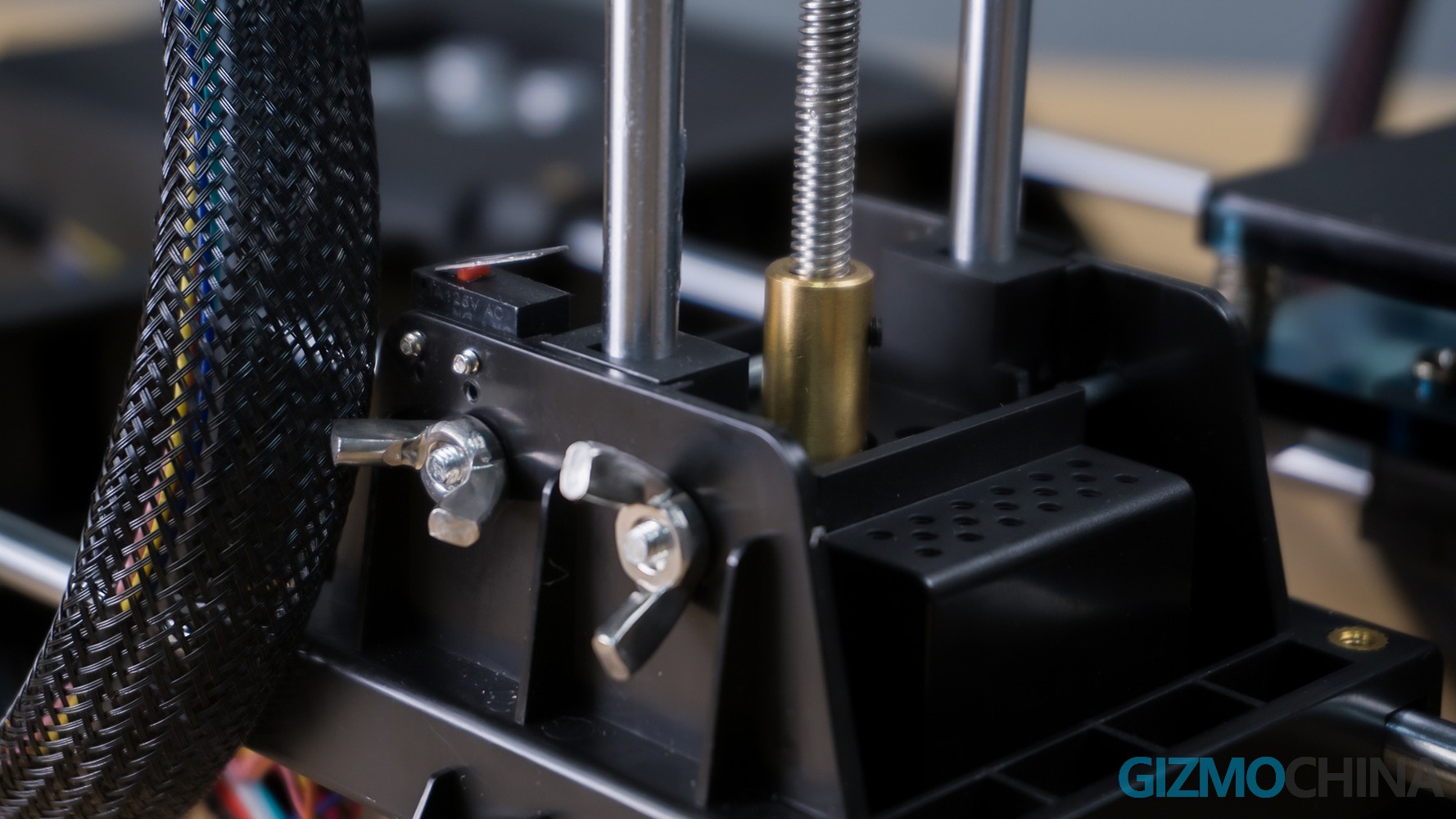
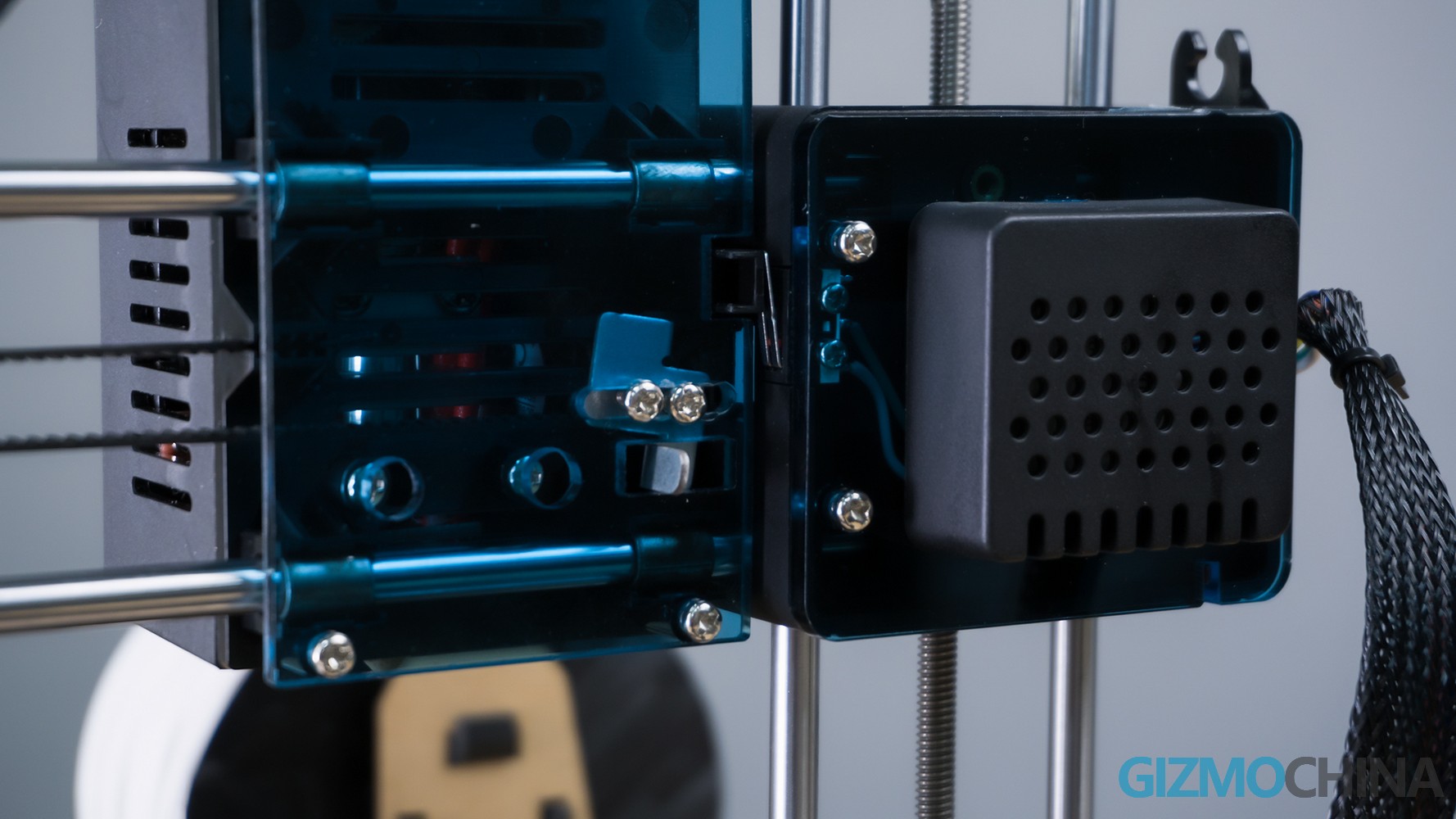
At first glance, the Selpic Star A surprised us and changed our perception about the size of a 3D printer. Although we knew it was going to be a compact device, in real life it turned out to be smaller than we expected. Rather than call it a machine, we would like to consider it as a functional toy for individuals. It’s the most compact and lightweight open-source 3D printer that we have seen so far. It is even smaller than most paper printers (measuring 10.2 x 9.4 x 9.8 inch & weighing 4.4 lbs). With its compact design, the Star A can be moved easily and placed on your working tables.
Easy to install & set up
Unlike other complicated 3D printers for enterprises, this printer is very easy to operate and set up.
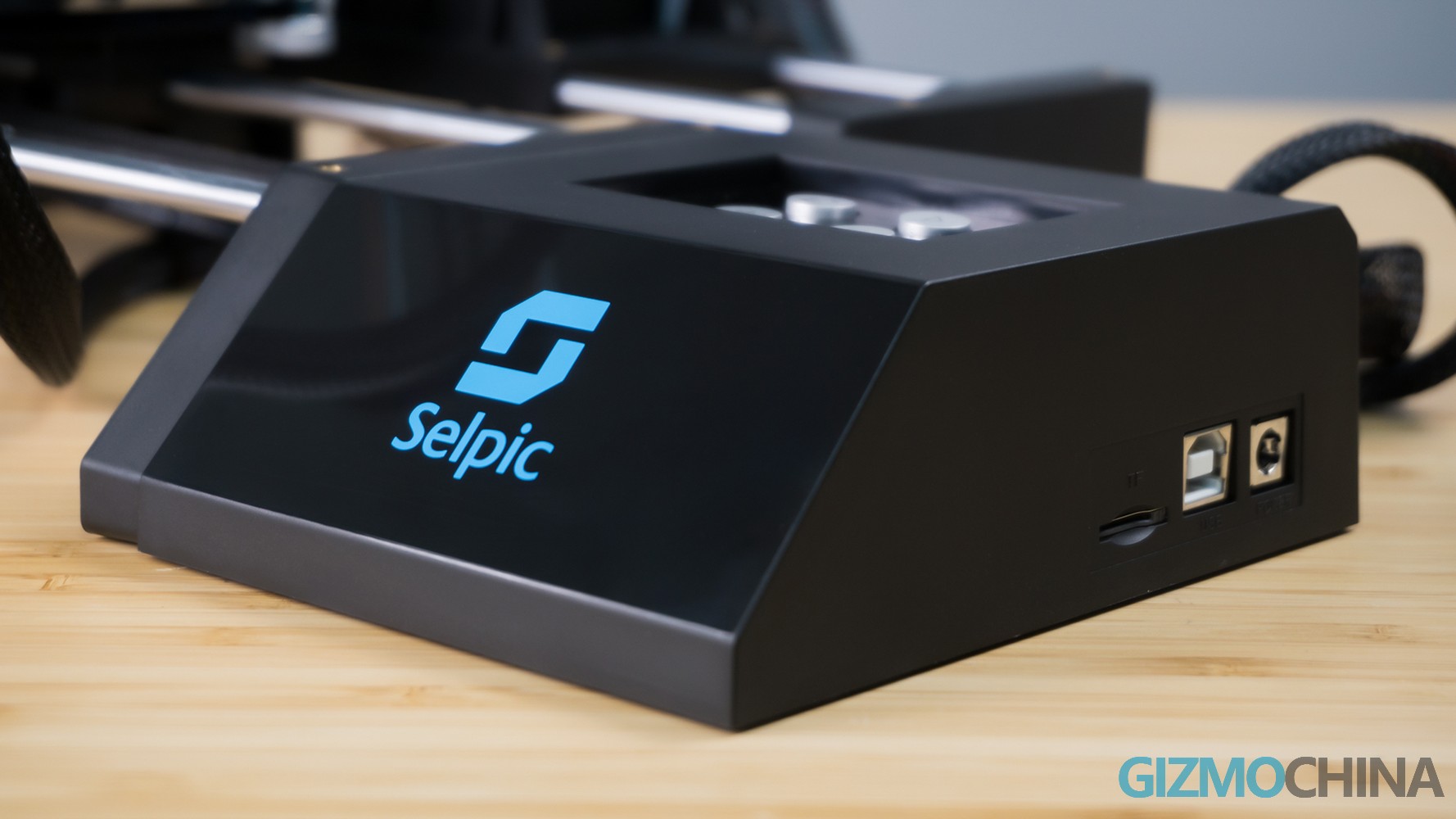
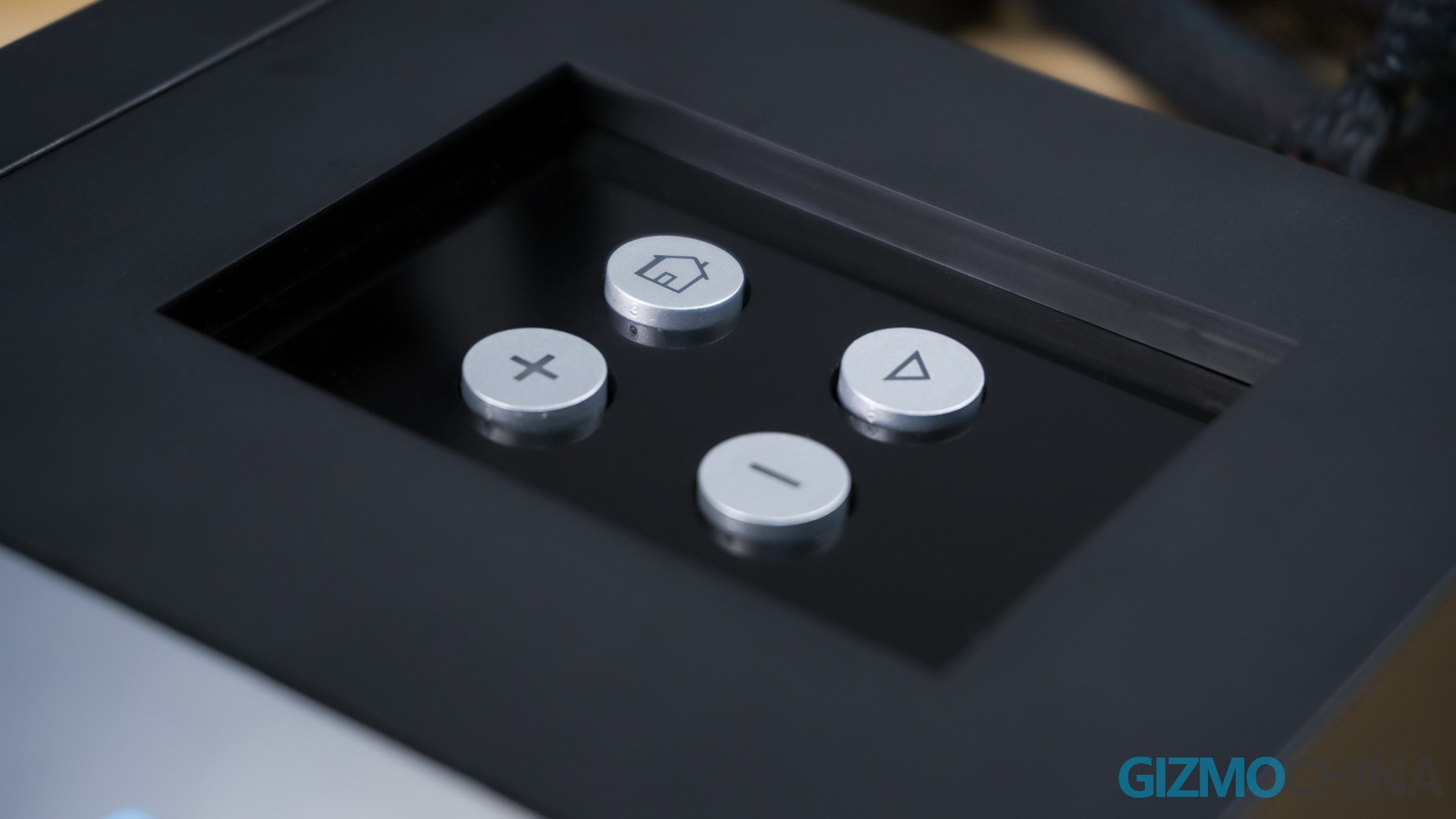
The talk about its ease of operation has to begin with the installation. The printing body is separated into the platform module with Y-axis and another arm module with X-axis and Z-axis. Its installation can be finished in just 4 steps. What you need to do is just insert the arm module, turn screws, connect some cables, and load the filaments. And the control platform containing 4 intuitive operating buttons can help with an easy reset, printing, filament feed, and release.
The Star A supports wired-connected printing and wireless printing with TF-card expansion. And you can also create your own G-code file using some common open-source printer programs, such as Cura or Repetier-Host.
The software setup is not complicated. For example, in Cura all you need to do with printer settings is to confirm its printing 3D space (120 x 120x 120 mm). And you can open any kind of model files (e.g. slr file) through Cura and then generate a G-code file. When you start printing with a TF-card, the Star A will automatically select the latest generated G-code file and start printing. Even if you are not a professional model creator, there are a lot of model resources on the internet that you can download and transfer into a G-code file through these open-source programs.
Print
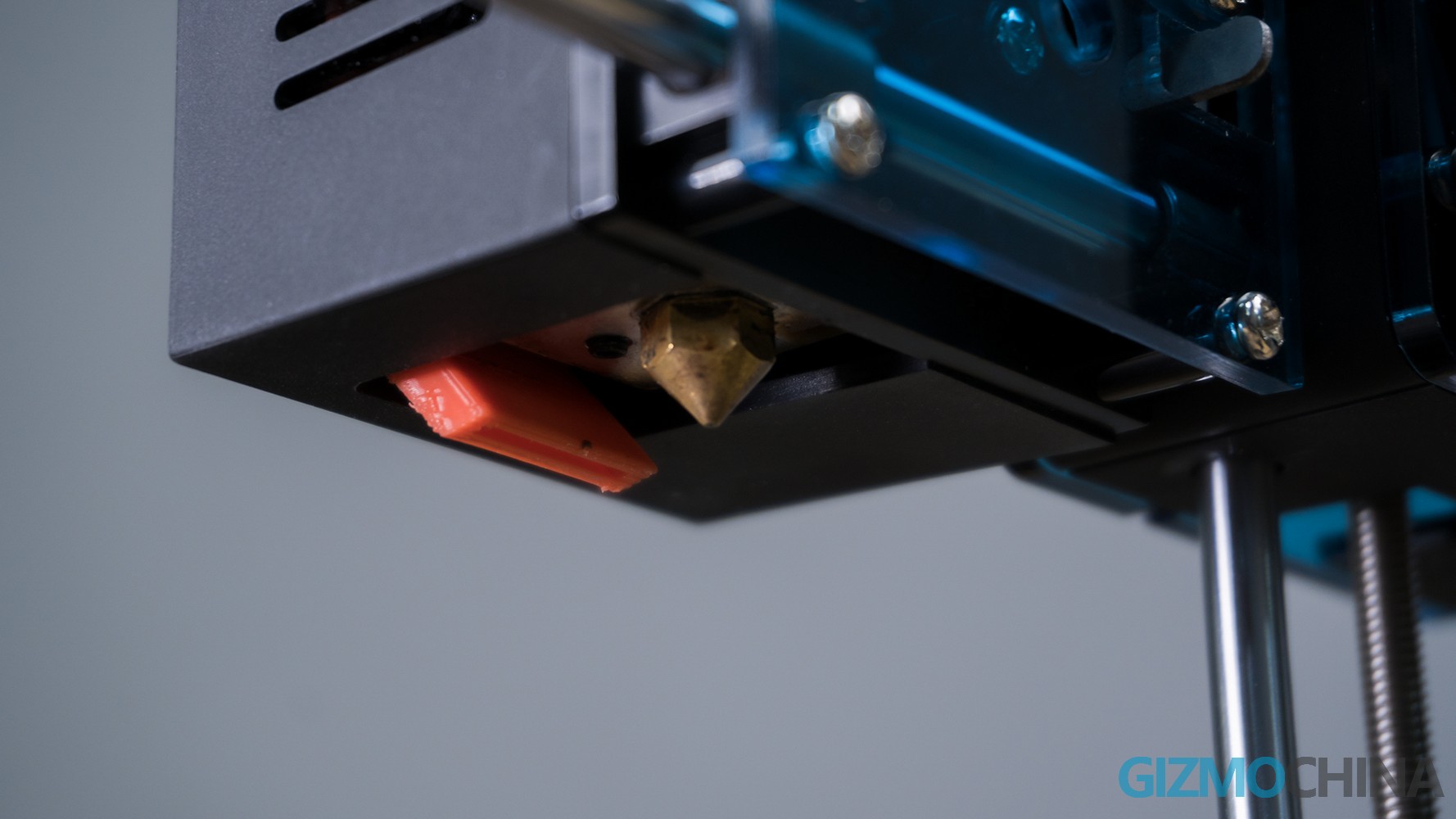
The Star A also has excellent printing accuracy. With the X-axis and Y-Axis accuracy of 100 μm and the Z-axis accuracy of 50 μm, the Star A’s printing resolution is ±0.1mm and the layer thickness can reach 0.1-0.2 mm, which can guarantee accurate printing even for tiny gadgets. As a lightweight individual printer, the Star A adopts low-noise motors, which can have a relatively low-noise performance during printing(<60dB).
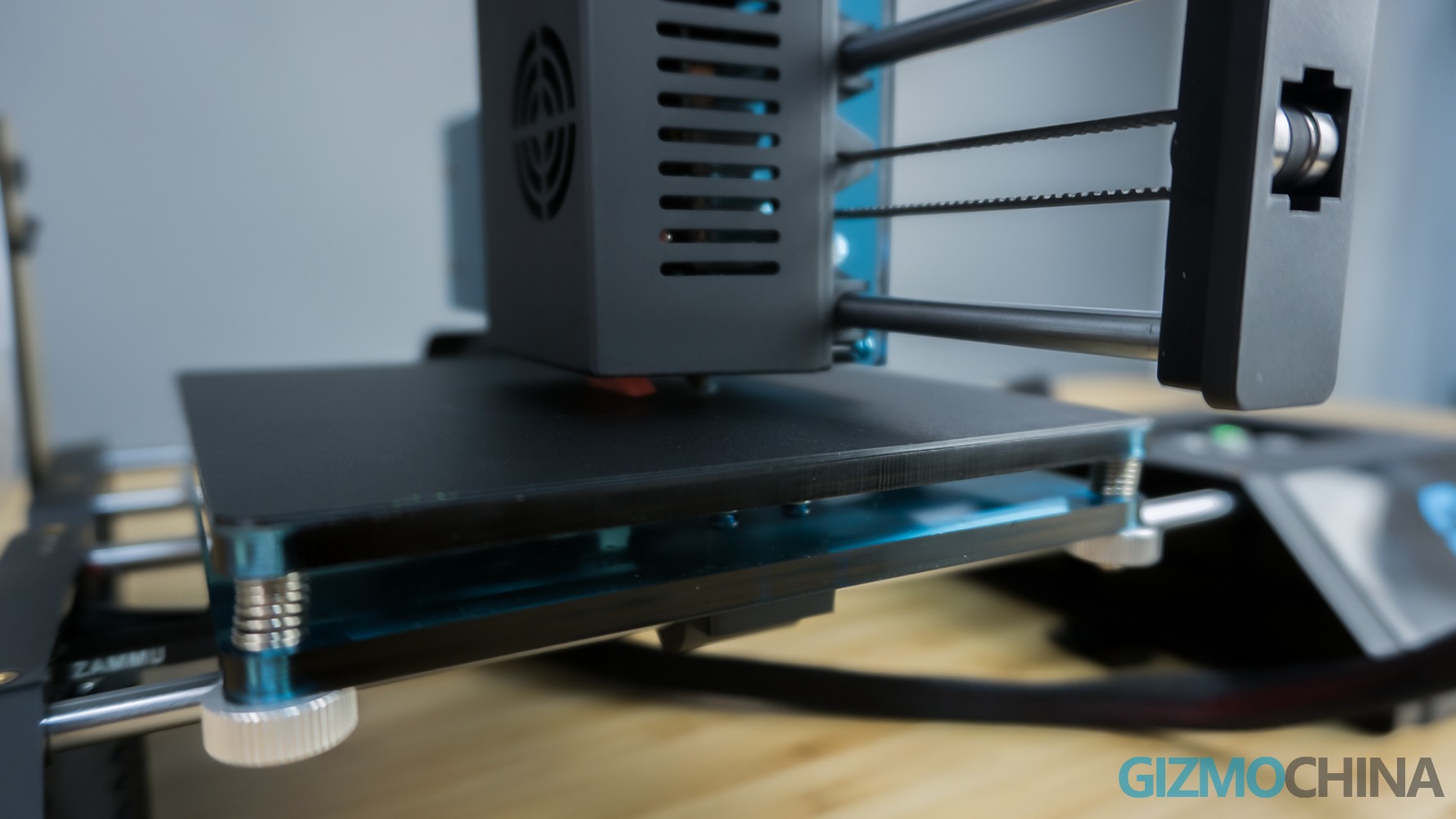
Before printing, the Star A supports one-click to finish the process of filament load and feed in around 2 minutes. After seeing the regular silk come out of the nozzle, you can press the play button to start printing. During preparation, note that the nozzle height should be over 3 cm, which can be adjusted by pressing the play button for 3 seconds to lift up by 1cm.
A wonderful feature for improving printing efficiency and keeping printer safe is the resume-printing function. This function helps users save filament and make sure the work continues even when it needs a replacement filament. Besides, when users experience an unexpected power outage, the resume-printing function also helps users stay calm as it automatically restarts the printer and resumes the work.
The most cost-effective 3D printer
It’s worth noting that besides the basic option, Selpic offers a wonderful collection of add-ons for upgrading Star A’s parts ($129) on Kickstarter. The add-on collection includes a hotbed kit of which temperature can reach 100℃, a 2.4-inch touch screen kit, and another 1.6W Laser Engraving Head Kit. If you want to have the laser engraving on the leather, cardboard, wood, etc., this add-on collection will be a good option that we recommended.
So far we haven’t tapped into the full potential of the Star A, but we did appreciate the efforts that Selpic has done to simplify 3D printing for common users. There should be more possibilities beyond what is mentioned here. If you are interested in this budget 3D printer and start your model printing works, you can check more on Kickstarter and support them.
For more information about the Selpic Star A, click here.
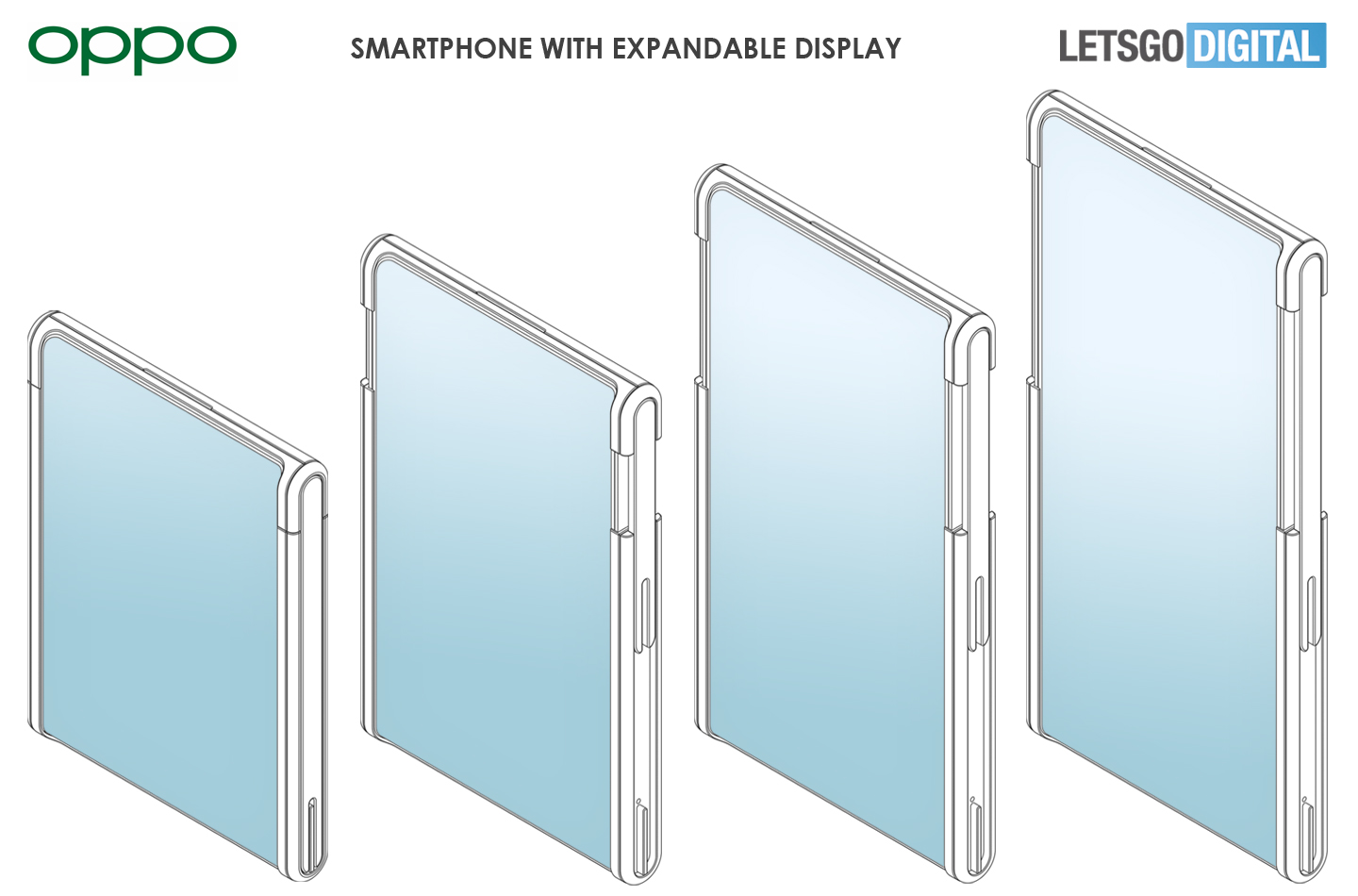
Lately, OPPO has been patenting designs and utilities related to foldable smartphones. Only last week we covered a weird foldable design by the company with a block structure. Now, another design patent by the Chinese smartphone maker has emerged imagining a phone with an extendable display.
This patent was filed by Guangdong Oppo Mobile Telecommunications with the CNIPA (China National Intellectual Property Administration) at the end of April 2020. But it got approved and published on November 13. As usual, LetsGoDigital was the first publication to find it.
The new OPPO design patent is identical to the upcoming rollable smartphone by LG, which is reported to launch next year under the company’s ‘Explorer Project’. This mysterious LG phone could debut as ‘LG Rollable’ but we don’t have any name for this OPPO patent.
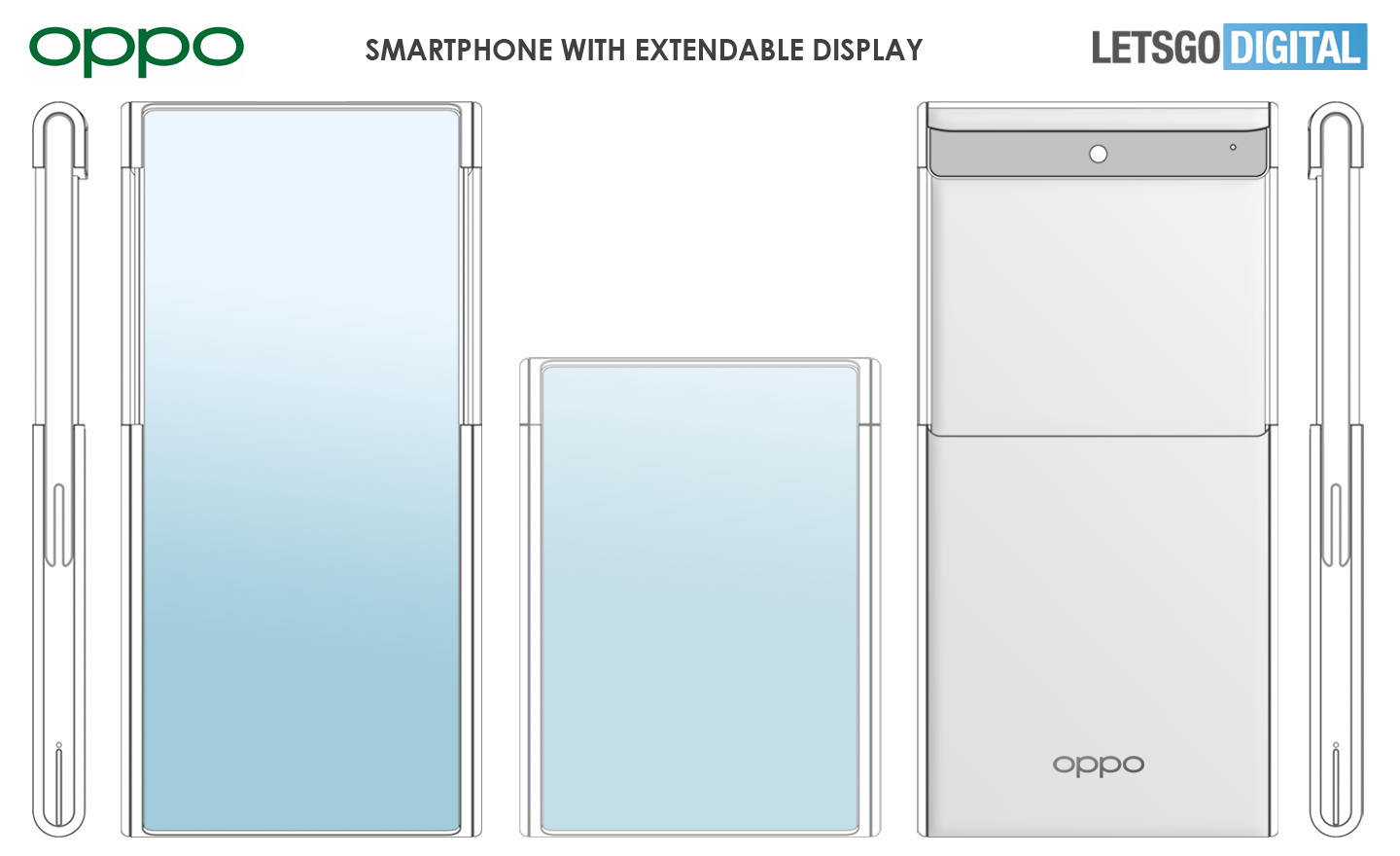
The front design of this device is clean without any notch or punch-hole on the front. Hence, it could feature an under-display camera. Further, the sides are rounded with no buttons or whatsoever and the back of the phone only houses a single camera.
Above all, the most important part of this design is the screen. The display on this smartphone can be extended by pulling it upwards. Hence, it can be transformed into a traditional smartphone from a tiny phone from years ago.
Having said that, the only use case of this design is portability similar to the already available clamshell foldables like Galaxy Z Flip and Motorola razr.
So will OPPO implement this design in a consumer-grade product? We cannot tell for sure but the company may showcase it at the OPPO INNO DAY 2020 conference, which will take place on November 17.
A week ago, Qualcomm confirmed that it has applied for a license to supply chips to Huawei. Now, a report from China says that the company has been given the green-signal for 4G instead of 5G chips.
According to a report from China, Supply Chain manufacturers say that Qualcomm has got the license to sell 4G chips to Huawei. The company had previously worked closely with Huawei in 4G chips mainly undertaken by Xi’an Research Center.
Now, after obtaining the license, it will look to increase the supply for 4G mobile phones further. A couple of days back, reports said Qualcomm already got the license to do business with Huawei. However, the new report suggests that it can only sell 4G chips at least for now.
Many companies have been getting permission to do business with Huawei lately. Among them, notable ones are AMD, Intel, Samsung Display, and more. If the report is true, there are approximately 300 companies waiting to get approval from the US government.
For the unware, US Government has been in a tussle with Huawei. After banning its companies from using Huawei’s 5G equipment over security concerns, it recently blocked the company’s chip business too. Due to this, Huawei came under a lot of pressure. It couldn’t use Google’s services, manufacture its own Kirin chipsets through TSMC, and spread its 5G technology world-wide.
Coming back, the report says Qualcomm will benefit a lot from this approval. The company, which was once a major QTL(patent business) partner of Huawei, lost business after the latter started growing up. Following this, a ban on chipset business(QCT) had further weakened the tie-up. That said, as per the company’s early statement, a license to sell chips to Huawei will be of greater significance in the future.
Furthermore, close to 10 manufacturers across regions including TSMC, SMIC, SK Hynix, Samsung Electronics, Western Digital have lineup for approval. That said, this news falls in line with earlier reports which said US Government is granting license as long as the components aren’t for Huawei’s 5G business.
Although it’s a relief for Huawei, which is diving towards scarcity of chips, adopting 4G instead of 5G will be difficult. Anyway, let’s wait and see how Huawei and Qualcomm leverage this opportunity to expand their business.
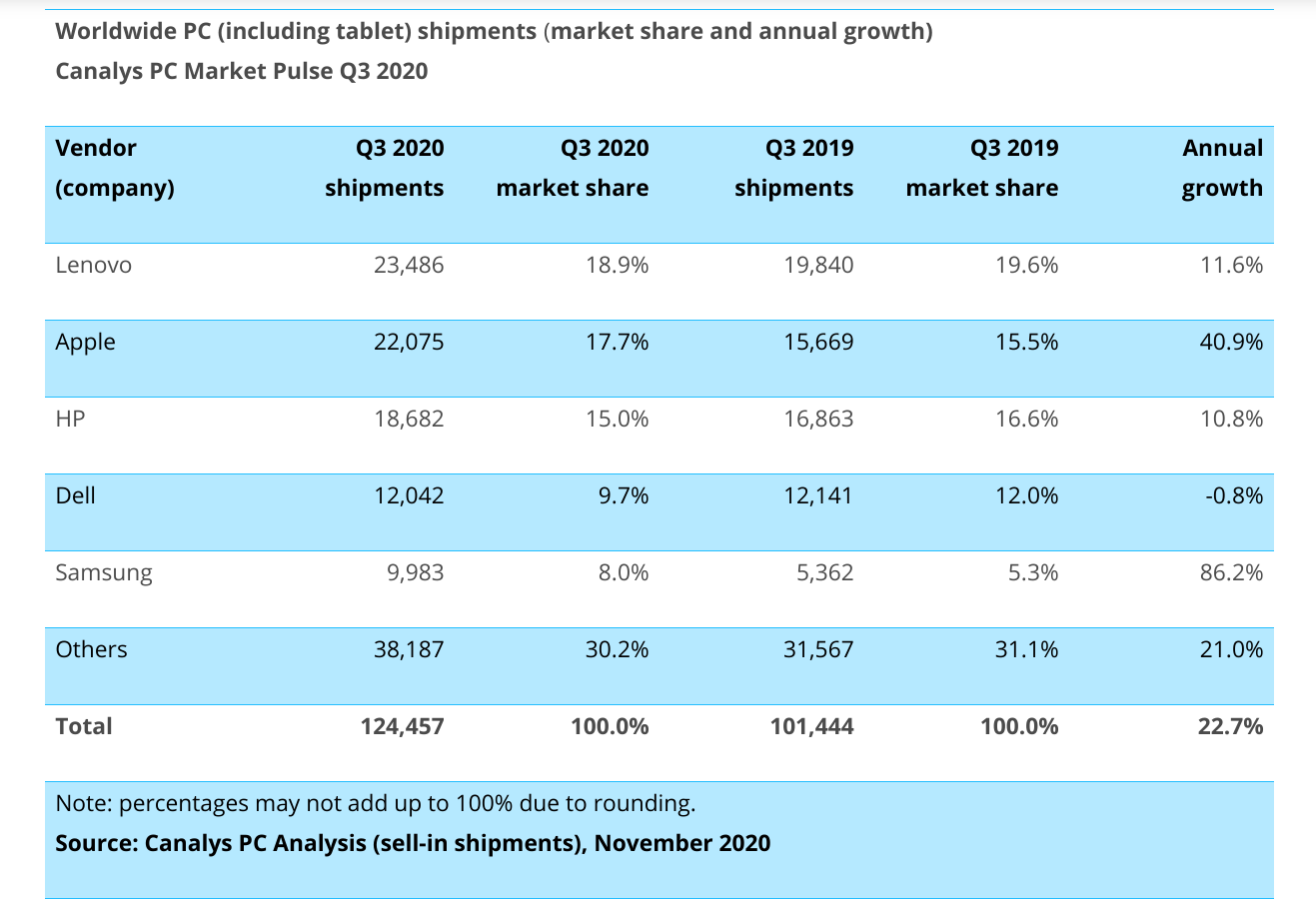
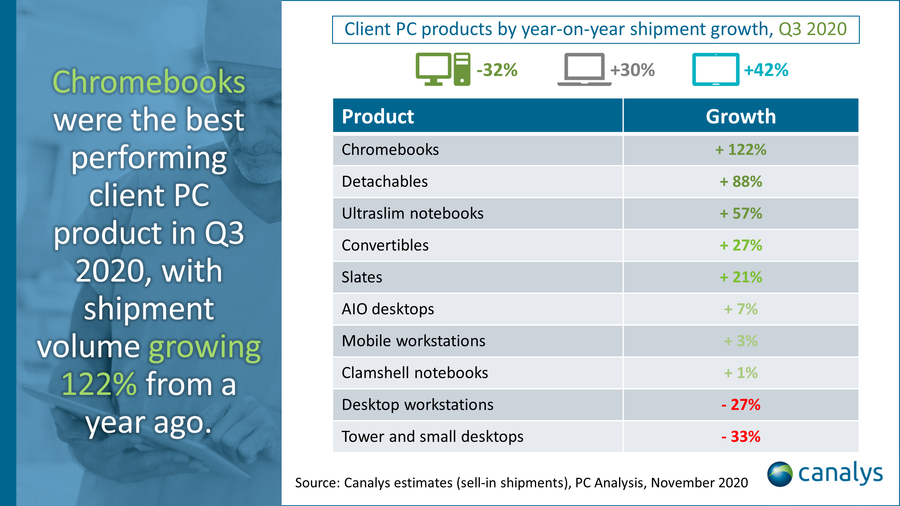
Canalys has published a report on Global PC Market Q3 2020. This report not only consists of notebooks and desktops but also includes tablets. According to it, the entire market grew by 23% YoY with 124.5 million units in shipments. Chromebooks were the best-performing client PC product and the tablet market remained strong second quarter in a row.
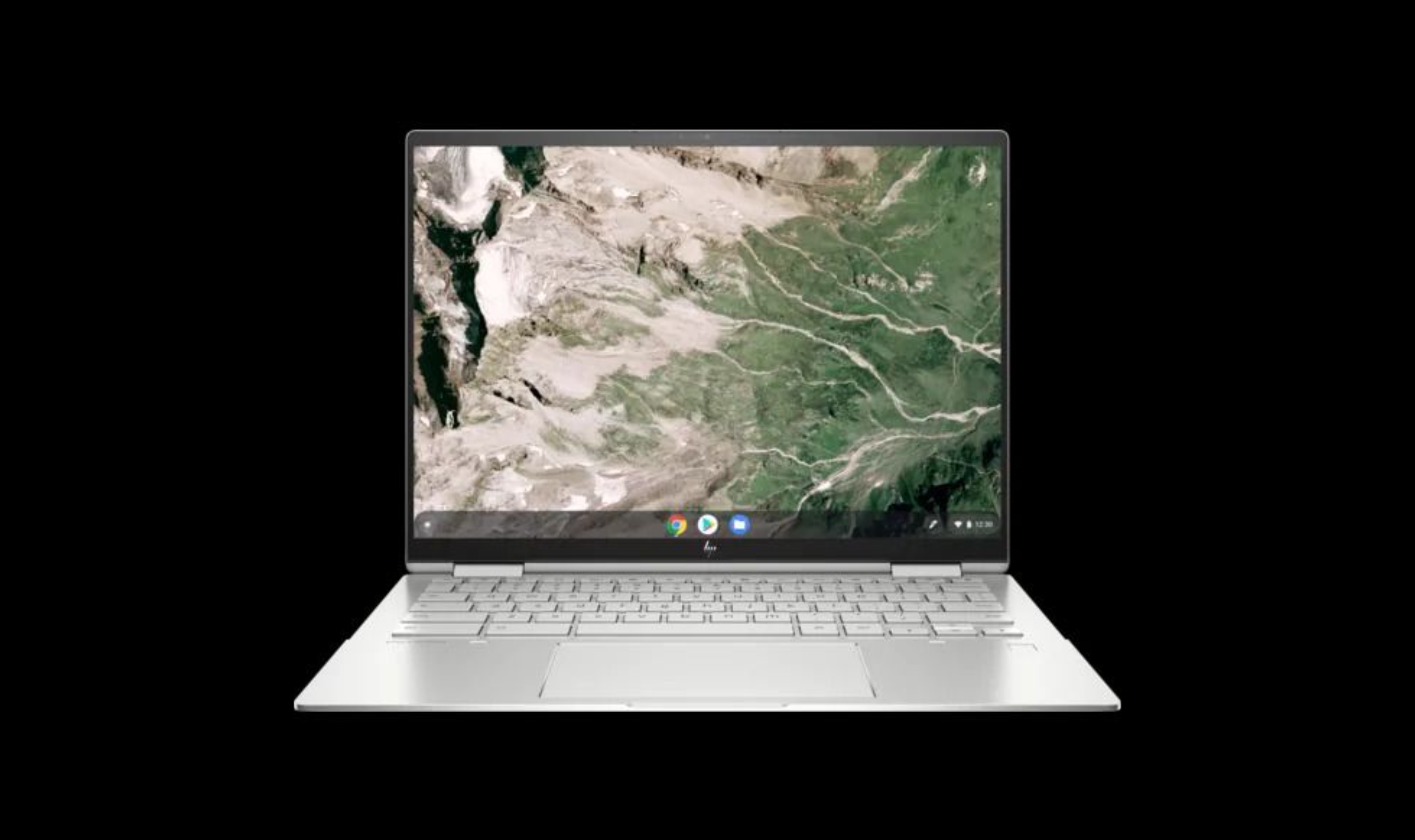
HP Elite c1030 Chromebook
As per the report, Lenovo led the overall PC market by shipping 23.5 million units. Whereas, Apple, HP, Dell, and Samsung came second, third, fourth, and fifth respectively. Apple and Samsung made the top 5 list solely because of their tablets. This clearly explains the tablet market’s 43% YoY growth as the shipments reached 44.3 million units.
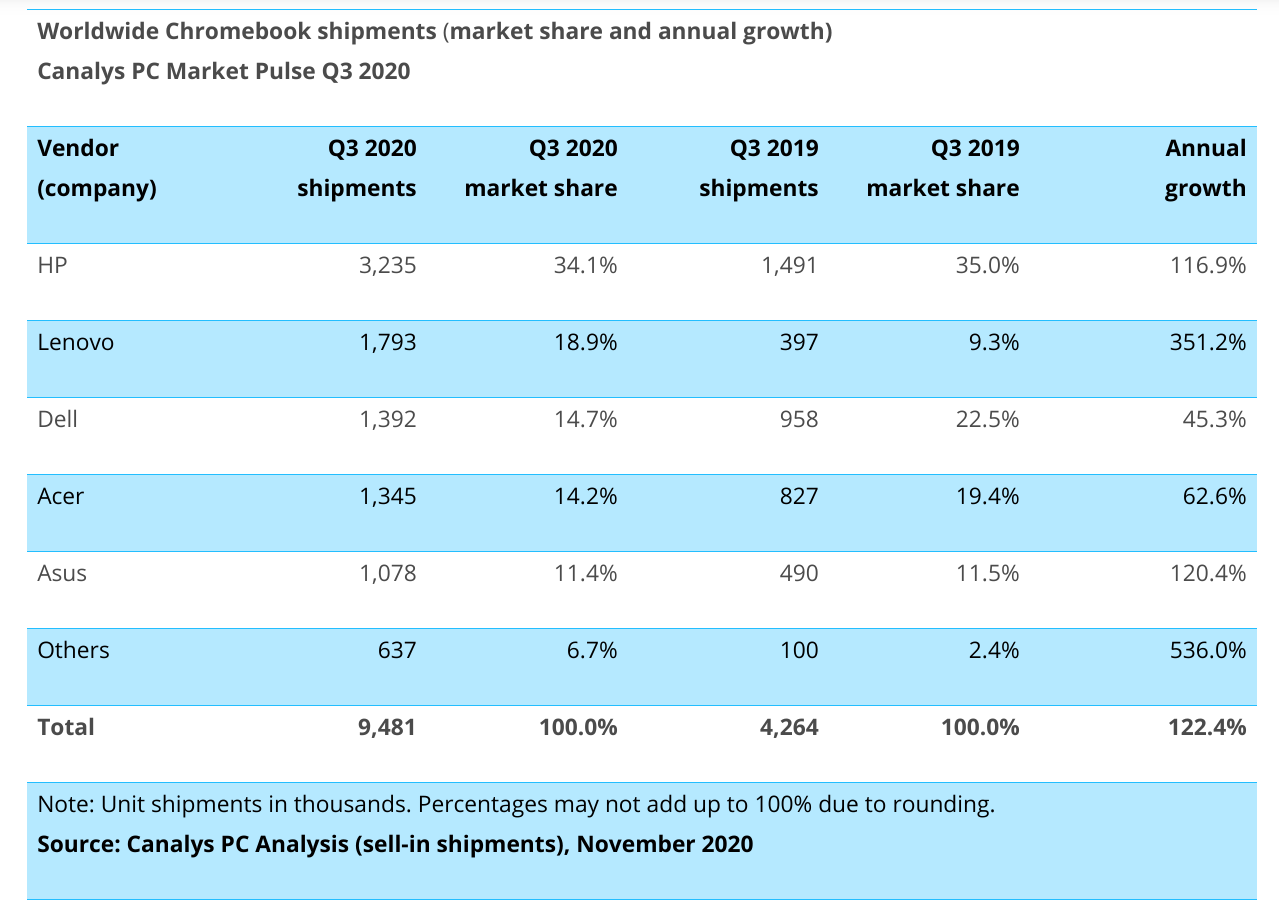
Talking about client PC products, Chromebooks performed exceptionally well by growing 122% YoY with shipments of 9.5 million units. Their success was mostly because of educational institutions and SMBs. HP was the market leader by shipping 3.2 million units, followed by Lenovo, Dell, Acer, and Asus. However, Lenovo was the best-performing brand with a whopping 351.2% YoY growth.
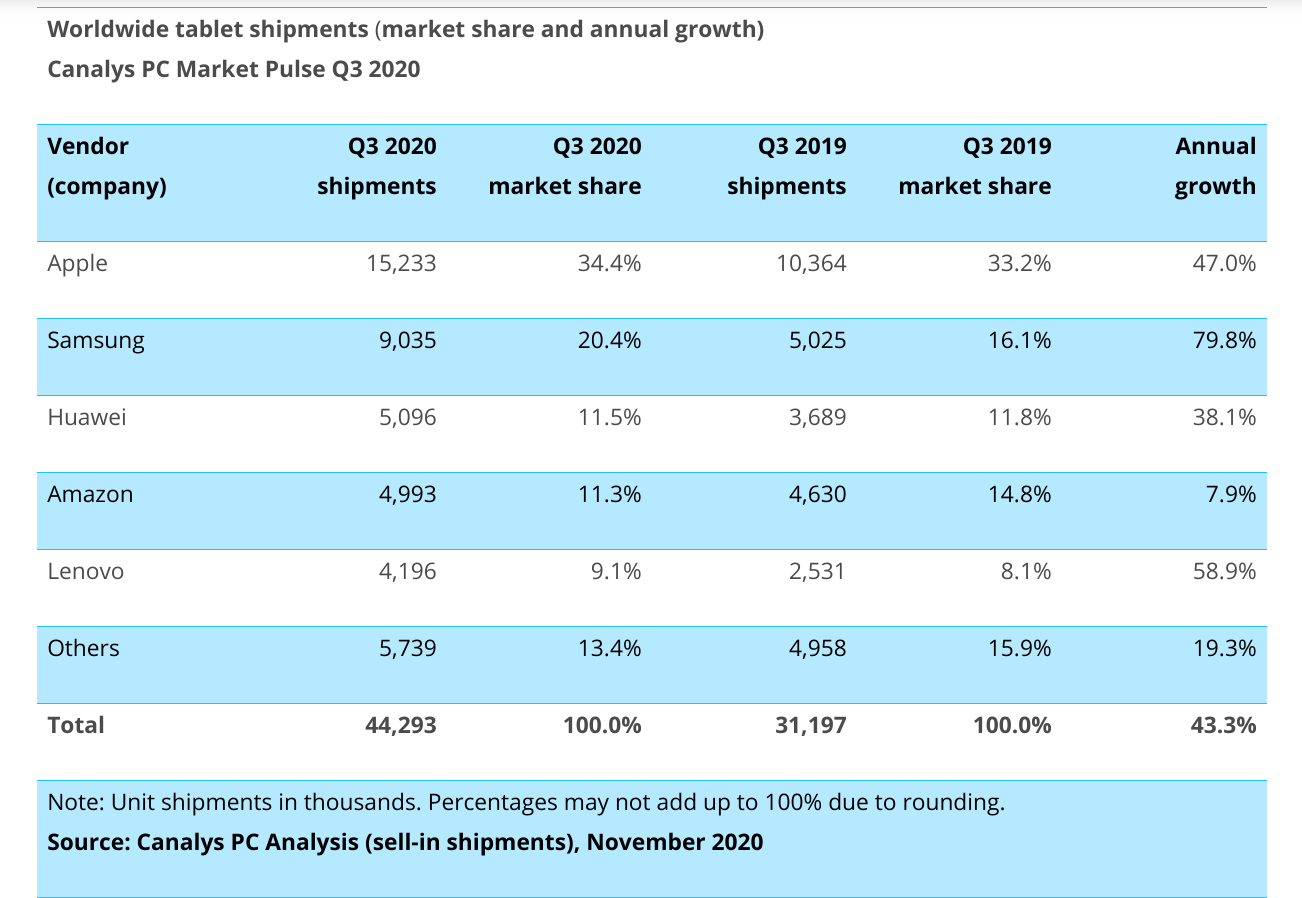
Coming to tablets, unsurprisingly, Apple led the market with 15.2 million units in shipments. Whereas, Samsung in second place only shipped 9 million units. Further, Huawei, Amazon, and Lenovo captured third, fourth, and fifth positions respectively. Interestingly, Huawei continued to remain strong in Europe even with the lack of GMS (Google Mobile Services) on its tablets.
1 of 4
Also, it is worth noting that Q3 2020 was the only quarter other than Q2 2020 in which the tablet market grew since 2015. So we can say that the pandemic resurrected tablets from the dead after five years.
Last but not least, the overall desktop market declined by 32% YoY, however, AIO (All-in-One) category grew by 7% YoY.
Earlier today (13th November 2020), OPPO officially announced a new concept application called CybeReal. It is an AR (Augmented Reality) based platform that will help bridge the boundaries between the digital and real world.
During the conference, the Chinese tech giant unveiled its new real time high precision positioning and scene recognition technology, which will be used in CybeReal. The company is calling it an AR super application. According to the company’s official notes, CybeReal can display information regarding the scene being displayed on the screen through a device’s cameras.
This would help in various aspects like navigation, information regarding stores and their activities, and even introduction to local attractions or landmarks. Simply put, users can just open the camera through an app, which will allow them to see information regarding their surroundings in real time. The technology is also somewhat similar to Huawei AR Maps 2.0, which was announced back in October.
AR applications have been growing in recent times with OEMs working to include in many forms like marketing, launches, and even commerce to a certain degree. Unfortunately, finer details regarding the AR platform from OPPO is currently unknown. The company has emphasized its functionality with entertainment and navigation, but further applications can only be speculated at the moment.
Ghost of Tsushima has achieved another record, as the game becomes the fastest selling PlayStation 4 Original title. It has already sold over 4 million copies worldwde and has even beaten other notable titles like Horizon Zero Dawn.
Earlier this week, PlayStation Worldwide Studios head Hermen Hulst shared a tweet that revealed that Ghost of Tsushima has become the fastest selling first party PS4 game with more than 5 million copies sold, despite being launched back in July 2020. This also marks an incredible achievement for the Sucker Punch game studio (which has also developed the popular Infamous series).
An important aspect to note here is the “Original” tag on the game since other titles have performed better than Ghost of Tsushima. A great example being Marvel’s Spider-Man, which sold over 3.3 million copies in just three days alone. Although, the IP is owned by Marvel and not Sony. Furthermore, Naughty Dog’s The Last of Us Part II had also released a month prior to Ghost of Tsushima and had sold over 4 million copies in three days. However, it was not considered an original title as it was a sequel.
Just prior to Diwali (one of India’s largest festivals), OnePlus launched a new campaign alongside social media giant, Snapchat. The two companies have teamed up together to launch new Diwali themes AR (Augmented Reality) lenses.
These lenses will allow users to transform iconic and globally known landmarks like the Tower Bridge in London, the Eiffel Tower in Paris, the Taj Mahal in Agra, and the Gateway of India in Mumbai, into special festive themed spots. The Chinese smartphone maker has also released a short video commemorating the same, while also demonstrating the lens in action in the aforementioned locations and is an effort to bring the warm festivities amid social distancing.
Snapchat is a major social media app with hundreds of million daily users, which also heavily utilizes its AR features. Thus, this partnership allows a vast number of users to access the special AR experiences that can transform the known landmarks in real time. The OnePlus’ Snapchat’s AR Lenses is live from 11th November 2020 and will be available to Snapchat users across India. Following the ‘Open your palm to release the wishes’ gesture, users can also send words of positivity like peace, joy, hope, and more that would float up to the sky to form the Diwali message to share with friends and family.
According to Siddhant Narayan, Head of Marketing, OnePlus India said, “As a brand that is dedicated to its community we have leveraged technology to bring our global user base together and share the love forward this Diwali. Through this campaign with Snapchat, we wanted to enable users across the world to celebrate the festival of lights in a safe and secure manner during the time of social distancing. In the wake of the pandemic, we also aim to share the message of hope with our global community as we prepare to celebrate one of India’s biggest festivals.”
A group of 165 companies and industry bodies have called for stricter action and tougher lines against Google, stating that the US search engine giant unfairly favors its own services on its web searches.
According to a Reutersreport, the group includes companies from both the US and UK, along with others from over 21 different European countries. These firms sent a joint letter to EU antitrust chief Margrethe Vestager earlier this week. In the letter, the group expressed that Google was giving unfair preference to its own services such as accommodation, travel, and jobs, in terms of placements in search results and have called for swift action against the company to end the practice.
Google has since refuted the allegations of it favoring its own services. The tech giant further added that its users are not locked in and that competition to its services is just one click away on the internet. As per a Google representative, “People expect Google to give them the most relevant, high quality search results that they can trust.”
The representative also stated that “They do not expect us to preference specific companies or commercial rivals over others, or to stop launching helpful services which create more choice and competition for Europeans.” Notably, Vestager has already levied fines of over 8.25 billion euros (roughly 9.7 billion US Dollars) against Google in the past three years alone for abusing its market dominance, through Android and other platforms.
Notable members of the 165 strong group include Yelp, Expedia, Trivago, Kelkoo, Stepstone, and Foundem, which are a part of the largest ever consortium to write to the EU competition chief for action. The European Commission said it had received the letter and a reply will arrive in due time. It further added that the market will be carefully assessed as well.
In the letter titled ‘UNJUSTIFIED ADVANTAGES,’ the group called out the search giant stating that “While we compete amongst ourselves for the best consumer experience, there is one common competitor that does not compete fairly – Google. It gained unjustified advantages through preferentially treating its own services within its general search results pages by displaying various forms of grouped specialized search results (so-called OneBoxes).”
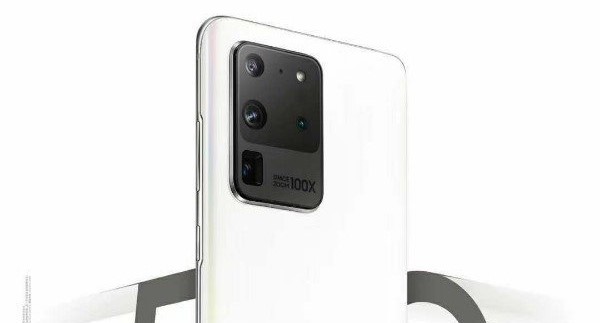
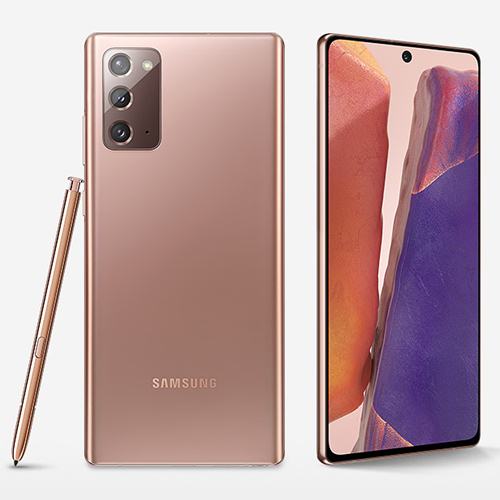
Back in October, a new software update had been rolled out for the Samsung Galaxy S20 Ultra and the Galaxy Note 20 Ultra. However, since the update was made available, certain units have been facing troubles with the devices’ wireless charging.
Samsung Galaxy S20 Ultra Cosmic White
According to a PhoneArenareport, a number of Samsung users have been facing this issue. This problem has even been shared on official and unofficial forums. The primary issue is related to the third party wireless chargers that have stopped working with their Galaxy Note 20 Ultra or Galaxy S20 Ultra handsets after the new update. Although, this problem has seemingly not affected the wireless chargers made by Samsung.
Users have reported that the wireless charging gets interrupted constantly every few seconds, with affected users stating that the issue was not present previously with any third party wireless chargers. While up until recently, it was unknown what was causing the issue for the high end premium grade flagship models from the South Korean tech giant, but now, a fix has been found.
Samsung Galaxy Note 20 Ultra
Apparently, the wireless charging problem is fixed by turning off NFC. This workaround was discovered by James Drissel on XDA Developers Forums and is the unofficial fix for the issue at the moment. Unfortunately, it still doesn’t explain how the problem began in the first place and an official update to fix the bug has yet to be rolled out. So stay tuned for more updates.
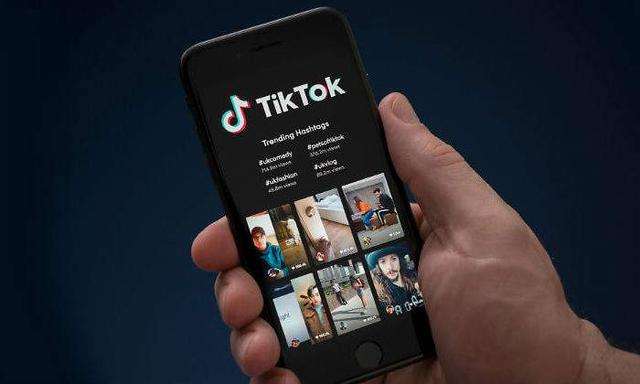
Earlier this week, the US Commerce Department announced that it would not be enforcing its orders that would’ve had the Chinese short video sharing app, TikTok, be banned from the region.
According to a WallStreetJournalreport, the Commerce Department is backing down and delaying its implementation of the order, which was set to take effect on Thursday (12th November 2020). The order would have had the social media platform be banned from app stores offered by major companies, namely Google, Apple, and even Amazon. In other words, this would’ve effectively ended the US operations of TikTok.
For those unaware, the Trump administration has been behind the action that was being taken against the ByteDance owned app. However, with changes in leadership after the recent US elections, it is unknown how Joe Biden will handle the situation regarding TikTok. Although, many members of Congress have already voiced their concerns regarding the Chinese app stealing users’ data and being a national security risk as well.
Furthermore, this isn’t limited to just TikTok, as it remains to be seen what stance and direction the newly elected President would take regarding the current state of the US and China relations. This news also arrives amid the lawsuit filed against the Commerce Department’s orders by popular TikTok users and the preliminary injunction towards the order by US District Judge Wendy Beetlestone.
We use cookies on our website to give you the most relevant experience by remembering your preferences and repeat visits. By clicking “Accept”, you consent to the use of ALL the cookies.
This website uses cookies to improve your experience while you navigate through the website. Out of these, the cookies that are categorized as necessary are stored on your browser as they are essential for the working of basic functionalities of the website. We also use third-party cookies that help us analyze and understand how you use this website. These cookies will be stored in your browser only with your consent. You also have the option to opt-out of these cookies. But opting out of some of these cookies may affect your browsing experience.
Necessary cookies are absolutely essential for the website to function properly. This category only includes cookies that ensures basic functionalities and security features of the website. These cookies do not store any personal information.
Any cookies that may not be particularly necessary for the website to function and is used specifically to collect user personal data via analytics, ads, other embedded contents are termed as non-necessary cookies. It is mandatory to procure user consent prior to running these cookies on your website.