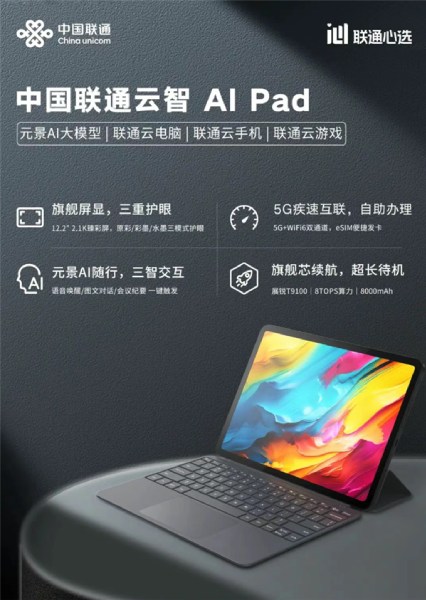
Chinese telco operator China Unicom has launched a new tablet called the Cloud AI Pad. It’s a 5G tablet that runs both Android and Windows environments, but with a catch.
At first glance, the Cloud AI Pad has fairly standard hardware. It features a 12.2-inch LCD screen with a resolution of 2160 × 1440. The front also has an 8-megapixel camera, while the back houses a 13-megapixel shooter.
Under the hood, the tablet runs on the Unisoc T9100. The T9100 is built on TSMC’s 6nm process and uses an eight-core CPU with a 1+3+4 tri-cluster layout. That includes one 2.7GHz Cortex-A76 core, three 2.3GHz A76 cores, and four 2.1GHz Cortex-A55 efficiency cores. Graphics are handled by a Mali-G57 MC4 GPU running at 850MHz.
The chip supports LPDDR4X memory, UFS 3.1 storage, and an integrated 5G full-mode baseband, which pairs with the tablet’s 5G eSIM that can be activated online. There’s also a built-in NPU rated at 8 TOPS for AI features.
China Unicom ships the Cloud AI Pad with 6GB of RAM and 128GB of storage, an 8000mAh battery, and 18W wired charging. The company claims up to 10 hours of continuous video playback.
The dual OS system
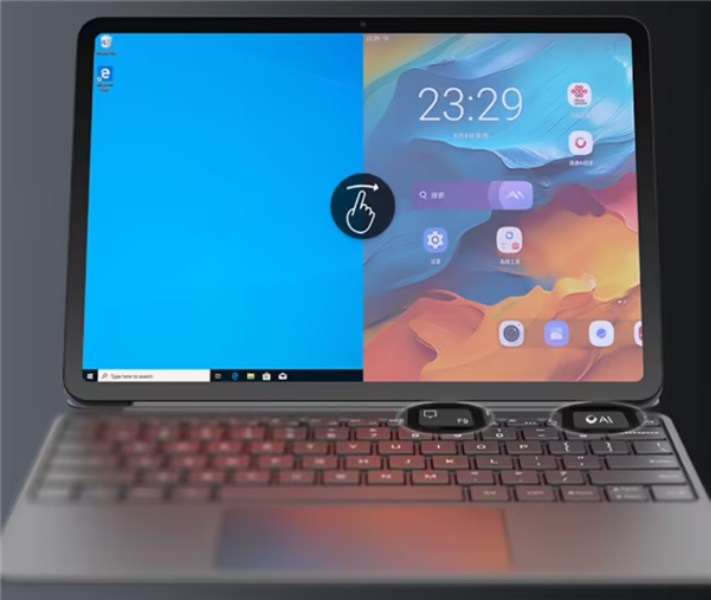
Among all, what makes the tablet unique is its software. The tablet boots on Android by default. However, you can switch to a Windows environment in the cloud by pressing the F9 button on the keyboard accessory. And yes, that’s where it gets its name, Cloud AI Pad.
It’s effectively two systems on one device, stitched together by cloud computing. The keyboard also has a dedicated AI key to wake up an AI assistant powered by Unicom’s Yuanjing large model.
The Cloud AI Pad is listed on JD.com for 1,799 yuan.
Casio’s G-Shock continues to be one of the most beloved watch families for its durability, design diversity, and collector appeal. As we look toward 2026, several fresh models and collaborations are already being teased or revealed in fresh leaks, ranging from full-metal premium timepieces to fun limited editions tied to global brands. So if you’re looking forward to Casio’s new 2026 watch lineup, here are a few upcoming models to look out for.
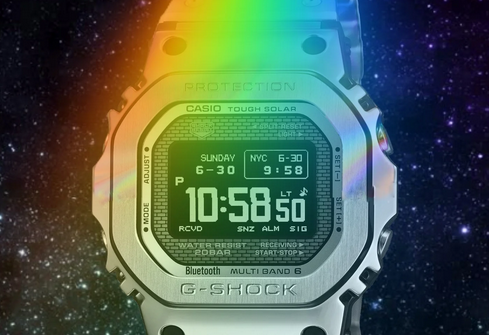
Casio is rumored to be working on a premium new watch that could get a multicolored hue to its metallic shine. Following the launch of the GMW-BZ5000, the popular watch maker is reportedly preparing to release a new GMW-BZ5000RC-1 model, which could be a rainbow ion plated version. This limited edition will add a bold gradient finish to the already modern classic silhouette of the 5000 series, blending premium materials with eye-catching style.
It will also bring a full metal case with premium features that likely include Tough Solar power, Bluetooth connectivity, and Multi-Band 6 radio timekeeping. The original GMW-BZ5000D came with a black and gold ion plated variant recently, so the new limited edition model adds a bold new finish, which is likely aimed at collectors and enthusiasts.
2. G-Shock x Coca-Cola CasiOak
Casio x Coca-Cola G-Shock Watch Collaboration
For collectors and fans of quirky collaborations, one of Casio’s 2026 lineup might be the perfect fit. Casio and Coca-Cola previously teamed up on limited editions, and leaked info suggests a follow-up model. Reportedly, the next model in the series is the GA-2100CC-3A with design cues inspired by Coca-Cola’s classic branding and the iconic green glass bottle aesthetic for the popular CasiOak watch. These kinds of collaboration models generally focus on eye-catching design details, co-branded packaging, and collectible appeal rather than major technical upgrades. But this helps it stand out from a traditional watch.
3. Japanese shochu meets Casio G-Shock
Casio x iichiko Super (GM-5600U)
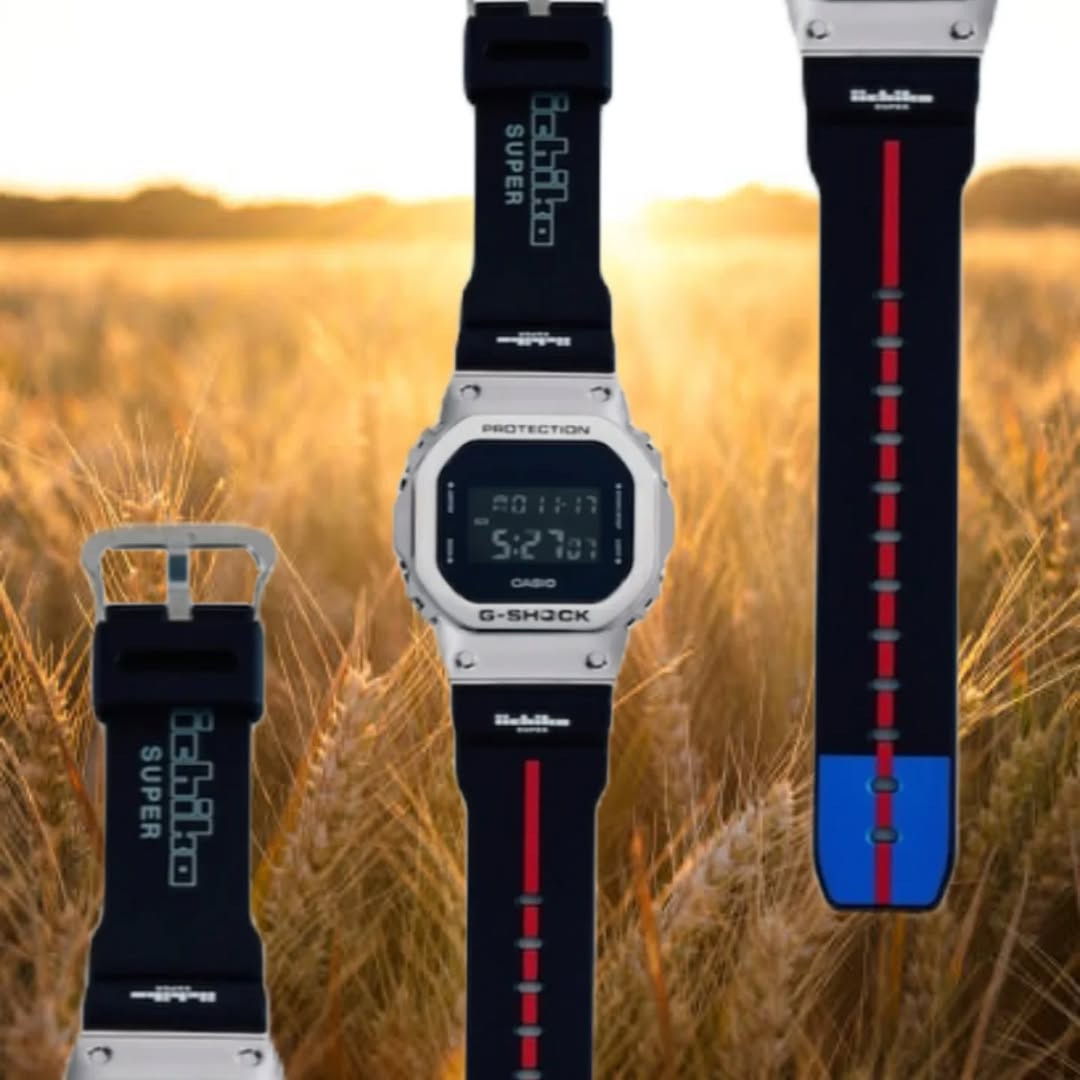
The Coca-Cola edition CasiOak isn’t the only collaboration in the works, as a recent leak hints at another partnership for a special edition G-Shock watch. Casio is apparently joining hands with Japanese shochu label iichiko Super, which is built on the GM-5600U square. Based on the leaked images, there is a stainless steel bezel, a negative digital display and a custom strap with a red stripe and blue tip with iichiko Super’s bottle colors. The strap even carries the Japanese spirit makers’ logo. Expect limited quantities and a distinct design that celebrates both brands’ identities.
4. Speed meets precision with Casio x Honda
Casio Edifice x Honda ECB-2300HR-1AJR
While not strictly G-Shock, the Edifice x Honda collaboration (ECB-2300HR-1AJR) is part of Casio’s broader 2026 wristwear lineup and worth mentioning for its premium build and racing-inspired design. Officially listed in Japan with a March 2026 release and a price tag around ¥66,000 (~$426), this limited edition draws on the story of Honda’s historic motorsport achievements. Edifice models blend precise chronograph functionality with bold aesthetic nods to automotive heritage, making them a strong choice for fans of performance-inspired timepieces.
For more daily updates, please visit our News Section.
Samsung is about to become Apple’s go-to memory supplier again, and yes, the ongoing memory shortage is to blame here.
According to a report from South Korea, Apple is reportedly placing a massive order for Samsung memory chips for the iPhone 18 series because Apple’s current suppliers (SK Hynix and Micron) are focusing more on high-bandwidth memory (HBM) production used in data centers rather than the LPDDR memory it uses for iPhones.
If you are unaware, high-bandwidth memory is in huge demand thanks to AI accelerators from companies like NVIDIA. And it’s not just demand, but these AI companies are also paying extra to secure the deal of HBMs to be used in their data centers.
As a result, memory makers are shifting production away from low-power LPDDR memory and toward HBM that goes into servers. And that shift is now squeezing Apple and every other smartphone maker, for that matter.
Samsung to the rescue
That leaves Samsung as Apple’s most reliable option. According to the report, Samsung is expected to secure around 60 to 70 percent of Apple’s memory chip orders for the iPhone 18 lineup.
Apple ships roughly 230 million iPhones every year and demands both price stability and guaranteed supply at scale. With SK Hynix and Micron prioritizing higher-margin AI memory, Samsung is now the only supplier with the capacity and willingness to meet those requirements.
There’s also a hint of déjà vu here. More than a decade ago, during Apple and Samsung’s high-profile patent battles, Apple deliberately reduced its dependence on Samsung and shifted more memory orders to SK Hynix. Now, with market dynamics flipped, Samsung is once again emerging as Apple’s go-to partner.
That doesn’t mean Samsung will handle everything. Around 30 to 40 percent of Apple’s memory orders are still expected to be split between SK Hynix and Micron, allowing Apple to maintain its long-standing multi-supplier strategy.
For more daily updates, please visit our News Section.
Realme has officially confirmed the launch of its 16 Pro series in India on January 6, 2026. The company revealed camera specifications and design details for the lineup today, positioning the 16 Pro+ as a “200MP Portrait Master.”
Official Design Details
According to realme, the series features Urban Wild Design created in collaboration with designer Naoto Fukasawa. The company states this design blends natural textures with modern urban aesthetics to help users find their “field of freedom” in city life.
Realme confirms the phones use industry-first bio-based organic silicone material with handcrafted curves and luxury finishing techniques. The company is offering four colors: Master Gold, Master Grey, Camellia Pink, and Orchid Purple.
Camera Specifications Announced
Realme revealed the series includes a 200MP LumaColor Camera designed for high-definition portraits with clarity, depth, and natural color expression. The company says the camera handles detailed group shots, solo portraits, and stage photography across multiple focal lengths with refined bokeh and accurate skin tones.
The brand is debuting its proprietary LumaColor IMAGE technology globally on this series. Realme describes it as a self-developed portrait imaging system that intelligently balances light and color for natural, expressive portraits across diverse environments.
Realme announced it has established the LumaColor IMAGE LAB in collaboration with TÜV Rheinland to ensure consistent and accurate color performance.
The company states the 16 Pro series continues its Number Series legacy by combining premium design with advanced imaging experiences for young users. Full specifications, pricing, and availability will be announced at the official launch event on January 6, 2026.
For more daily updates, please visit our News Section.
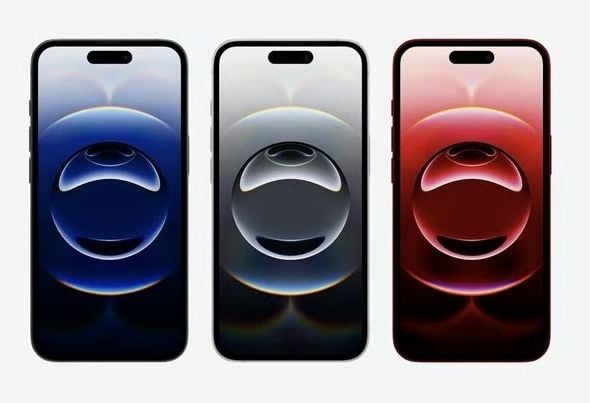
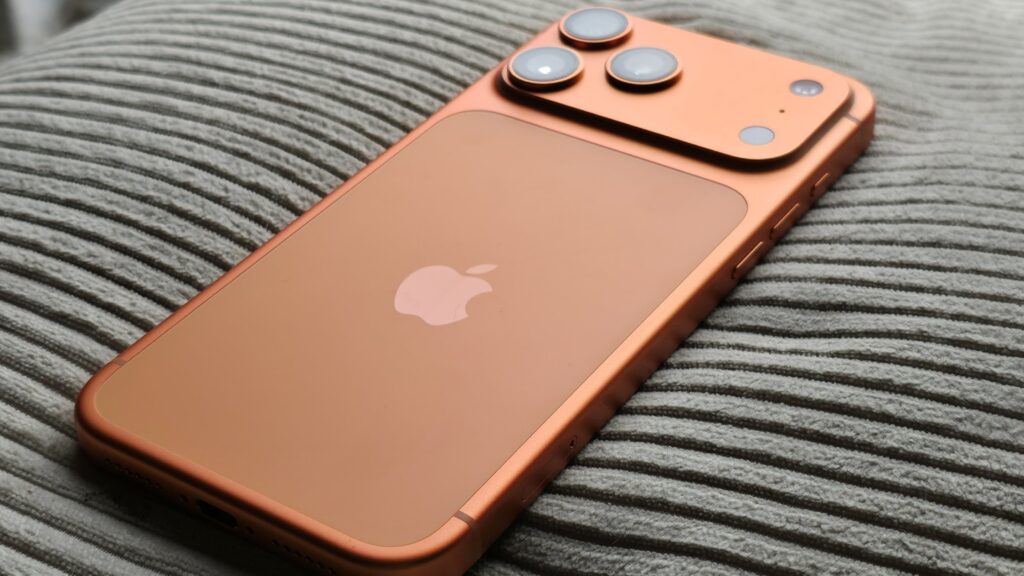
While the iPhone 17 series only recently hit the market, early leaks around Apple’s 2026 flagships are already starting to surface. A recent leak hinted at an unconventional hole-punch camera placement for the iPhone 18 Pro models. However, the latest leak suggests fans hoping for a dramatic redesign may want to temper their expectations.
According to Chinese leaker Fixed Focus Digital, the iPhone 18 Pro and Pro Max are unlikely to see any major exterior changes. The rear design, in particular, is said to remain largely unchanged, with Apple sticking to a familiar camera layout and overall look.
As for the rumor surrounding the introduction of under-display tech and the removal of the Dynamic Island, the latest report casts doubt on the timeline. Realistically, Apple is likely to preserve something “groundbreaking” for its 20th anniversary iPhone, set to arrive in 2027. So, if the 2026 iPhones appear as a minor refresh over the newly redesigned iPhone 17 lineup, it wouldn’t be too surprising. Apple is likely to continue using the current pill-shaped cutout design for at least another generation, while the UDC tech it’s known to have been working on for a while gets some final refinement.
That said, this is still very early in the product cycle. There’s still plenty of time before the 2026 iPhones enter mass production, a phase when supply chain details typically become clearer. Until then, plans could still change.
For now, the leak points to another evolutionary update rather than a visual overhaul—something Apple has leaned on repeatedly in recent years.
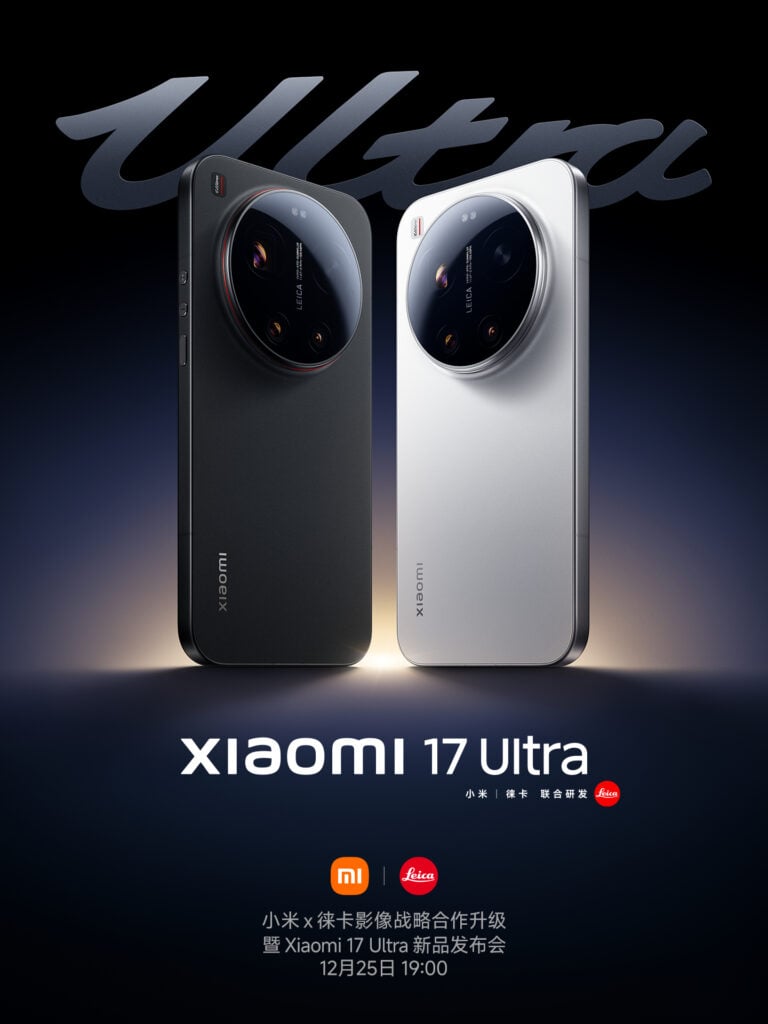
Xiaomi is set to launch the Xiaomi 17 Ultra on December 25th in China. It’s the company’s top-of-the-line phone and will compete with the iPhone 17 Ultra and the upcoming Samsung Galaxy S26 Ultra. And this year, Xiaomi is doing everything it can to stay ahead in the competition.
Here’s everything you need to know about the Xiaomi 17 Ultra ahead of its launch this Thursday.
Xiaomi 17 Ultra launch teaser
A new phase of Xiaomi × Leica
Xiaomi has worked with Leica for several years, but the Xiaomi 17 Ultra is the first phone built under what the company calls a “strategic co-creation model.” In simple terms, Leica now participates in the earliest stages of development instead of stepping in at the end to tune colors and image profiles.
According to Xiaomi, this deeper collaboration has influenced sensor selection, lens design, and the overall camera system layout. The company says its goal is to deliver noticeable improvements in night photography and telephoto performance.
A new 1-inch main camera sensor
At the center of the Xiaomi 17 Ultra’s camera system sits a new 1-inch main sensor called the OmniVision OV50X. This flagship sensor, developed in China, includes third-generation LOFIC (Lateral Overflow Integration Capacitor) technology.
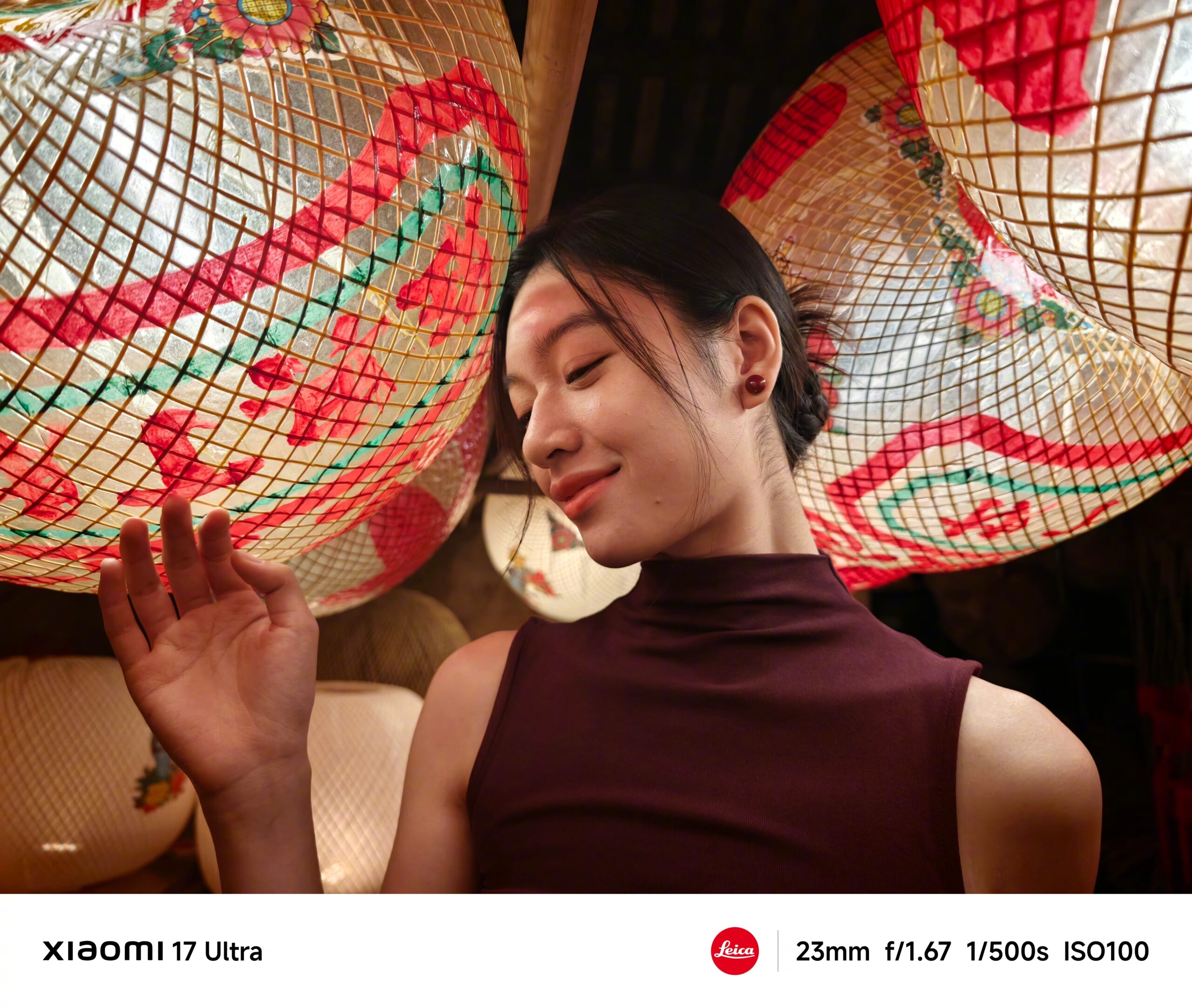
Xiaomi 17 Ultra camera samples
LOFIC improves dynamic range by handling bright and dark areas more effectively within the same frame. Xiaomi says this will be especially useful in challenging scenes such as fireworks, night cityscapes, or indoor shots with harsh lighting. In theory, it should reduce blown-out highlights while preserving shadow detail.
A single, more capable telephoto camera
The biggest change, however, comes to the telephoto system.
Instead of using two separate telephoto lenses like the Xiaomi 15 Ultra, the Xiaomi 17 Ultra switches to a single 200-megapixel periscope telephoto camera. Samsung supplies the sensor, which measures 1/1.4 inches and pairs with Leica APO-certified optics and a lens module that is 35 percent larger than before.
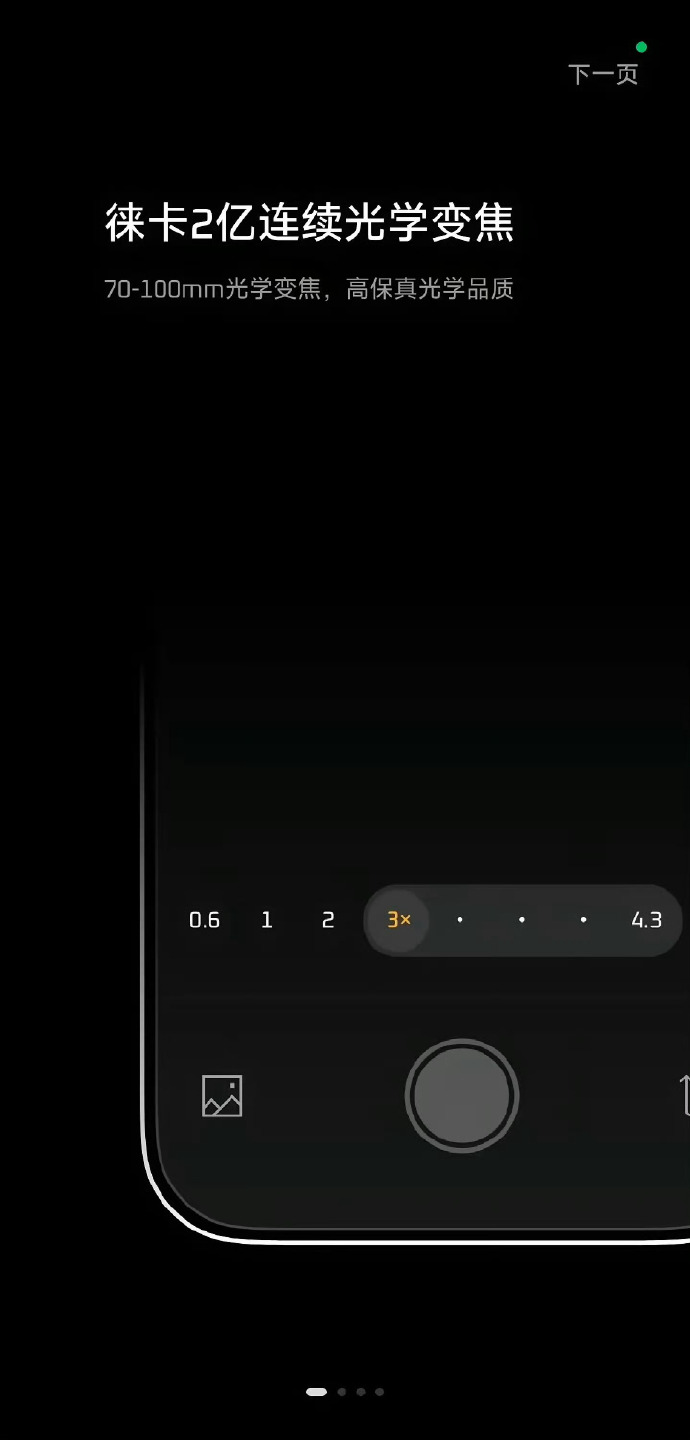
What makes this camera particularly interesting is its continuous optical zoom capability. A camera app screenshot revealed in a previous report shows that the phone can perform smooth optical zoom between 3x and 4.3x, covering focal lengths of roughly 70mm to 100mm.
Xiaomi 17 Ultra camera UI
Rather than switching between fixed lenses or relying on digital zoom in between, the system appears to physically adjust its optics to deliver true optical zoom across that range. That’s a meaningful improvement.
Sony has experimented with similar technology in its Xperia lineup, but most manufacturers still rely on multiple fixed telephoto lenses because they are easier to engineer.
The Leica APO certification also matters here. APO lenses minimize chromatic aberration, which reduces color fringing around edges. Xiaomi says this should result in sharper images with cleaner color separation, even at higher zoom levels.
A cleaner, flatter design
The Xiaomi 17 Ultra doesn’t radically change the Ultra design language, but it does refine it.
The phone keeps the centered circular camera island with Leica branding in the middle. This time, however, Xiaomi has slightly reduced the camera bump, which the company says improves grip comfort.
On the front, the phone now features a flat 2D display with large, rounded corners. By comparison, the 15 Ultra uses a curved panel. The flat screen should make the phone easier to handle and reduce accidental touches.
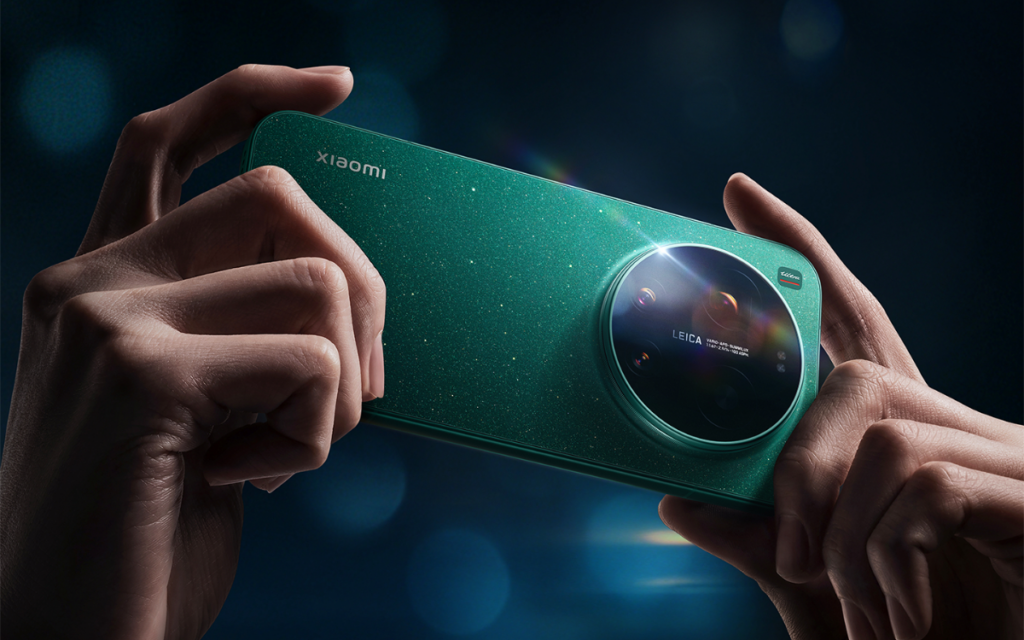
Xiaomi 17 Ultra in Starry Green
Xiaomi has also redesigned the buttons. The volume controls now use separate circular keys, which the company says provide better tactile feedback.
The phone measures just 8.29mm thick, making it the slimmest Ultra model Xiaomi has released so far. Despite that, it still includes a large battery and a complex camera system, which is no small engineering feat.
Alongside the standard black and white options, Xiaomi has introduced a new “Starry Green” variant of the 17 Ultra. The company describes it as its most visually striking Ultra phone to date.
The green model features a textured finish made with mineral-like particles. Xiaomi also uses a wraparound frame design, which helps the large device feel more balanced in the hand.
Performance, battery, and charging
Under the hood, the Xiaomi 17 Ultra is expected to run on Qualcomm’s latest Snapdragon 8 Elite Gen 5 processor. Xiaomi will likely pair it with up to 16GB of LPDDR5x RAM and up to 1TB of UFS 4.1 storage.
Powering the phone is a rumored 6,800mAh battery that supports 100W wired and 80W wireless charging. The device also includes dust and water resistance, ultra-wideband support, and satellite connectivity on higher-end variants.
Pricing and the reality of rising costs
Xiaomi is being unusually transparent about pricing this year. The 17 Ultra will almost certainly see a price increase over the 6,499-yuan launch price of the 15 Ultra. It is expected to start at around 6,999 yuan (roughly $999).
According to Xiaomi Group president Lu Weibing, rising component costs, including memory, are the main reason for the hike. Lu further warned that 2025 through 2027 will be especially challenging years for hardware pricing across the industry.
For more daily updates, please visit our News Section.
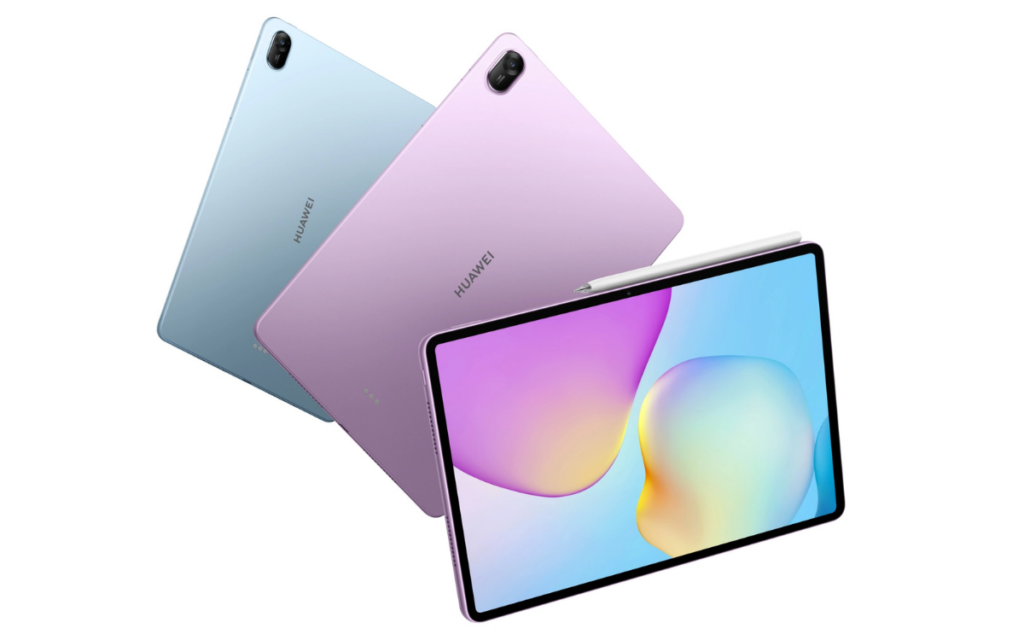
Huawei refreshed its tablet lineup at the Nova 15 series launch event by introducing the MatePad 11.5 (2026), a HarmonyOS-powered tablet designed for students and families.
Huawei MatePad 11.5 2026 Specs
The tablet is equipped with an 11.5-inch IPS LCD display boasting a resolution of 2456×1600 pixels and a 3:2 aspect ratio. It supports adaptive refresh rates of 60Hz, 90Hz, and 120Hz with peak brightness up to 600 nits.
Huawei offers two display types: the Standard Version and the Soft Light Edition. The latter uses a soft light screen with nano-etching anti-glare technology that reduces ambient light interference by 99% and reflectivity by 60%. It also uses circular polarization to simulate natural light and reduce visual fatigue. Both versions are TÜV Rheinland certified, while the Soft Light Edition additionally carries SGS Low Visual Fatigue 2.1 Gold certification.
The standard version is powered by the Kirin T82B processor, while the soft light edition uses the Kirin T82 chip. Both versions benefit from an internal 3D heat dissipation system, helping sustain smooth performance during multitasking and long learning sessions.
The tablet runs on HarmonyOS 5.1 and integrates Huawei’s AI Health Learning 2 system, offering modes like Minor Mode, Study Mode, Eye Protection Mode, and Do Not Disturb Mode, along with parental controls through Remote Guardian.
For imaging, it includes a 13MP rear camera with f/1.8 aperture and autofocus, supporting 1080P video. On the front, there is an 8MP camera with an f/2.0 aperture, suitable for video calls, classes, and selfies.
Huawei has equipped the tablet with a 10,100 mAh battery, which offers up to 14 hours of local video playback. It supports 40W fast charging.
The MatePad 11.5 (2026) features quad speakers tuned with Huawei Histen 9.0, dual microphones, and Wi-Fi 6 with a dual-antenna design. The tablet supports multi-device collaboration and optional accessories like the third-gen Huawei M-Pencil and Smart Keyboard.
Pricing & Availability
The MatePad 11.5 (2026) comes in Island Blue, Deep Space Gray, Frost Silver, and Feather Sand Purple. Pricing is as follows:
Standard 8GB + 128GB: 1,799 yuan ($252)
Soft Light 8GB + 128GB: 2,099 yuan ($294)
Soft Light 8GB + 256GB: 2,299 yuan ($322)
Soft Light 12GB + 256GB: 2,599 yuan ($364)
Full Network 8GB + 256GB: 2,799 yuan ($392)
Pre-orders have opened through Huawei Mall, leading e-commerce platforms, and offline retail channels, while official sales start on December 25, 2025.
For more daily updates, please visit our News Section.
Sony India now offers its LinkBuds Fit WF-LS910N wireless earbuds in Pink. The new color joins Black, White, and Green options. All specs stay the same.
The earbuds use Air Fitting Supporters with soft, hollow tails that cut ear pressure. Hard, hooked parts stop them from falling out. Sony based the shape on long-term ear data. The case and earbuds use recycled plastic. The packaging has no plastic. White and Green cases have a marbled pattern.
The earbuds pack 8.4mm Dynamic Driver X units. They support LDAC for high-resolution wireless audio, plus SBC, AAC, and LC3 codecs. DSEE Extreme uses AI to improve compressed music. Sony’s Integrated Processor V2 runs real-time Adaptive Noise Cancelling that adjusts to your surroundings through dual sensors.
You get 360 Reality Audio and Dolby Atmos through the Sony Headphones Connect app. The app scans your ear shape to tune the sound. Spatial sound with head tracking works in games like Ingress.
Beamforming microphones and AI noise reduction make calls clearer. Ambient Sound Mode and Adaptive Sound Control change settings based on what you’re doing and where you are. The earbuds are IPX4-rated for sweat and water resistance.
Bluetooth 5.3 gives you low latency, stable connections, and LE Audio support. You can connect to two devices at once. Google Assistant and Alexa work with these earbuds. Controls include tap, wide area tap, Quick Access, Auto Play, head gestures, and Speak-to-Chat. You can customize everything in the app.
Battery lasts 5.5 hours with ANC on or 8 hours with it off. The case adds 21 more hours total. A 5-minute USB-C charge gives you 1 hour of playback. The case weighs 41g.
Price and Where to Buy
The Sony LinkBuds Fit WF-LS910N cost Rs. 18,990. They’re available now on Amazon.in, Flipkart, ShopatSC.com, Sony Centres, Croma, and Reliance stores.
For more daily updates, please visit our News Section.
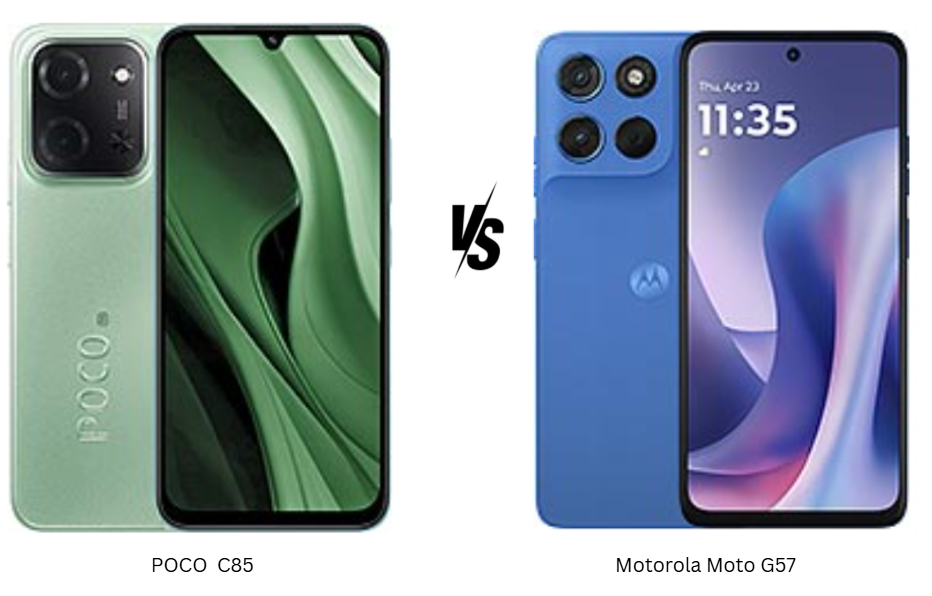
Poco C85 and Motorola Moto G57 sit right at the point where budget decisions start to matter. Both are aimed at buyers who want a reliable daily phone without stepping into mid-range pricing, yet they promise very different experiences for that extra spend. This comparison matters because the gap between “good enough” and “worth paying more for” can show up every single day. For value hunters, first-time buyers, and upgraders on a budget, choosing the right one can make the difference between saving money and feeling satisfied long term.
Major Features :
Feature
Poco C85
Motorola Moto G57
Winner
Display
IPS LCD, 120Hz, HD+ resolution
LCD, 120Hz, Full HD+ resolution, higher brightness
Moto G57
Performance
MediaTek Dimensity 6300
Snapdragon 6s Gen 4
Moto G57
Battery & Charging
6000mAh, 33W fast charging, reverse charging
7000mAh, 33W fast charging
Moto G57
Rear Camera Setup
50MP main camera
50MP main + 8MP ultra-wide camera
Moto G57
Price
Approx. $150
Approx. $200
Poco C85
Best For Who
Budget-focused buyers who want core features and long battery life
Users who want sharper display, better performance, and a more capable camera
Poco C85 goes for a bold, no-nonsense design that prioritizes practicality over style. It feels sturdy and built for everyday use, appealing to users who like large, functional phones. The Moto G57 feels more refined, thanks to its leather-inspired back and added durability standards. It has a calmer, more premium presence that fits better into daily professional or lifestyle use. Between the two, the Moto simply feels more thoughtfully finished, while the Poco focuses on being dependable and fuss-free.
Display Quality
Both phones offer smooth scrolling with high refresh rate LCD panels. The Poco C85 emphasizes size and immersion, making videos and casual gaming enjoyable. The Moto G57 delivers a sharper and brighter viewing experience, which improves readability and visual clarity. Side by side, the Moto’s display feels cleaner and more balanced, especially during long usage sessions.
Verdict
Poco C85 favors immersion and simplicity, but the Moto G57 offers a more polished design and a noticeably better display experience.
2. Specifications
Performance
The Poco C85 delivers stable everyday performance suited for browsing, social apps, and light gaming. It feels reliable rather than fast, which works well for casual users. The Moto G57 feels quicker and more responsive, especially during multitasking. Apps open faster, and overall system behavior feels smoother. Over time, the Moto’s performance feels better optimized for longer-term use.
Battery and Charging
Battery life is a strength on both phones. The Poco C85 comfortably lasts through heavy daily usage, making it dependable for long screen time. The Moto G57 pushes endurance even further, often lasting multiple days for moderate users. Charging speeds are similar, but the Moto’s efficiency gives it a slight real-world advantage.
Verdict
Moto G57 feels faster and more future-ready, while the Poco C85 remains a solid choice for consistent performance and strong battery life.
3. Camera
Main and Secondary Lenses
The Poco C85 keeps things simple with a single main camera that performs well in good lighting. It’s reliable for everyday photos but lacks creative flexibility. The Moto G57 adds an ultra-wide lens, making it more versatile for landscapes and group shots. Image processing also feels more refined, especially for video and stabilization, giving the Moto a more complete camera experience.
Selfie Camera
Selfie hardware is similar, but results differ. The Poco’s selfies are serviceable but basic. The Moto produces more natural-looking selfies and offers better video quality, making it more suitable for calls and content sharing.
Verdict
Poco C85 is fine for casual photography, but the Moto G57 clearly offers better versatility and camera confidence.
4. Pricing
Poco C85 is priced at around $150, making it a strong choice for buyers who want the basics at the lowest possible cost. It delivers solid everyday performance and excellent battery life without stretching the budget. The Moto G57 comes in at roughly $200, and the extra spend brings noticeable upgrades in performance, display sharpness, camera versatility, and overall refinement. The price gap reflects real usability differences rather than minor extras.
Verdict
Choose the Poco C85 for maximum savings. Pick the Moto G57 if paying extra for a smoother, more polished experience makes sense to you.
Disclaimer: Prices are approximate and may vary based on country, region, and applicable taxes.
5. Conclusion
Poco C85 stands out for its aggressive pricing, long-lasting battery, and large-screen experience. It’s designed for users who want maximum usage time with minimal spending. The Moto G57 focuses on balance, combining cleaner software, stronger performance, better cameras, and added durability. It feels more thoughtfully built for long-term daily use.
Verdict
Poco C85 is the better choice for budget-first buyers who want endurance and simplicity. The Moto G57 makes more sense for users seeking smoother performance, better cameras, and a more premium daily experience.
Overall, the Moto G57 feels like the stronger all-around phone, while the Poco C85 remains a compelling value pick.
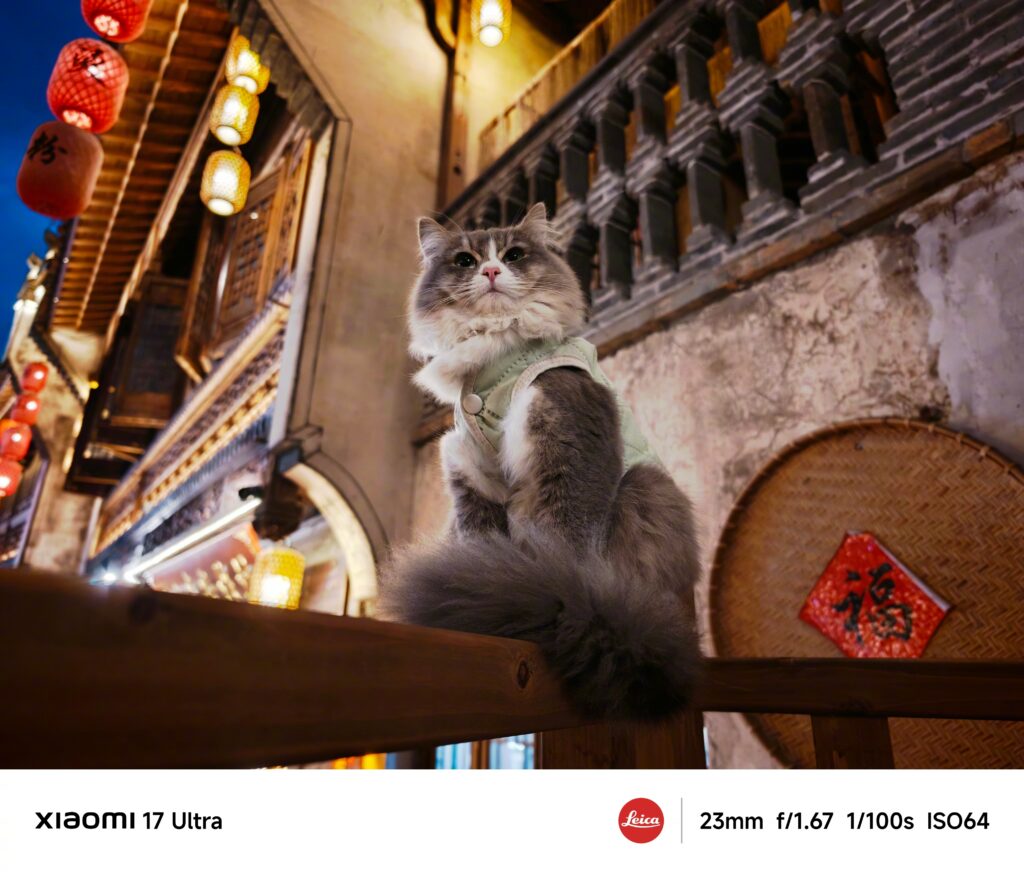
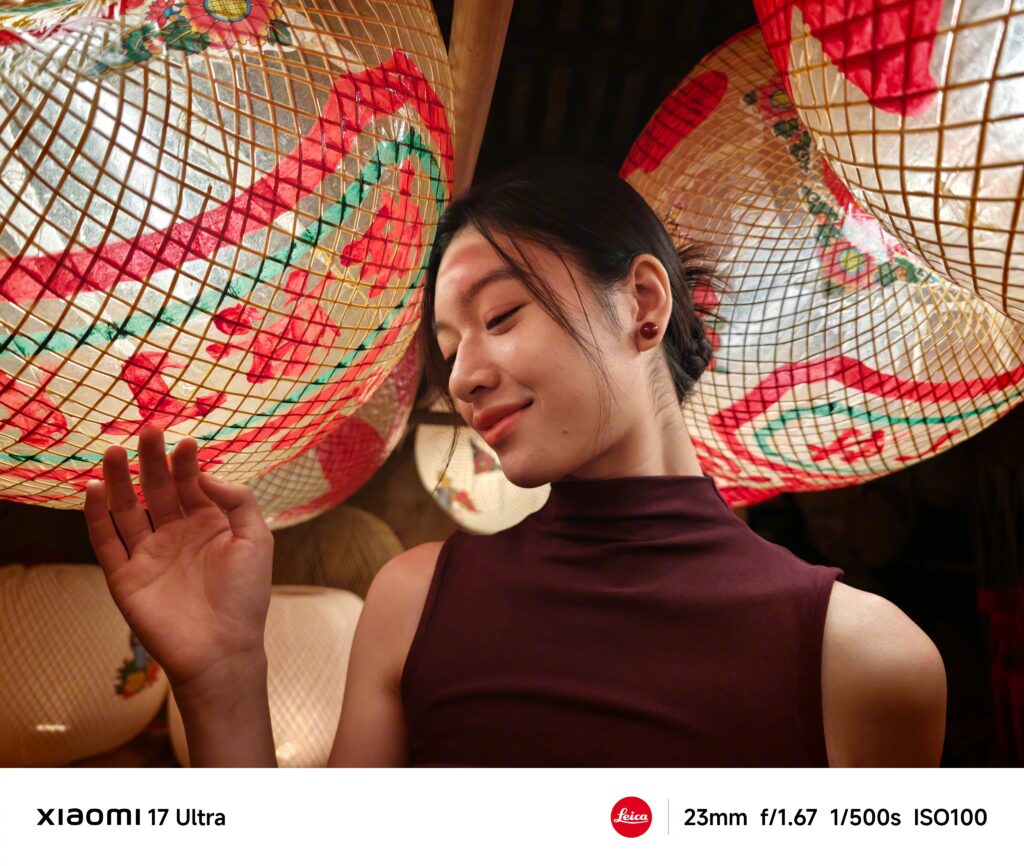
Xiaomi has shared a new set of official camera samples from the upcoming Xiaomi 17 Ultra, offering an early look at its photography and video capabilities ahead of launch.
Posted on Weibo, the samples include both photos and a video. Not all of the samples were taken under ideal lighting. One image of a cat, for example, appears designed to show how the camera handles noise and fine detail after sunset. The photo, shared at a resolution of 4090 × 3482, shows very little visible noise or obvious artificial sharpening when examined closely. The watermark of this low-light shot reveals a 1/100s shutter speed and ISO 64, highlighting how much light the sensor can capture even in challenging environments.
Two additional samples featuring faces suggest natural-looking skin tones, good detail retention, and minimal artifacts. While these are promotional images from a flagship device expected to set the tone for smartphone cameras in 2026, the wider industry shows that noise and artifacts are still not uncommon, even in favorable lighting conditions.
Xiaomi also showcased video footage captured with the phone mounted on a drone, filming fireworks from above. According to the company, its “LOFIC ultra-high dynamic range technology” (translated from Chinese) helps balance exposure and color in high-contrast scenes. Based on the shared clip, highlights appear well-controlled while colors remain vivid.
Some samples, taken in more favorable lighting, are clearly styled and carefully framed. While that’s expected from official material, they still offer a useful glimpse into the technical potential of the Xiaomi 17 Ultra’s camera system.
The company says LOFIC technology improves single-frame dynamic range and enables frame-by-frame intelligent exposure adjustment, with a focus on cleaner high-dynamic-range night shots.
Xiaomi has also confirmed a few hardware details. The 17 Ultra is the thinnest Ultra model the company has made so far, measuring 8.29mm, around 11.3% thinner than its predecessor. More details are expected as Xiaomi moves closer to the phone’s official launch.
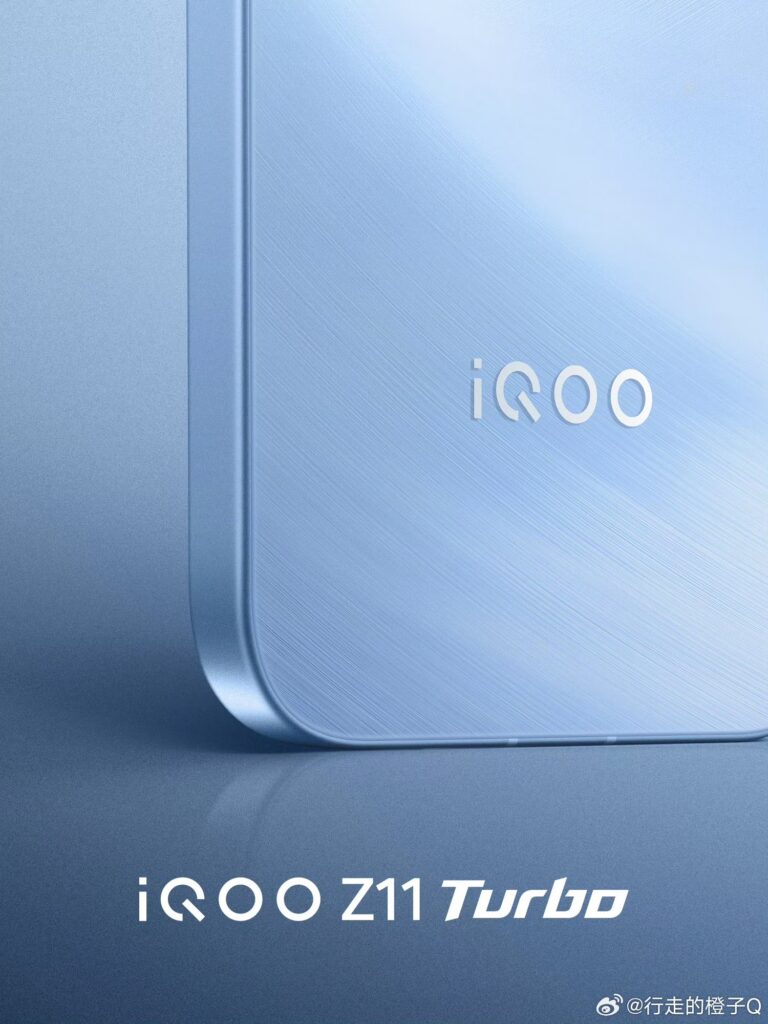
Recent reports have revealed that iQOO is gearing up to a new Z-series phone in China. And today, the brand rolled out the Z11 Turbo’s first teaser to give a glimpse of its design. At the same time, a leak by tipster Digital Chat Station has revealed the key specifications of the device.
iQOO Z11 Turbo’s first teaser released
iQOO Z11 Turbo design teased
The official teaser reveals that the iQOO Z11 Turbo will arrive in a blue shade. While the company has released only the first teaser of this phone, it appears that the device may launch by early January 2026 as only few days are remaining in this month. Also, the company is yet to share the technical details of this device.
iQOO Z11 Turbo specifications (rumored)
According to a recent Weibo post by reliable tipster Digital Chat Station, the iQOO Z11 Turbo will feature a 6.59-inch OLED screen that offers a 1.5K resolution and an ultrasonic in-screen fingerprint sensor.
Under the hood, the Z11 Turbo will feature the Snapdragon 8 Gen 5 chipset and a massive 7,600mAh+ battery. The tipster claims Z1 Turbo offers the largest battery size compared to all other phones in similar form factor. As per another report, the device could be equipped with a 200-megapixel Samsung HP5 primary camera.
In terms of design, the tipster claims that the Z11 Turbo has the same large R corners on the display, a metal middle frame, and a glass back like the iPhone. For durability, the device will offer an IP68/69-rated dust and water resistance. The other details of the device are under wraps, and there’s no clarity whether it will be released globally.
For more daily updates, please visit our News Section.
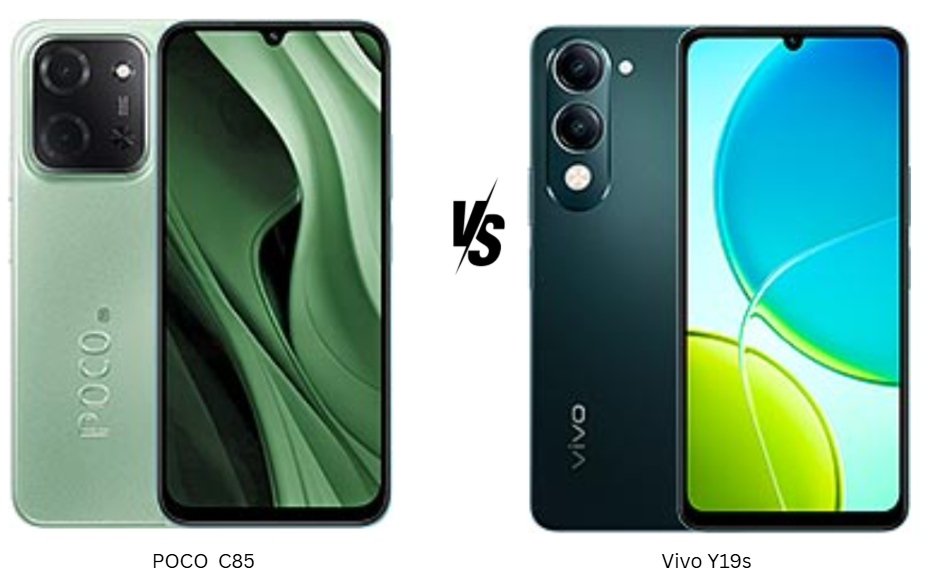
Budget 5G smartphones are no longer about basic compromises, and the Poco C85 vs Vivo Y19s comparison reflects that shift. Both phones target value-focused buyers who want long battery life, smooth everyday performance, and reliable brand support without stretching their budget. For students, first-time 5G users, and practical upgraders, choosing between these two comes down to priorities rather than price. Comparing them side by side matters because small differences in experience can significantly shape long-term satisfaction in this competitive budget segment.
Both phones focus on practicality, but they target different preferences. The Poco C85 has a bolder, more youth-oriented design that feels modern and energetic. The Vivo Y19s looks cleaner and more restrained, fitting better in professional or everyday settings. IP64 protection on both covers basic spills and dust. Vivo’s MIL-STD-810H certification adds reassurance for daily knocks, even if it’s not built for extreme conditions. Overall, the Poco feels more expressive, while the Vivo feels safer and more conservative.
Display Quality
Poco C85 gains a clear edge with its 120Hz refresh rate, making scrolling and animations noticeably smoother. The Vivo Y19s uses a 90Hz panel that still feels responsive but less fluid. Outdoor visibility slightly favors the Poco due to higher brightness. Both displays stick to HD+ resolution, which is acceptable for the price but not especially sharp for text-heavy use.
Verdict
The Poco C85 delivers a smoother, more engaging display, while the Vivo Y19s offers a calmer, more understated visual experience.
2. Specifications
Performance
Both devices use the same Dimensity 6300 chipset, so everyday performance is largely similar. Daily tasks, streaming, and social apps run smoothly on both. The key difference lies in storage. The Poco C85’s UFS 2.2 storage feels faster during app installs and multitasking, especially in higher RAM variants. The Vivo Y19s relies on eMMC storage, which can feel slower over time. In regular use, the Poco feels slightly snappier and more future-ready.
Battery and Charging
Battery capacity is identical, but charging speed changes the experience. The Poco’s 33W fast charging reduces downtime and suits busy routines. The Vivo’s 15W charging feels slow by comparison. Reverse charging on the Poco adds extra flexibility.
Verdict
Thanks to faster storage and charging, the Poco C85 delivers a more satisfying overall performance package.
3. Camera
Main and Secondary Lenses
The Poco C85 clearly leads with its 50MP main camera, producing sharper images and better detail in good lighting. Colors appear more vibrant, making it better for social media and casual photography. The Vivo Y19s’ 13MP camera delivers usable shots but lacks clarity and dynamic range. Low-light performance is limited on both, though the Poco retains slightly more detail.
Selfie Camera
The Poco again has the advantage with a higher-resolution selfie camera that captures clearer facial details and handles HDR better. The Vivo’s front camera is fine for video calls but feels basic for frequent selfies.
Verdict
For users who value camera quality, the Poco C85 feels more capable and consistent overall.
4. Pricing
With similar pricing, both phones offer value in different ways. The Poco C85 focuses on features that are immediately noticeable, smoother display, faster charging, stronger cameras, and quicker storage. These upgrades enhance daily use and keep the phone feeling fresh longer. The Vivo Y19s takes a more conservative route, emphasizing durability claims, stereo speakers, and a simpler overall experience.
For spec-focused buyers, the Poco clearly delivers more for the money. The Vivo Y19s appeals more to users who prioritize stability, brand familiarity, and a no-frills approach. Both are fairly priced, but they serve different buyer mindsets.
5. Conclusion
Poco C85 stands out with its 120Hz display, faster UFS storage, 33W charging, reverse charging support, and higher-resolution cameras. These features make it feel surprisingly advanced for its price. The Vivo Y19s responds with stereo speakers, MIL-STD-810H certification, and a cleaner, more reserved design that suits long-term everyday use.
Verdict
Overall, the Poco C85 feels like the better choice for users who want speed, smoothness, and stronger features right out of the box. It offers better long-term value and a more modern experience. The Vivo Y19s makes sense for buyers who prefer a simpler, sturdier phone with dependable basics. For most budget 5G buyers, the Poco C85 is the more compelling option.
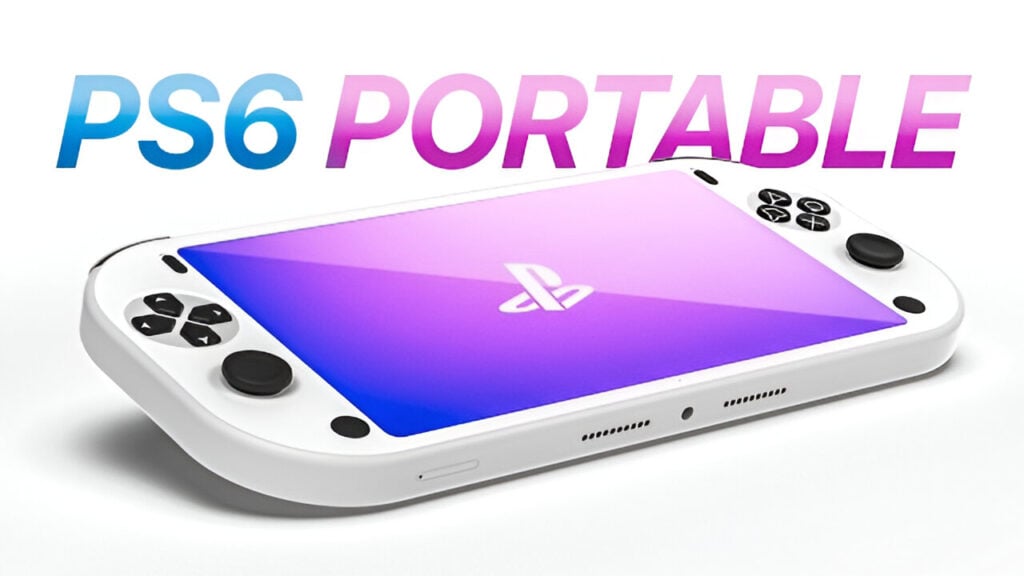
A big leak that surfaced recently has suggested an interesting twist in Sony’s next-gen PlayStation strategy. Rather than chasing raw power like previous consoles, Sony appears to be emphasising low-power, efficient hardware that could possibly support a new PS6 variant that could go all in on handheld gaming. So here’s what the latest leaks reveal and what they could mean for the future of PlayStation gaming.
Recent leaks from hardware insider Moore’s Law Is Dead, and corroborating reports indicate that Sony has been urging developers to prioritise Low Power and Power Saver modes in the PlayStation 5 software development kit. The Power Saver mode is now included by default in PS5 dev tools, and it’s reportedly being treated as a higher priority than some PS5 Pro-specific optimisations. That suggests Sony might be laying the groundwork for hardware that runs at lower total power. All of this basically points to a portable console for a handheld gaming form.
According to leaked documentation, Sony is also encouraging studios to make games that can run on lower CPU configurations, possibly because future PS6 handheld hardware may not support as many high-power cores or threads as a full-fledged console like the PlayStation 5. Leaks claim developers are being asked to ensure games can run using eight CPU threads. In other words, an upcoming PlayStation might have limited horsepower to work with.
2. Moving towards handheld
We have recently seen a bunch of handheld gaming consoles drop in the market, like the new ASUS ROG Xbox Ally series. So the recent leak might be the latest competitor in the market. Furthermore, the power saving focus could imply that Sony wants games to maintain a target framerate by lowering resolution and load, rather than simply throttling physics or cutting frame rates.
This is what led to the speculations of Sony preparing developers to make games that scale better for gaming rigs with lower thermal and power budgets, like handhelds. Other leaks have also suggested that Sony may ship a device with four Zen 6c cores along with two low power cores for background processes. The new configuration wouldn’t make sense on a home console, but favors efficiency in a portable rig.
3. How does the regular PlayStation fit into the bigger picture?
Sony’s Power Saver focus is already showing up in updates, with support for Low Power modes being adding to existing titles and the PS5’s system software. So regular consoles like the PlayStation 5 or the upcoming PlayStation 6 might be for gamers who want to enjoy AAA titles with high graphical fidelity, while the low powered “PS6 Portable” might target players who want console-quality games on the go.
4. What This Could Mean for the Future of PlayStation
If these leaks are to be believed, Sony’s strategy might be a significant shift. The company appears to be redefining expectations around efficiency and optimisation. This mirrors broader industry trends, already seen in mobile gaming, where hardware doesn’t have to be the most powerful ever. In practical terms, this could mean a PS6 handheld that runs games at slightly lower resolutions or uses next-gen upscaling tech to hit framerate targets.
For more daily updates, please visit our News Section.
Some Google Pixel users are growing increasingly frustrated with the company’s aggressive push to integrate AI features across its phones, with complaints suggesting that the experience now feels more cluttered than helpful.
Recent Reddit discussions show Pixel owners questioning whether Google’s AI-first direction is starting to undermine the clean, simple Android experience the lineup was once known for.
The discussion gained traction after a Reddit user, JxK_1, shared concerns about what they described as unnecessary layers of complexity added through AI tools. The user said they preferred using an older Pixel 7, citing its simpler interface and fewer interruptions.
Several complaints focus on day-to-day usability. The Reddit user mentioned full-screen AI overlays appearing when tapping the Google search bar, as well as added steps when editing screenshots. Tasks that were previously one-tap actions now require digging through menus or tapping additional options labeled “more.”
Others echoed similar frustrations. One user pointed out that translating a screenshot, once available through a dedicated button, now involves opening a menu, selecting Google Lens, and locating a small icon. Some commenters suggested disabling AI features where possible, while others said they had considered switching to custom ROMs such as GrapheneOS.
Not all feedback is negative, though. Some Pixel owners defended features like Magic Eraser and AI-powered search, saying they remain genuinely useful. Still, critics argue that these tools demand more system resources, especially RAM.
The debate highlights a familiar challenge for Google: balancing innovation with familiarity and ease of use. As the company continues to lean heavily into AI, some longtime Pixel users say they simply want more control over which features are enabled—and which ones stay out of the way.
Alongside the Nova 15, Huawei has officially launched the Nova 15 Pro and Nova 15 Ultra smartphones in China, positioning them as premium mid-range devices with a strong focus on imaging and AI features.
Huawei Nova 15 Ultra
Nova 15 Pro & Ultra Specifications
Both the Nova 15 Pro and Ultra feature a 6.84-inch OLED flat display with a resolution of 2856×1320 pixels, 10.7 billion colors, and P3 wide color gamut. The panel supports 1-120Hz LTPO adaptive refresh rate and reaches up to 4000 nits peak brightness. The Ultra version adds 2160Hz high-frequency PWM dimming and enhanced Kunlun Glass protection with anti-reflective treatment. Huawei has also integrated AI HDR and dynamic eye-care features across both models.
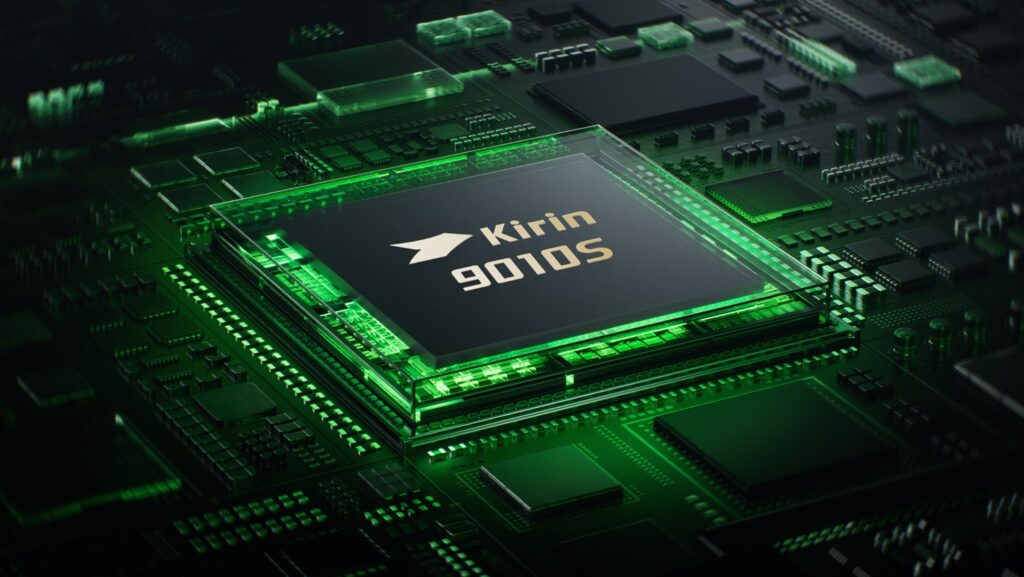
Both devices are powered by Huawei’s in-house Kirin 9010S chipset and run HarmonyOS 6. The company claims an 18% performance boost over the previous generation, with improved system fluency and gaming frame rate stability enabled by HarmonyOS-level hardware-software optimization.
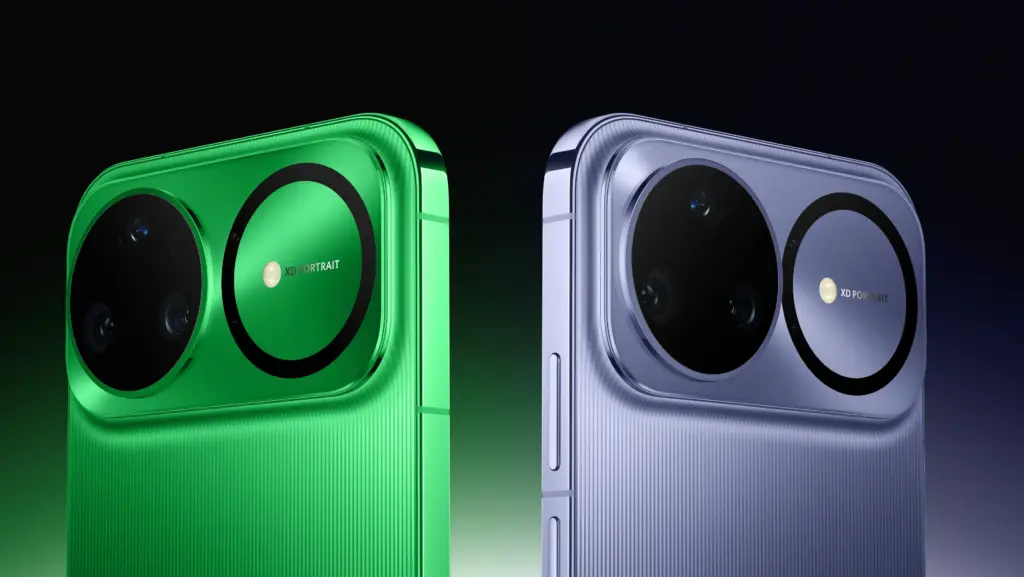
In terms of camera specs, both phones debut Huawei’s Dual Red Maple Imaging system. On the front, they use a 50MP ultra-sensing portrait camera paired with a Red Maple multispectral sensor, supporting 4K video recording and AIS stabilization.
The rear camera setup on the Nova 15 Ultra features three 50MP RYYB sensors: a main camera with a physical variable aperture (f/1.4-f/4.0) and OIS, a 50MP periscope telephoto with 3.7x optical and 100x digital zoom, and a 50MP ultra-wide macro shooter. It also features a 1.5MP Red Maple color sensor that enhances color reproduction. The Pro model swaps out the periscope lens for a 12MP telephoto portrait camera and uses a 13MP ultra-wide macro sensor. It also drops the variable aperture from the main lens.
Huawei Nova 15 Pro
Both models house a 6500mAh silicon-based battery. They support 100W wired Huawei SuperCharge Turbo 3. The Ultra model adds 50W wireless charging and 7.5W reverse wireless charging.
The Nova 15 Ultra includes dual satellite communication capabilities (Beidou image messaging and Tiantong voice), IP68 and IP69 water and dust resistance, stereo speakers with Audio Vivid certification, and advanced call noise reduction. It also supports NearLink digital car keys and lossless audio transmission up to 4.6Mbps. The Pro model skips satellite voice communication, offers IP65 protection, and lacks wireless charging. Both phones support Wi-Fi 7+, Bluetooth 6.0, NFC, USB-C, and multi-band GNSS positioning.
Pricing and Availability
The Nova 15 Pro is priced from 3,499 yuan ($490) for the 256GB variant. The 256GB Kunlun Glass version costs 3,599 yuan ($504), while the 512GB Kunlun Glass model is priced at 3,899 yuan ($546).
The Nova 15 Ultra starts at 4,199 yuan ($588) for the 256GB Kunlun Glass version. The 512GB Kunlun Glass variant is priced at 4,499 yuan ($630), and the top-end 1TB model with Basalt Tempered Kunlun Glass costs 4,999 yuan ($700).
Both phones are already on sale in China and are available in four color options: Vibrant Green, Elegant Purple, Zero White, and Phantom Black.
For more daily updates, please visit our News Section.
OnePlus has confirmed that it will unveil the OnePlus Turbo, a new series of performance-focused smartphones, in January 2026 in China. Ahead of the expected launch, the alleged device has appeared on the Geekbench database. At the same time, a reliable tipster has revealed new details about the phone’s potential global arrival.
OnePlus Turbo Geekbench listing
As seen in the listing, an upcoming OnePlus phone meant for the Chinese market, bearing the model number PLU110, has surfaced on Geekbench. The benchmark data reveals that the device is powered by the Snapdragon 8s Gen 4 chipset. This has been deduced based on the CPU and GPU details available in the Geekbench metadata.
The listing further reveals that the device is equipped with 12GB of RAM and runs Android 16. The handset has also managed to score in both the single-core and multi-core tests.
Previous reports have already claimed that the upcoming OnePlus Turbo will be powered by the Snapdragon 8s Gen 4 chipset. Therefore, it is likely that the model number PLU110 is associated with the OnePlus Turbo. Rumours surrounding the device suggest that it will feature an OLED screen with a 165Hz refresh rate and a massive 9,000mAh battery.
In related news, tipster Abhishek Yadav has claimed that an upcoming OnePlus phone codenamed “Volkswagen” will also feature the Snapdragon 8s Gen 4 chipset. He added that this device could pack a 9,000mAh battery with 80W fast charging support and a 6.xx-inch OLED display offering a 1.5K resolution and a 165Hz refresh rate.
The said device is expected to launch in global markets, including India. While the tipster has not revealed the official name, it could be a rebranded or slightly tweaked version of the OnePlus Turbo. More clarity is expected as additional reports surface in the coming days.
For more daily updates, please visit our News Section.
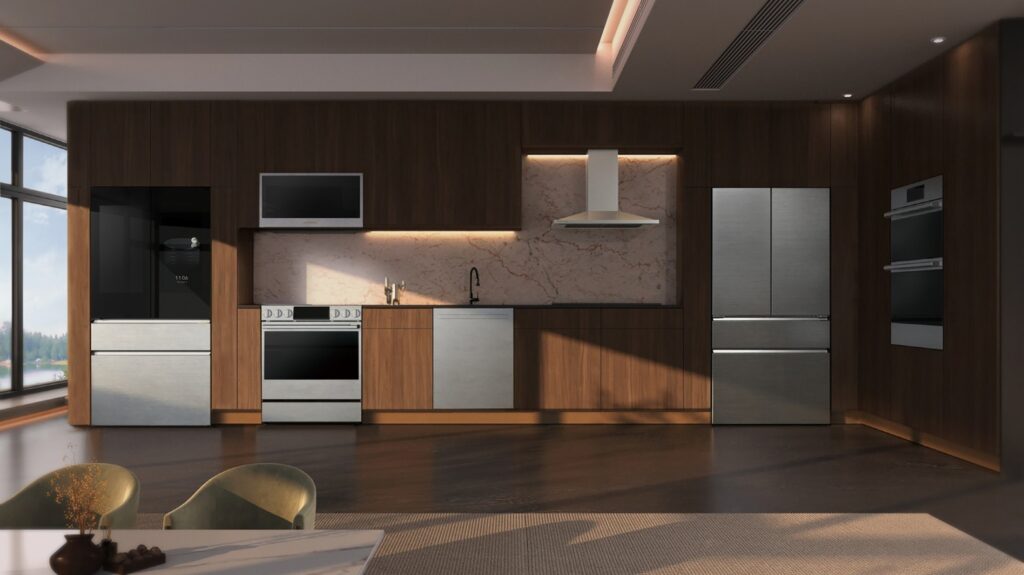
LG Electronics is celebrating ten years of its LG SIGNATURE brand at CES 2026 in Las Vegas with new appliances that use artificial intelligence.
The updated lineup runs on LG’s AI Core-Tech platform, which learns how users interact with their appliances and adjusts settings automatically. The system uses generative AI to make appliances easier to use without requiring manual adjustments.
The main product is a new LG SIGNATURE refrigerator with conversational AI based on Large Language Model technology. Users can talk to it naturally through a 6.8-inch LCD display. The AI Fresh function tracks temperature changes based on how often you open the door and pre-cools the inside up to two hours before you’re likely to use it. This keeps food fresher for longer.
The Smart InstaView model adds ThinQ Food features. An internal camera identifies what’s stored inside, suggests recipes based on available ingredients, and recommends substitutions. When you’re not using these features, the T-OLED InstaView panel shows visual content and blends into your kitchen.
The LG SIGNATURE Oven Range comes with Gourmet AI. An internal camera recognizes more than 85 dishes and sets the correct cooking temperature and time automatically. The AI Browning feature watches your bread while it bakes and sends a notification through the ThinQ app when it reaches your chosen browning level. You can monitor cooking in real time, get a time-lapse summary when it’s done, and share results from your phone.
The design keeps LG SIGNATURE’s Refined Minimal style with clean horizontal lines, gold accents, and detailed craftsmanship. LG is launching three design collections: Seamless, Iconic, and Tailored. These offer different materials and styles while maintaining high performance.
LG partnered with Italian luxury brand Poliform to create display spaces showing how the appliances fit into premium homes. Baek Seung-tae says the expanded lineup aims to set a new standard for premium home appliances by combining design, performance, and user experience.
The full collection is at booth 15004 in the Las Vegas Convention Center from January 6 to 9. LG also has plans to introduce a new wireless home audio system built around the H7 soundbar, as well as its latest Micro RGB evo TVs, which use a new Micro RGB backlight system built from ultra-small, individually controlled RGB LEDs.
For more daily updates, please visit our News Section.
Oppo appears to be preparing its next premium smartwatch, with a new device carrying the model number OOWW261 recently passing network access certification from China’s Ministry of Industry and Information Technology. The listing is widely believed to point to the upcoming Oppo Watch X3.
According to reports, the Watch X3 could debut alongside Oppo’s next foldable flagship, the Find N6. While Oppo has yet to confirm launch details, early certification activity suggests the wearable is moving closer to release.
Tipster @experiencemore claims the Watch X3 may switch to USB-C charging, replacing Oppo’s proprietary solution. If accurate, this would make charging more convenient and reduce the need for specialized cables. Other specifications remain unconfirmed for now.
The Oppo Watch X2 from February 2025 started at 2,499 yuan (about $354 at the current exchange rate), with subsidies bringing the price down to around 2,124 yuan. It featured a titanium alloy bezel with dual-tone finishing, a 1.5-inch LTPO display with a peak brightness of 2,200 nits, and sapphire crystal protection rated above Mohs 8. The watch also included a rotating crown with a pyramid-style texture for navigation.
Battery life was another strong point. Thanks to Oppo’s Glacier Battery technology, the Watch X2 offered up to five days in full smart mode and up to 16 days in power-saving mode. Health features included ECG support, hypertension risk assessment, multi-channel heart rate and blood oxygen sensors, and wrist temperature tracking.
If the Watch X3 builds on this foundation while adding USB-C charging and launches alongside the Find N6, it could strengthen Oppo’s ecosystem of premium devices. More details are expected to surface in the coming weeks.
Huawei has officially launched the Nova 15 in China, positioning it as a feature-rich mid-range smartphone with a strong focus on imaging, battery life, and HarmonyOS-driven AI experiences. Let’s check out the key specs and pricing details.
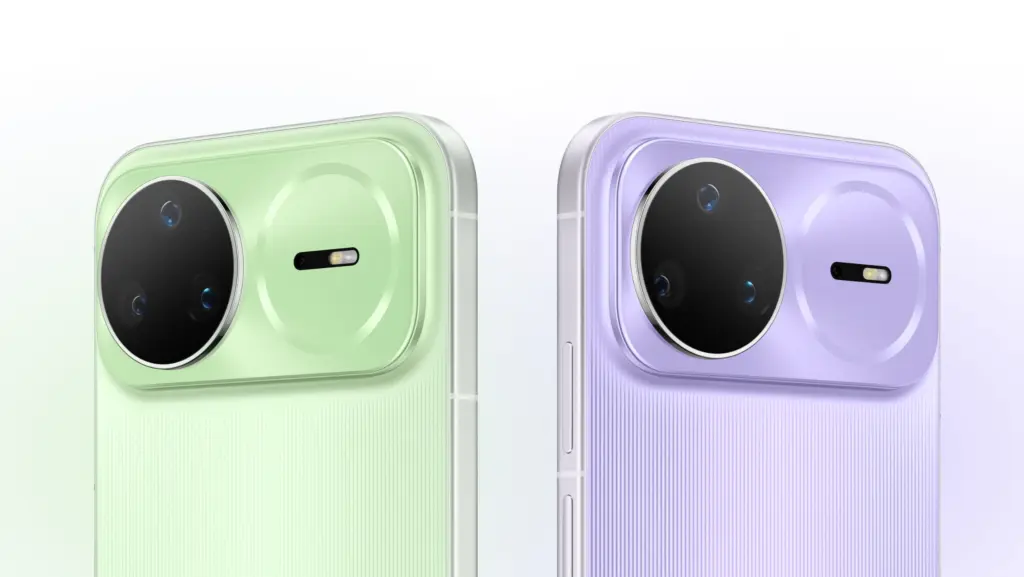
Huawei Nova 15 Specifications
The Nova 15 features a 6.7-inch flat OLED display with a Full HD+ resolution of 2412×1084 pixels. It supports a 120Hz refresh rate, 300Hz touch sampling rate, and 2160Hz high-frequency PWM dimming to reduce eye strain.
The screen is capable of displaying 10.7 billion colors with P3 wide color gamut coverage. For durability, Huawei has used aluminum silicate glass protection, and the display carries SGS five-star certification for improved drop and impact resistance.
The device is powered by the Kirin 8020 processor, Huawei’s latest 5G-ready chipset. Built with performance and efficiency in mind, the chip is said to deliver a 62% overall performance boost compared to the previous generation. Huawei claims a 52% improvement in CPU multi-core performance, 26% in GPU, and 128% in NPU capabilities. The phone also benefits from end-cloud-chip coordination, which enhances app launch speeds, multitasking, and gaming responsiveness.
Out of the box, the Nova 15 runs HarmonyOS 6.0. The new version integrates system-level AI features, including intelligent sensing controls. These enable AI air gestures, AI air transfer, and AI smart payment. The phone also supports HarmonyOS smart communication technologies such as Beidou satellite image messaging and 2.4GHz StarLink off-grid connectivity.
At the back, the Nova 15 includes a triple-camera setup under the Red Maple imaging system. This consists of a 50MP main camera with an f/1.9 aperture and large 1/1.56-inch sensor, a 12MP RYYB telephoto portrait lens with 3x optical zoom and OIS, and a 1.5MP multispectral color sensor for accurate tone rendering. It supports up to 30x digital zoom and 4K video recording. The front houses a 50MP ultra-clear portrait camera with a 90-degree wide-angle lens, a 1/2.5-inch sensor, and 4K video support with AIS stabilization.
The device comes with a 6,000mAh silicon anode battery. It supports 100W Huawei SuperCharge Turbo, enabling rapid charging.
For connectivity, it includes Wi-Fi 7, Bluetooth 6.0, NFC, USB Type-C, and multi-band positioning systems like GPS, Beidou, Galileo, and NavIC. The phone weighs around 196 grams and measures 7.2mm in thickness. It also carries an IP65 rating for dust and splash resistance.
Pricing and Availability
The Huawei Nova 15 is available in two storage options in China. The 256GB variant is priced at 2,699 yuan (around $378), while the 512GB model costs 2,999 yuan (around $420). The phone comes in Vibrant Green, Elegant Purple, Zero White, and Phantom Black, and it is already on sale in the Chinese market.
For more daily updates, please visit our News Section.
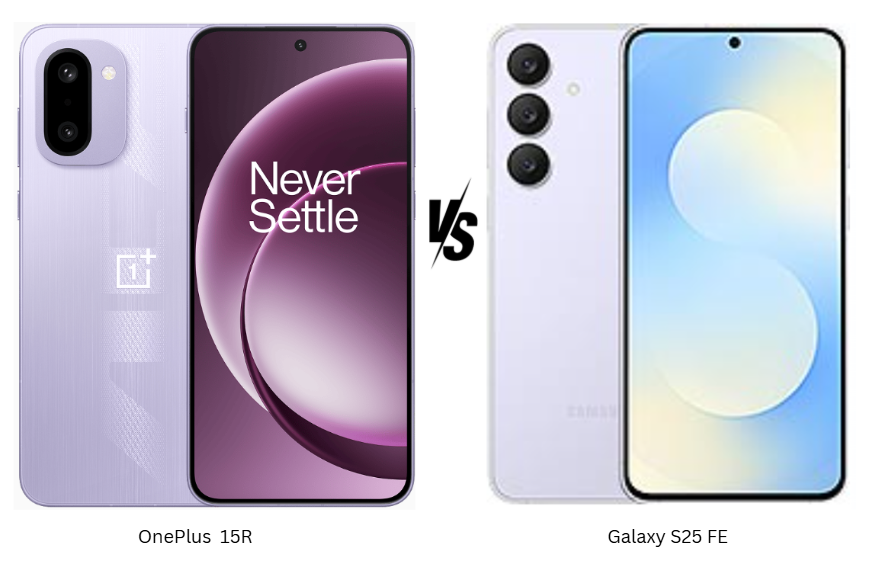
OnePlus 15R and Samsung Galaxy S25 FE attract the same buyer for very different reasons. One promises speed, power, and a more thrill-driven experience, while the other offers familiarity, balance, and long-term peace of mind. This comparison matters because choosing between them isn’t about brand loyalty; it’s about deciding whether day-to-day excitement or long-term reliability matters more. For buyers spending flagship-level money, understanding this difference can make the purchase feel like a smart choice.
The OnePlus 15R goes for a bold, performance-first look with a distinctive rear finish that feels more experimental and tech-driven. It stands out visually and feels purpose-built rather than decorative. The Galaxy S25 FE sticks to a familiar premium formula with polished glass and a refined frame, giving it a cleaner, more conservative appeal. OnePlus feels more daring in the hand, while Samsung feels immediately comfortable and familiar.
Display Quality
OnePlus delivers an ultra-smooth AMOLED experience that prioritizes motion clarity and visual punch. Scrolling and gaming feel exceptionally fluid. Samsung’s display is more restrained but highly refined, with excellent color balance and adaptive smoothness that works well for long viewing sessions. The OnePlus display feels exciting, while Samsung’s feels more controlled and easygoing.
Verdict
OnePlus wins on bold design and visual impact. Samsung counters with refinement and long-term viewing comfort.
2. Specifications
Performance
The OnePlus 15R focuses on raw speed and sustained performance, handling heavy multitasking and demanding apps with ease. It feels tuned for users who push their phones hard. The Galaxy S25 FE delivers stable, reliable performance for daily use, but it prioritizes efficiency over peak power. OnePlus feels faster under pressure, while Samsung feels more measured and consistent.
Battery and Charging
OnePlus emphasizes endurance and fast wired charging, making it well-suited for heavy users who value quick top-ups. Samsung offers more flexibility with wireless and reverse charging, fitting better into a connected device ecosystem. OnePlus feels more direct and performance-focused, while Samsung feels more versatile.
Verdict
OnePlus suits power users who want speed and stamina. Samsung fits users who prefer balance and charging flexibility.
3. Camera
Main and Secondary Lenses
Samsung takes the lead in versatility with a well-rounded camera system that covers everyday shots, portraits, and zoom photography. Image processing is consistent, and video recording feels especially polished. OnePlus focuses more on primary camera quality, delivering sharp and contrast-rich images, but with fewer creative options due to limited secondary lenses.
Selfie Camera
The OnePlus front camera captures more detail and works well for video calls. Samsung’s selfie camera prioritizes natural skin tones and consistency across lighting conditions, which often looks better for social sharing.
Verdict
Samsung wins overall for camera flexibility and video strength. OnePlus delivers strong main-camera results but feels more specialized.
4. Pricing
With similar pricing, the OnePlus 15R delivers immediate value through performance, display smoothness, and battery confidence. It feels exciting from day one. The Galaxy S25 FE justifies its price through long-term software support, ecosystem features, and overall reliability. Its value becomes clearer over time rather than instantly.
OnePlus appeals more to spec-focused buyers who want maximum performance per dollar. Samsung targets users who prioritize longevity, updates, and a well-rounded ownership experience.
5. Conclusion
The OnePlus 15R stands out for its performance-driven identity, fast charging, and high-refresh display that favors power users. The Galaxy S25 FE differentiates itself with extended software support, camera versatility, wireless features, and ecosystem integration that quietly adds long-term value.
Verdict
If we have to choose one, then the OnePlus 15R is the better overall choice. It delivers stronger performance, a smoother and more immersive display, and significantly better battery confidence at the same price. It feels faster, more future-proof, and more rewarding in day-to-day use. The Galaxy S25 FE remains a solid, safe option for long-term software support and camera versatility, but the OnePlus 15R offers the more compelling all-around value right now.
We use cookies on our website to give you the most relevant experience by remembering your preferences and repeat visits. By clicking “Accept”, you consent to the use of ALL the cookies.
This website uses cookies to improve your experience while you navigate through the website. Out of these, the cookies that are categorized as necessary are stored on your browser as they are essential for the working of basic functionalities of the website. We also use third-party cookies that help us analyze and understand how you use this website. These cookies will be stored in your browser only with your consent. You also have the option to opt-out of these cookies. But opting out of some of these cookies may affect your browsing experience.
Necessary cookies are absolutely essential for the website to function properly. This category only includes cookies that ensures basic functionalities and security features of the website. These cookies do not store any personal information.
Any cookies that may not be particularly necessary for the website to function and is used specifically to collect user personal data via analytics, ads, other embedded contents are termed as non-necessary cookies. It is mandatory to procure user consent prior to running these cookies on your website.