The Apple Glass, an AR headset, may offer a few interesting features. To make the whole experience more immersive it could offer an accurate reproduction of sounds on a 3D plane, according to a report from AppleInsider.
Virtual reality in gaming and augmented reality has become increasingly more popular in recent times, and the people behind such technology are constantly trying to make the world you see more believable. The latter in particular has revolved around bringing more to the mundane world around the user. Thus, the added realism from the accurate audio could make digitally created structures seem more genuine.
This could also help improve interactions with said artificially produced objects in the users’ vision. While most stereo headphones offer basic left and right differentiation, a virtual sound system can reproduce audio positioning on a 3D plane by altering the properties of the sound effects to mimic the distortions caused by different factors.
The Apple patent titled “Head related transfer function selection for binaural sound reproduction,” points at such a system. In simpler terms, the Cupertino based giant seeks to improve 3D sound positioning by having Head related transfer function (HRTF), which is basically a pair of acoustic filters for each ear. These help in differentiating the transmission of sounds from various positions in the environment around the user.
Unfortunately, the Apple patent does show the company’s interest in this field. Although, it does not provide any guarantee that the company would work on such a system. Rather, it could be their efforts in covering various bases for future possibilities which are again unlikely.
While foldable smartphones were first seen commercially in 2019, only a few OEMs have so far launched such devices. This includes brands like Huawei, Samsung, and Motorola. However, Vivo might also be joining the club as a new patent application suggests a possible foldable handset.
Samsung Galaxy Fold 2 render by Benjamin Geskin
Vivo recently applied for a number of new patents that were under the display and electronic equipment title, according to a MyDrivers report. The description reveals a new display technology and an electronic device. What’s interesting is that the display is flexible, with multiple layers. The flexible display will be connected to a protective layer through a type of adhesive.
According to the patent, the display is made of three parts, with the first and second being protective layers that surround the third layer that is the flexible display. The emphasis on display protection is likely to provide a solution to the issue that the current generation of flexible displays faces, which are easier to damage than conventional screens.
Furthermore, the Chinese tech giant also patented two other patents for the display technology and an electronic equipment/device. The patent for these mainly highlights the connection between the device and the display, while the former application solely aimed at protection and durability. This might be Vivo’s attempt at a future possible foldable smartphone launch or just simply covering all bases. Unfortunately, it is also unknown if the company would actually work on such a device.
The Xiaomi Mi TV Sick is one of the most leaked gadgets of 2020. It was officially unveiled for the European market at “Xiaomi Ecosystem Product Launch 2020” earlier this month. Now, within a few days, the streaming stick (1080p version) has been also confirmed to launch in India on August 5.
Xiaomi is India’s largest smartphone as well as smart TV brand in terms of shipments. In May of this year, the company launched Mi Box 4K in the country as a rebranded Mi Box S for only ₹3,499 ($47).
With the launch of Mi TV Stick 1080p next month, the company will try to enter more living rooms in the country as we expect it to be priced somewhere around ₹2,499 ($33). For context, the same product retails for €39.99 in Europe, which equals to the price of Mi Box 4K in India. Hence, we believe the Mi TV stick to be at least ₹1,000 cheaper as it has fewer features.
Talking about specifications, the Xiaomi Mi TV Stick 1080p is powered by a 2.0GHz quad-core processor consisting of Cortex-A53 cores paired with Mali-450 GPU and 1GB RAM along with 8GB eMMC storage. As the name suggests, the streaming stick supports a maximum resolution of FHD.
It features Bluetooth 4.2, dual-band WiFi, 1 x HDMI 2.0a, 1 x MicroUSB, Android TV Pie with support for leading streaming platforms such as Netflix, Chromecast built-in, and comes with a voice remote for Google Assistant.
Adam Zheng, the former CEO of ZTE mobile division might be joining Xiaomi as the Vice President of the company and the Mobile Phone Department President, according to a new report.
Adam Zheng resigned from ZTE back in 2017 and has 20 years’ worth of experience in the industry. His portfolio includes notable roles in various top brands including Sharp, ZTE, and more. Now, a new rumor has suggested that he has also been appointed by Xiaomi to lead the research and development and production of its smartphone offerings.
Notably, Zheng had founded Huixin Communication, a joint venture between the local government and scientific groups. Xiaomi had invested in this joint venture which focused on developing cutting edge technology and improve the 5G infrastructure as well. Furthermore, Xiaomi has been actively recruiting various high ranking officials from different companies since last year.
Thus, the move of hiring a former ZTE mobile division CEO could be a part of the same plan. For those unaware, Xiaomi has recruited individuals like Lu Weibing, Gionee President, Chang Cheng, the Lenovo Mobile Phone business founder, and others. According to a Xiaomi official, “Only by continuously introducing external talents can our team be full of vitality.”
OnePlus has been using AMOLED display on its smartphones starting with OnePlus 3 from 2016. But even after 4 years, the company’s handsets still lack AOD (Always-on Display). Thankfully, earlier this year in March, this feature got enough votes through the OnePlus IDEAS program to get selected for implementation. Later, in May, the brand even shared a rough timeline for the rollout. Now, Pete Lau, the founder and CEO of OnePlus officially teases the arrival of AOD on Twitter.
OxyygenOS is one of the most popular Android skins in the market, thanks to its resemblance to stock Android and quick animations. Though it has tons of useful features and customization options, it still lacks Always-on Display.
As a matter of fact, AOD has been the most requested feature on OnePlus smartphones for years now. Looks like it is finally coming with the release of OxygenOS 11 based on Android 11 as per a teaser image tweeted by none other the company’s CEO Pete Lau.
His tweet simply reads “11 on display” with a picture of AOD-esque analog clock. According to a timeline shared by the brand, the development for Always-on Display should have begun in June and it should be incorporated in Closed Beta builds in August, followed by Open Beta in September.
In other words, supported devices, probably OnePlus 6 and above will be getting AOD by the end of this year if the company manages to roll out stable Android 11 to them by then.
Apple’s true wireless earphones, dubbed as AirPods, remains one of the best-selling products from the company. The company improved the offering with the launch of AirPods Pro by introducing an active noise cancellation feature.
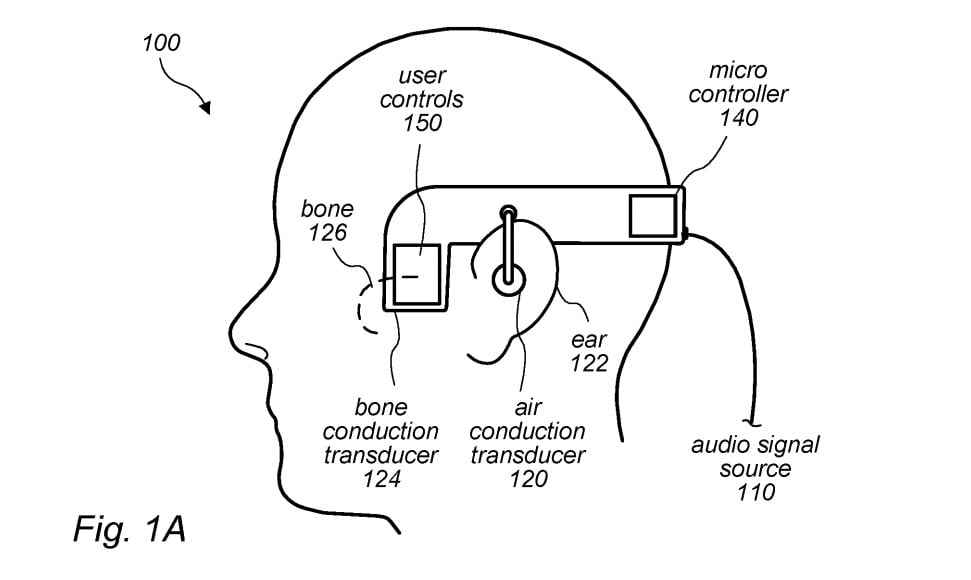
Now, a new patent granted to Apple (via AppleInsider) suggests that the company could be working on a new version of AirPods with bone conduction audio. The US-based tech giant has proposed a system that combines bone conduction with normal air-based sound transmission.
For those who are unaware, bone conduction includes transmitting sound to the inner ear through the bone of the skull. This allows users to hear audio content without blocking the ear canal or using earpieces.
However, there are some drawbacks to this technology, mainly the lack of its ability to work at high frequency. Human hearing ranges from 20Hz to 20,000Hz but bone conduction is only effective at sub-4,000Hz levels and then the audio quality starts deteriorating. Also, for the technology to work, it required contact with the head but causes a tactile tickling sensation, which could be annoying for some users.
Apple patent has a workaround for the high-frequency audio. It will deliver mid- and low-frequency signals using a compressor through bone conduction while the high-frequency signals will be transmitted through air, enabling the best of both worlds.
The patent from Apple titled “Multipath audio stimulation using audio compressors” was originally filed in May 2018. Do note that Apple files the number of patents every year and not all of them materialize into commercial products.
Ming-Chi Kuo, a well-known Apple analyst, claims that the next-generation AirPods, likely to be named AirPods 3 with bone conduction technology, will have the same design as the AirPods Pro and could get launched ahead of next year’s WWDC.
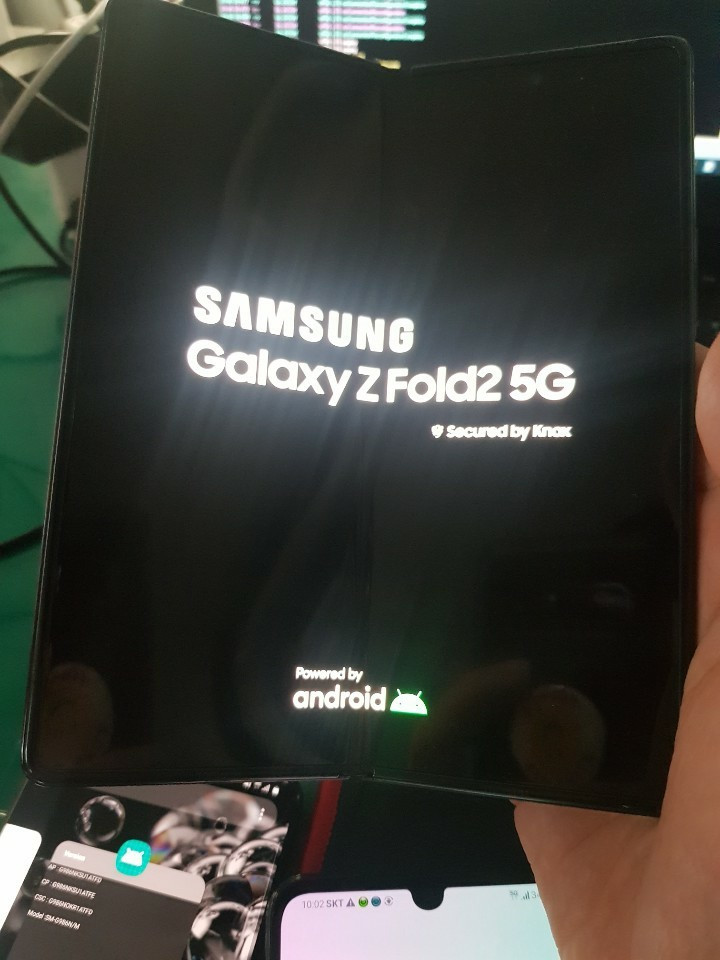
Samsung will be announcing a new foldable smartphone alongside the Galaxy Note20 series, Galaxy Tab S7, Galaxy Watch 3, and Galaxy Buds Live on Aug. 5. Initial rumors dubbed the device as Galaxy Z Fold, but newer reports revealed that it could be called Galaxy Z Fold 2. A leaked image of the device was shared by a Twitter user via Max Weinbach. It confirms that it will indeed break cover as Galaxy Z Fold 2. Also, it gives a look at the refreshed inner display of the Z Fold 2.
The Samsung Galaxy Fold that debuted last year came with a 7.3-inch inner display. A notch was placed at the top-right corner of the screen. It housed a dual-camera setup.
Due to the glare from the logo on display, the design of the internal screen is not clearly visible in the leaked shot. However, it does seem to show that the South Korean company has done away with the notch. Instead of the notch, it appears to feature a punch-hole for the front cameras. The design appears to match with the following leaked render of the Z Fold 2 that appeared last month.
Rumors have it that the Galaxy Z Fold 2 has a 7.59-inch internal AMOLED display that supports 2213 x 1689 pixels resolution and 372ppi pixel density. The internal display is said to support 120Hz refresh rate. The display cutout could be featuring a 10-megapixel front camera.
The Galaxy Z Fold 2 is rumored to come with a 6.23-inch cover display with slim bezels around it. It could be a 60Hz screen that may produce 2267 x 819 pixels resolution. It is also expected to sport a punch-hole design.
Samsung Galaxy Fold 2 🔥 Render based on latest leaks
The Snapdragon 865 Plus SoC is expected to fuel the device. It could be sporting a 12-megapixel (ultrawide) + 12-megapixel (wide-angle) + 64-megapixel triple camera system. It could be housing a 4,365mAh dual-part battery that will support 25W fast charging and 15W wireless charging. The foldable phone could be available in 256 GB and 512 GB storage choices.
Samsung Electro-Mechanics, an electronic component manufacturing arm of the South Korean giant Samsung, is now considering to enter the mid-range smartphone camera module market. This was announced by the company during its second-quarter earnings call earlier this week, as reported by The Elec.
The company’s Vice President Bae Kwang-wook said that the company demand for camera modules of mid-range smartphones has been on the rise and it anticipates increased demand for the high-resolution sensors and optical zoom sensors.
He added that the company has been planning to enter this market for some time and it plans to compete based on the pricing of the module. Samsung Electro-Mechanics will likely provide high-resolution camera modules for the Samsung Galaxy A-series phones.
Interestingly, the announcement comes just a day after it was reported that Samsung Electro-Mechanics has secured a contract from Apple to supply camera parts as the US-based tech giant looks to diversify its supply chain.
Samsung Electro-Mechanics, which has supplied camera modules for premium smartphones such as Galaxy S- and Galaxy Note-series, could be entering the mid-range market because of the falling demand for premium phones.
In line with this, it is also being reported that the company could introduce Optical Image Stabilization (OIS), a premium feature, for the upcoming Galaxy A-series smartphones launching next year. It is also planning to offer differentiating features such as better optical zoom and slimmer design.
For the second quarter of this year, the company posted 96 billion won in operating profits and 1.8122 trillion won in revenue, which represents a decline of 41 percent and 5 percent, respectively compared to last year.
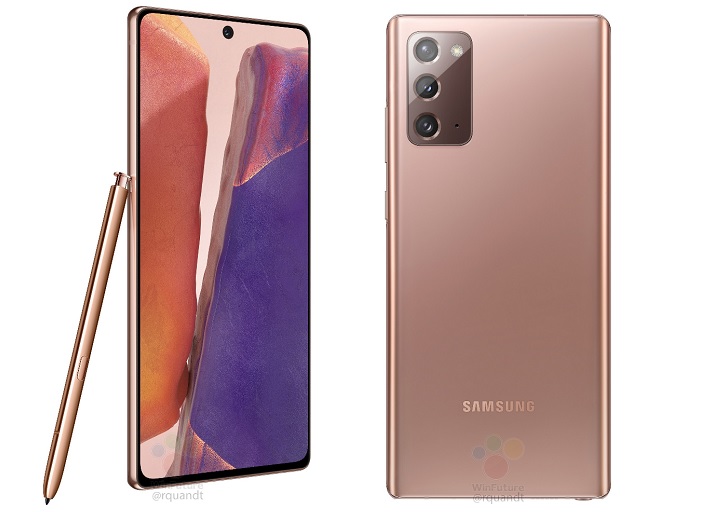
Samsung is all set to launch its next-generation Galaxy Note20 series flagship smartphones next week through a virtual Galaxy Unpacked conference. While most of the details about the phones have surfaced online, we are getting some more info ahead of the launch.
While the flagship smartphones will come powered by the Qualcomm Snapdragon 865 Plus chipset, some markets will get the Samsung Exynos 990 variant. The new report claims that the Exynos 990 has been improved and seems more like 990 Plus.
Samsung Galaxy Note20
Essentially, it is said that the Exynos 990 chipset packed inside the upcoming Samsung Galaxy Note20 smartphone is different from the one found in the Galaxy S20 series smartphones launched earlier this year.
The Exynos 990 chipset has been optimized with improved performance and will be on-par with the newly announced Qualcomm Snapdragon 865 Plus chipset. However, this is just a claim by a tipster and we need to test the device once it launches, to confirm the claim related to improved performance.
I Hope everyone understands this:
The Exynos 990 on Note 20 series is an improved version with better optimization than the Snapdragon version and runs just as cool and just as fast as the Snapdragon.Its like an Exynos 990+
Samsung will also market the Exynos990 model as better
As per the reports, the Samsung Galaxy Note20 is expected to come with a 6.7-inch Full HD+ flat display with 2400 x 1080 pixels screen resolution and 60Hz refresh rate. In the camera department, the phone could have a triple-camera setup on the back, consisting of a 12MP + 12MP + 16MP sensors.
Samsung Galaxy Note20 Ultra
The device is also said to come with features like Bluetooth 5, Wi-Fi 6, IP68 rating, stereo speakers, dual-SIM support. Running on Android 10 with Samsung One UI on top, the device will be powered by a 4,300mAh battery.
Coming to the pricing, as per the leaks, the European pricing is likely to start at €999. Recent leak claims that in India, the smartphone will be priced at ₹77,999 (~$1,043) while the Galaxy Note20 Ultra will cost ₹1,05,999 (~$1,418).
After a considerable delay due to the COVID-19 pandemic, Vivo unveiled the Vivo V19 smartphone in India in May. The handset was introduced with a price tag of Rs. 27,990 (~$374). After two months of making it available for purchase, the Chinese firm has now slashed its price by Rs. 4,000 (~$54) in the country.
The Vivo V19 was introduced in two models in India. The 8 GB RAM + 128 GB storage and the 8 GB RAM + 256 GB storage version of the V19 were priced at Rs. 27,990 (~$374) and Rs. 31,990 (~$428), respectively. With the new price revision, these models are now available for Rs. 24,990 (~$334) and Rs 27,990 (~$374), respectively. The Vivo V19 will be available with Rs. 4,000 (~$54) price cut until Aug. 31.
The Vivo V19 can be now bought with revised pricing through Vivo India’s official website, Flipkart, Amazon, and other retailer sites. The handset is also available discounted price tags trough offline stores in the country. The Vivo V19 can also enjoy other benefits like 10 percent cash back for EMI transactions through ICICI bank cards, one-time screen replacement, EMI plans, and Jio benefits worth Rs. 10,000 (~$133).
The Vivo V19 has a 6.44-inch AMOLED screen that offers Full HD+ resolution and 20:9 aspect ratio. The pill-shaped cutout on the screen has a 32-megapixel main selfie snapper and an 8-megapixel ultrawide lens. The back panel of the device is decked with a 48-megapixel + 8-megapixel (ultrawide) + 2-megapixel (macro) + 2-megapixel (portrait) quad-camera system.
The Snapdragon 712 mobile platform fuels the Vivo V19 with LPDDR4x RAM. The handset has UFS 2.1 storage and it boots to FunTouch OS 10 based Android 10 OS. The 4,500mAh battery of the Vivo V19 supports 33W fast charging.
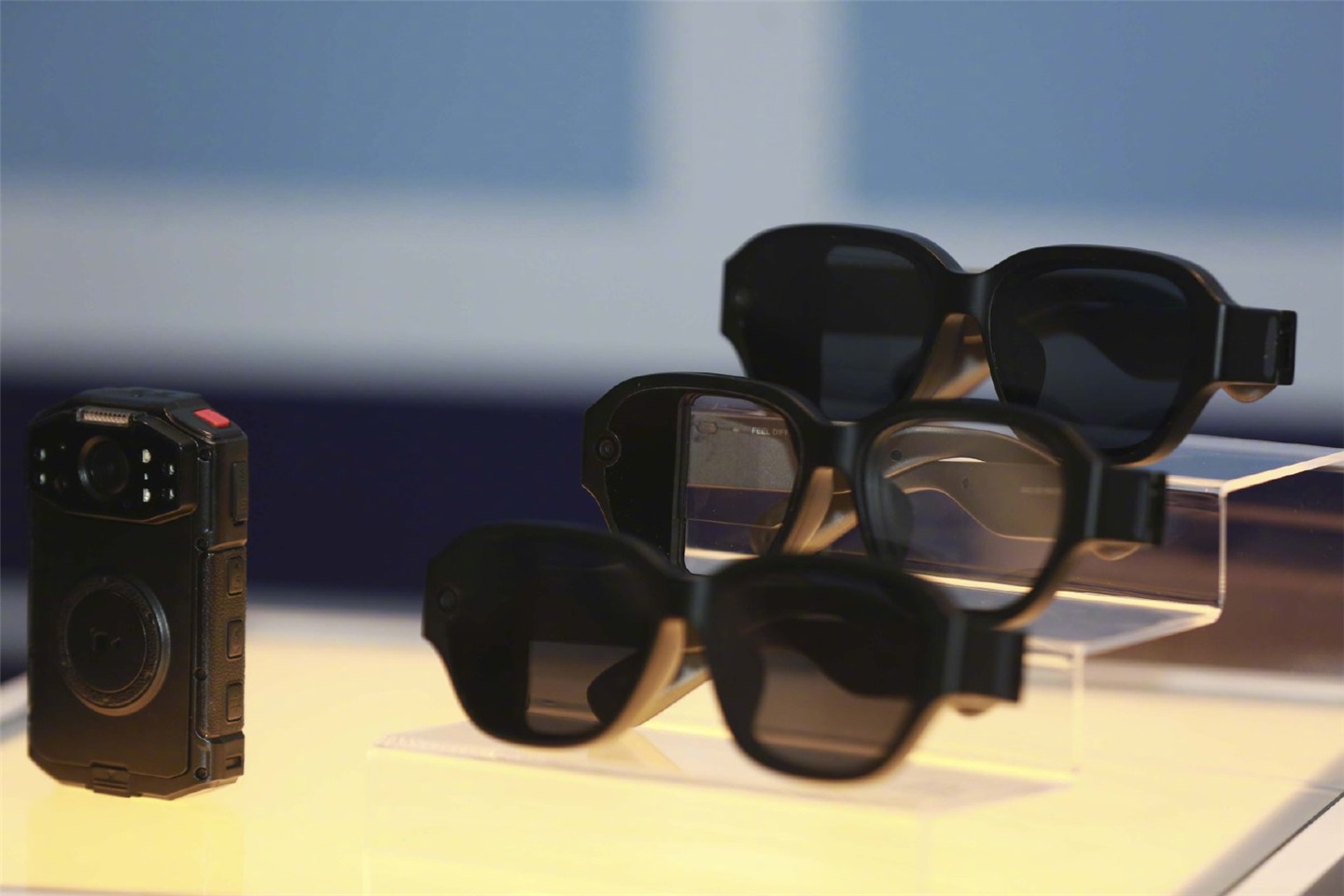
Coolpad Group hosted a new product launch conference with the theme of “Unlimited Horizons” and at the event, the Chinese company launched its smart wearable AR glasses, dubbed as Coolpad Xview.
The company claims this newly launched smart device as the first wireless all-in-one AR glasses in China. It is also claimed to be the first such device in the market to come powered by a wearable chipset.
Coming to design, it seems very similar to the regular sunglasses and has lens measuring just 3mm. The product comes with an optical display which is equipped with optical waveguide technology. Coolpad claims that it offers industry-leading light transmittance, contrast, and color.
As for the interactions, it offers high-precision fusion positioning, space marking, target recognition, and tracking along with other features powered by algorithms based on the wearable chipset. This is achieved through a 5-year collaboration of Coolpad and Beijing University of Aeronautics and Astronautics.
The company has launched two variants of this new Coolpad Xview Smart Wearable AR Glasses. The consumer version is focused on lightweight AR apps such as navigation, shopping guide, communication, etc. It can be used in a standalone mode or can be connected to smartphones through Bluetooth.
There’s another variant of the same which comes with support for 4G connectivity, which is also claimed to be the first. The company is now planning to introduce support for 5G connectivity as early as next year.
As for the pricing, the Coolpad Xview consumer version is priced at 2,999 yuan which roughly converts to $428. The company is yet to reveal availability details, but it will definitely be limited to the Chinese market for now.
The Indian government banned 59 Chinese applications earlier this year which includes some of the most popular apps such as TikTok, ShareIt, UC Browser, WeChat, CamScanner, and more. Recently, India banned 47 more apps, which mostly include the ‘Lite’ versions or clones of the apps banned earlier.
Now, it is being reported that the government has prepared a list of 275 Chinese apps which are being studied for potential privacy and security issues. The list includes some of the biggest names, including PUBG Mobile and Alibaba‘s AliExpress.
The report adds that more applications from ByteDance, the parent company of TikTok are under scrutiny, including Resso music streaming and ULike. Further, 14 applications from Xiaomi or Mi are also being tested for the said violations.
The ban on PUBG Mobile could be a serious blow to PUBG Corporation, backed by Tencent. With more than 175 million installs, India is the largest market for the game, accounting for around 24 percent of the total downloads.
However, do note that the Indian government could ban all of these apps, some of these apps, or none of them. There’s no certainty about this and there’s no timeline about when this could happen. It is also being reported that the Indian government is developing a formal process for such bans, including a law or regulation that would require constant monitoring of apps.
When India banned the 59 apps earlier this year, Ji Rong, spokesperson of the Chinese Embassy in India, has said in a statement that China firmly opposed the decision and claimed that it’s a “violation of World Trade Organisation rules.”
The decision of banning Chinese applications is a result of rising tensions related to border disputes between India and China. Along with banning apps, India has also restricted neighboring countries from bidding on public contracts, exclusive Bangladesh, Myanmar, and Nepal which means that it is clearly targeting China.
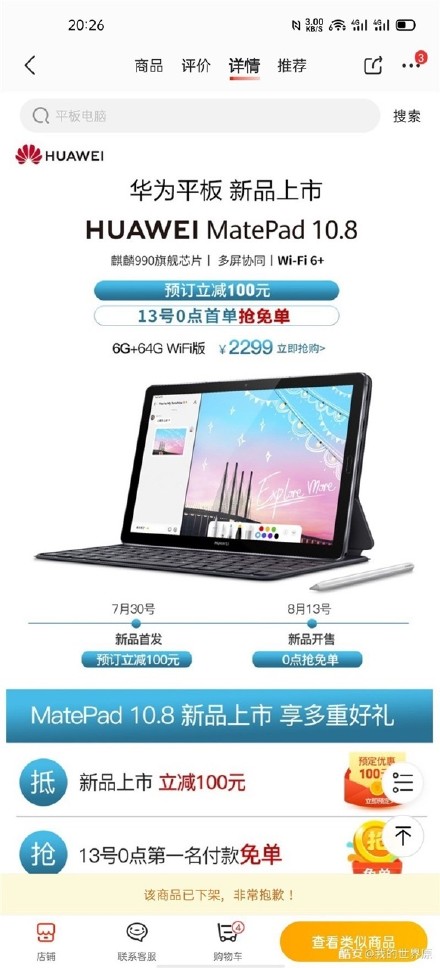
Today, Huawei confirmed that it will be holding a launch event on July 30 to announce a couple of new devices such as the MatePad 10.8 tablet, MateBook D 15 2002 Ryzen Edition, TalkBand B6 fitness tracker, and Kids Watch 4X. It appears that the Chinese retailer JD.com jumped the gun by adding a listing for the MatePad 10.8. The listing is no available on the retailer site, but its screenshot is now doing rounds on Weibo.
The screenshot shown above shows that the Wi-Fi-only version of the MatePad 10.8 with 6 GB of RAM and 64 GB of storage is priced at 2,299 Yuan (~$328). The listing states that the product will be announced on July 30 and the company will carry out its sales on Aug. 8. It also reveals that people who purchase the device during the first sale will benefit from 100 Yuan (~$14) discount.
A poster of the MatePad 10.8 with its key features and specs is also being circulated on Weibo. The image has revealed that the tablet is powered by the Kirin 990 SoC and 6 GB of RAM. The device draws power from a 7,500mAh battery.
The 10.8-inch screen of the MatePad 10.8 produces 2K resolution. Also, the display delivers an aspect ratio of 16:10. The tablet is equipped with support for Wi-Fi 6 connectivity.
The MatePad 10.8 is fitted with Harmon Kardon tuned quad speakers for 3D stereo output. The speakers are coupled with Histen 6.1 audio technology from Huawei.
The tablet carries support for NFC connectivity and M-Pencil stylus. Past reports have stated that the device has a rear camera of 13-megapixel and it has a front camera of 8-megapixel. A recent report had claimed that the Chinese firm had previously planned to launch the device as Huawei MediaPad M7.
A Vivo phone that has a model number of V2024A was spotted on the Geekbench benchmarking platform in June. The listing revealed that it is an upcoming flagship phone from the brand powered by the Snapdragon 865 or Snapdragon 865 Plus SoC. The V2024A has now passed 3C certification in China. It is unclear whether this phone will be breaking cover as a Vivo or an iQOO branded device. The 3C certification is a good hint that the phone may go official as early as next month.
When the V2024A had appeared on Geekbench, some reports had claimed that it could be the iQOO 3 Pro 5G smartphone. The 3C listing of the phone reveals that it carries support for 5G connectivity. The charger that can be seen in the listing supports a maximum charging rate of 11V/5A (55W).
The Geekbench listing of the Vivo V2024A had revealed that it runs on Android 10 OS. The listing also revealed that the device has 8 GB of RAM. Apart from these details, there is no other information available on its specs. Hence, it is unclear whether this device could be arriving in the market as iQOO 3 Pro 5G.
iQOO 3 Pro 5G specifications (Rumored)
A Chinese tipster had shared alleged specs of the iQOO 3 Pro 5G last month. It was revealed that the Snapdragon 865+ iQOO 3 Pro 5G will have a 90Hz 6.56-inch AMOLED display with an in-screen fingerprint reader. The phone will have up to 12 GB of LPDDR5 RAM and 256 GB of UFS 3.1 storage. It will have a 16-megapixel selfie snapper and a Sony IMX586 48-megapixel + 8-megapixel + 13-megapixel triple camera setup. It will house a 4,500mAh battery.
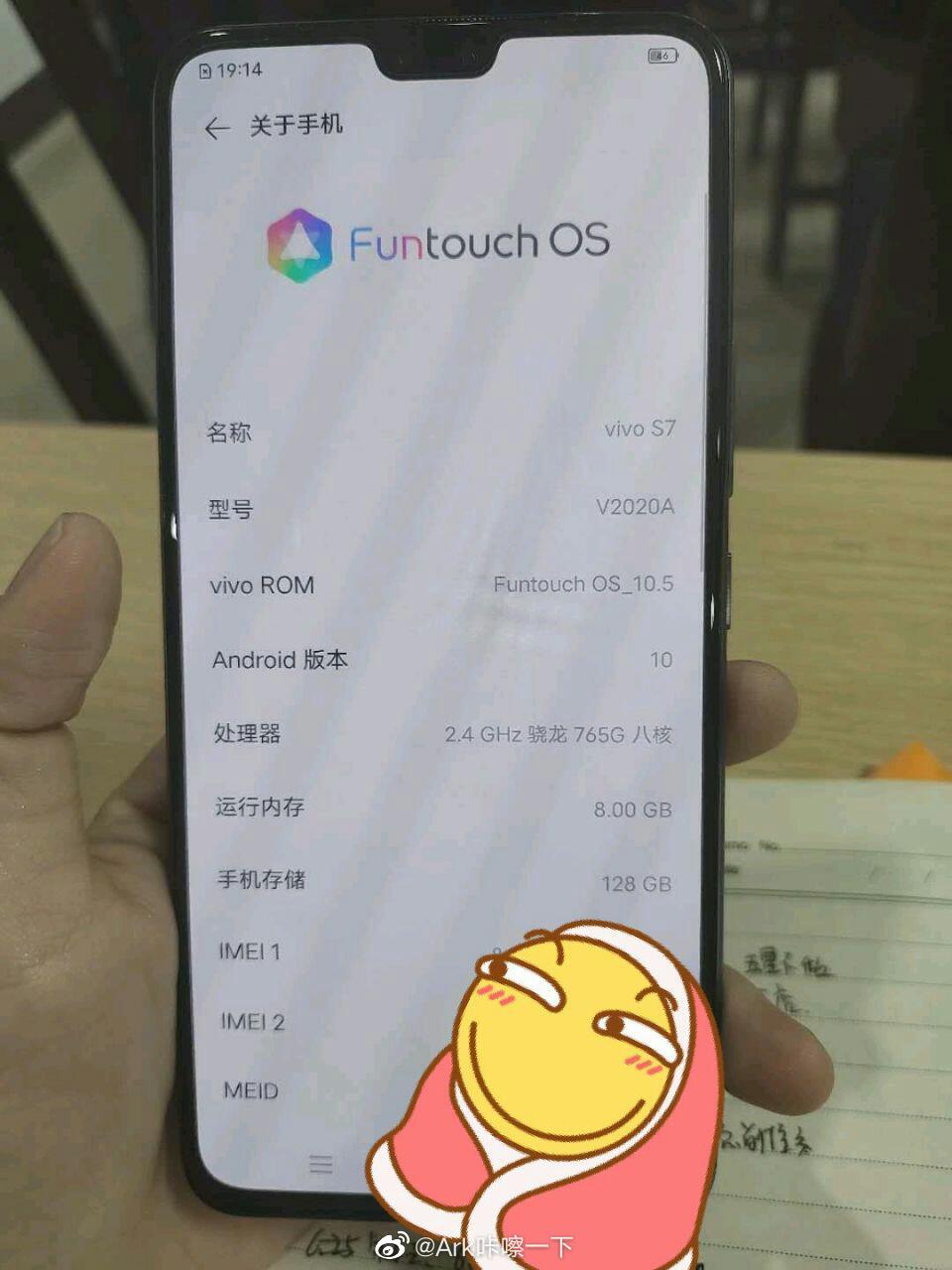
Vivo will be announcing the Vivo S7 5G smartphone on Aug. 3. Yesterday, a render of the smartphone on Weibo to reveal its front and rear design. The image revealed that the Vivo S7 5G has a wide notch for its dual selfie cameras and its rear is equipped with Vivo X50-like camera housing. A live shot of the Vivo S7 5G has appeared on Weibo. The leak was spotted by tipster ZyadAtef and shared on SlashLeaks The image not only gives at the look at the frontside of the device, but also reveals its key specifications.
A careful look at the display notch reveals that the Vivo S7 5G indeed features two front-facing cameras. Past reports have revealed that it has an autofocus enabled 44-mgeapixel main selfie camera and an 8-megapixel ultrawide shooter.
The image reveals that the Vivo V2020A model number belongs to the Vivo S7 5G. This model number was previously spotted at 3C certification platform of China. The listing revealed that it is a 5G phone and it could be shipping with a 33W fast charger.
The leaked shot reveals that the Vivo S7 5G runs on FunTouch OS 10.5 based Android 10 OS. The phone is fueled by the Snapdragon 765G chipset that works at 2.4GHz. The SoC is coupled with 8 GB of RAM and the device offers 128 GB of storage.
It is speculated that the Vivo S7 5G has an AMOLED screen of 6.43 inches. The screen seems to be integrated with a fingerprint scanner. The rear-facing triple camera setup reportedly includes a 64-megapixel main camera, an 8-megapixel ultrawide sensor, and a 13-megapixel portrait lens. The phone could be equipped with a 4,500mAh battery. The official teaser released by the company revealed that the Vivo S7 5G has an ultra-thin chassis.
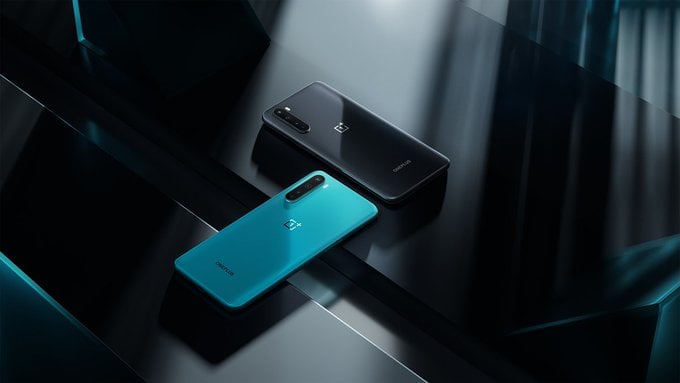
OnePlus recently introduced the Nord series of smartphones by introducing the OnePlus Nord 5G smartphone. Now that the series has been introduced, the Chinese manufacturer may launch more budget-friendly phones in the future. Before the launch of the OnePlus Nord, a mysterious OnePlus handset powered by Snapdragon 690 5G chipset was spotted on Geekbench. The listing suggests that it could be a forthcoming Nord series smartphone. A new report on XDA Developers has revealed vital information of a handset that appears to be a Snapdragon 690 powered OnePlus Nord phone.
Scouring through the OxygenOS 10.5 available on the OnePlus Nord, the publication could find references of a mysterious OnePlus phone that is codenamed as “Billie.” As shown in the screenshot above, the “isSM6350Products” method was associated with model names such as “BE2025”, “BE2026”, “BE2028”, and “BE2029.”
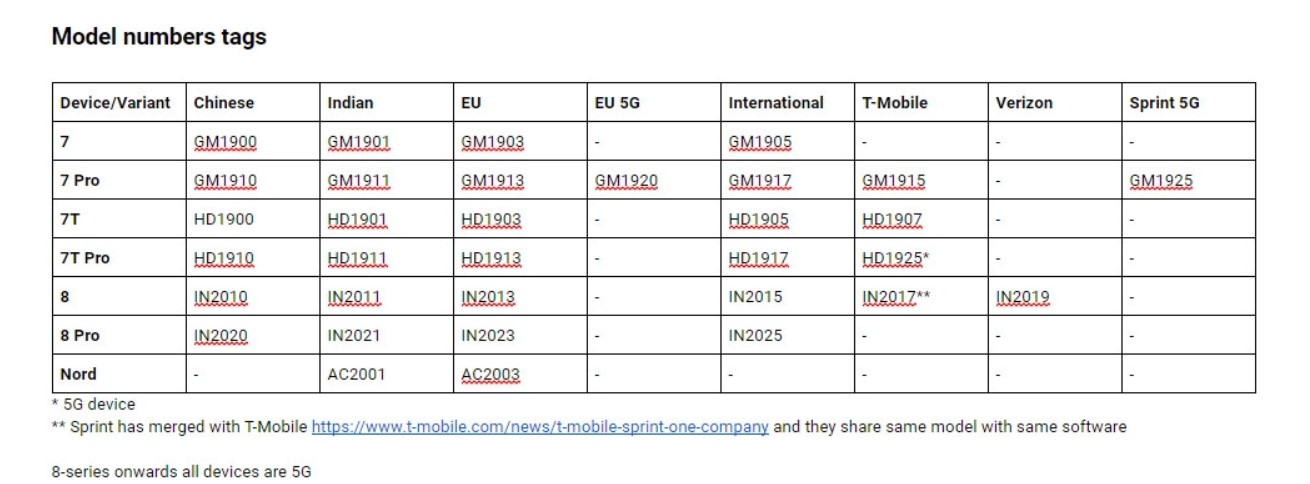
The sm6350 is the part number of the Snapdragon 690 mobile platform that debuted in June. OnePlus phones heading to different markets have different model numbers as shown in the chart below. Hence, it appears that “BE2025”, “BE2026”, “BE2028”, and “BE2029” are model names/numbers of the upcoming OnePlus Nord phone fueled by the SD690 chip.
The letters “AC” in the model names such as “AC2001” and “AC2003” that belong to the OnePlus Nord is a short form of its Avicii codename. It is named after the popular Swedish DJ.
According to the publication, the letters “BE” in the BE2025/6/8/9 model could be a short form of Billie Eilish, a well-known singer and songwriter from America. The Bille2T and Billie8T texts seen in the below-shown screenshot of the OnePlus Launcher APK suggests that the smartphone could be available in two variants.
The mysterious Snapdragon 690 SoC powered OnePlus device could be the Nord smartphone arriving in the U.S. later this year. The handset could also be coming to markets in Europe and India. The Snapdragon 765G powered OnePlus Nord starts at Rs. 24,999 (~$334) in India. The alleged SD690 driven Nord phone may start around Rs. 20,000 (~$267) in the country. At present, there is no official information available on its existence.
All the screenshots in the post are courtesy of XDA Developers.
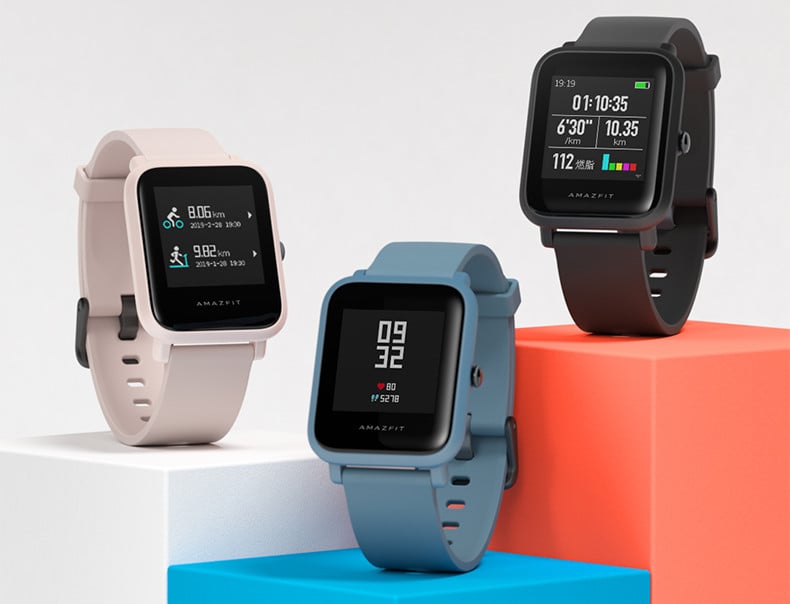
Huami’s Amazfit Bip line of smartwatches is quite popular, thanks to their features such as its transflective display, GPS support (select models), impressive battery life, and affordable price tag.
Amazfit BIP Lite
Following the launch of the original Amazfit Bip in 2017, Huami has added other models including the Amazfit Bip S Lite that was launched in India yesterday.
However, the multiple models and similar names may make it confusing for prospective buyers, so we have decided to explain the differences between them, to make it easier to tell them apart.
The Amazfit Bip Line has five models in all which are listed below:
10 sports modes -
indoor cycling, outdoor cycling, treadmill, outdoor running, elliptical trainer, indoor swimming, open water swimming, yoga, walking, and freestyle
Heart Rate and Sleep Monitoring
Yes
Yes
Yes
Yes
Yes
PAI Health Assessment
No
No
Yes
Yes
Yes
NFC
No
No
No
No
Yes
Waterproof rating
IP68
3 ATM
5 ATM
5 ATM
5 ATM
Built-in GPS
GPS + GLONASS
No
GPS + GLONASS
No
GPS + GLONASS
Sensors
PPG heart-rate sensor
3-axis geomagnetic sensor (compass)
Air pressure sensor
PPG heart-rate sensor
3-axis acceleration sensor
BioTracker PPG Bio-Tracking Optical Sensor
3-axis acceleration sensor
3-axis geomagnetic sensor (compass)
BioTracker PPG Bio-Tracking Optical Sensor
3-axis acceleration sensor
BioTracker PPG Bio-Tracking Optical Sensor
3-axis acceleration sensor
3-axis geomagnetic sensor (compass)
Music Playback Control
No
Yes
Yes
Yes
Yes
Operating System
Not stated
Not stated
Amazfit OS
Amazfit OS
Amazfit OS
Bluetooth Version
Bluetooth 4.0, Bluetooth Low Energy
Bluetooth 4.1, Bluetooth Low Energy
Bluetooth 5.0, Bluetooth Low Energy
Bluetooth 5.0, Bluetooth Low Energy
Bluetooth 4.2, Bluetooth Low Energy
Battery capacity and battery Life
190mAh
Basic Usage - 45 days
Typical Usage - 30 days
GPS continuous working time - 22 hours
Standby mode - 120 days
200mAh
Typical Usage - 45 days
Standby mode - 120 days
200mAh
Basic usage - 40 days
Typical usage - 15 days
Standby mode - 90 days
GPS continuous working time - 22 hours
200mAh
Basic usage - 30 days
Standby mode - 90 days
200mAh
Typical usage - 30 days
Standby mode - 80 days
GPS continuous working time - 22 hours
Weight
31 grams with strap
32 grams with strap
31 grams with strap
30 grams with strap
32 grams with strap
Colors
Onyx Black, Cinnabar Red, White Cloud and Kokoda Green
Red Orange, Carbon Black, White Rock, and Warm Pink
Charcoal Black, Oxford Blue, and Sakura Pink
Orange, Carbon, Rock White, and Warm Pink
With the table, you should be able to choose which of them best suits your needs. We have decided not to include prices, as that varies depending on the market. Also, it is possible to find the older models on sale for less than their launch price.
Which of the smartwatches do you own or do you plan to get? Do let us know in the comment box below.
Before the launch of the OnePlus Nord, OnePlus revealed that the phone will not be launched in the US. However, they did say they “…look forward to bringing more affordable smartphones to North America in the future”. It has now been revealed that the United States will be getting a OnePlus Nord later this year.
The info was revealed by Carl Pei to Wired magazine. The co-founder had revealed that a Nord-branded phone will be launched in the US later this year. Remember that Nord is not just the name of a phone but a line of affordable OnePlus smartphones.
There are speculations that the upcoming phone may be the already OnePlus Nord with slight modifications for the US or a different phone entirely.
We are already in the third quarter of the year and we expect details of this new phone will begin to surface beginning in August with a launch planned for September or maybe October alongside the OnePlus 8T series.
Let us not also forget that before the launch of the OnePlus Nord, a OnePlus smartphone with a Snapdragon 690 processor was seen on Geekbench. The phone which was referred to as the OnePlus Nord might just be the one heading to the US, and since it is packing a less-powerful processor, it should have an even lower price tag.
Realme just launched its best battery phone: the Realme C15. Despite coming with one of the biggest batteries in the last generation of Android devices, it is an entry-level phone carrying a very affordable price. But is it the best entry-level out there or it is just the typical battery phone with mediocre specifications? Here is a comparison with two other great handsets in the entry-level segment which will let you find out. We compared the specifications of the Realme C15 with the recently-announced Redmi 9C and the Samsung Galaxy M01s; you can let us know if you agree with our opinions in the comments.
Realme C15 vs Xiaomi Redmi 9C vs Samsung Galaxy M01s
Quad 13 + 8 + 2 + 2 MP f/2.2, f/2.3, f/2.4 and f/2.4
8 MP f/2.0 front camera
Triple 13 + 5 + 2 MP, f/1.8, f/2.4 and f/2.4
5 MP front camera
Dual 13 + 2 MP f/1.8 and f/2.4
8 MP f/2.0 front camera
BATTERY
6000 mAh, 18W fast charging
5000 mAh, 10W charging
4000 mAh
ADDITIONAL FEATURES
Dual SIM slot
Dual SIM slot
Dual SIM slot
Design
When you look for an entry-level device, you should not focus on the design that much. These devices all come with a polycarbonate body and they do not offer premium materials. But on the other hand, their designs are all but ugly. They come with narrow bezels around the display and modern looks, as well as decent build quality. I like the Realme C15 due to its higher screen-to-body ratio, and it even offers the Gorilla Glass protection by Corning for the display. But it is all about tastes: which design would you pick?
Display
Given that the Samsung Galaxy M01s sports a PLS display, we doubt it will reach the level of the Realme C15. The Realme C15 and the Redmi 9C come with IPS panel and they offer a slightly better image quality. They have the same resolution and a similar size, you should only notice marginal differences between their quality. They are below-average IPS panels, do not expect a high definition and a great color accuracy, as the specs on the paper suggest.
Specs & Software
The most powerful hardware department belongs to the Realme C15: it sports the Helio G35 chipset by MediaTek which has pretty good CPU and GPU performance, as well as up to 4 GB of RAM. You get the Helio G35 SoC on the Redmi 9C as well, but it is paired with max 3 GB of RAM. The Samsung Galaxy M01s has a weaker Helio P22 which has no chances to compete with the Helio G35, and it comes with 3 GB of RAM. However, it has a light user interface (called One UI Core and based on Android 9 Pie) which gets its performances better. But with Realme C15 and Redmi 9C, you get Android 10 out of the box.
Camera
Realme C15 has the most complete camera department. It is the only one to pack a quad camera on the rear which includes an ultrawide sensor. The Realme C15 is better than Redmi 9C when it comes to the front camera, thanks to a superior 8 MP sensor. The Samsung Galaxy M01s has the same front camera. If we talk about normal photos, you should get slightly better quality with the Redmi 9C and Samsung Galaxy M01s which have a main sensor with a brighter aperture. Samsung Galaxy M01s lacks both an ultrawide sensor and a macro camera.
Battery
The 6000 mAh battery found on the Realme C15 guarantees a longer battery life simply because it has a higher capacity. It is even the only one to support fast charging (18W). Right after, we got the Redmi 9C with a 5000 mAh battery (but no fast charging). Samsung Galaxy M01s is still a nice battery phone, but it has just 4000 mAh.
Price
Realme C15 is priced less than €120/$140 in its base variant with 3 GB of RAM and 64 GB of internal storage, Redmi 9C starts from €90/$105 (2/32 GB), and Samsung Galaxy M01s costs €110/$129. I would personally go for the Realme C15 because of its bigger battery, quad-camera, and good selfie snapper. I would not choose the Samsung Galaxy M01s because it has a smaller battery and an inferior chipset. With its nice main camera, Redmi 9C is a good compromise.
OUKITEL has officially revealed a landing page of its upcoming C21 smartphone on its website with a “best buy in 2020” tag line. According to its landing page, the smartphone will globally launch on August 11 and will feature mid-range specifications. It is a highly anticipated device considering the presence of Helio P60 and a 20-megapixel front camera.
The new OUKITEL C21 sports a 6.4-inch FHD+ hole-punch display with a 20-MP selfie camera on the regular left side. There’s also a matrix quad camera on its rear side that consists of a 16MP main camera. It couples with the 4GB RAM, 64GB ROM, and an Helio P60 Octa-Core Processor. The chipset is 12nm middle range chipset which is highly efficient and can save enough battery power.
The phone runs Android 10 OS out of the box and packs a 4,000 mAh battery, and is optimized for today’s most demanding applications. These are the features that were listed officially by the OUKITEL. For more information about the phone, we may have to wait until the release date i.e August 11. Apart from these, earlier leaks suggest that the smartphone is going to be official in the black and purple colors.
Apart from the OUKITEL official leak, there’s hardly any information about the device anywhere else.
It is rumored to cost less than $100 under the introductory offer. OUKITEL C21 will hit the market very soon after its initial release on Aug 11. In the meantime, OUKITEL is running a big giveaway to recruit 10 trial users for improving user experience. You can join the Aliexpress giveaway here. To learn more about the device wait for some more time.
We use cookies on our website to give you the most relevant experience by remembering your preferences and repeat visits. By clicking “Accept”, you consent to the use of ALL the cookies.
This website uses cookies to improve your experience while you navigate through the website. Out of these, the cookies that are categorized as necessary are stored on your browser as they are essential for the working of basic functionalities of the website. We also use third-party cookies that help us analyze and understand how you use this website. These cookies will be stored in your browser only with your consent. You also have the option to opt-out of these cookies. But opting out of some of these cookies may affect your browsing experience.
Necessary cookies are absolutely essential for the website to function properly. This category only includes cookies that ensures basic functionalities and security features of the website. These cookies do not store any personal information.
Any cookies that may not be particularly necessary for the website to function and is used specifically to collect user personal data via analytics, ads, other embedded contents are termed as non-necessary cookies. It is mandatory to procure user consent prior to running these cookies on your website.