This decision is bad news for anyone in the UK with a mobile phone.
The press statement which was published on Twitter says the decision “threatens to move Britain into the digital slow lane, push up bills and deepen the digital divide”. Huawei continues by saying that rather than “leveling up, the (UK) government is leveling down” and they urge them to reconsider.
Huawei claims in the press release that the recent US sanctions will not have affected the resilience of the products they supply to the UK. Huawei also claims the matter is about trade policy and not about security.
Statement regarding UK government decision Ed Brewster, a spokesperson for Huawei UK, said: "This disappointing decision is bad news for anyone in the UK with a mobile phone. It threatens to move Britain into the digital slow lane, push up bills and deepen the digital divide."1/4 pic.twitter.com/A0V7O1LQmr
Despite the new development, Huawei says it will continue to work with the UK government to explain how it can continue to contribute to a better connected UK and it will continue to support its customers.
Outgoing Huawei UK Chairman, John Browne. Source: Sky News
In related news, the chairman of Huawei UK, John Browne, has announced that he will be resigning in September 2020. The date is six months earlier than when his tenure is supposed to end. The announcement was made before the UK government announced the ban.
The former head of British Petroleum became the chairman of Huawei’s board of directors in 2015. A spokesman for the company said Mr. Browne “has been central to our commitment here dating back 20 years” and they thank him for his valuable contribution.
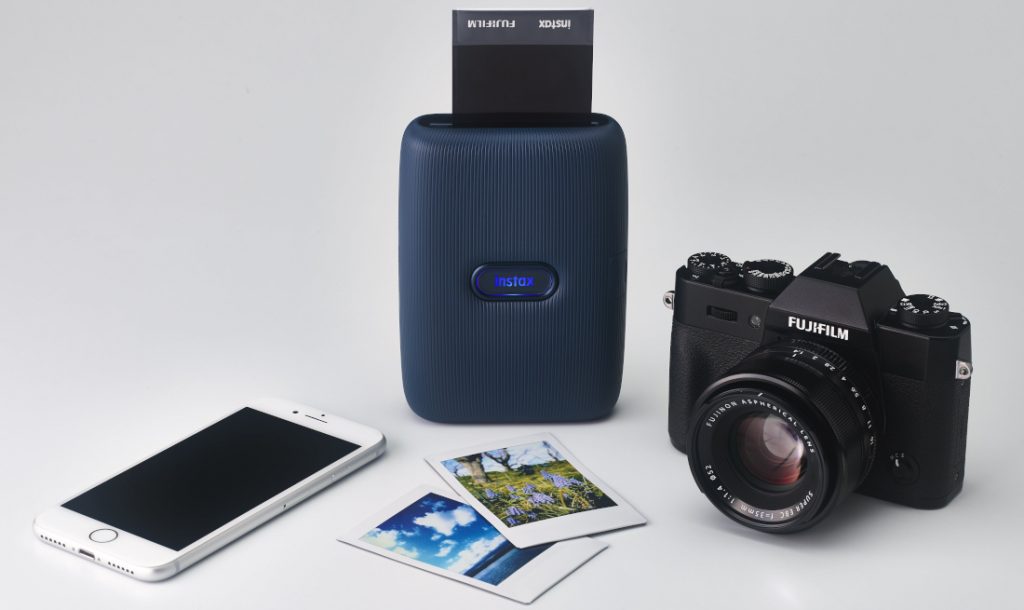
Photography giant Fujifilm has officially unveiled its latest product in India. The product dubbed Instax Mini Link Smartphone Printer adopts a portable design and comes with a price tag of Rs.9499 (~$126).
Fujifilm Instax Mini Link Smartphone Printer is a printer that allows users to print pictures directly from their smartphones. The device is no bigger than a power bank and uses the Fujifilm Instax Mini Instant Films. It also offers customisation options before the photo is printed.
The printer prints photos on a 62mm x 46mm card with a resolution of 12.5 dots/mm. It offers users not just a way of printing photos stored on their smartphones but also the opportunity to do it quickly and easily. The portable printer can be paired with a smartphone via Bluetooth as it supports Bluetooth 4.2. The device can even be connected to a Fujifilm camera that supports Bluetooth connectivity. The printer takes just around 12 seconds to print photos.
The portable device which weighs just about 200g is bundled with a companion app called Instax mini Link app. The app allows users to effect customisations such as rotation, filter selection and brightness adjustments.
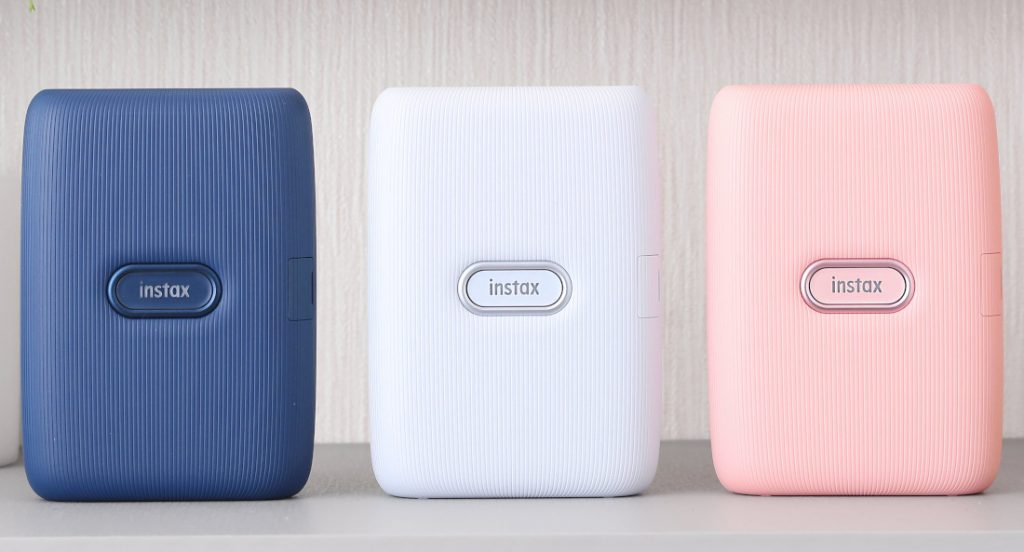
Talking of the price, the Fujifilm Instax Mini Link Smartphone Printer is available for purchase on Amazon.in for Rs. 9499 (~$126). It is available in three different colours: Ash White, Dark Denim and Dusky Pink.
The rapid cycle phones go through at the hands of users who are quick to switch to newer models have created a huge business in phone recycling. One start that sprang up in China to provide recycling services is Shenzhen-based mobile phone recycling start-up Huishoubao. The company which astounded in 2014 has a ranking that is released regularly. The latest report dubbed “Mobile Phone Value Index for the First Half of 2020” has just been released.
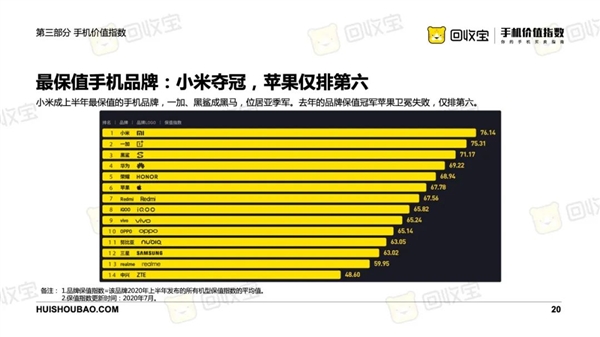
The report ranks Xiaomi as the most value retaining mobile phone brand in the first half of this year. At the same time, OnePlus and Black Shark emerged for the first time in the second position. Huawei and Honor phone brands are at the fourth and fifth positions respectively. Apple who previously holds the position as the top brand dropped to the sixth position in H1 2020.
1 of 4
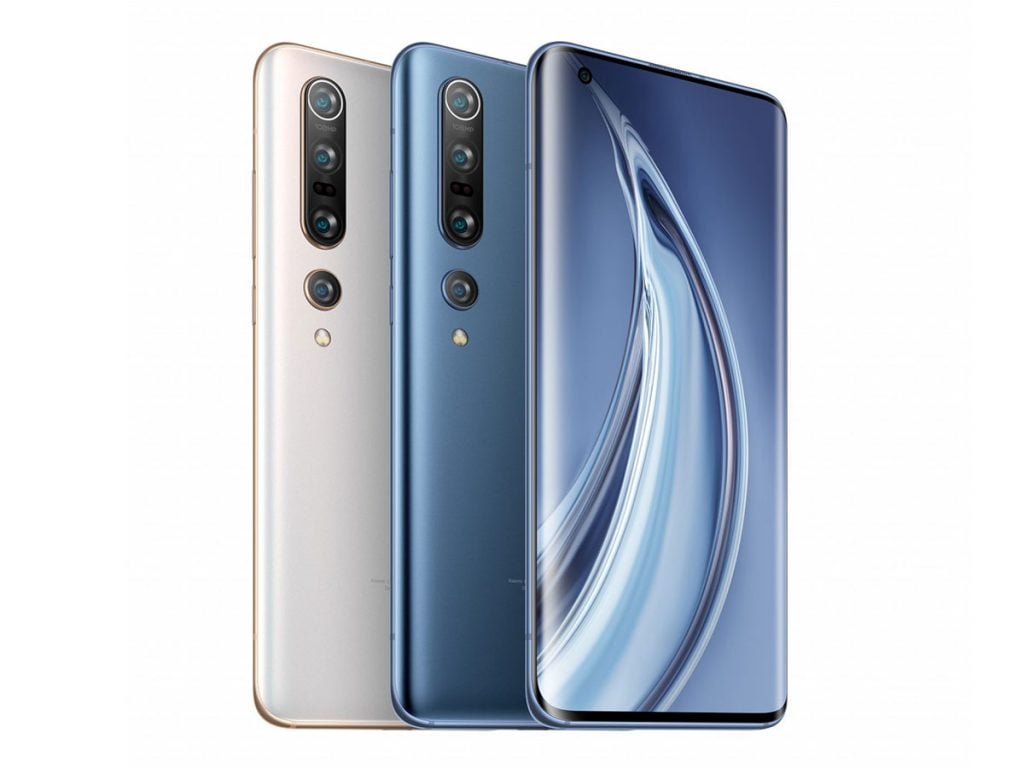
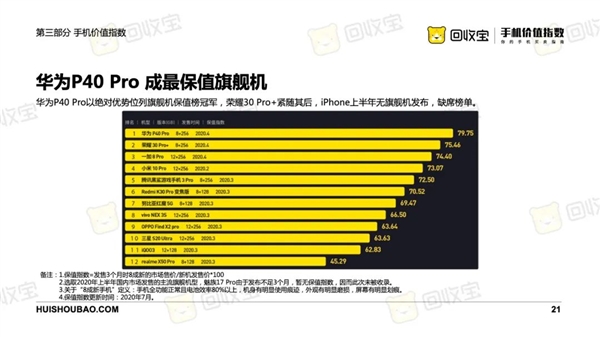
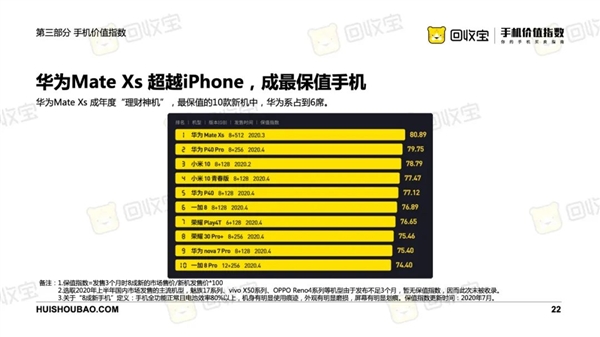
The ranking takes into consideration the rate at which phone users retain their various mobile phone brands. Xiaomi is given a brand preservation index of 76.14. However, in terms of specific flagship models, Huawei P40 Pro is ranked as the highest value retaining flagship phone followed by Honor 30 Pro. OnePlus 8 Pro, Xiaomi Mi 10 Pro, Tencent Black Shark Game Phone 3 Pro, Redmi K30 Pro Zoom Edition, Nubian Red Devils 5G, Vivo NEX 3S, OPPO Find X2 Pro, and Samsung S20 Ultra also join the top 10.
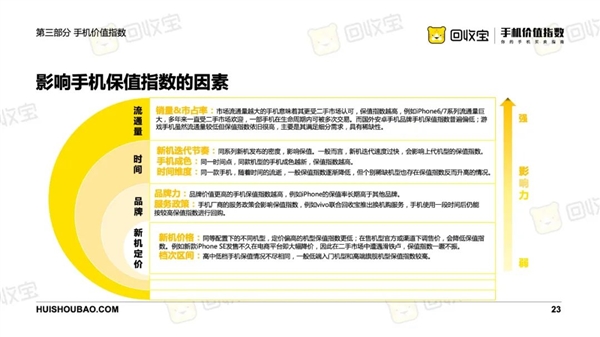
The report also pinpoints some factors that affect the mobile phone index such as liquidity, time, brand and new model pricing.
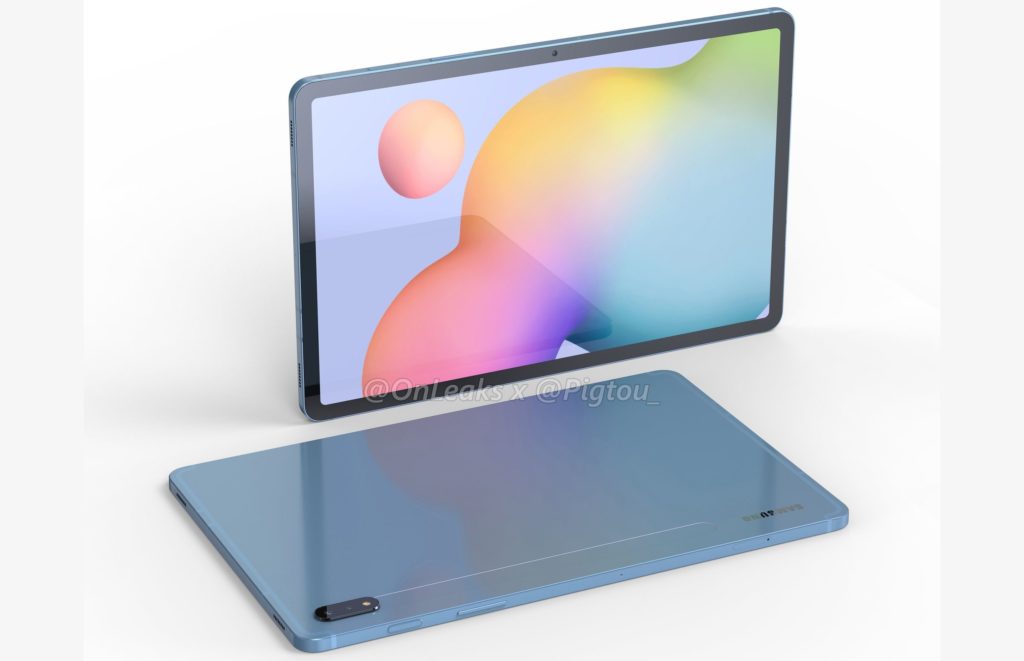
Samsung is expected to launch Galaxy Tab S7 on August 5 Galaxy Unpacked event at which the company will be unveiling the Galaxy Note 20 series. According to a tip from last week, the company’s flagship tablet and Galaxy Watch 3 may debut on July 22 instead. That said, today a new leak reveals this tablet to not feature an in-display fingerprint sensor.
The South Korean tech giant has been launching a single flagship tablet model every year since the beginning. But this year, the company will be debuting two models called Galaxy Tab S7 and Galaxy Tab S7 Plus.
According to SamMobile, the major difference between the two will be their screen sizes – 11-inch and 12.4-inch respectively. But now, a new exclusive report by the same publication reveals that the smaller Galaxy Tab S7 will also miss out on in-display fingerprint sensor. Instead, its fingerprint reader will be embedded in the power key.
Apart from these two changes, the upcoming Samsung Galaxy Tab S7 will also be backed by a smaller 7,700-7,800 mAh battery compared to 10,090 mAh cell on the Plus model.
Whereas, rest all features will be identical on the same like 4G and 5G variants, AMOLED display, AKG speakers, support for S-Pen, microSD card slot, and more.
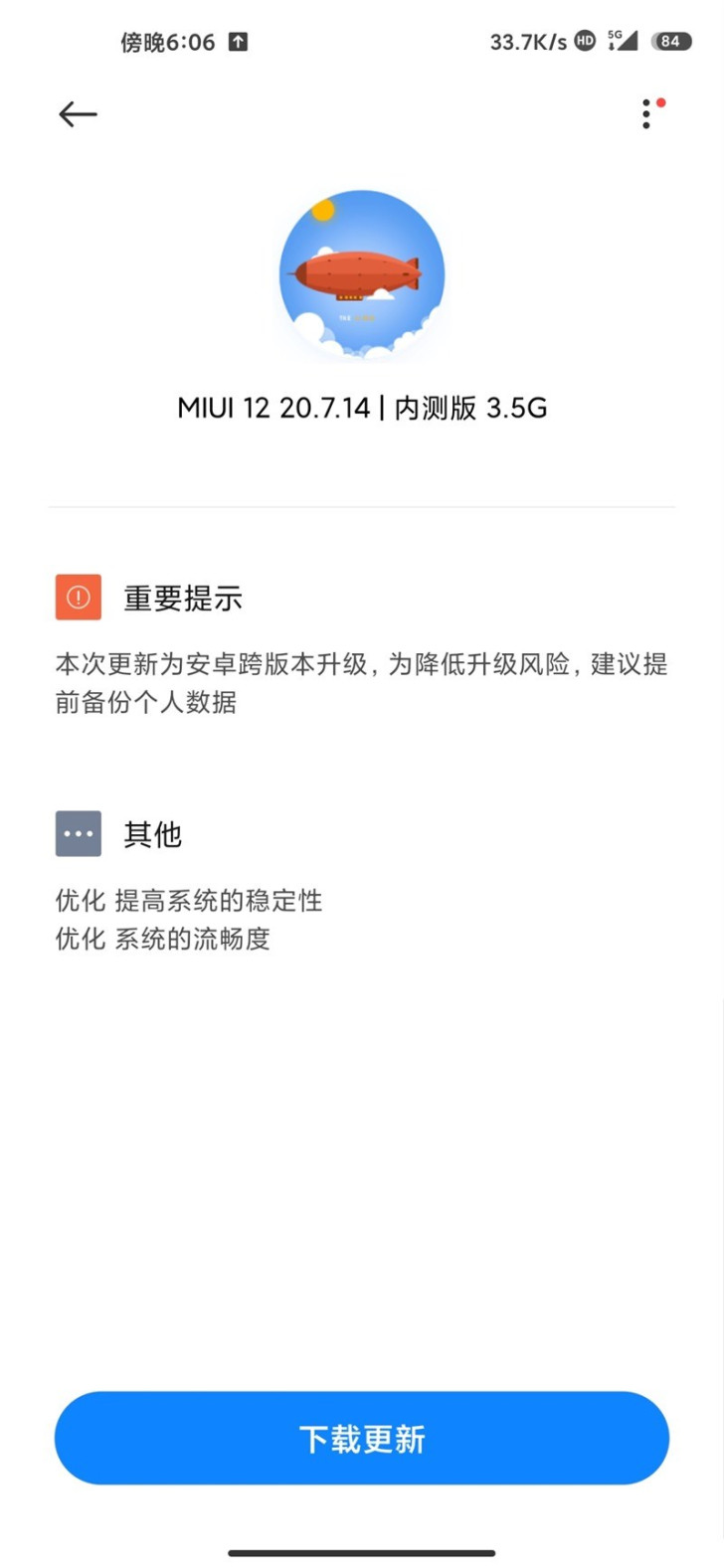
Xiaomi last month announced that Android 11 Beta 1 will be available for the Mi 10 and Mi 10 Pro. There are reports that the Chinese tech giant has started pushing the update ushering MIUI 12 beta development version based on Android 11 to models in China.
This is a surprise one because even though Android 11 beta was expected, there wasn’t any indication if it would have the MIUI 11 or latest MIUI 12 custom skin. The company is yet to commence ma roll out of MIUI 12. As such, users would be experiencing the new features that MIUI 12 brings alongside Android 11’s own features. However, such pre-release version is usually laced with bugs and this one is not an exception. The update is said to come with the issue of users not being able to adjust the volume on some third-party video apps. A temporary fix is given that such users can set the media volume control to allow in use or always allow in permission management. This issue is expected to be fixed in subsequent updates.
Google is expected to release the Android 11 stable on September 8 and with the current move of making it available to OEMs early, we expect a quick roll out to phone models worldwide.
Huawei has just suffered a devastating blow by the UK government. After a meeting today by the National Security Council, the UK government has decided to ban the Chinese company from its 5G networks.
The meeting which was chaired by the prime minister, Boris Johnson, arrived at the decision to have Huawei’s technology removed from its 5G networks latest by the end of 2027. The purchase of Huawei equipment has also been banned after December 31, 2020.
A press statement said the decision was influenced by recent sanctions issued by the US which will affect Huawei’s supply and block access to technology their products are currently based on. The technical experts of the National Cyber Security Center (NCSC) said the US sanctions will force Huawei to reconfigure its supply chain and that they (the UK) do not have sufficient confidence in any of Huawei’s alternatives.
They also added that the “new restrictions make it impossible to guarantee the security of Huawei equipment in the future”. These led to the agreement that UK operators stop purchasing Huawei equipment and that their technology is replaced latest by 2027.
Below is a summary of the UK’s Digital Secretary points from the meeting:
5G will be transformative for our country, but only if we have confidence in the security and resilience of the infrastructure it is built upon
Following US sanctions against Huawei and updated technical advice from our cyber experts, the government has decided it is necessary to ban Huawei from our 5G networks.
No new kit is to be added from January 2021, and UK 5G networks will be Huawei free by the end of 2027. This decisive move provides the industry with the clarity and certainty it needs to get on with delivering 5G across the UK.
By the time of the next election, we will have implemented in law an irreversible path for the complete removal of Huawei equipment from our 5G networks.
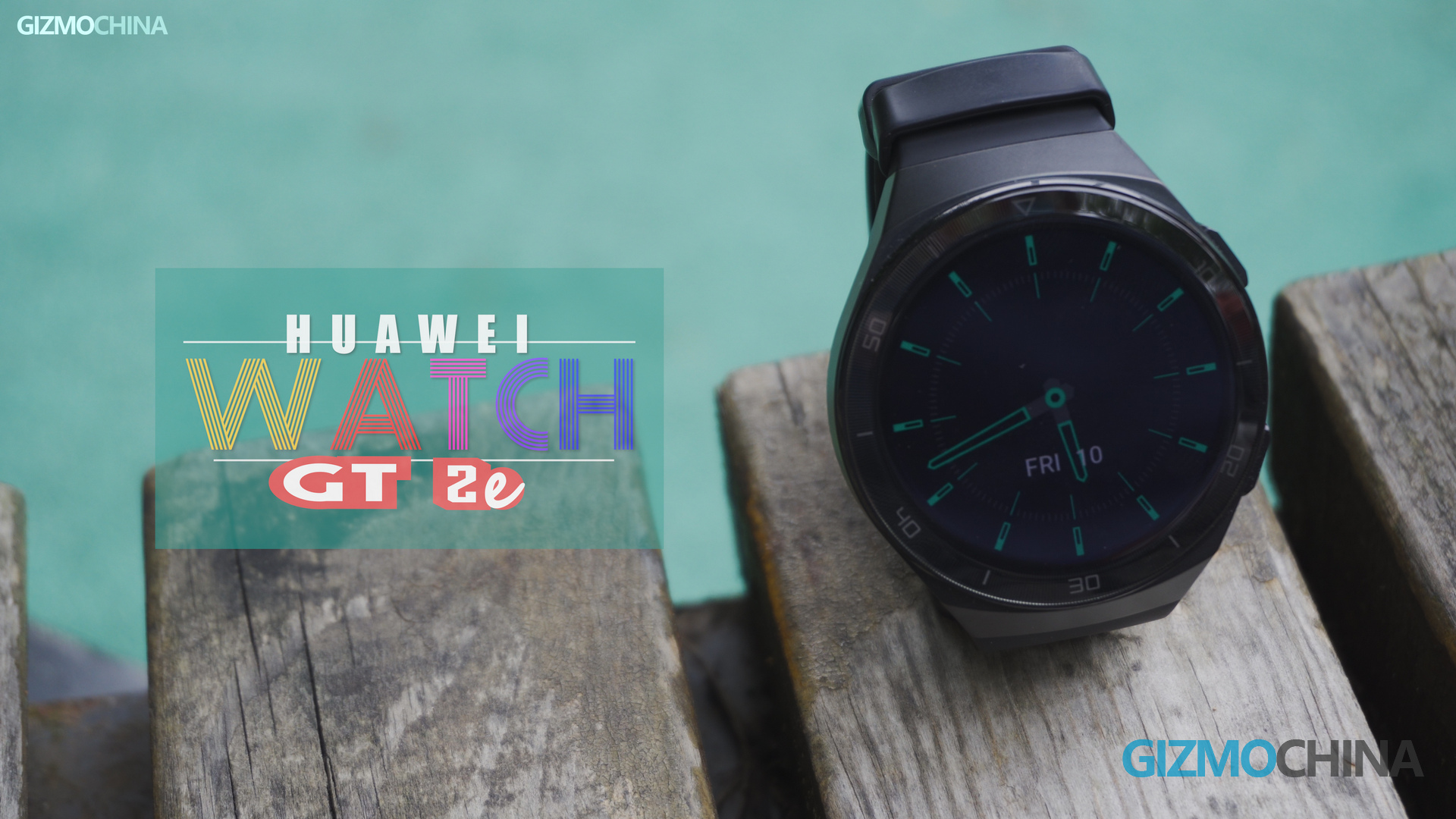
Since 2019, Huawei has pushed its strategy for its smart products, similar to how the company charged into the smartphone market a few years back. And this year, the company has launched a bunch of interesting smart products including the Huawei GT 2e smartwatch.
The Huawei GT 2e is a new product in the GT 2 lineup. Compared to GT 2, it’s sportier but at the same time, reserves a polished design for daily use. The biggest difference is that the GT 2e doesn’t feature a speaker for music playback. But except for this, both GT 2 and GT 2e are almost the same in terms of features.
Huawei GT 2e Review: Design
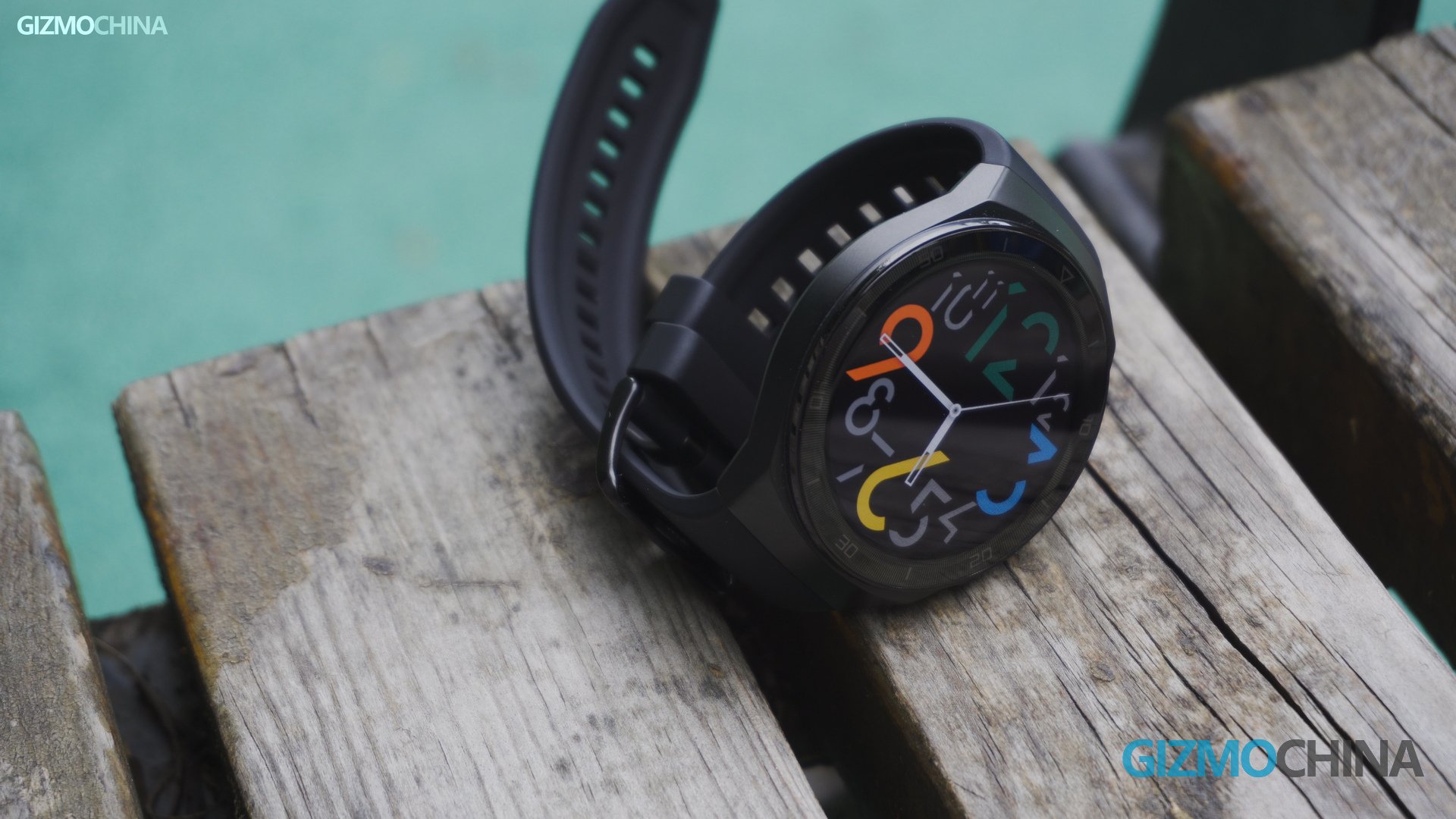
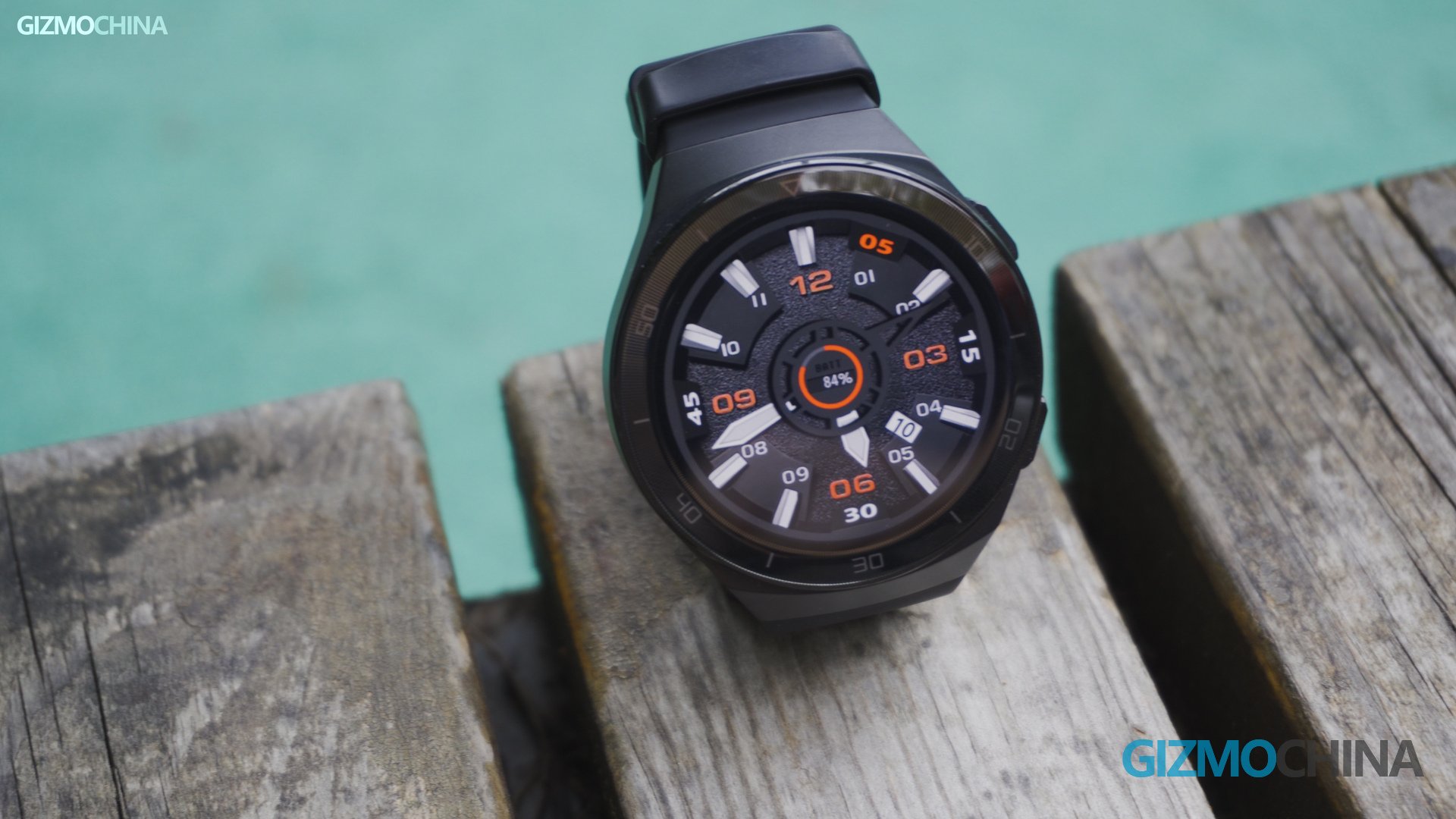
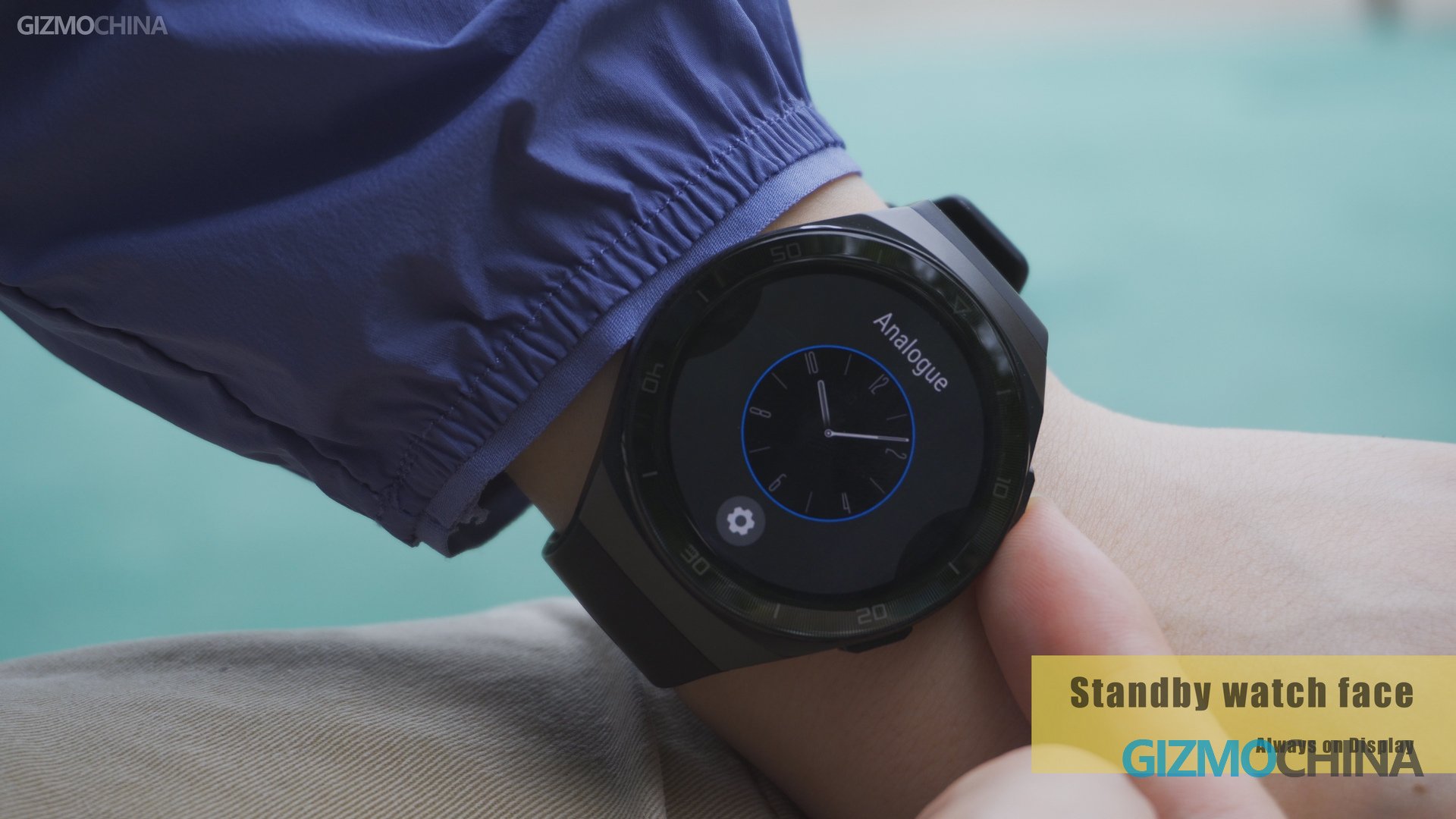
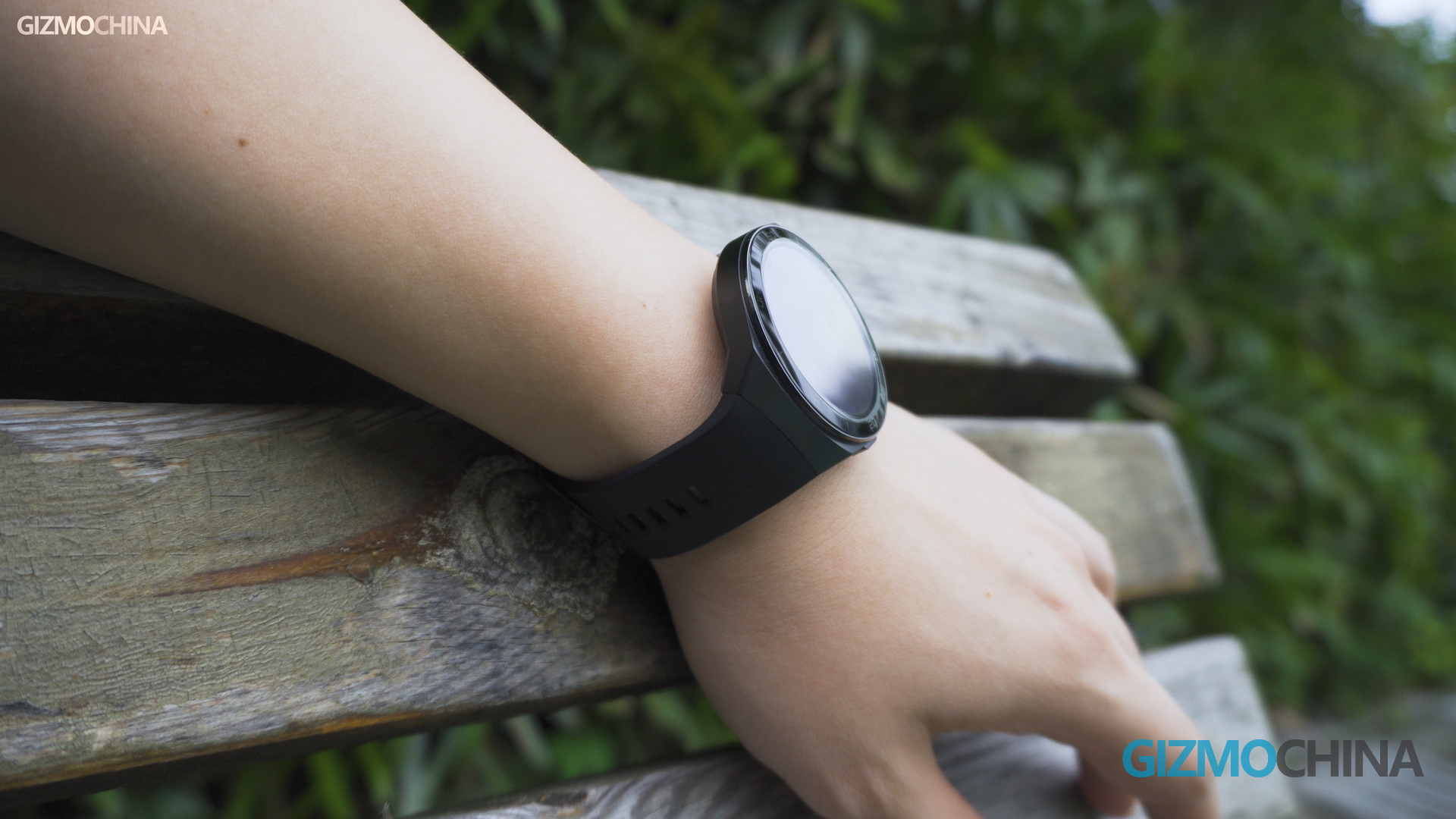
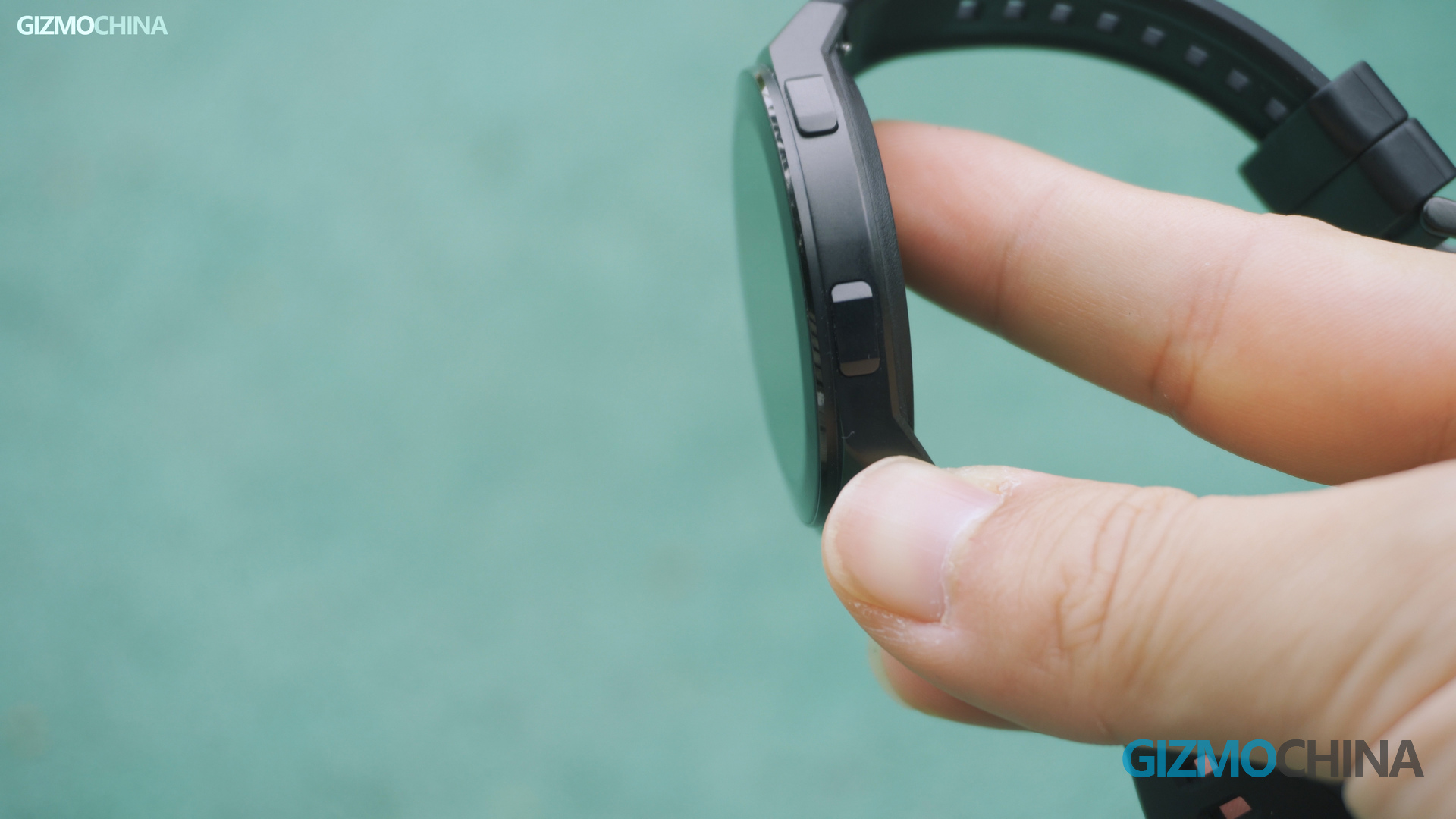
The Huawei GT 2e features a 1.39-inch AMOLED display, paired with the durable stainless-steel frame. Compared to the Watch GT 2, the more compact design of the GT 2e makes it sporty and fashionable. And with the lightweight multiple-color sporty straps, the total weight of 70g is still acceptable for most people.
We knew AMOLED display was the best choice for smartwatches due to its power-saving ‘always-on’ feature. During these two weeks of wearing the GT 2e, we truly experienced the efficiency of the display. The feeling of wearing the GT 2e was also familiar to a traditional watch. As we turn on the standby watch face, there is no need to check the time by waking the screen, though the GT 2e also allows wrist raise to light up the display. In addition to this, the GT 2e also supports auto-brightness adjustment. Even as we enjoy outdoors and are exposed to sunlight, the watch display is still clearly visible.
1 of 6
Huawei Watch GT 2e Review 08
Huawei Watch GT 2e Review 04
Huawei Watch GT 2e Review Smartwatch
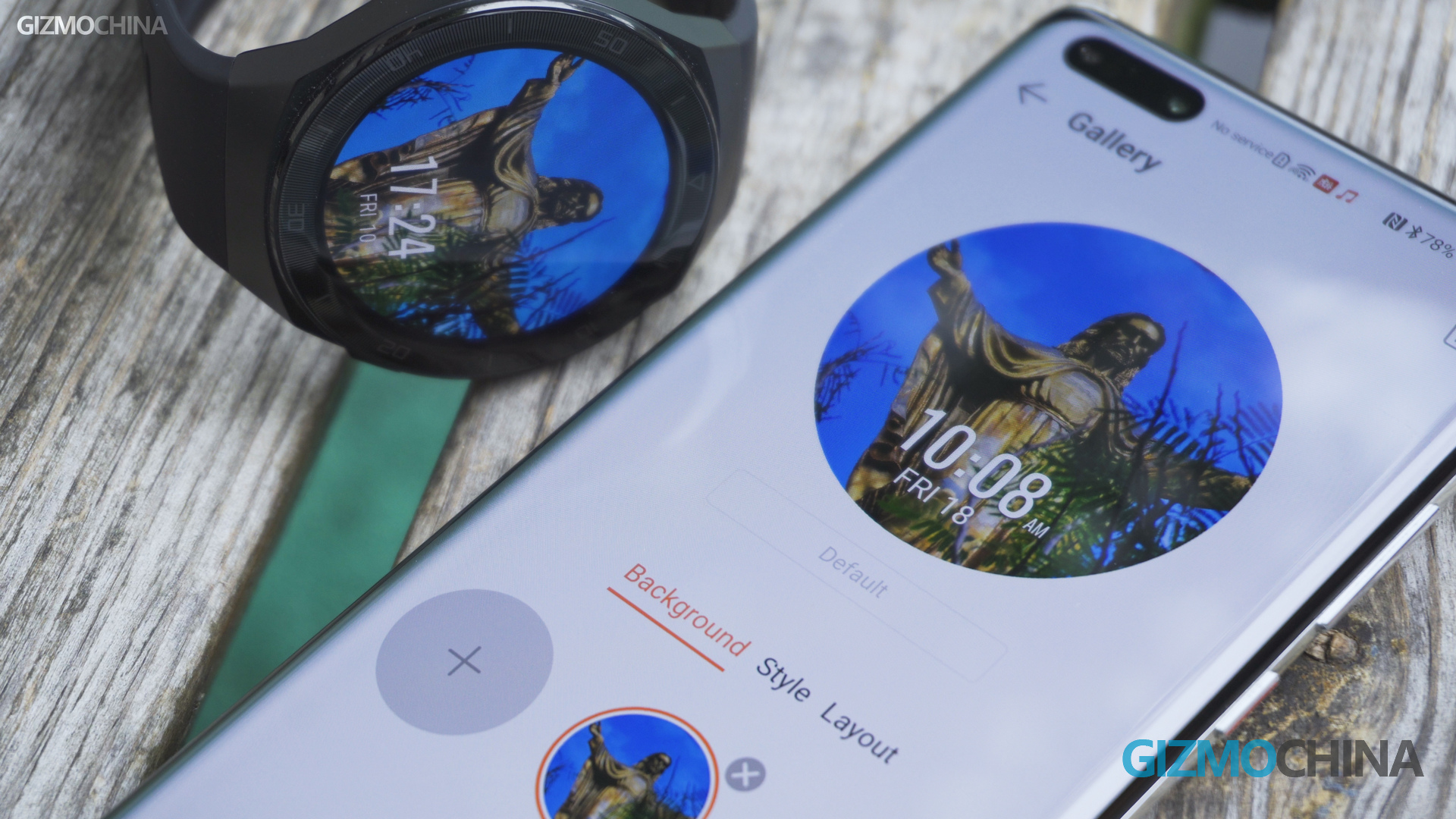
Meanwhile, for personalization, users can customize their own watch faces through the dial store. There’re various watch face designs for free, or just customize the watch with your favorite photo.
Huawei GT 2e Review: Features
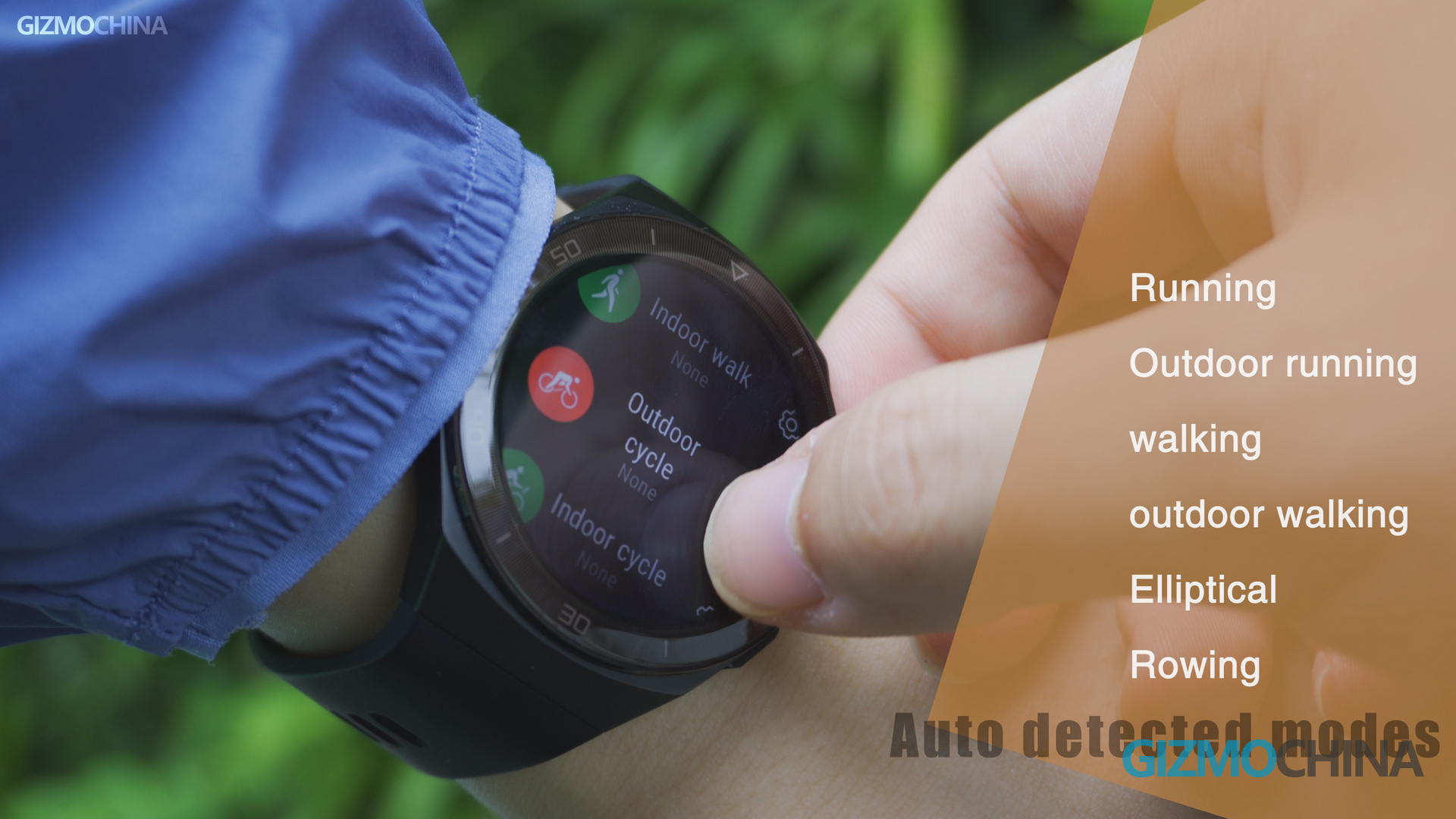
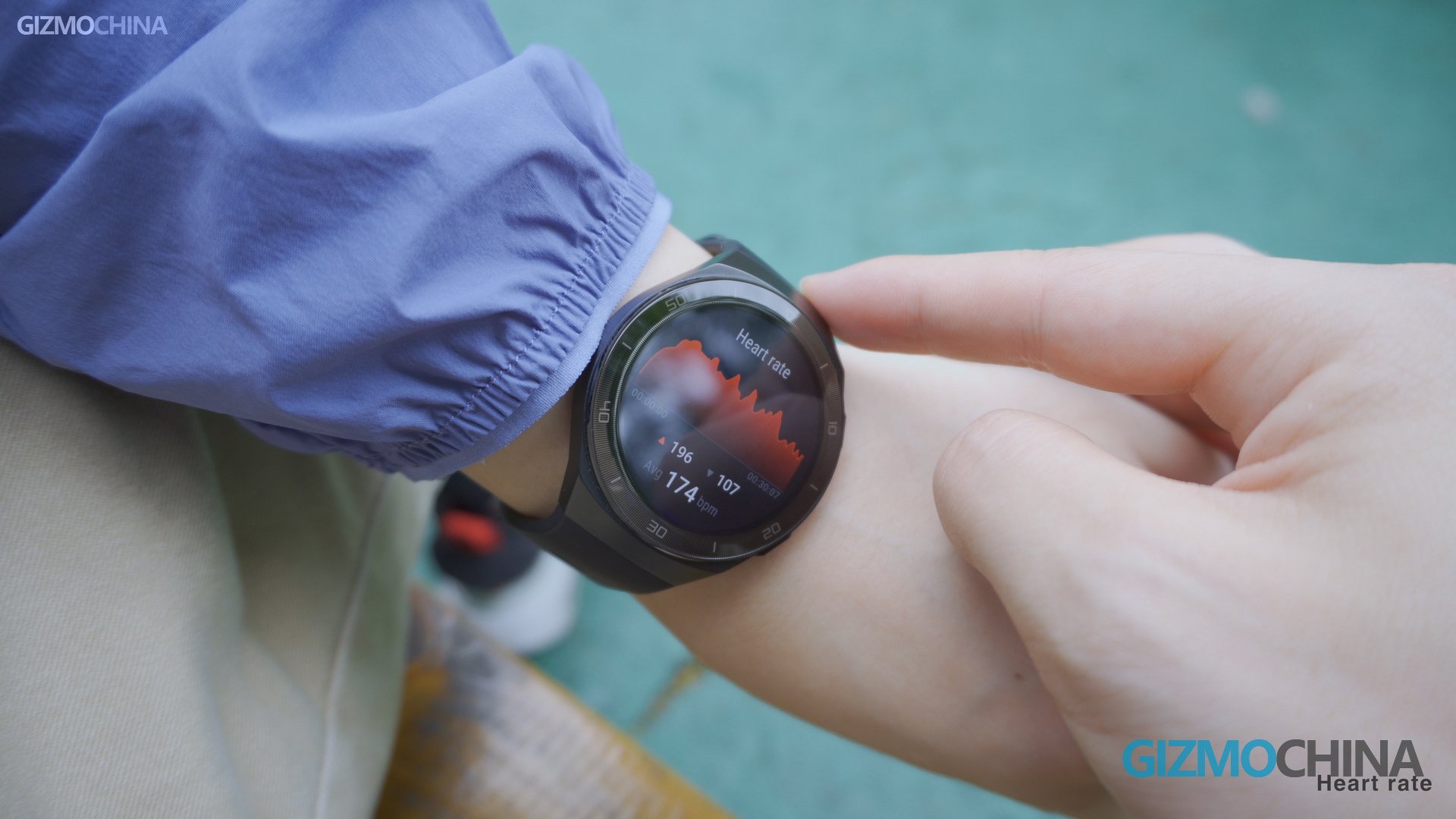
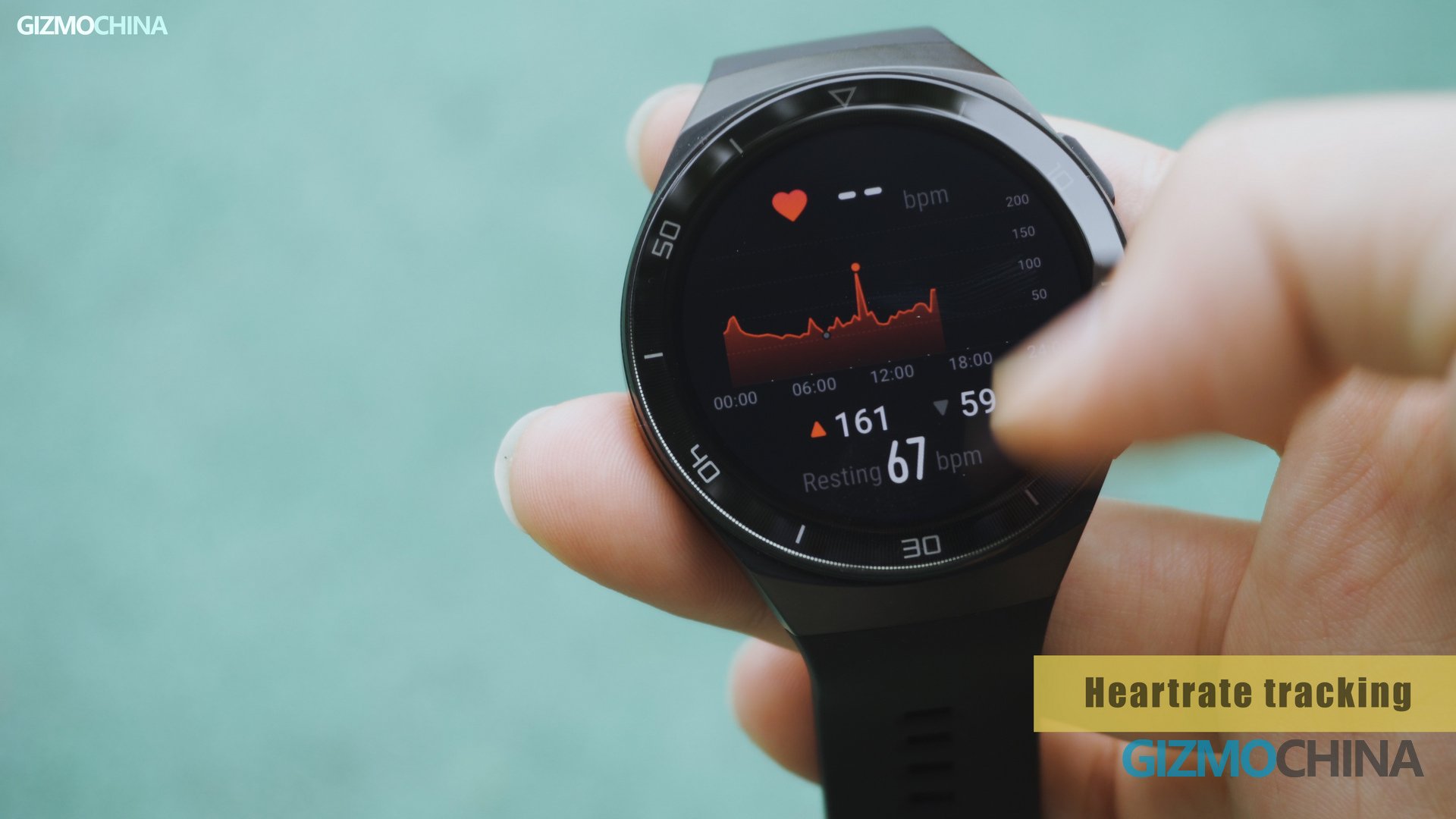
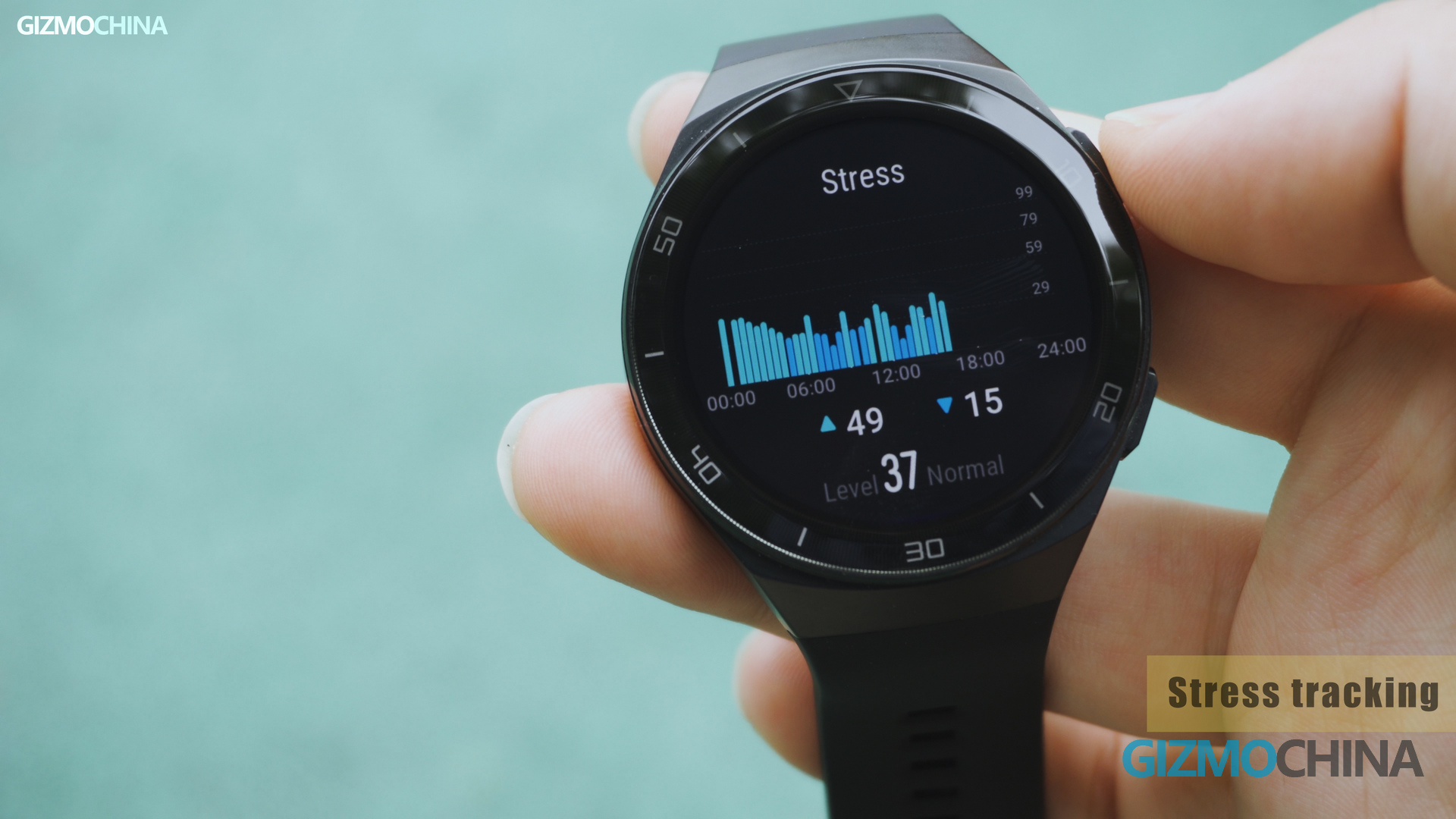
The GT 2e sports almost all the important fitness features that a smartwatch product should have in 2020, like 100 sport modes tracking, heart rate tracking, sleep monitoring, blood oxygen saturation tracking, and stress tracking. The GT 2e also supports an auto-detect feature for 6 sport modes – indoor or outdoor running/walking, elliptical, and rowing.
1 of 5
Huawei Watch GT 2e Review 17
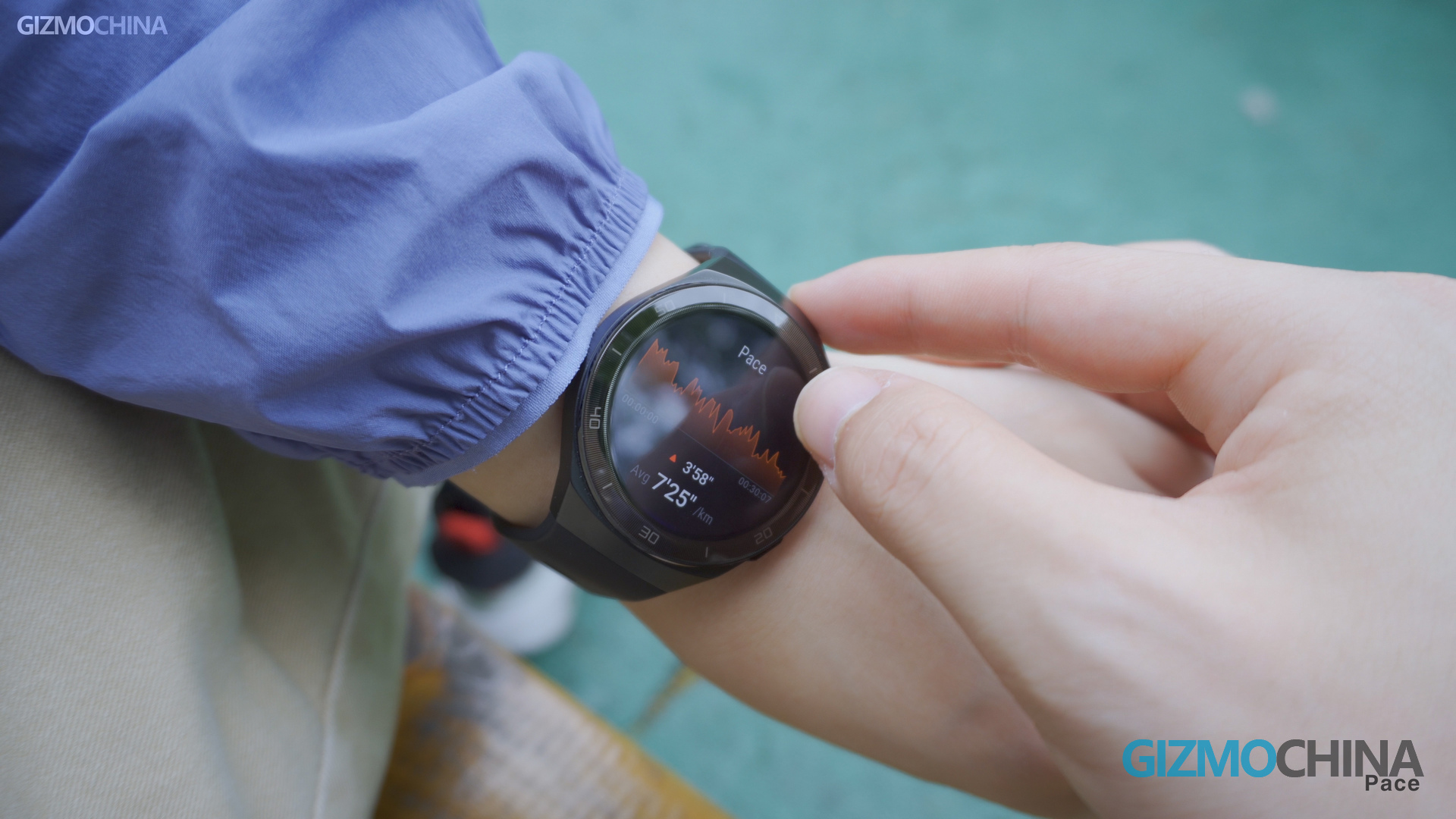
While jogging, the GT 2e was perfectly showing all the important details on its screen, such as heart rate monitoring, average pace, distance, and so on. And thanks to 4GB storage, you are able to wear your Bluetooth-connected earbuds and play the music from its internal storage without carrying a phone. The same storage space allows you to freely store and view all the important tracking records on the GT 2e.
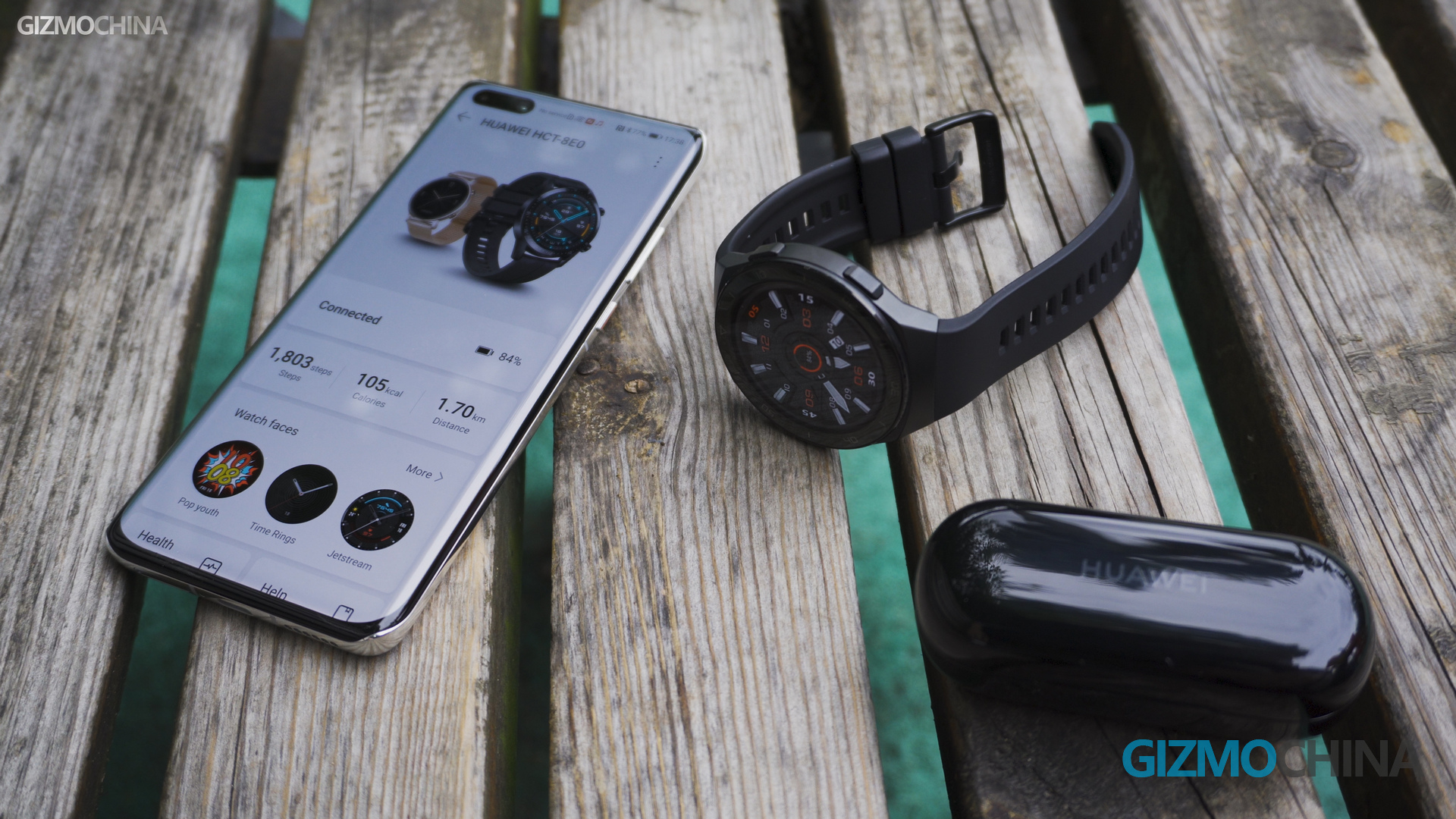
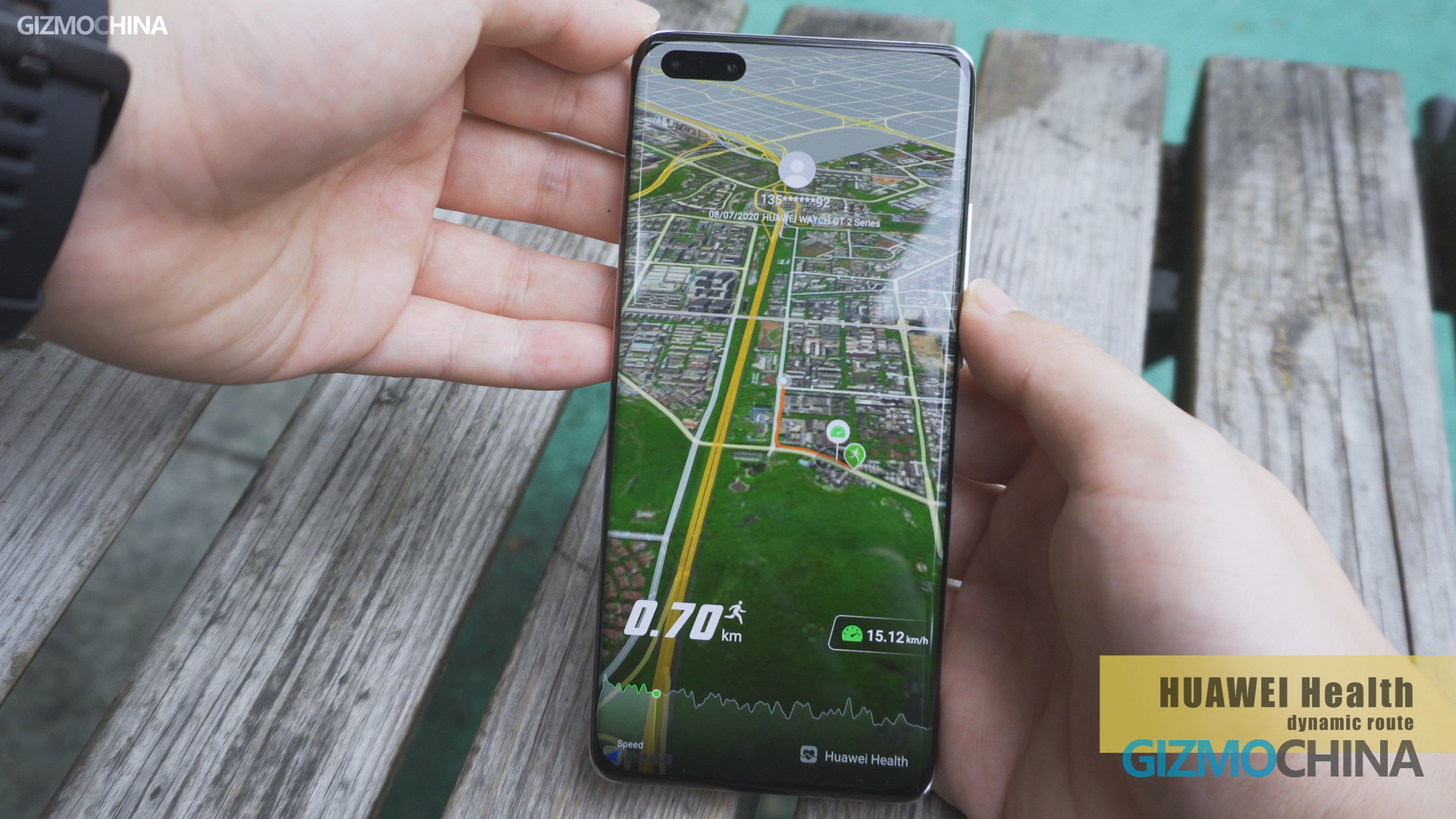
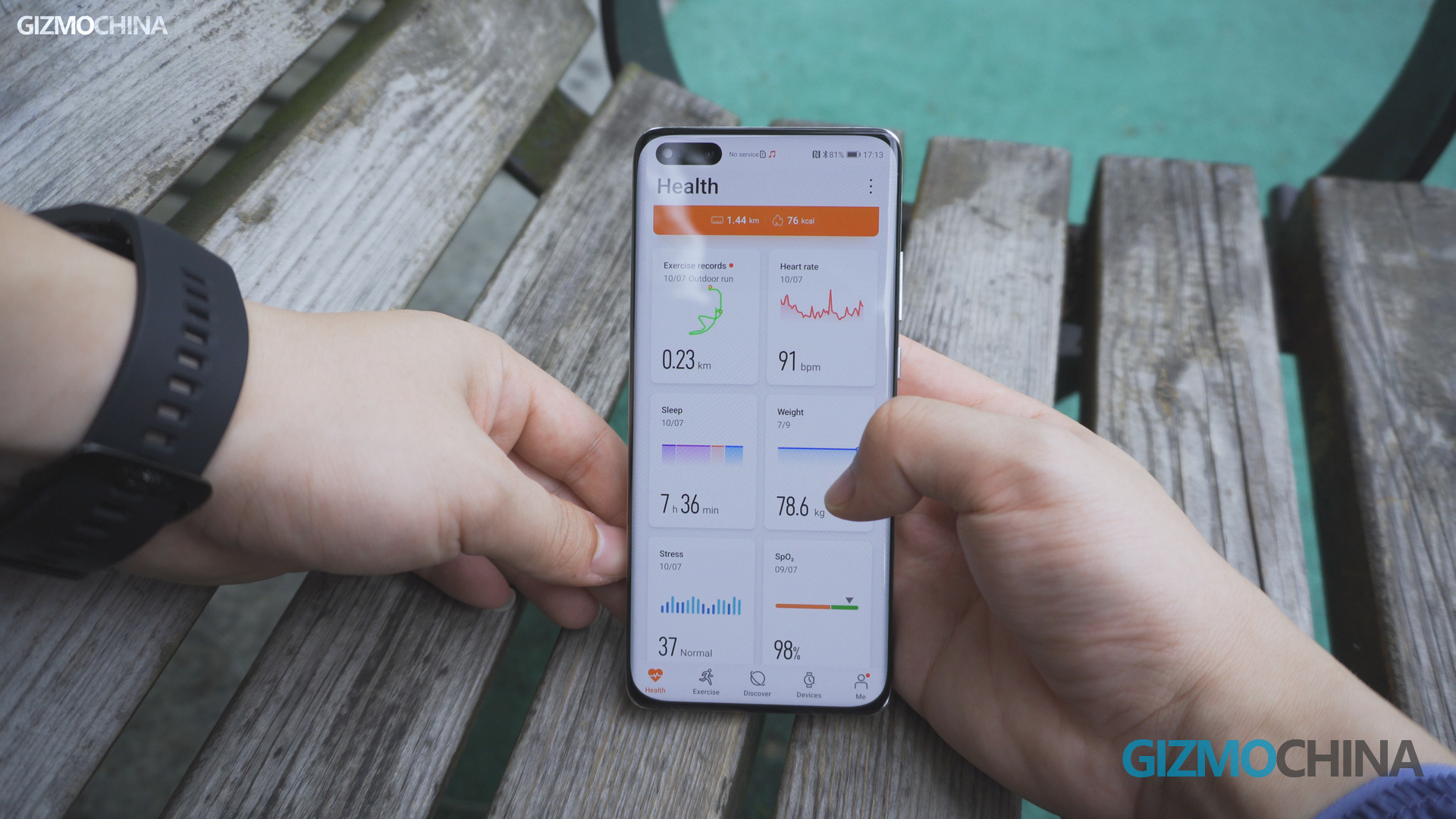
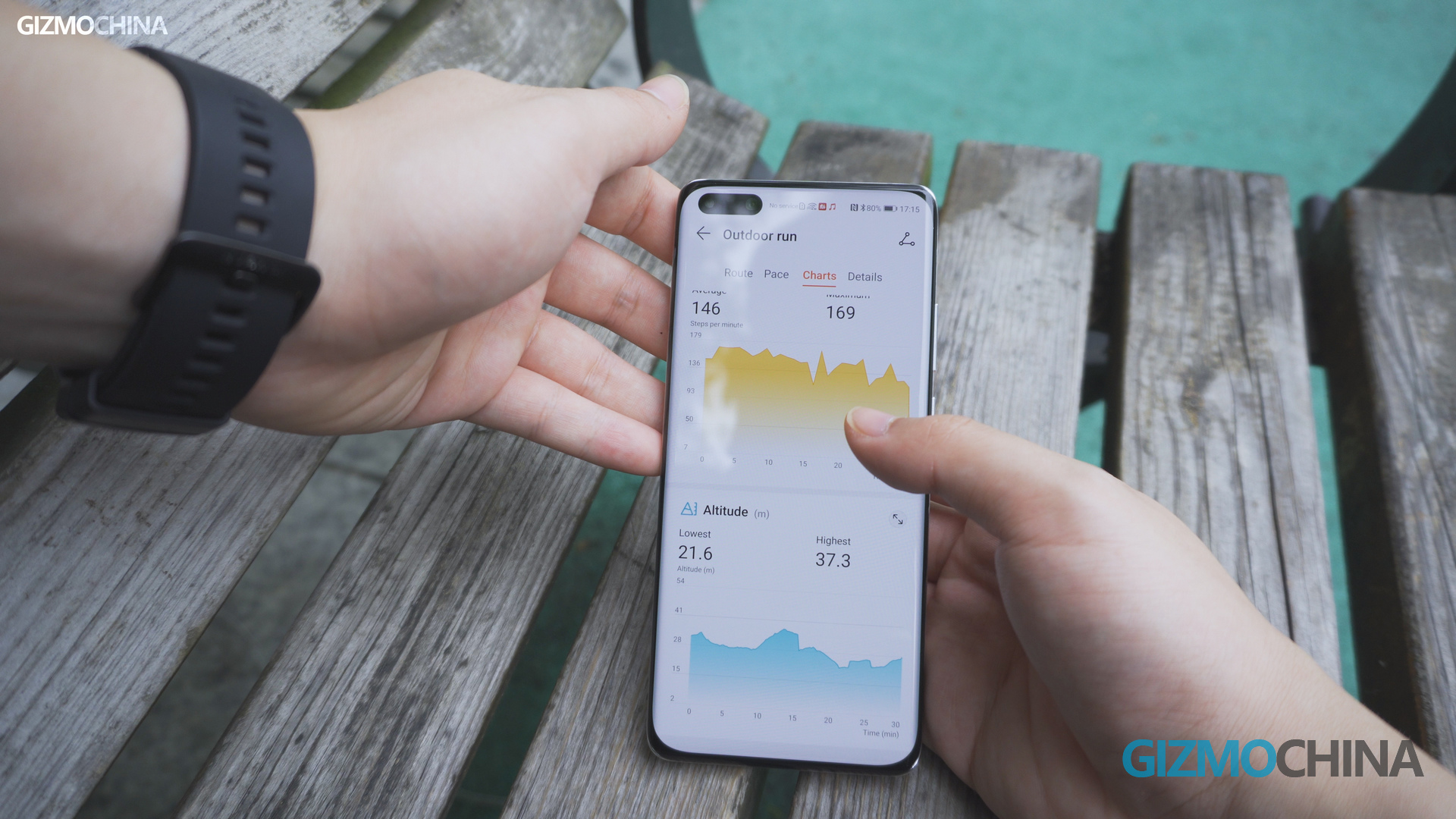
Going back to the phone app, Huawei Health, you would find an even more detailed report generated by the watch, including the route detail shown on the map. And you can also open the dynamic route to check a short video about the whole running, which is really motivating for users to keep running.
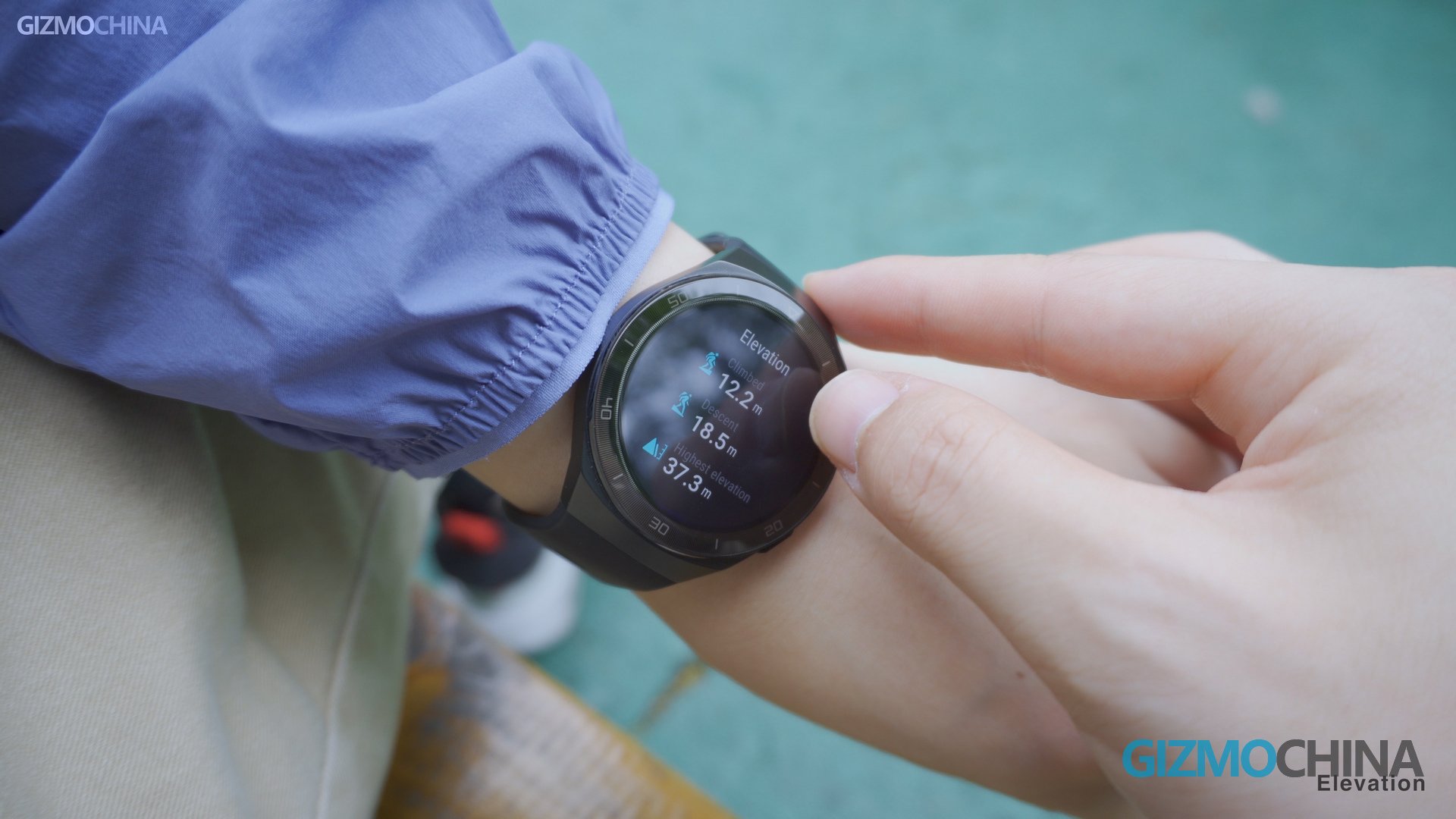
The smartwatch also shows some workout information that we’ve never seen before. For example, several diagrams show changes in heart rate, pace, cadence, altitude while running.
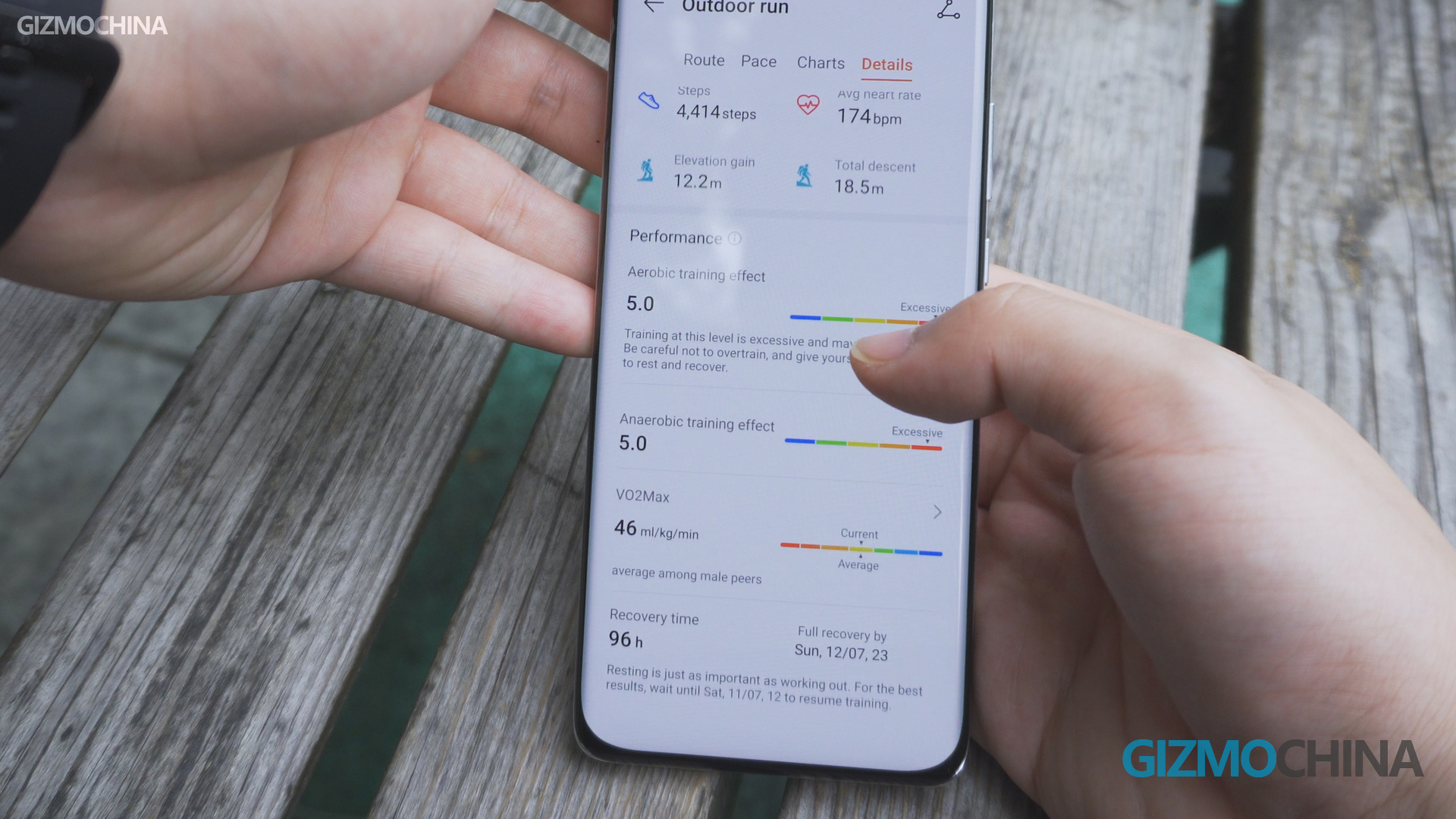
It even shows you how hard you train. For example, in one of the evaluation reports, the watch suggested me to be careful not to overtrain, and have enough rest time to avoid injuries. And the suggested recovery time it gave me was 96 hours.
And the maximum oxygen uptake index shows that my aerobic capacity and lung function is just at the average level. The Huawei Health app suggested that it could be improved by taking long-term systematic training.
1 of 4
All the features we mentioned above could be activated independently without connecting the phone. The route information was provided by the watch’s GPS sensor, while the music play function was supported by the internal storage and Bluetooth connectivity.
No doubt that the Huawei GT 2e is one of the most-sporty smartwatches I’ve ever seen, not just because it could accurately record the exercise information but also for its superb user-experience. What it provided was professional and exceeded my expectation.
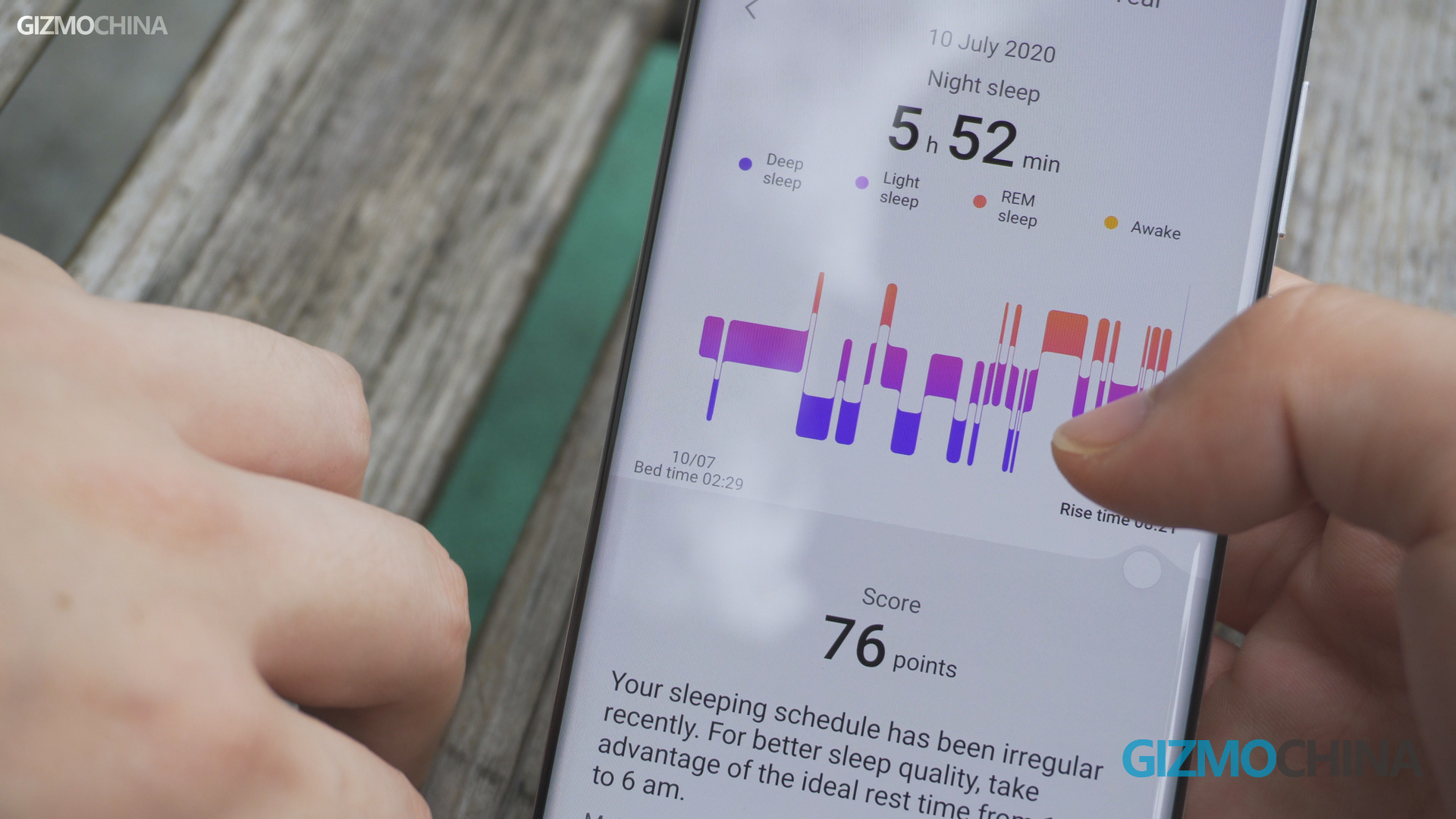
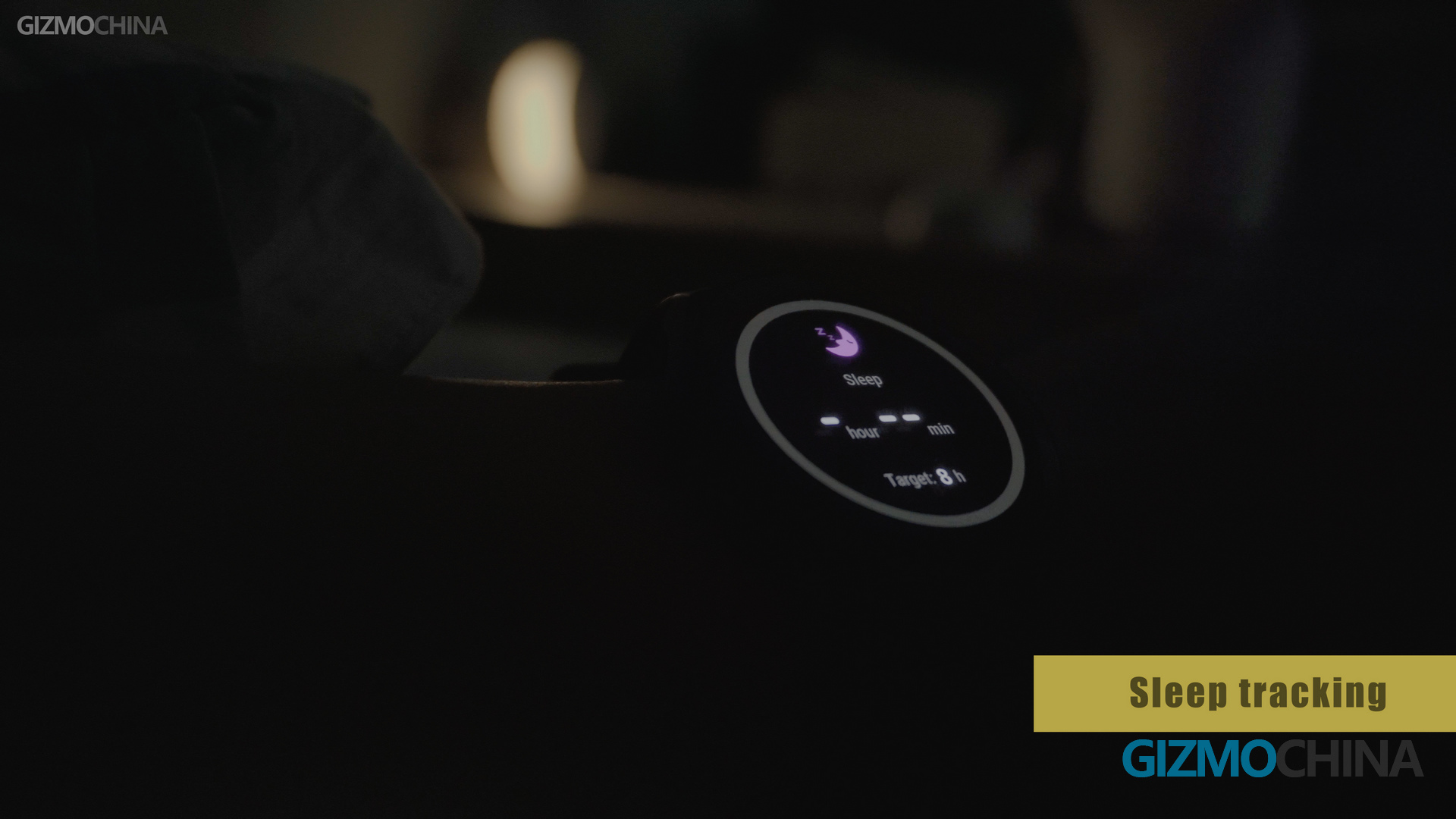
Besides the professional performance of sports tracking, other fitness tracking features were also working well. For example, sleep tracking is sensitive and accurate. Compared to Xiaomi wearables, the sleep tracking report is more specific and helpful as it tells users about their sleep quality and offers some quiet sounds or music as sleep aids to improve sleep. And the new stress test is also helpful to know better about your mental health.
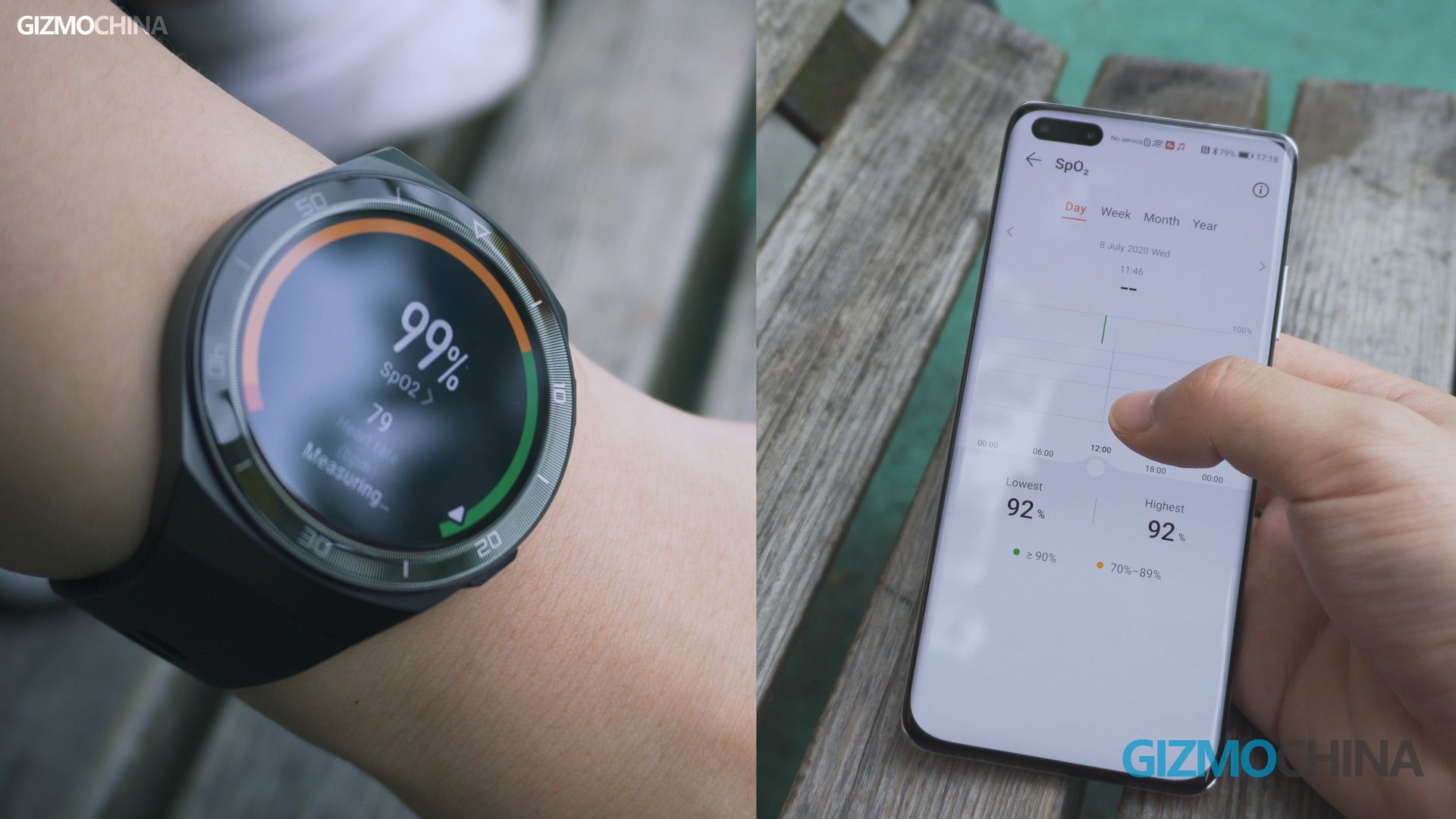
For the blood oxygen saturation tracking, we sent the watch to my friend who is a doctor, and asked him to compare the Sp02 watch performance with professional equipment. He told us that the results were very close. Even so, we still need to remind you that the watch is not professional medical equipment, and don’t judge your physical health only with the smartwatch.
The other features like remote camera control, notifications, weather, compass, barometer, are very practical for those who love outdoor activities.
Huawei GT 2e Review: Battery
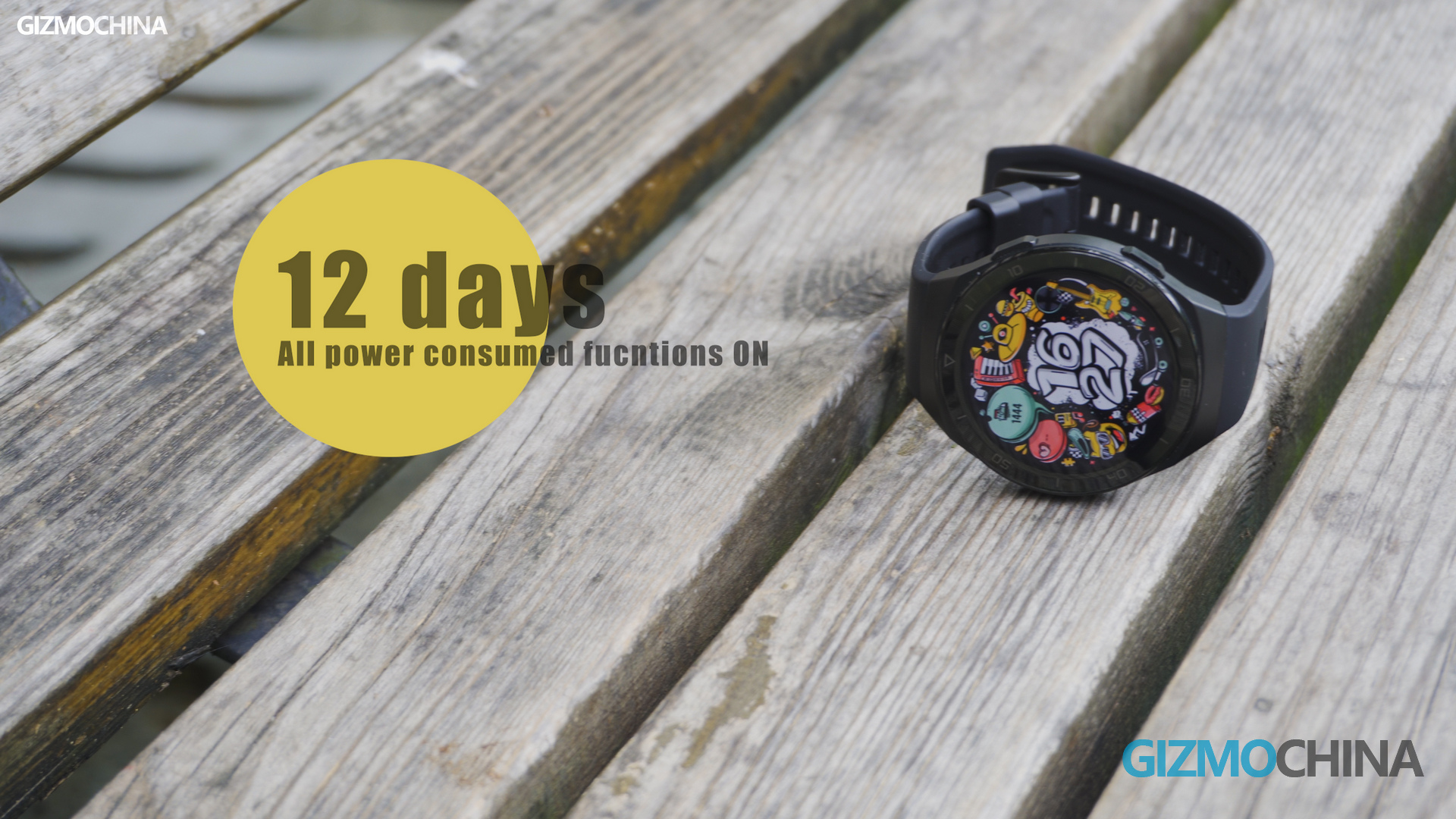
Thanks to the power-saving algorithm of the Huawei self-developed chip Kirin A1, the GT 2e is optimized for a longer-lasting battery. During our daily use, the Huawei Watch GT 2e lasted for around 12 days. Though it’s a bit shorter than the 2 weeks claimed by Huawei, we have to say that the actual use should be very close to the 2-week battery life, considering that we turned on almost all the power-consuming functions including most monitoring and standby watch face during our testing phase
The GT 2e is 5ATM waterproof, which means that it could be used for shallow-water activities like swimming but should not be used for diving or other underwater activities.
So, the GT 2e is definitely our pick in the smartwatch segment in the first half of 2020. Especially if you’re using Huawei phones or Huawei earbuds, the GT 2e should be an ideal companion accessory to track your fitness and health.
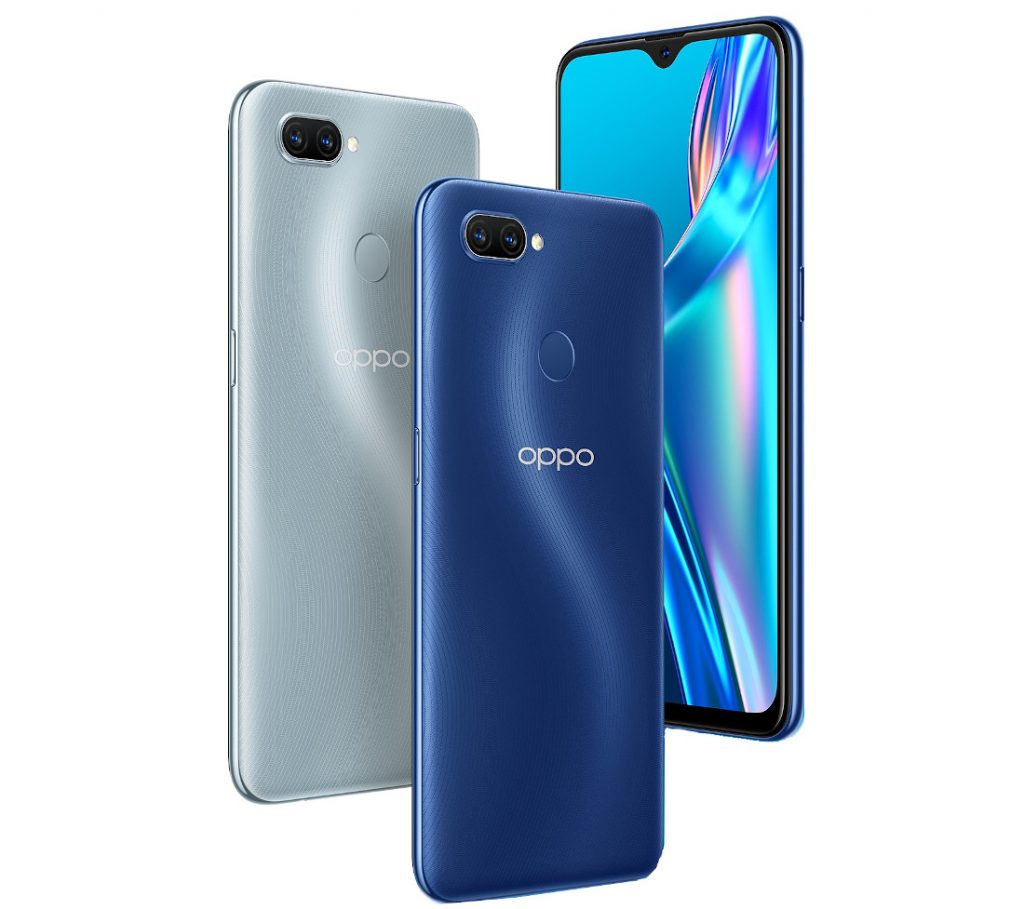
OPPO has added a new model to the A-series of smartphones. The model is the OPPO A12s and it was officially launched in Cambodia. The model comes just barely two months and a month after the A12 was launched in Indonesia and India respectively.
The OPPO A12s adopts a similar design as the A12 but is availed in new point job options. The model is available in Blue and Grey colours. It retains the 6.2-inch display with a waterdrop notch as its sibling. The display has an HD+ resolution of 1520 x 720 pixels.
At the rear aspect, the phone packs a dual-camera set up made up of a 13-megapixel main sensor and a 2-megapixel lens that is likely a depth sensor. The rear panel utilises a plain matte finish different from the 3D Diamond Blaze finish on the A12. There is equally a fingerprint sensor mounted at the back. For selfies, there is a 5-megapixel sensor.
The mobile phones powered by an Octa-core MediaTek Helio P35 chipset paired with 3GB of RAM. You also get 32GB of internal storage which can be expanded up to 256GB via microSD slot. The phone comes with two SIM slots and a third slot for microSD card. For interface, the A12s runs on ColorOS 6.1 based on Android 10 and gets its juice from a mammoth a 4230mAh battery. Other features include a 3.5 mm audio jack, FM Radio, 4G VoLTE, WiFi 802.11 b/g/n, Bluetooth 4.2, GPS/GLONASS, Micro USB Port.
The OPPO A12s is priced at $129 USD for the 3GB+32GB storage variant which is the only option available. The price is just slightly lower than that of the A12 which sells in India for Rs. 9990 (around $132). The phone will be available in Cambodia but we expect it to hit other markets soon.
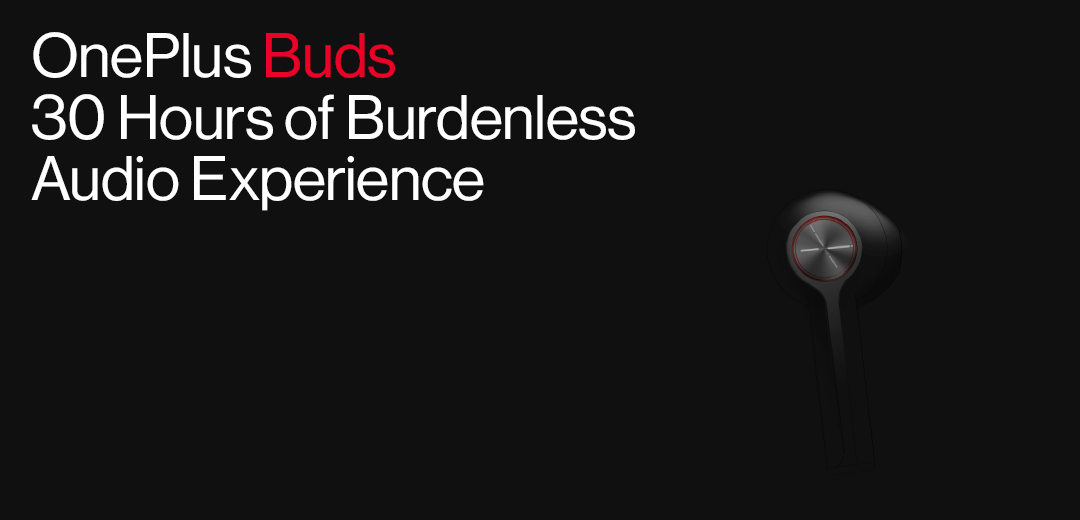
It has been confirmed that the OnePlus Buds will launch alongside the OnePlus Nord on July 21. Today, Pete Lau, the CEO of OnePlus has shared a post on the OnePlus Forum site that reveals more details of the TWS earbuds. We also get a first look at the blue variant of the earbuds.
The post first talks about the design of the OnePlus Buds. The company’s top executive said they have designed the earbuds to be “more than comfortable for long wear”. The TWS earbuds have a “half-in-ear design” to achieve this comfortability.
Coming to battery life, the OnePlus Buds will provide up to 7 hours of continuous use. That goes up to 30 hours with the case which can charge the earbuds more than three times before having to recharge it.
OnePlus boasts that even with the impressive battery life, the earbuds are “exceedingly light” at 4.6 grams each while the case weighs 36 grams.
Pete says the OnePlus Buds are designed to work with a wide range of devices but OnePlus phones get deeper optimizations; one of which is an ultra-low latency mode similar to that of wired headphones once you enter gaming mode on your OnePlus phone.
We also get a first look at the blue variant of the earbuds thanks to a video just updated by YouTuber, MKBHD. The video is an interview with Carl Pei on the OnePlus Nord, and we see the co-founder wearing a pair of blue TWS earbuds we are pretty sure is the OnePlus Buds.
The earbuds have a stem of average length. As you can see, they are not as short as that of the AirPods Pro. They look pretty good and with the 30-hour battery life mentioned above, it should be a best-seller as long as it is affordable.
OnePlus 8 and OnePlus 8 Pro are some of the few devices in the Android 11 Beta program. After receiving Beta 1 last month, users of both the handsets from the Chinese smartphone maker can now install Beta 2, which was out earlier today.
Although some OEMs like Xiaomi are providing Android 11 Beta builds in AOSP form, OnePlus’ come with OxygenOS. It can be used by any user, however, given the nature of the beta builds, it is not recommended for all.
Android 11 Beta program is primarily meant for developers as not everyone has access to Google Pixels. Anyway, tech-savvy users can try to out the latest features if they can cope up with unknown bugs.
Interested users can download the build for their device from the link provided at the end of the post. Before that, make sure to read the below-mentioned problems issued by OnePlus.
All data will be cleared while flashing the build
Certain UI screens look less than desirable
Some camera functions are not available
Some apps may not function as expected
System stability issues
If you are fine with the above points, then first download the proper file. Up next, go to Settings > System > System Updates > Click top right icon > Local upgrade -> Select the downloaded file-> Upgrade -> Tap on Restart.
If you want to return back to the stable build, then download the required rollback package and follow the same steps mentioned above.
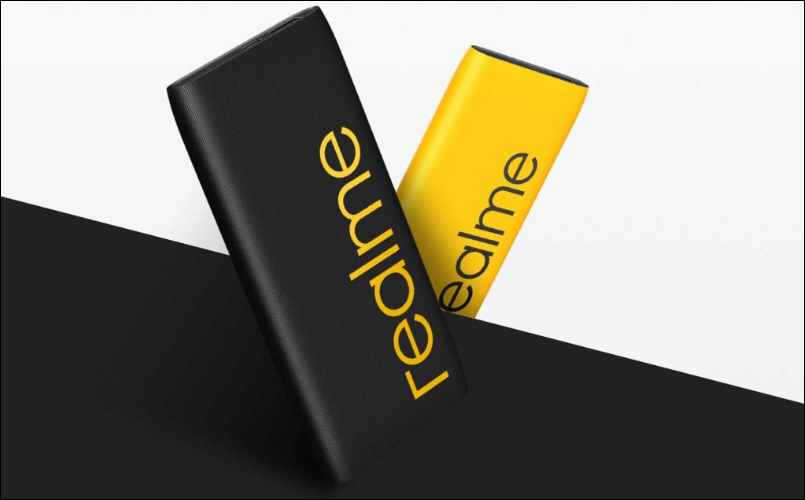
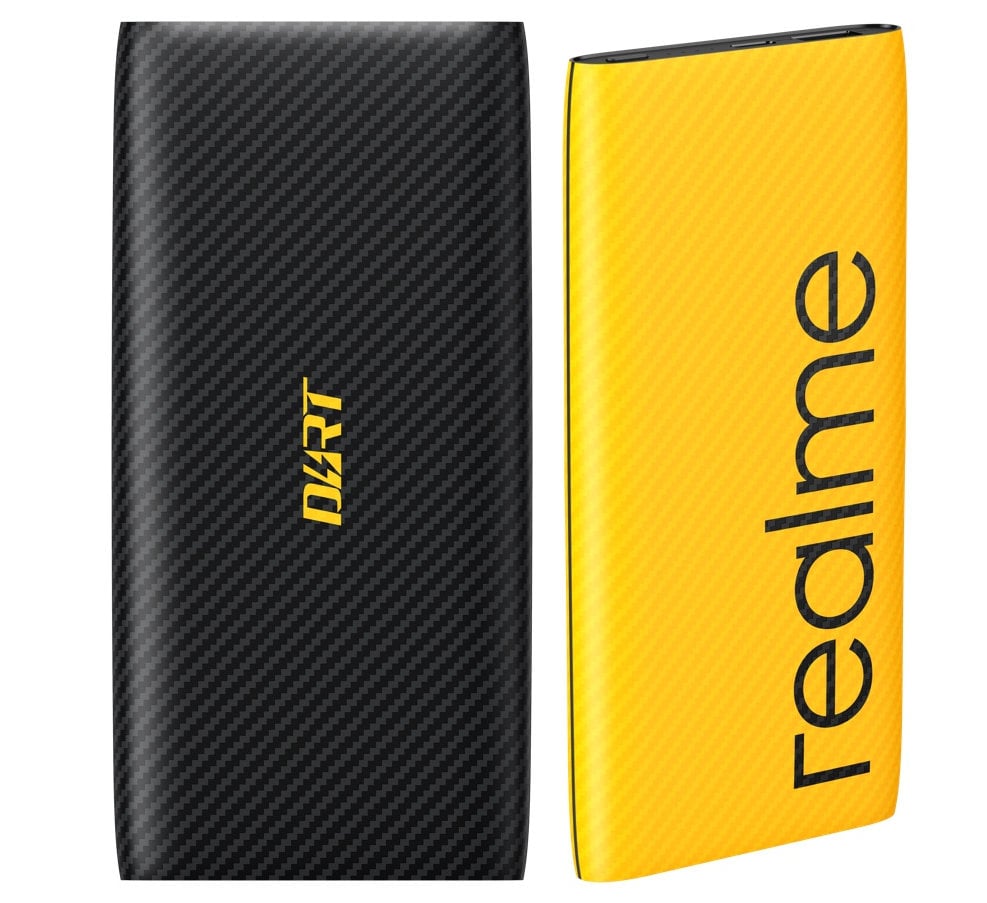
Realme recently teased the launch of a 30W Dart Charge 10000mAh power bank in India for July 14. Indeed, the company has officially launched the power bank. The 30W two-way fast charging power bank is an upgraded version of the Realme Power Bank 2 which was launched in India a few months back.
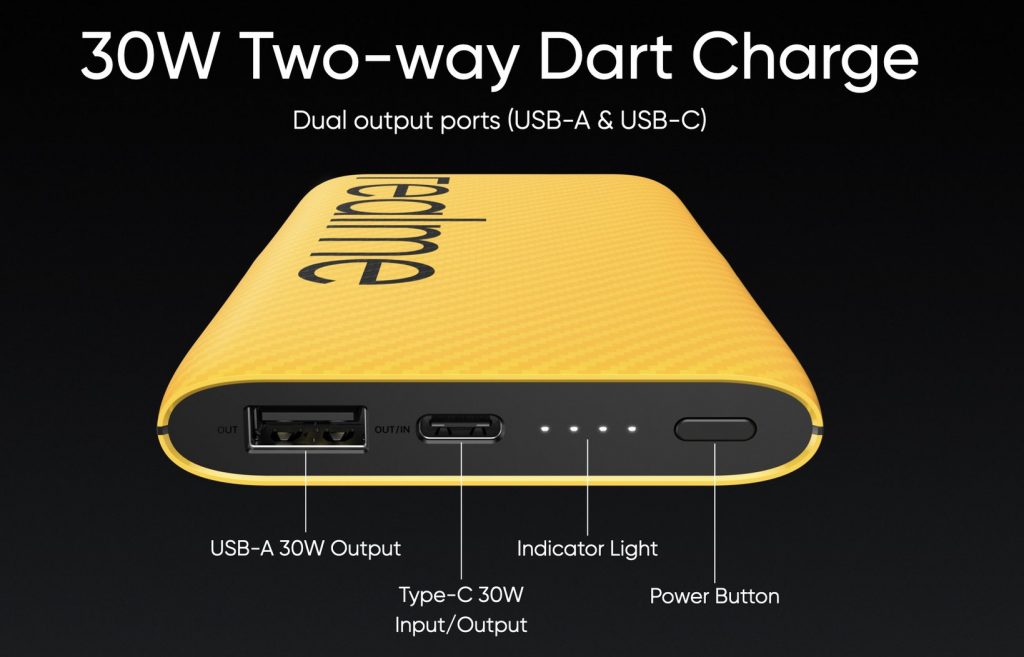
The 10000mAh 30W two-way fast charging power bank brings to the table 53% faster-charging speed compared to the 18W power bank. It equally supports 30W VOOC / Dart Charge devices and is also compatible with 20W, 18W, 15W and 10W devices. The power bank features a USB- and USB-A port making it possible to charge two devices at the same time.
In terms of the build, the Realme 30W Dart Charge power bank adopts a similar design with its predecessors. The body has a unique carbon fibre texture on the outside created using advanced lithography machine along with the Realme logo and Dart charging logo. The power bak also comes with 15 layers of protection including current, over-power, short circuit, over charger or discharge and more.
The Power bank also comes with support for fast charging going from zero to full charge in just 1.9 hours with a 30W charger. It comes in the traditional Black and Yellow colours.
As for the price, the Realme 30W Dart Charge Power bank will go on sale for Rs. 1999 (~$26). The sale will commence from July 21 via Flipkart and realme.com.
Selpic is globally popular for its handheld printers offering high-end specifications and features. Selpic S1 and S1+ are two new handheld printers which were launched by the company a few months ago at reasonable prices. However, the company is offering an exceptional 30% discount on the eve of Mid-Year sale from July 14 to 20.
Selpic is offering a 30% discount on both the Selpic S1 and S1+ portable printers. You can grab the Selpic S1 and Spelic S1+ at the price of $199 and $239, respectively.
Both the printers offer abundant features to flawlessly print text, graphics, barcodes, QR codes and images on any surface including wood, textile, leather, ceramic, glass and cardboard. It can be easily paired with iOS and Android devices to harness the full potential of these tiny portable yet useful printers.
The major difference between Selpic S1 and S1+ is the print head size, which affects the print speed. Selpic S1+ houses print head of 1.0″ which enables to print at 20~300 mm/s, while the Selpic S1 has 0.5″ head with slightly slow printing speed.
You can grab the Selpic printers at discount prices. The offer is limited to printers, while the ink cartridges are retailing at the same price. There’s an option to choose between different colours Ink Cartridges including Black, White, Yellow, Green, Red and Blue. You can head over to the Selpic store to get portable printers at reduced prices. The interested users can head over to the Selpic official website to view the whole product catalogue.
There is CES Las Vegas and there is was CES Asia. Yes, was, because the Consumer Technology Association (CTA) has announced that it is canceling the five-year-old event.
An official statement on the official CES Asia website said the event has now been canceled going forward. The decision to cancel the annual event was influenced by multiple reasons, one of which is the COVID-19 pandemic.
“CTA has now decided to cancel CES Asia going forward. We have enjoyed annual growth and success since CES Asia was launched in 2015 in Shanghai.” – Consumer Technology Association
The pandemic had caused the organization to cancel this year’s edition of CES Asia which was supposed to take place last month between June 10 and June 12 in the city of Shanghai. The event was originally postponed in March before its eventual cancelation.
The statement also said that the event enjoyed growth and success but lost momentum after two years. Other reasons stated include the economy, and the CTA’s ”visible role as an American trade association”.
The CTA also said in its statement that “China is an important market and we look forward to improved relations with the US and western world”.
During its short stint as a tech show, CES Asia was organized by the CTA, China Electronics Chamber of Commerce, and China Chamber of Commerce for Import and Export of Machinery.
The CTA is still going ahead with an in-person event in Las Vegas scheduled for 2021 and has also said it will expand access to the show digitally.
Huawei has been rolling out EMUI 10.1 to eligible devices worldwide since its announcement alongside the P40 series. Now, as the company is almost done with the update rollout in China, it has shared global update timeline/schedule for other regions like West Europe, Northeast Europe, Middle East Africa, Russia and Central Asia, Latin America, Canada, and Japan.
It is worth noting that some of the devices have already received the update while few have just begun to get it in the mentioned regions. That said, here is the official EMUI 10.1 global update timeline/schedule for various regions.
West Europe
Device
Model Number
Update Rollout
Status
Huawei P40 Lite
JNY
Mid-May
Delivered
Huawei Mate 30 Pro
LIO
Mid-June
Delivered
Huawei P30
ELE
End of May
Pushing in batches
Huawei P30 Pro
VOG
End of May
Pushing in batches
Huawei Mate 20
HMA
Early July
Pushing in batches
Huawei Mate 20 Pro
LYA
Early July
Pushing in batches
Porsche Design Huawei Mate 20 RS
LYA
Early July
Pushing in batches
Huawei Mate 20X 5G
EVR
Early July
Pushing in batches
Huawei Mate Xs
TAH
Early August
Not Started
Huawei Mate 20X 4G
EVR
Mid-July
Not Started
Huawei Nova 5T
YAL
Mid-July
Not Started
Northeast Europe
Device
Model Number
Update Rollout
Status
Huawei P40 Lite
JNY
End of May
Delivered
Huawei Mate 30 Pro
LIO
Mid-June
Delivered
Huawei P30
ELE
End of May
Pushing in batches
Huawei P30 Pro
VOG
End of May
Pushing in batches
Huawei Mate 20
HMA
Early July
Pushing in batches
Huawei Mate 20 Pro
LYA
Early July
Pushing in batches
Porsche Design Huawei Mate 20 RS
LYA
Early July
Pushing in batches
Huawei Mate 20X 5G
EVR
Early July
Pushing in batches
Huawei Mate Xs
TAH
Early August
Not Started
Huawei Nova 5T
YAL
Mid-July
Not Started
Middle East Africa
Device
Model Number
Update Rollout
Status
Huawei Mate 30 Pro 5G
LIO
Early June
Delivered
Huawei Mate 30 Pro
LIO
Early June
Delivered
Huawei Nova 7i/Huawei P40 Lite (South Africa)
JNY
Early June
Delivered
Huawei P30
ELE
End of June
Pushing in batches
Huawei P30 Pro
VOG
End of June
Pushing in batches
Huawei Mate 20 Pro
LYA
Early July
Pushing in batches
Porsche Design Huawei Mate 20 RS
LYA
Early July
Pushing in batches
Huawei Mate Xs
TAH
Early September
Not Started
Huawei Mate 20 X 4G
EVR
End of July
Not Started
Huawei Mate 20
HMA
End of July
Not Started
Huawei Mate 20 X 5G
EVR
End of July
Not Started
Huawei Nova 5T
YAL
End of July
Not Started
Russia and Central Asia
Device
Model Number
Update Rollout
Status
Huawei P40 Lite
JNY
Early June
Delivered
Huawei Mate 30 Pro
LIO
Mid-June
Delivered
Huawei P30
ELE
End of June
Pushing in batches
Huawei P30 Pro
VOG
End of June
Pushing in batches
Huawei Mate Xs
TAH
Early August
Not Started
Huawei Mate 20
HMA
Early August
Not Started
Huawei Mate 20 Pro
LYA
Early August
Not Started
Porsche Design Huawei Mate 20 RS
LYA
Early August
Not Started
Huawei Nova 5T
YAL
Early August
Not Started
Latin America
Device
Model Number
Update Rollout
Status
Huawei Mate 30 Pro
LIO
Early June
Delivered
Huawei P40 Lite
JNY
Mid-June
Pushing in batches
Huawei P30
ELE
Early July
Pushing in batches
Huawei P30 Pro
VOG
Early July
Pushing in batches
Huawei Mate 20
HMA
Early August
Not Started
Huawei Mate 20 Pro
LYA
Early August
Not Started
Huawei Nova 5T
YAL
Early August
Not Started
Huawei Mate Xs
TAH
Early August
Not Started
Canada
Device
Model Number
Update Rollout
Status
Huawei P30
ELE
End of July
Not Started
Huawei P30 Pro
VOG
End of July
Not Started
Huawei Mate 20 Pro
LYA
Mid-August
Not Started
Huawei Mate 30 Pro
LIO
End of August
Not Started
Japan
Device
Model Number
Update Rollout
Status
Huawei P30
ELE
Mid-June
Delivered
Huawei Mate 20 Pro
LYA
Early July
Pushing in batches
Huawei Nova 5T
YAL
End of July
Not Started
Huawei Mate 30 Pro 5G
LIO
Early August
Not Started
Having said that, the above-mentioned timeline/schedule for EMUI 10.1 rollout in different regions may vary depending on certain reasons. However, the update will be definitely seeded out to the listed devices.
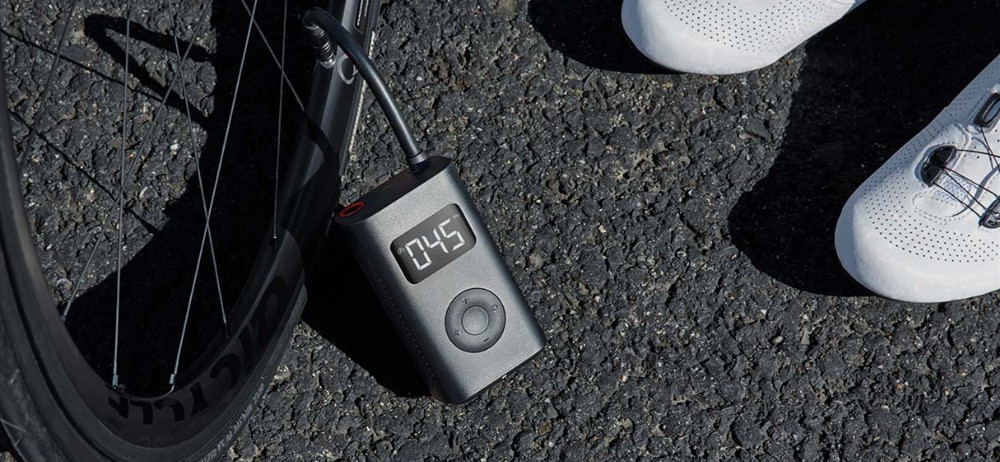
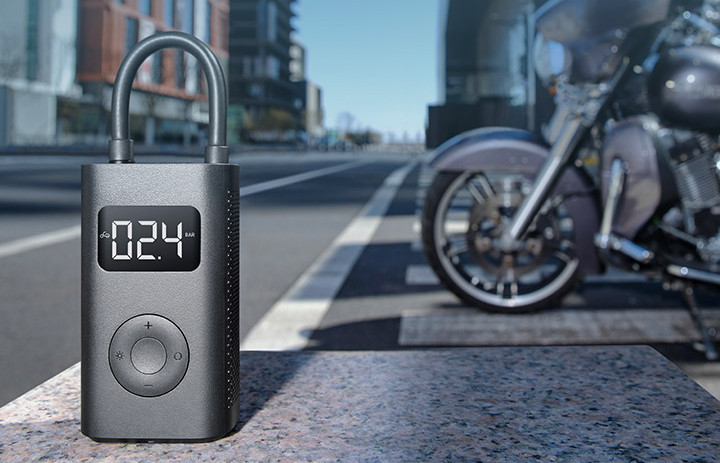
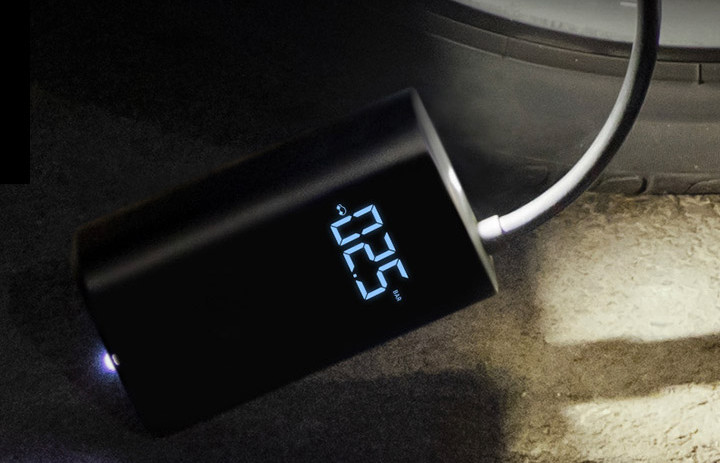
Xiaomi has officially taken the wraps off the Mi Portable Electric Compressor in India after teasing the launch over the weekend. The product is launched under crowdfunding and carries a price tag of Rs. 2,299 (~$30) which is the same with what it was sold in China. The gadget which comes in black is expected to start shipping from August 10.
The Mi Portable Electric Air Compressor has a cylindrical shape manufactured from aluminium alloy using high-precision technology. The portable electric pump is designed to work with a wide range of nozzles. It is housed in a compact body so that you can easily carry it everywhere you go.
Statically, the Xiaomi Mi Portable Air Compressor can easily inflate 215/60/R17 car tyres for five times once fully charged. It can refill motorcycle tires six times and bicycle tires 8 times. A football can be refilled from 0 psi to 120 psi seven times.
In addition, the Mi Portable Air Compressor offers an inflation pressure range of 0.2-10.3bar/3-150psi. It offers a sensor accuracy of ±2psi. On top of that, the feature-laden tire electric inflator pump produces noise less than 80dB from 1 meter and stops when the device is fully charged. The Mi Portable Electric Air Compressor draws its juices from a 2000mAh (14.8Wh) battery and can be charged in less than three hours with the 5V-2A charging parameters over a micro-USB port.
Elephone is working diligently to expand its reach and across the globe. Starting about 4 years ago, the company is expanding its wings across Western Asia by entering Turkey. Elephone will launch its latest smartphones via offline and online markets in Turkey.
However, details about the smartphones which are launching in Turkey are not available yet. But, it is highly anticipated that Elephone could launch PX Pro and E10 pro smartphone which were launched by the company a few weeks ago. Other devices with waterdrop notches, punch-hole display devices will be available.
According to the official Elephone Turkey Handle, the Elephone U3H model will certainly launch along with many other goodies. Elephone U3H is teased to feature a triple rear camera module with 48-megapixel primary camera. Moreover, it will feature MediaTek chipset built on 12nm process having a maximum clocking speed of 2.1GHz. It is available in 8GB RAM and 128GB internal storage variant.
It is an important market to capture entire Asia and will facilitate the company’s global footprint. The company recently expanded across the Middle East and Pakistan.
Apart from expanding its reach, the company has also succeeded in extending its portfolio from smartphones to wearables and now TWS wireless earphones are the latest entrant. The earbuds start from a jaw-dropping price of $9.99 and go up to $39.99.
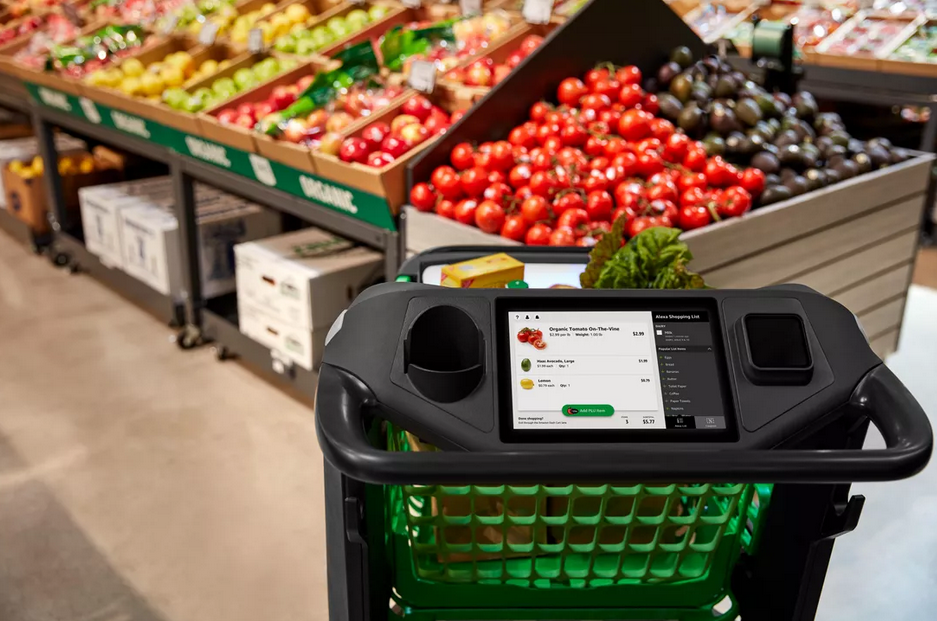
Amazon has just unveiled the Dash Cart, its reinvention of the regular shopping cart. The company announced Dash Cart earlier today (14th July 2020), and is capable of scanning your items as you place them in the cart. This will help people skip the busy checkout lines.
The Dash Cart from the e-retailing giant is essentially a mobile version of Amazon Go. For those unaware, Amazon Go is a store with no checkout since it used hundreds of cameras on the ceiling that automatically checkout the items that the customers pick up. In other words, a similar experience with automatic scanning, bringing the store on wheels.
According to Dilip Kumar, vice president of Amazon’s physical retail and technology, “Our primary motivation for building this was to be able to save customers time. The alternative solutions are standing in the express checkout lanes or fumbling through self-checkout stations.” The service will debut at Amazon’s Woodland Hills, California, grocery store.
This store was unveiled back in November 2019 and is a part of the company’s plans for creating a new supermarket chain in the region. These stores will offer both Dash Cart along with conventional checkout lanes. The new smart carts are Amazon’s take on recreating and replacing the old squeaky and unbalanced shopping carts and adding a techie upgrade to them.
Last year, Xiaomi showcased its 100W Super Charge Turbo fast charging solution in a video. This technology is capable of fully charging a 4,000 mAh battery in just 17 minutes. Now, after more than a year later, a smartphone with support for this tech has entered mass production according to the latest leak.
The mystery 100W Xiaomi smartphone has been rumored for a while now. A 120W Xiaomi charger with model number MDY-12-ED was recently certified by China’s 3C. This adaptor could come bundled with the said phone.
Xiaomi’s fastest charging phone was tipped to launch by the end of this year. But the new tip by Digital Chat Station suggests it might be unveiled next month itself as the company has begun to mass manufacture it.
The tipster says that this handset will also support fast wireless charging, however, he did not mention the rate of charging. Earlier this year, Xiaomi demoed its 40W wireless charging and therefore, there is a little chance of it to debut on this mystery phone. At least, we can expect 30W wireless charging like the Mi 10 series.
Additionally, when a blogger asked Wang Teng, the Product Director of Redmi brand regarding the announcement of 100W charging, he replied that they have already announced this tech earlier. He added “what’s next, you figure” (Chinese translation) indicating the imminent launch of this phone in line with the latest leak.
Having said that, Xiaomi’s 100W smartphone is still a mystery. It could be either the rumored Mi 10 Pro Plus, Mi Mix 4 or maybe something else altogether.
With the calendar crossing the half yearly mark, Huawei has announced its financial report for the period. In the report, the Chinese tech giant has witnessed a positive trend with both its revenue and net profit increasing by 13.1 percent and 9.2 percent respectively year on year.
The financial report revealed that Huawei generated 454 billion Yuan (roughly 64 billion US Dollars) in revenue. Out of this, the carrier business brought in 159.6 billion yuan, while the enterprise business brought in 36.3 billion Yuan. The company’s consumer business, which includes smartphones, generated 255.8 billion Yuan in revenue.
Looking at these figures, it is clear that more than of Huawei’s income is from its consumer business that has it sell tablets, smartphones, wearables, and many other products across the globe. Although, the networking gear and carrier provider aspect of its operations is brought the ban on the company, and accounts for just 35 percent of the total revenue.
Additional reports regarding financial figures of the first half and second quarter are expected to arrive later this month. These will hopefully provide a larger picture of its global smartphone market as well. The first half of 2020 suffered the brunt of the Coronavirus pandemic, so the figures will reveal how Huawei stands amongst its various other competitors.
Earlier today (14th July 2020), Microsoft announced that it is continuing to expand its partnership with Samsung to bring a digital transformation for real estate development and property management industries across the globe.
The new strategic alliance between both tech giants will have both companies work to optimize energy management, equipment maintenance, and more. This partnership will utilize Microsoft’s productivity cloud services and Azure IoT platform and Samsung’s smart devices and SmartThings platform. The announcement also builds on Microsoft’s $5 billion investment into the security of its own IoT.
This collaboration will allow Microsoft to expand its IoT technology into newer markets, with the help of Samsung. In other words, saving millions to develop its own smart devices. Furthermore, real estate development and property management industries will also have to depend on this joint venture to improve their existing building maintenance and management processes.
According to Sam George, corporate vice president, Azure IoT, Microsoft, “This collaboration with Samsung opens up new opportunities for further innovation in the real estate development and property management industries. Together, we’ll bring the best of Microsoft’s trusted, easy-to-use and secure Azure IoT platform, Azure Digital Twins, and Dynamics 365 Field Service technology with Samsung’s expertise in connected devices and appliances to streamline building operations and maintenance.”
We use cookies on our website to give you the most relevant experience by remembering your preferences and repeat visits. By clicking “Accept”, you consent to the use of ALL the cookies.
This website uses cookies to improve your experience while you navigate through the website. Out of these, the cookies that are categorized as necessary are stored on your browser as they are essential for the working of basic functionalities of the website. We also use third-party cookies that help us analyze and understand how you use this website. These cookies will be stored in your browser only with your consent. You also have the option to opt-out of these cookies. But opting out of some of these cookies may affect your browsing experience.
Necessary cookies are absolutely essential for the website to function properly. This category only includes cookies that ensures basic functionalities and security features of the website. These cookies do not store any personal information.
Any cookies that may not be particularly necessary for the website to function and is used specifically to collect user personal data via analytics, ads, other embedded contents are termed as non-necessary cookies. It is mandatory to procure user consent prior to running these cookies on your website.