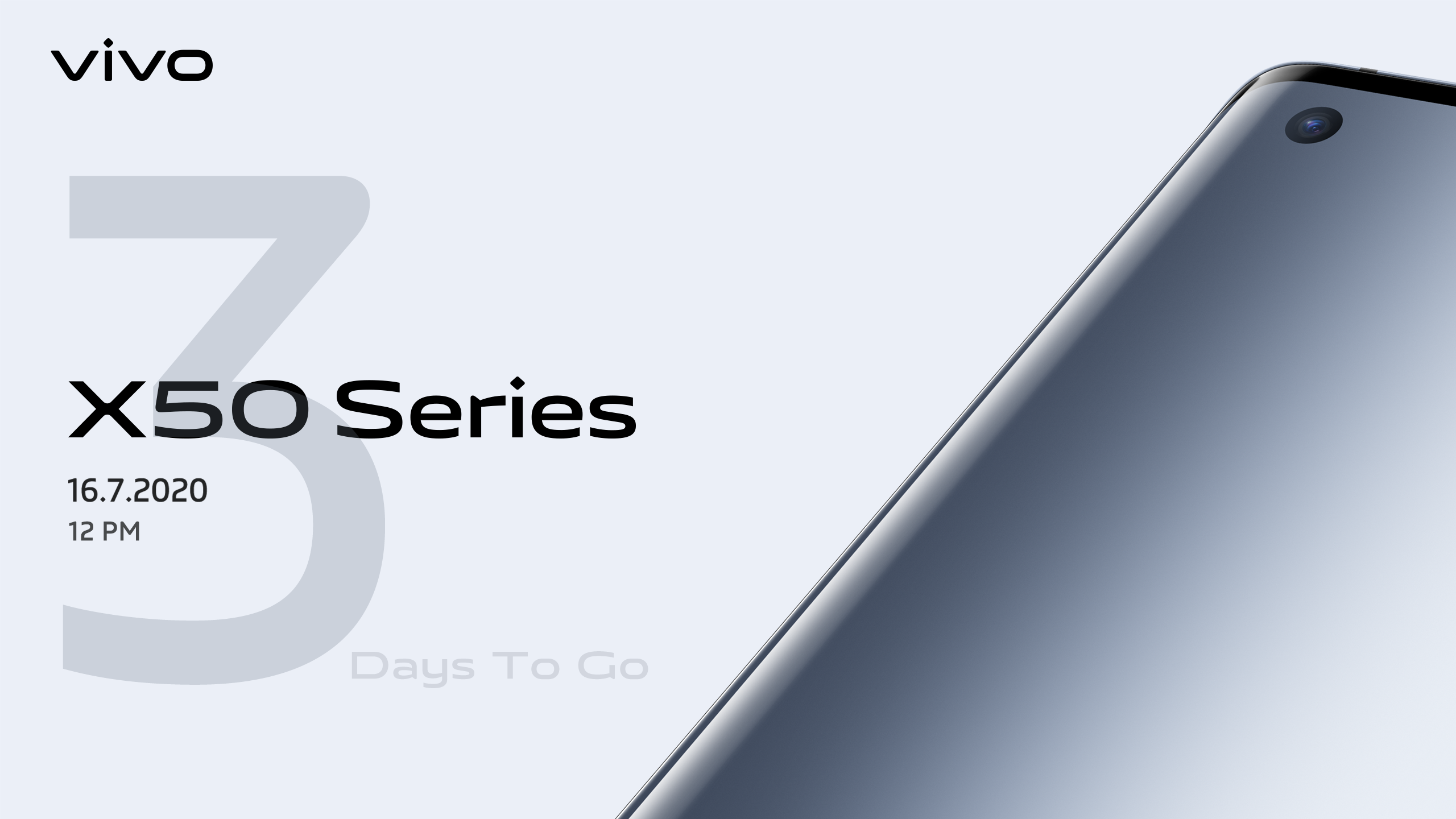
Last month, Vivo had unveiled its Vivo X50 series smartphones, which includes three models — X50, X50 Pro, and X50 Pro+. Now, the company has confirmed that the Vivo X50 series will be officially launched in India on 16th July.
Vivo has revealed that the launch event will begin at 12:00 PM IST on 16th July. The company is promoting this upcoming smartphone lineup by claiming the smartphone to be the “future of smartphone pro-photography.”
To remind you of the specifications, the Vivo X50 and X50 Pro feature a 6.56-inch FHD+ AMOLED screen with a 90Hz refresh rate. The X50 Pro also comes with a 55-degree curved screen. Under the hood, both of them are powered by the Qualcomm Snapdragon 765G SoC with support for 5G SA/ NSA.
The X50 comes with a 48-megapixel rear camera with a Sony IMX598 sensor, an 8-megapixel 120° ultra-wide lens, 13-megapixel 50mm equivalent portrait camera, and a 5cm 1.5cm macro sensor. The X50 Pro features the same 48-megapixel rear camera with a Sony IMX598 sensor but comes with 5-axis OIS gimbal-like structure. It has the same 13-megapixel 50mm equivalent portrait camera and an 8-megapixel 120° ultra-wide lens, and an 8-megapixel 5x periscope telephoto lens that supports up to 60x zoom.
On the other hand, the X50 Pro+ comes with a 6.56-inch FHD+ AMOLED 55-degree curved screen with a 120Hz refresh rate, 240Hz touch sampling rate. It is powered by Qualcomm Snapdragon 865 with 5G SA/ NSA support.
In the camera department, it features 50MP Samsung ISOCELL GN1 1/1.31″ CMOS sensor with 1.2μm size, uses the optical anti-shock feature, along with 13-megapixel periscope 5x telephoto camera with up to 60x zoom, a 32-megapixel 50mm portrait camera and a 13-megapixel 120° ultra-wide-angle lens.
All the models run the Android 10 operating system with the company’s own FunTouch OS 10.5 on top. The X50, X50 Pro, and X50 Pro+ are powered by 4,200mAh, 4,315mAh, and 4,350mAh batteries respectively.
In December last year, HMD Global had launched the Nokia 2.3 entry-level smartphone and now the company seems to be all set to launch its successor, dubbed as Nokia 2.4. The smartphone has now been spotted on the benchmarking platform GeekBench, revealing some of the key details.
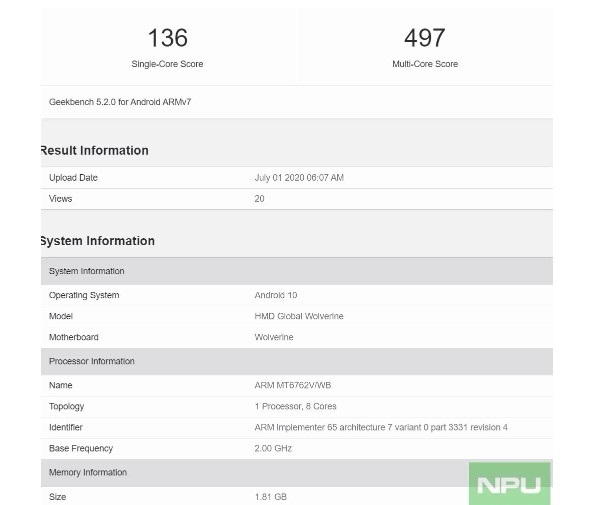
The Geekbench listing shows that the smartphone will come powered by the MediaTek MT6762V/WB chipset, which is the MediaTek Helio P22 SoC. In comparison, the Nokia 2.3 is powered by the MediaTek Helio A22 processor.
The listing also reveals that the phone will have 2GB of RAM. While the storage capacity is not yet known, we expect it to be either 16GB or 32GB. As for the score, it managed 136 points in the single-core test and 497 points in the multi-core test.
Given that the smartphone has appeared on the benchmarking platform, the launch should not be far away. We expect to get more information about this upcoming smartphone in the coming days or weeks, ahead of its launch.
Meanwhile, the company has confirmed that it will be among the first to launch a smartphone powered by the newly announced Qualcomm Snapdragon 690 SoC. The phone is confirmed to be “truly global 5G” and is expected to be priced lower than the Nokia 8.3.
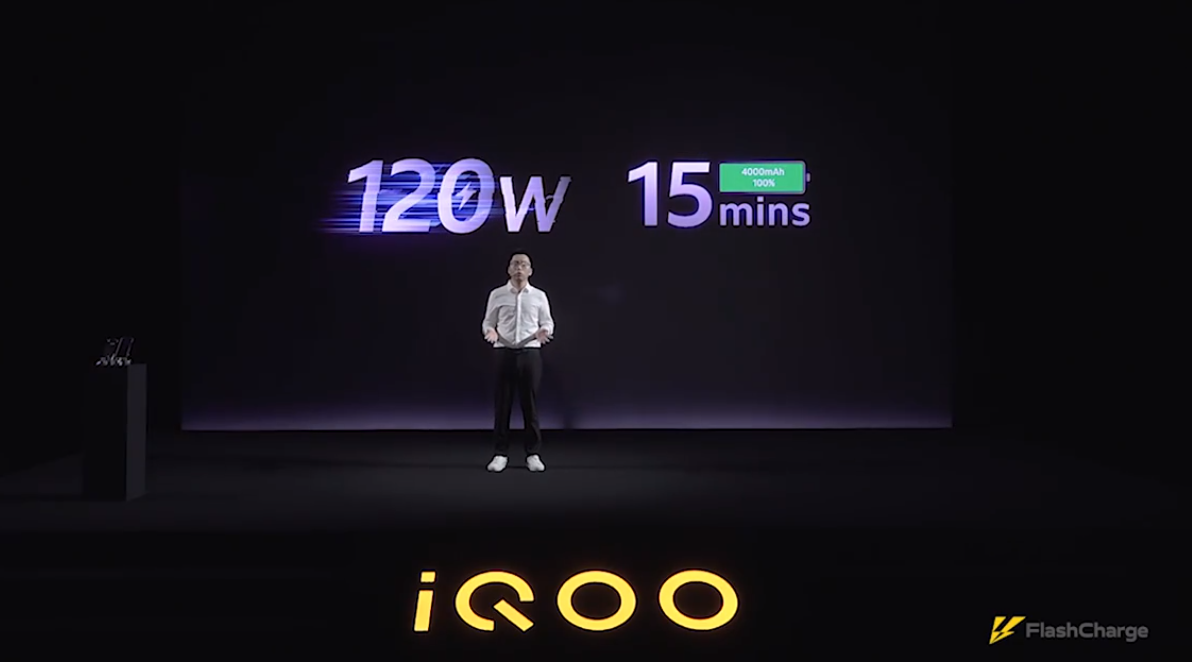
The second half of the year has just started, and the Chinese smartphone brands have begun announcing their next-generation fast charging technologies. OPPO confirmed that it will be launching the 125W super flash charge technology on Wednesday. However, rival brand iQOO suddenly unveiled its 120W Ultra-Fast charging technology today. The new charging tech from the brand can completely a charge 4,000mAh battery phone in just 15 minutes.
iQOO already offers fast charging solutions such as 33W, 44W, and 55W on its smartphones. The Chinese brand today unveiled the 120W Ultra-Fast rapid charging technology that promises to charge 50 percent of a 4,000mAh battery in 5 minutes and it can be fully charged in 15 minutes.
Vivo had unveiled its 120W FlashCharge technology at the Mobile World Congress Shanghai 2019 tech exhibition last year. However, it was not a commercial announcement. Also, the technology is yet to be mass-produced. Hence, today’s announcement by iQOO can be called as the world’s first 120W fast charging technology.
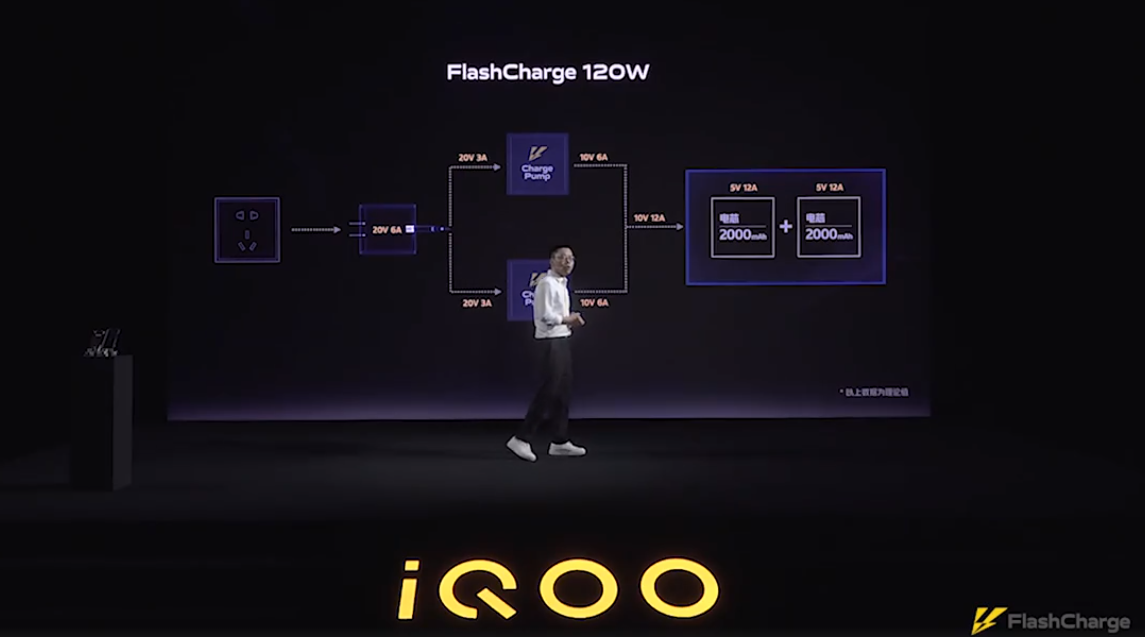
At the launch event, the iQOO Product Manager demonstrated the 120W rapid charging tech. The 4,000mAh battery phone has a dual battery system featuring an industry-first 6C cell, each one measuring 2,000mAh in size. Both batteries charge at 5V/12A (60W) by means of a customized chip to achieve a total charging speed of 120W with 97 percent charging conversion rate.
For safety and stability, the charging adapter will come equipped with array type pole structure cell impedance. Phones featuring the 120W ultra-fast charging will come with super VC liquid cooling technology to regulate the internal temperature of the device.
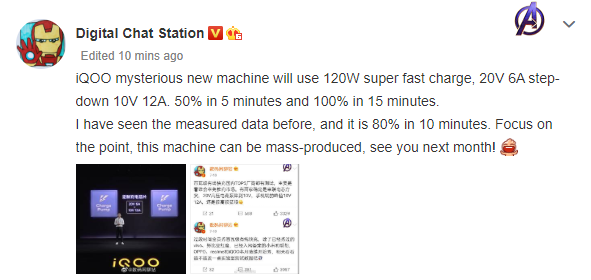
According to a leakster, a mysterious iQOO phone with 120W ultra-fast charging is already in works. He claims to have seen the measured data before and he found that the charging tech can fast enough to achieve 80 percent battery capacity in just minutes.
He revealed that the mysterious iQOO phone’s mass production has started, and it will debut next month. Could it be the rumored Snapdragon 865+ powered iQOO Pro 3 5G phone? Hopefully, new leaks will reveal the identity of the device in the coming days.
As the month of September is approaching, leaks and reports related to the upcoming iPhone 12 series have started surfacing online. After details about the phone’s display panels, now is the time for battery.
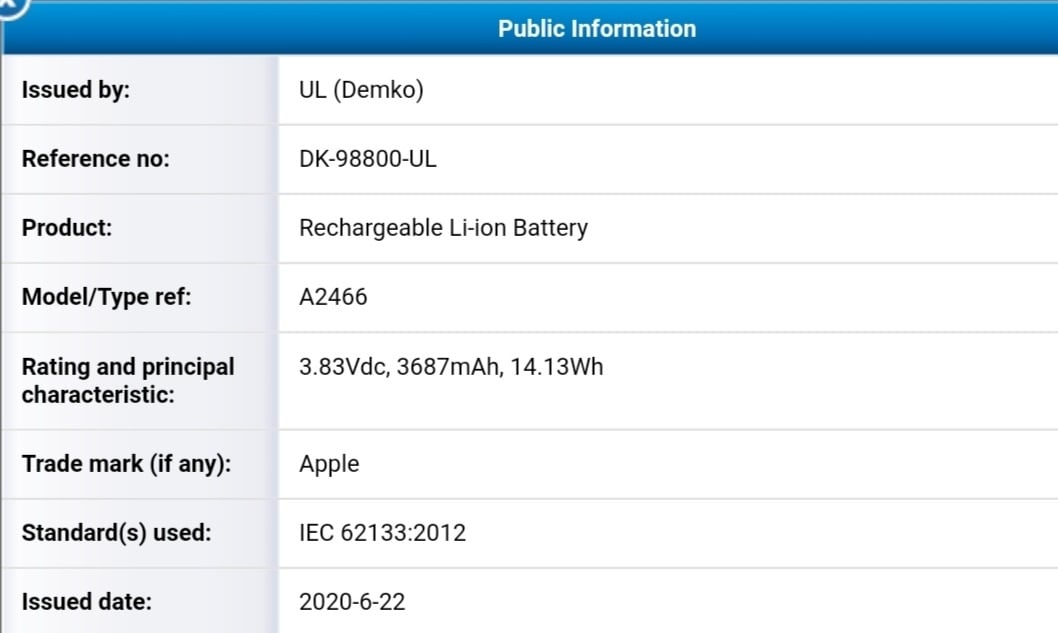
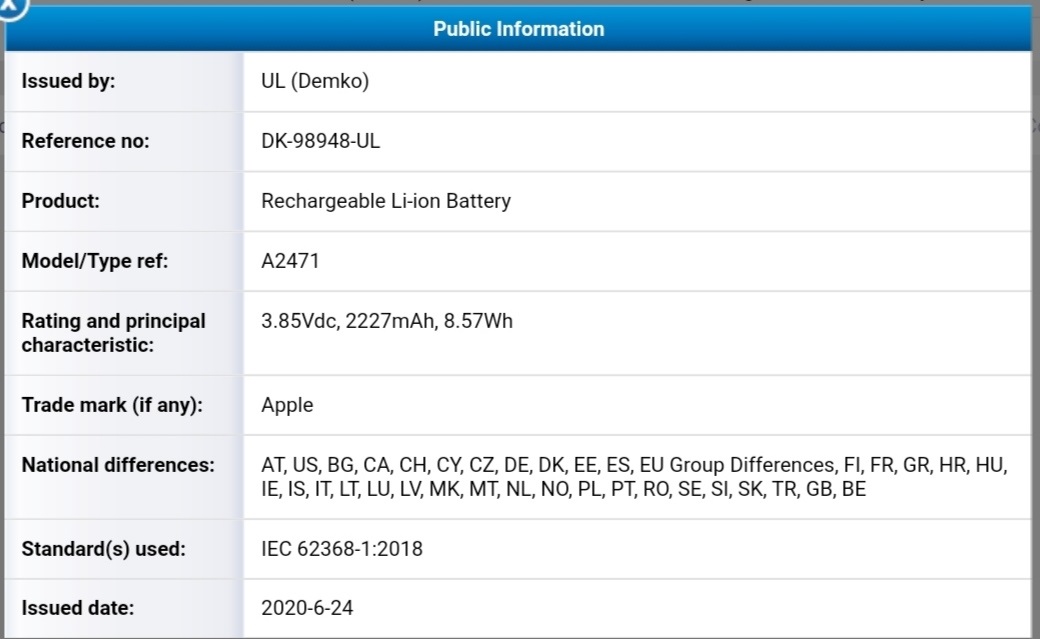
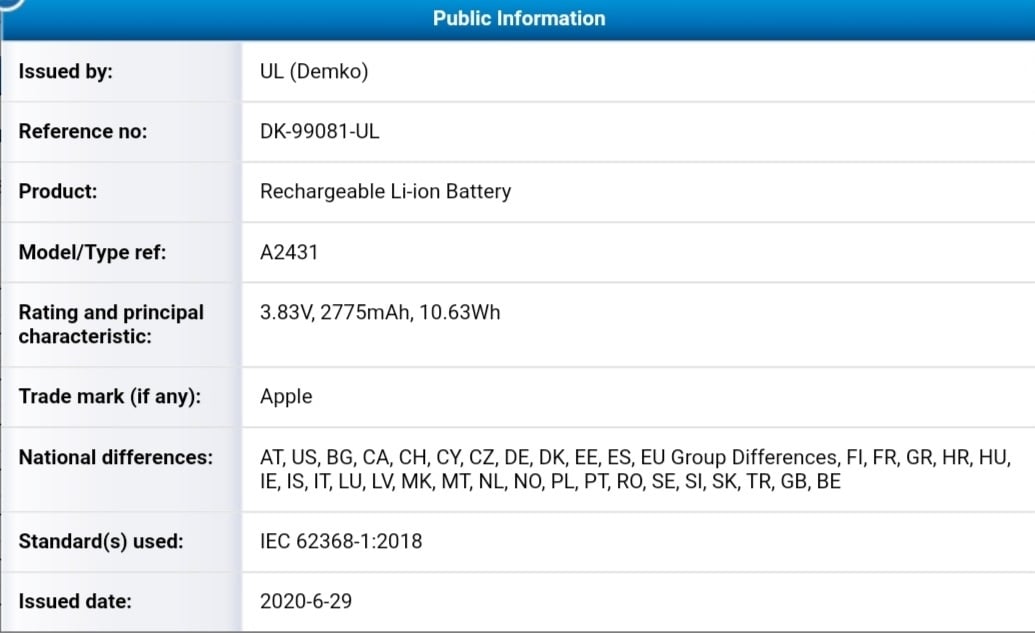
In the latest update, three new iPhone batteries have been certified by The Korea Industrial Technology Laboratory (KTL), passing their safety test. The three batteries which got certified in Korea are — A2471, A2431, and A2466.
Coming to the battery capacity, the A2471 has a capacity of 2,227mAh while the A2431 carries a capacity of 2,775mAh. The A2466 comes with a 3,697mAh capacity, the highest among the three.
The certificate listing also reveals that the battery is produced by Guangdong Desai Group, and the largest A2466 uses an L-type battery. But it remains to be seen which battery ends up in which iPhone model.
It’s noteworthy that the battery capacity of these new models is lower than the capacity of the most models in the iPhone 11 series. The iPhone 11, 11 Pro, and 11 Pro Max are powered by 3,110mAh, 3,190mAh, and 3,500mAh battery respectively.
Recently, it was reported that all the iPhone 12 models launching this year will come with an OLED display panel, completely ditching the LCD panels. There could be four variants this time, including iPhone 12, iPhone 12 Max, iPhone 12 Pro, and iPhone 12 Pro Max.
As per the reports, the standard iPhone 12 will have a 5.4-inch display while the Max and Pro models will have a 6.1-inch screen. The top-end model in the form of the iPhone 12 Pro Max will reportedly have a 6.7-inch display.
There are also reports making rounds that Apple may not include a power adapter as well as the Earpods in the box for the new iPhones. Despite that, the pricing for the base model in the iPhone 12 series is expected to be $50 more, starting at $749.
Just days after the launch of the iQOO Z1x smartphone in China, the company has today announced a new limited edition version of the iQOO Z1 smartphone which was launched in China a couple of months ago.
The newly announced smartphone, dubbed as iQOO Z1 Nautical King Limited Edition will be available for purchase in the company’s home market from 22nd July. The company has said that it will be available in limited quantities only.
iQOO has not revealed much about this limited edition device but from the teaser poster released by the company, it seems that there won’t be any difference compared to the standard edition, apart from the design. The company could reveal more information about the phone in the coming days.
As for the specifications of the iQOO Z1, the smartphone features a 6.57-inch IPS LCD screen with a punch-hole at the upper-right corner. The HDR10 complaint display supports DCI-P3 color gamut and offers a Full HD+ screen resolution of 1080 x 2400 pixels along with a refresh rate of up to 144Hz.
Under the hood, the device is powered by the MediaTek Dimensity 1000+ chipset, making it the first device powered by this SoC in the world. It packs up to 8GB of LPDDR4X RAM and UFS 3.1 storage of up to 256GB.
In the camera department, there’s a triple-camera setup that includes a 48-megapixel main lens, a 112-degree 8-megapixel ultrawide sensor, and a 2-megapixel macro shooter. On the front side, it has 16-megapixel snapper for taking selfies and video calling.
The 5G-compatible device runs the Android 10 operating system out-of-the-box with the company’s own iQOO UI On top. The smartphone features a 4,500mAh battery that carries support for 44W fast charging.
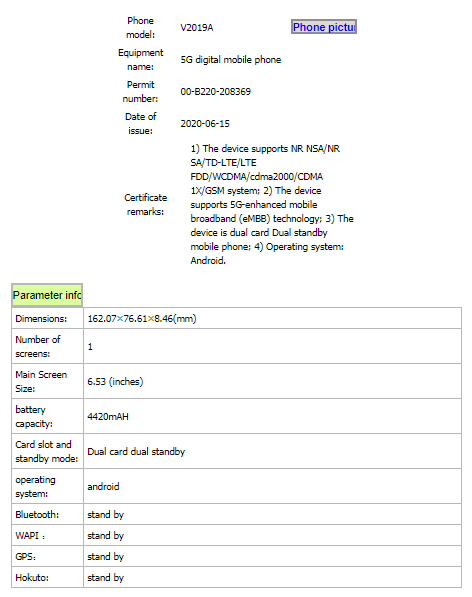
In the previous, couple of Vivo devices such as V2012A, V2019A, W2052/W2056 and V2011A received approval from the 3C authority of China. The V2011A and V2012A devices have already debuted as Vivo X50 Pro+ and iQOO Z1x 5G phones, respectively. The W2052/W2056 is the upcoming Vivo Watch smartwatch. A Chinese tipster had claimed that the V2019A is an entry-level 5G smartphone. Today, the handset has appeared as ‘iQOO V2019A’ in the database of China’s TENAA telecom regulatory body. Hence, it appears that the V2019A could be arriving in China as the cheapest 5G-ready smartphone.
The iQOO V2019A smartphone measures 162.07 x 76.61mm and its thickness is 8.46mm. It is equipped with a display that measures 6.53 inches. The rated capacity of the V2019A’s battery is 4,420mAh. Its typical capacity could be about 4,500mAh.
The V2019A 3C listing revealed that it is a 5G smartphone and it could be an 18W fast charger. iQOO phones that have launched so far come with 33W, 44W, and 55W fast charging capabilities. The iQOO Z1x 5G that went official earlier this month came equipped with a 33W rapid charger.
The iQOO Z1x 5G was announced with a starting price of 1,598 Yuan (~$228). At present, the Redmi K30i 5G with a pricing of 1,499 Yuan (~$214) is selling as the most affordable 5G phone in China. The upcoming iQOO V2019A could possibly snatch the title of the world’s cheapest 5G phone from the Redmi handset.
The images of the iQOO V2019A have appeared yet on TENAA. Hence, the design of the device is under wraps now. The TENAA listing is expected to get updated soon with its entire specifications and images.
In September 2019, OPPO introduced 65W SuperVOOC 2.0 rapid technology. It was made available first on the Snapdragon 855+ powered OPPO Reno Ace phone that debuted in October. It is currently the industry’s fastest rapid charging technology. Within a year of SuperVOOC 2.0, OPPO is planning to launch a more powerful and faster rapid charging solution for its smartphones. Today, it confirmed that it will be holding a launch event on July 15 at 3 PM (local time) to unveil the 125W Super Flash Charge technology.
The 65W SuperVOOC 2.0 can completely charge a 4,000mAh battery in around 30 minutes. Recently, leakster Ishan Agarwal had revealed Realme may soon introduce 120W Ultra Dart technology that can charge one-third of a 4,000mAh battery in only 3 minutes. Hence, it can be said that this tech can fully charge a 4,000mAh battery in around 10 minutes. There is no official word on the arrival of the 120W Ultra Dart technology.
Similar charging speeds can be expected in the upcoming 125W Super Flash Charge technology from OPPO. Apart from releasing the above video, the Chinese did not reveal any details on its fast charging solution.
OPPO Reno Ace
OPPO may formally announce the 125W charging technology on July 15 and then start with its mass production for commercial use. Hence, a phone feature the 125W rapid charging technology may break cover at some point at the end of Q3 or in early Q4.
Last month, a leak had revealed that OPPO is working on 80W SuperVOOC 3.0 technology. The Chinese firm is yet to release an official word on its existence. The 65W SuperVOOC 2.0 powered Reno Ace debuted in October. Hence, there is a possibility a new Ace series may come equipped with the 125W Super Flash Charge technology.
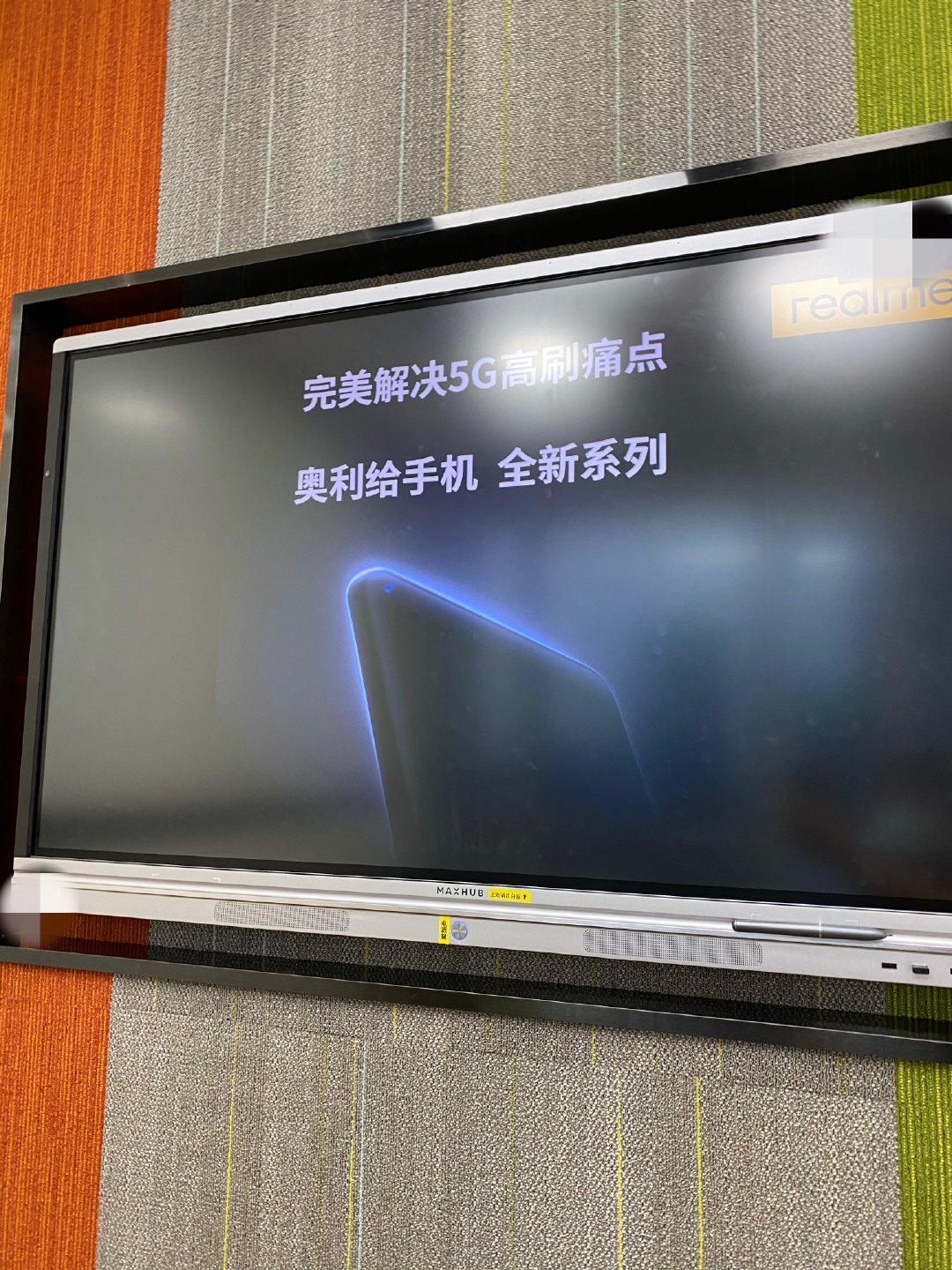
Realme has not launched a new phone in China after the Realme X50 Pro Player Edition that went official in China. A popular tipster from China has shared a leaked shot of an upcoming Realme phone. The leak reveals that it will be arriving as a new series phone from the brand.
The machine-translated text states that the next 5G phone from Realme will solve some issues that are associated with 5G smartphones that have launched so far. The name of the device is not known yet. The tagline of the device is ‘Aoligei’ mentioned in Chinese. It translates to ‘Come On’ or ‘Just Do it.’ The tipster who shared the leaked shot states that the mysterious phone is equipped with a punch-hole display and it supports a high refresh rate. The screen appears to be curved towards the edges.
Battery performance is one of the issues associated with 5G-ready phones. Hence, there is a possibility that the mysterious handset could either come with a large-sized battery or it come with impressive fast charging capabilities. So far, the Realme X50 Pro 5G and its Player Edition are the two phones from the brand that comes with the fastest 65W SuperVOOC 2.0 rapid charging capabilities. It remains to be seen whether the next Realme phone for China comes with faster-charging technology.
Speaking of fast charging, Realme is reportedly working on the launch of its 120W Ultra Dart rapid charging technology. It is said that the company may unveil it this week in China. The 120W Ultra Dart can charge one-third of a 4,000mAh battery in just 3 minutes. It indicates that the 4,000mAh battery phone can be fully charged in around 10 minutes. Will the 120W Ultra Dart technology arrive on the mysterious Realme phone shown below? It is advisable to wait for further reports to know more about it.
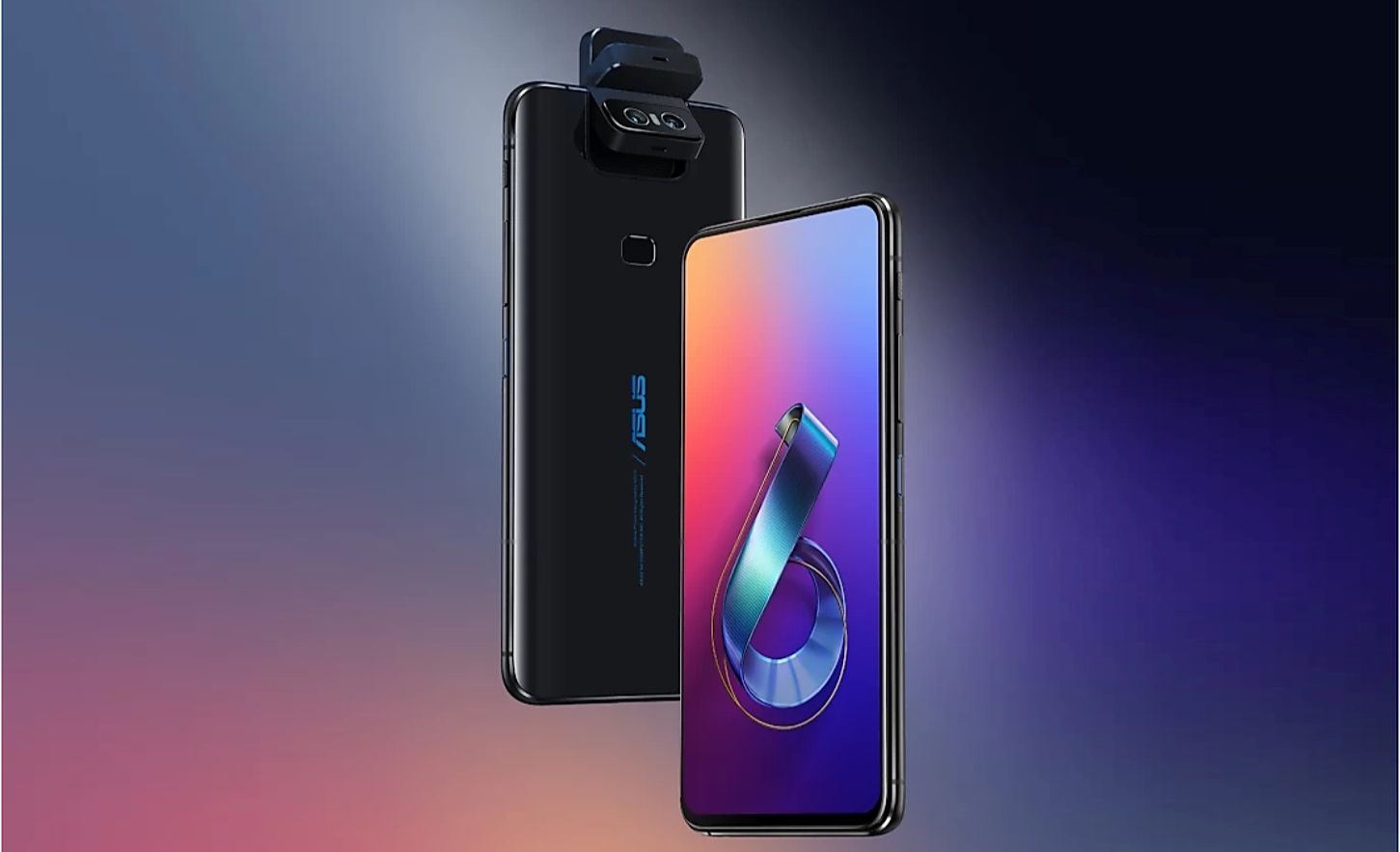
Last year, the ASUS launched the ZenFone 6 (ASUS 6Z) flagship phone with a notch-less display and a flip camera system that doubled as a selfie snapper. In February, Qualcomm released the list of phones that will feature the Snapdragon 865 SoC. The ZenFone 7 was mentioned in the list. However, the rumor mill has been silent on the specs and features of the ZenFone 7. A fresh report on TNNToday reveals that the Taiwanese manufacturer could be soon launching the ZenFone 7 series.
The report states that the ZenFone 7 will come in two variants. It will include a standard model called ZenFone 7 and an advanced version named ZenFone 7 Pro. These phones could be available in black and white color variants.
The ZenFone 7 and ZenFone 7 Pro are expected to inherit the flip camera system that was introduced on the ZenFone 6. Last year’s model came with a notch-less LCD screen and it did not feature a dedicated selfie camera. Instead, the rear camera could be flipped up to function as a front camera.
Hence, the ZenFone 7 and 7 Pro are likely to come with a notch-less display design. The ZenFone 7 series may also feature an in-screen fingerprint reader. With SD865 onboard, it will arrive with support for 5G connectivity. The ZenFone 6 had two cameras, but the successor models are expected to come with more cameras.
At present, there is no information on the other specs of the ZenFone 7 series. The report claims that it will be priced lower than the ASUS ROG Phone 3 that is all set to launch on July 22. The handset may arrive in India as ASUS 7z.
In June, a mysterious ‘asus ZF’ phone believed to be the ZenFone device was spotted on Geekbench. The listing revealed that it is an SD865 phone with 16 GB of RAM. The phone ran on Android 10 OS and it scored 973 and 3346 in the single-core and multi-core tests of Geekbench 5, respectively.
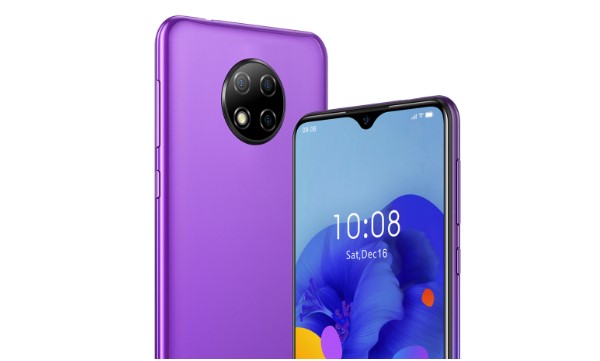
Oukitel recently unveiled its super affordable entry-level smartphone – Oukitel C19. The new smartphone features 6.49-inch display, 4000 mAh Battery and runs on Android 10 Go Operating System for the price of $59. As promised, the global open sales for the smartphone is now live, and the interested users can directly purchase it via AliExpress. It is available four different options of Black, Green, Purple and Blue Gradient.
Oukitel C19 features a massive 6.49-inch IPS LCD display featuring an HD+ display resolution of 1560 x 720 pixels. In order to provide optimal performance, the smartphone houses a MediaTek MT6737 chipset coupled with a 2GB RAM and 16 GB internal storage. However, you can even expand the storage up to 256GB via a microSD card.
The smartphone houses a 13MP Sony IMX214 rear camera coupled with AI Scene Recognition technology for better-quality images. There are other two sensors which further enhance the photography experience. A single 5-megapixel front-facing camera is present for selfies and video calling.
Oukitel C19’s 4000 mAH battery is enough to work for a couple of days without charging.
The interested users can grab the newly launched smartphone at a limited-time discount of the price of $59.99. It will start retailing at the actual price of $99.99 after some days. You can head over to AliExpress to buy the device.
The popular smartwatch maker Kospet is soon launching the Prime 2 smartphone featuring several advancements over its predecessor – Kosptet Prime, launched last year. There are already rumours about the new smartwatch, but still, details about its launch, specs and pricing are unknown. However, a recent leak reveals that the Kospet Prime 2 smartwatch will feature the 3D-sensing camera.
The new sensor will improve the smartwatch’s camera support and will aid in measuring the size of any object more accurately.
Previous leaks and rumours suggest that the Kospet Prime 2 will carry MediaTek Helio P22 chipset. It offers better performance, multi-frame noise reduction and clear-image zoom technology. It is more efficient and can provide better battery standby time while maintaining optimal performance.
However, the 5G support information is still unknown, and we will have to wait for some time to get some accurate details about the device.
Kospet Prime was launched last year with dual-cameras running Full OS with support for 4G connectivity. It carries the 1260 mAh battery, 1.6-inch HD display, 3GB RAM and 32GB internal storage.
The Vivo S series was updated in March with a new model called the Vivo S6 5G. The phone is not only the first in the series with 5G support but is also one of the few Vivo phones powered by an Exynos processor. New info says Vivo will announce a new S-series phone next month.
The source of the info is the Chinese leaker Digital Chat Station. According to him, the Vivo S series will “be updated probably next month”. Based on his statement, we expect the new phone should launch as the Vivo S7.
Last month, it was reported that the manufacturer will launch a new phone that may arrive as the Vivo S6 Pro 5G. This phone is yet to launch and we do not know if it is the same device Digital Chat Station said will launch next month.
While we are still in the dark regarding the specifications of this new phone expected to launch next month, we are pretty sure it will have support for 5G.
At the moment, Vivo has its focus on the global launch of the Vivo X50 series. The phones are scheduled to launch in India on July 16. It has also been reported that the Vivo TWS Neo will also be announced on that day too.
The Samsung Unpacked event is scheduled for August 5. The highlight of the launch is going to be the Galaxy Note20 series but Samsung is expected to launch other items. Previous reports have said the Galaxy Z Fold 2 will also launch on that day but a new leak says that won’t be the case.
Samsung Galaxy Fold 2 render
According to Max Weinbach (@MaxWinebach), the Galaxy Z Fold 2 will not launch at Galaxy Unpacked on August 5. In replies to the tweet, he revealed that the software is not close to being ready for launch.
This is absolutely no surprise. The software isn't even close to ready for a September launch and there is very few mentions of anything hardware wise. It's likely been delayed a bunch and that's why.
I looked into it a bit more. Galaxy Store only shows user testing for the Note 20 and Flip 5G. I do see carrier testing for the Fold 2, which looks like it just got put in. There's no way they can have it announced with 0 information about it.
He also added that the possible launch date might be September or even October. At the moment, the phone is said to be under carrier testing. So we should not expect a launch until the device passes carrier testing.
To clarify, I'm 60% sure they won't even talk about it at the event but I'm 100% sure they won't release it. https://t.co/5FUixTLqu9
In a quoted tweet, he adds that he is 60% sure it may not even be mentioned at all.
The Galaxy Z Fold 2 is the successor of the Galaxy Fold that was announced last year. The device will keep the folding design of its predecessor but come with changes in its appearance. For example, it will feature a larger outer display and the main foldable display is expected to have a punch hole for the selfie camera.
Other reported specifications are a 4500mAh battery, a 120Hz refresh rate, a Snapdragon 865 Plus processor, and up to 512GB of storage.
Apple was reported around mid-June to have got AR glasses and an advanced HMD with a stunning display in the works. The rumour first carried by Patently Apple gathers weigh due to several patent filings the company had engaged in over the two subject matters.
Apple has now reportedly commenced trial production of the AR Glasses in one of Foxconn Technology’s factories. According to digital media outfit The Information, the Cupertino-based company is teaming up with Foxconn Technology to develop semi-transparent lenses for its AR devices. The Taiwanese manufacturing firm is Apple’s largest contract manufacturer and the one responsible for building most iPhones, to develop semi-transparent lenses for its AR devices.
Augmented reality (AR) overlays digital content and information onto the physical world — as if they’re actually there with you, in your own space. The lenses are considered as one of the most important components of the devices that would be worn on the head. The report quotes a source familiar with the matter to have disclosed that the lenses passed the prototype stage and entered trial production about two months ago.
The source also hinted that the AR lenses have been in development by Foxconn for about three years. This was the same period the US tech giant acquired Colorado-based startup Akonia Holographicscthat utilized a liquid-crystal-on-silicon display to project images inside its proprietary lenses. It is not certain if the AR glasses would feature any of Akonia’s technology.
We have no idea when these AR glasses would be launch but whenever itis, we expect the product to revolutionize the industry just as that AirPods did to the hearable market.
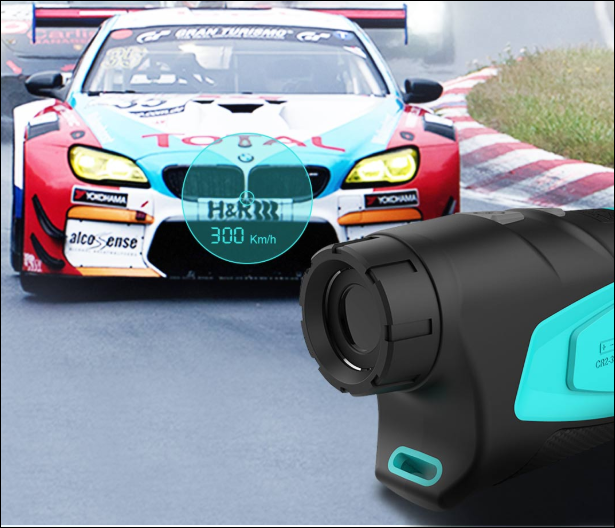
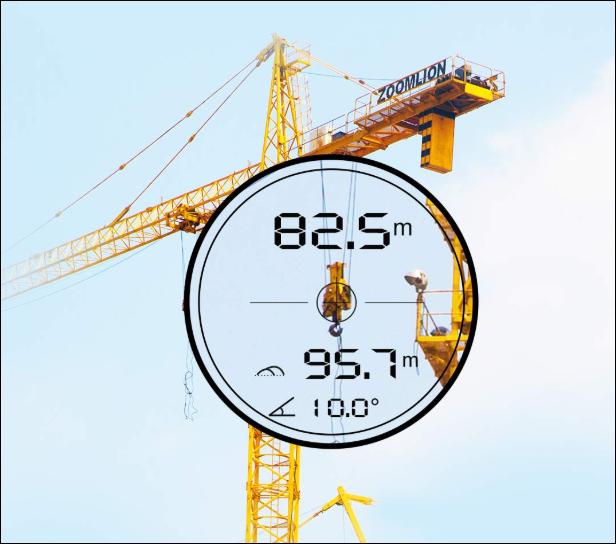
Xiaomi has launched the Mileseey Golf Laer Range Finder under the Youpin crowdfunding platform. The product is available to order in China for 399 yuan (~$57). As the name suggests, the range finder finds application in golfing but is also useful in other areas where finding a range is needed. The device is also a telescope with up to six times magnification.
The Mileseey Golf Laser Range Finder adopts a simple design, made from soft plastic that has anti-skid and wear-resistant properties. The device has a circumference of 110x65x38mm, making it easy to carry.
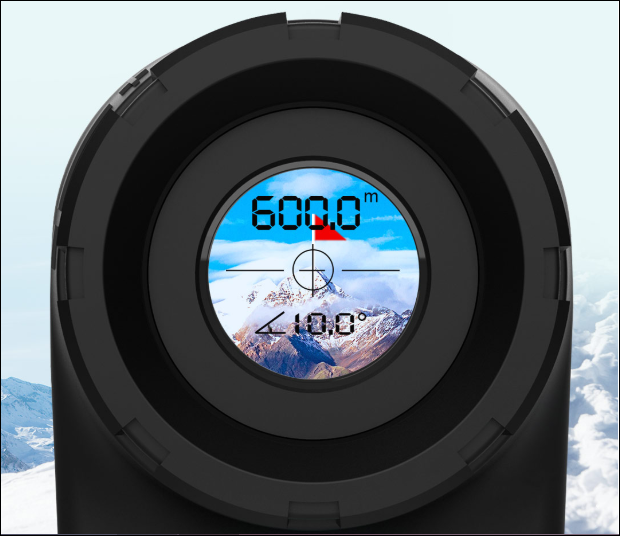
In terms of lenses, the laser range finder has a 6X fixed-focus optical telephoto system, with a 7° field of view. The lens is coated delivering a bright field of view. It can achieve long-distance ranging from 600 meters and the error margin within 600 meters is only 0.5 meters.
In addition to measuring the distance, it can also detect the speed at which an object is travelling. The user only needs to press the measurement key and follow the measured object. The telescope can display the moving speed of the object in real-time, which is suitable for watching racing games.
It is worth mentioning that in order to facilitate users to play golf, the telescope has specially set the flagpole locking function and the golf ball trajectory compensation function. Among them, the flagpole locking function allows the telescope to preferentially lock the nearest measurement target for measurement, and the golf ballistic compensation function can quickly calculate the ballistic compensation distance for the user.
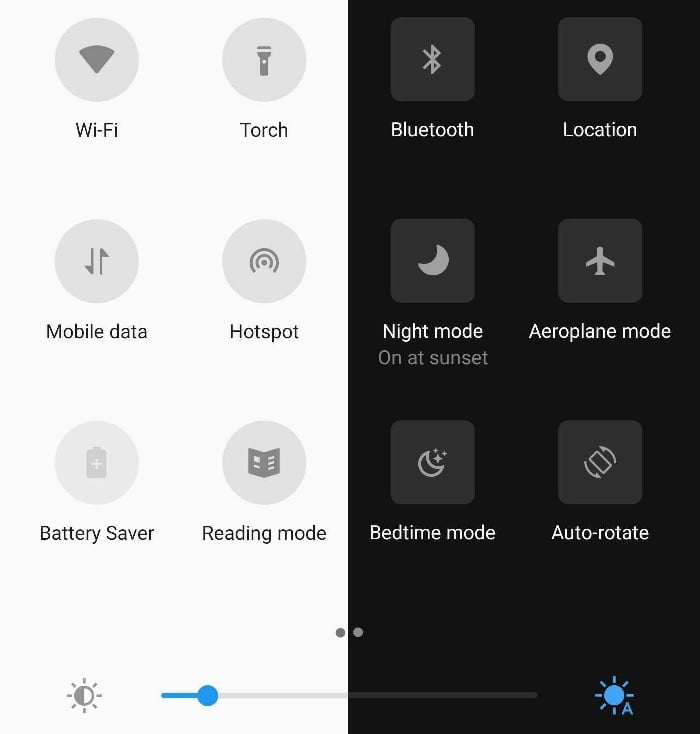
Dark Mode or Dark Theme has become a common feature on devices – from phones to tablets to computers and even game consoles. The feature is also available on a lot of apps too.
Dark Mode has a bunch of advantages but the key one is that it is easy on the eyes especially when using your device at night. However, while some of us will prefer every app or device to have it, there are those who dislike it.
For this week’s poll, we want to know which you prefer? Are you Team Dark Mode or Team Light Mode or do you have the themes set to change on schedule? Do take the poll below and also share a comment telling us why you prefer one over the other.
You can currently get a 5G phones at a great price, even in the global market. We already published a comparison between affordable 5G phones sold globally: we compared the newly-announced Moto G 5G Plus with Realme X50 5G and Xiaomi Mi 10 Lite. Now, we decided to make another comparison in order to include the remaining affordable 5G phones sold in the European market. We are talking about the Huawei P40 Lite 5G and the Oppo Find X2 Lite, two other great choices if you need 5G on a budget. Let’s see which device has the highest value for money.
Motorola Moto G 5G Plus vs Huawei P40 Lite 5G vs Oppo Find X2 Lite
Quad 64 + 8 MP + 2 + 5 MP f/1.8, f/2.4, f/2.4 and f/2.4
16 MP f/2.0 front camera
Quad 48 + 8 + 2 + 2 MP f/1.7, f/2.2, f/2.4 and f/2.4
32 MP f/2.0 front camera
BATTERY
5000 mAh, fast charging 20W
4000 mAh
Fast charging 40W
4025 mAh, Fast charging 30W
ADDITIONAL FEATURES
Dual SIM slot, 5G
Dual SIM slot, 5G, reverse charging
Dual SIM slot, 5G
Design
Despite Moto G 5G Plus and Huawei P40 Lite 5G come with a punch-hole display and Oppo Find X2 Lite has a classic waterdrop notch, Oppo Find X2 Lite is my favorite handset when it comes to the design. It is more compact, beautiful, minimalistic, thinner, and lighter than its two rivals. It is very elegant and it is easier to use with one hand. Motorola Moto G 5G Plus is made with cheaper materials, but it is splash resistant, so it remains a very interesting device in terms of build quality.
Display
The Oppo Find X2 Lite wins the display comparison because it sports an AMOLED panel: it provides more brilliant colors and deeper blacks, for a more interesting overall image quality, as well as lower energy consumption. Right after, we got the Moto G 5G Plus which offers the HDR10 certification and a 90 Hz refresh rate, but it has a classic LCD display. Huawei P40 Lite 5G lacks both an AMOLED display and a high refresh rate, but it still comes with an above-average LTPS panel.
Hardware/Software
On benchmarks, the Kirin 820 chipset found on the Huawei P40 Lite 5G actually obtains higher results than the Snapdragon 765G by Qualcomm. However, a lot of people trust Qualcomm’s chipsets more for their stability, modding compatibility, and more. Further, Huawei P40 Lite 5G lacks Google services out of the box: instead, it comes with Huawei Mobile Services to replace them in the global market. If you do not mind about the above-mentioned disadvantages, then you can go for the Huawei P40 Lite 5G. But I would personally choose the Oppo Find X2 Lite with its Snapdragon 765G which offers 2 GB RAM more than the Huawei P40 Lite 5G.
Camera
You should not focus too much on the cameras while choosing between one of these devices. Not because they are bad, but because their camera departments are more or less at the same level. In each case, we are talking about above-average, but not high-end, camera phones. Note that with the Motorola Moto G 5G Plus you get the best front cameras: an ultrawide dual sensor with 16 and 8 MP resolutions.
Battery
Motorola Moto G 5G Plus lasts a lot more on a single charge because it sports a way bigger battery than Huawei P40 Lite 5G and Oppo Find X2 Lite. Huawei P40 Lite 5G wins the fast charging comparison with its 40W power, and it even supports reverse charging.
Price
In the global market, you can get the Motorola Moto G 5G Plus and the Huawei P40 Lite 5G for €399/$450 (4/64 GB and 6/128 GB respectively), while Oppo Find X2 Lite is priced €499/$564 in the configuration with 8 GB of RAM and 128 GB of internal storage. At the end of the day, we can not pick a definitive winner because it mostly depends on the user’s needs. Oppo Find X2 Lite has a great design and an AMOLED display, as well as very nice rear cameras and more RAM. Huawei P40 Lite offers higher charging speeds and reverse charging, as well as a great chipset. Motorola Moto G 5G Plus has pretty nice cameras and longer battery life, but in its base configuration, it has just 4/64 GB. Which one would you pick?
Smart displays have been in existence for a few years now. They can perform the functions of a smart speaker and even more such as play videos, make video calls, and more. Now, there is a new category of smart display that has been specially created for Microsoft Teams called Microsoft Teams Displays.
The best way to describe a Microsoft Team Display is as a desk phone with a touchscreen and smart features. It is powered by Cortana and seamlessly works with your PC. Microsoft says they are designed to handle video-conferencing and content viewing, and thus freeing your computer for work.
You can ask the smart display to join a meeting on Teams, add contacts to a meeting, and more.
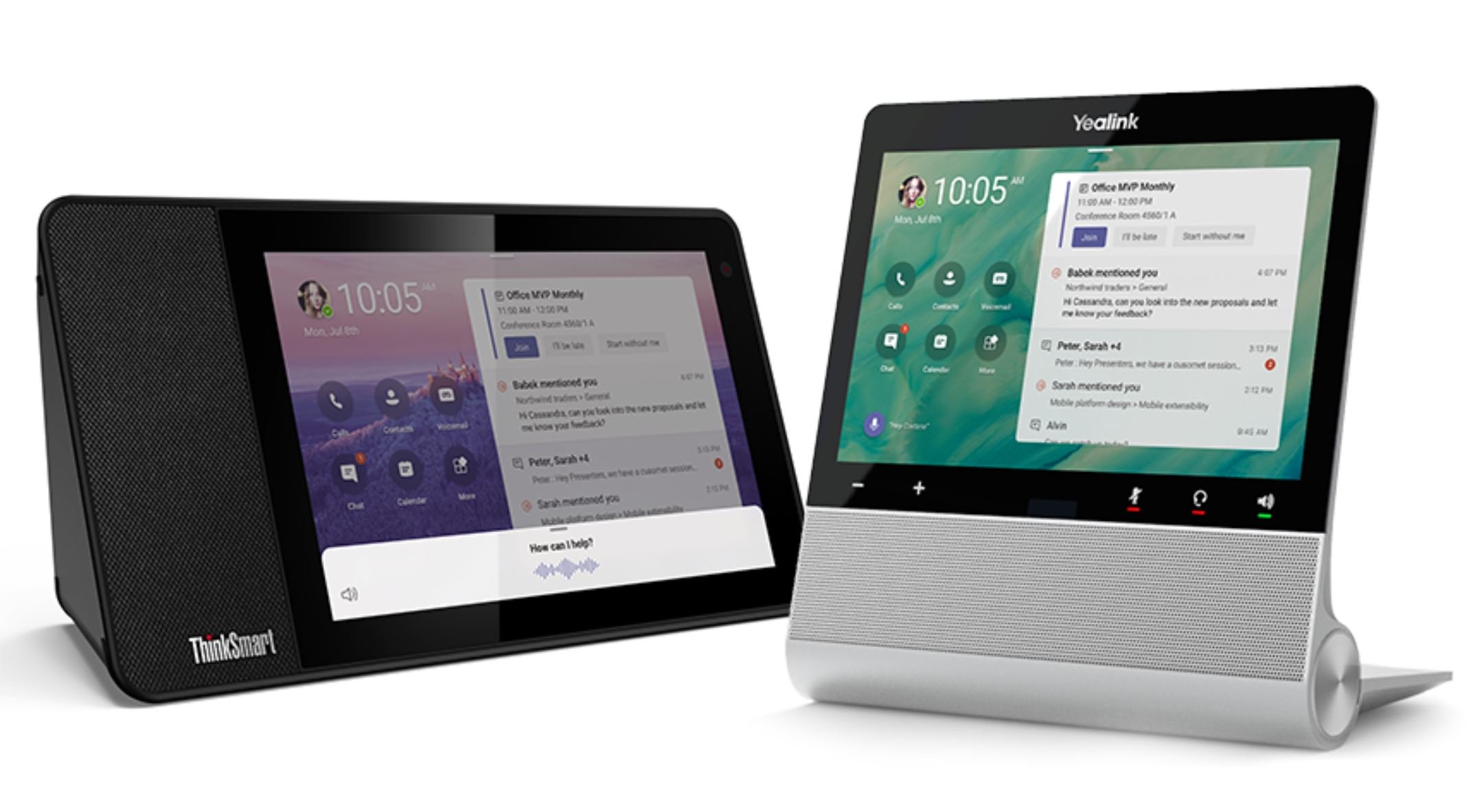
Lenovo has a Microsoft Teams Display Device called the ThinkSmart View and it shares a striking resemblance to the Lenovo Smart Display 8.
Priced at $349, the ThinkSmart View has an 8-inch HD touch display, a 1.75” 10W full-range speaker with two passive tweeters, far-field microphones, and an HD camera with a privacy shutter. The description says it is built on the Microsoft Teams platform and the spec sheet says it runs Android AOSP 8.1. It has Bluetooth 4.2 and also supports dual-band Wi-Fi. If you need one, you can grab one on the Microsoft online store.
There will also be another Microsoft Smart Display from Yealink (pictured above beside the Lenovo ThinkSmart) later this year. It is shown to have a different design but the screen seems to be 8-inches too. There is no news of a Surface-branded Microsoft Teams Display yet but we may see one in the future.
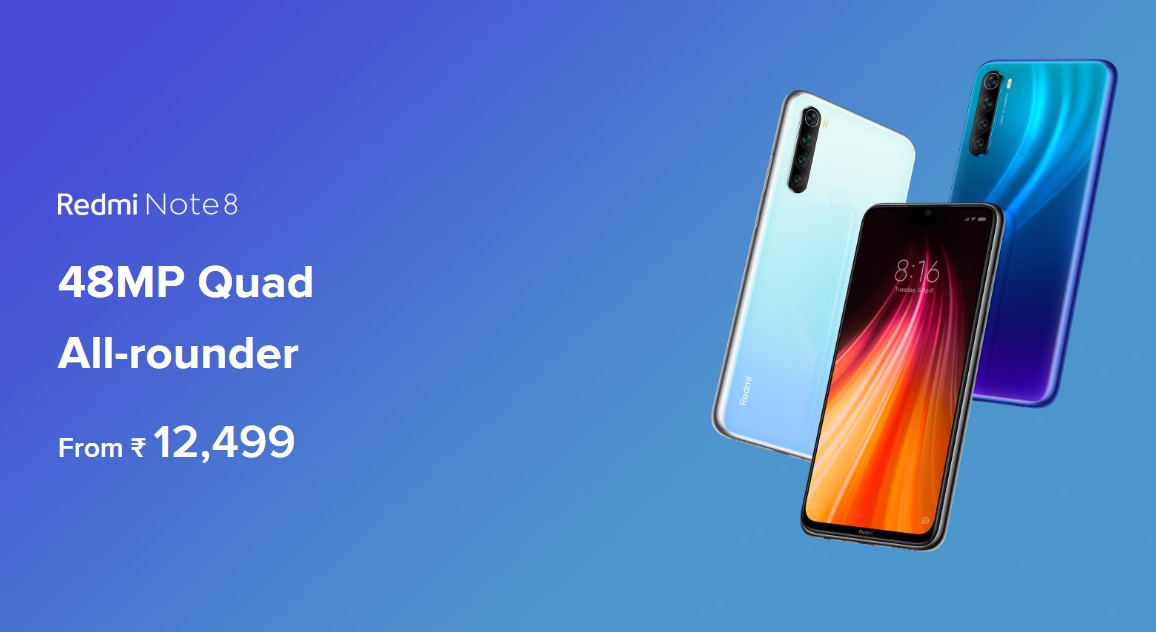
The 4GB RAM + 64GB phone which was originally launched with a starting price of INR 9,999 (~$132.97) last year now goes for INR 12,499 (~$166.22). The new price is an increase of INR 500 over its last selling price. The official Xiaomi website has been updated with the new price, and 91Mobiles has reported that the new price has taken effect at offline stores today.
There is a little bit of good news though. The price of the 6GB RAM + 128GB version has not been increased, so that still sells for INR 14,499 (~$193).
The Redmi Note 8 has a 6.3-inch FHD+ LCD display with a notch at the top for a 13MP front-facing camera. It is powered by the Snapdragon 665 processor. There is a 48MP camera on the back of the phone along with an 8MP ultrawide angle camera, a 2MP macro camera, and a 2MP depth sensor. The phone also has a 4000mAh battery, support for 18W fast charging, an audio jack, and a rear-mounted fingerprint scanner.
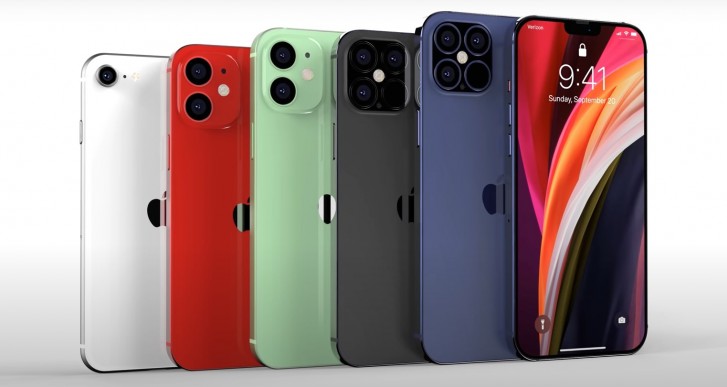
Apple is expected to launch the iPhone 12 series in a few months from now. According to analysts, it will ship without a bundled charger and EarPods. Now, a new report says the price of the entry-level model will be $50 more than the previous generation.
The new report comes from an analyst named Jeff Pu (via MacRumors). He forecasts the price of the base-model iPhone 12 to be $749. This variant is expected to come with 5.4-inch OLED display, 5nm A14 chipset, 5G connectivity, and dual-camera setup.
For comparison, last year’s iPhone 11 debuted at $699, $50 lesser than the iPhone XR before it. On the other hand, Jon Prosser, a tipster claims the price of base iPhone 12 to be $649.
Since the iPhone 12 is reported to come with 5G, Mr Pu says customers will not mind the hike in the price and the demand won’t be affected either. However, the lack of an in-box charger and EarPods may create controversy.
Anyway, the upcoming iPhone 12 series will still start lesser than its primary Android competitor Galaxy S20, which retails for $999 in the US. Nevertheless, Apple is only expected to ship 15-20 million units in 2020.
We use cookies on our website to give you the most relevant experience by remembering your preferences and repeat visits. By clicking “Accept”, you consent to the use of ALL the cookies.
This website uses cookies to improve your experience while you navigate through the website. Out of these, the cookies that are categorized as necessary are stored on your browser as they are essential for the working of basic functionalities of the website. We also use third-party cookies that help us analyze and understand how you use this website. These cookies will be stored in your browser only with your consent. You also have the option to opt-out of these cookies. But opting out of some of these cookies may affect your browsing experience.
Necessary cookies are absolutely essential for the website to function properly. This category only includes cookies that ensures basic functionalities and security features of the website. These cookies do not store any personal information.
Any cookies that may not be particularly necessary for the website to function and is used specifically to collect user personal data via analytics, ads, other embedded contents are termed as non-necessary cookies. It is mandatory to procure user consent prior to running these cookies on your website.