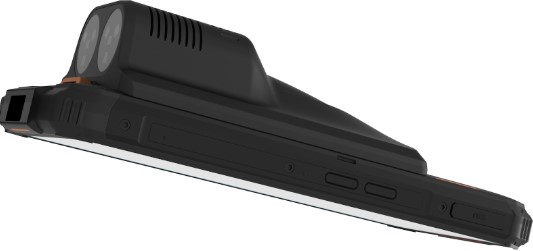
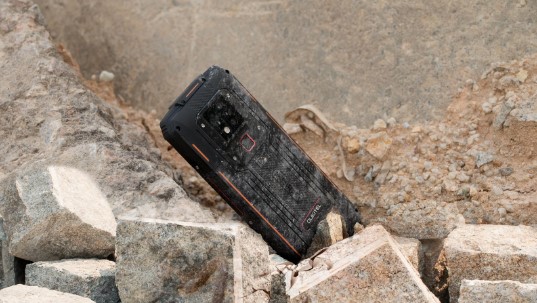
After waiting for such a long time, Oukitel launched the Oukitel WP7 rugged smartphone last week, featuring impressive specifications at an affordable price. Initially, the smartphone was made available via the official Oukitel store, but now it has surfaced on Banggood and that too at a special price of $299.99. The smartphone with a built-in infrared Night Vision camera also hosts traditional functions apart from being a rugged smartphone.
Oukitel WP7 is a fully IP68 certified device for protection against dust, water, and accidental drop. It also features high-end features like night vision detection, high-intensity light for UVC sterilization.
High-End Camera with Infrared Cameras
OukiTel WP7 packs triple camera sensors consisting of a 48-megapixel primary sensor, an 8-megapixel IR Night vision sensors, and a 2-megapixel depth lens. It is among rare smartphones that feature a built-in infrared night vision camera enabling you to get a clear photo in a night environment without any light. It can snap beautiful scenes in the low-light environment supporting LED fill-in light.
Ultra Flashlight
Oukitel WP7 supports the Ultra Flashlight external module, which can fully lit dark environments. The high-intensity torch supports five different smart modes, including intense light, mediate light, weak light, flashlight, and SPS. It is the best source to send SOS signals in danger.
UVC Sterilization
The backlight is easily switchable to UVC sterilization mode. It enables the users to eliminate 99.99% bacteria and kill viruses within 10 seconds. In the ongoing Pandemic era, users can easily sterilize their hands whenever and wherever.
Other Features
The smartphone features a powerful MediaTek Helio P90 chipset, 8GB LPDDR4X RAM, and 128GB UFS 2.1 ROM. A triple rear camera resides to capture high-quality and detailed photos. There’s a 5000 mAh massive battery with support for NFC, IP68, IP69K, and MIL-STD-810G certification.
It is among the most potent yet rugged smartphones available at a reduced price. The smartphone is available for $299.99 at a reduced rate on Banggood between June 15 and June 21. The smartphone features competitive specifications at such a jaw-dropping price of $299 from Banggood. You can know more about the features by heading to the official website.
Top tier flagships became incredibly expensive but also incredibly powerful. Unlike 2019, this year, Samsung and Huawei launched three variants of their flagship lineups. The most expensive variants are the Huawei P40 Pro+ (which just hitten several European markets) and Samsung Galaxy S20 Ultra. Meanwhile, Motorola is back in the flagship segment after years of silence with its Motorola Edge+. All of these devices carry a price tag superior to €1,000, but are they worth the money asked? And which one should you prefer? We will try to answer these questions through the following specs comparison between Huawei P40 Pro+, Samsung Galaxy S20 Ultra, and Motorola Edge+.
Huawei P40 Pro+ vs Samsung Galaxy S20 Ultra vs Motorola Edge+
Motorola Edge+
Samsung Galaxy S20 Ultra
Huawei P40 Pro+
DIMENSIONS AND WEIGHT
161.1 x 71.4 x 9.6 mm, 203 g
166.9 x 76 x 8.8 mm, 222 g
158.2 x 72.6 x 9 mm, 226 g
DISPLAY
6.7 inches, 1080 x 2340p (Full HD+), OLED
6.9 inches, 1440 x 3200p (Quad HD+), Dynamic AMOLED 2X
Dual SIM slot, fast reverse wireless charging 27W, 5G, eSIM
Design
If I had to make a choice by considering the design only, I would go for the Motorola Edge+. First of all, it has a higher screen-to-body ratio. It is more compact and its rear side is more elegant due to its smaller camera module. But several people may not agree with me because Huawei P40 Pro+ comes with more unique and premium materials (it is made of ceramic). Further, unlike the Motorola Edge+ which is just splash resistant, Huawei P40 Pro+ is waterproof with the IP68 certification. Samsung Galaxy S20 Ultra should be sturdier thanks to its waterproof certification (IP68) and the Gorilla Glass 6 protection for both front and back glasses, but its dimensions are big, just like its camera module.
Display
Samsung Galaxy S20 Ultra provides the most impressive display: not only it is wider with its 6.9-inch diagonal, but it also supports a higher 120 Hz refresh rate, despite you can only use it by setting a Full HD+ resolution. The Dynamic AMOLED display of the Samsung Galaxy S20 Ultra has the HDR10+ certification and a high Quad HD+ resolution, while Huawei P40 Pro+ and Motorola Edge+ stop at Full HD+. Currently, we believe the only displays which can compete with the Samsung Galaxy S20 Ultra in the Android world belong to OPPO Find X2 Pro and OnePlus 8 Pro.
Hardware/Software
The Motorola Edge+ has the most interesting hardware department because it is fueled by the Snapdragon 865 mobile platform which has currently no rivals among Android phones. On the other hand, while providing a less powerful chipset, Samsung Galaxy S20 Ultra comes in a variant with a higher amount of RAM and internal storage: 16 GB and 512 GB respectively. Motorola Edge+ only comes in a configuration with 12 GB of RAM and 256 GB of native storage, while Huawei P40 Pro+ stops at 8 GB of RAM. Note that if you get the global version of the Huawei P40 Pro+, you won’t get Google services out of the box due to the U.S. ban.
Camera
The most amazing camera (and not only of this comparison) is on board of the Huawei P40 Pro+. It features a 50 MP Penta-camera (the fifth sensor is a TOF 3D sensor) including 10x optical zoom and a 40 MP ultrawide lens. Further, on the front side, the 32 MP selfie snapper is accompanied by another TOF sensor for 3D facial recognition. The silver medal goes to the Samsung Galaxy S20 Ultra offering a 108 MP quad camera with a 48 MP periscope lens, 4x optical zoom supporting 8K video recording, and awesome stabilization.
Battery
Since it packs a huge 5000 mAh battery and a less energy-demanding display than Samsung Galaxy S20 Ultra, Motorola Edge+ is more satisfying in terms of battery life. However, the Motorola Edge+ has slower charging speeds (just 18W with wired charging and 15W with wireless charging), while Samsung Galaxy S20 Ultra and Huawei P40 Pro+ charge at 40W and 45W, respectively.
Price
Huawei P40 Pro+ is priced €1399 globally, Samsung Galaxy S20 Ultra starts from $1199/€1099, and Motorola Edge+ costs $1199/€1200. Is it worth getting one of these handsets? Well, if you need an astonishing camera quality or you are a power user, then yes. But if you do not want the max you can get, there are a lot of more affordable devices that will let you save a lot of money while still giving you nearly perfect user experience.
Despite Huawei P40 Pro+ does not have Google services, it remains a very impressive phone due to its ceramic design, better cameras, and very fast wireless charging technologies. Samsung Galaxy S20 Ultra has the best display, while Motorola Edge+ has longer battery life than S20 Ultra but inferior cameras and display. What do you think about actual top tier flagships? Do they cost too much or they deserve a chance? Let us know by using the comment box below.
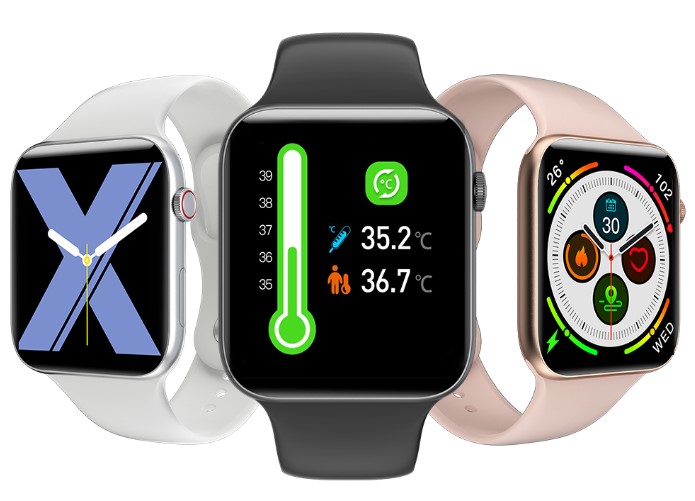
The Smartwatch market is flourishing from the past few months due to the improved features that come bundled with them. Smartwatches have become a lifesaver with the added features such as Real-Time body temperature for 24*7 monitoring in an ongoing pandemic era. The Fobase Air Pro Smartwatch also carries these features at an affordable price of $29.99.
Fobase Air Pro smartwatch packs temperature control and real-time Heart Rate monitor for every easy and effective monitoring. It is quite a useful wearable that can help aid in preventing the COVID-19 pandemic. It can monitor your temperature throughout the day and can send a notification if there’s any anomaly found in your body temperature. The sensor is fully verified under laboratory environment for reliability and accuracy purposes.
The smartwatch from Fobase houses a thin and light design carved out of the metal body. There’s a rubber strap, metallic body, and 7H tempered glass lens for comfortable use across different environments.
It features a 1.54-inch TFT large color display to bring you information about weather, step counts, calorie burn, real-time temperature, ongoing activity, and heart rate essentials. The watch supports beautiful, colorful, and stylish UI interfaces for better user interaction.
Fobase Air Pro Smartwatch can monitor your blood pressure and SPo2 accurately with its advanced VC31 heart rate monitoring sensor. The sensor carries the ability to monitor heart rate 24 * 7 and is compatible with Level 15 black skin.
Apart from the extraordinary features of the smartwatch, it extends support for call reminders, rejection, and message reminders. The Sleep monitoring feature helps to analyze the quality of sleep and patterns of sleep. The sedentary reminder is also a part of the smartwatch that can help you remind you to wake, walk, or stand up.
Fat Burning Sports Mode is quite effective in burning fat by daily exercising for 5 minutes. Moreover, it can easily distinguish between different sports activities like running, cycling, swimming, Table Tennis, Badminton, and Tennis.
It offers an efficient battery life of up to 15 days of continuous normal use upon full charge.
Hardware Specifications of Fobase Air Pro Smartwatch
RK8762C
Bluetooth 5.0
200 mAH battery
Lithium Polymer battery
128MB Flash storage
1.54-inch TFT with 240 x 240 pixel resolution
Fobase Air Pro Smartwatch is available six different colors of light blue, navy blue, Obsidian black, silver-green, silver-white, and rose gold. You can grab the smartwatch at the affordable price of $29.99 from AliExpress.
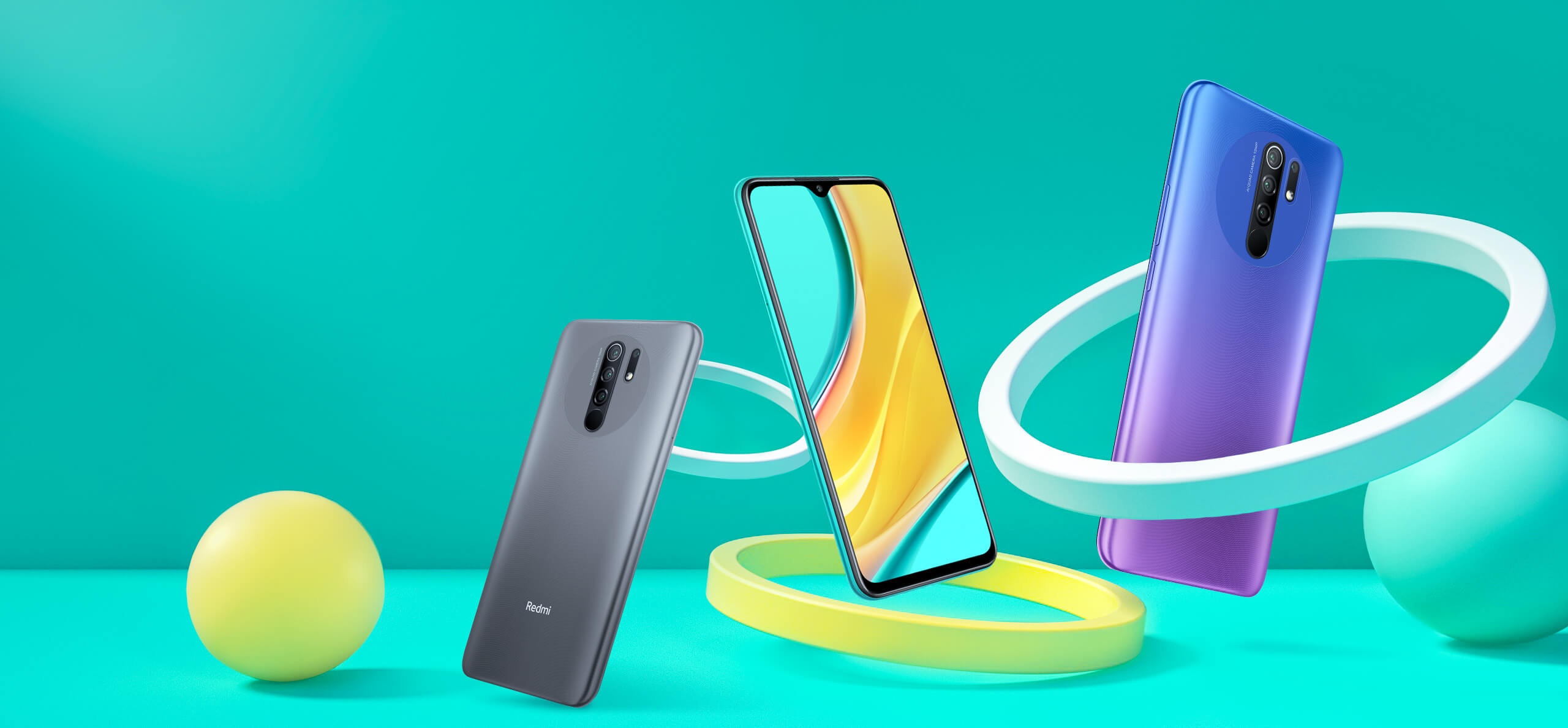
Xiaomi launched the budget Redmi 9 last week in Europe with a starting price of €150. The phone is now set to hit other markets in South East Asia as it has been launched in Malaysia. The phone will go on sale from June 18.
As should be expected, the Redmi 9 is priced lower than what it sells in Europe. The device starts at MYR499 (around €103) for the 3GB+32 GB version while the 4GB+64GB version is priced at MYR599(~€125). The phone will b sold on Shoppee Malaysia and early birds even have the opportunity of buying the 3GB+32 GB version for MYR449 (€93) which is an amazing offer.
As a reminder, the Redmi 9 features a 6.53-inch FHD+ IPS LCD panel with 19:5:9 aspect ratio, 394 PPI, 70% NTSC color gamut, 400 nits brightness. The display holds a waterdrop notch and is covered by a Gorilla Glass 3. The phone is powered by MediaTek Helio G80 SoC paired with 3GB/4GB LPDDR4X RAM and 32GB/64GB eMMC 5.1 flash storage options.
The phone adopts a polycarbonate body with a matte finish. For photography, it packs a Quad-camera setup at the rear comprising a 13MP (primary) + 8MP (118° ultra-wide) + 5MP (macro) + 2MP (depth) setup. Selfies are taken care of by an 8MP camera. The phone also holds a rear-mounted fingerprint sensor.
The Redmi 9 also packs features such as dual SIM, 4G connectivity, VoLTE, single-band (2.4 GHz) WiFi, Bluetooth 5.0, GPS, wireless FM radio, dedicated microSD card slot, multifunctional NFC, IR blaster, 3.5mm headphone jack, and USB Type-C. It runs on MIUI 11 based on Android Pie and crams a huge 5,020 mAh battery under the hood with 18W fast charging.
Oppo will be soon launching the Find X2 series in India on June 17. The brand has confirmed that it will be bringing both Find X2 and Find X2 Pro to the country. Now, just a couple of days ahead of launch, their pricing has been tipped by Money Control.
According to the website, their sources have revealed the pricing for both the handsets in the series. However, they are only sure of the standard Find X2’s price, which is said to retail between ₹60,000 ($789) and ₹65,000 ($855) for the 12GB + 256GB variant.
For comparison, the same device sells for €999 ($1,126, ₹85,616) in Europe. In fact, India could be the cheapest place to buy the Find X2. Because in China, the handset maxes at 8GB + 256GB and that variant itself costs 5,999 Yuan (₹64,284, $846).
This is not the first time we are seeing a smartphone selling for a lower price than other markets. OnePlus 8 series launched in April also retails for a much lower price tag in Indian than western nations.
OnePlus and Oppo managed to do this as their phones are locally assembled in the same factory in India along with Realme.
Anyway, we would still highly advise you to take this piece of information with a pinch of salt. We will know the exact Indian pricing of Find X2 series on June 17.
Xiaomi Mi 10 flagship is done and dusted for the year or so we thought. We had expected that the next big thing in terms of flagship phone this year should be the Mi Mix 4. However, a poster has merged which appears to reveal the moniker Mi 10 Pro+.
The poster which appeared online recently also shows the supposed Mi 10 Pro+ will feature a 65W super flash charge support. This is higher than the 50W fast charge support which the Mi 10 Pro had. The device will also pack a new 100MP main camera sensor with support for up to 12x optical zoom. There is equally a 120Hz super-sensing screen and a Snapdragon 865 chipset onboard.
In other aspects, the Mi 10 Pro+ is also expected to be equipped with 16GB RAM and 40W wireless fast charging support.
However, we can’t vouch for the authenticity of these leaked details. It is difficult to see the essence of this model since it will feature the same Snapdragon 865 chipset. here are rumours that Qualcomm will not be launching a SNapdragon 865+ chipset this year. Nevertheless, going by Xiaomi’s product releases this year, it won’t be surprising if indeed it is confirmed that the Mi 10 Pro+ is indeed in the works.
Prior to the launch in Europe, the official Realme India website listed the Realme X3 SuperZoom alongside a standard edition called the Realme X3. Today, it has now been officially confirmed that the Realme X3 is coming soon.
Shared on Twitter a short while ago, the tweet said the device is on its way but didn’t say when and which markets will get it first. There are speculations the Realme X3 may be announced alongside the Realme X3 SuperZoom in India, but until there is an official announcement, we advise you to take it with a pinch of salt.
The Realme X3 is reported to have similar specs to the SuperZoom edition according to a leak from early this month. So you will get a 6.6-inch FHD+ display with a 120Hz refresh rate, a Snapdragon 855+ processor, up to 12GB of RAM, and a 64MP quad rear cameras. It will also come with 16MP + 8MP dual front-facing cameras and a 4200mAh battery with support for 30W fast charging.
The difference between the two phones seems to be the camera configuration. The SuperZoom edition has an 8MP periscope camera with 5x optical zoom but the standard edition has a 12MP telephoto camera with 2x zoom. The Realme X3 SuperZoom also has 32MP + 8MP dual front-facing cameras.
Though Samsung was overtaken by Huawei globally in the month of April, the company witnessed its highest average selling price (ASP) in 6 years in Q1 2020 according to Strategy Analytics.
Samsung’s ASP was $292 from January to March, an 8.5% YoY increase and 20.7% more than Q4 2020. This is indeed a great achievement by the South Korean tech giant despite the global pandemic.
Last time the company’s ASP was around this value ($297) was in Q2 2014, almost 6 years back. Though the new steep ASP is $5 less than the previous one, it is yet much better than the other quarters.
In previous years like 2017, 2018, and 2019, Samsung’s average selling price was $243, $251, and $247 respectively.
The huge increment in Q1 2020 was due to the demand for expensive flagships like the Galaxy S20 series and Galaxy Z Flip clamshell foldable smartphone. Samsung’s revenue surged 22.1% in this period from 21.7% last year and 14.4% from the previous quarter (Q4 2019).
For comparison, Apple had the highest revenue of 37.5% at the same time. Samsung is expected to launch Galaxy Fold 2, a cheaper Galaxy Fold, and Galaxy Note 20 series in the second half of this year. If the demand for high-end devices stay constant or increase, the company’s ASP could further improve.
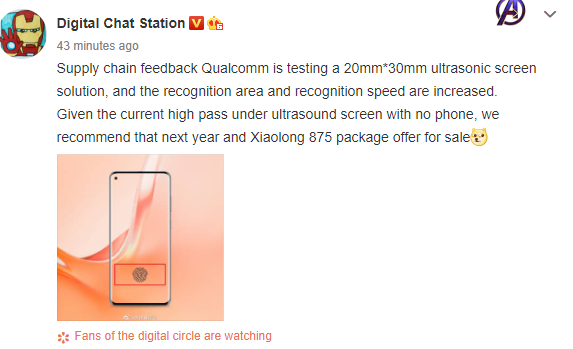
Qualcomm not only makes chipsets but also makes fingerprint sensors. For example, the ultrasonic in-display fingerprint scanner used in the Galaxy S10 series is actually supplied by Qualcomm. A new report says the San-Diego-based semiconductor company is testing a new sensor with a larger area and increased unlocking speed.
The info was revealed on Weibo by Digital Chat Station and he said he was informed by someone from the supply chain that Qualcomm is testing a 20mm x 30mm ultrasonic in-display sensor.
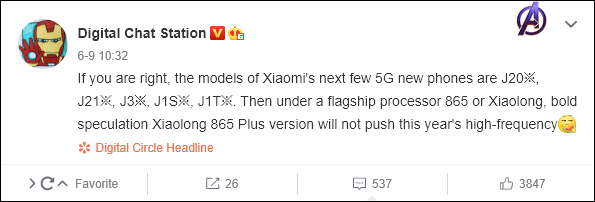
The new sensor has a larger scanning area and the speed of recognition is also faster. The Weibo post says that the new sensor may likely be bundled with the Snapdragon 875 processor next year. This means we may see the new sensor in 2021 flagship phones first.
Qualcomm also has another sensor that is yet to appear in devices. This sensor is its 2nd-gen 3D Sonic Max fingerprint sensor and it is capable of scanning two fingerprints at the same time. This means you can have both thumbs on the screen before your device unlocks. The sensor is expected to appear in the upcoming Galaxy Note20 series set to launch in August.
If it had crossed your mind that exploding earbuds could be a thing someday, it definitely won’t hit you that an Apple product will suffer such fate. We have mostly heard of exploding smartphones with the Galaxy Note 7 still in mind but it is extremely rare to hear of earphone explosion.
A report on Weibo says an AirPods allegedly exploded on May 19 while the owner was on a call. The report hinted that Zheng Tang, 23, sustained minor injuries on his right ear when the AirPods piece he was using exploded. The report also included a supposed medical report issued by the First Affiliated Hospital of Zhengzhou University. The medical report confirmed the skin rupture of the anterior wall of the boy’s right ear canal to have been caused by an explosion. The ear’s condition improved after two days of treatment with anti-inflammatory drugs but the victim still gets pain and hearing loss. A revisit to the doctor reveals swelling in front of the right ear with fresh blood oozing out. A crack was also noticed on the anterior cartilage of the right ear canal, about 1cm, and the tympanic cavity seemed to have blood accumulation.
However, from the pictures of the exploded AirPods, there was no obvious sign of scorching or charring but just a noticeable crack.
The ill-fated AirPods was purchased from an Apple dealer store in Wanda for 1,276 yuan (around $180). Apple has retrieved the unit for further investigation to ascertain what actually happened. The customer will be compensated in accordance with extant laws if the product is found to have quality issues.
Xiaomi launched the Redmi Note 9S as a rebranded Redmi Note 9 Pro Indian variant. It is one of the best budget smartphones in its price segment continuing the legacy of Redmi Note series. But lots of users are reporting a weird WiFi issue on this handset.
Multiple Redmi Note 9S users have shared a common WiFi bug on forums like Mi Community and XDA. According to them, the phone randomly disconnects from the internet on WiFi after 10-15 minutes from locking the screen.
Also, the data transmission won’t resume on WiFi even after unlocking the phone. The issue seems to be limited to the European variant of the handset as there are no reports from Indian users.
Some users claim the latest MIUI 11.0.8.0 Global Stable build partially fixes the bug as per Android Authority. The fix in question involves the phone logging out of the network every 10 minutes, followed by a login within a few seconds but this is not a perfect solution.
On a regular basis, all Android devices reconnect to a WiFi network every few hours to renew the IP address. But the Redmi Note 9S is doing the same procedure for every few minutes. This is absurd even when we think of it.
We hope Xiaomi fixes it properly via future OTA update as it seems like a software issue rather hardware as units running MIUI India build does not have the same problem.
Qualcomm has reportedly announced that it will hold a new Snapdragon launch event on June 17. According to Tencent’s QQ news, the US chipmaker is expected to announce the Snapdragon 775G processor on that day.
The Snapdragon 775G is expected as the newest addition to the Snapdragon 7 series mid-range SOCs. The chip will reportedly be shipped in small scale in mid-June and compared to the Snapdragon 765, the performance has reportedly been improved by 40% while the upgraded GPU is 50% better. It also features Vulkan support.
Although, we can’t vouch for the authenticity of this information the processor is likely the Qualcomm SM7350 which is rumoured to be the successor to the SD 765G. The details of the chipset are not known at this moment.
Recently, a rumour had emerged that Xiaomi is working on the Mi CC10, the successor to the Mi CC9. The rumour also tips the device to run on the unannounced Qualcomm Snapdragon 775G chipset. The phone is said to bear the internal codename “Gauguin and will be equipped with a 64MP main camera while the high-end version, possibly the CC10 Pro will have a 108MP camera. The phone is expected to be unveiled in July.
If you live in Brazil and use WhatsApp, there is good news. Starting today, you will be able to send and receive money securely right from within your chat with friends, family, and businesses.
The press release on WhatsApp’s blog says that the feature is powered by Facebook Pay. Users will be able to send money to loved ones and folks with WhatsApp business accounts. The feature should make it easier for small businesses to easily receive payments.
WhatsApp users in Brazil can now send money to friends and family or pay a business right from your chat 💸💸💸 pic.twitter.com/BwrcCq9CJW
WhatsApp says the payment is secure and a six-digit PIN or fingerprint will be required before transactions can be completed.
At the moment, WhatsApp payment is supported by Visa and Mastercard debit and credit cards from Banco de Brasil, Nubank, and Sicredi. WhatsApp also says it is working with Cielo, Brazil’s leading payments processor, and has built an open model to make it easy for more partners to join in the future.
The payment doesn’t attract a charge when you send or receive money save for businesses that will have to pay a processing fee to receive payments from their customers.
The service is already rolling out to users already and should arrive for everyone in the coming weeks.
WhatsApp first began receiving payments in India in 2018 but it was a test run. The service was supposed to roll out to more users but the company has been facing challenges with approvals.
WhatsApp is yet to announce which countries will be getting the feature next.
The latest version of Microsoft’s operating system is still Windows 10 and Microsoft intends to keep it that way for the foreseeable future. So anyone with that knowledge will have his/her alarms go off when they see a pre-order page for Windows 11.
Mark Wyciślik-Wilson of betanews reports that he came across a Windows 11 pre-order page on a site called SoftwareKeep that says it is a Microsoft Certified Partner. Armed with the knowledge that Microsoft isn’t planning to release Windows 11, he began a live chat with a support agent called Emir.
The support agent claimed Windows 11 will be posted on Microsoft’s site on July 1 and released on July 29. When told that Microsoft has no plans to release Windows 11, he insisted he was “100 percent sure” it will be announced. He also added that he had contacted the content department and they had told him (Emir) that it was directly from Microsoft.
Not too long after the chat with the support staff ended, Mark said he received an email from “Calvince from SoftwareKeep”. The mail was an apology for the misinformation for the product listing and gratitude to Mark for bringing it to their notice.
The mail claimed the product listing had been removed but Mark said the page was still accessible for hours after the mail. SoftwareKeep offered to send a thank-you gift to Mark but he said he declined to send his address as required. However, he did say that he contacted Microsoft to inform them that a certified partner listed a fake product for sale. Sadly, Microsoft is yet to reply.
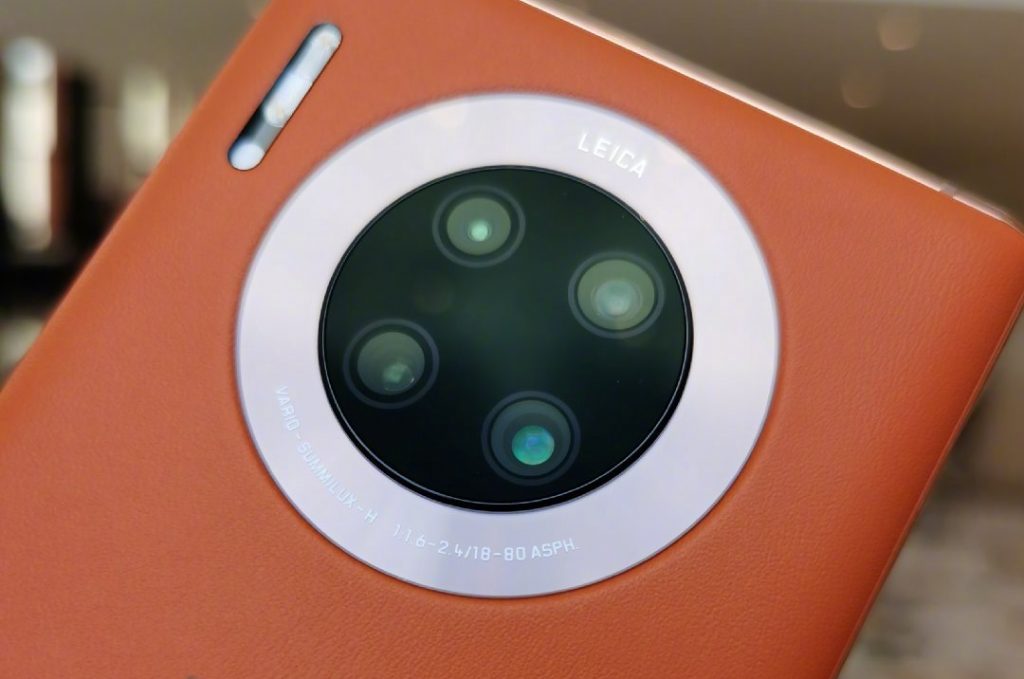
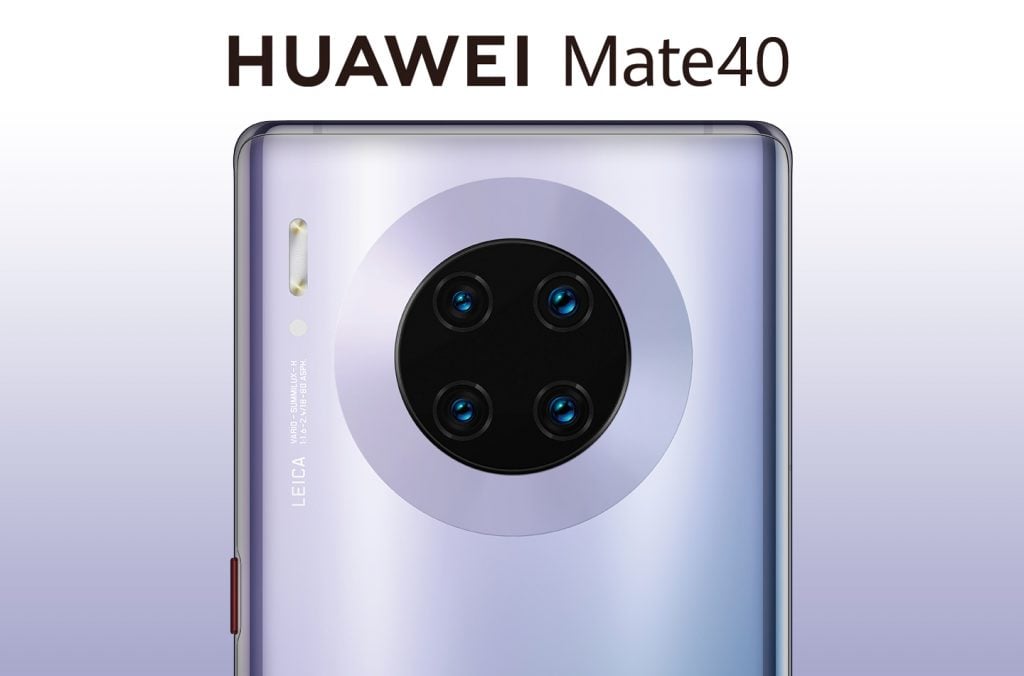
With the launch fo the Huawei Mate 40 series edging closer, more rumors and reports regarding the flagship lineup are surfacing. The latest one reveals information regarding the premium grade handset’s camera technology, which features a 9P FreeForm lens.
According to Lin En-Ping, CEO of Largan Precision, the company has finished the development of FreeForm lens and 9P (nine plastic lens pieces) camera modules. Additionally, the shipments will for the former is expected to start from Q4 of 2020, with the latter being adopted by clients at the beginning of the final quarter as well.
For those unaware, Largan Precision is a Taiwan based supplier of camera lens modules, which are used in smartphones, tablets, digital cameras, and more. Notably, Largan Precision is being conservative about business operations in Q3 of 2020. Despite the period being a booming season, the Coronavirus pandemic has seen its clients cut orders. Thus, shipments for the third quarter are currently uncertain and the fact that US sanctions against Huawei are also affecting Largan doesn’t make things easier for the company.
We had previously reported on the known analysts Ming-Chi Kuo’s report regarding a FreeForm lens for the Mate 40 series back in April 2020. To explain the FreeForm camera technology, it is a digital lens that has its curvature generated and not molded. This improves the overall sharpness of the images and reduces noise in the shot and blurriness as well. In other words, pictures clicked with this lens should offer a more precise capture than conventional lenses.
Furthermore, the addition of the 9P lens will also help in improve camera performance. The 9P lens enables better light intake for the image sensor, which is especially useful during low light scenarios. FreeForm lens technology will also help reduce distortion in wide angle lenses, which is a inherit since wide angle lens has the fish eyed effect that is noticeable on the edges of an image.
OnePlus is apparently working on a new feature for its smartphones. The company is working on adding a new software function that will allow users to find public charging stations, that will allow for a quick battery charge when outside.
The new function was discovered by a senior member of XDADevelopers. A new string of functions was uncovered in the Settings app within Android 11 Beta 1 for the OnePlus 8 and OnePlus 8 Pro. The description for these strings indicates that the company is working on building a network of public Charging Stations to help its users get a quick charge when on the move.
These charging stations will be equipped with BLE beacons that will allow them to broadcast their location to nearby OnePlus smartphone users. These charging stations will support fast charging rates, with graphics assets that suggest the same also being discovered in the Settings app. Unfortunately, it is currently unknown when the company will announce this new Charging Station network.
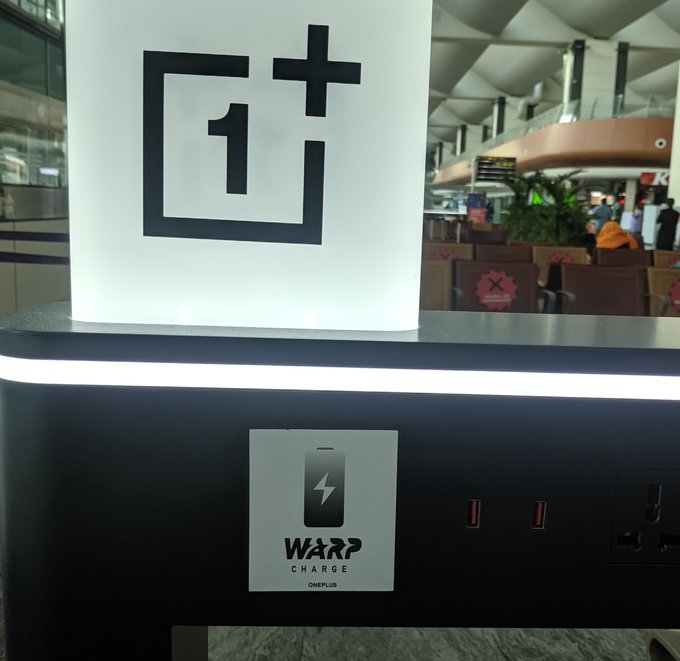
Although, its deployment has already started. A Twitter user shared an image of the new Charging Stations that were found in the Bengaluru Airport, India. Looking at the image, the OnePlus brand logo can be spotted under which the Warp Charge designation is etched. The charging station also has two USB ports along with a standard universal charging plug.
Galaxy M51 could become the first Samsung smartphone with non-Samsung Display OLED panel. This checks out as it was recently spotted on Geekbench. It was even reported to launch in September a few days back.
Despite previous reports to the contrary, we hear the Samsung M51 will use a China Star OLED. Display shipments start in July. This will be the first Galaxy OLED smartphone not using displays from Samsung Display.
Samsung’s upcoming Galaxy M series phone includes the recently benchmarked Galaxy M51 and Galaxy M41 whose renders surfaced in March. According to The Elec, the latter will be the first Samsung phone to feature OLED panel from a different supplier than Samsung Display.
Samsung Display is the market leader as the supplier of OLED panels to smartphone OEMs. Last year, the sister company of Samsung Electronics accounted for 80% of small and medium-sized OLED panels market.
But the monopoly of Samsung Display may soon end as Chinese panel suppliers have begun to improve their quality over the past few years. In fact, Samsung Electronics itself had sent a Request for Quotation (RFQ) to BOE for Galaxy S21, however, those panels failed in tests.
Now, according to a new report, the forthcoming Galaxy M41 will use China’s TCL China Star Optoelectronics Technology (CSOT) made OLED panel. The flexible screen will be of 6.67-inches with FHD+ (1080 x 2340 pixels) resolution and 19:5:9 aspect ratio.
The same panel is found in high-end smartphones like Xiaomi Mi 10 series and Motorola Edge series
The report further states that Samsung Electronics is also testing BOE OLED panel for Galaxy M41. If CSOT manages to supply panels for Samsung, future Galaxy M and Galaxy A series might feature displays made by these two Chinese companies rather than Samsung Display.
Both CSOT and BOE have already supplied LCD panels for Samsung’s budget smartphones earlier.
By using low-cost yet reliable OLED panels from Chinese suppliers, Samsung Electronics can aggressively price their budget smartphones in countries like India. On the other hand, companies like BOE and CSOT will attract more clients in the future increasing their market share.
HyperX has just announced a new gaming event series. The HyperX Showdown is a series of online gaming events that will feature various celebrities from different fields of entertainment. This includes stars from the music, entertainment, and even sports and gaming industries.
The event will be hosted across a period of eight weeks, during which time, popular online streamers will also be participating in the gaming event. In the event, well known games like Call of Duty: Warzone, NBA 2K, Fortnite, Madden, and more will be featured with the first event scheduled to start on the 16th of June 2020 at 3 pm ET. The first event will feature two known music stars, Afrojack and Nicky Romero, who will also be paired with two professional esports athletes from the London Royal Ravens playing Call of Duty: Warzone.
The event will be streamed on Twitch, a live streaming platform owned by Amazon, through HyperX’s official channel. This gaming series will be held entirely online, which is to be expected since the world is still facing a global pandemic at the moment.
You can also expect other known figures like Offset, Future, Young Thug and sports stars like Gordon Hayward (Boston Celtics), JuJu Smith-Schuster (Pittsburgh Steelers), Dele Alli (Tottenham Hotspur F.C.), Philip Forsberg (Nashville Predators), DeMarcus Cousins (NBA All Star), Mikal Bridges (Phoenix Suns), Onyeka Okongwu (2020 NBA Draft Prospect), Cole Anthony (2020 NBA Draft Prospect), and Joc Pederson (Los Angeles Dodgers).
Popular games like Fornite will be one of the games featured in the event
More special guests are yet to be announced and the series will also be hosting a special HyperX Showdown episode, which will feature an all-female event and an NBA Rookie Challenge. By the end of the eight weeks of gaming events, the athlete who HyperX considers the best will be named as its brand ambassador. The online event will also be collaborating with Excel Sports Management that will procure talent and provide guidance.
The Huawei Enjoy Z debuted last month in China as the company’s cheapest 5G-ready phone. Recent reports have revealed that Huawei will be launching a couple of Huawei Enjoy 20 series smartphones soon. It was reported earlier today that the Chinese firm may launch the Enjoy 20 phone in August. Speculations were rife that the company will launch the Huawei Enjoy 20 Pro in the coming week. However, the firm confirmed today that the Pro model will be made official on June 19.
The below-shown video confirms the launch date for the Enjoy 20 Pro smartphone. The other thing that can be deduced from the video is that its appearance is identical to the Enjoy Z. Also, rumor surrounding the specs of the Enjoy 20 Pro will not be different from the Enjoy Z. Hence, the Enjoy 20 Pro could be meant for the offline market in China.
The video reveals that the Enjoy 20 Pro has a teardrop notch. It is a 5G-ready phone with a triple camera setup on its back. It has a side-facing fingerprint reader. Dark blue and light blue are the two color variants of the smartphone.
The Enjoy 20 Pro is expected to come with an IPS LCD screen that delivers up to 90Hz refresh rate. It could be powered by Dimensity 800 5G chipset and a 4,000mAh battery that supports 22.5W fast charging.
The rear side of the Enjoy 20 Pro is said to be fitted with a 48-megapixel + 8-megapixel + 2-megapixel triple camera setup. It could be featuring a front camera of 16-megapixel. There is no word on the pricing of the Enjoy 20 Pro.
Earlier today (15th June 2020), Huami Technology, the known wearables maker, held its AI Innovation Conference in China. In the event, the company showcased a number of AI innovation technologies, and with it, the second generation of its self developed Huangshan processor.
The Huangshan 2 SoC arrives nearly two years after the first generation of the self developed chip from Huami. The chip will power the company’s upcoming smart wearables and was developed by the company’s chip research and development department. According to the company, the process was not an easy task and only a few domestic companies have achieved mass production of self developed chips to date.
The release of Huangshan 2 is a breakthrough from Huami and took over 450 days of hard work after the original Huagshan’s launch. The latest generation of the chipset features a new architecture, which was developed based on the RISC-V instruction set.
For those unaware, RISC-V is open sourced and has recently been gaining ground in the industry. Furthermore, the Huangshan 2 has managed to achieve higher efficiency than its predecessor, with lower power consumption and computing functions built specifically for its wearable gadgets. Notably, the chip also has an independent NPU neural network engine.
This allows it to also achieve higher artificial intelligence computing efficiency. An example of its capabilities includes a higher recognition rate of atrial fibrillation based on heart rate data, which 7 times better than the Huangshan 1. Additionally, its software algorithms on the market have also been improved by 26 times. The new chip will also support the Always On module that intelligently lowers power consumption.
The Huangshan 2 also introduces the new C2 Coprocessor. This processor works when the main chip is in sleep or even turned off, and experimental data shows a 50 percent reduction in power consumption overall. The original Huangshan chip was mass produced and commercialized last year to great success, so the newer Huangshan 2 chips bringing improvements will likely boost Huami’s wearables performance, especially related to functions regarding the user’s biodata. The chip is expected to be mass produced by Q4 2020 and should be seen in the market by 2021.
We use cookies on our website to give you the most relevant experience by remembering your preferences and repeat visits. By clicking “Accept”, you consent to the use of ALL the cookies.
This website uses cookies to improve your experience while you navigate through the website. Out of these, the cookies that are categorized as necessary are stored on your browser as they are essential for the working of basic functionalities of the website. We also use third-party cookies that help us analyze and understand how you use this website. These cookies will be stored in your browser only with your consent. You also have the option to opt-out of these cookies. But opting out of some of these cookies may affect your browsing experience.
Necessary cookies are absolutely essential for the website to function properly. This category only includes cookies that ensures basic functionalities and security features of the website. These cookies do not store any personal information.
Any cookies that may not be particularly necessary for the website to function and is used specifically to collect user personal data via analytics, ads, other embedded contents are termed as non-necessary cookies. It is mandatory to procure user consent prior to running these cookies on your website.