In May last year OnePlus took the covers off the OnePlus 7 series of smartphones comprising the OnePlus 7, its Pro variant along with a 5G-ready OnePlus 7 flagship smartphone. The Chinese company also unveiled an upgraded pair of Bluetooth earphones bearing the OnePlus Bullets Wireless 2 moniker during the launch event.
Aside from updating the name, OnePlus also updated the design of its Bluetooth earphones by getting rid of the fin-shaped earplug and replacing it with a relatively more comfortable in-ear bud design. The OnePlus Bullets Wireless 2 retains the rest of the design elements of the original version.
Available in metallic black and red color schemes, the Official OnePlus Bullets 2 Wireless Earphones have gone up for sale carrying considerably lowered prices on Giztop. While the black-tinted model would normally set you back $99.99, the popular Chinese e-tailer is offering it for just $49.99.
Likewise, the green color option usually retails for $124.99 on both online, as well as offline stores but you can purchase it for just $74.99 from Giztop. The OnePlus Bullets 2 comes with highly comfortable earbuds that are each connected through a tether that has the inline remote and a couple of additional modules for accomodating the battery and wireless connectivity tech.
It sports a basic design but delivers enhanced bass using three 10mm drivers. Moreover, for mids and highs, it includes Knowles balanced armature drivers. There is one dynamic driver that covers the lower frequencies. On top of that, the OnePlus Bullets 2 Wireless Earphones supports Google Assistant straight out-of-the-box. OnePlus upgraded the connectivity by replacing Bluetooth 4.1 with Bluetooth 5.0 that warrants a more stable connection. Furthermore, the company has included aptXHD support, which is a notable upgrade from the aptX-supported originals.
The Official OnePlus Bullets 2 Wireless Earphones delivers up to ten hours of listening time on a single 10-minute charge. When fully charged, the Bluetooth earphones deliver an impressive 14 hours of playback.
You can follow this link to check out more details about the Official OnePlus Bullets 2 Wireless Earphones and place your order via Giztop to avail of the discount before the promo comes to an end.
The Gizmochina Coupons is a community that finds, reports and evaluates deals and coupons of Chinese products from online shops. Please visit it here to find more coupons to save money on mobiles and smart gadgets.
Last week, Oppo unveiled its first smartwatch dubbed as ‘Oppo Watch’ alongside the Find X2 series in China. Starting at 1,999 Yuan (~$285), it features almost everything one needs in a smartwatch. However, the company did not say anything about its international availability at the launch. But now it has been confirmed to debut in Western Europe later this year by none other than the brand’s Vice President Brian Shen on Twitter.
On the China release of OPPO Watch Series, each model is equipped with esim to make calls. For the price I think this is great value for the user.
Users will have to stay tuned for our global launch, there will be a separate launch in western Europe later on this year. 👀 https://t.co/nD9lFYBBAj
Oppo has been making smartphones for years now but the company introduced its first smartwatch last week. Brian Shen, the company’s Vice President and President of Global Marketing has been lately sharing glimpses of the brand’s upcoming devices on his Twitter profile. Following his regular routine, he revealed the Oppo Watch to be launched globally in Western Europe sometime later this year. Unfortunately, he did not provide any further information and merely asked his followers to stay tuned.
Oppo watch is the brand’s most ambitious product in recent times. It comes powered by Qualcomm Snapdragon Wear 2500 platform paired with Apollo 3 co-processor. The wearable runs ColorOS Watch OS, a custom skin based on unspecified Android. The device sports a 1.6-inch (41mm) / 1.91-inch (46mm) curved AMOLED display and even features eSIM functionality. Other specs of the Oppo Watch include water resistance up to 5 ATM, heart rate monitor, ECG, 8GB internal storage, built-in GPS, NFC, Bluetooth 4.2, and a 300 mAh / 430 mAh battery with support for VOOC fast charging.
In December 2019, Samsung announced the Galaxy A51 and Galaxy A71 smartphones in Vietnam. Now the company has discreetly announced the Galaxy A11 with entry-level specifications. The A11 has arrived as one of the most affordable phones with punch-hole screen and its equipped with three cameras on the rear.
Samsung Galaxy A11 specifications
The Samsung Galaxy A11 features a 6.4-inch LCD panel with Infinity-O design. It offers HD+ resolution of 720 x 1560 pixels resolution. The top-left corner positioned punch-hole on the screen is the home for its f/2.0 aperture 8-megapixel selfie camera.
Samsung Galaxy A11
Samsung did not reveal the name of the processor that powers the Galaxy A11. It has only revealed that the smartphone is powered by a 1.8GHz octa-core chipset. The handset comes in two RAM variants such as 2 GB and 3 GB. Both models come with an internal storage of 32 GB. There is a microSD card slot onboard for additional storage.
The rear shell which appears to be made of polycarbonate material is fitted with a triple camera setup at the upper-left corner. Alongside it is an LED flash. The camera setup includes an f/1.8 aperture 13-megapxiel main lens, an f/2.2 aperture 5-megapixel ultrawide sensor and an f/2.4 aperture 2-megapixel depth assist lens.
The Galaxy A11 is backed by a 4,000mAh battery. It carries support for 15W fast charging. The back panel of the phone has a fingerprint reader. The phone also supports face recognition.
The Galaxy A11 has 161.4 x 76.3 x 8.0mm dimensions and it weighs 177 grams. Black, white, blue and red are the four color editions of the smartphone. Samsung is yet to confirm on the pricing and availability of the smartphone. The color variants of the phone may differ depending on the carrier and market.
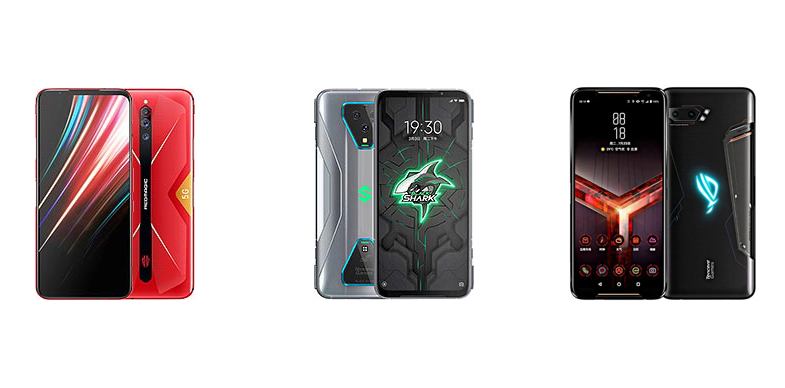
The gaming phone niche has a new player: Nubia Red Magic 5G. And it is a stunning device. But is it the best gaming phone out there? We think there is no better way to have an idea about it than comparing it with the most amazing gaming phones launched by other brands. Besides Nubia, even Xiaomi launched a new flagship gaming phone recently: the Black Shark 3 Pro. And the most advanced gaming-centric handset from 2019 is the Asus ROG Phone II. Excluding the iQOO series, we believe these are the most awesome phones with gaming-centric design and features, that is why we made this specs comparison.
Nubia Red Magic 5G vs Black Shark 3 Pro vs Asus ROG Phone 2
Triple 64 + 13 MP + 5 MP f/1.8 and f/2.3 and f/2.2
20 MP f/2.2 front camera
Dual 48 + 13 MP f/1.8 and f/2.4
24 MP f/2.2 front camera
Triple 64 + 8 + 2 MP, f/1.8
8 MP f/2.0 front camera
BATTERY
5000 mAh
Fast charging 65W
6000 mAh, Fast Charging 30W with Quick Charge 4.0
4500 mAh, fast charging 55W
ADDITIONAL FEATURES
Dual SIM slot, magnetic charging, support for external accessories, 5G
Dual SIM slot, support to external accessories, RGB light
Dual SIM slot, 5G
Design
Given that they are phones meant especially for gamers, these devices all come with an aggressive and original design just like gaming PCs and peripherals. Which one you should prefer is up to your tastes. I personally like the Asus ROG Phone II more because it is the only one to come with a glass back and it has a more elegant look, while Black Shark 3 Pro and Nubia Red Magic 5G have an aluminum body. Further, Asus ROG Phone II offers more compatibility for external accessories, including a desktop dock. On the other hand, Nubia Red Magic 5G has a more beautiful front panel since it features a higher screen-to-body ratio.
Display
Here it is a close fight, but we would pick Black Shark 3 Pro as the winner of the display comparison. Nuba Red Magic 5G offers the highest refresh rate (144 Hz), which is very important for gamers. It supports full DCI-P3 coverage, HDR10, and 240 Hz touch-sampling rate. But Asus ROG Phone II is very close with its 120 Hz refresh rate, 108% DCI-P3 gamut and HDR10. On the other hand, Black Shark 3 Pro has one of the widest panels in the Android world with a 7.1-inch diagonal. Unfortunately, it has a lower refresh rate (90 Hz) but also a higher refresh rate. But it is the only with a high Quad HD+ resolution and HDR10+. We would go for the Black Shark 3 Pro, but if we only consider gaming environments, the higher refresh rate of the Nubia Red Magic 5G is definitely more suitable.
Hardware/Software
On the paper, Nubia Red Magic 5G wins the hardware comparison. Just like the Black Shark 3 Pro, it is equipped with the Snapdragon 865 and 5G connectivity. But unlike Xiaomi’s flagship, it features 16 GB of RAM in the most expensive configuration. So if we consider the highest-end configuration, Nubia Red Magic 5G is superior. Asus ROG Phone II loses the comparison since it has an older and less powerful Snapdragon 855+ chipset. It even lacks 5G connectivity. But Asus ROG Phone II is definitely more interesting on the software side since it allows to switch between a customized user interface and stock Android.
Camera
Unfortunately, we won’t be able to give you a definitive vote about the cameras, even on the paper, until we tested both Black Shark 3 Pro and the new Nubia Red Magic 5G which became official just yesterday. On the paper, Black Shark 3 Pro looks better since its sensors have more potentialities. But we do not want to underestimate any device.
Battery
Asus ROG Phone II is the longest-lasting phone on a single charge with a huge 6000 mAh battery: one of the biggest ones ever seen on a flagship smartphone. It even supports reverse charging, but not wireless charging. Black Shark 3 Pro has the fastest charging technology with a power of 65W, and it even supports magnetic charging thanks to the presence of pins on the back cover. Thanks to magnetic charging, playing games is comfortable even while the smartphone is charging.
Price
Black Shark 3 Pro debuted with a $502/$450 starting price in China, Red Magic 5G begins at $540/€485, and Asus ROG Phone II launched in China last year with a $509/€457 starting price. Despite it is a phone from last year, Asus ROG Phone II still has something to say thanks to its amazing display, the support to more external accessories and a huge battery. But the lack of 5G connectivity and the lower-end chipset would let me go either for the Black Shark 3 Pro or the Nubia Red Magic 5G. The former (which looks slightly more interesting) has a wider display and a bigger battery, while the latter has a higher refresh rate, as well as very reactive capacitive triggers.
OnePlus has been rumoured to announce the OnePlus 8 series earlier than usual. Initial reports suggested it to be announced in mid-March but that isn’t happening, possibly due to coronavirus outbreak. Now, a fresh tip from Max J, a well-known leakster, reveals the launch of next generation of OnePlus smartphones to take place on April 15.
OnePlus is popular for its reasonably priced flagship premium smartphones. Thus, the brand’s handsets are one of the most anticipated product launches in the tech community. Ever since the first-ever CAD render leak of the OnePlus 8 series came into picture, it has been rumoured to debut much earlier than usual. But unfortunately, the coronavirus outbreak seems to have affected the development and manufacturing of the OnePlus 8 smartphones. Nonetheless, the company might announce them on April 15 via an online only event, which is exactly a month later than the previously suggested time period. Additionally, we think this info to be legit as multiple sources have confirmed the same.
However, even if OnePlus announces the OnePlus 8 series next month, the availability of these smartphones will still be a question. A report even suggested the new lite variant to be only made available months after the launch of the standard OnePlus 8 and OnePlus 8 Pro. Further, earlier today, the OnePlus 8 Pro was spotted in the hands of the brand’s ambassador Robert Downey Jr. suggesting an imminent launch in line with the new leak.
Although Xiaomi is short of supplies in China for the Mi 10 series, its smartphone business in India will not be affected due to the coronavirus outbreak, says Muralikrishnan C, the Chief Operating Officer of Xiaomi India. However, the supply chain for its TV lineup has already been disturbed.
The COO of Xiaomi India told IANS that because of the ‘exceptional job’ in managing smartphone supplies by the company’s supply chain team and partners, it hasn’t faced any issue yet. The brand envisions India as a very important market and assures the COVID-19 pandemic will not affect its smartphone business in the country and thus it will continue launching new smartphones. On the other hand, the same cannot be said for the smart TVs sold by the company in the country. That is because the panels used in them are ‘imported from abroad’ and they are currently taking more time to arrive in India.
Just yesterday, Xiaomi announced the Redmi Note 9 series in India powered by the brand-new Qualcomm Snapdragon 720G, which comes with support for NAVIC satellite navigation system. The Pro variant starts at INR 12,999 (~$175), whereas the Pro Max version costs INR 14,999 (~$202) for the base storage option. They will be available to purchase for the first time on March 17 and March 25 respectively from Mi Online Store and Amazon India.
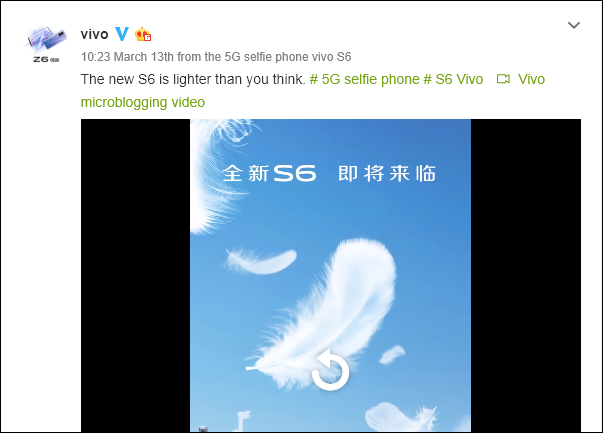
Vivo recently confirmed that it will be launching the 5G Vivo S6 later this month. The company is yet to reveal a specific launch date but has continued to tease some features of the phone. A new teaser video shared on Weibo by the company promotes the flagship model as having an ultra-thin and lightweight build.
This latest teaser video happens to be the third the Chinese tech giant is releasing concerning the Vivo S6. The company first teaser points to the presence of a dual-mode 5G chip onboard the device. A second teaser was shared which promotes a night view selfie feature that would be included on the S6’s selfie camera.
The frequency at which the company has been releasing teasers suggests the Vivo S6 launch is imminent. As per this latest teaser, the company is suggesting the device will be featherweight which would be a good thing. However, in the 5G era, battery capacity and power efficiency are features that buyers look out for. We do hope Vivo isn’t sacrificing the size of the battery for a lighter weighing smartphone. That isn’t likely going to happen. Likely scenario is the use of materials that won’t increase the weight of the device like a glass body instead of metal and such like.
Vivo is yet to release key specs details of the Vivo S6 but the device is likely to be powered by the Qualcomm Snapdragon 765G SoC since it supports 5G. This potentially makes it an upper mid-range model. We expect the device to feature Vivo’s propriety SuperVOOC fast charging technology among other things.
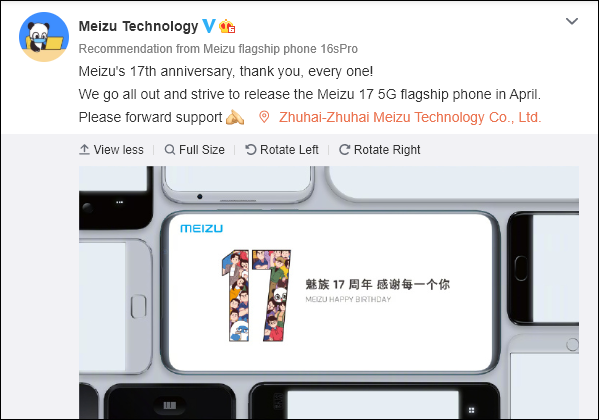
The innovative Chinese tech company, Meizu has hinted that its next flagship model which would be called Meizu 17 will be launched sometime in April. This was revealed via an open letter published on the firm’s official Weibo account. The post didn’t include a specific date but the device is expected to be Meizu’s first 5G phone.
Meizu has stuck to its non-conformist approach of not including any form of notch design on its flagship smartphones right from when the notch began trending until now. Instead, the company has maintained the symmetrical design style and in the process has brought out some amazing smartphones with extremely reduced bezels which received rave reviews. But for the poor distribution network and awful custom ROM which keeps some potential buyer away, Meizu might have climbed into the top 5 global vendors by now.
The Meizu 17 is likely to keep up with the full-screen, notch-less design and several renders, including official ones have popped up online. The display will adopt a near-bezel-less approach with just a strip of bezel holding the screen in place on all four sides.
The Meizu 17 will come as Meozu’s 17th-anniversary flagship and will be powered by Qualcomm’s latest Snapdragon 865 chipset. We equally expect the device to feature an in-display fingerprint scanner, a large battery. It will definitely run Android 10 but then that will be with the company’s FlymeOS skin on top of it.
We expect the company to officially announce the specific launch date in the coming days.
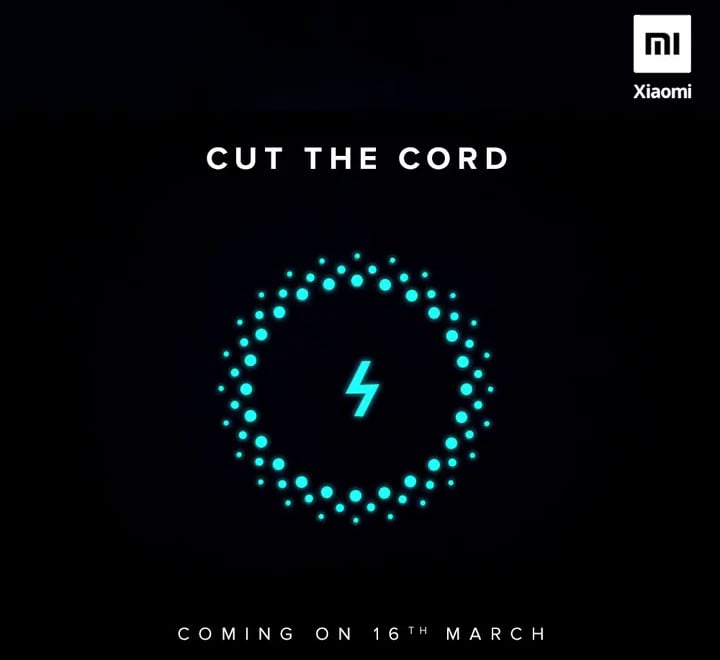
In a bid to cement its place in history as a formidable internet company, Xiaomi doesn’t only focus on its smartphone business but on other IoT products as well as accessories. The company’s next product in India could be a cool accessories that could wireless charge all your gadgets even while on the go, so the teaser says. The company released a teaser which points to the launch of a new product on March 16.
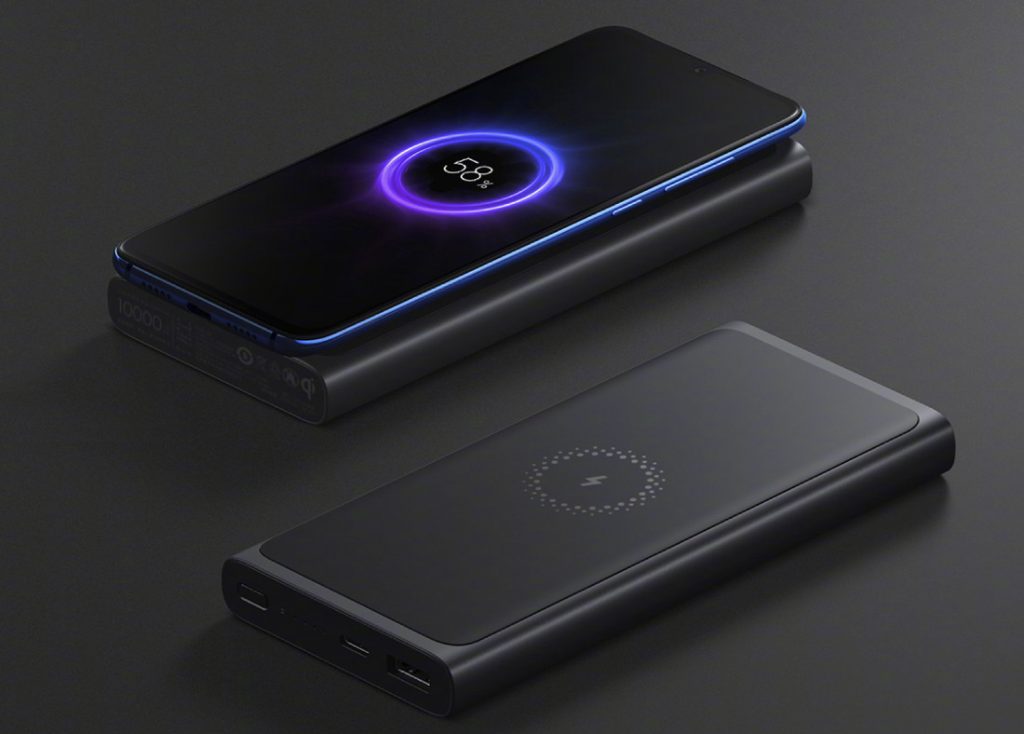
The company did not reveal the name of the product that will be launched on that day but going by details cooped from the teaser video, the product is likely a wireless charging-supporting power bank.
One less wire to deal with.
Mi fans, it's time to #CutTheCord. All the power you need without any hassle.
— Mi India #108MP IS COMING! (@XiaomiIndia) March 13, 2020
The teaser promotes the upcoming product by appealing to our utmost desire to have gadgets that won’t require you to carry so many charging cables around. The text on the display in the reads “One less wire to deal with. Mi fans, it’s time to #CutTheCord. All the power you need without any hassle. Guess what this is.” Also, take note of the hashtag “CutTheCord”. This clearly suggests the product is a wireless charging solution and it could only be a power bank if we are to entirely do away with the cord.
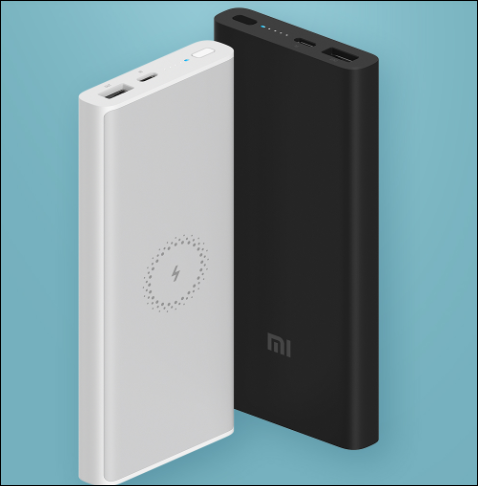
Xiaomi already has a couple of wireless charging power banks to its name one of which is the Mi Wireless Power Bank with 10W wireless charge support. The company also has a trimmed down Mi Wireless Power bank Youth Edition. Both models support 18W fast charging via the USB-A ports and use the Qi charging standard for the wireless charging protocol.
We’ll have to wait until March 16 which is just a couple of days away to find out what the product really is. We’ll keep you updated here on Gizmochina.
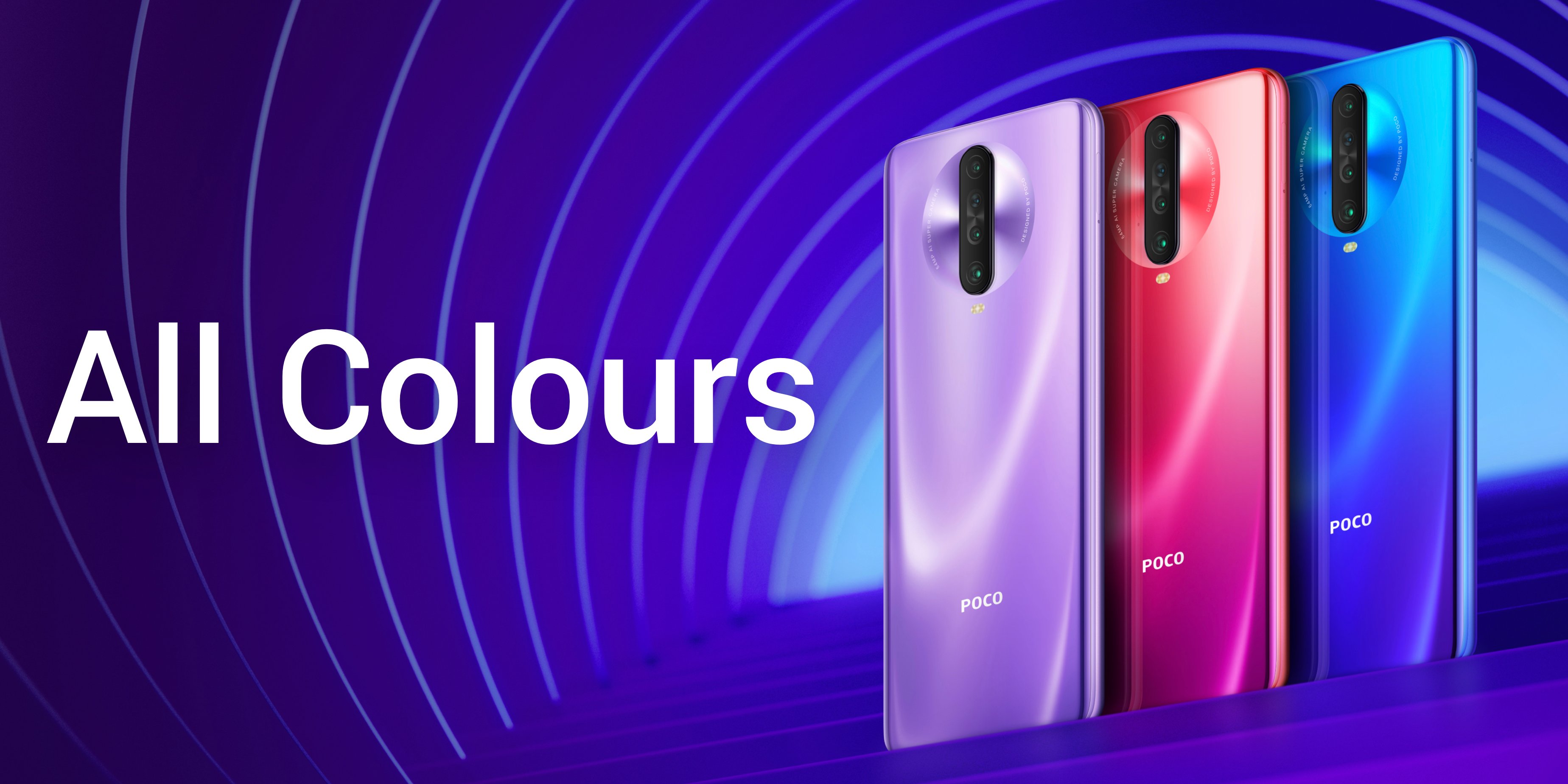
The recent launch of the Redmi Note 9 series may end up being a blessing in disguise for the Poco X2, Poco’s latest smartphone. Recall that the Poco X2 was launched in India last month after a hiatus from the Xiaomi-nurtured OEM following the release of the Poco F1 in 2018. The Poco X2 has been well-received even with a design that is practically the same as the Redmi K30.
Redmi K30 4G has been rebranded as POCO X2 in India
It has now emerged that Poco X2 has been crowned as the highest-rated smartphone on Flipkart. The device scored an average user rating of 4.6 out of 5 to outshine other rival brands that have more than 10,000 user ratings in just a month after it was released. The product page shows that the X2 has received rave reviews and top ratings from over 20,000 users as of March 13, 2020.
As regards the feat which could be considered a milestone, Manmohan Chandolu, General Manager, POCO India had this to say; “We are ecstatic with this achievement and want to thank all our customers who have been a part of this new-yet-fruitful journey. Since POCO X2’s launch last month, we have received an amazing response from across all categories of users and I am confident that it is just the beginning. We intend to continue the momentum and keep up with the gusto.”
POCO X2 packs an impressive 6.67-inch display powered by the RealityFlow 120Hz engine, a first in this category. The display offers a tall 20:9 aspect ratio wrapped around a 3D curved glass body, which enables a large cinematic screen experience. It is worthy of note that the Poco X2 happens to be India’s first smartphone to feature the Sony IMX686 camera sensor.
POCO X2 is available on Flipkart but you’ll have to wait until March 17 when the next flash sale will hold at 12 noon. As for the prices, the 6GB + 64GB comes in at INR 15,999 ($216), the 6GB + 128GB is offered for INR 16,999 (~$230) and the 8GB + 256GB storage variant goes for INR 19,999 (~$270). Flipkart is offering an additional instant discount of INR 1,000 on ICICI credit card and EMI transactions.
Companies patent a number of technologies but not all of them come into fruition as a product. And that seems to be the case with a new patent by Apple, which feeds onlookers with false data when they try to peep at your phone, tablet or laptop screen.
Apple, on March 12, filed a new patent at the US Patent and Trademark Office titled ‘Gaze-dependent Display Encryption’. This tech will work on the basis of tracking user’s gaze while using Apple products such as iPhone, iPad or MacBook. By doing so, the screen will display the original data only in the region where the user stares at. Whereas, the other surrounding region will be encrypted in the form of displaying false data to make the content on the screen illegible to the people in the surrounding. What’s more interesting is the encrypted phony data will look similar to that of original content so that the onlookers don’t find it suspicious.
The Cupertino-based tech giant has always been a forerunner of privacy on its products. This is not the first time we are seeing someone trying a solution to this issue. A few years back, Blackberry-branded Android smartphones had a feature called ‘Privacy Shade’, which would hide the content on the screen completely except for a small movable window to let the user access the content. But, that was software-based and easy to implement. On the other hand, Apple’s patent requires a combination of hardware as well as software and therefore it is also hard to implement as there is literally no place on the front of the gadgets to include additional sensors.
Maybe, we might see this patent in action in some other way in near future or perhaps never at all.
Xiaomi announced the Mi 10 series last month but unfortunately, due to the COVID-19 pandemic, the availability of this handset has been affected severely. So far, the Mi 10 duo (selected variants) went on sale a couple of times post the launch event on February 13. But that might change soon as the Chinese smartphone maker sold all the storage variants of the Mi 10 in a sale today.
The sale scheduled for today was the third sale for Mi 10. The last sale on February 14 was only limited to the 8GB + 256GB variant. But this time around, all the storage configurations of the device were made available, however, with some caveats. Only the 8GB + 128GB and 12GB + 256GB variants priced at 3999 Yuan (~$571) and 4699 Yuan (~$671) respectively were available for purchase, whereas the 8GB + 256GB version retailing for 4299 Yuan (~$614) could only be pre-ordered. Also, the shipping is expected to commence before March 26, which is about two weeks from today.
Going by the situation, we can clearly picture how coronavirus is affecting businesses in China (worldwide too). Xiaomi’s Lei Jun took to Weibo to announce that Mi 10 Pro and the standard Mi 10 will be only made available once a week on Tuesdays and Fridays respectively. He even added that supplies will still take some time to recover suggesting the situation in China to be not yet stable. Hopefully, the condition will turn around soon as the rise of new COVID-19 cases has been falling in China and thus most businesses have already begun lately.
With all that being said, Xiaomi is yet to launch the Mi 10 series globally, which is set for March 27.
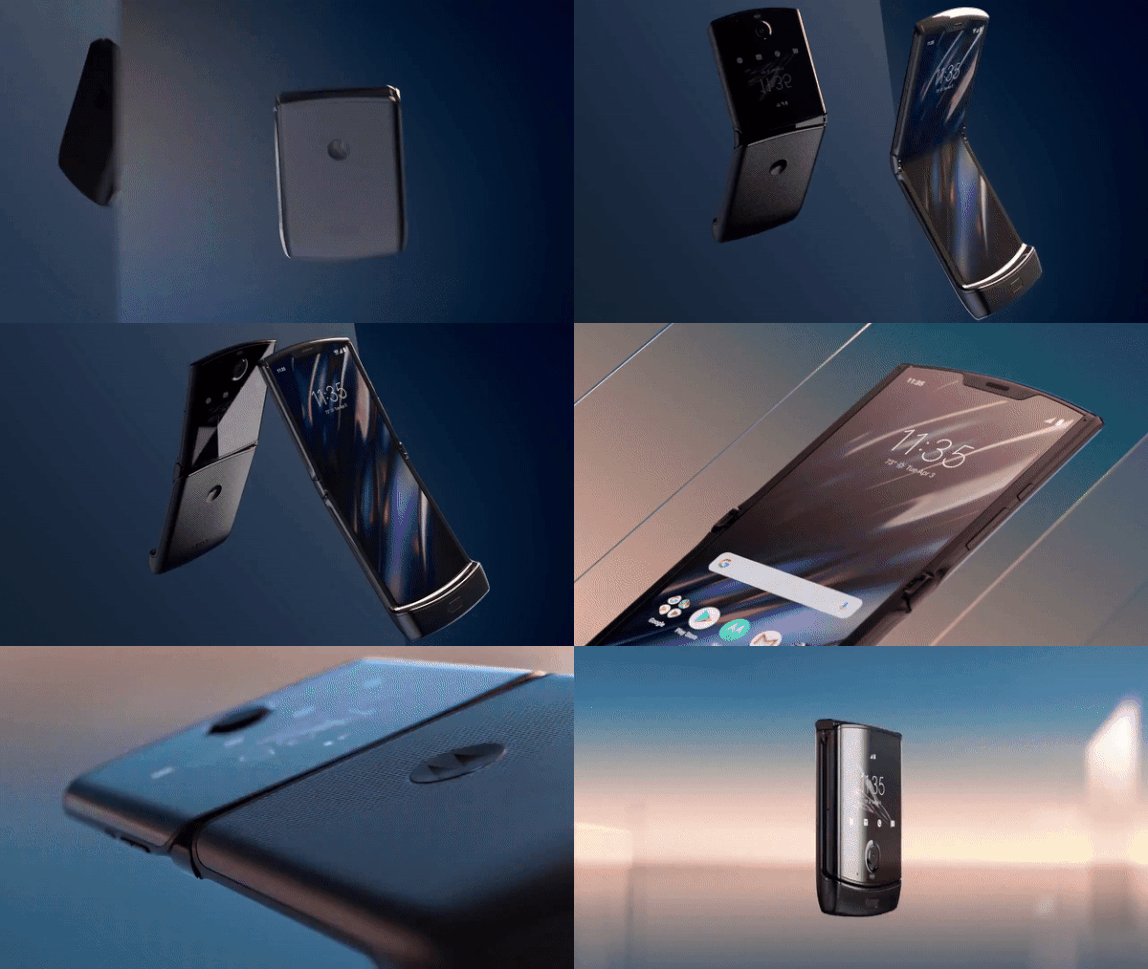
The Motorola Razr 2019 is no new name in the industry as the foldable device was launched by Motorola as a rebirth of the classic Motorola Razr that held sway several years back. While the device made its debut in November 2019, Motorola hinted that the phone will be launched in India on March 16 at 12.30 pm. More details have now emerged that the Razr 2019 will be launched on Flipkart on that day.
The new Razr 2019 still retained the flip design but lack a physical keyboard. Instead, what we got is a foldable screen in the most simplistic of form. No surprise the Motorola Razr 2019 has been a popular model since it was launched. The design may have even inspired the Samsung Z flip that was launched last month. You may check out our comparison article of the two models from here.
As per the specifications, the Motorola Razr 2019 features an internal P-OLED foldable display with a resolution of 876 x 2142 pixels. The display also uses an aspect ratio of 21:9. The outer screen houses a G-OLED screen of 2.7 inches with a resolution of 600 x 800 pixels.
The Razr 2019 is powered by a Qualcomm Snapdragon 710 mobile platform paired with 6 GB of RAM and 128GB of native storage. For photography, you get a 5MP selfie camera at the front while at the rear, there is a 16MP with f/1.7 aperture along with dual-LED flash. The phone packs a 2,510mAh battery and supports 15W TurboPower fast charging through USB-C.
Motorola is yet to reveal the price of the Razr 2019 in India but in the international markets, the Razr is selling for $1,499.
Last year in November, Xiaomi backed QIN brand announced its AI Assistant Pro, an iPod touch akin product running an Android skin. Now, within four months, the brand has come out with an upgraded version of the device with more storage and a better processor. It is priced at 799 yuan ($114) and is already up for sale on Xiaomi’s Youpin crowdfunding platform just like its predecessors.
The new QIN AI Assistant Pro is similar to the old version in many ways except for the Unisoc SC9863A processor, 64GB internal storage, and 12 free applications opposed to Unisoc SC9832E SoC, 32GB ROM, and 6 free apps on the previous model. Other than these three changes, the new Assistant Pro is basically the old one in terms of design, build, and software.
That means it sports the same 5.05-inches display with 576 x 1440p pixels and 22:5:9 aspect ratio. It weighs only 105g and is made of polycarbonate with a maximum thickness of 8.6mm. The back of the device features a 5MP camera accompanied by an LED flash, whereas the right side accommodates the volume rockers, power key, and an accented dedicated XiaoAI (Xiaomi AI) assistant button. It does not have a 3.5mm headphone jack but does feature a USB Type-C port to charge its 2,100 mAh battery.
As far as software is concerned, it runs a modified version of Android 9.0 Pie Go Edition with added AI functionalities and IR blaster to control appliances with remote control and Mijia smart home products. It also supports real-time translation of 62 languages including 36 with voice support and 10 with pictures. Last but not least, it also supports the full version of the WeChat app, which enables voice calling feature on the device.
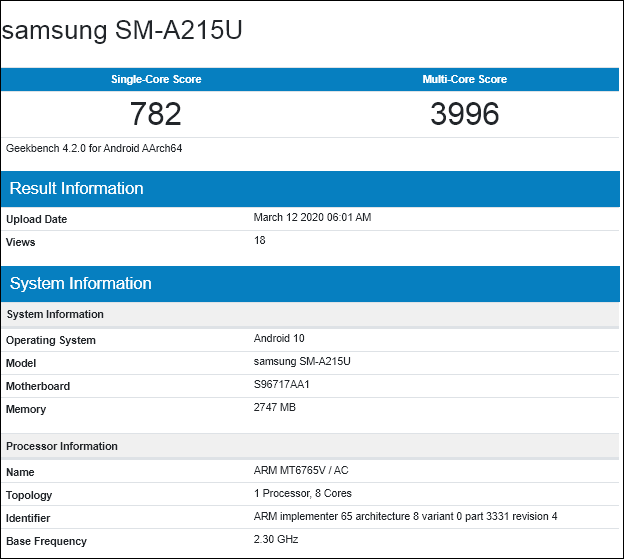
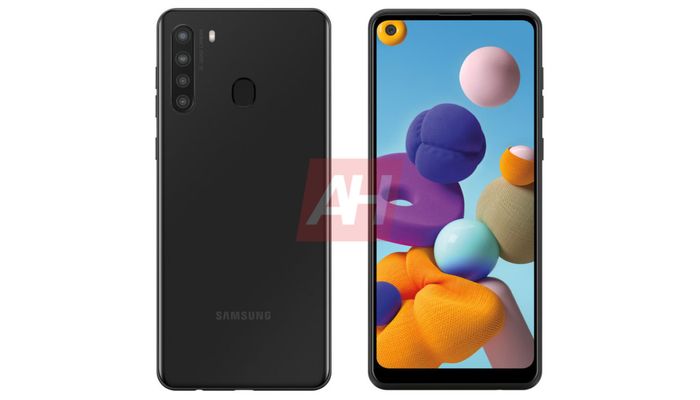
Around the middle of last year, Samsung filed trademark applications for some of its 2020 Galaxy A series models. One of the names that were trademarked is the Galaxy A21. The model has now reportedly appeared on GeekBench database.
The device is listed as Samsung SM-A215U and is listed to pack an ARM MT6765V/AC processor which is likely the MediaTek Helio P35 Systems-on-Chip (SoC). The device is also listed with 3GB of RAM which is likely the base RAM version. In addition, the device will boot Android 10 operating system out of the box.
In terms of performance, the Galaxy A21 had a single-core test score of 782 points and on the multi-core test, it scored 3996 points.
The Galaxy A21 is the successor of the Galaxy A20 that was launched last year. The phone is a budget phone but renders leaked earlier this year points to an impressive design. The device is shown to have a hole-punch full-screen design. At the rear, the renders reveal a quad-camera setup-up adopting a vertical alignment. The rear panel which will likely have a polycarbonate build is also shown to have a fingerprint reader slapped on the middle.
Samsung may take the wraps off the device any moment from now.
Since its first incidents of adoption, 5G networking has faced numerous accusations regarding its health safety parameters. Many had claimed that the radiation from the newer and faster bandwidth can potentially harm human beings and even some animals, but that has now been debunked by an International authority on the matter.
According to a report from the Internation Commission on Non-Ionizing Radiation Protection (ICNIRP), the 5G network’s millimeter-wave is safe. The German based scientific group assessed the potential health risks of the radio frequency broadcast and issued the statement. This also marks the first time in 20 years, that the advisory has updated its guidelines.
A 5G antenna being tested in a special measuring room at in Regensburg, Bavaria. (Image Via Lukas Barth-Tuttas/EPA)
Notably, the organization is also in charge of setting limits on the exposure to radiation and has optimized its policies for 5G as well, setting a new maximum. However, it has been found that the 5G infrastructure in place in certain parts of the US and Europe have output levels far below the newly set maximum limit. In other words, there is no risk at all with the 5G network currently being implemented.
According to an official from the ICNIRP, the aim of the new guidelines was also to spread awareness and help put unfound beliefs to rest. Meaning, the concerned individual or group can breathe a sigh of relief. Interestingly, during the testing, it was found that the radio frequencies 5G uses in the UK are similar to those that were used in mobile telephones back in 1998.
Multiple testings from the source also confirmed that the radiation levels barely reached 1 percent of the maximum limit. Even when run at the maximum possible power, it still will not cross the 50 percent barrier, although this level will never be reached in day to day usage.
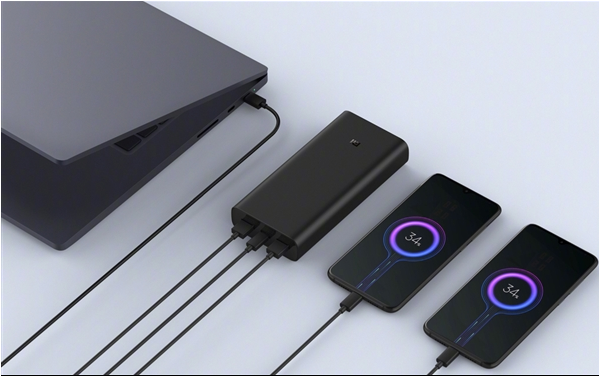
Earlier today (13th March 2020), data reports showcased that the Xiaomi Changjiang Industrial Investment Fund had invested in a Chinese fast charging chipmaker called Hypower Microelectronics. The investment fund was initially jointly created by Xiaomi back in 2017 and has strategically invested in multiple different fronts since.
Xiaomi Mi PowerBank 3 50W fast charge version
Hypower Microelectronics Co Ltd was established back in March 2018, with its business operations primarily revolving around circuitry and wholesale of integrated circuit chips. The company is represented by Wang Qiang who also owns 36.71 percent of the stakes in the Hypower. And now, Xiaomi has also invested in the company and secured a 9.92 percent stake as well.
According to public data reports, Hypower is currently developing integrated circuits, with a special focus on reducing the overall power supply while also boosting the efficiency of the same. In recent times, Xiaomi has invested heavily in the field of microelectronics and chipsets, which is evident with its latest investment.
However, it doesn’t end there, as the Xiaomi Changjiang Industrial Investment Fund had just invested in a semiconductor company called, Senscomm last month as well. The firm used the funding to develop and mass produce various new Wi-Fi 6 standard AIoT products. This investment is also in line with the Chinese government’s (Note: the local government also had a stake in the investment fund) initiative to encourage local businesses to develop proprietary core technologies and products such as chips.
OnePlus is popularly known for its premium smartphones featuring refined OxygenOS and some dedicated applications like OnePlus Camera, OnePlus Gallery, and OnePlus Launcher. These applications possess compelling features while ensuring a bug-free experience. The stock-Android like experience makes these apps favorite among most of the users. These feature-rich applications often attract non-OnePlus users. We have got a hands-on modified OnePlus Launcher APK that is compatible with all Android devices.
OxygenOS is one of the most refined Android Skins available right now. The company has worked effectively on every tiny feature of the OxygenOS. Due to such refinement, the OxygenOS offers blazing-fast performance while offering some additional features that are usually a part of custom ROMs. OxygenOS features a night mode theme, fast performance, and few apps that enhance the premium experience on OnePlus smartphones. However, now the users can download and install OnePlus Launcher on any Android device.
OnePlus Launcher Features
OnePlus launcher is a powerful utility app officially compatible with all OnePlus smartphones. It has received various new features overtime via upgrades. It features much-needed tweaks while maintaining the premium features. Here are some major OnePlus Launcher features:
Wallpaper, Icon Pack and App Shortcuts support.
Left-Side shelf for weather information, notes, recent Apps, storage stats, and parking location, cricket card, wallet, zen mode, and dashboard.
Support for third-party widgets in home screen or Left-Side shelf.
Ability to Hide Apps
These are some inbuilt features of OnePlus Launcher which are usually absent from any other stock launcher. Let’ss see below the way to get it on any Android smartphone.
Note:The modified APK is compatible with devices running Android 8.0 or newer.
Download OnePlus Launcher
It is quite easy to sideload an external APK on Android smartphones. The users just need to enable installation from “unknown sources” on the smartphone. Grab the APK from the link below:
Note: If you’re installing any external apk for the first time, then you need to enable installation from “unknown sources” by heading to the device settings.
Download the OnePlus Launcher APK from the link above.
Tap on the APK file and Install OnePlus Launcher.
Tap on the Home button, and then select the OnePlus Launcher as default.
Enjoy!
We hope you have successfully installed the OnePlus Launcher successfully on your non-OnePlus smartphone. If you have any problem, then do let us know via the comments below.
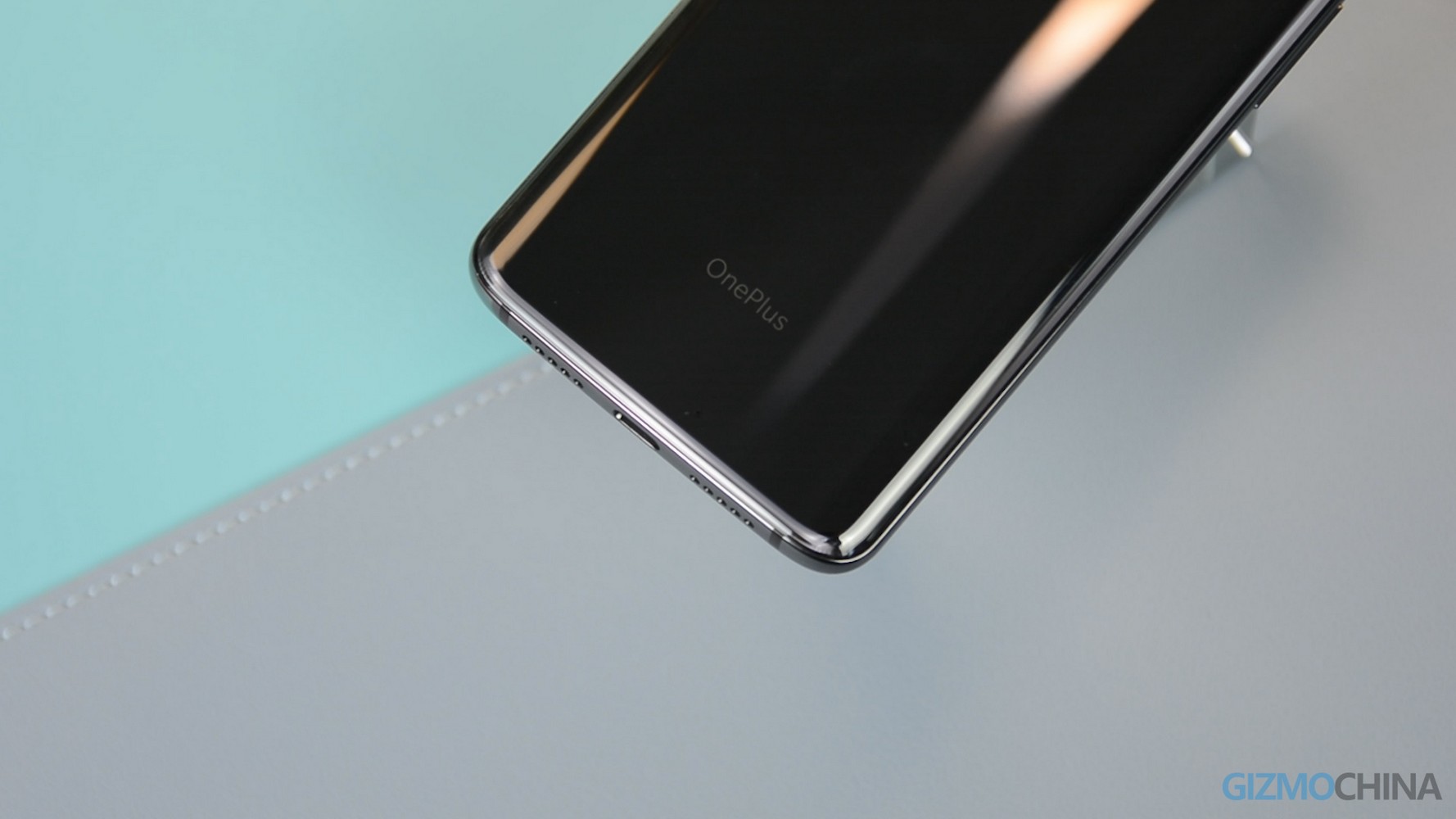
OnePlus, the smartphone manufacturer is committing 30 million US Dollars into the research and development of 5G networking. The move was announced earlier this week and will be in line with its plans on implementing the newer and faster bandwidth in its handset offerings.
As of right now, 5G networking is one of the top priorities of various industries, especially the smartphone market. Multiple OEMs are currently offering or are working towards launching a smartphone that supports 5G. So it arrives as no surprise that OnePlus would want to include it as well.
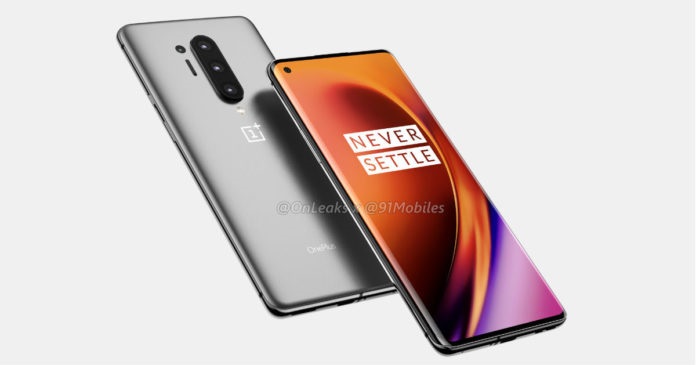
OnePlus 8 renders
Although OnePlus is rather slow in the innovation aspects of things, it is known to offer the newest technological trends in its flagship smartphones. The Chinese company is also popular in offering handsets with great value in the price they are offered in. Furthermore, OnePlus had recently unveiled a concept device that also hints at its own strides research and development.
According to a OnePlus official, the company plans on being one of the first OEMs to offer 5G enabled devices that include the entire series. This is quite the statement considering OnePlus is expected to launch a Lite version in the OnePlus 8 series. Thus, it is a big deal since 5G is generally found in premium grade handsets.
OnePlus has stated that its 5G R&D labs will place an emphasis on a broad range of technologies and products from the company, including circuitry, antennas and even other multimedia hardware like the camera modules. Additionally, the brand also wishes to hold a market share in nations with 5G infrastructure through its lucrative offerings.
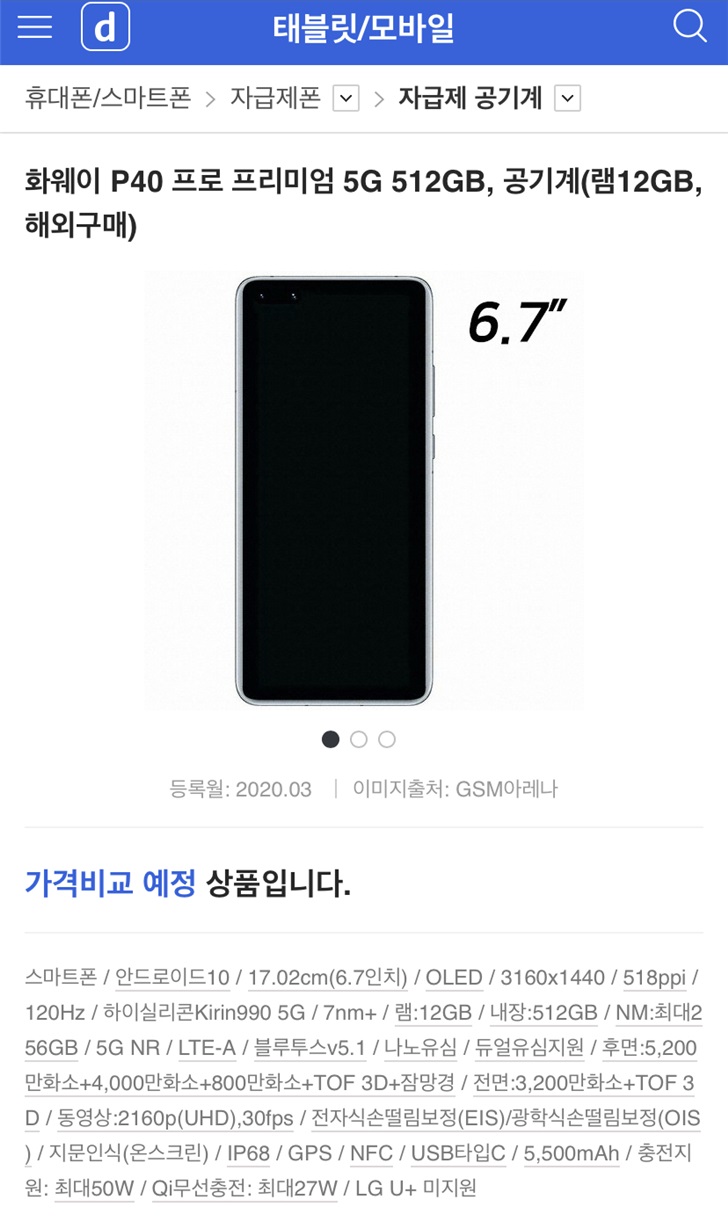
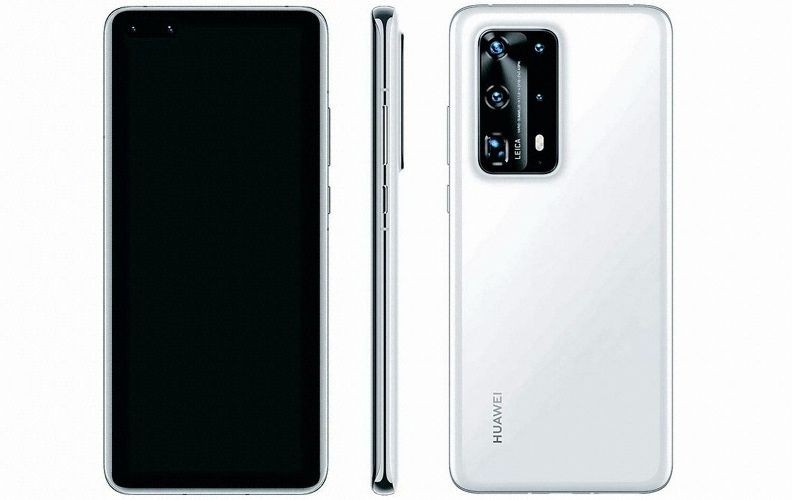
The upcoming P40 series of flagship phones from Huawei is rumored to include three phones such as Huawei P40, P40 Pro and P40 Pro PE (Premium Edition). As the name suggests, the latter is expected to arrive as a more powerful version of the P40 Pro. A South Korean retailer seems to have listed the Huawei P40 Pro PE smartphone. The listing carried its image and specifications.
The listing revealed that the Huawei P40 Pro Premium Edition will be equipped with a dual punch-hole OLED curved display that offers 120Hz refresh rate. The 6.7-inch display supports high resolution of 1440 x 3160 pixels along with a pixel density of 518ppi. The OLED panel seems to be integrated with a fingerprint reader
The Kirin 990 5G chipset will be present under the hood of the Huawei P40 Pro PE. The SoC is supported by 12 GB of RAM. The internal storage of the device is 512 GB. The handset will come preloaded with Android 10 OS.
The P40 Pro PE is the first Huawei phone to sport a penta-lens camera setup. It includes a 52-megapixel main lens, a 40-megapixel secondary lens, an 8-megapixel third lens, a 3D ToF (Time of Flight) sensor and a periscope zoom camera. The front-facing dual camera setup of the phone has a 32-megapixel main lens and a 3D ToF lens coupled with EIS and OIS.
The Huawei P40 Pro PE is backed by a humungous 5,500mAh battery that supports 50W fast charging and 27W rapid wireless charging. The handset will be sporting an IP68 rated chassis and it will include other features like Bluetooth 5.1, GPS, USB-C and NFC. The retailer did not reveal the pricing of the phone. A recent leak had revealed that it could be priced between 1,199 euros (~$1,338) and 1,299 euros (~$1,450).
We use cookies on our website to give you the most relevant experience by remembering your preferences and repeat visits. By clicking “Accept”, you consent to the use of ALL the cookies.
This website uses cookies to improve your experience while you navigate through the website. Out of these, the cookies that are categorized as necessary are stored on your browser as they are essential for the working of basic functionalities of the website. We also use third-party cookies that help us analyze and understand how you use this website. These cookies will be stored in your browser only with your consent. You also have the option to opt-out of these cookies. But opting out of some of these cookies may affect your browsing experience.
Necessary cookies are absolutely essential for the website to function properly. This category only includes cookies that ensures basic functionalities and security features of the website. These cookies do not store any personal information.
Any cookies that may not be particularly necessary for the website to function and is used specifically to collect user personal data via analytics, ads, other embedded contents are termed as non-necessary cookies. It is mandatory to procure user consent prior to running these cookies on your website.



 OnePlus upgraded the connectivity by replacing Bluetooth 4.1 with Bluetooth 5.0 that warrants a more stable connection. Furthermore, the company has included aptXHD support, which is a notable upgrade from the aptX-supported originals.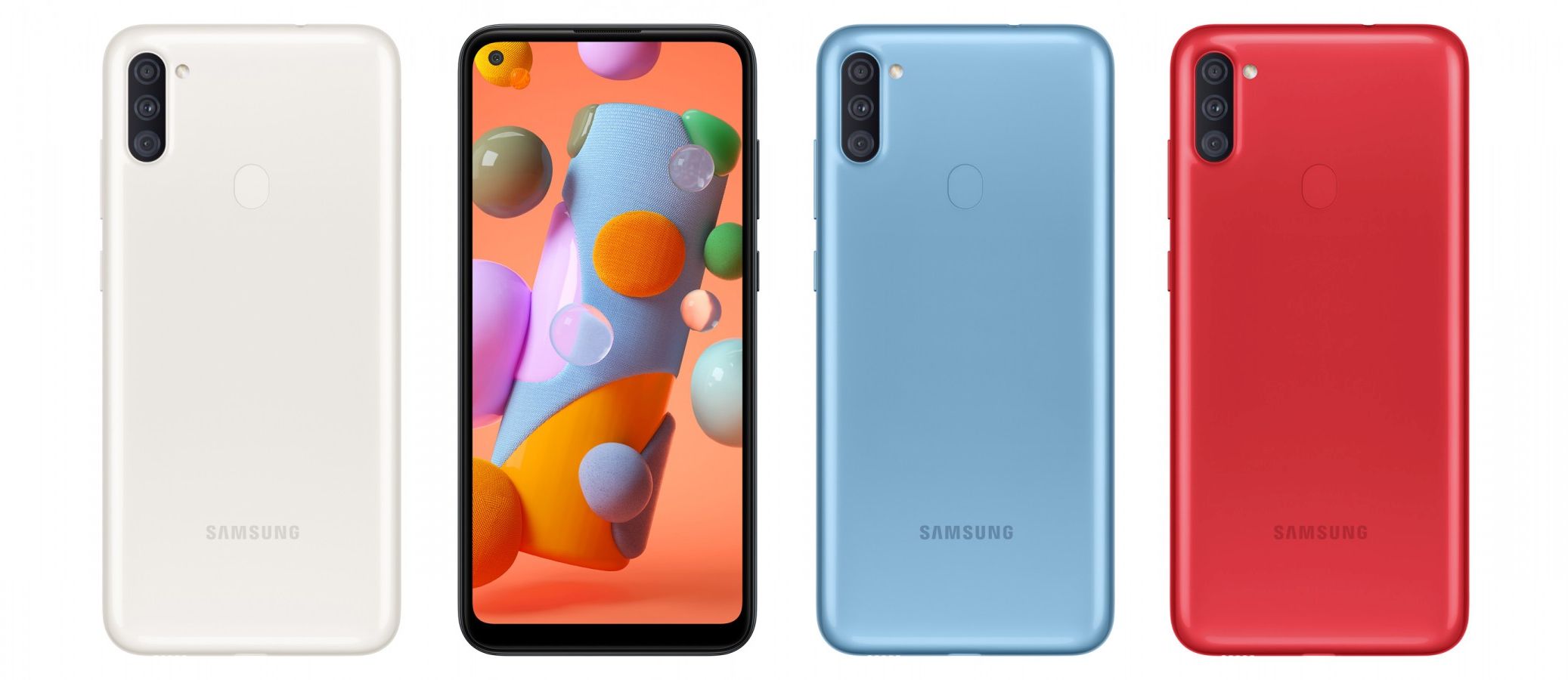











UP NEXT: Samsung working on a new type of display for future smartphone