Advertisement

Huawei P40 Pro PE renders reveal penta-lens camera setup ahead of March 26 launch

Samsung’s Galaxy S20 will be the entry-level smartphone in the S20 series. The lineup includes Galaxy S20+ and the advanced Galaxy S20 Ultra 5G. So far, the rumor mill has claimed that the rival Huawei P40 series includes two device such as Huawei P40 and P40 Pro. A fresh leak has revealed that there is another model called Huawei P40 Pro PE. Leaked renders of the P40 Pro PE show that it is decked with a penta-lens camera system on its back. Reputed tipster Evan Blass has claimed that the Huawei P40 series will be made official on March 26.

Huawei P40 Pro PE renders

The Huawei P40 Pro PE (Premium Edition?) renders reveal that it has a pill-shaped cutout at the top-left corner of the screen. Like the P40 Pro the smartphone could be equipped with quad curved display. The bottom edge of the device has a USB-C port, a microphone, an external speaker and a SIM card slot. A volume rocker and a power key are present on the right edge of the device.

Huawei P40 Pro PE render
Huawei P40 Pro PE

The rectangle-shaped camera module on the backside of the Huawei P40 Pro PE includes as many as five cameras. The camera bump on the device is quite pronounced. The squarish lens in the camera setup is the periscope lens that is expected to bring support for 10x optical zoom. The exact configurations of the five cameras of the P40 Pro PE are not known yet. A tweet from popular tipster Evan Blass suggests that the P40 Pro PE could be flaunting a ceramic rear.

There is no word on the specifications of the Huawei P40 Pro PE. It could be powered with Kirin 990 5G and may feature highest amount of RAM and largest storage space in the P40 series. The following tweet from leakster Teme the penta-lens camera system of the P40 Pro PE with the triple camera setup of the Huawei P40 and quad cameras of the P40 Pro.

Huawei P40 Pro renders

An exclusive leak from Android Headlines reveals the design of the Huawei P40 Pro from all angles. The design of the P40 Pro is almost identical with P40. The only major difference between the two devices in terms of design is that the P40 Pro has an extra camera on its rear, and it features a curved display.
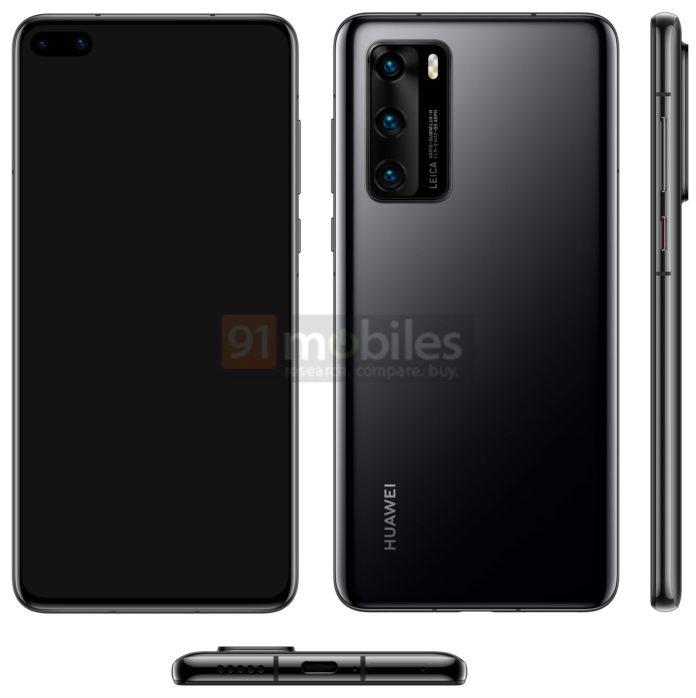
Huawei P40 Pro new renders
Huawei P40 Pro

The rear camera setup of the device is rumored to include a 52-megapixel main lens, a 40-megapixel cine lens, a periscope zoom shooter and a 3D ToF (Time of Flight) sensor. The Huawei P40 has triple rear cameras and it seems to lack a 3D ToF sensor. And, instead of a periscope lens, it could be housing an 8-megapixel telephoto lens with 3x optical zoom.
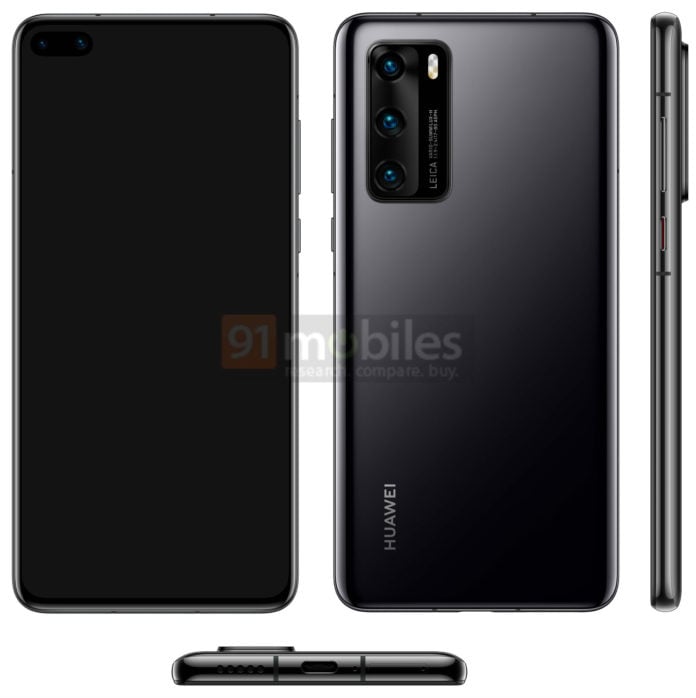
Huawei P40 new renders
Huawei P40

The Huawei P40 Pro is expected to come in five colors like Black, Blush Gold, Silver Frost, Deep Sea Blue, and Ice White with a gradient finish. The Huawei P40 is also speculated to come in same color options Hopefully, more details on the P40 series will surface before the March 26 unveil event that will be held in Paris.


(source 1, 2, 3)

Realme opens up registration for Realme UI’s “early adopter” program on the Realme X2

Here’s some news for the Realme community. The Realme X2’s “early adopter” UI program registrations have opened for the limited batch of 500 people. You can only register if you have a Chinese variant of the Realme X2 and the early adopter realme UI will obviously be very buggy. In case you’re thinking of signing up, backup your personal data before updating.

So now, how exactly does this update work? Well, once you’ve registered, you’ll receive an update for the device to test out unfinished software. At least he first batch will be essentially untested software, and making it highly risky to use on a daily basis. For users who want to experience a relatively stable experience are recommended to wait for the second batch which will come with a bunch of fixes.

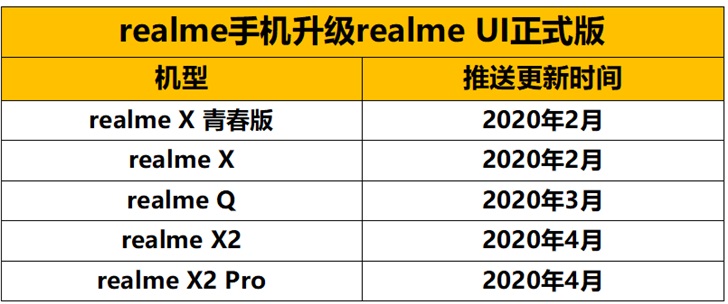
The information we have shows that the first batch is limited to 500 people, and the system push time is before the Chinese Spring Festival. Then once that’s out of the way, the second batch of registration deadline is February 1, while the update itself takes place between February 7-8. In addition, the official version of realme UI will be launched in February 2020.

With realme UI, users are able to design the icons and can choose their transparency as well. The sizes of the icons are also customizable and are personalized, even for the actual image in the icon. Alongside the fresh look, the UI brings 11 new background wallpapers for the home screen of Realme smartphones. Notably, the wallpapers are based on “natural elements” and will users can always find a match with a particular color scheme.

The Android 10 based Realme UI also brings performance improvements as well. It arrives with new power saving features and a lot more. A new Focus Mode helps disconnect from the outside world and even plays relaxing music to help improve concentration.

(Source)

Noise Shots XO TWS earbuds brings wireless charging and more for ₹5,499 (~$77)

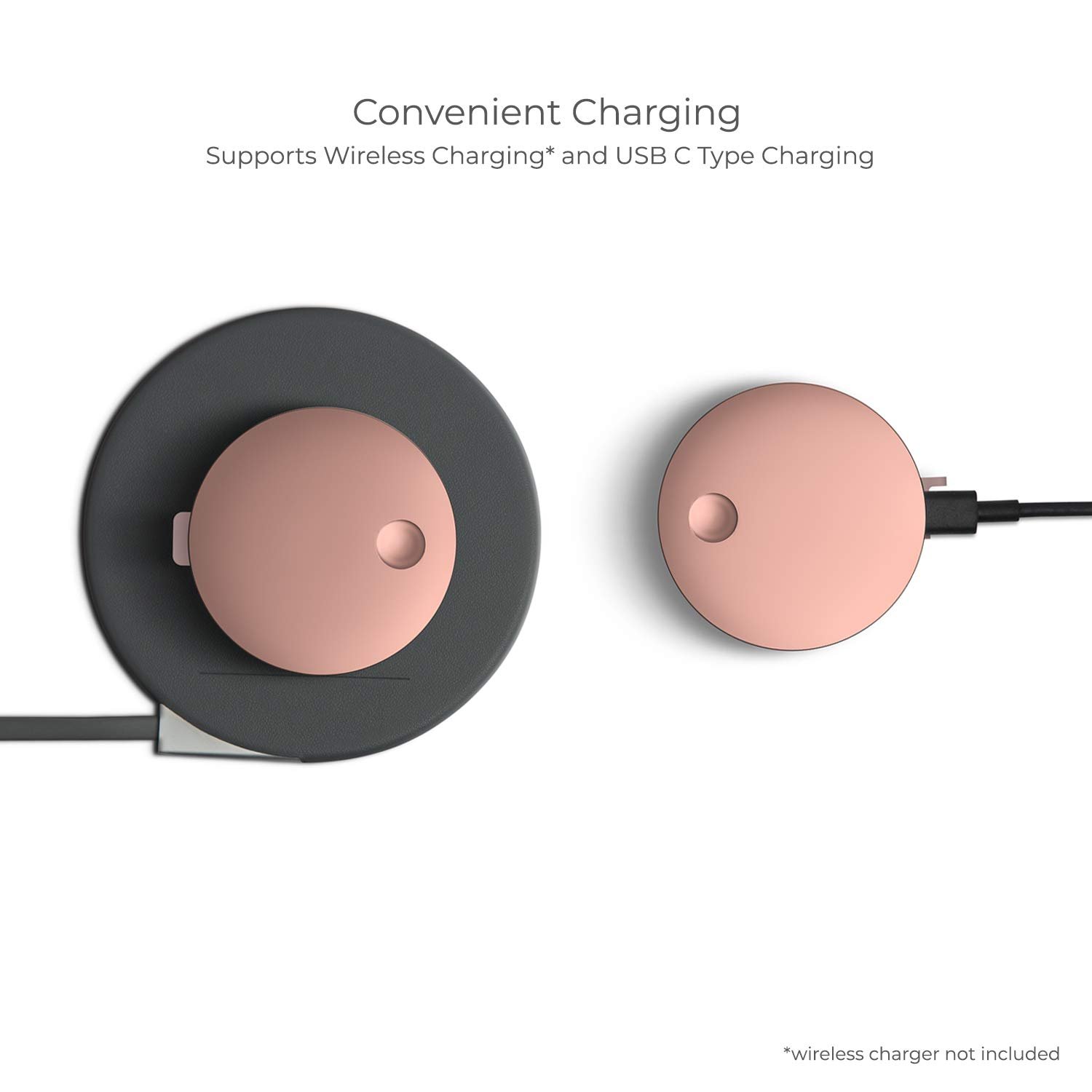
If you reside in India and are in search of a new pair of wireless earbuds, then the Realme Buds Air is most likely one of those you are considering. However, while it may tick all of your boxes in terms of features such as support for wireless charging and USB-C charging, you may actually not like the design. If you prefer earbuds that look nothing like Apple’s AirPods, then you may want to check out the new Noise Shots XO.

Noise Shots XO

The Noise Shots XO is a new pair of wireless earbuds from a company called Noise. This is not their first TWS earbuds but it is their first to support wireless charging and USB-C charging. Noise also makes smartwatches and action cameras.

The earbuds have a metallic paint job and come in a circular case with a swiveling lid. There are three color variants – Metallic White, Rose Gold, and Space Grey.

[envira-gallery id=”301146″]

The Noise Shots XO connects via Bluetooth 5.0. It has support for voice assistants and also has an IPX7 rating making them safe for use for exercising and in the rain. There is support for Qualcomm’s aptX for HD audio and CVC 8.0 with wind noise cancellation for clearer calls. The earbuds will provide up to 6 hours of playback on a single charge but that goes up to 36 hours when you include the charging case. The earbuds takes 2 hours to charge.

The Noise Shots XO support touch controls. You can adjust the volume by tapping and then holding, call up the voice assistant by tapping thrice, answer or end calls by tapping once, and tapping twice to change tracks.

Noise Shots XO charging

You can pick up a unit on Amazon India or on Flipkart for ₹5,499 (~$77).


(Via)

Oppo F15 vs Samsung Galaxy A51 vs Redmi Note 8 Pro: Specs Comparison

Oppo F15 just debuted in the Indian market with midrange specifications at a pretty affordable price. It is hard to find weak points in its specifications, it is a very well-balanced device. In order to highlight its pros and cons, we compared it to the devices released from the concurrence with a similar price tag. Samsung Galaxy A51 is the one released by the world’s first smartphone brand, while Redmi Note 8 Pro is the device that we define as the best-buy of the category. In this specs comparison, you can learn about all the differences between these three interesting smartphones.


Oppo F15 vs Samsung Galaxy A51 vs Xiaomi Redmi Note 8 Pro

Xiaomi Redmi Note 8 Pro Samsung Galaxy A51 Oppo F15
DIMENSIONS AND WEIGHT 161.3 x 76.4 x 8.8 mm, 199 grams 158.5 x 73.6 x 7.9 mm, 172 grams 160.2 x 73.3 x 7.9 mm, 172 grams
DISPLAY 6.53 inches, 1080 x 2340p (Full HD+), 395 ppi, LTPS IPS LCD 6.5 inches, 1080 x 2400p (Full HD+), 405 ppi, Super AMOLED 6.4 inches, 1080 x 2400p (Full HD+), 408 ppi, AMOLED
PROCESSOR Mediatek Helio G90T, octa-core Samsung Exynos 9611, octa-core 2.3 GHz MediaTek Helio P70, octa-core 2.1 GHz
MEMORY  6 GB RAM, 128 GB – 8 GB RAM, 128 GB – micro SD slot 4 GB RAM, 64 GB – 4 GB RAM, 128 GB – 6 GB RAM, 128 GB – micro SD dedicated slot 8 GB RAM, 128 GB – micro SD dedicated slot
SOFTWARE Android 9 Pie, MIUI Android 10, One UI Android 9 Pie, ColorOS
CONNECTIVITY Wi-Fi 802.11 a/b/g/n/ac, Bluetooth 5.0, GPS Wi-Fi 802.11 a/b/g/n/ac, Bluetooth 5.0, GPS  Wi-Fi 802.11 a/b/g/n/ac, Bluetooth 5.0, GPS
CAMERA Quad 64 + 8 + 2 + 2 MP f/1.8, f/2.2, f/2.4 and f/2.4
20 MP front camera
Quad 48 + 12 + 5 + 5 MP f/2.0, f/2.4, f/2.4 and f/2.2
32 MP f/2.2 front camera
Quad 48 + 8 + 2 + 2 MP f/1.8, f/2.3, f/2.4 and f/2.4
16 MP f/2.0 front camera
BATTERY 4500 mAh, fast charging 18W with Quick Charge 4+ 4000 mAh, fast charging 15W 4025 mAh, fast charging 20W
ADDITIONAL FEATURES Hybrid Dual SIM slot Dual SIM slot Dual SIM slot

Design

Due to a more elegant look, a more compact body and a thinner profile, Oppo F15 and Samsung Galaxy A51 are more attractive than Redmi Note 8 Pro, at least according to my opinion. Samsung Galaxy A51 has a more beautiful front panel since it sports a punch-hole display and it does not need a notch in order to boast very narrow bezels. On the other hand, I like the rear side of the Oppo F15 because it sports a smaller camera module and a more minimalistic look, while the Samsung Galaxy A51 has a bigger iPhone 11-like camera module.


Display

A lot of people would opt either for the Oppo F15 or the Samsung Galaxy A51 due to their AMOLED display including an in-display fingerprint reader. But Redmi Note 8 Pro does not have a bad display. Despite it is an IPS panel, we are talking about an HDR screen with very high brightness. Our recommendation is not to focus on the display while making a choice between these three handsets. You would better mind about the rest of their specifications as you will find big surprises.


Specs & Software

Not everyone is familiar with MediaTek chipsets and not everyone likes them, but we have to face the truth: the Helio G90T found on the Redmi Note 8 Pro is not only the most powerful chipset of this comparison, but it is also one of the best midrange processors for mobile devices. It is meant specifically for gamers and power users. Redmi Note 8 Pro even comes with up to 8 GB of RAM and a fast UFS 2.1 internal storage. The silver medal goes to the Oppo F15: it is fueled by an Helio P70 chipset paired with up to 8 GB of RAM and UFS 2.1 internal storage. But Samsung Galaxy A51 is the only with Android 10 out of the box.


Camera

We still had no chance to test the cameras of the Oppo F15 and Samsung Galaxy A51 since they are still not available to purchase. The data we have is not enough to fully evaluate those cameras, but we can tell you that according to the specs on the paper, these devices are all midrange camera phones. So expect great photos, but not amazing shots like top-end camera phones. We can tell you the same about the front cameras.


Battery

Besides providing better performance, Redmi Note 8 Pro should also offer a much longer battery life thanks to its 4500 mAh battery. But Oppo F15 has a faster charging technology with a 20W power bringing the battery to 50 percent in just 30 minutes.


Price

Oppo F15 debuted in India with a price tag of about $262, Samsung Galaxy A51 should cost about €240/$267, and Redmi Note 8 Pro costs about €203/$226. At the end of the day, despite being a more affordable handset, Redmi Note 8 Pro looks more convincing. But there are still a few doubts and they regard the camera departments and the battery life of Oppo F15 and Samsung Galaxy A51.


Oppo F15 vs Samsung Galaxy A51 vs Xiaomi Redmi Note 8 Pro: PROs and CONS

Xiaomi Redmi Note 8 Pro

PROs

  • Higher performance
  • Affordable
  • Big battery
  • Liquid cooling

CONS

  • Nothing particular


Samsung Galaxy A51

PROs

  • Nice cameras
  • Micro SD dedicated slot
  • AMOLED display
  • More interesting design

CONS

  • Lower performance


Oppo F15

PROs

  • AMOLED display
  • Micro SD dedicated slot
  • Faster charging

CONS

  • Nothing particular


Xiaomi showcases the Mi Mix Alpha Concept smartphone in India

Looks like Xiaomi plans to unleash the full arsenal of its flagship Mi line products this year. The Chinese tech giant recently held a media round-table where it teased the products that will possibly be launched this year. The tech giant equally announced the return of its Mi sub-brand to the Indian market and shared some details about the Mi-banded products that we may see in the year. The most interesting part is the unveiling of the premium Mi MIX Alpha.

The Mi Mix Alpha was only showcased at the event and details of the launch, availability and official pricing wasn’t revealed. That means the tech giant isn’t planning to launch it in India soon, obviously due to the mass production difficulty.  Xiaomi did provide a rough estimate regarding the possible pricing of the MIX Alpha at about Rs 2.5 lakh. Thus, the Chinese company likely has plans to release the Mix Alpha in India in the future.

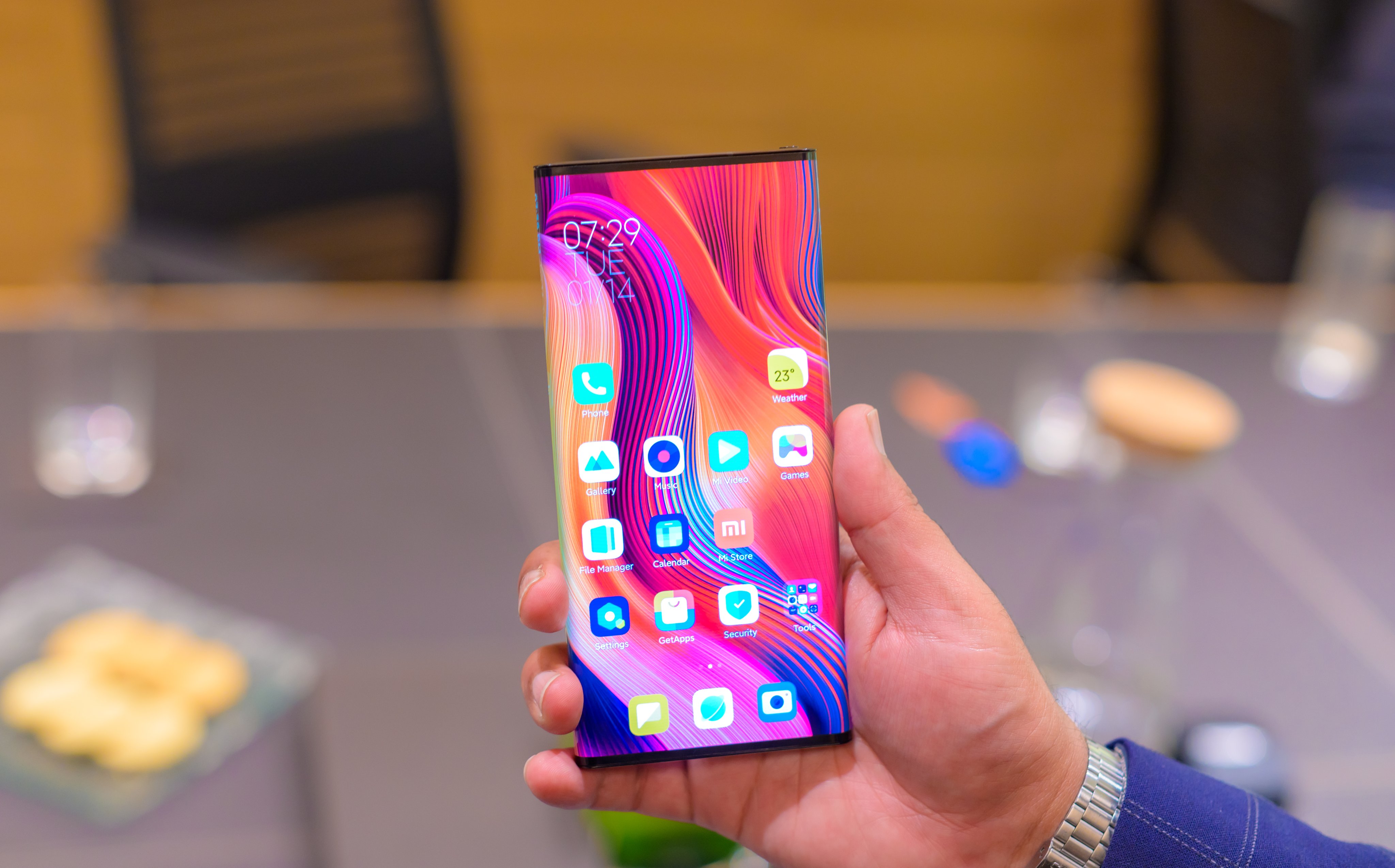
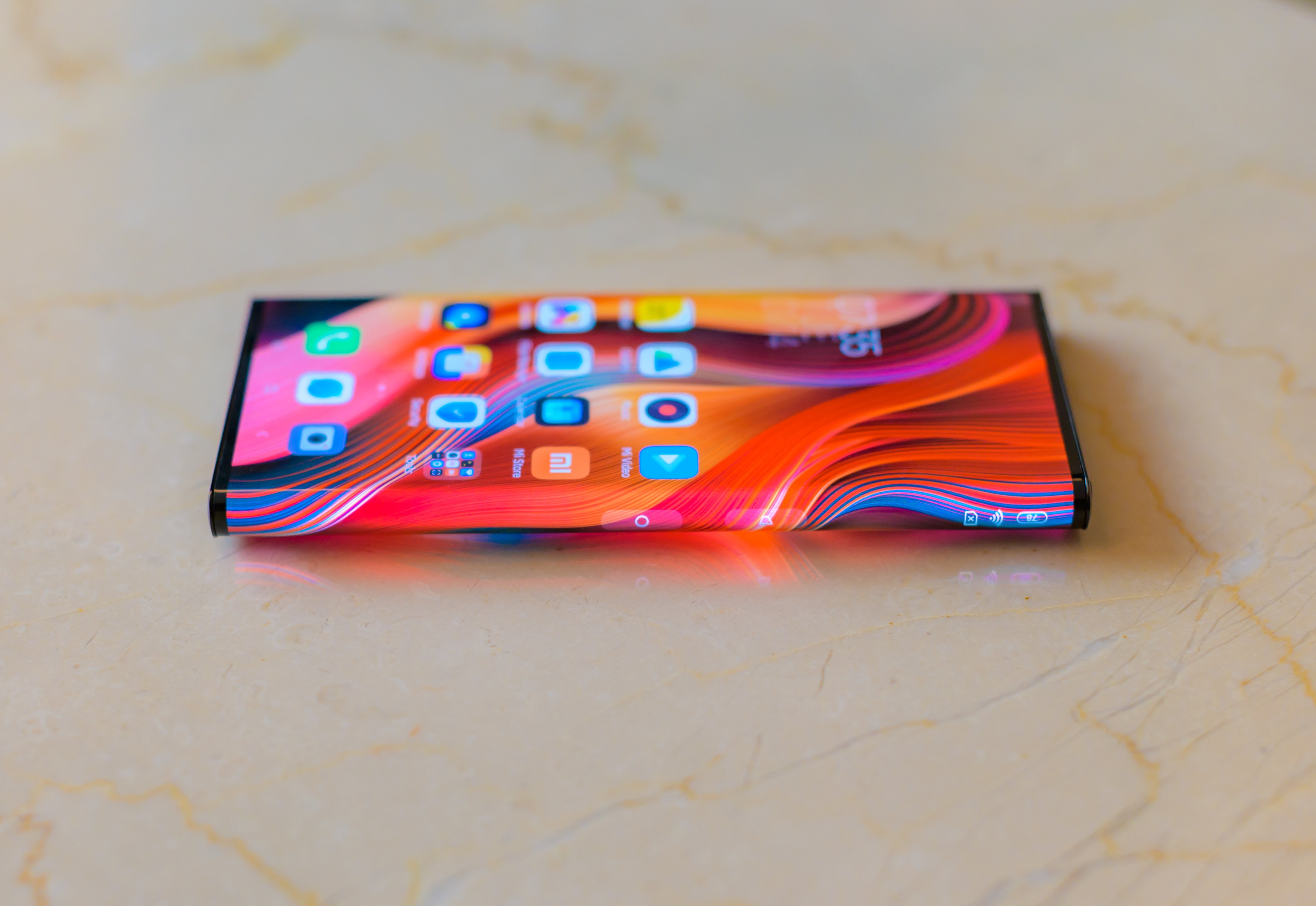
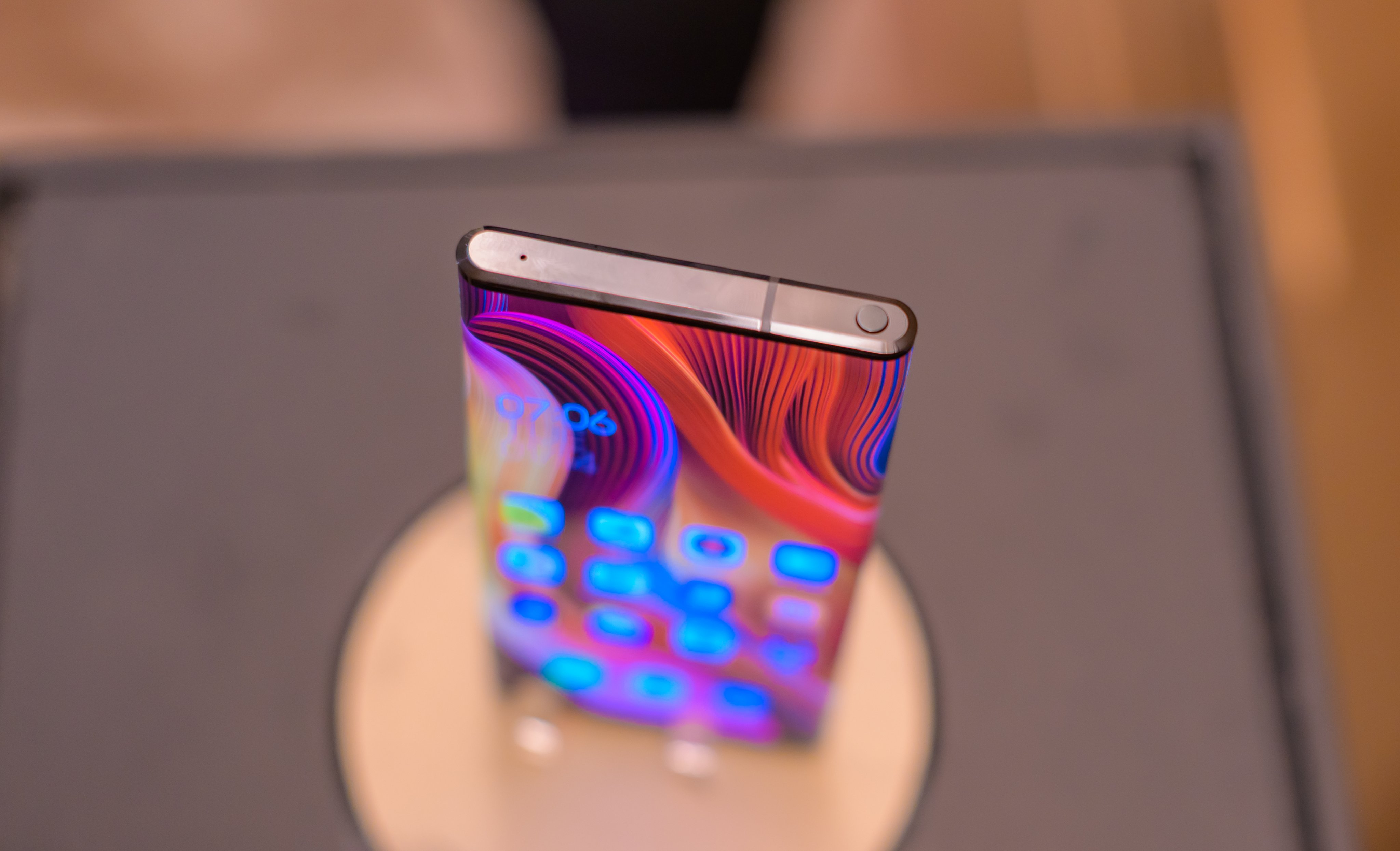
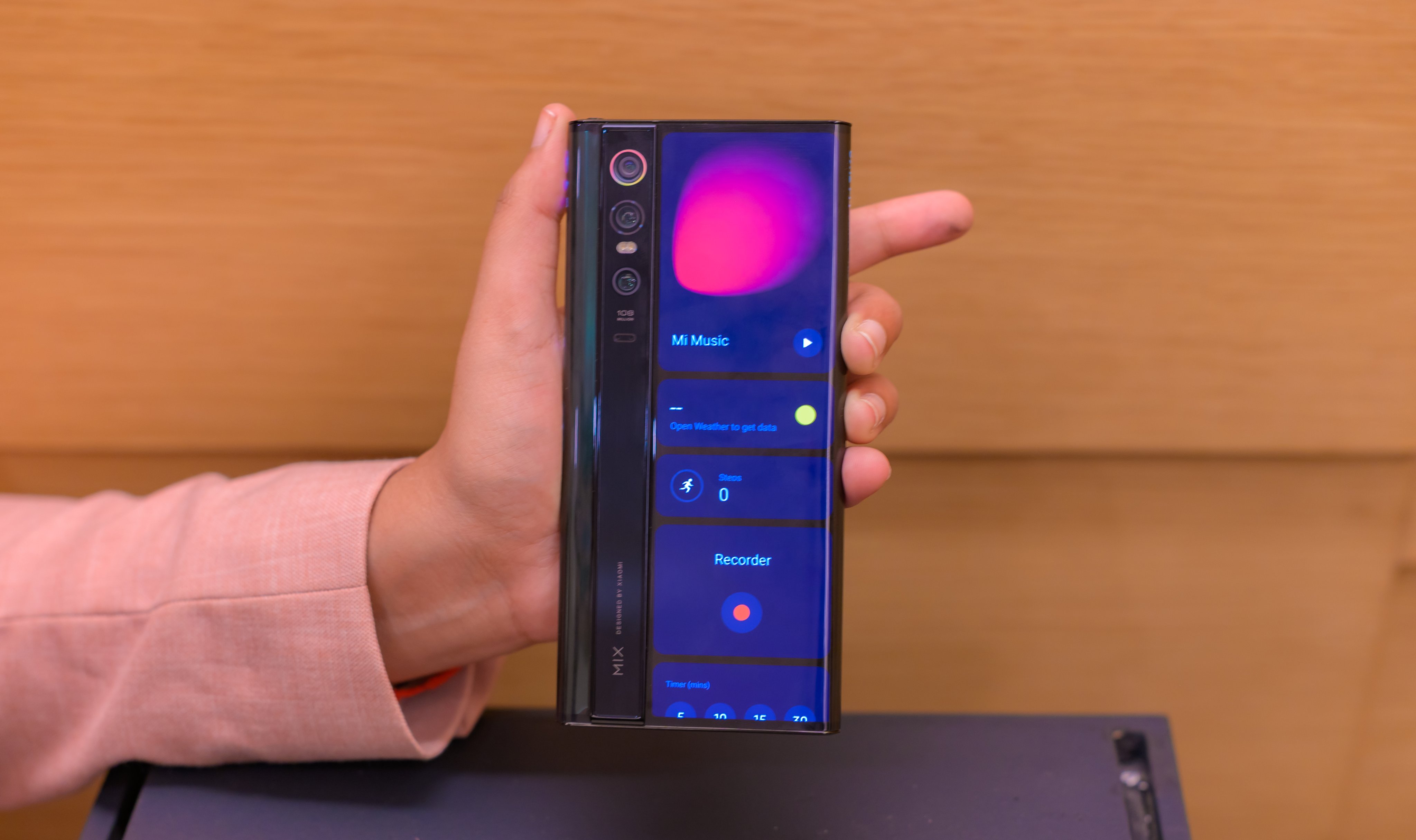
The Xiaomi Mix Alpha utilises a flexible OLED with a plastic finish to create a unique 4D surround display. It offers an impressive 180.6 percent screen-to-body ratio. This new display also features a brand new display acoustic technology to get rid of the earpiece. The technology also works as an ultrasonic proximity sensor for the smartphone. If there is any confusion, the display does curve and wrap around the sides to continue on the back.

The back houses a uniquely designed triple-camera setup aligned vertically. The device holds the record as the world’s first smartphone to feature a 100MP+ resolution camera sensor. This is made possible by using the Samsung ISOCELL Bright HMX 108MP camera sensor at the back of the device. The 108MP primary sensor on the Mi Mix Alpha is ultra-large with a 1/1.33″ sensor. The second sensor is a 12MP telephoto camera with 2x optical zoom and the third, a 20MP ultra-wide-angle camera lens with 117° FOV. This setup also supports 1.5cm macro photography. Other features of the setup include a four-axis OIS, Laser focus, and a flicker sensor. There is no selfie camera but you can flip the rear camera and use the rear display as a viewfinder for selfies.

Xiaomi is yet to disclose when the MIX Alpha will be launched in China or anywhere else.


(source)


Lava Z71 launched in India with Android 9 Pie, fingerprint sensor, priced at Rs 6,299 ($88)

Lava has launched an entry-level smartphone for the Indin market. The device dubbed Lava Z71 comes with an affordable price tag of Rs 6,299 (around $88). The phone will be available to buy from Flipkart and comes in two colour variants – Steel Blue and Ruby Red.Lava Z71

As for the specifications, the Lava Z71 comes with a 5.7-inch HD+ dot notch display with 19:9 aspect ratio. At the back, the device comes with a mirror finish design. It packs a rear-mounted fingerprint sensor and dual camera setup. The main camera is a 13-megapixel sensor assisted by a 2-megapixel depth sensor and LED flash.

For selfies, there is a 5-megapixel front-facing camera with support for soft flash. The device ships with Android 9 Pie OS. The phone’s camera app supports a professional mode as well as an AI studio mode.

The Lava Z71 is powered by a MediaTekHelio A22 chipset paired with 2GB RAM and 32GB storage which can be expanded by up to 256GB using a microSD card. The handset sports a 3,200mAh AI battery, which the company claims can last for one and a half-day on a single charge. The latest entry-level phone from Lava supports dual SIM with 4G as well as VoLTE support.


(source)


Huawei P40 and Huawei P40 Pro camera configuration revealed

This week renders of the Huawei P40 and Huawei P40 Pro were posted on the web. The images revealed not only the design of the two phones but also the color variants that will be announced. Now we have the camera configuration for the two phones.

Huawei-P40-Pro-leaked-render
Huawei P40 Pro

According to @RODENT950, the Huawei P40’s three rear cameras are a 40MP Cine (ultrawide) camera with a 1/1.5” sensor size, a 52MP main camera with a 1/1.3” sensor size, and an 8MP telephoto camera with 3x optical zoom.

The Huawei P40 Pro will also have a 40MP Cine (ultrawide) camera with a 1/1.5” sensor size and will pair it with a 52MP main camera with a 1/1.3” sensor size. Rather than a telephoto camera, Huawei is going with a periscope zoom lens like that of the Huawei P30 Pro. This will offer more optical zoom, at least 5x, and of course more digital zoom. The P40 Pro will also have a 3D ToF camera.

It is interesting to see that both the standard and Pro models will have the same Cine camera but probably have different aperture sizes. And if it is the same sensor as that of the Mate 30 Pro, it should also have auto-focus.

However, one of the drawbacks of the Cine camera of the Mate 30 Pro is its field of view which is not as wide as that of the ultrawide angle camera of some other phones. Huawei sure must have listened to feedback regarding its last flagship as a follow-up tweet by the leaker says the cine camera will be getting a wider field of view.

The camera configuration of the front cameras are still unknown. Both phones will have dual front-facing cameras housed in a pill-shaped punch hole at the top left corner of the display. If Huawei decides to tow the same line it did with the Nova 6 5G, then the front cameras should be a primary sensor and a secondary ultrawide camera for wide-angle selfies.

Huawei is expected to announce the two phones in March at an event in Paris. Both devices will come with the Kirin 990 processor with support for 5G. There will also be a P40 Lite but a leak from last year revealed it will be a re-branded Nova 6 SE.


(Sources: 1, 2)

Meizu’s 2020 New Year Gift Box actually teases the Meizu 17

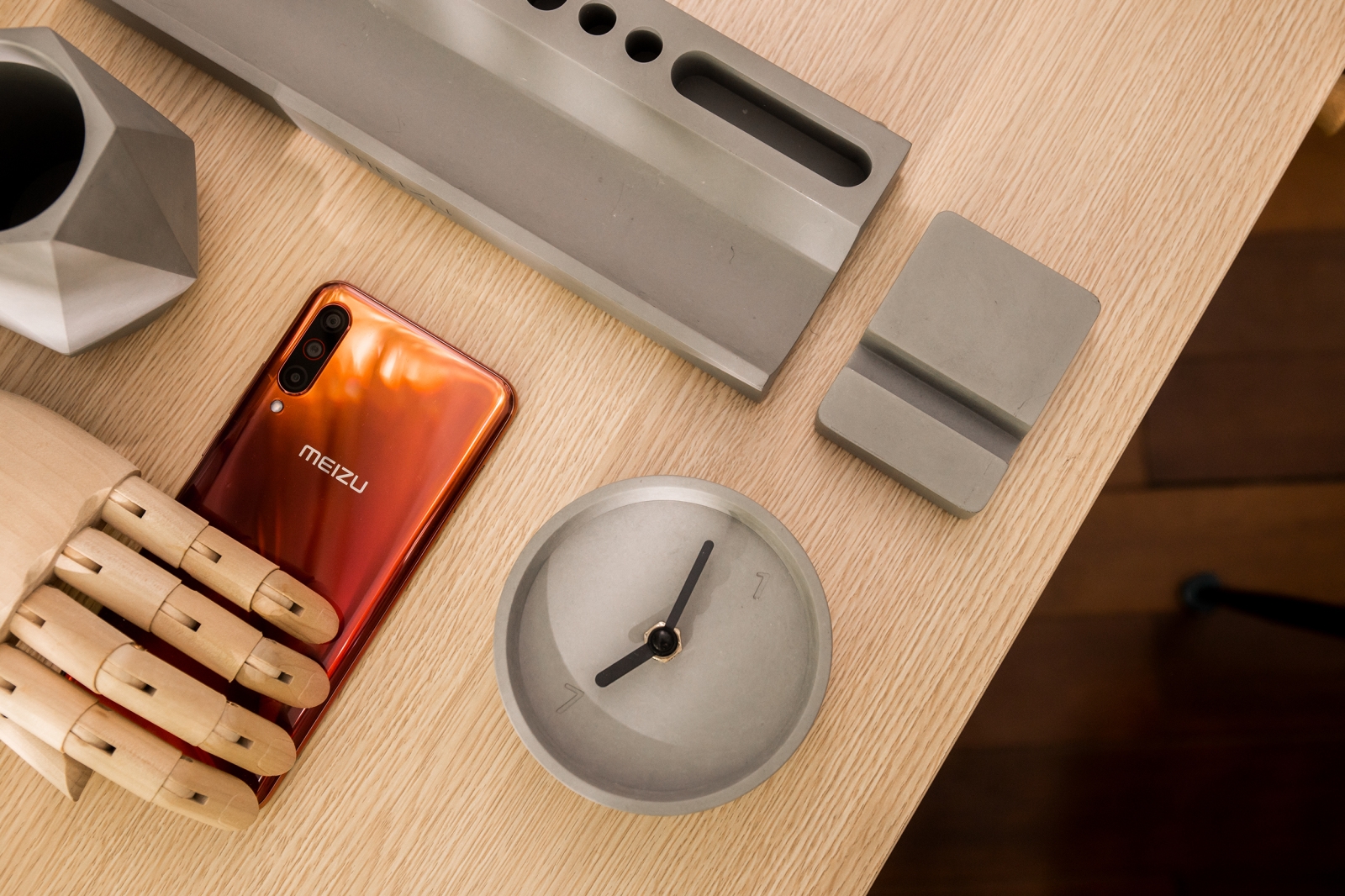
Meizu released its 2020 New Year Gift Box today and shared photos of the contents. While the contents are items that will reside on your desk, they actually tease what is to come this year.

For starters, the clock in the box actually has only two figures – “1” and “7”. This shouldn’t be a surprise since the Meizu 17 is the name of its flagship set to launch this year.

Meizu 17 teaser

Another thing to note is the choice of the material. All the contents of the box are made of concrete. Of course we won’t be getting a phone made out of concrete but there is a possibility the Meizu 17 will have a gray color variant similar to that of concrete.

The Meizu 17 should have a Snapdragon 865 processor along with the Snapdragon X55 5G modem. A render of the phone that surfaced last November showed the selfie camera will be hidden between the icons on the right of the status bar, making it less-distracting compared to other phones with a punch-hole display.

The manufacturer plans to announce five high-end 5G phones so we expect there will be a Meizu 17 Pro, and possibly, a successor to the Meizu 16T too. Our guess is as good as yours with respect to the other two devices.

Meizu says it plans to do things differently this year with its products and lineup. We look forward to their announcements and we hope it gets things right with respect to support for global users.


UK’s PM Boris Johnson throw shade at the US; asks Huawei’s critics to suggest alternatives

US government has been mounting pressure on its UK counterpart not to use Huawei‘s 5G technology. That advice seems to have done little to dissuade the UK government from giving Huawei a thought. That has prompted the recent outburst by US official branding any decision to go for Huawei’s 5G technology as madness.

As a response, British Prime Minister Boris Johnson is reported to have requested that opponents of Huawei should suggest alternatives to the Chinese technology giant. “The British public deserves to have access to the best possible technology,” Johnson said in an interview with the BBC. “Now, if people oppose one brand or another, then they have to tell us what’s the alternative, right?”
Johnson noted that on the other hand, “I don’t want, as the U.K. prime minister, to put in any infrastructure that is going to prejudice our national security or our ability to cooperate with Five Eyes intelligence partners,” which include the U.S., Canada, Australia and New Zealand.

Apart from the UK, the U.S. has been trying to persuade all its European allies to avoid using Huawei equipment in superfast next-generation telecom networks, over concerns China’s authorities can compel the company to spy on user data. Huawei has repeatedly denied the existence of such a possibility.

The British government is expected to make a final decision on Huawei’s role in “non-core” parts of the network, such as antennas. Multiple British media reports said the U.S. delegation told British officials that using Huawei would be “madness” and presented them with a technical file of new security risks.

Huawei said it’s confident the U.K. government will make its decision “based upon evidence, as opposed to unsubstantiated allegations.” Victor Zhang, vice president of Huaweiaadded; “Huawei has worked with the UK’s telecoms companies for 15 years, and looks forward to supplying the best technologies that help companies like BT and Vodafone fulfil the government’s commitment to make gigabit broadband available to all.”


Xiaomi Youpin launches the 59 yuan ($8) Pinjing Electric eyebrow trimmer

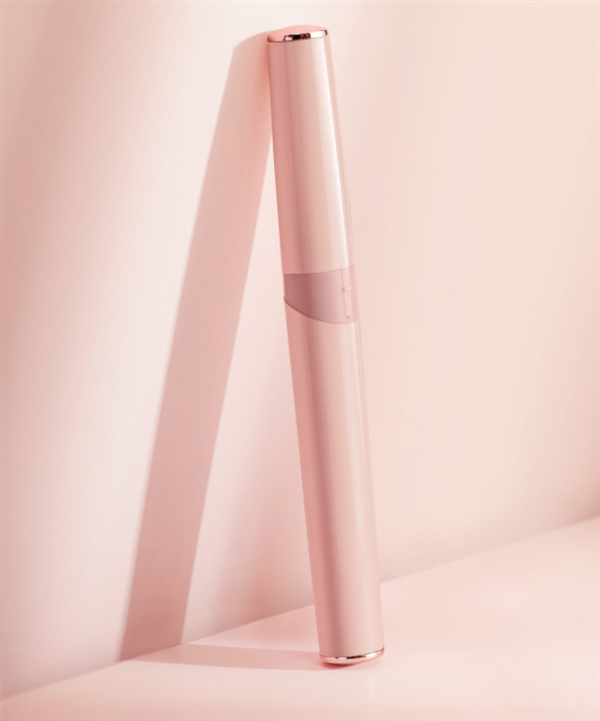
Xiaomi Youpin is home to several cool gadgets including gadgets that you don’t even know you need. The company has launched an eyebrow trimmer dubbed Pinjing electric eyebrow trimmer. The product adopts an affordable price tag of 59 yuan ($8).Pinjing Electric Eyebrow Trimmer

Pinjing Electric eyebrow trimmer is equipped with a high-quality stainless steel blade which is up to 0.1mm thin and sharp. The eyebrow trimmer uses a double-layer blade design. The fixed blade isolates the skin, and the retractable eyebrow trimmer is safer without touching the skin. In addition, the teeth are rounded and do not irritate the skin.

Thanks to the humanized 45 ° rotating blade design, when trimming the eyebrow, the blade can be flexibly rotated according to the contour of the eyebrow to closely fit the skin and shave excess hair.

The eyebrow trimmer is equipped with two heads- one long and one short head. The long head quickly cleans large areas of hair while the short head carefully repairs the brow and the end of the eyebrow. The matching eyebrow comb can control the length of each eyebrow trimming. Two lengths are available, 4mm/2mm which can be used to trim evenly long or short eyebrows.

In addition to eyebrow trimming, the trimmer can be used to trim other facial hair and body hair. In terms of battery life, if the device is used twice a week for 5 minutes each time, it can be used for 2 months.


Samsung Galaxy S20 (SM-G981U) Geekbench listing spotted

Recently, the Samsung Galaxy S20+ 5G smartphone was spotted on Geekbench with some of its key specifications. The handset has a model number of SM-G986U. Today, the Galaxy S20 5G smartphone that has a model number of SM-G981U has appeared on the same benchmarking platform.

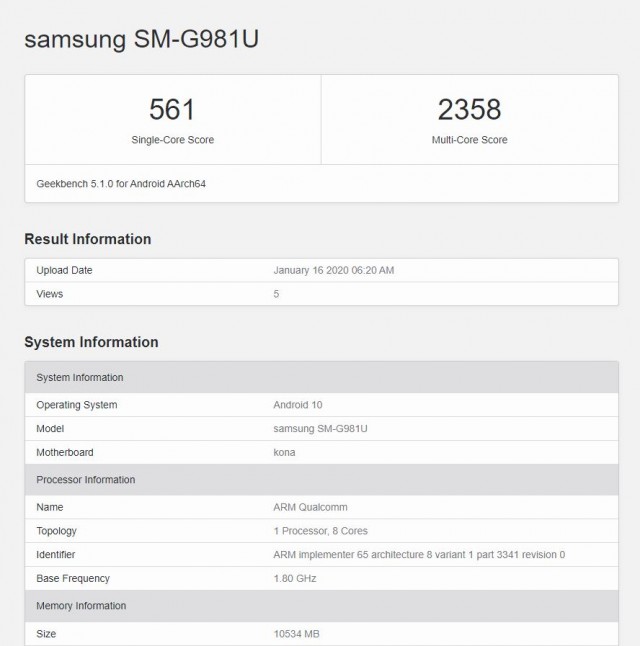
The Galaxy S20 is the smallest or entry-level smartphone in the S20 series. It was previously referred to as Galaxy S11e by the rumor mill. The Geekbench 5 listing of the Galaxy S20 5G reveals that it has scored 561 and 2358, respectively in the single-core and multi-core benchmark tests.

Samsung Galaxy S20 (SM-G981U) Geekbench

The Galaxy S20 is preinstalled with Android 10 OS and it has 12 GB of RAM. The Android OS could be overlaid with the latest One UI 2.0. The motherboard field in the Geekbench listing has ‘kona’ mentioned in it. It is nothing but the codename of the Snapdragon 865 mobile platform. Certain markets are expected to receive the Exynos 9830 (Exynos 990) edition of the Galaxy S20 series.

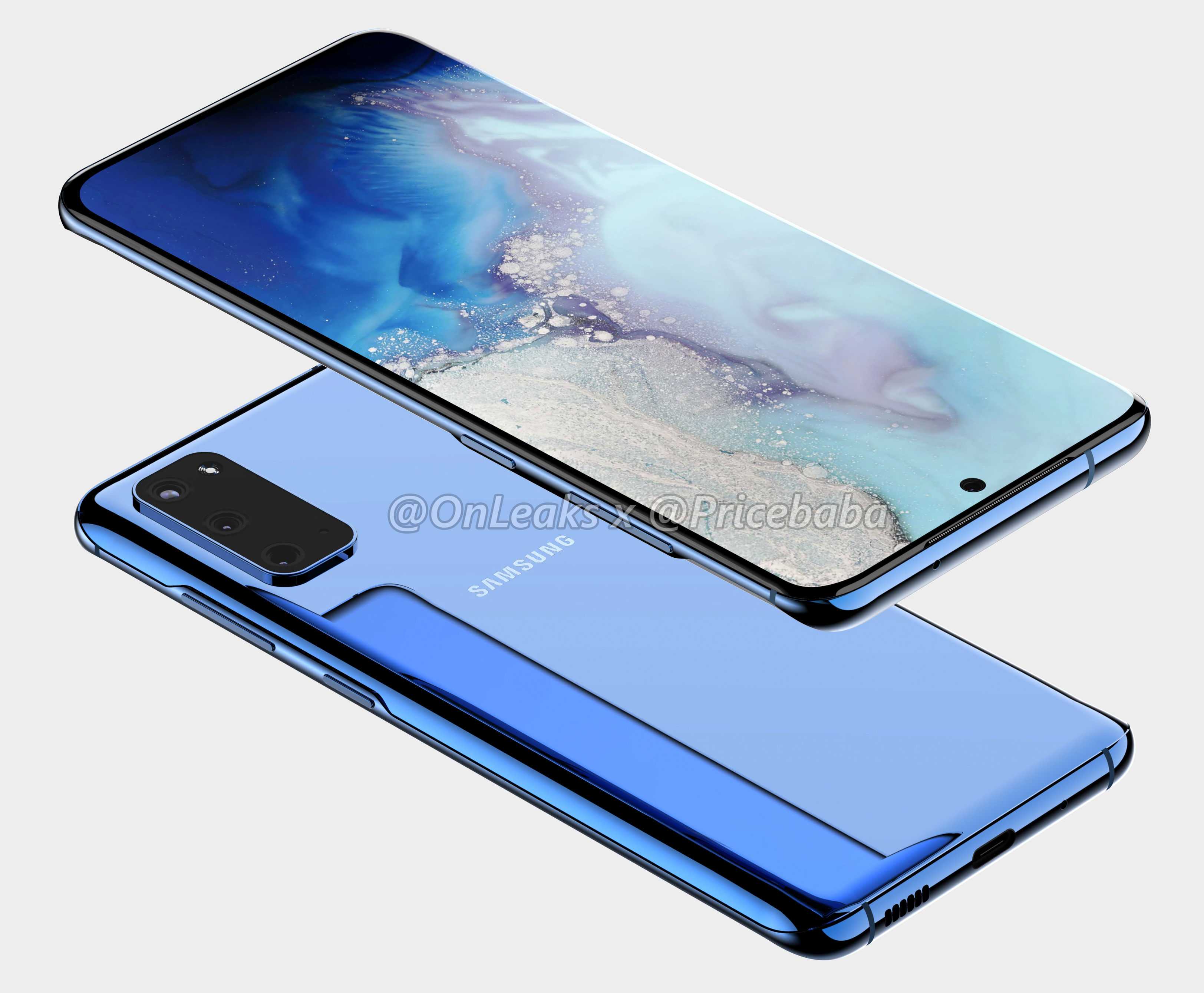
The Galaxy S20 CAD renders that were released by OnLeaks few weeks ago revealed that it is equipped with a punch-hole display and its rear shell has a rectangle-shaped camera setup. The latter is expected to house three cameras such as a 12-megapixel main lens, a 64-megapixel telephoto lens and a 12-megapixel ultrawide sensor.

Samsung Galaxy S11e

The smartphone could be housing a 6.2-inch display that may support 120Hz refresh rate. It is expected to continue to sport an ultrasonic in-screen fingerprint reader. The smartphone could be housing a 4,000mAh battery. The 3C listing of Galaxy S20 5G had revealed that it could be coming with a 25W fast charger.

So far, the rumor mill has revealed the Galaxy S20 lineup will include five devices such as Galaxy S20 5G, Galaxy S20 5G, Galaxy S20+ 5G, Galaxy S20+ and Galaxy S20 Ultra 5G. Samsung will be announcing the S-series flagship smartphones on Feb. 11. The South Korean company is also expected to unveil the Snapdragon 855 mobile platform powered Galaxy Z Flip foldable clamshell phone.

(source|via)


Huawei collaborates with Airtel and Vodafone to start 5G trials in India

Huawei, the electronics giant, is well known for its consumer products like smartphones and other home appliances. However, the company is also a renowned telecommunications equipment provider, especially for the 5G network. Now, the Chinese company is partnering with local network providers like Airtel and even Vodafone to start 5G trials in India.

According to a new report, Huawei will team up with Bharti Airtel for the first 5G trials in Bangalore, alongside testing in Delhi with Vodafone. The telecom firms have already submitted the applications, as per an anonymous source. On 31st December 2019, the Indian Government had initiated the process of rolling out 5G network in India and had met various operators and vendors for the same. As per the road map, the early trials will take place during January and March of 2020.

Huawei
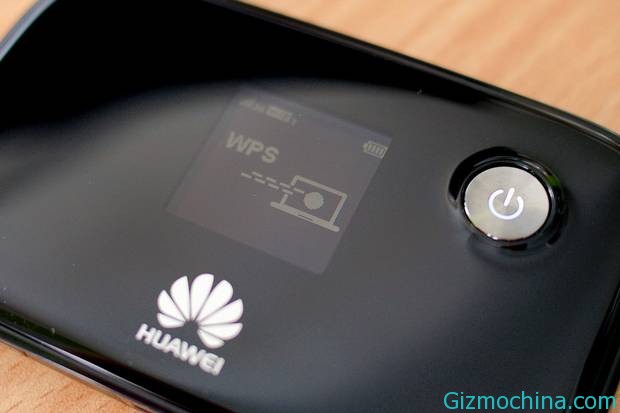
Huawei 5G Modem

Furthermore, the last date to submit an application for the trials was yesterday, 15th January 2020. These applications will be taken into consideration by the Government, which will distribute trial regions to the licensed telecom service providers. The reporting agency had also tried reaching Huawei for a statement but the company has yet to respond.

Currently, Huawei is facing scrutiny in various western regions like the US and other European countries. It has faced multiple allegations from foreign Governments regarding a possible link to China and the security of the data it handles through its telecommunications equipment and smartphones. The US is at the forefront of such accusations and believes the company has the capabilities of spying on other countries for the Chinese Government.

Huawei has frequently denied such claims but it still faces obstacles even in Australia, Japan, Canada, and New Zealand. On the other hand, nations like, Russia, Indonesia, Malaysia, South Korea, Turkey, and Saudi Arabia are accepting of Huawei. 5G is the next major step in networking advancements and is also being seen as a hallmark of a developed nation. Thus, countries like China and South Korea which are leading in this regard are seeing an increase in 5G smartphones in their home markets.

In India, the Department of Telecommunications (DoT) has already approved the prices for the spectrum auction, which is scheduled to be held by April 2020. Out of the 8,300MHz of airwaves, 6,050MHz has been allocated to 5G network with a cost of INR 492 crore (roughly $69 million) per megahertz. The Government is also pushing for telecom firms to conduct experimental spectrum trials by providing incentives and lesses fees per trial.

Huawei

As of right now, Huawei has secured more than 50 commercial contracts for 5G networking in various countries. In comparison, India is behind on the adoption curve of the newer and faster bandwidth. However, the local Government is placing an increased emphasis on network advancement alongside education, agriculture, waste management, and healthcare.


(Via)

Mi True Wireless Earphones Lite certified by Bluetooth SIG

A recent report by Strategy Analytics revealed Xiaomi has the second largest share of the TWS earbuds market. The Chinese manufacturer trails after Apple but leads Samsung, JBL, and Huawei. Xiaomi is able to achieve this thanks to its lineup of affordable TWS headsets which include the Mi Bluetooth Earphones Air (Mi True Wireless Earphones), the Mi AirDots Youth Edition (Mi True Wireless Basic), and the Mi True Wireless Bluetooth Headset Air2.

Over the past few months, the Bluetooth Special Interest Group has certified a couple of new TWS headsets from Xiaomi but they are yet to launch. There is the Mi True Wireless Earphones 2 that was certified back in July 2019 and that we think is the international version of the Mi True Wireless Bluetooth Headset Air2. There is also the Mi True Wireless Earphones 2S that was certified in December 2019. Now a new one called the Mi True Wireless Earphones Lite has been spotted on the certification site.

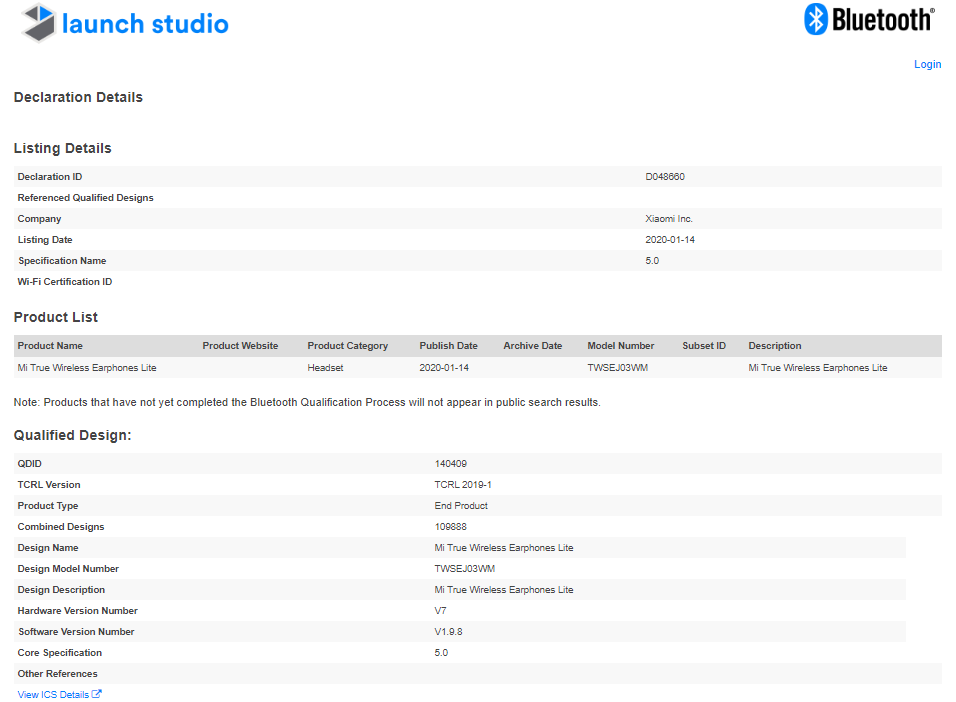
Mi True Wireless Earphones Lite

The Mi True Wireless Earphones Lite has the model number TWSEJ03WM and was certified on January 14, 2020. The certificate reveals the wireless earbuds will connect via Bluetooth 5.0.

Other than the aforementioned, there are not any more details about the upcoming TWS earbuds. At the moment, we have not heard any report of the launch of new pair of wireless earbuds from Xiaomi. However, if we were to take a wild guess, we will say the Mi True Wireless Earphones Lite may be a lite version of the Air2.

Xiaomi will want to maintain its grip of having the second largest share of the TWS markets and to do that, it needs to announce new models that bring new features while keeping the price tag affordable.

It has not announced any new phone launches outside China but when it does, we expect it to announce at least one new pair of TWS earbuds.


(Source)

Amazfit X crowdfunding page goes live on Indiegogo – launching soon

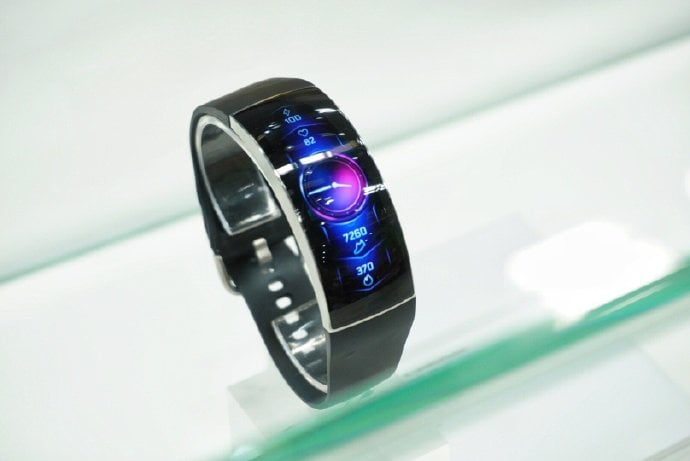
In August 2019, Huami Technology held a press conference where three products were unveiled. One of them is the Amazfit X Concept Watch with a flexible curved display. The smartwatch maker during its annual strategic media conference for 2019 held in December last year disclosed that the Amazfit X mass production would commence in 2020.Amazfit X

Turns out Huami isn’t planning to sell the concept smartwatch in China alone. The tech giant has the intention of bringing the product to the global market. To this end, a crowdfunding campaign page for the Amazfit X concept watch has gone live on Indiegogo. The page lists the features of the smartwatch but the campaign is yet to open to backers. However, you can register your email to get alerted when the campaign commences.

As a reminder, the Amazfit X adopts an all-metal integrated design with hidden electronic buttons that replace the traditional buttons. The watch features a proprietary 2.07-inch flexible curved screen with a super-arc curvature of 92°. The curvature is said to have been achieved by heating the metal body through an ultra-high temperature of 700°C with a 6-bend bending process.

The Amazfit X is shaped like a new moon and has a larger display area of up to 244% compared to the display area of wearable devices with similar size. The screen also has 326ppi, 100% NTSC high color saturation and up to 430nits screen brightness. The watch uses a 220mAh curved lithium battery which is said to have support for up to 7 days battery life. Since the motherboard can’t be curved, the Amazfit X uses a 3-segment motherboard in order to adapt to the curvature.


(source)


Apple products may get Smarter as the company buys an Edge Computing Startup for $200 million

Apple, the known smartphone maker, has bought an Edge computing based startup for a massive sum of 200 million US Dollars. A new report had surfaced after a close source to the smartphone OEM shared the information to a reporting agency called GeekWire.

Xnor.ai is an Edge computing based startup that had branched out from the nonprofit Allen Institure for AI back in 2017. Apple has confirmed the transaction of the large sum to acquire the firm. The Cupertino based giant also mentioned that it acquires smaller businesses every now and then but generally doesn’t incline in sharing the purpose or plans of the buyout.

Apple
Xnor.ai’s computer vision tool has the ability to recognize objects using software algorithms that are found in an Apple iPhone itself, without a cloud computing service. (Xnor.ai Illustration)

Initially, Xnor.ai focused on machine learning with efficient algorithms being developed that could run on various low tier hardware, or IoT devices (Internet of Things). This includes electronics like a security camera which consumer low amount of power to function and had a one-track streamlined function. However, with Xnor.ai’s algorithms, these gadgets could accomplish complex tasks like object recognition; which is a task that generally requires powerful processing from cloud based computer via an internet connection.

According to the source, the amount of 200 million US Dollars for the acquisition is just an estimate so the numbers are not concrete. Although, the numbers and investment are still ranging in tens of million which surpass any of its previous investments raised by a large margin. Xnor.ai is also expected to move to the Seattle offices of Apple which, as stated by the report.

Apple Logo

The acquisition for an Edge computing based firm by Apple is forward thinking move from the company. Other industry giants like Google, Microsoft, and even Amazon are heavily investing in this field. With Xnor.ai, Apple plans on making its products work more independently from its cloud computing services to possibly include functions like facial recognition, natural language processing and augmented reality as well.

The implications of the field also extend towards security and privacy, since edge computing places an emphasis on local processing. Thus, Apple can make its devices more secure and even improve its imaging algorithms with machine learning. Notably, iPhones are a loose example of edge computing with local storage of biometric data (facial recognition or fingerprint scanners) and its processing.


(Source,Via)

Mysterious Huawei phones appear on TENAA with key specs

A mysterious Huawei phone with two variants MED-AL00/TL00 and MOA-AL00/TL00 with identical specs have appeared on TENAA. The images of the phone haven’t surfaced yet o the database of China’s telecom regulatory body. Also, the TENAA listings of the aforementioned phones currently carry only minimum details.

The MED-AL00/TL00 and MOA-AL00/TL00 phones are equipped with 6.3-inch displays. Since the images of the phone are not available yet, there is no confirmation on whether they are equipped with waterdrop notch or punch-hole displays. These handsets have identical measurements of 159.07 x 74.06 x 9.04mm. The MEA-AL00/TL00 and MOA-AL00/TL00 are quite thick because they are packed with big batteries of 4,900mAh capacity. The typical capacity of the battery could be 5,000mAh.

Both phones were certified by the 3C authority of China in December last year. Their 3C listings revealed that these devices will possibly carry support for 10W fast charging. Hopefully, the mystery behind MED-AL00/TL00 and MOA-AL00/TL00 phones will end with the appearance of its full specs and images on TENAA.

As it can be seen in the preliminary listings of MED-AL00/TL00 and MOA-AL00/TL00 phones, these phones have identical dimensions, display size and batteries. Hence, there is a possibility that these phones may differ in departments like camera, RAM and storage. The MED-AL00/TL00 and MOA-AL00/TL00 smartphones are expected to break cover as the first Huawei phones o the year 2020.

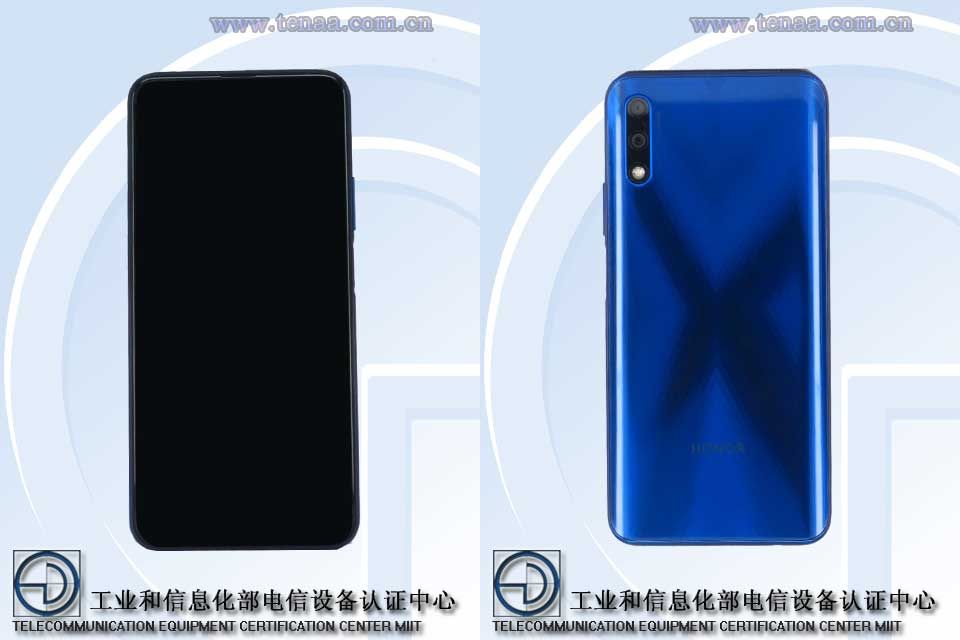
Honor HLK-AL00a TENAA

In related news, an Honor phone with model number HLK-AL00a was spotted at TENAA with full specifications and images. It seems to be a variant of the Honor 9X smartphone from last year that carried a model number of HLK-AL00. The Honor 9X and the newly spotted Honor HLK-AL00a smartphones have identical specs. The only difference between the two devices is that a 2.27GHz octa-core processor is present under the hood of the Honor 9X whereas the HLK-AL00a is equipped with a 2.0GHz octa-core processor. It is advisable to wait for further reports to know the exact identity of the HLK-AL00a smartphone.


How to use Substratum custom themes on Samsung One UI 2.0

Samsung’s custom skin OneUI features various new improvements and enhancements over its predecessor – TouchWiz. The new custom skin is light, more productive and offers better customisation features. However, despite the compatibility of custom themes, Samsung has blocked the custom overlays for OneUI. As like last time, the Projekt team has found a workaround to run custom skins on OneUI 2.0 using Synergy.

synergy

The team Projekt announced took to Twitter to announce the compatibility of Synergy v0.6.3 with One UI 2 devices. It is more refined and stable rather than the Custom Theme Installer for OneUI. The Custom Theme Installer is quite a useful app but gives a miss on core features that make a theme more stable. On the other hand, Synergy lets user import themes directly from Substratum Lite repository. Both the apps – Synergy and Custom Theme Installer offer OneUI customisation but follows a different way to make it work.

Synergy v0.6.3 syncs perfectly with most of the themes, but few of them are having some issues. To install the custom Substratum themes on OneUI 2.0 devices, follow the process below carefully.

Steps to install Substratum on OneUI 2.0

  • Download Synergy and Substratum Lite from the Play Store.
  • Download the desired theme that is compatible.
  • Now, open Synergy app and then click on “Add Overlays”.
  • Select Substratum Lite
  • Now, select the theme of your choice from the list.
  • Before clicking install in the bottom right corner, select each app about the theme.
  • Tap build at the bottom of Synergy.
    (Note: Synergy will ask you to install a theme from Samsung Theme Store to replace OneUI theme files.)
  • Now, go to Synergy and uninstall and install apps as required.
  • Reboot the smartphone, and then goto Settings > Wallpapers and Themes > Themes and click the Synergy icon and apply themes.
  • Once again reboot the device.
  • Open Synergy app and tap three lines in the bottom left corner and select Night Mode settings.
  • Install the required app.
  • Enable night mode.

It is th only way to enjoy Substratum themes on your One UI 2.0 based devices. If you get any issue while installing the theme, then make comment below.

(source)

TSMC 10nm chip shipments contributed to just 1% of wafer revenue, 7nm at 35% in Q4 2019

TSMC (Taiwan Semiconductor Manufacturing Company) has shared its financial report for the fourth quarter of 2019. The quarter saw the company having a growth in both revenue and profits alongside an increase in shipments of 7nm chips.

The company is a major player in the semiconductor market and is a key supplier of chipsets across smartphones and even desktop grade processors. According to the financial report, TSMC generated a revenue of 10.5 billion US Dollars out of which profits amounted to 3.8 billion US Dollars in Q4 2019. This marks a 10.6 percent of growth over Q3 2019. The figures have also slightly surpassed expectations from analysts that had predicted income of 3.7 billion US Dollars.

TSMC

Notably, one of the main contributing areas where the company generated its revenue from was the 7nm chipset category. The size is currently used in various high end smartphone processors while even being the next step in advancement in computer CPUs as well. 7nm chips contributed 35 percent of total wafer revenue, in comparison, the 10nm only garnered 1 percent of the same in Q4 2019.

As mentioned earlier, the 7nm chips are booming after AMD, a known chipmaker in the desktop PC market, ordered 20 percent of TSMC’s 7nm processing capacity. Recently, AMD‘s third generation of Ryzen processors and Radeon graphic cards have shifted towards 7nm processing, unlike Intel that is still struggling to reach 10nm after its 14nm processors. Hence, TSMC is currently seeing gross margins that have surpassed the other three quarters of 2019.

TSMC
AMD’s Radeon Graphic Cards series

Furthermore, TSMC saw a yearly revenue of 35.7 billion US Dollars and expects to see a notable growth of 15-20 percent in revenue; thanks to the new 5nm processing nodes being planned for mass production. The smartphone market has seen stagnation recently but is still expected to see a global shipment of around 1.4 billion units in 2020, an increase of 1.5 percent over 2019 due to an increase in demand for 5G networking.


(Via)


ZTE raises 11.8 billion yuan via private offering to fund 5G R&D

ZTE has not been able to fully recover since after their US ban was lifted. Despite all problems and obstacles however, the company has managed to push forward, even making a break for the 5G smartphone race with the Axon 5G last year. Now, the company is once again looking up to 5G R&D to mount a serious push for a slice of the market, but they’re going to need funding to achieve that.

ZTE said it was looking to raise 11.51 billion yuan ($1.7 billion) from a private placement of A shares, and that it plans to use the proceeds for research and development of 5G networks and working capital. ZTE claims it will issue about 381 million A shares, which are denominated in RMB and traded on the Shanghai and Shenzhen stock exchanges to ten independent institutional investors in China at CNY30.21 a share.

In a statement, ZTE said the fundraising will enable it to maintain its “high level of investment in research and development, ensure its technological competitive edge and develop its main products and businesses with core advantages”. The investors buying the shares will be subject to a 12-month lock-up period. ZTE already has approval from shareholders to proceed with the offering.

“It is because of the lock up period which give investors confidence of a stable stock price during the period, and that support the shares from advancing despite the discount,” said Steven Leung, a sales director at UOB Kay Hian in Hong Kong. “Its a vote of confidence to the prospect of 5G and related companies,” Leung added.

ZTE’s Shenzhen-listed shares rose as much as 4% to 38.10 yuan in early trade. Hong Kong-listed stock briefly rose 3.7% to HK$28.05, the highest since March 2018.

(Source)

TikTok dethrones Facebook, becomes most downloaded app after WhatsApp

2019 was a boon for Chinese short-video content platform TikTok and its Chinese equivalent Douyin. Despite being banned by the US Navy and Army on grounds of causing security breach, the social media platform was downloaded over 700 million times around the globe, overtaking giants like Facebook and Messenger to take on the #2 spot, right behind WhatsApp. As other platforms take note of TikTok’s business strategy and launch rival products, 2020 will be a test for parent firm Bytedance.

The global leader WhatsApp is at 850 million downloads, followed by TikTok. Both platforms rely heavily on the young Indian audience for sustenance. According to a survey conducted by Sensor Tower, 45% of the first-time downloads were from India. While WhatsApp’s growth for Q4 2019 was up by 39%, primarily due to the Indian audience.

Likee, a product of Singapore-based Bigo, is a smaller rival with close to 330 million downloads, half of which are from India. The survey conducted by Sensor Tower takes data from the Google Play Store, and App Store. However, the figures are likely to be higher since Google Play is blocked in China.

TikTok has revolutionized the Short video format for sure. Some of the bigger names like Facebook and Instagram are taking note and plan on acting on them shortly” revealed Meenakshi Tiwari, an analyst at technology market research firm Forrester. The assessment comes shortly at the heels of Reels, Instagram’s short video platform designed to counter TikTok, which launched in Brazil two months back.

WhatsApp poses an imminent threat to TokTok as the former has not yet monetized its user base. TikTok is under serious cash crunch at the moment, since most of its revenue is generated in China despite its rapid global expansion. Beijing-based Chenjin Culture operates individual accounts for TikTok and Douyin. While the Douyin account earns between 50,000 yuan (~7,268$) and 100,000 yuan (~$14,536) with 5 million users, TikTok has failed to generate profits despite its 1.6 million-strong userbases.

TikTok is now looking at an advert strategy by luring advertisers with a news feed with content curated from its users and professional creators. Hence, mimicking rival Snap’s strategy. TikTok’s efforts may be in vain as most advertisers are afraid their content will run alongside distressing or even illegal content.

In response to news of TIkTok’s monetization plan, a US spokesperson for the company said it was exciting to see the diverse range of creativity coming from the community and TikTok’s steady popularity with the creators. Besides competition, TikTok is also facing flak from US lawmakers over the potential security breaches. In response, TikTok has made numerous changes to its policy to refrain from posting political content, which is termed misleading in its Terms of Service (ToS).