Stadia, Google’s game streaming service, which launched last year, will now work on several more smartphones starting tomorrow, February 20. The newly supported devices include Samsung’s new Galaxy S20 series, the ROG Phone, and the Razer Phone.
Starting February 20, you can play Stadia with even more phones. ASUS ROG Phone I & II, Razer Phone 1 & 2, and a variety of Samsung phones, including the Samsung S20 line, are all supported.
When Stadia launched last year, support was limited to just the Pixel phones save for the first-gen Pixel. Now, Google is adding more than ten new smartphones with most of them being Samsung devices. Below is the list of the new Stadia-compatible smartphones:
Other than smartphones, Stadia also works on laptops, desktops, and TVs connected to Chromecast Ultra. Google says Stadia will work on tablets but up until now, no tablet is supported. Not even the Galaxy Tab S6.
Last month, the Stadia Team announced that more features will be coming to Stadia this quarter but there was no mention of tablet support. Nevertheless, we hope that happens soon.
Gizmochina is expanding its presence in India and we are looking for a couple of full-time news writers based in Navi Mumbai, India. We already have a team that’s spread across the globe and would like the two new writers to supplement our news coverage team.
Important points to note:
You should be based in Mumbai, India and will be required to travel to our office from Monday – Friday.
You should be familiar with the Chinese and Indian smartphone scene. We prefer candidates who have prior knowledge about Chinese tech companies like Xiaomi, Meizu, Huawei, OPPO, Vivo, and so on.
This will be a full-time paid writing position and we expect you to deliver quick and high-quality news stories every day.
If you think you are a fit for this position, please APPLY via this GOOGLE FORM.
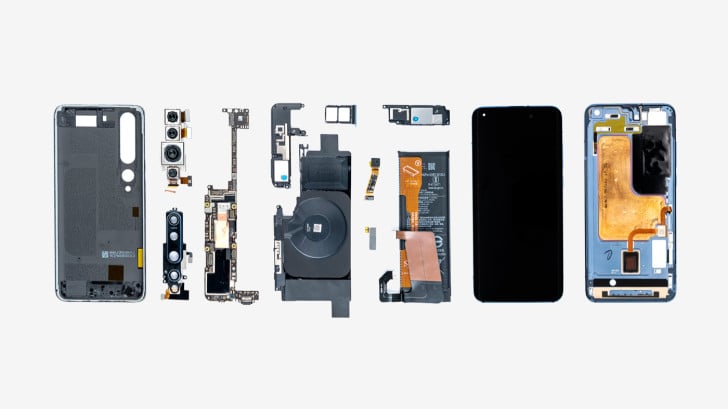
Xiaomi, the Chinese smartphone manufacturer, has just released the official teardown video of its latest flagship, the Mi 10 Pro. The video offers a look inside the internal structure of the smartphone and also provides a brief explanation with texts and images.
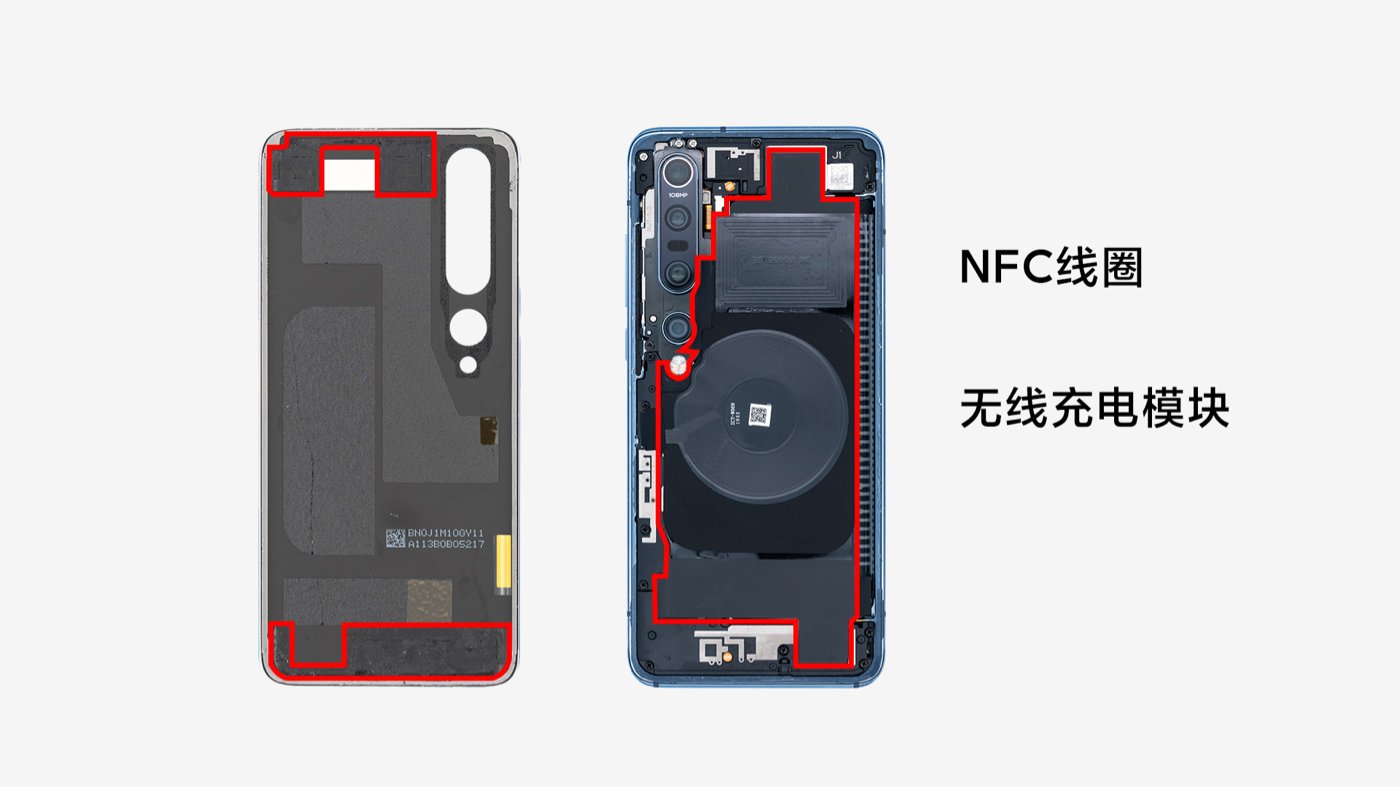
Starting from the rear, Xiaomi reveals the internals of the device by removing the back panel of the device. After removing the glue that binds the rear cover to the body, two large foam rubbers can be observed at the top and bottom of the device. These primarily serve the purpose of protection from fall damage and accidents. Furthermore, a large portion of the internals is also covered with thermally conductive graphite which is found in the region that has the motherboard. Other components like NFC coils and wireless charging technology can also be seen.
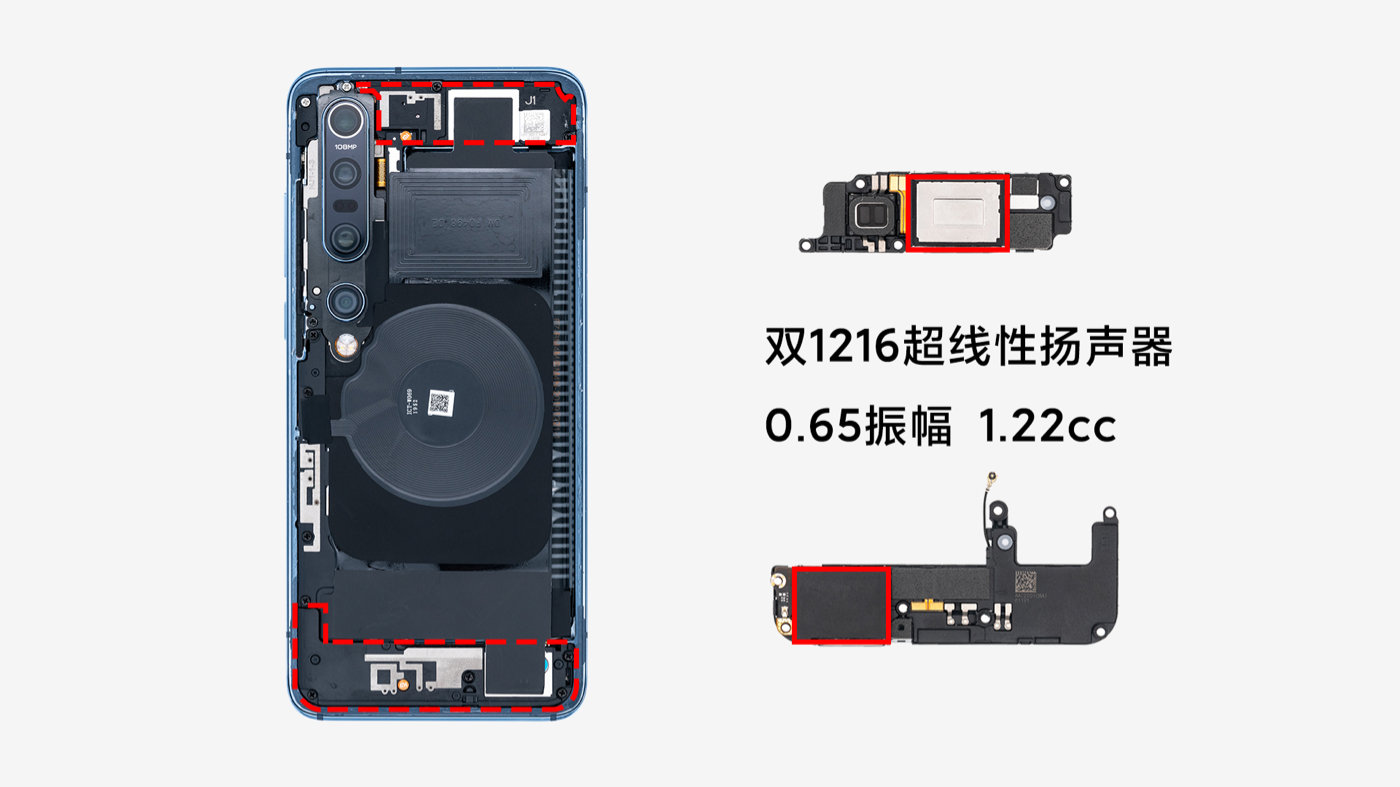
The speakers of the Xiaomi Mi 10 Pro are housed symmetrically on the top and bottom of the device. It features a magnetic steel design and arrives with a 1.22cc large cavity, which enables a better stereo audio experience. Notably, the Mi 10 Pro’s speakers are said to have improved on the volume levels over its previous generations by 100 percent.
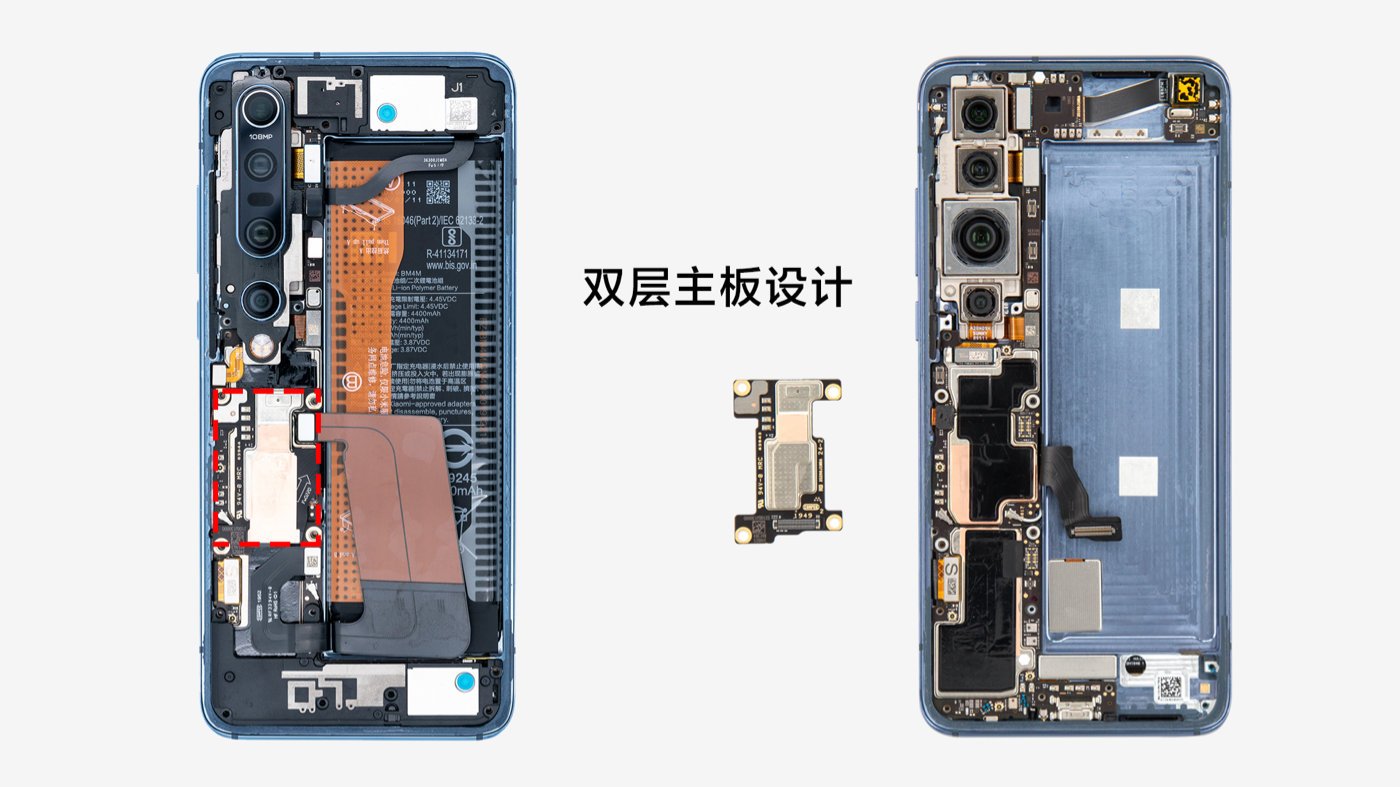
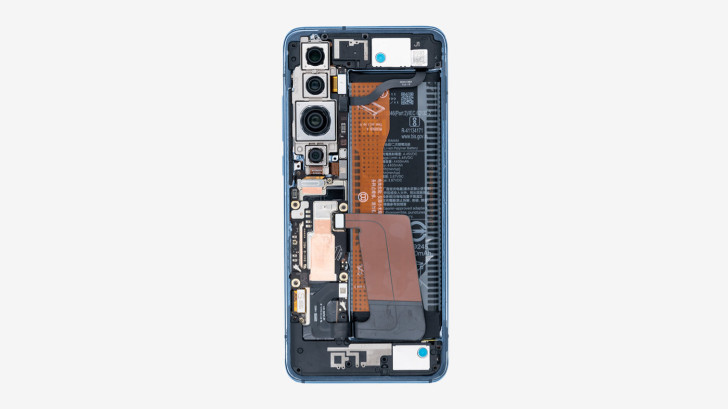
After removing the motherboard cover, the actual board and the Mi 10 Pro’s battery pack is made visible. The main board area uses a double layer motherboard design, meaning a smaller board being stacked upon the primary board to save space, and is found on the left side. On the right, the large 4,500mAh battery pack can be found and is housed on a middle frame, which also takes up most of the internal space. Under the battery pack, an ultra thin optical fingerprint scanner is situated, which is used for the in display fingerprint reading whilst saving previous internal space.
Once the rear camera cover is removed, one can also see the entire quad camera module of the Xiaomi Mi 10 Pro. As seen in the images, its 108 megapixel camera is the largest sensor and is conveniently placed in the middle. Other components, like LED flash and a laser focusing module, are also present that allows for better visibility and focusing speed in low light environments. On the other hand, the Mi 10 Pro sports a 20 megapixel selfie shooter on the front.
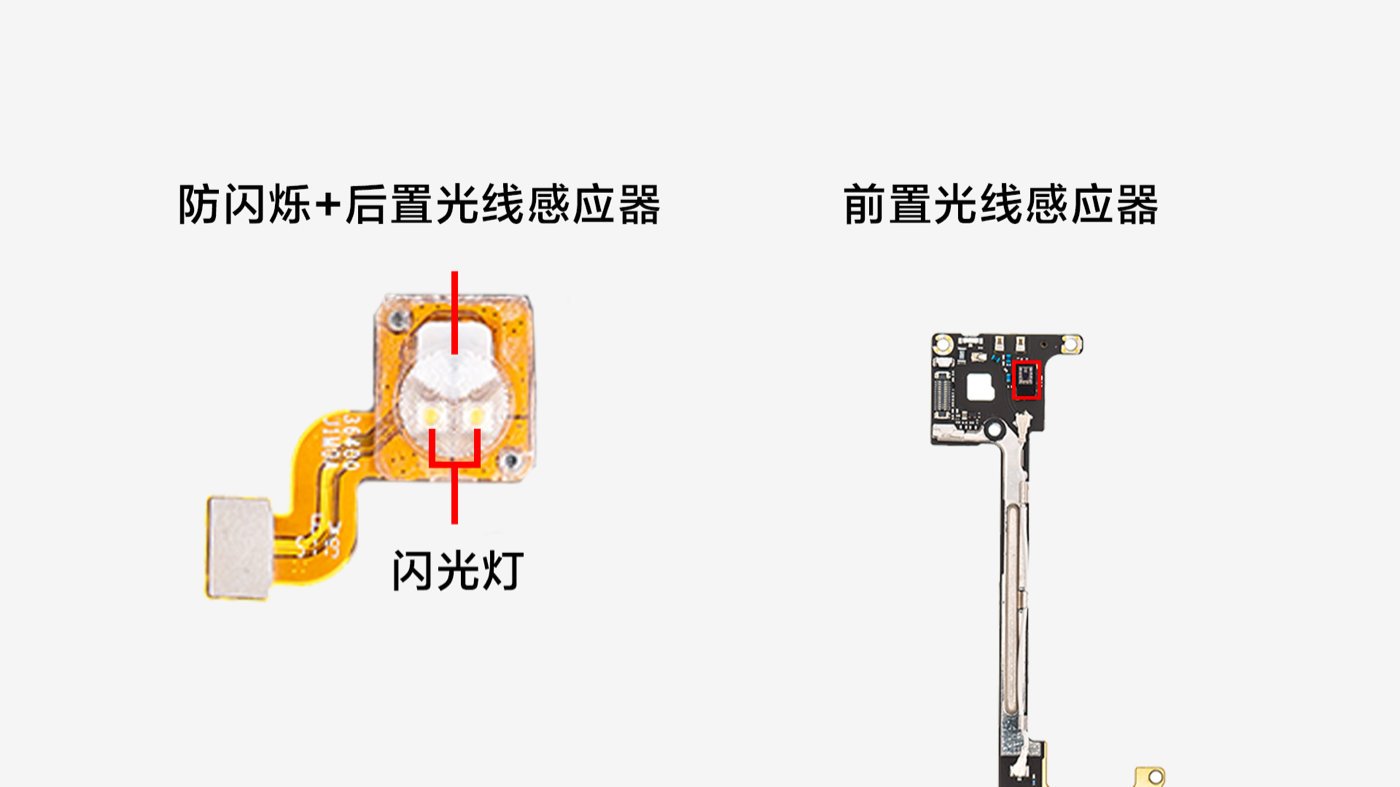
With the Mi 10 Pro, Xiaomi has adopted a unique 360 degree front and rear dual light sensor technology. In other words, the handset is better equipped in detecting light sources and the ambient lighting in its surroundings. This enables a better camera performance whilst also making the automatic screen brightness adjustment more intelligent and proactive.
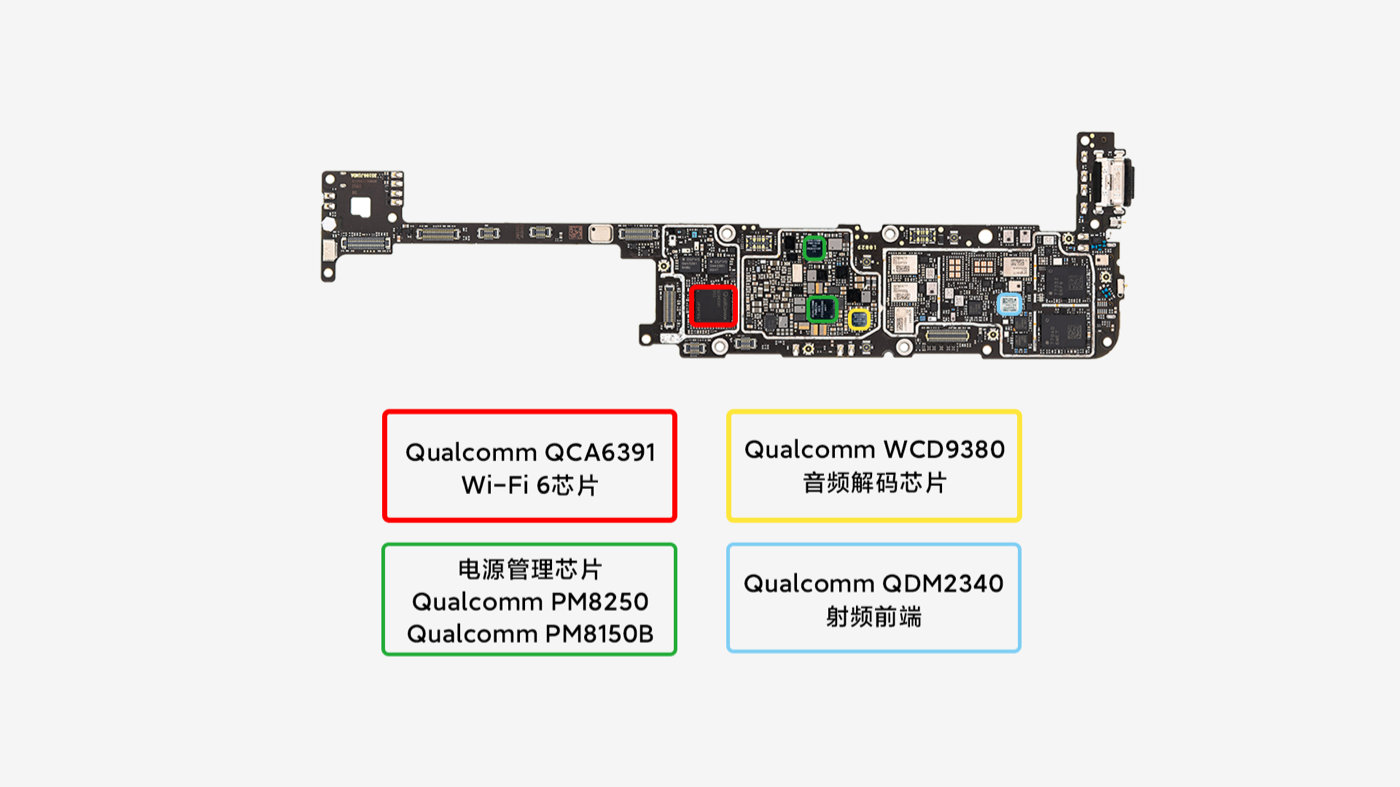
The motherboard of the flagship smartphone uses an “L” shaped design with copper foils and the graphite shield. Its upper regions contain the newly developed Wi-Fi 6 chip while the middle holds the power management module and audio decoding technology. The bottom of the motherboard houses a radio frequency chip. Additionally, this portion also features a few of the highlighting components of the Mi 10 Pro. Qualcomm’s Snapdragon 865 SoC alongside the X55 5G modem is housed here. The pair of LPDDR5 flash memory and UFS 3.0 storage also enables class leading read and write speeds as well as fast data transfer capabilities.
With the Mi 10 Pro, Xiaomi has completely revamped its internal layout that manages to include an X axis linear vibration motor in the compact space while still catering for heat dissipation. To protect from heat related damages, the handset has built in VC soaking plate, 6 layers of graphite structure, large amounts of copper foil and thermally conductive gel as well. This VC protection layer extends across the power management chip and the 5G modem, covering an area of 3,000 square millimeters.
For added protection, it had a built in matrix temperature sensor and other temperate sensors spread across the device as well. This allows the Mi 10 Pro to accurately map heat in different regions in real time, including the 5G modem, the processor, battery pack, charging interface and more. Through this, the AI temperature control module automatically finds a suitable temperature by controlling device’s power output and performance simultaneously. In other words, a technological marvel which one may never really notice.
Avid gamers usually spend a lot of money on gaming laptops for experiencing an immersive game playing experience. Inexpensive alternatives, on the other hand, usually fail to deliver the desired performance.
In short, you must shell out tens of thousands of dollars on high-end gaming laptop if you want to play popular games without experiencing lag and freezing. This also means that cost-conscious players have to settle for a substandard laptop.
If you have been waiting with bated breath to get your tech greedy hands on a high-end gaming laptop that doesn’t cost a bomb, we got good news for you. AliExpress is currently doling out a noteworthy 17 percent off on the Hasee K670D-G4E6 Laptop for gaming, which usually retails for $660.
Integrated with 8GB of DDR4 RAM and 256GB of SSD storage capacity, the Hasee K670D-G4E6 can now be yours for a lowered price of just $547.80. Aside from getting the discount, you can take advantage of the $2 Off New User Coupon and save more money at checkout if this is your first order with AliExpress.
The black-tinted Hasee K670D-G4E6 is capable of delivering awesome desktop-grade power with Intel’s Coffee Lake processor G5400 that offers to speed up to 3.7GHz. It packs the powerful GeForce GTX 1050, which transforms your PC into a true gaming machine, drawing power from the most powerful gaming GPU architecture, the NVIDIA Pascal.
Furthermore, the Hasee K670D-G4E6 sports a 15.6-inch Full-HD display with wide-view angles. It has a matte finish for restricting glare and reflections that distract gamers while playing their favorite games. It is designed to offer faster speeds, coupled with incredible energy efficiency.
You can visit this link to check out more details about the Hasee K670D-G4E6 Laptop and place your order. It is worth noting that the promo will come to an end soon.
The Gizmochina Coupons is a community that finds, reports and evaluates deals and coupons of Chinese products from online shops. Please visit it here
to find more coupons to save money on mobiles and smart gadgets.
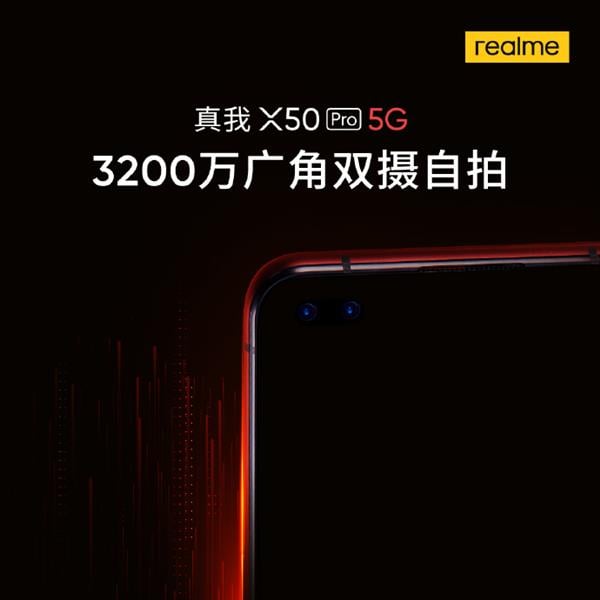
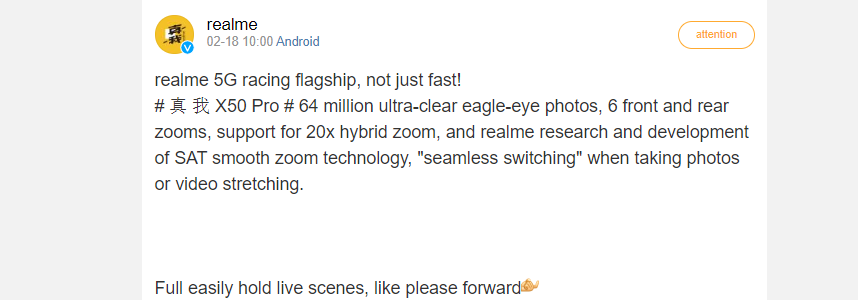
Earlier today (19th February 2020), Realme officially revealed a few specifications regarding its upcoming Realme X50 Pro smartphone. The company went on its official Weibo account to share certain details regarding the device’s new front facing camera module.
According to the post shared, the Realme X50 Pro will arrive with a dual selfie camera setup. The primary lens is a 32 megapixel sensor while the secondary is an ultra wide angle lens. Furthermore, the smartphone manufacturer also shared other details regarding the smartphone in the Weibo post, a Chinese microblogging website. The ultra wide angle lens had a 105 degree field of view and also supports UIS Max Super Video Stabilization.
As the name suggests, this will likely be a video stabilization tool that will help in capturing steady videos even while moving; and as an added bonus, the front camera’s wide angle lens will also help capture a wider frame overall. This makes the selfie shooter on the Realme X50 Pro a really attractive offering. Similarly, the rear sensors of the device have already been revealed as well, with a 64 megapixel quad camera setup, including a 20x hybrid zoom feature.
The Realme X50 Pro will be the company’s latest flagship when launched and thus will arrive with top notch specs. It will be powered by the Qualcomm Snapdragon 865 SoC alongside 12GB of LPDDR5 RAM and UFS 3.0 flash memory for storage. The handset will also support fast charging up to 65W (dubbed SuperDart) and will sport a Super AMOLED display panel with a refresh rate of 90Hz. The Realme X50 Pro is set to launch on 24th February 2020, so stay tuned for the launch event.
In November 2019, OPPO released its newly updated custom user interface for its mobile Android operating system — ColorOS 7. With that, the company had also revealed one of the largest adaptation plan for the new interface.
So far, the company has gradually released ColorOS 7 update for several of its smartphones in China, including Reno Ace, Reno 10x Zoom Edition, Find X, Reno2, among others while the global variant of Reno 10x Zoom, Reno2, and F11 and F11 Pro have also received the new update.
Today, the Chinese smartphone maker issued a new statement that the ColorOS 7 adaptation process has been impacted due to special circumstances and the company is doing everything to maintain the commitment.
Because of the coronavirus outbreak in China, it is difficult to maintain smooth operations in the company as several worker are not coming and some have reported late, affecting the planned operations.
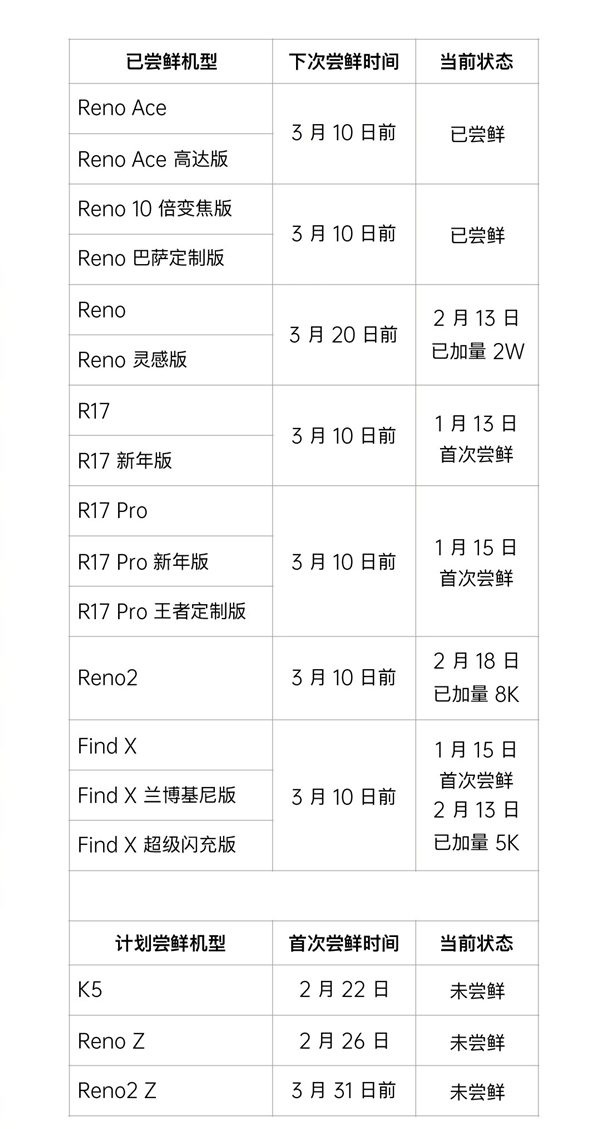
The company says that it has been stepping up deployment of resources to improve the efficiency along with ensuring the health and safety of engineers. The company has thus updated the early adopters plan for the ColorOS 7 in the Chinese market.
With this, the OPPO Reno Ace, Reno Ace Gundam Edition, Reno 10x Zoom Edition, and Reno Barcelona Custom Edition, will be getting the update on 10th March 2020 instead of earlier plan of releasing update in January.
On the other hand, OPPO Reno and Reno Inspiration Edition are now set to get the ColorOS 7 update on 20th March while OPPO R17 and R17 New Year Edition will get the same on 10th March, postponed from January 2020.
Other smartphone models which are set to get the new ColorOS update on 10th March include OPPO R17 Pro, R17 Pro New Year Edition, R17 Pro King Custom Edition, Reno2, Find X, Find X Lamborghini Edition, and Find X Super Flash Charge Edition. OPPO K5 will get the update on 22nd February while Reno Z and Reno2 Z will get the same on 26th February and 31st March respectively.
ColorOS 7 is based on Oppo’s Infinite Design concept that has its core philosophy in lightweight visuals for a clean and user-friendly interface. It brings additional privacy-related features such as the Personal Information Protection option that allows users to protect their personal data from third-party apps and software. To know more about the new interface, including all the new features, click here.
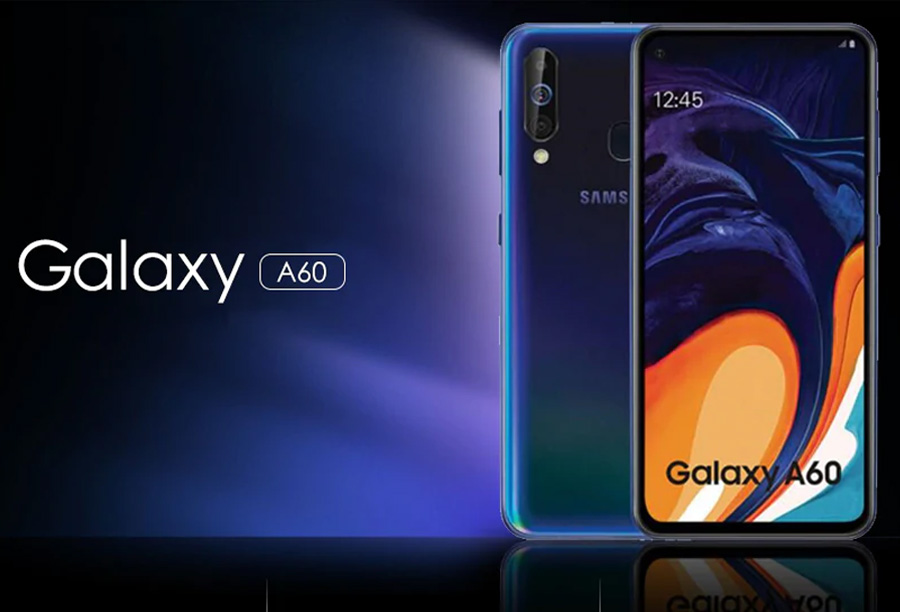
Samsung relied on the Galaxy A series to reclaim its losing grip in the Chinese market. Launched in April last year, the lineup comprised the Galaxy A60 and the Galaxy A40s smartphones.
Even months after hitting the store shelves, the Galaxy A60 continues to garner noteworthy popularity among the South Korean phone maker’s huge fanbase. Taking its undying demand and skyrocketing popularity into consideration, Samsung is now offering the A60 for a lowered price through Gearbest.
The light blue tinted Galaxy A60 model that ships with 6GB RAM and offers 128GB of internal storage capacity would normally set you back $387.35, but thanks to Gearbest’s latest flash sale, this variant can now be yours for a lowered price of just $299.99. This is a 23 percent reduction in the phone’s original asking price.
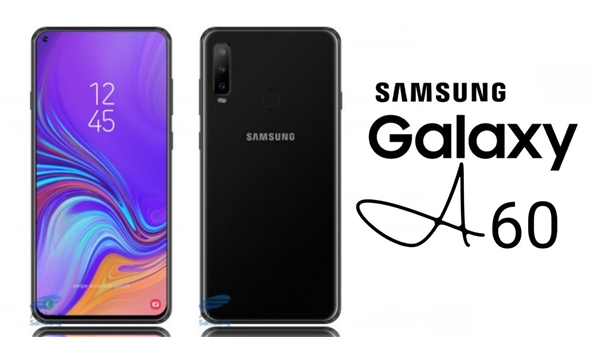
The Galaxy A60 is an irresistible smartphone that sports a mammoth 6.7-inch FHD+ LCD (2340 x 1080 pixels resolution) that features a punch hole to accommodate the 32MP selfie camera. Rather than having a traditional speaker placed at the top, the phone adopts the sound-on-display technology, which we have seen in the Galaxy A80.
Moreover, the dual-SIM phone packs a powerful Snapdragon 675 Octa-Core processor along with a highly competent Adreno 612 GPU under the hood. It houses a triple camera setup featuring a 32MP, 5MP and an 8MP camera at the back.
The Galaxy A60 runs the Android 9.0 Pie operating system and is backed by a 3500mAh non-removable battery. Aside from that, the A60 comes with a slew of useful sensors such as the Accelerometer, three-axis Gyro, proximity sensor, geomagnetic sensor, gravity sensor and more.
You can head straight to this link to check out the full specification and place your order. Gearbest had sold out more than a hundred pieces at the time of writing, and it is worth noting that the flash sale will come to an end in just nine days.
The Gizmochina Coupons is a community that finds, reports and evaluates deals and coupons of Chinese products from online shops. Please visit it here to find more coupons to save money on mobiles and smart gadgets.
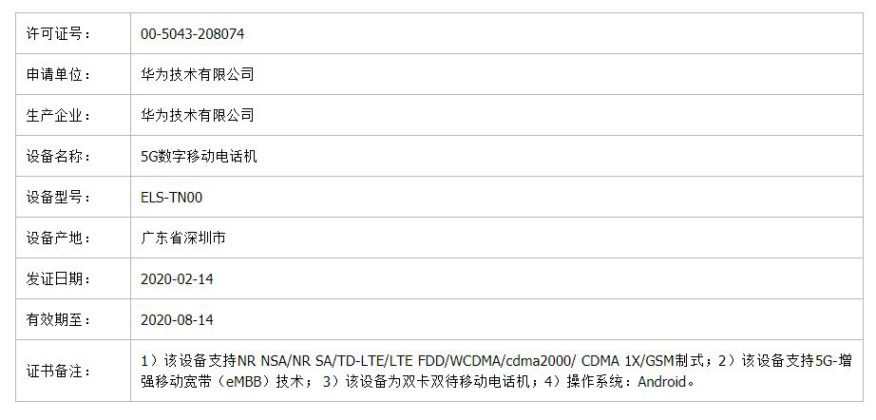
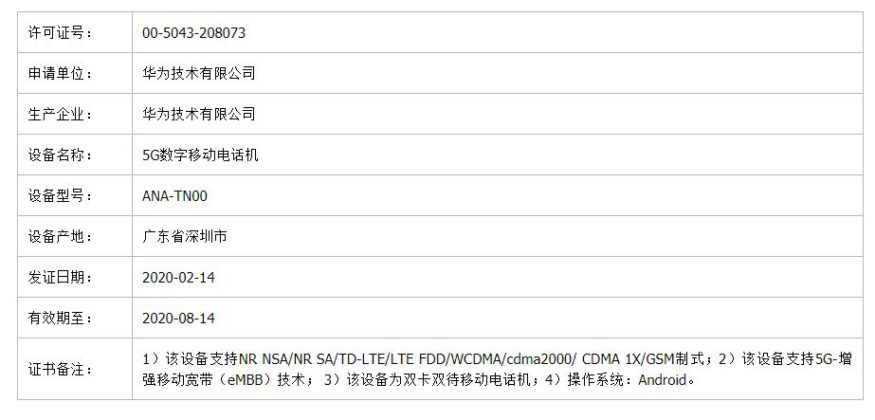
Chinese smartphone maker Huawei is gearing up to launch its next-generation P-series flagship devices, which should be Huawei P40 and P40 Pro. While the phones have been leaked in the past, both of them have now appeared on TENAA.
Since the P40 and P40 Pro have been listed on certification website TENAA, it is being speculated that the launch of the flagship smartphones in the China isn’t far away. However, the company is yet to revealed any information regarding the same.
As per the TENAA listing, the Huawei P40 carries model number Huawei ANA-AN00 and ANA-TN00 while the P40 Pro carries model number ELS-AN00 and ELS-TN00. While the listing doesn’t reveal their specifications, it does confirm that both the smartphones will come with support for 5G connectivity.
Since the 5G support is touted, we expect the devices to come powered by the company’s latest flagship chipset — Huawei HiSilicon Kirin 990 5G SoC. We expect to know more about the phone’s specifications in the coming days or weeks.
As per the leaks, the Huawei P40 will come with a triple rear camera setup which will consist of a 40MP Cine (ultrawide) camera with a 1/1.5” sensor size, a 52MP main camera with a 1/1.3” sensor size, and an 8MP telephoto camera with 3x optical zoom.
On the other hand, the Pro model will come with a 40MP Cine (ultrawide) camera with a 1/1.5” sensor size paired with a 52MP main camera with a 1/1.3” sensor size. Rather than a telephoto camera, Huawei is said to adopt a periscope zoom lens like that of the Huawei P30 Pro. It is said to offer more optical zoom, at least 5x, and of course more digital zoom and the phone will also have a 3D ToF camera.
Huawei is expected to offer an OLED display with 120Hz refresh rate and the phones will have features like in-display fingerprint sensor. The screen will also come with a dual punch-hole cut-outs for housing the front-facing cameras of 32MP and 8MP.
Huawei P40 Pro PE render
As Huawei is still banned from doing business with the United States, the company lacks license to use Google Mobile Services. Thus, instead of GMS, the smartphones will come with the company’s own suite of apps named Huawei Mobile Services aka HMS. However, the device will be running the latest Android 10 operating system out-of-the-box with its own EMUI custom interface.
Apart from the P40 and P40 Pro, Huawei will also be launching another smartphone in the lineup — Huawei P40 Lite E. The smartphone has been spotted on Geekbench with 1.71GHz octa-core processor and 4GB of RAM, along with Android 10 OS.
Huawei usually launches its P-series flagship smartphones in the month of March and we expect the Chinese giant to continue doing the same this time as well. Thus, we expect the company to soon announce the P40 series launch dates for the month of March.
The market is teeming with a wide range of essential car accessories such as air fresheners, emergency kit, car safety hammer, universal chargers, etc that you must-have for a safer driving experience, especially if you travel by car daily or usually have family members on board.
If you search for car accessories online, you are highly likely to come across a slew of steeply-priced products that usually require you to go through an arduous installation process. Thankfully, the popular Chinese e-tailer offers a myriad of easy-to-install car accessories that you can get your hands on without emptying your pocket.
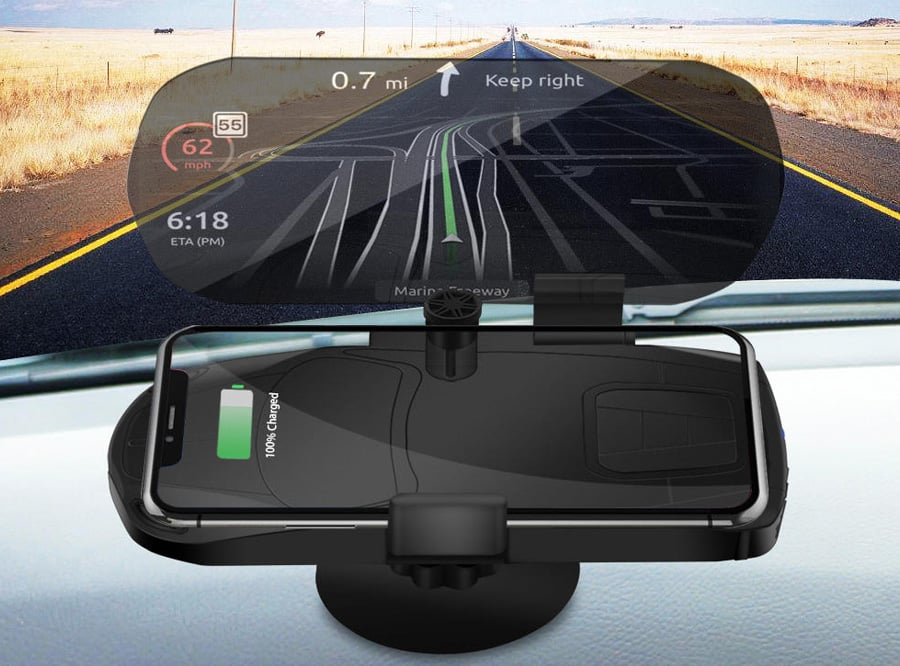
We’d be checking out the Universal HUD Head Up Display 10W Wireless Fast Charging Car Cell phone GPS Navigation Image Reflector Holder Mount that is currently available through Banggood for a considerably lowered price. Staying true to its reputation for offering the best bang for your buck, Banggood is offering the amazing gadget for just $25.59.
Aside from doling out a noteworthy 15 percent discount on the gadget that usually retails for $29.99, Banggood is also giving its users a chance to avail of free shipping, provided your cart value exceeds $19.99. Moreover, if you are placing your first order through the Chinese online store, you qualify to use the $18 Off New User Coupon and save more money at checkout.
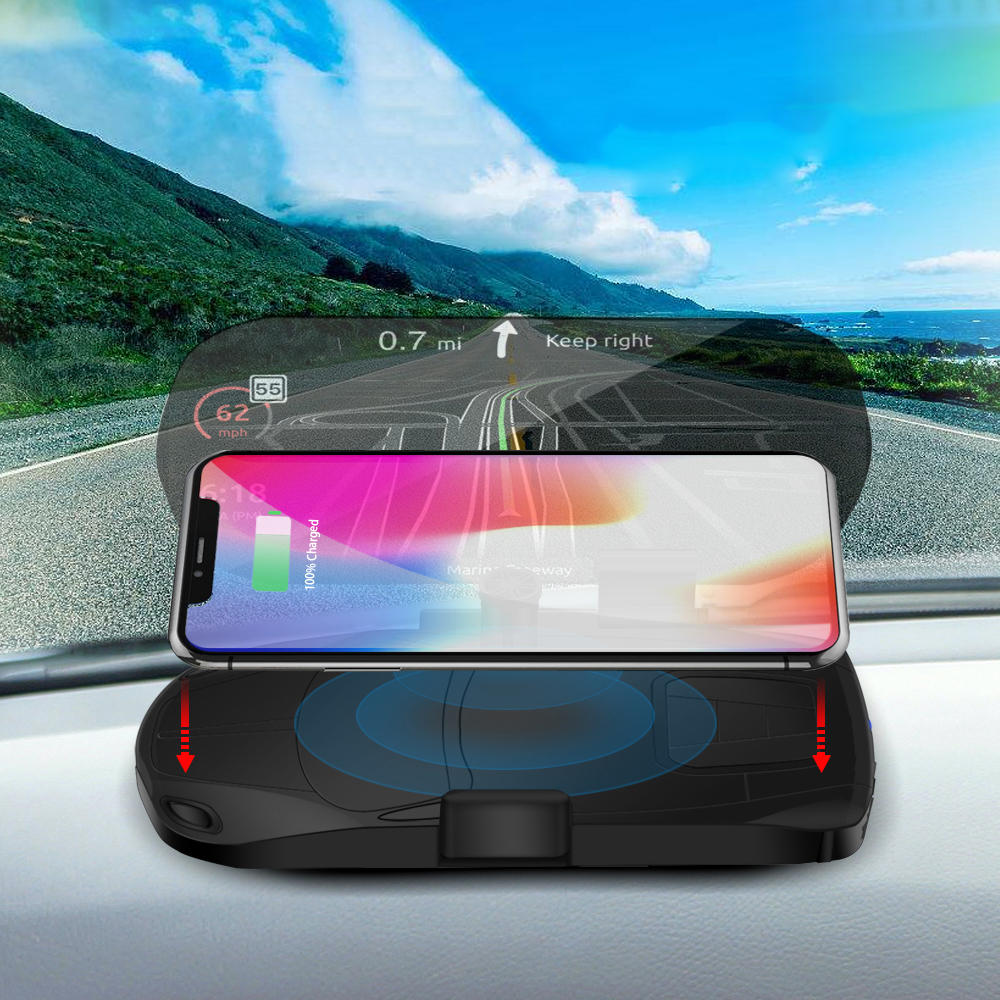
The New HUD (Head-Up Display) wireless fast charging mobile navigation holder mount comes with a no base mode that suits the environment of the instrument room in your car. Based on the driver’s line of sight, the display can be adjusted by 180-degrees.
Furthermore, it adopts import chip multiple advanced technology protection and delivers 10W wireless fast speed charging. This smart chip offers low temperature charging for extended battery life.
The large screen display provides a crystal clear and wider view of the road. It can accommodate and wirelessly charge mobile phones that measure under 7-inches. The HUD provides the display for navigation.
To know more about the Universal HUD Head Up Display 10W Wireless Fast Charging Car Cell phone GPS Navigation Image Reflector Holder Mount, you can simply visit this link. Don’t forget to place your order before the promo ends if you are interested in receiving the discount.
The Gizmochina Coupons is a community that finds, reports and evaluates deals and coupons of Chinese products from online shops. Please visit it here to find more coupons to save money on mobiles and smart gadgets.
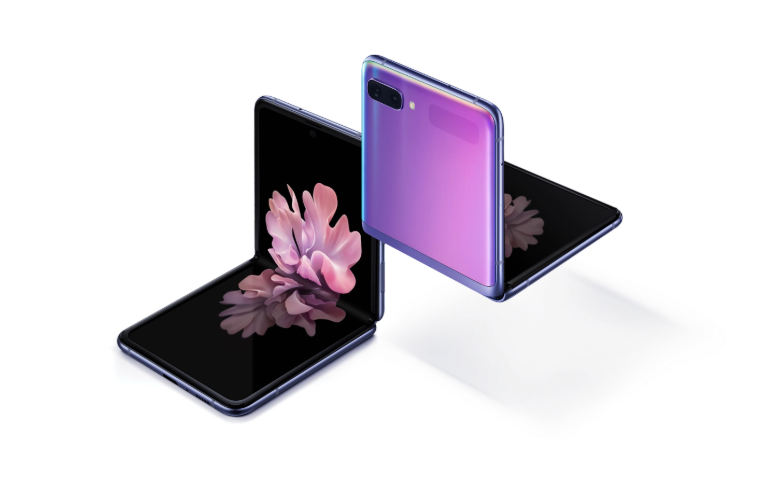
Foldable smartphones are becoming mainstream and even though it carries an expensive price tag, such devices seem to be in-demand. While the build quality has improved from what companies offered last year, there’s still concern about the same because of how expensive such devices are.
The focus is currently on the newly launched Samsung Galaxy Z Flip smartphone and from what we’ve seen so far, it seems that the device is not easy to crack. iFixit recently shared a video teardown of the phone, showing the phone’s internals and revealing its build.
Samsung has been advertising its new “fiber shield” hinge which intends to trap stray dust and keep it from getting inside the smartphone. While the phone does have this new type of hinges, the working isn’t as good and impressive as what Samsung made it look.
Folks at iFixit dropped the foldable smartphone it into a bag of purple dust, they took the phone out and shook out the dust but despite this, some dust got inside the Galaxy Z Flip and it even stopped the hinge from fully opening.
As this is not a situation that you will face in your regular usage, the company may have designed the phone just keeping the real-time scenarios in mind and the fiber shield hinges are for repelling day-to-day pocket lint.
Also, it’s noteworthy that the company clearly says that the smartphone is not water and dust resistant and the same warning shows up on the screen when you first turn on the Galaxy Z Flip.
There are a few other teardown videos on the internet which shows that the screen is prone to marks and scratches just like a plastic screen but the company is advertising the screen to be glass. Samsung clarified that the display is indeed glass, but has a “protective layer” on top.
When that protective layer is removed, the screen stops working. This is similar to the original Galaxy Fold which wouldn’t work when the protector was peeled off, sparking concerns about its build and forcing Samsung to delay its launch.
Overall, it is evident that the Samsung Galaxy Z Flip is an impressive device as far as engineering is concerned. However, the device does have some flaws in terms of design and build, which could lead to durability issues.
Face mask have been in demand for protecting users from environmental issues such as air pollution as well as from being affected with viruses. They are currently more in-demand in China because of the coronavirus outbreak.
While Xiaomi is already selling face masks in its home country, the company has now obtained a patent for the new “smart masks” from the United States Patent and Trademark Office (USPTO).
Xiaomi Youpin F95 Face Mask
The patent description reveals that the upcoming smart mask from Xiaomi will come equipped with a computing unit for the processor to calculate all the data that the sensors on the mask collects.
The collected data will be stored on the mask using the storage module and can also be transferred to other devices, thanks to the connection module. Along with all this, there’s also a built-in battery that powers the standard air filter.
It will also come with sensors like accelerometers and gyroscopes which will help the mask determine if the user is moving or in a stationary position. Sensors on the Xiaomi smart mask will be recording data such as total wearing time, pollution absorption, breathing volume, breath counts, among others.
The mask can also be connected to a mobile application which will show all the data in real-time along with giving information about the weather and air quality of users’ city. It seems that the smart mask will also be able to detect potential breathing abnormalities and could also recommend a healthier breathing method.
However, do note that this is just a patent application from Xiaomi which has been granted and the company has not indicated if it plans to launch any such product in the market. Even if it does, there’s no guarantee that the smart mask will be available for purchase in the market anytime soon.
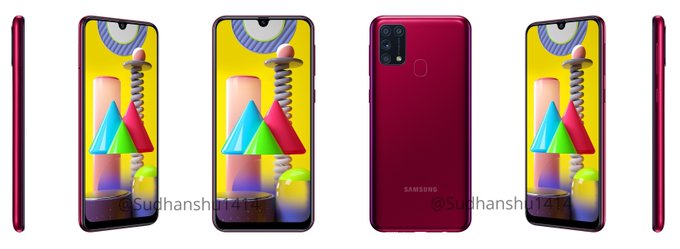
The Galaxy M31 is an upcoming mid-range smartphone from Samsung set to launch on February 25. The launch is still a week away and promotional pages put up by Samsung and Amazon India have already confirmed a few specs. If you do not want to wait until next week for the full spec sheet, then it will please you to know it has been leaked along with renders of all the color variants.
The leak comes from Sudhanshu Ambhore (@Sudhanshu1414). According to his tweet, the Galaxy M31 will be powered by the Exynos 9611 which is the same processor that powers the Galaxy M30s.
Full Specs- Exynos 9611 6.4" Super AMOLED Infinity U, 2340 x 1080 res 64MP (f/1.8) Main + 8MP (f/2.2) Wide-Angle + 5MP (f/2.2) Depth + 5MP (f/2.4) Macro 32MP (f/2.0) 6000mAh with 15W charging 6/128 Dual SIM + dedicated microSD slot upto 512GB 159.2 x 75.1 x 8.9 mm 191 g
The phone has 6GB of RAM and 128GB of storage and there is a dedicated MicroSD card slot for up to an additional 512GB just in case you need more storage.
We already know the phone will have a 6.4-inch Super AMOLED Infinity-U display with an FHD+ resolution. We also know the selfie camera is a 32MP sensor and the primary rear camera is a 64MP (f/1.8) sensor. However, his tweet reveals the other rear cameras are an 8MP f/2.2 wide-angle camera, a 5MP f/2.2 depth camera, and a 5MP f/2.4 macro camera.
The Galaxy M31 will have a 6000mAh battery with support for 15W charging. It will come with dual SIM slots too. Its dimensions are given as 159.2 x 75.1 x 8.9 millimeters and its weight is 191 grams.
Alongside the spec sheet, he also posted renders of the phone in the three color variants it will be available in. We have already seen the phone in blue and black but this is the first time we are seeing the red variant.
The renders show the device has a small camera bump. You can also make out the hole for the audio jack at the bottom. There is also a fingerprint scanner on the back of the phone.
Based on the above specs, the Galaxy M31 is just a Galaxy M30s with better and more cameras.
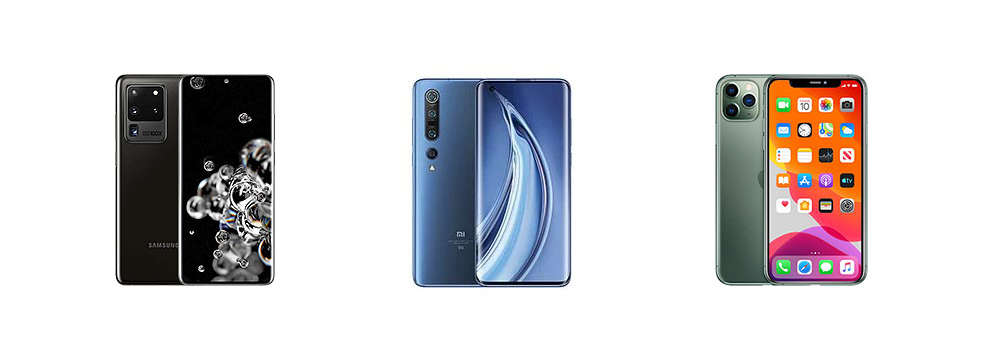
After the launch of the Samsung Galaxy S20 and the Xiaomi Mi 10 lineups, we think it is time to compare the most powerful variants of the flagship series from the hottest brands of the moment. If you are looking for the best Samsung flagship and you have no budget limits, then you should go for the Samsung Galaxy S20 Ultra. The latest and most powerful Chinese handset of the moment is the Xiaomi Mi 10 Pro, while iPhone 11 Pro Max is the best Apple mobile device. Through this comparison between their specifications, you can learn which one offers the highest number of advantages on the paper.
Samsung Galaxy S20 Ultra vs Xiaomi Mi 10 Pro vs Apple iPhone 11 Pro Max
Apple iPhone 11 Pro Max
Samsung Galaxy S20 Ultra
Xiaomi Mi 10 Pro
DIMENSIONS AND WEIGHT
158 x 77.8 x 8.1 mm, 226 g
166.9 x 76 x 8.8 mm, 222 g
162.6 x 74.8 x 9 mm, 208 g
DISPLAY
6.5 inches, 1242 x 2688p (Full HD+), Super Retina XDR OLED
6.9 inches, 1440 x 3200p (Quad HD+), Dynamic AMOLED 2X
6.67 inches, 1080 x 2340p (Full HD+), Super AMOLED
You might find it very hard to make a decision after evaluating the design of these three handsets. I will share with you my personal thoughts about the aesthetics since most of the opinions on the design are subjective. Samsung Galaxy S20 Ultra is definitely a very elegant and futuristic design, but it has bigger dimensions and a huge camera module, that is why it would not be my choice. Apple iPhone 11 Pro Max is more compact and it comes with more premium materials (stainless steel for the frame), that is why it is my favorite choice. Xiaomi Mi 10 Pro is very elegant as well, it looks even more futuristic than both its rivals, but it has an inferior build quality and it lacks a certification for water resistance.
Display
Samsung Galaxy S20 Ultra wins the display comparison. It has a higher resolution (so a higher level of detail), a higher refresh rate and a better overall quality. And we are not the only ones saying this: the device has just been tested by DisplayMate which confirmed its amazing screen. Despite it lacks a high refresh rate, we give second place to the Super Retina XDR OLED display found on the iPhone 11 Pro Max. There is a silly and bigger notch, but it includes Face ID, so we can forgive it. Xiaomi Mi 10 Pro still comes with an astonishing display, especially for that price. You get just a Full HD+ resolution, but there is a 90 Hz refresh rate and a 180 Hz touch sampling rate, as well as HDR10+.
Hardware/Software
All of these devices feature top-tier hardware including the best Qualcomm’s and Apple’s chipsets, as well as an amazing software optimization. I had no chance to test the performances of the best Samsung device and Xiaomi Mi 10 Pro since they are still not available globally, but overall, you should not get big differences given that they all feature an amazing hardware department. Samsung Galaxy S20 Ultra and Xiaomi Mi 10 Pro run Android 10 out of the box, while iPhone 11 Pro Max runs iOS. Note that S20 and Mi 10 support 5G connectivity, while iPhone 11 Pro Max does not.
Camera
Samsung Galaxy S20 Ultra wins the camera comparison as well, at least on the paper. It features up to 100x digital zoom (10x hybrid optical zoom) thanks to a 48 MP periscope lens, and it even comes with a huge 108 MP main sensor and an ultrawide lens. Even its front camera is top-notch with its 40 MP resolution. Even Xiaomi Mi 10 Pro and iPhone 11 Pro Max are top-end camera phones, with the latter providing an astonishing quality when it comes to video recording. But unlike Samsung Galaxy S20 and Xiaomi Mi 10 Pro, the iPhone 11 Pro Max does not support 8K video recording.
Battery
Samsung Galaxy S20 Ultra has a huge 5000 mAh battery and it will likely last a lot more on a single charge. Xiaomi Mi 10 Pro should come right after with a 4500 mAh battery supporting the fastest charging technology (50W wired and 30W wireless). But you still get a great battery life with the iPhone 11 Pro Max, despite it has a battery capacity below 4000 mAh. In each case, you get wireless charging.
Price
Prices are the weakest points of these flagships. Samsung Galaxy S20 Ultra has a starting price of €1349/$1399, Xiaomi Mi 10 Pro starts from €660/$712 (actually we only know its Chinese price, it will cost more globally) and iPhone 11 Pro Max is priced €1189/$1099 for its base variant with 64 GB of internal storage. Overall the most interesting and awesome device on the paper is the Samsung Galaxy S20 Ultra. It offers an amazing camera department, a bigger battery, and a better display experience.
After launching the Samsung Galaxy A51 smartphone in the Indian market last month, the South Korean giant seems all set to launch yet another smartphone in the A-series — Samsung Galaxy A71 in India tomorrow.
A new report from IANS citing sources aware of the development claims that the Galaxy A71 will go official in the Indian market tomorrow as a premium mid-range device and will be priced around ₹30,000, which roughly converts to $419.
Since the smartphone has already been made available in Vietnam, we know what to expect from it. The phone comes with a 6.7-inch S-AMOLED Infinity-O display that is integrated with a fingerprint reader.
The display offers Full HD+ resolution of 1080 x 2400 pixels and a tall aspect ratio of 20:9. Under the hood, the device is powered by Qualcomm Snapdragon 730 SoC clocked at 2.2GHz and is packed with 6GB and 8GB of RAM with 128GB of internal storage.
In the camera department, the smartphone features a quad-camera setup on the back consisting of an f/1.8 aperture 64-megapixel main lens, an f/2.2 aperture 5-megapixel depth sensor, an f/2.4 aperture 5-megapixel macro lens and an f/2.2 aperture 12-megapixel ultrawide sensor. On the front side, it features a 32-megapixel snapper with f/2.2 aperture for taking selfies and video calling.
As for the software, the device runs the latest Android 10 operating system out-of-the-box and comes pre-loaded with Samsung’s One UI 2.0 on top. The device is powered by a 4,500mAh battery and supports 25W fast charging technology.
The report indicates that Samsung is likely to bring some useful “Make for India” features in the Galaxy A71 which have been developed at Samsung R&D Institute in Bengaluru. It is Samsung’s biggest research and development facility outside of home country South Korea.
While the Samsung Galaxy A71 is expected to go official in India tomorrow, it is said to be available for purchase in the country from 24th February. To know for sure about the phone’s availability as well as pricing information, we’ll have to wait for a few more hours.
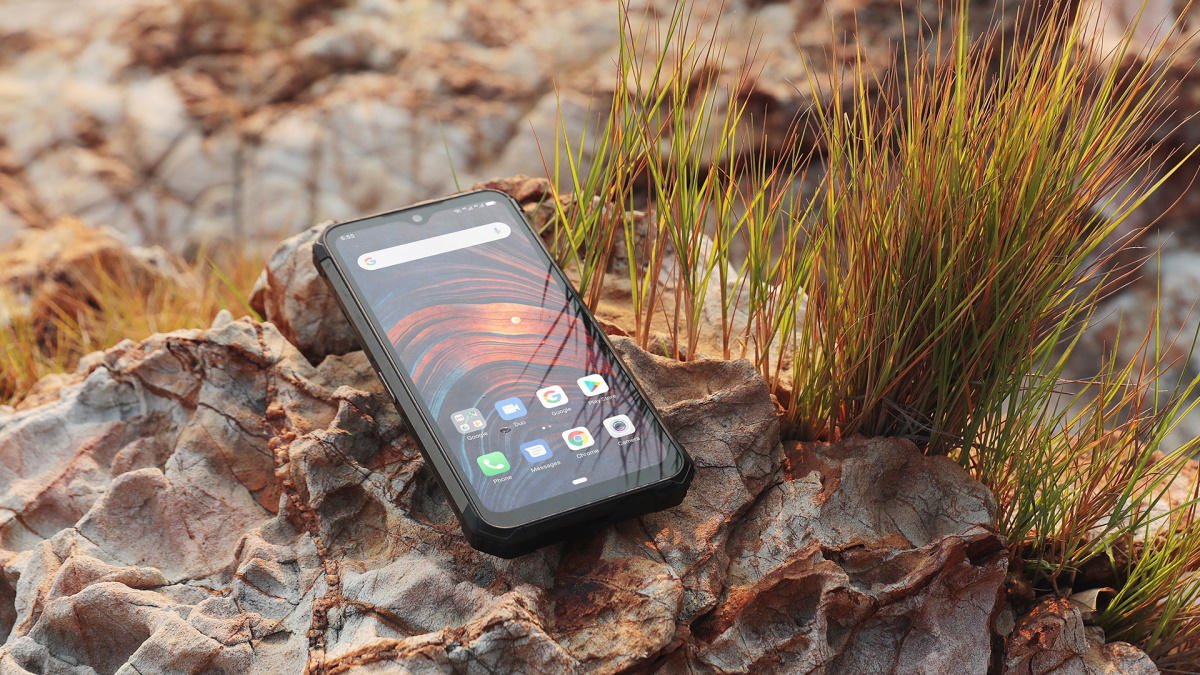
Ulefone is a well-established brand in the rugged smartphone market and its latest flagship -Armor 7- not only can withstand extreme working conditions but is a great performer too. Of course, there are other famous brands on the market as well and today’s video puts Armor 7 against the famous CAT S61. Let’s check out how the 2 rugged flagships performed in the video down below.
Ulefone’s Armor 7 sports the Helio P90 SoC backed by 8GB of RAM and 128GB of internal storage and this bundle achieves a score of 210472 points in AnTuTu Benchmark test, 2 times higher than its famous opponent. App launching and multitasking is much faster and smooth on Armor 7 compared to CAT S61 and even large games like Arena of Valor and PUBG run without and hiccups. Also, Armor 7’s camera performance is far superior to that on the S61 as it comes with a triple rear camera with 48MP main sensor that captures detailed photos with lower noise and bright colors, close to the original subject. On the other hand, the result on CAT S61 seems a bit dim. The overall user experience is superior on the Armor 7.
Lastly, there’s another field where the Armor 7 excels in: price. It currently is on sale on Aliexpress selling at just $369.99 whereas its opponent’s original price is $999, almost triple! It’s clear that famous brands aren’t always the best choice. If you are interested, you can grab the Armor 7 on Aliepxress. For more details about the company and its other products, check out their official website.
It is already a confirmed fact that Realme will be launching its first 5G phone – the Realme X50 Pro 5G simultaneously in Spain and India on February 24. The event which will be an online-only event will also see the company unveil its plans for future IoT products.
Realme doesn’t have any IoT device in the market presently but has just announced an app that will serve as a hub for its ecosystem. The app is called the Realme Link. According to the company, the Realme Link will come pre-installed on all future Realme smartphones and it will let you view and control all your Realme IoT products from one place. The app is obviously still in development as the company recently shared four different icons on Realme Community and is seeking for users to vote for the one they like best. According to Realme, the main icon consists of two interconnected letters L, which stands for “Link”. The letter “O” in the middle, stands for “Operator”. Also, +the “O” represents an ecosystem. “We hope to bring you an ecosystem with excellent IoT experience through realme Link. The extension of the circle represents that realme aims to continuously enrich AIoT product categories and prefect the experience of the realme ecosystem. You can also see the icon as two people hugging. realme Link wants to provide a platform for our fans to have more connections with each other.”
The voting is open until February 21, 4:30 PM IST. We expect some cool smart home gadgets to also go official on February 24. Already, we know the company will launch a fitness tracker and TWS headset.
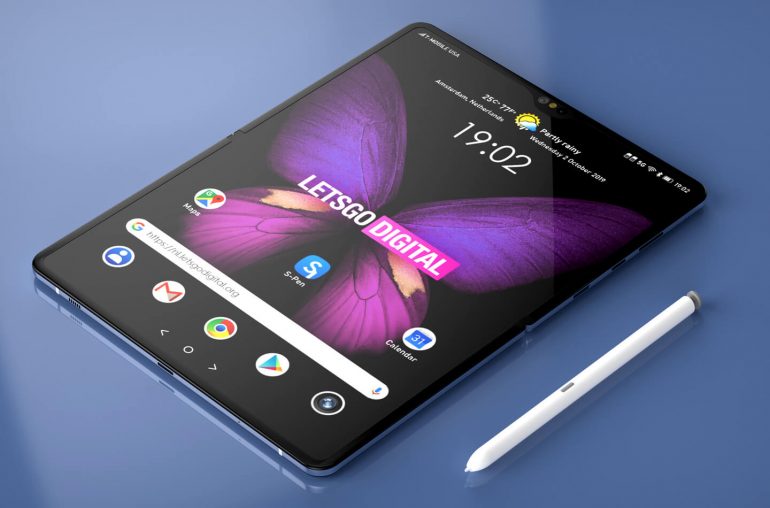
Samsung’s Galaxy Z Flip is still making the news and it sure deserves the spotlight. However, it is not the only foldable phone we are getting from Samsung this year as the Korean manufacturer is going to release a successor to the Galaxy Fold later. There have been leaks of the Galaxy Fold 2 floating across the web in recent weeks, and another one popped up online yesterday, this time from Max Weinbach of XDA Developers.
Image source: LETSGODIGITAL
According to him, the Galaxy Fold 2 will have an Infinity-V display up in front. There is no mention of the screen being bigger than that of its predecessor but there is a high chance it will be.
Galaxy Fold 2: front cover is infinity V display. Main is either hole punch or under display camera. New form of SPen. S20+ camera setup. Ceramic and stainless steel. Will come in Blue, Silver, Gold, Pink, Black.
He adds that the main display either has a hole for the camera or will have an under-display camera. This should mean that “notch” at the top left of the Galaxy Fold’s display is gone.
The big reveal is actually that the Galaxy Fold 2 will have an S Pen and a new type for that matter. This is exciting news since the device practically unfolds into a tablet and a stylus will definitely make it a more productive device.
Max also mentions that the Galaxy Fold 2 will have the Galaxy S20+‘s camera configuration which is a 12MP main camera paired with a 64MP telephoto camera, a 12MP ultrawide camera, and a 3D ToF camera.
The tweet also reveals the phone will come in both ceramic and stainless steel variants and will be available in blue, silver, gold, pink, and black.
The Galaxy Fold 2 sure sounds pretty exciting with all these new additions but it may also translate into a more expensive device than its predecessor.
US fabless chipmaker Qualcomm has been at the forefront of the 5G chip development for mobile devices. The company hopes to continue its exploit with the planned release of an integrated 5G modem and RF system that can aggregate 5G mmWave and sub-6 bands and include a smaller antenna.
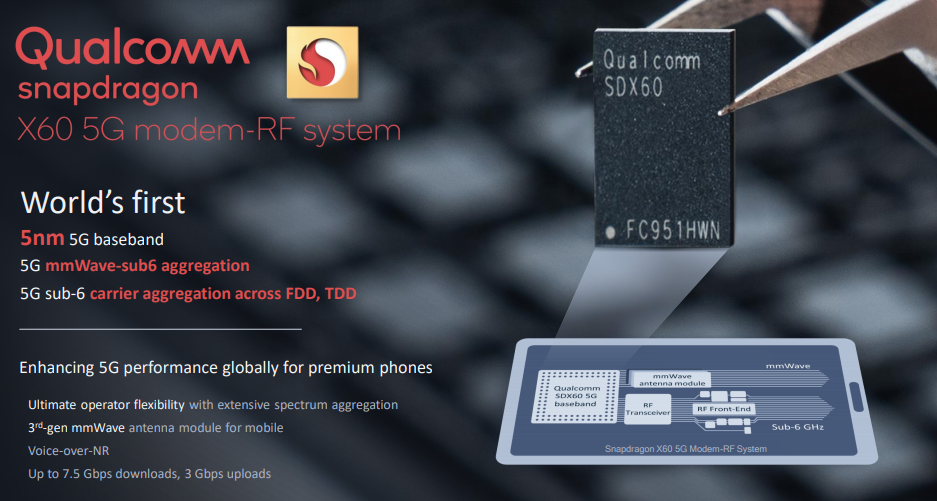
The Snapdragon X60 will be the third generation of Qualcomm’s 5G modem integrated with an RF system. The X50 kicked off 5G and the X55 is being used in the latest Samsung devices. The X60 is designed to scale 5G devices and allow carriers to be flexible with the spectrum and optimize performance.
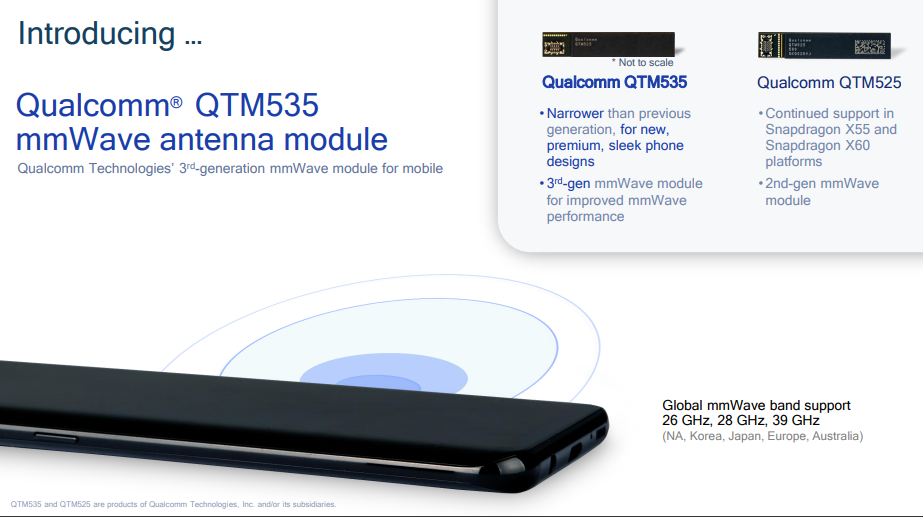
Snapdragon X60 comes with the first 5-nm 5G baseband design. X60 has the ability to aggregate multiple 5G bands and combinations including mmWave and sub-6 using frequency division duplex (FDD) and time division duplex (TDD). The modem is equipped with the Qualcomm QTM535 mmWave antenna module with a more compact design. Qualcomm didn’t mention how much smaller the QTM535 is relative to its predecessor.
The 5G modem-to-antenna system can deliver up to 7.5 Gbps download speeds with 3 Gbps upload speeds.
The x60 will reportedly be sampled in the first quarter of this year and will start finding its way into devices from early 2021.
Honor as well as its parent company, Huawei will both hold an online event on February 24. It has now been revealed that Honor’s event which is called the All-Scenario Intelligence Conference will also double as the global launch of the Honor 9X Pro.
According to Android Authority, Honor stated in a press release sent to them that the Honor 9X Pro will be its “first HMS-based smartphone”. HMS is short for Huawei Mobile Services and is the solution Huawei came up with as an alternative to Google Mobile Services (GMS). This info nullifies the earlier report that the Honor View 30 will be the first HMS-based smartphone.
The Honor 9X was already announced in China more than six months ago but it will just be getting a global launch. The phone has a Kirin 810 processor which is more powerful than the Kirin 710/Kirin 710F found in the global version of the Honor 9X.
The Honor 9X Pro has a 6.59-inch 1080 x 2340 display. It comes with 8GB of RAM and 128GB or 256GB of expandable storage. There is a 16MP motorized pop-up selfie camera and a 48MP + 8MP + 2MP triple camera setup on the back. Honor has included a side-mounted fingerprint scanner and ships it with a 4000mAh battery and Android 9 Pie.
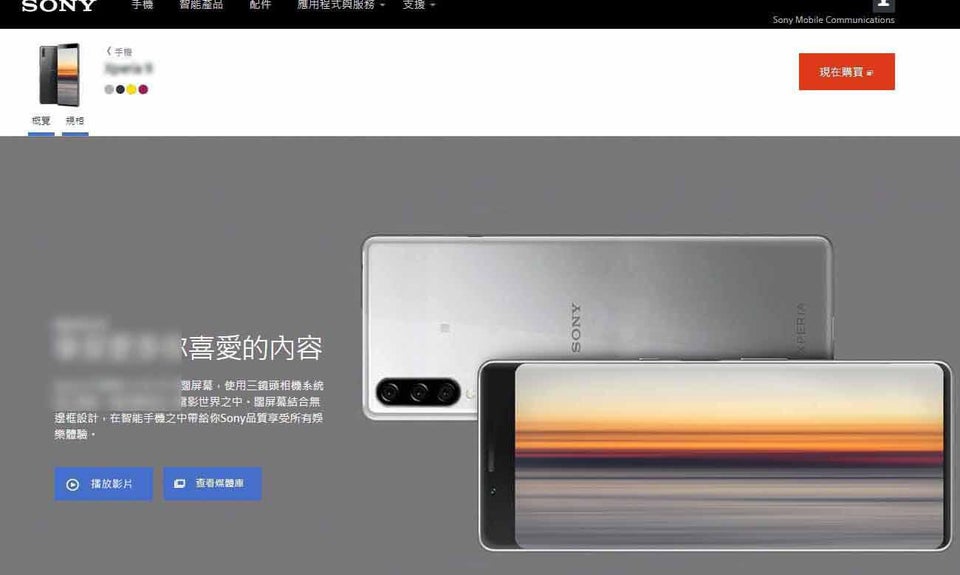
Sony’s naming scheme is messed up at the moment. It launched the Xperia 1 in February 2019 and followed it with the Xperia 5 in September 2019. One of the phones it was supposed to announce at MWC 2020 before the event was canceled is said to be a flagship phone called the Xperia 5 Plus or Xperia 1.1. Now a new leak has surfaced of an upper mid-range phone called the Xperia 9 and it should be the successor to last year’s Xperia 10.
A press render of the Xperia 9 was posted on Reddit a few days ago and it gives us our first look at the upcoming device which is rumored to be powered by a Snapdragon 765 processor.
The Xperia 9 is shown to have a curved display with a big bezel at the top and a significantly smaller one at the bottom. The phone looks like an elongated Pixel 4. The forehead of the phone houses a single camera and the cutout for the speaker.
On the back of the device are triple rear cameras arranged vertically. All three sensors share the same housing while an LED flash sits below the setup. If you look closely, you should see the NFC logo a few millimeters from the camera setup.
The authenticity of this image is not yet verified, so we advise you to take it with a grain of salt.
Sony says it will have an online event on its Xperia YouTube channel. We will have to wait until then to know if this leak is false or not.
We use cookies on our website to give you the most relevant experience by remembering your preferences and repeat visits. By clicking “Accept”, you consent to the use of ALL the cookies.
This website uses cookies to improve your experience while you navigate through the website. Out of these, the cookies that are categorized as necessary are stored on your browser as they are essential for the working of basic functionalities of the website. We also use third-party cookies that help us analyze and understand how you use this website. These cookies will be stored in your browser only with your consent. You also have the option to opt-out of these cookies. But opting out of some of these cookies may affect your browsing experience.
Necessary cookies are absolutely essential for the website to function properly. This category only includes cookies that ensures basic functionalities and security features of the website. These cookies do not store any personal information.
Any cookies that may not be particularly necessary for the website to function and is used specifically to collect user personal data via analytics, ads, other embedded contents are termed as non-necessary cookies. It is mandatory to procure user consent prior to running these cookies on your website.





 The New HUD (Head-Up Display) wireless fast charging mobile navigation holder mount comes with a no base mode that suits the environment of the instrument room in your car. Based on the driver’s line of sight, the display can be adjusted by 180-degrees.