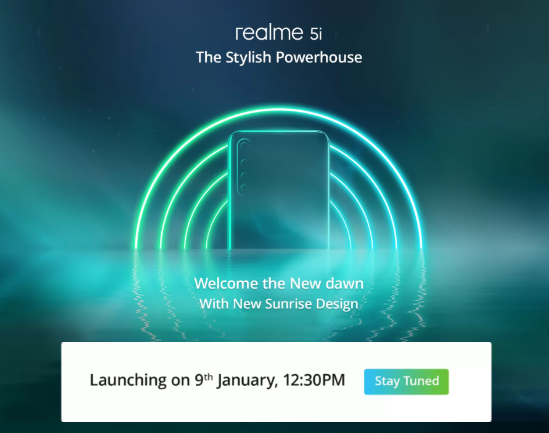
Realme is launching the much-awaited Realme 5i in Vietnam today. The teaser page of the Realme 5i also went live on Flipkart to confirm its launch date for India. It reveals that the smartphone will launch at 12.30 PM (IST) on Jan. 9. The landing page on the retailer site has revealed that the smartphone is powered by a powerful Snapdragon chipset, flaunts a massive 5,000 mAh battery, and sports a quad-camera setup at the rear.
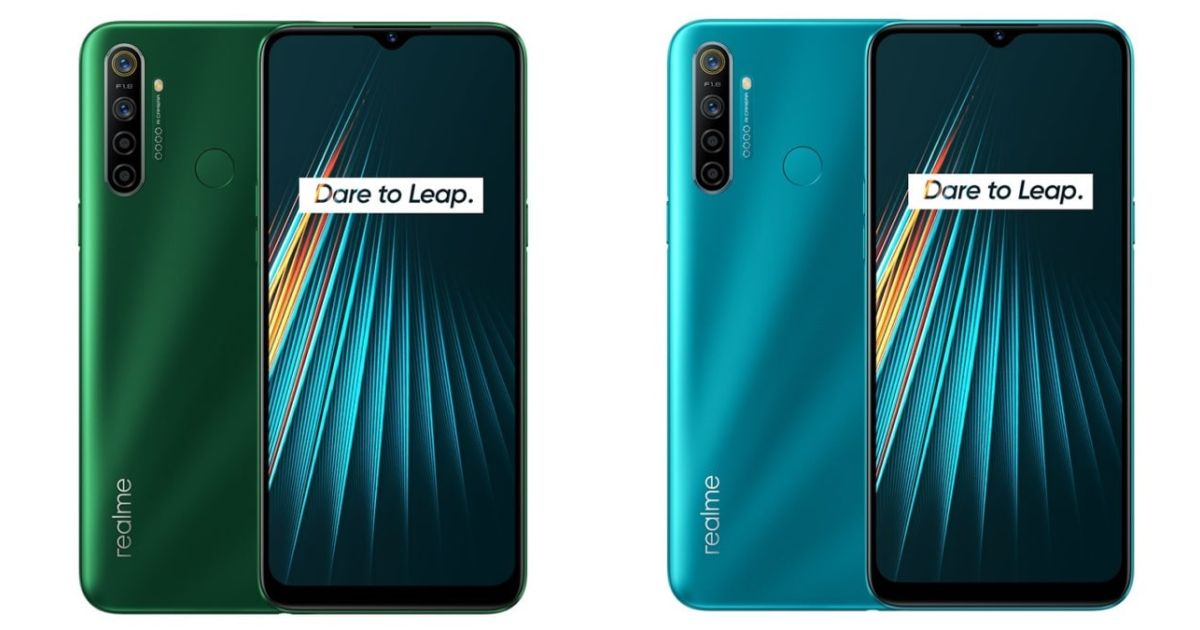
Recent reports have revealed that the Realme 5i may come with a less attractive rear panel than the Realme 5. Also, it will be featuring a downgraded front camera of 8-megapixel. The Realme 5i comes with a 13-megapixel front camera. The rest of the specs of the Realme 5i are expected to resemble the Realme 5. The Realme 5 is currently listed at Rs. 8,999 (~$125), and the upcoming Realme 5i should sit right below it in the price range.
Recent reports have revealed that the Realme 5i smartphone flaunts a 6.5-inch IPS LCD display with a resolution of 1600 x 720 pixels, a screen-to-body-ratio of 89%, and an aspect ratio of 20:9. Powering the Realme 5i is a 2.0 GHz octa-core Snapdragon 665 SoC integrated with an Adreno 610 GPU. The smartphone is equipped with up to 4 GB of RAM and up to 64 GB of native storage, which is expandable up to 256GB via a microSD card.
In terms of optics, the Realme 5i flaunts a rear quad-camera setup. It uses an f/1.8 aperture 12-megapixel primary lens, with an 8-megapixel wide-angle lens, and two 2-megapixel sensors for macro and portrait photography. On the front, the device features a 13-megapixel lens. The Realme 5i draws power from a 5,000 mAh battery. It runs on Android 9.0 Pie with the ColorOS skin on top. Connectivity options include dual-SIM 4G LTE, Wi-Fi 802.11 ac/b/g/n, Bluetooth v5.0, GPS, A-GPS, and micro USB 2.0. The Realme 5i flaunts a rear-mounted fingerprint scanner for additional safety. It is expected to arrive in Blue and Green color variants.
Samsung has confirmed that Galaxy Unpacked, its launch event for mobile devices, will take place on 11 February, and that could see the reveal of the Samsung Galaxy S11/S20. While that’s definitely exciting, what’s also intriguing are the recent rumors that Xiaomi are planning to unveil their Snapdragon 865 powered Mi 10 right before the Galaxy S11 launch.
Xiaomi is planning to launch the Mi 10 and Mi 10 Pro together as the company’s 2020 flagship series. Reportedly, the two smartphones in the series will share the stage in the launch event in the first quarter of 2020 before the upcoming Samsung Unpacked event. Furthermore, the handsets are confirmed to feature Qualcomm’s latest Snapdragon 865 SoC, also making the series one of the first to feature the new chipset.
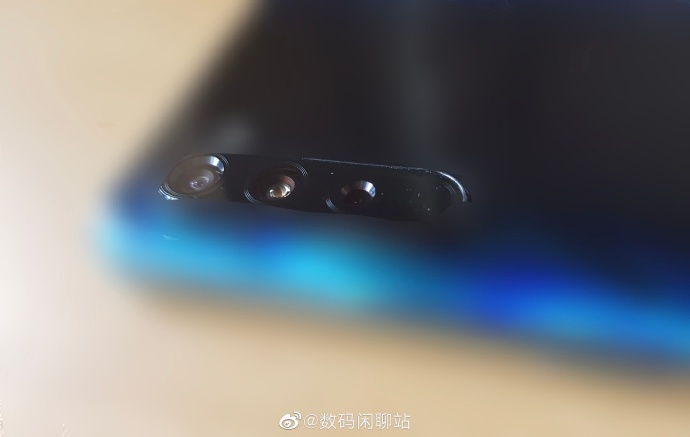
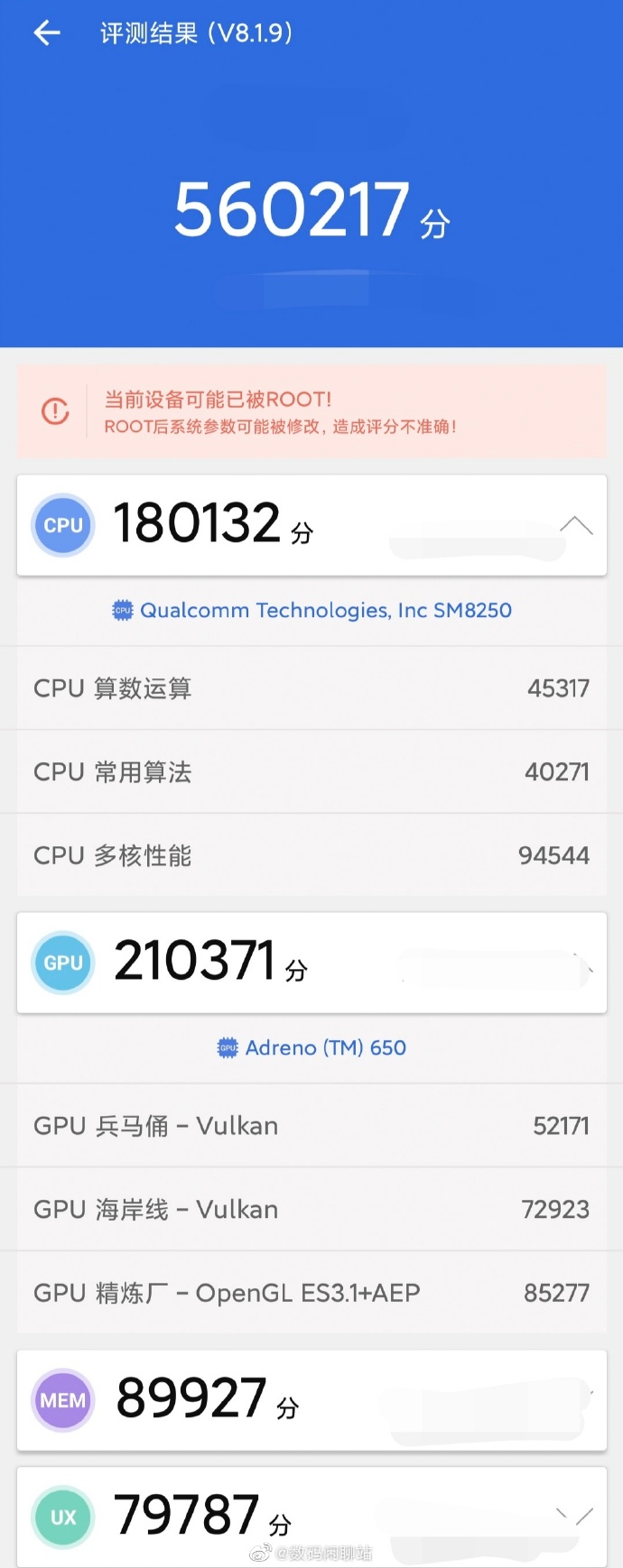
With Weibo users speculating that the device could arrive early nex\t month, the rumor mill is now actively working on spilling information on the flagship series. Over the weekend, a leaked image of the Xiaomi Mi 10’s rear was shared by a Chinese tipster. The same tipster also released an image that seemingly shows the AnTuTu scores of the smartphone.
The Xiaomi Mi 10 Pro may come with a 120Hz refresh rate display. Its quad camera system is expected to house a 108-megapixel primary lens, a 20-megapixel lens, a 12-megapixel unit and a 5-megapixel sensor. It is speculated to arrive with a 4,500mAh battery with 66W fast charging support.
On the other side, the Mi 10 may sport a 90Hz refresh rate screen. It may possess a 64-megapixel (Sony IMX686) + 20-megapixel (ultrawide) + 12-megapixel (telephoto) + 5-megapixel (depth) quad camera setup. It may sport a 4,800mAh battery that offer 30W rapid charging.
Its been just a few days since the new year 2020 has started and details about the flagship smartphones getting launched this year have started to surface online. In such as development, Nubia CEO Ni Fei seems to have revealed information about the company’s upcoming gaming smartphone.
The Nubia Red Magic 5G smartphone getting launched this year is shown to be powered by the latest Qualcomm Snapdragon 865 SoC which was revealed last month. The leak also reveals that the smartphone will feature a triple-camera setup on the back.
Ni Fei posted something on Weibo and it reveals that the post on the Chinese microblogging platform was made from “Red Magic 5G Gaming Smartphone” and the sample watermark at the bottom reads “SHOT ON NUBIA TRIPLE CAMERA”.
The smartphone, being powered by SD865 SoC, is expected to come with support for both SA and NSA dual-mode 5G. It could make Nubia Red Magic 5G the first gaming smartphone to have 5G dual-mode support.
The 7mm Snapdragon 865 octa-core chipset includes four ARM Cortex-A77 performance cores out of which three Kryo 585 cores clock at up to 2.4GHz and the other Kryo 585 core works at up to 2.84GHz.
The Kryo 585 ARM Cortex-A55 efficiency cores deliver a maximum clock speed of 1.8Hz. The chipset includes Adreno 650 graphics. The CPU and GPU both offer 25 percent better performance than their predecessors.
The SoC supports up to 16GB of LPDDR4X RAM at 2133MHz and LPDDR5 RAM at 2750MHz. The chipset requires the external Snapdragon X55 5G modem for mmWave and sub-6GHz 5G networks. The X55 modem promises download speeds of up to 7.5Gbps and upload speeds of 3Gbps on 5G.
The Snapdragon 865 also comes with company’s fifth-generation AI engine which is coupled with Hexagon Tensor Accelerator to deliver 15TOPs computing power. The Sensing Hub AI engine ensures highly accurate voice recognition and always-on contextual awareness for smarter virtual assistants.
The SD865-powered phone with the all new Snapdragon Elite Gaming features will offer desktop grade gaming experience. The chipset also comes with support for Quick Charge 4+ and Quick Charge AI charging capabilities.
Xiaomi Mi 10 and Mi 10 Pro flagship phones are expected to go official as early as next month in China. The rumor mill is now actively working on spilling information on the Mi 10 series. Over the weekend, a leaked image of the Xiaomi Mi 10’s rear was shared by a Chinese tipster. The same tipster also released an image that seemingly shows the AnTuTu scores of the smartphone. Also, an alleged render of the phone also appeared on Weibo to reveal its front and rear design.
Xiaomi Mi 10 design
The above shown leaked image of the purported Xiaomi Mi 10 showcases its camera setup. It shows the presence of a vertical strip that includes four cameras at the top-left corner of the phone’s rear. The below shown render that is now doing rounds on Weibo showcases the front and rear of the Mi 10.
The image shows the phone flaunting a punch-hole display. The screen is surrounded by very thin bezels on all four sides and it is integrated with a fingerprint sensor. The right side of the phone has a volume rocker and a power button. The rear side shows the presence of an LED flash alongside the quad camera system.
Xiaomi Mi 10, Mi 10 Pro specifications (Rumored) and AnTuTu appearance
The Xiaomi Mi 10 Pro may come with a 120Hz refresh rate display. Its quad camera system is expected to house a 108-megapixel primary lens, a 20-megapixel lens, a 12-megapixel unit and a 5-megapixel sensor. It is speculated to arrive with a 4,500mAh battery with 66W fast charging support. On the other side, the Mi 10 may sport a 90Hz refresh rate screen. It may possess a 64-megapixel (Sony IMX686) + 20-megapixel (ultrawide) + 12-megapixel (telephoto) + 5-megapixel (depth) quad camera setup. It may sport a 4,800mAh battery that offer 30W rapid charging.
Shown above is a leaked shot of the AnTuTu listing of the alleged Mi 10 / Mi 10 Pro smartphone. It reveals that the phone is powered by Qualcomm’s SM8250 that tags along with Adreno 650 graphics. It is nothing but the Snapdragon 865 mobile platform that comes with X55 5G modem for dual-mode 5G connectivity. The handset has recorded a remarkable score of 560,217 on the benchmarking platform.
OnePlus designer Hao Ran has showcased a new model of the company’s previous flagship smartphone OnePlus 6. The model, which comes with a wooden back cover with a Canvas Blue hue, is unfortunately not available for purchase.
Hao Ran says that the wood with canvas blue and gold embellishment embodies a pleasant and relaxed nature, allowing the product to integrate into life. He added that the company keeps experimenting with different designs and what it needs is the cooperation of the environment and human perception.
As mentioned, Hao Ran has just shared the images of this model of OnePlus 6 smartphone which the company was experiment in terms of design and is not actually released or available for purchase.
OnePlus 6 was launched in May 2018 and was offered in four color options — Mirror Black, Midnight Black, Silk White, and Amber Red. The phone features a 6.28-inch notched AMOLED display with screen resolution of 2280 x 1080 pixels and 19:9 aspect ratio. Under the hood, it is powered by Qualcomm‘s Snapdragon 845 octa-core processor.
It packs up to 8GB RAM and up to 256GB internal storage with support for microSD card slot. The phone is powered by a 3,300mAh battery, with support for the company’s fast charging technology.
On the back side, there’s a dual camera setup, sporting a 16MP primary Sony IMX519 sensor with f/1.7 aperture, 1.22um pixels, and OIS, and a 20MP Sony IMX376K secondary camera sensor, mainly for depth information. On the front side, there’s a 16MP snapper for taking selfies and video calling.
The device is running the company’s own OxygenOS, which is based on Android 8.1 Oreo operating system out-of-the-box. However, the phone has already received the latest Android 10 update.
Recently, MasterLu benchmarking platform released a report listing top performing smartphones of 2019 and now the company has released a new report which has listed the top smartphones of the year 2019 in terms of smoothness.
The listing has ranked the Huawei Mate 30 Pro 5G smartphone as the “Smoother Smartphone” of 2019 with a score of 174.84. On the other hand, the company has listed HydrogenOS or OxygenOS from OnePlus as the “Best UI of the Year” 2019.
As for the smoothest performing smartphone, the Huawei Mate 30 Pro 5G’s combination of Kirin 990 5G SoC and EMUI 10 is indispensable, says the company. Followed by Mate 30 Pro 5G is Nubia Red Magic 3S and OnePlus 7T Pro in the second and third spot.
Other smartphones in the list includes Honor V30, Oppo Reno Ace, Realme X2 Pro, Meizu 16s Pro, Vivo NEX 3 5G, Samsung Galaxy Note 10+ 5G, and Xiaomi’s Mi 9 Pro 5G, making the company’s Top 10 list.
Now, coming to the user interface, OnePlus’ HydrogenOS (Chinese version of the OxygenOS) has been named the best. The user interface is very much similar to the native Android operating system interface and offers very smooth experience.
The company says that the design concept for the OnePlus Hydrogen OS has not changed in these many years and is said to be the most stable user interface that have come up in the recent years.
Apart from the Hydrogen OS, the list also includes Joy UI, Nubia UI, EMUI, Smartisan OS, ColorOS, FunTouch, MIUI, Flyme, and One UI. Although EMUI 10 is not ranked about the top three, it has played a major role to make Huawei Mate 30 Pro 5G as the smoother smartphone of the year.
MasterLu says that the newly launched EMUI 10 has been optimised and upgraded in various aspects, thanks to the powerful artificial intelligence algorithms. The company has also made major changes to its design language, make it more suitable for youth.
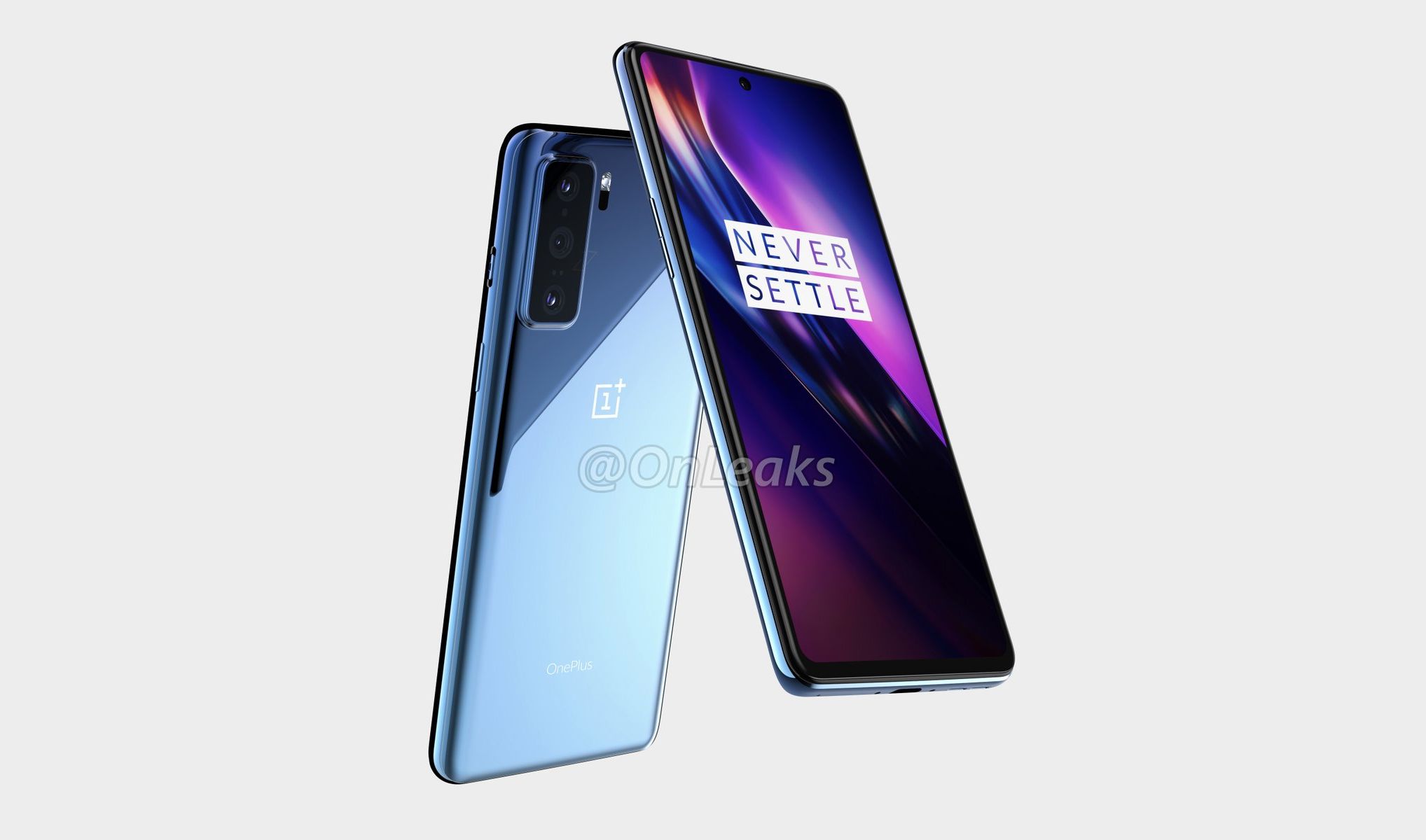
OnePlus 8 lineup that is expected to launch in the second quarter of 2020 may include three models such as OnePlus 8, OnePlus 8 Pro and a new one called OnePlus 8 Lite. In December, reputed leakster @OnLeaks shared the first CAD renders of the OnePlus 8 Lite. The renders had revealed that the phone is quipped with dual rear cameras and a display with a top-center punch-hole. SlashLeaks has carried some shots of a dummy unit of the OnePlus 8 Lite. The image shows the device sporting a triple camera system instead of dual rear cameras. Now @OnLeaks has shared an updated render of the OnePlus 8 Lite with triple rear cameras.
The leaked shot seems to show a bunch of OnePlus devices placed inside a container. The blue colored device with triple rear cameras seems to be the OnePlus 8 Lite. The OnePlus phone that can be seen on the OnePlus 8 Lite with triple rear cameras has a notch on its display could be OnePlus 6. Hence, it appears that the frontside of the OnePlus 8 Lite will continue to feature a punch-hole display.
The updated render by @OnLeaks now features a triple camera system at the top-left corner. An LED flash can be seen placed next to the top camera. The rear shell of the phone seems to be made out of glass and there is a OnePlus logo towards the center. The punch-hole display of the phone is likely to be equipped with an in-screen fingerprint reader.
A leaked specs sheet of the OnePlus 8 series that had surfaced on Weibo in December had also carried the specs of the OnePlus 8 Lite. It had revealed that the OnePlus 8 Lite will be arriving with a 6.4-inch S-AMOLED display that will offer 20:9 aspect ratio, 90Hz refresh rate and full HD+ resolution of 1080 x 2400 pixels.
The MediaTek Dimensity 1000 may power the OnePlus 8 Lite with 8 GB of LPDDR4x RAM. The handset could be made available in 128 GB and 256 GB UFS 3.0 storage editions in China. The leak revealed that the EIS and OIS assisted triple camera system of the OnePlus 8 Lite includes a 48-megapixel Sony IMX586 main lens, a 16-megapixel ultrawide lens and a 12-megapixel telephoto lens. It may arrive with a frontal shooter of 16-megapixel (Sony IMX471).
The OnePlus 8 Lite could be housing a 4,000mAh battery with 30W fast charging. It could be an IP53 certified phone with stereo speakers. The 128 GB and 256 GB editions of the OnePlus 8 Lite could be respectively priced at 2,999 Yuan (~$430) and 3,299 Yuan (~$473). Readers to digest the specs and pricing leak of the phone with a pinch of salt.
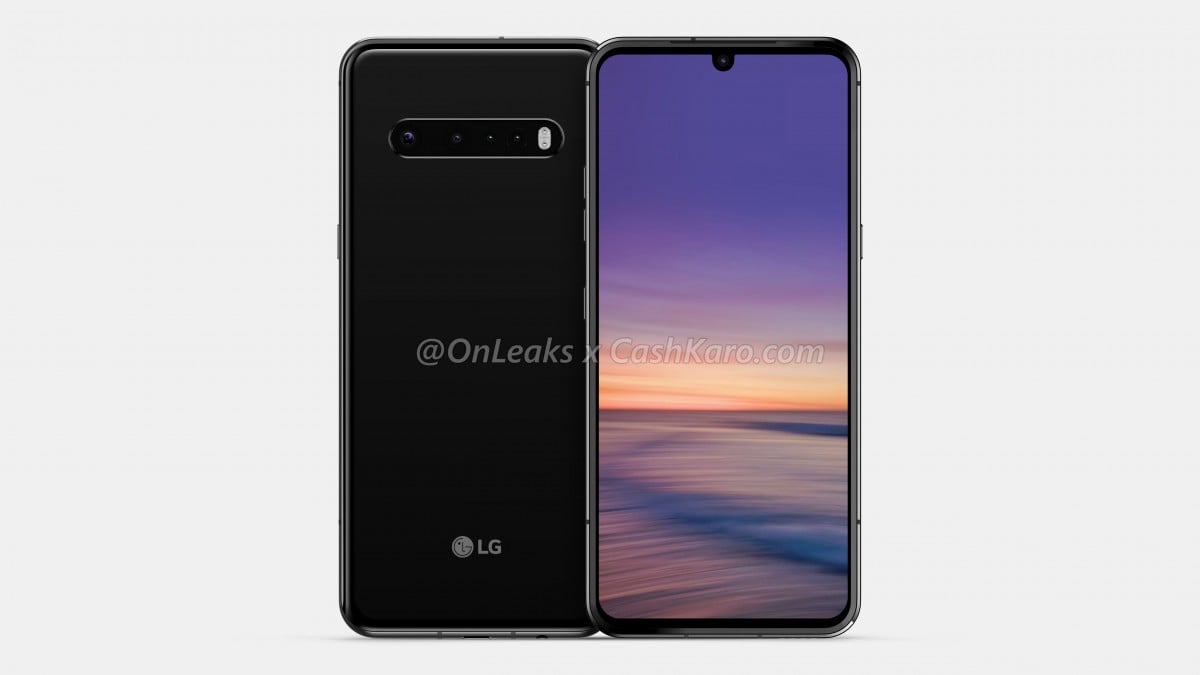
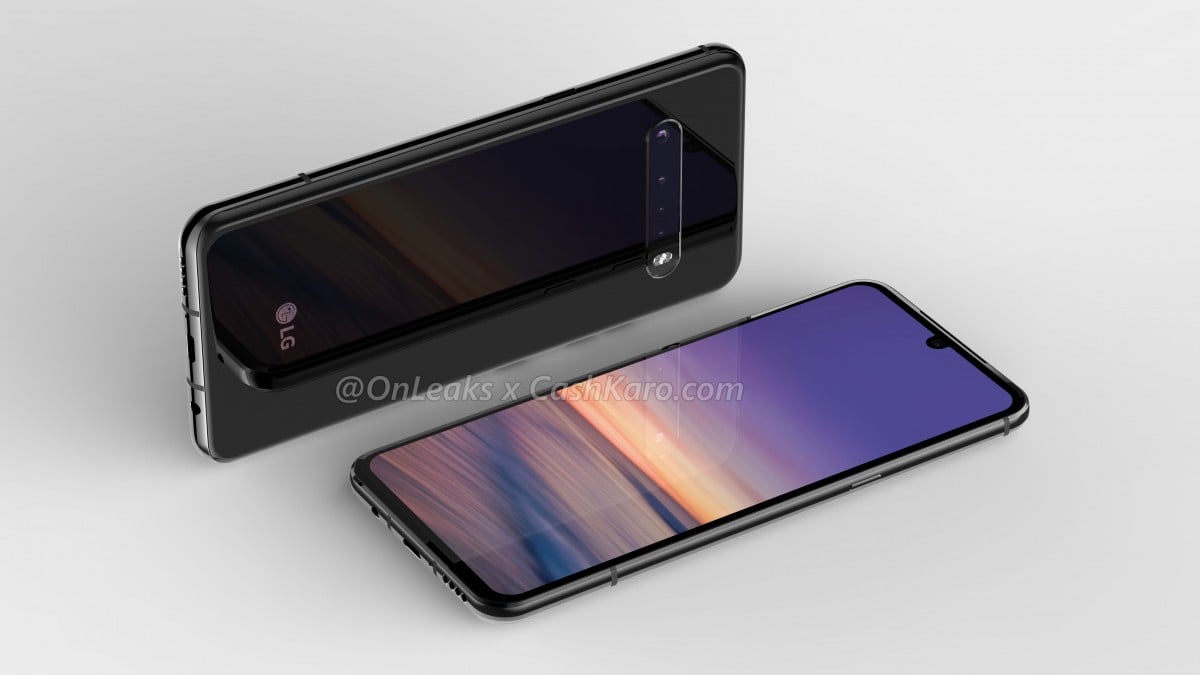
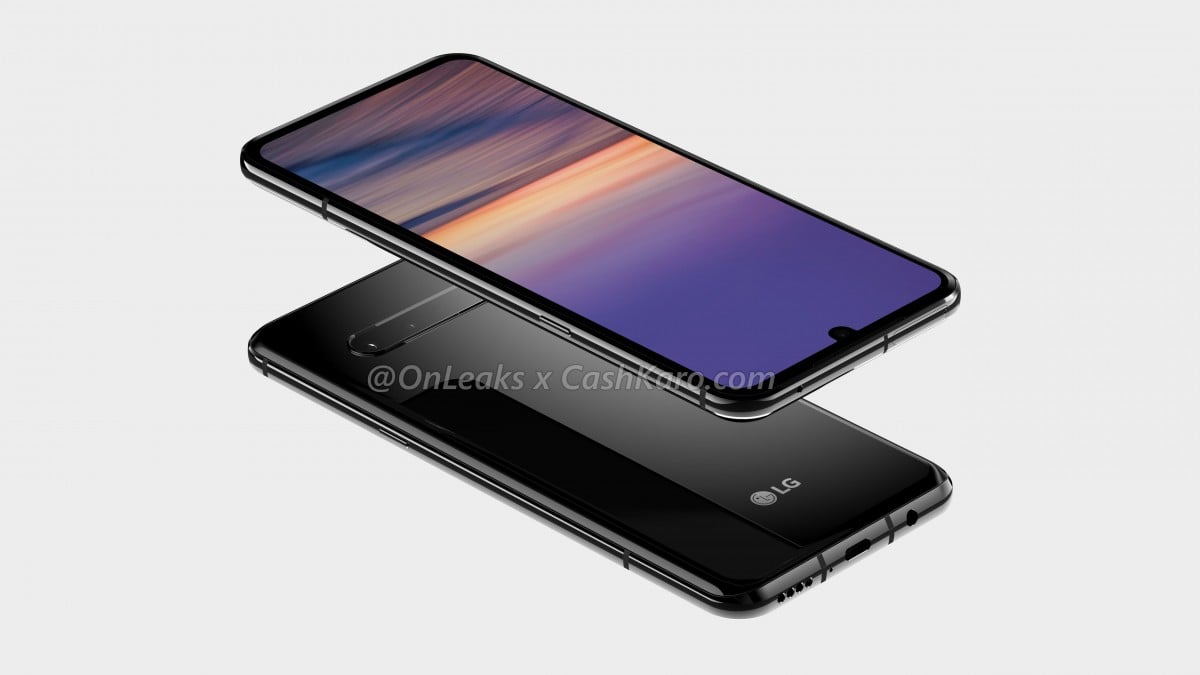
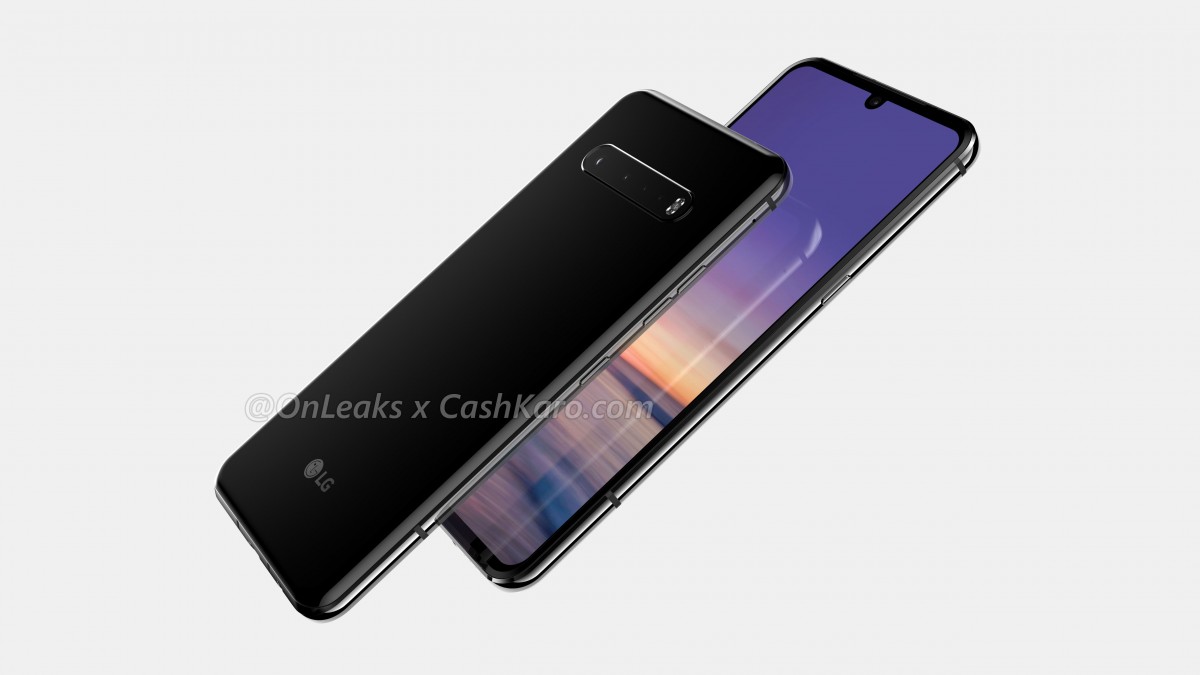
LG is expected to showcase its next-generation G-series flagship at the Mobile World Congress (MWC) 2020 tech trade show in the coming month. The successor of the last year’s LG G8 ThinQ is mostly like to debut as LG G9 ThinQ. Well ahead of the launch, reputed tipster @OnLeaks has worked with CashKaro.com to bring the CAD renders and 360-degree video of the LG G9.
LG G9 Renders
The CAD renders reveal that the LG G9 will be sporting a front that is quite similar to the LG G8X ThinQ flagship phone that had debuted in September last year. The LG G9 can be seen sporting a waterdrop notch screen in the new renders. The reduced notch suggests that the smartphone won’t be featuring the palm recognition and hand gestures that were made available on the LG G8.
1 of 4
LG G9 ThinQ
Renders of the LG G9 ThinQ that has been reportedly cancelled
LG G9 ThinQ
LG G9 renders
LG G9 renders
The leakster has claimed that the phone could be equipped with a 6.7-inch or 6.9-inch display. The OLED display will be integrated with a fingerprint sensor. The handset will be measuring around 169.4 x 77.6 x 8.8mm. At the camera bump on the back, the thickness of the device will increase to 9.4mm.
The rear shell of the phone features a horizontal camera system that houses as many as four lenses. By this, the LG G9 will become the first LG phone to flaunt quad rear cameras. The LG G9 will be one of the few flagship phones from mainstream brands to continue to sport a 3.5mm audio jack. It can be seen on the bottom edge of the device along with a USB-C port and an external speaker. There is a SIM slot on the top edge of the device and it also seems to be equipped with a dedicated trigger button for Google Assistant on its right edge. The volume up and down buttons along with a power key can be spotted on its left spine.
There is no information available on the other specifications of the LG G9. However, it is very likely to be equipped with Snapdragon 865 mobile platform. It could be the first G-series phone to support 5G connectivity. Apart from LG G9, the South Korean company is also expected to unleash the LG V60 ThinQ smartphone at the MWC 2020. The device is expected to arrive with improved dual screen accessory.
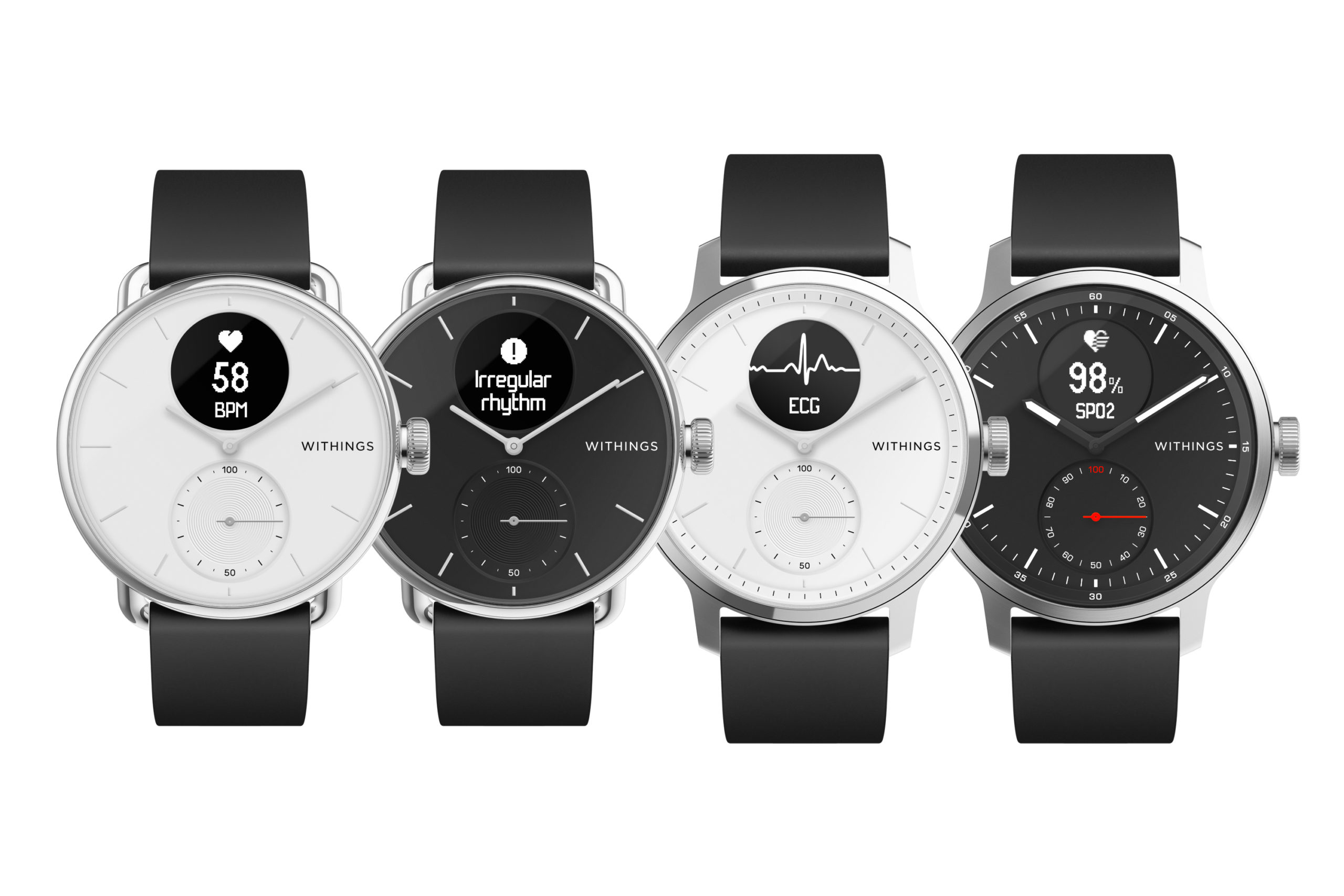
Smartwatches have been advancing rapidly in terms of features offered — from fitness and lifestyle features to now medical features. Continuing the same, Withings has announced its new product named Withings ScanWatch at Consumer Electronics Show 2020.
The company claims that it is the first hybrid to offer medical-grade Electrocardiogram and sleep apnea detection. The device comes with a larger display than any of the company’s previous models.
It also comes with a redesigned crown and is powered by a battery that is claimed to offer 30-day usage on a single charge. As for the highlighting feature, similar to the Apple Watch, this new Withings ScanWatch looks for early signs of AFib. When the user is experiencing symptoms, or the watch is alerting an irregular heartbeat, an ECG can be taken within 30 seconds.
There’s an SpO2 sensor that emits and absorbs a light wave passing through blood vessels which can help the watch detect sleep apnea. It measures oxygen saturation within the blood, centralizing all the info in the Health Mate app, together with sleep monitoring data for length, depth, and quality.
Users can also track activity and workout through Health Mate which is also capable of sharing data with more than 100 third-party apps such as Apple Health, Google Fit, Strava, or MyFitnessPal among others.
The Withings ScanWatch will be available in two sizes — 38mm and 42mm. It will go on sale starting Q2 2020 in Europe and the U.S. for €249/£229/$249 (38mm), and €299/£279/$299 (42mm), after it gets CE and FDA-clearance.
A few days ago, Samsung announced Lite versions of its two flagship lines. Although the price tags for the Galaxy S10 Lite and Galaxy Note10 Lite are yet to be announced, both are definitely affordable versions of the Galaxy S10 and Galaxy Note10 respectively. And in the case of the Note10 Lite, a less powerful version.
Both phones share a similar design and even some of the same specifications such as screen size, design, and resolution; selfie camera; RAM and storage; and battery capacity.
For this week’s poll, we are asking which of the two devices you prefer. Have you always wanted an affordable version of the Galaxy Note series, so you don’t mind that the Galaxy Note10 Lite uses the Exynos 9810 processor, and also prefer a telephoto camera over a macro camera? Or do you prefer the S10 Lite with its more powerful chipset and Super Steady OIS? Do take the poll and also post a comment telling us why you are picking one over the other.
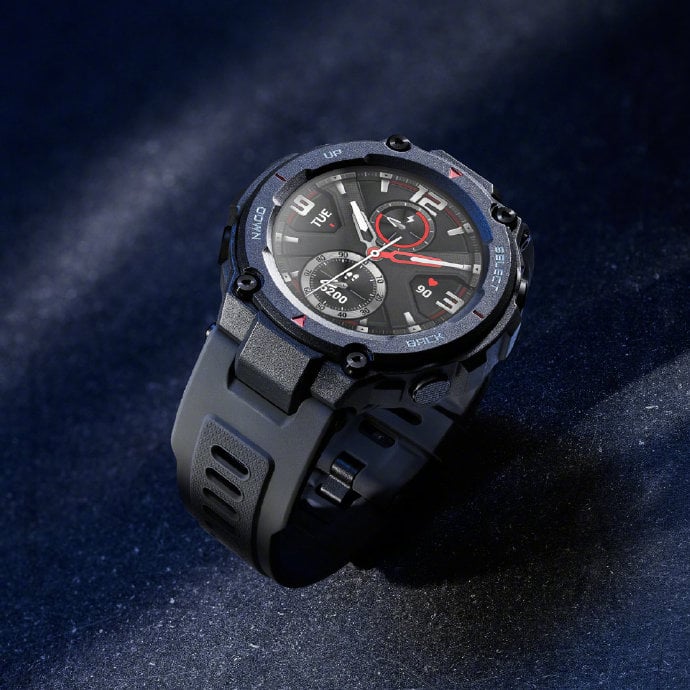
Huami will be attending CES 2020 where it will unveil a couple of new products. One of them is the Amazfit T-Rex, a rugged smartwatch that will be announced on Wednesday, the 8th of January. Ahead of the event, the company’s CEO has shared an official render of the smartwatch.
The render shows the Amazfit T-Rex has a bulky blue case paired with a black rubber strap. There are four buttons on the watch labeled Select, Back, Down and Up (clockwise). The watch face shows the smartwatch has a heart rate sensor and a step counter.
Based on the image, the Amazfit T-Rex is definitely not a small watch. The display is most likely 1.39-inches in size like the Stratos 3 but its extra thickness may be due to its battery capacity.
The watch should have support for GPS, GLONASS, and BeiDou. It should also have a compass, a barometer, and an altimeter. The Amazfit T-Rex will come with a number of sports modes including outdoor ones such as skiing, hiking, mountain climbing, trail running.
Last month, a leak from Steve Hemmerstoffer (@OnLeaks) revealed that OnePlus will release a device called the OnePlus 8 Lite. The leak included renders of the phone and they showed it will have a punch-hole display like that of the new Galaxy Note10 Lite. It will also have a rectangular camera housing on the back that houses two cameras and an LED flash. Today, alleged live photos of the phone have surfaced on the web but they show a different design (and specs).
The photos show the OnePlus 8 Lite has a notch. This is not a waterdrop notch like that of the OnePlus 6T but a wide notch like the one on the OnePlus 6. The images show there is a camera visible on the left side of the notch.
Moving to the back, we see the OnePlus 8 Lite has three rear cameras and not two as the renders showed, although the camera housing has remained unchanged. However, the LED flash is no longer inside the housing and has now moved to the left side of the setup and has taken the form of a pill.
There is a OnePlus logo on the back of the phone and nothing else. Since there is no fingerprint scanner on the back, it is safe to say it has an in-display fingerprint scanner under its AMOLED display.
The source of the images has said nothing about the specifications of the OnePlus 8 Lite. There are speculations it will be a mid-range phone but it is also possible it may have a flagship processor such as the Snapdragon 855 or Snapdragon 855+ inside it. This makes sense so that those who can’t afford the OnePlus 8 and OnePlus 8 Pro which will be 5G devices can pick up the OnePlus 8 Lite (without 5G).
The OnePlus 8 Lite can also go up against the newly announced Galaxy S10 Lite, Galaxy Note10 Lite, and if priced well, may actually be a worthy option over the upcoming Pixel 4a. Is this the year we get a $400 OnePlus phone? Let us keep our fingers crossed.
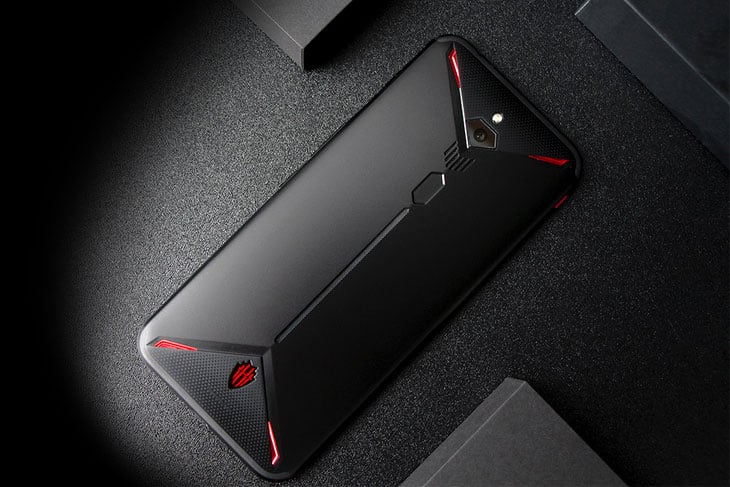
It has been reported that Black Shark, the Chinese gaming smartphone manufacturer, may announce a new smartphone next month. This phone is believed to be the Black Shark 3, and now some of its specifications have leaked.
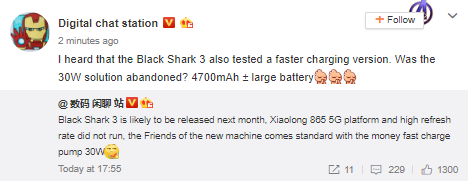
The Black Shark 3 will come with a Snapdragon 865 processor and is expected to have a high refresh rate according to Digital Chat Station. He also added that the phone should support 30W fast charge but then made a separate post that the manufacturer is testing an even faster-charging technology which means it may ditch the 30W Flash Charge.
The Chinese leaker also said the phone should pack a battery capacity of about 4700mAh.
The Black Shark 2 Pro was the last phone from the manufacturer and it was announced back in July. It has a 6.39-inch FHD+ screen, a Snapdragon 855+ processor, and packs a 4000mAh battery with support for 27W fast charge. With the successor having 5G support, it makes sense that it is getting a battery boost and also faster charging.
There is no information on the screen size, design, and type for the Black Shark 3 neither are there any details about its camera specs. However, we hope it keeps the stereo speakers since it most likely won’t have an audio jack like its predecessor.
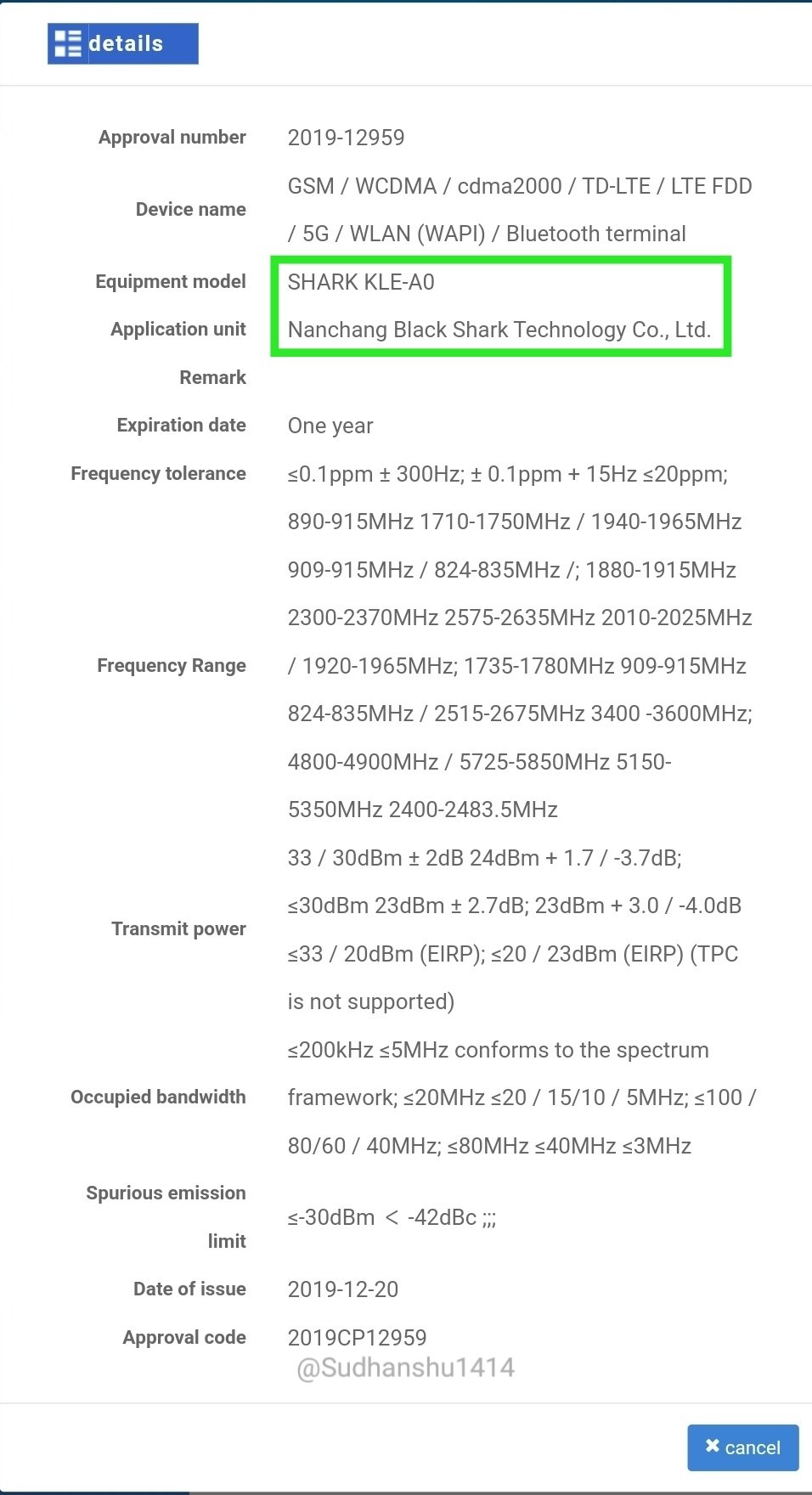
A phone with model number SHARK KLE-AO was certified in China last month and is believed to be the Black Shark 3. The certificate didn’t reveal much but states that the phone has support for 5G.
Xiaomi phones run MIUI save for the Android One and Android Go ones. Originally, these phones running MIUI used to ship with Xiaomi’s own Dialler app and Messaging app. However, that changed with the launch of the Mi 9T Pro which came bundled with Google Dialler and Google Messages. Now, there is an explanation for the development.
The statement was published on the official Mi forum and it said that all Xiaomi devices, starting with the Mi 9T Pro, launched outside China will ship with Google’s Phone and Messages app. The reason for this is because of “privacy laws and restrictions around the globe”.
With the switch to Google’s own phone app, it means users can no longer use Call Recording, a feature available on Xiaomi’s own phone app. However, it has been reported that the feature will become available on the Google Phone app this year.
MIUI is customized for different regions. There is a version for the European market, so also are there versions customized for India, Indonesia, Russia, and of course China. So it is not much of a surprise that certain features are available in some regions while others do not have it.
A few days ago, Honor India shared a teaser on Twitter hinting at the launch of a new phone. It has now been reported that invites have been sent out for an invite on January 14.
The invite doesn’t say which device(s) will be announced but there are reports it is the Honor 9X. The device launched in China back in July and then in Europe in October 2019. While both phones have the same name in the two markets, they are actually different.
The model sold in China has a Kirin 810 processor and a side-mounted fingerprint scanner while the European version has a Kirin 710F processor and a rear-mounted fingerprint scanner. Since Honor still has not been able to get the Kirin 810 certified by Google, India should get the same version as the one sold in Europe.
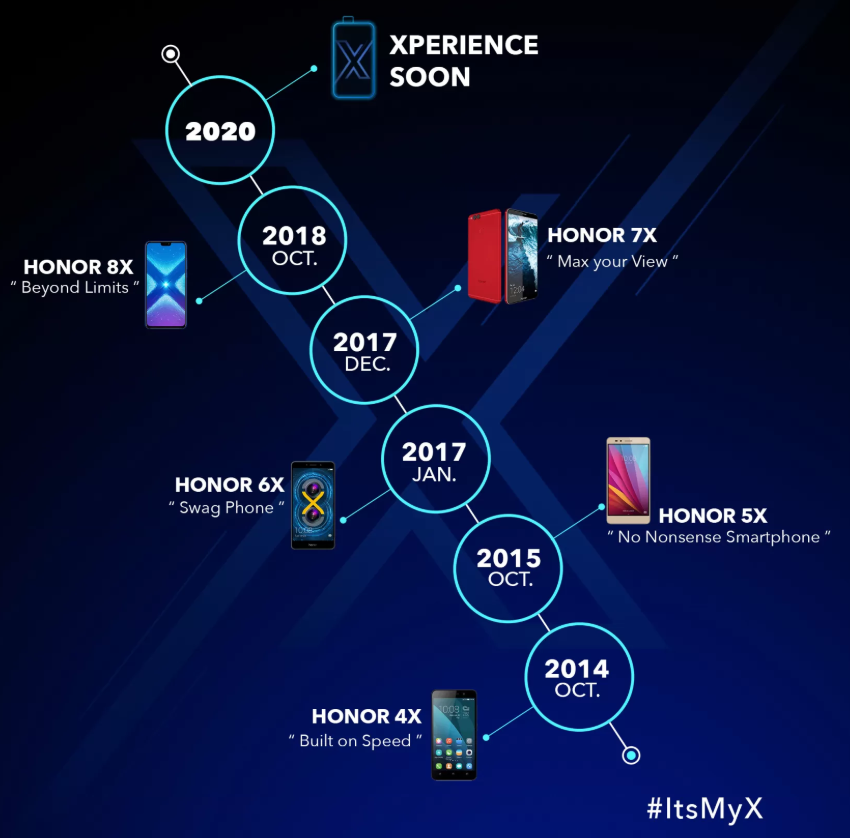
Other than the invite, there is also a promotional page that has been put up by Flipkart, hinting at the device being sold by the online store. The page lists the previous Honor X series smartphones released in the past starting with the 2014 Honor 4X and culminating with the 2018 Honor 8X. There is also a silhouette of the Honor 9X showing its pop-up selfie camera.
The Honor 9X has a 6.59-inch 2340 x 1080 LCD display. Along with the Kirin 710F processor is 4GB or 6GB of RAM and 64GB or 128GB of expandable storage. It has a 16MP pop-up selfie camera and 48MP + 8MP + 2MP triple rear cameras. The phone also has dual SIM support (hybrid), Bluetooth 4.2, an audio jack, and an FM radio. There is a 4000mAh battery inside with support for 10W charging via a USB Type-C port. The phone launched in Europe for €299 but should sell for less in India.
Honor is also expected to announce the Magic Watch 2 smartwatch alongside the smartphone too.
January is the month of the Consumer Electronics Show and it usually brings a lot of innovation in the technology world. CES 2020 will kick off on January 7 and several companies will attend and showcase their most innovative products. That is why, given that we mostly talk about smartphones, we decided to write a post including all the important upcoming launches in January 2020 in regards to smartphones. We still do not know every device which will be launched this month, but we tried to guess all the companies which will come up with a new phone in January.
Upcoming smartphones of the month
Realme X50 and X50 Lite
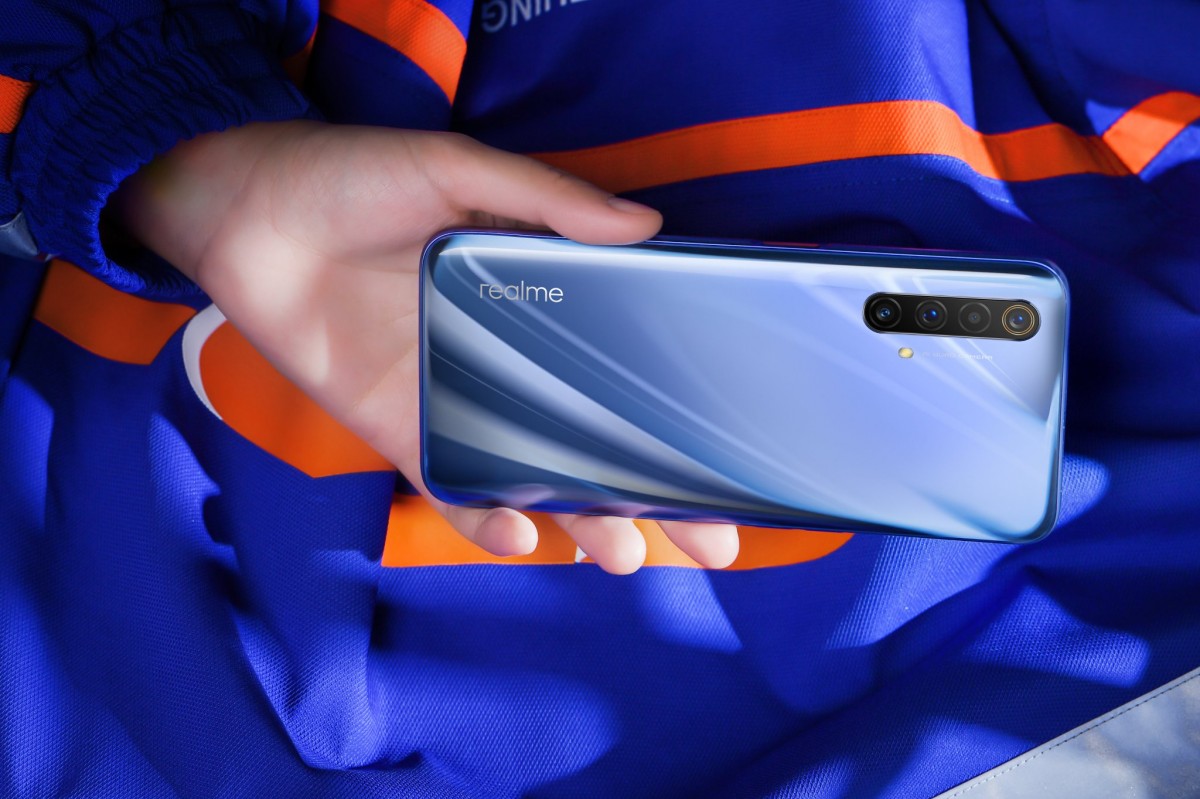
Oppo‘s brand already confirmed that it will officially unveil the Realme X50 series on January 7. The line-up will include two models: Realme X50 5G which will be the first 5G smartphone of the brand, and Realme X50 Lite. The Realme X50 5G just appeared on TENAA listings with all of its most important specifications. It will feature an LCD display with a 6.67-inch diagonal and a Full HD+ resolution. It will be powered by the Snapdragon 765G and it will be available in various memory configurations including 6, 8 or 12 GB of RAM and up to 256 GB of internal storage. On the rear side, there will be a quad camera with a 64 MP main sensor, while on the front you will get a dual front camera with 16 and 8 MP resolution housed in a punch hole. The battery will have a 4100 mAh capacity and the support of VOOC 4.0 fast charging technology.
OnePlus will bring a concept phone to CES 2020. Its name is OnePlus Concept One and, given that it is a concept, it will not become a commercial device. The company published an official teaser about the phone and revealed that it will come with an “invisible camera” technology. The rear cameras will be placed underneath a one pixel LCD panel. The rear side of the smartphone is supposed to be made of leather and the phone could be launched in cooperation with McLaren.
Sony has officially announced that it is going to hold an event at CES 2020. In the statement the company says that it will be unveiling a unique vision of the future, bringing creativity and technology together like never before. It is still unknown whether or not it is talking about a smartphone. The company is supposed to launch the Xperia 3 this year, but it will more likely unveil it at MWC 2020 in February. But in the past the company unveiled several midrange smartphones at CES in Las Vegas, so do not lose your hope.
Just like Sony, LG was used to unveil budget devices at the Consumer Electronics Show. For example, in 2017 the company announced the Stylus 3 with a capacitive pen. We do not expect it to unveil a new flagship phone at CES 2020, but the company might come up with a new affordable device. LG’s main flagship LG G9 should debut at MWC 2020 in February and it might be announced alongside the LG V60 ThinQ.
Samsung Galaxy A51 and A71
Last month Samsung announced its new generation of mid-rangers from the Galaxy A series. The company unveiled Galaxy A51 and A71, but they are still not on sale globally. They will be officially available to purchase in the global market starting from the middle of January. They will be sold for €379,90 and €479,90, respectively (prices may change depending on the region). Samsung Galaxy A51 and A71 are offering punch-hole Infinity-O displays and a quad camera setup. They belong to the midrange segment and provide a long battery life thanks to 4000 and 4500 mAh battery respectively.
Samsung will announce its main flagship series of the year in February. We are talking about the Samsung Galaxy S20 lineup, which will be joined by the Galaxy Fold 2. But we expect the Korean giant to reveal something about Galaxy S20 and Fold 2 during CES 2020. A promotional video leaked on the web revealing that the company will hold an Unpacked event, but Samsung still did not confirm it officially. CES 2020 is expected to be the right place for that announcement. Further, Samsung might showcase its Galaxy Fold 2 just like it did in the past with the Galaxy Fold. We already know that Samsung Galaxy S20 will probably include an Ultra variant and that Galaxy Fold 2 will have a clamshell design.
Last month, Xiaomi’s sub-brand announced Redmi K30 and K30 5G. The latter is the first midrange phone hitting the market with 5G connectivity. It will be officially available to purchase starting from January 7 in China. Redmi K30 5G is powered by the Snapdragon 765G with an integrated 5G modem and it boasts a dual front camera embedded in a punch-hole display. The vanilla K30 has a Snapdragon 730G SoC and it only supports 4G. Both the phones offer a huge 4500 mAh battery and a 120 Hz display with a 6.67-inch diagonal. If you were careful, you probably noticed a lot of similarities with the Realme X50 5G which will be its main rival.
TCL will hold an event at CES 2020 in which it will showcase new Mini-LED TVs. There is no info about the launch of a new smartphone, but given that the company recently launched its first phone under the TCL brand and it owns Alcatel and BlackBerry, it is legit to expect something new.
Last week, popular leaker, OnLeaks shared renders of the Pixel 4a, the successor to Google’s first affordable Pixel phone, the Pixel 3a. He didn’t share renders of a successor to the Pixel 3a XL, so we assumed the device, which should arrive as the Pixel 4a XL, will show up in the future. Unfortunately, that may not happen according to tech YouTuber, Dave Lee.
In a YouTube video he posted yesterday, he revealed that there will be no Pixel 4a XL (around the 30-second mark). This is surprising as all the Pixel phones Google has released so far have a bigger variant.
He explains that the reason Google is ditching the bigger variant is that it didn’t sell as much as the smaller variant. The Pixel 3a launched for $399 while the Pixel 3a XL was priced at $479, pushing it into the affordable flagship killer price range. Seeing as the more affordable sold more, it is understandable why there won’t be an XL model this year.
[envira-gallery id=”298895″]
He also revealed in the video that the Pixel 4a will come in three colors – Black (with a green power button), White (with an orange power button), and Arctic Blue (with a hot pink power button).
The Pixel 4a will have a 5.81-inch display with a punch hole at the top left corner. On the back is a squircle-shaped camera housing with a single camera and LED flash inside. There is also a fingerprint scanner in the middle.
The phone will have a plastic unibody with an audio jack at the top and a USB Type-C port at the bottom. It won’t have support for wireless charging which isn’t surprising as it is not a feature we expect a mid-range phone to have. The camera specs, battery capacity, and processor remain unknown at the moment but we are pretty sure it will run Android 10 out of the box.
Yesterday, OnePlus released a teaser video showing a feature of the OnePlus Concept One smartphone it wants to show off at CES 2020 next week. A part of the video showed the triple rear cameras of the phone invisible at first and then visible the next second. OnePlus said they were able to achieve that using color-shifting glass technology. Now there is an explanation of how the technology works.
How it works
In an exclusive story by Wired, we learn that the technology actually uses electrochromic glass. This special type of glass changes from opaque to transparent when a current is applied to the glass. It is used to make the sunroofs of some luxury cars, airplane windows and can even be found in some buildings where it is used as walls and windows. Now, OnePlus is bringing it to phones with help from McLaren.
The OnePlus Concept One has taken a piece of this special glass and used it to cover up the rear cameras of the phone. So at first look, the phone appears not to have cameras on the back but when you launch the camera app, a charge is sent to the glass that makes it transparent and then the sensors become visible. When you exit the app, the glass becomes opaque. It sure makes for a nice party trick, however, there is a lot of work behind it as well as challenges.
Challenges
First, OnePlus had to work on the time it takes for the glass to change between opaque to transparent. You don’t want to miss out on that perfect shot because the glass is yet to shift. For a company obsessed with speed, this is definitely a big deal but OnePlus’ CEO, Pete Lau, says the OnePlus Concept One is able to shift between opaque and transparent in less than a second.
Second, the glass requires power to function, so another thing they had to work on was how to minimize power consumption, so there is no impact on battery life.
Pete Lau said another challenge was the thickness of the phone as the electrochromic glass is said to require the addition of another material on the rear glass of the phone. They were able to do so successfully with just an increase of 0.1 millimeters to the overall thickness of the phone.
Last but definitely not least is reliability. No one wants a phone whose cameras can’t be used probably because there is an issue preventing the glass from shifting. It has also been reported that electrochromic glass can degrade after a number of years when switching between modes and is also not easily replaceable. OnePlus doesn’t really have to worry much since it says this is just a concept device and it has no plans to go into mass production anytime soon.
The Wired post also revealed details about the OnePlus Concept One. A model that was on display at a briefing in San Francisco last month is reported to be covered in leather that has the same papaya-orange color MacLaren uses. However, the one we saw in the teaser video appears to be all glass.
Based on some sketch diagrams of the product, the OnePlus Concept One appears to have a display unlike the curved one in the teaser video.
OnePlus Concept One sketch
The OnePlus Concept One is said to have the same rear camera specifications as the OnePlus 7T Pro McLaren Edition. That means it has a 48MP primary rear camera paired with an 8MP telephoto camera and a 16MP ultrawide angle camera. The electrochromic glass technology covering the cameras is the same used as an option for the McLaren 720S and the 2018 McLaren 570GT.
According to Xi Zeng, creative director at OnePlus, it was the McLaren 720S they saw on a tour of McLaren’s headquarters that inspired them to bring the technology to phones. By the end of 2018, there was a dedicated group of engineers working on the project already.
It remains to be seen if the mobile industry will adopt the use of electrochromic glass but it is interesting to see OnePlus is experimenting with a new design.
Soon after the launch of the Galaxy Note 10 and Note 10+ last year, it emerged that Samsung was working on a Lite version of the flagship. The tech giant has now gone official with the Galaxy Note 10 Lite alongside the Galaxy S10 Lite. The smartphone is designed as a cheaper variant of the Galaxy Note series. Even though the company is yet to announce the price, we expect it to be cheaper than the latest Galaxy Note 10.
Samsung Galaxy Note 10 Lite is powered by an Exynos 9810 processor which is the same chip used by the Galaxy Note 9 launched in 2018. This is a far cry from the Snapdragon 855 SoC crammed inside the Galaxy S10 Lite. Despite being an old SoC, the Exynos 9810 is still a powerful one that can compete with the top flagship SoCs around.
In other aspects, the device sports a 6.7-inch Full HD+ Infinity-O display, slightly smaller than the Galaxy Note 10+’s 6.8-inch QHD+ display. The Note 10 Lite is available in 6GB/8GB RAM options and 128GB storage which is expandable up to 1TB via microSD card.
For photography, the Galaxy Note 10 Lite features a triple camera setup. The primary 12-megapixel rear sensor is from the Galaxy Note 8 so it doesn’t have variable aperture while the 12-megapixel telephoto f/2.4 2x optical zoom sensor is from the Galaxy Note 9. It does have the same 16-megapixel f/2.2 super wide-angle camera like the Galaxy Note 10/10+, though. At the front, the device packs a 32-megapixel f/2.2 sensor.
The Galaxy Note 10 Lite equally comes equipped with an S-Pen which the Galaxy Note series is known for. While its S Pen does have Bluetooth Low-Energy support, it doesn’t have a 6-axis sensor, so you can’t do any of the cool gestures that you can with the Galaxy Note 10/10+’s S Pen. But Samsung did add the Text Export feature which allows users to transfer handwritten notes into text for quick sharing.
As for the interface, the Galaxy Note 10 Lite runs on Android 10-based One UI 2.0 out of the box. It also has features like Bixby, Samsung Pay, AR Emoji, and facial recognition. There’s a fingerprint sensor embedded in the display as well. Keeping the lights on is a massive 4500mAh battery which is even bigger than the Galaxy Note 10+’s 4,300mAh battery. The battery supports 25W super-fast wired charging.
The device comes in Aura Black, Aura Glow and Aura Red colours. It is expected to be available later this month. The pricing is also expected to be announced at a later date.
Sony has officially announced that it would be holding a launch event at CES 2020 where products whose identity are yet unknown would be unveiled. The statement released by the company hints that it will be ‘unveiling a unique vision of the future, bringing creativity and technology together like never before.’
Sony is expected to launch an Xperia 3 flagship this year but going by precedence, the company usually launches its phones at MWC, and not at CES.
Also, Sony’s next-generation game console, PlayStation5, will have a great chance to appear at this conference. At last year’s CES, Sony revealed that it sold 91.6 million PS4 game consoles worldwide. The company’s first 8K TV supporting Airplay 2 was also shown. The company also focused on Bluetooth accessories, such as its new external woofer and its WH-1000 headset, which will receive Alexa support. However, there was no mobile phone in all the new products unveiled last year. In the same vein, we may see a new TV, a new version of its external woofer and the WH-1000 headset.
The tech giant’s CES 2020 event will be live-streamed on the company’s official website.
We use cookies on our website to give you the most relevant experience by remembering your preferences and repeat visits. By clicking “Accept”, you consent to the use of ALL the cookies.
This website uses cookies to improve your experience while you navigate through the website. Out of these, the cookies that are categorized as necessary are stored on your browser as they are essential for the working of basic functionalities of the website. We also use third-party cookies that help us analyze and understand how you use this website. These cookies will be stored in your browser only with your consent. You also have the option to opt-out of these cookies. But opting out of some of these cookies may affect your browsing experience.
Necessary cookies are absolutely essential for the website to function properly. This category only includes cookies that ensures basic functionalities and security features of the website. These cookies do not store any personal information.
Any cookies that may not be particularly necessary for the website to function and is used specifically to collect user personal data via analytics, ads, other embedded contents are termed as non-necessary cookies. It is mandatory to procure user consent prior to running these cookies on your website.























UP NEXT: LG Gram Laptop crowned as one of the Best Laptops of 2019 by Consumer Reports