Avito, one of the largest classified information portal in Russia, has released the list of the five bestselling smartphones brands in the country for the first half of this year, i.e. H1 2019. As per the list, Huawei has secured the fourth place, moving up two places.
Huawei smartphones in Russia accounted for around 7 percent of the total sales, rising up two places compared to the previous list. On the other hand, HMD Global’s Nokia has been ranked fifth, accounting for around 2.8 percent of sales.
As for the first position, US-based Apple has secured that spot which reportedly accounted for around 43.5 percent of the total sales in the country. The company also reported that purchase through its platform increased by 12.5 percent year-on-year.
Growth of Huawei in Russia is good news for the Chinese brand which is currently struggling to maintain growth after the U.S. government put in on “Entity List”, effectively banning it from doing any kind of business with the US-based companies and technologies without special permission.
However, that is about to change soon if U.S. President Donald Trump’s recent comments during the G20 summit are to be believed. He said that US companies can continue selling components to Huawei as long as it doesn’t threaten United States national security. But we are yet to hear anything official in regards to this development.
Meanwhile, Huawei has lowered down its revenue expectation but is taking steps to reduce its reliance on US-based companies and technologies. For instance, the company has developed its own mobile operating system — HongMeng OS which is based on open source Android and is claimed to be faster than Google’s Android.
Huawei founder and CEO recently said that the company will try to keep using Google’s Android OS for its devices but in case that isn’t possible due to the U.S. government’s ban, the company has alternatives in place. He also said that Google could lose over 700-800 million users if Huawei is forced to ditch the Android operating system.
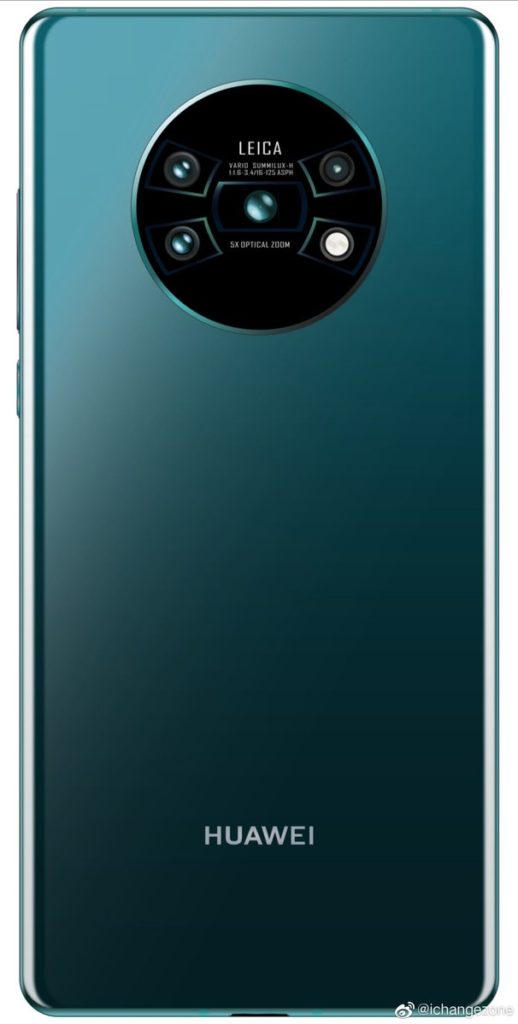
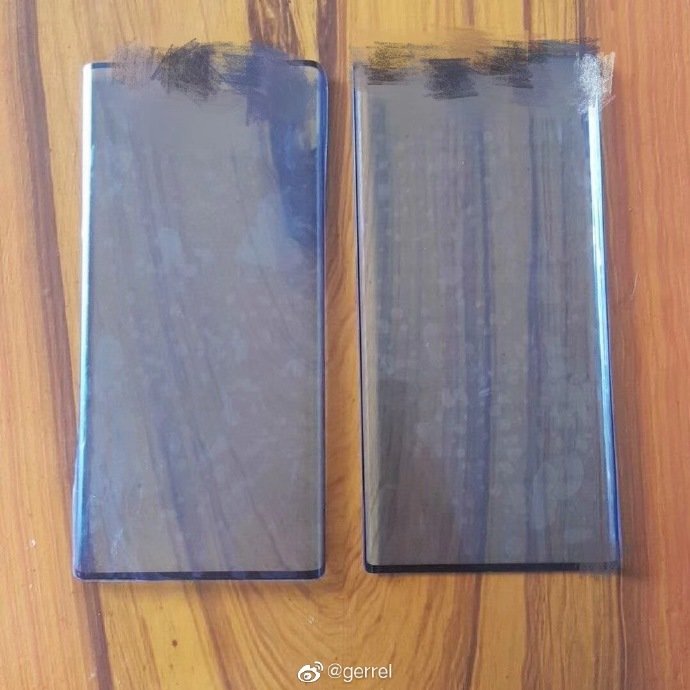
In October, Huawei is expected to launch the Mate 30 series of flagship phones. Reports in the past have claimed that the Mate 30 Pro will be equipped with a rectangular camera module on its rear. However, a leaked render that showcases a round-shaped module with four camera lenses have surfaced today. Also, the display design of the phone has been revealed through another leaked image.
A leaked photo of the glass back panel with a large-sized round cutout had surfaced earlier this week. Today, a leakster from China that is known for sharing vital details on upcoming Huawei phones has released a leaked render of the Mate 30 Pro. The color of the device is similar to the Emerald Green edition of the Huawei Mate 20 series.
The four camera lenses and LED flash are placed in “X” shape. The image reveals that the phone will be equipped with Leica engineered SUMMILUX-H lens and it will offer 5x optical zoom. As of this writing, there is no information on the camera configurations of the Mate 30 Pro. It goes without saying that the camera module of the handset has a very sophisticated appeal.
Also, a leaked image of the front panel of the Mate 30 Pro are now being circulated on Weibo. The top bezel of the phone is blurred in the image because of which it is difficult to determine whether it features a notch or not. The display is curved towards the left and right edges. The bottom bezel of the phone appears really thin compared to the predecessor model. This indicates that the Mate 30 Pro will offer higher screen.
Last year’s Huawei Mate 20 camera with a display with waterdrop notch whereas the Mate 20 Pro featured a larger notch on its display. The wide notch of the Mate 20 Pro housed complex sensors for 3D face recognition. Rumors surrounding the Mate 30 Pro have claimed that it won’t feature 3D face unlock. Hence, it is likely to sport a waterdrop notch or a center positioned punch-hole like the upcoming Samsung Galaxy Note 10 smartphone.
Rumors surrounding the Mate 30 series have claimed that it will be powered by 7nm Kirin 985 chipset. With Balong 5000 5G modem onboard, these phones are expected to carry support for dual-SIM dual-standby 5G connectivity like the upcoming Mate 20 X 5G edition.
A couple of months ago, Huawei launched its flagship smartphone series — Huawei P30 in the Chinese market. When launched, the Huawei P30 smartphone was made available in three models — 8GB RAM + 64GB storage, 8GB RAM + 128GB storage, and 8GB RAM + 256GB internal storage.
Today, the Chinese giant has announced a new base model of the smartphone in its home market which packs 6GB of RAM and 128GB of internal storage. This variant is priced at 3,998 Yuan (approximately $582) which is the same price as that of the 8GB RAM + 64GB storage variant. This new model is now available for purchase via JD.com.
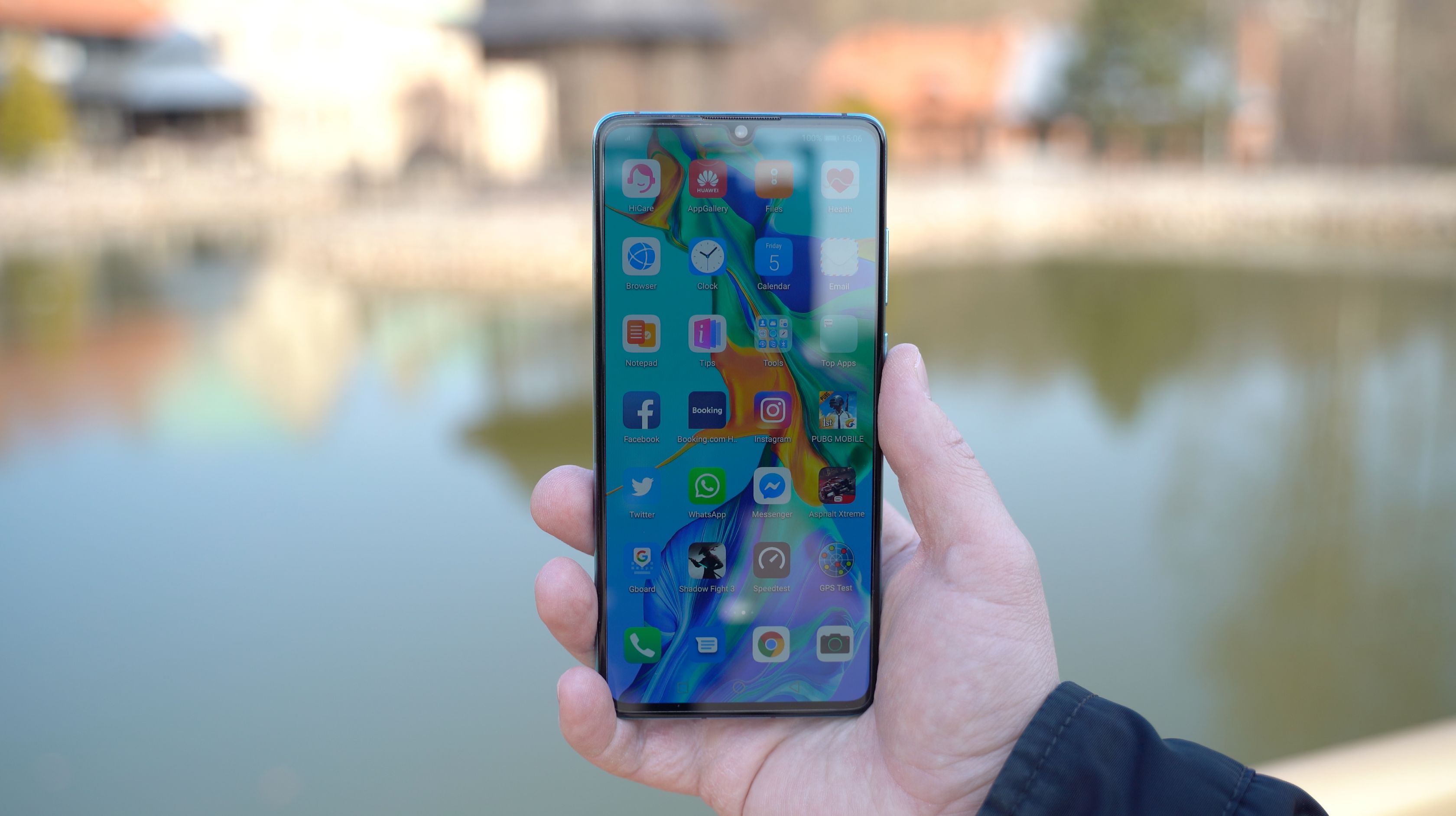
The Huawei P30 (Details) comes with a 6.1-inch OLED display with support Full HD+ screen resolution and is equipped with the trendy in-display fingerprint reader. Under the hood, it is powered by the company’s own 7nm Kirin 980 chipset.
As for the camera, the phone comes with a SuperSensing 40 MP Leica Triple Camera setup. It features a 40MP wide-angle lens, along with an 8MP telephoto lens and a 16MP ultra-wide lens. On the front side, the smartphone features a 32 MP snapper for taking selfies and video calling.
It runs Android 9 Pie-based EMUI 9.1 custom interface and is powered by a 3,650mAh battery that supports 40W SuperCharge fast charging support. It also offers 15W wireless charging as well as reverse charging support. The phone is IP57 rated, which means that the device is splash proof. It is made available in five color options — Pearl White, Black, Amber Sunrise, Aurora, and Blue Crystal.
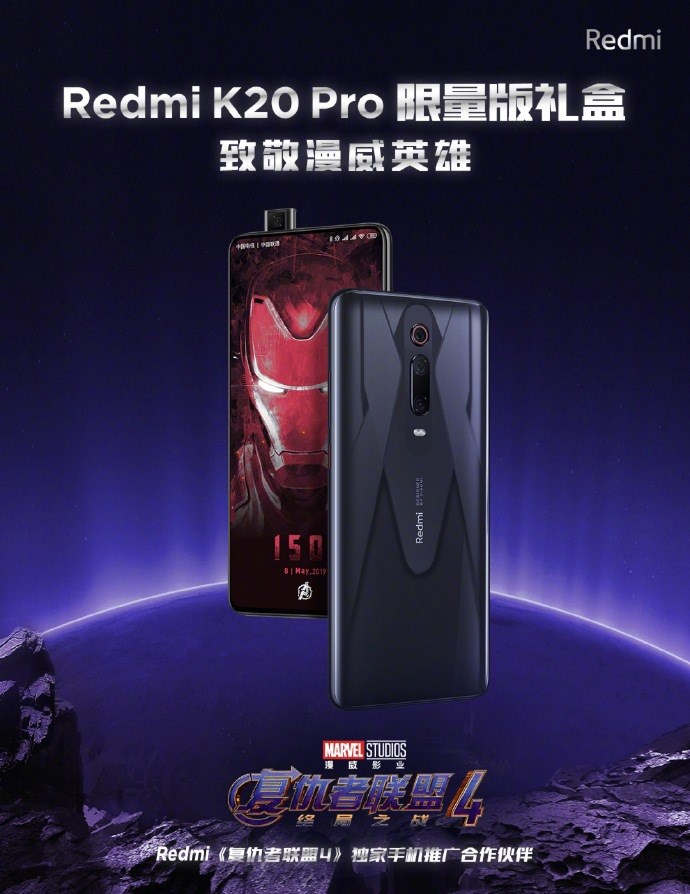
A couple of months ago, Xiaomi-backed Redmi launched the Redmi K20 and Redmi K20 Pro flagship smartphones in the Chinese market. Now today, the company has announced a new special edition of the Redmi K20 Pro in partnership with Marvel.
The company has launched the Redmi K20 Pro Marvel Hero Limited Edition smartphone in the Chinese market. As per Xiaomi, this limited edition device is launched in order to pay tribute to Marvel heroes.
The image shared by the company shows that the smartphone comes in Black and Grey color with a customized back panel that mimics Iron Man design/logo. It’s not yet known what comes packed inside the phone’s retail box.
As for the specifications, nothing seems to have changed compared to the standard Redmi K20 Pro. It flaunts a 6.39-inch AMOLED display that offers a tall aspect ratio of 19.5:9 and Full HD+ resolution of 1080 x 2340 pixels. The AMOLED screen is integrated with the latest seventh-generation in-display fingerprint reader and the phone also comes with support for full DC dimming and eye protection mode.
The device is powered by the Qualcomm Snapdragon 855 chipset with up to 8GB of RAM. It comes with an 8-layer of graphite sheet for heat dissipation. It possesses up to 256 GB of inbuilt storage but lacks support for microSD card.
In the camera department, the Redmi K20 Pro comes with a pop-up selfie camera of 20-megapixel with f/2.0 aperture. The rear shell of the phone features a triple camera unit that consists of 48-megapixel Sony IMX586 48-megapixel main sensor with f/1.75 aperture, a 124.8-degree 13-megapixel superwide lens with f/2.4 aperture and an 8-megapixel telephoto lens with f/2.4 aperture and 2x optical zoom capabilities.
The MIUI 10 based Android 9 Pie operating system comes preloaded on the device. For enhanced gaming experience, it carries support for Game Turbo 2.0. There is a 4,000mAh battery inside the phone that is coupled with 27W rapid charging.
Vivo has recently launched three Y-series smartphones such as Vivo Y17, Vivo Y15 and Vivo Y12 in India. Fresh information shared by 91mobiles states Vivo is working on an entry-level Y-series smartphone called Vivo Y90. Some details of the phone have also surfaced along with its rumored price.
According to the publication, the Vivo Y90 will be entry-level smartphone and the company is aiming it towards customers who desire to purchase a smartphone under Rs. 10,000 (~$145). The smartphone is expected to rival with the likes of Xiaomi Redmi 7A, Realme C2 and Samsung Galaxy M10.
The leak has no information on the display, processor and battery of the Vivo Y90. However, it states that the smartphone will be featuring a single camera of 8-megapixel on its rear and a selfie snapper of 5-megapixel. It will have 2 GB of RAM and an internal storage of 16 GB. The Vivo Y90 is expected to carry a price tag of Rs. 6,990 (~$101). The publication has claimed that the phone will be mid-July. Hopefully, more information on the specs of the Vivo Y90 will surface as the rumored launch nears.
Yesterday, Vivo announced the Vivo Z1 Pro smartphone in India. The smartphone is fully loaded with impressive specs like 6.53-inch punch-hole display, 2.3GHz Snapdragon 712 chipset, up to 6 GB of RAM, up to 128 GB of storage and 5,000mAh battery that supports reverse charging and 18W dual-engine fast charging. It has a front camera of 32-megapixel and on its rear is AI driven triple camera setup with a 16-megapixel Sony IMX499 main sensor, an 8-megapixel superwide lens and a 2-megapixel depth sensor. The 4 GB RAM + 64 GB storage, 6 GB RAM + 64 GB storage and 6 GB RAM + 128 GB storage editions of the Vivo Z1 Pro are respectively priced at Rs. 14,990 (~$218), Rs. 16,990 (~$247) and Rs. 17,990 (~$261). The first sale of the smartphone will take place on July 11 in the country.
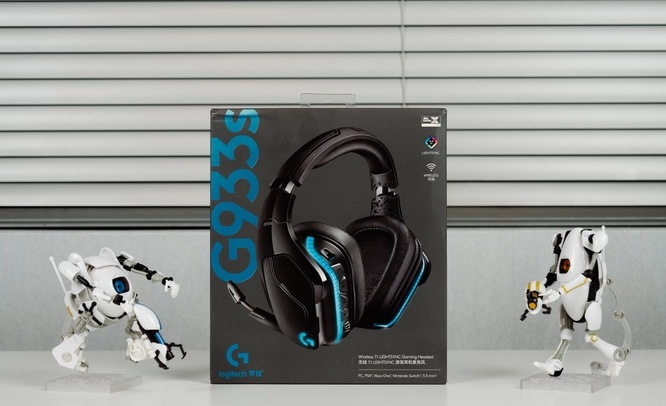
There aren’t too many companies, aside from Logitech that can claim to be more professional when it comes to gaming. In a bid to stay on top of the game, the Swiss computer and mobile peripherals manufacturer continues to refresh new limits on the keyboard and mouse design specs, and sweep its G-series game devices.
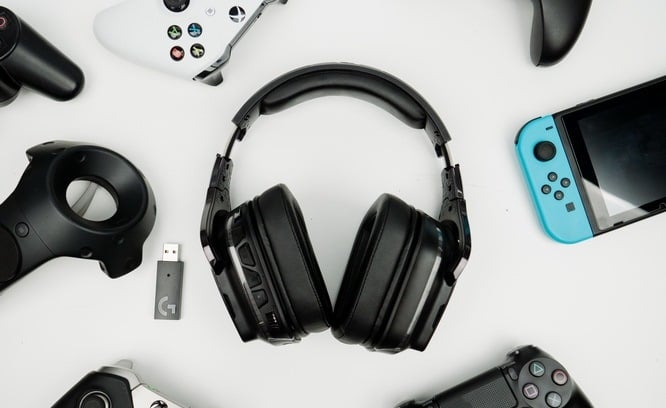
Designed to meet the varied needs of avid gamers, the flagship Logitech G933s gaming headset from the company’s well-received G series headphones doesn’t carry a steep tag. While other similar devices usually retail for about 2,000 yuan and 3,000 yuan, the Logitech G933s carries a more affordable 1,299 yuan price tag. In addition to being economical, the Logitech G933s boasts an impressive array of features and top-end specs that makes it a simply irresistible gaming headset.
Entertainment Overview
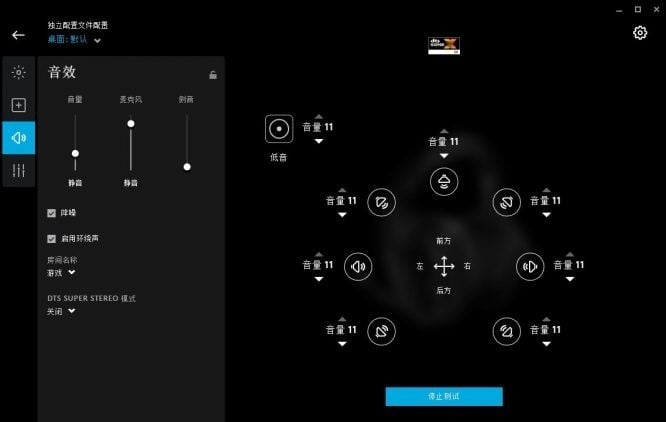
Logitech revamped the sound as part of the transformation from G933 to G933s. First off, the company DTS surround sound V1.0 with DTS Headphones to DTS Headphone: X v2.0. Relative to v1.0, DTS Headphone: X v2.0, emphasizing primarily on accent. Much to the delight of gamers, the Logitech G933s can reproduce seven directions of sound as well as a subwoofer.
Logitech
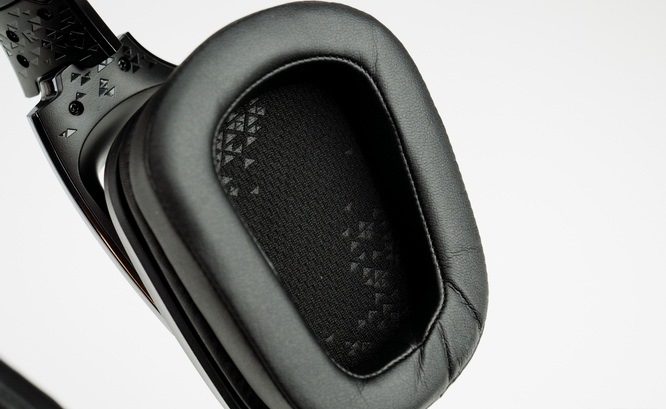
The newfangled audio renderer and head tracking enable the user to sense footsteps from enemies that are still far away. Simultaneously, the Logitech G933s received a headphone drive unit upgrade from the earlier Pro-G 40mm to the Pro-G 50mm. Moreover, the original sports woven mesh ear pad and headband were replaced with an artificial leather design, which facilitates soundproofing and wrapping.
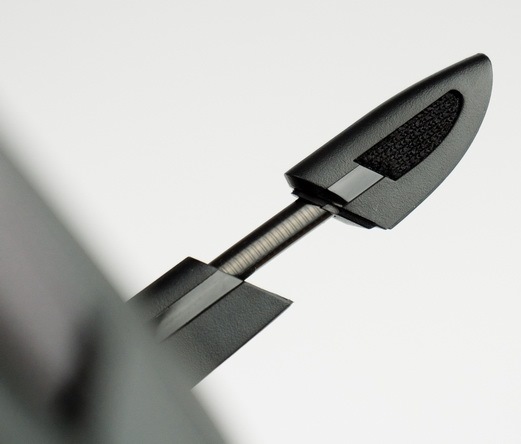
Furthermore, the headset microphone has been improved from the previous 4 mm folding mute microphone to the impressive 6 mm mute microphone.
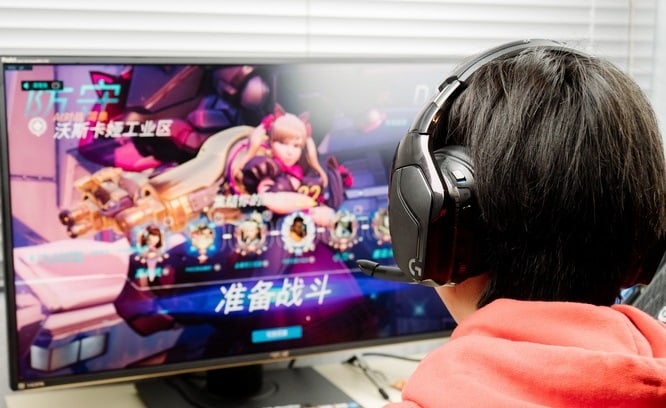
For instance, when you are playing PUBG the sounds of enemies stepping on the grass or someone climbing the steps are quite clear thanks to the strengthening of the subwoofer. Given that the enemy direction can be easily influenced, it is highly recommended to change the accent effect based on your preference at the time of use.
It is imperative for you to use the G933s properly, especially when you are fighting alone so that you can efficiently judge whether you can play without worrying about an enemy who could be hiding in the next corner.
It is worth noting that select PC headphones that are designed exclusively for gaming and entertainment have been equipped with DTS Headphone: X v2.0. Apart from sweeping avid gamers off their feet, the G933s is highly likely to impress cinephiles who fancy watching their favorite series and other online videos that support DTS multi-channel.
For example, in the DTS DEMO trailer voice of Solomon Ryan seems deeper, while the intense fighting rhythm of the drums, as well as the overall atmosphere, get relatively better than the regular PC headphones. On the downside, the D933 surround sound of G933s can be produced specifically using wireless transceivers that work with PCs. As a cost-effective DTS viewing solution, you might consider using mobile phones and external Blu-ray players.
The Logitech G933s gives users independent adjustment options for each channel of the 7.1, along with the DTS Super Stereo mode, which determines the environment before employing the front, wide, and traditional three sound field simulations. It is an efficient way of dealing with applications such as FPS, TPS, and others that aren’t very demanding on the ambient sound front.
Compatibility
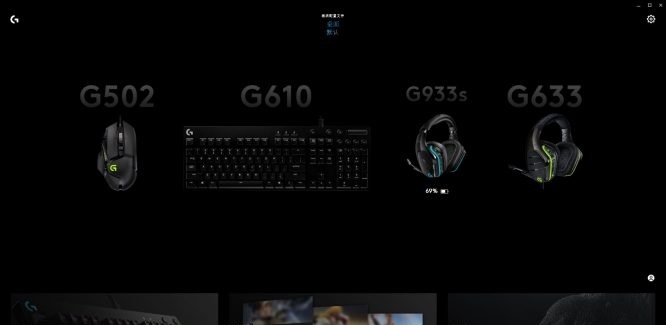
The compatibility of the original Logitech game software with the new Logitech G933s is something worth noting. Yes, the two of the software are no longer compatible with each other. With Logitech G933s, there comes a new Logitech G HUB which has fully upgraded its game interface and made the settings of the pages more intuitive.
Changing the lighting effects LightSync, custom button assignments, and adjusting sound effects is child’s play. All you need to do is to click on the corresponding device page on the first page of the software.
User Interface
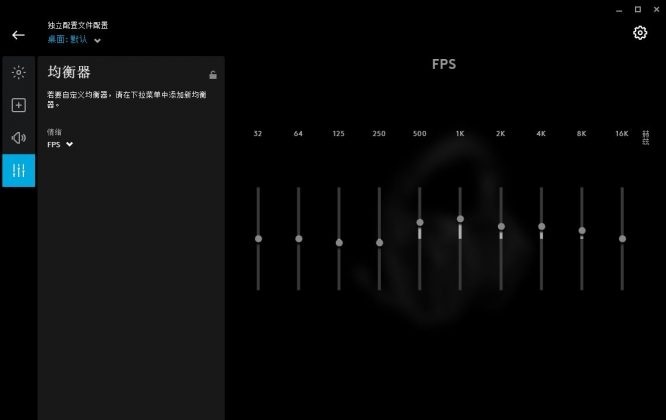
As far as the software UI level is concerned, G HUB has been considerably simplified. For instance, the second directory comprises relatively more complicated as well as usual details. Lighting control and a slew of other configuration files have been split into a single page, which comes in handy while implementing a unified solution for G-series keyboards, mice and headphones. As if that weren’t enough, you can adjust RGB lights, brightness, light effect, etc for a specific game.
On top of that, Logitech G HUB is forward compatible with all previously launched G series devices. It is capable of automatically identifying the downloaded driver and game matching through software. In order to identify all G series devices targeted matching games, all it needs to do is to download the corresponding configuration, and this is highly advantageous.
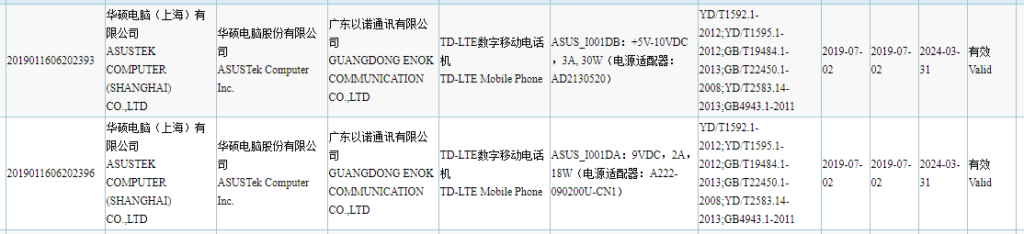
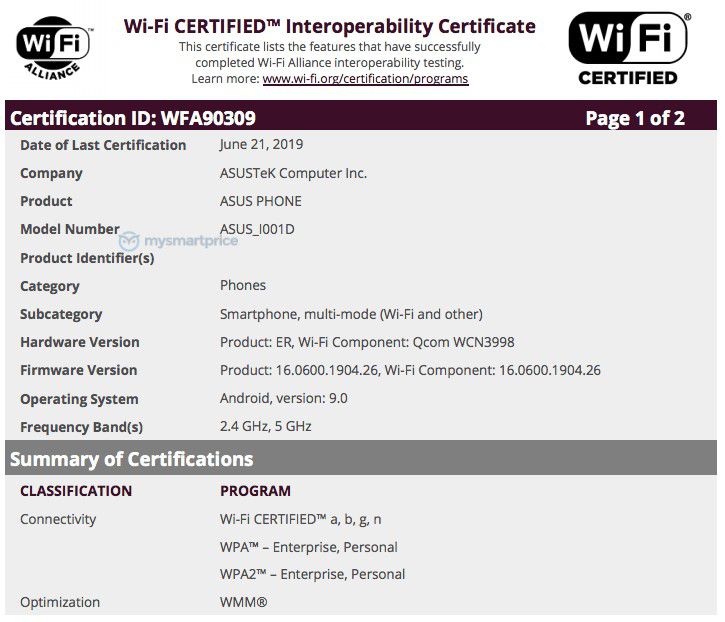
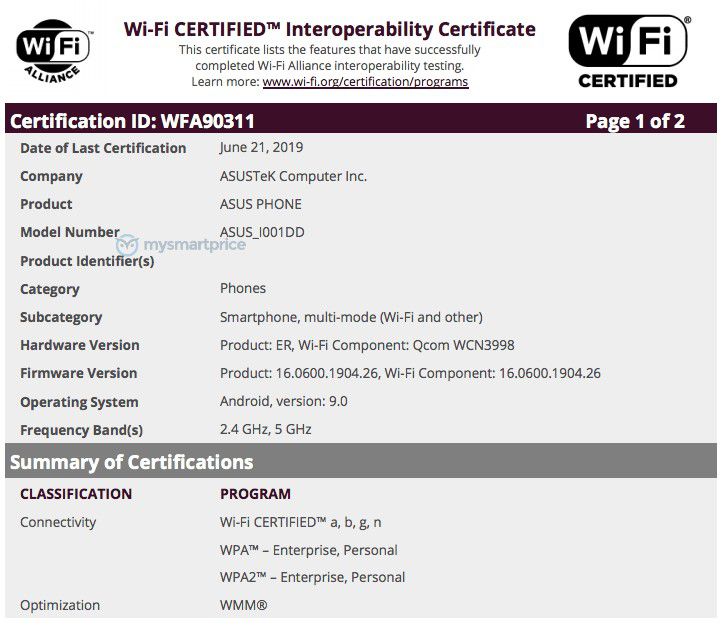
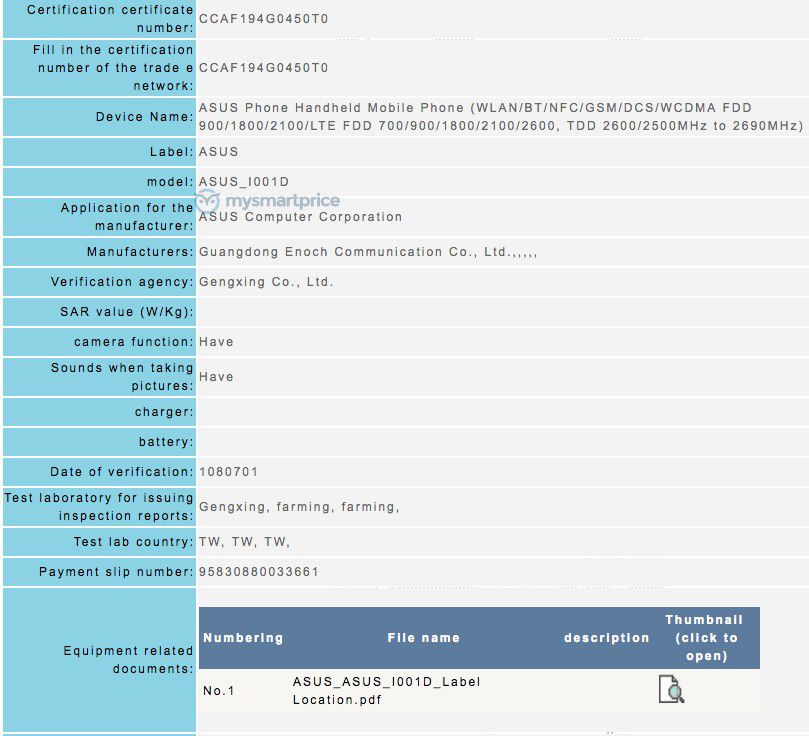
A new ASUS phone that has a model number of ASUS_I001D has been spotted receiving approvals from bodies like China’s 3C, Wi-Fi Alliance and Taiwan’s NCC. The exact identity of the phone is not known yet. However, some reports are claiming that it could be ASUS ROG Phone 2 that is scheduled to go official on July 23.
The database of China’s 3C certification has new listings for ASUS_I001DA and ASUS_I001DB variants for an upcoming ASUS phone. The listings reveal that the ASUS_I001DA handset will be available with a charger that will support for 30W rapid charging whereas the ASUS_I001DB will be arriving with an 18W fast charger. The support for 30W fast charging suggests that it could be the ROG Phone 2. However, the Wi-Fi certifications tell a different thing. The Wi-Fi Alliance listings of ASUS_I001D and ASUS_I001DD have revealed that it runs on Android 9 Pie OS and Wi-Fi 802.11 a/b/g/n which suggests that it could be a mid-range device.
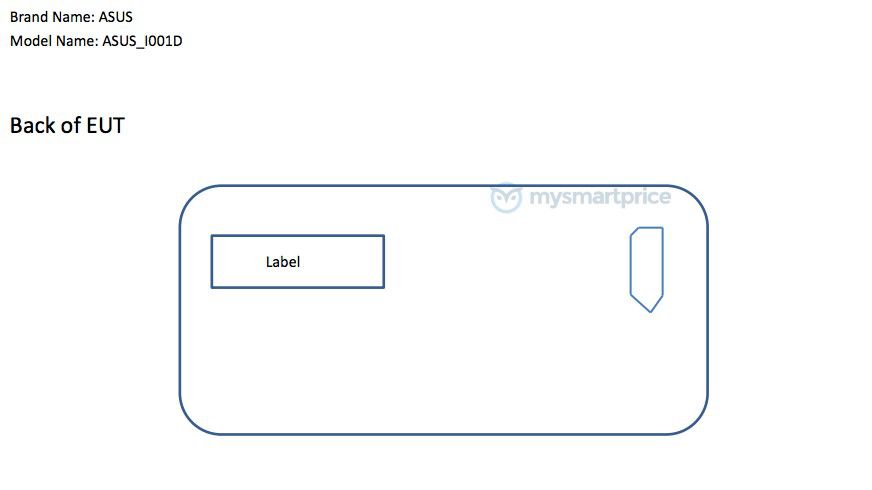
The same model number has been also certified by the National Communications Commission (NCC) in Taiwan. A schematic of the phone is available in the NCC documents, but sadly it reveals nothing on its design. There are no details of the phone’s specifications in NCC filings.
The Taiwanese company has previously confirmed that the upcoming ROG Phone 2 will be coming with a display that carries support for 120Hz refresh rate. The predecessor model had supported 90Hz refresh rate. The Snapdragon 855 mobile platform could be present under the hood of the device and it may feature up to 12 GB of RAM. The handset is rumored to release in two variants and its base model could be priced at 4,399 Yuan (~$635).
The ASUS ROG Phone from last year came with 6-inch AMOLED display with 18:9 aspect ratio, Snapdragon 845 chipset and 8 GB of RAM. It did not feature a microSD card slot but came in bigger internal storage options of 128 GB and 512 GB. The smartphone featured 12-megapixel + 8-megapixel dual camera setup and a selfie camera of 8-megapixel. It houses a 4,000mAh battery that supported 30W fast charging. For heat dissipation, it featured a carbon cooling pad, copper heat spreader and 3D vapor-chamber. It delivered enhanced gaming experience through built-in ultrasonic sensors that were dubbed as Air Triggers.
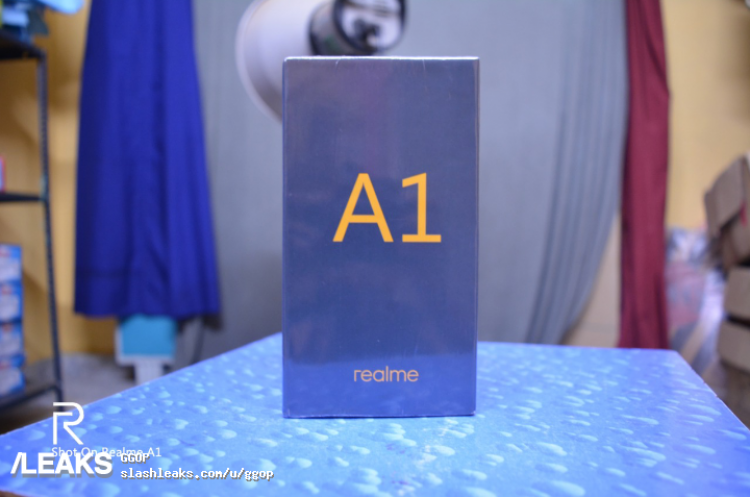
A few days before the end of 2018, news of an entry level Realme phone called the Realme A1 surfaced online. It was reported that it was going to launch soon back then but up until this moment it is yet to launch. Before today, the last time we heard of the Realme A1 was in February when it was reported it would launch alongside the Realme 3 but it didn’t. Now, a photo of the phone’s retail box has surfaced on the web.
The box doesn’t reveal any info about the device but seems to confirm that the product is still in the pipeline. Previous reports said the Realme A1 will be positioned between the Realme U1 and Realme 2. An alleged render of the phone even surfaced back then.
The Realme A1 is rumored to arrive with a waterdrop-notch, dual rear cameras, a 1.8GHz octa-core processor, 2GB/3GB of RAM, 32GB of storage and pack a 4200mAh battery. It should also launch with ColorOS 6 based on Android Pie.
Samsung has been having a pretty rough time in China but that doesn’t mean the company will be abandoning the World’s largest market anytime soon. The flagship Galaxy S10 was announced in China on February 28 and went on sale on March 8. The cumulative number of orders for the Galaxy S10 in just 15 minutes after it went on sale exceeded the orders the Galaxy S8 got on its opening day sales last year.
Counterpoint Research is attributed to have released a market data which gives us the idea that the S9’s opening day record wasn’t just a flash in the pan. The market data shows that the Galaxy S10 series sales from March to May 2019 have exceeded those of the Galaxy S9 in the same period.
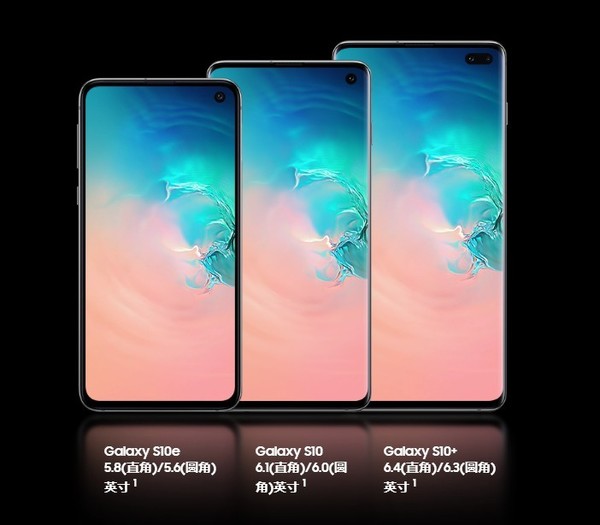
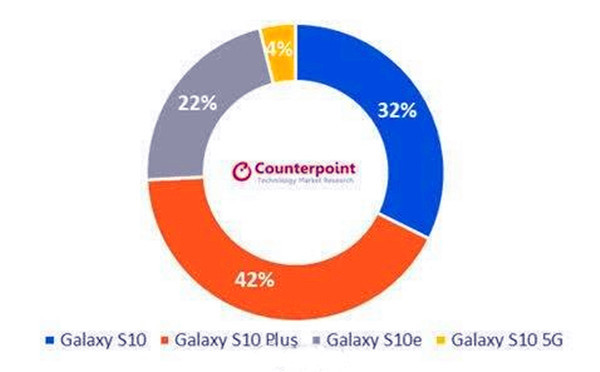
In the second quarter, 16 million Galaxy S10 mobile phones were sold worldwide, up 12% from the S9 sales in the same period last year. Specifically, the Samsung Galaxy S10+ is the most popular model, accounting for 42% of sales, followed by Samsung Galaxy S10, which accounted for 32% of sales. Samsung Galaxy S10e accounted for 22% of sales, while the Samsung Galaxy S10 5G Edition accounted for just 4%. The trend isn’t expected to stop soon and we believe the Galaxy S10 could help Samsung seize more market share. At present, Samsung’s flagship mobile phone has a 25% market share, an increase of 3% YoY.
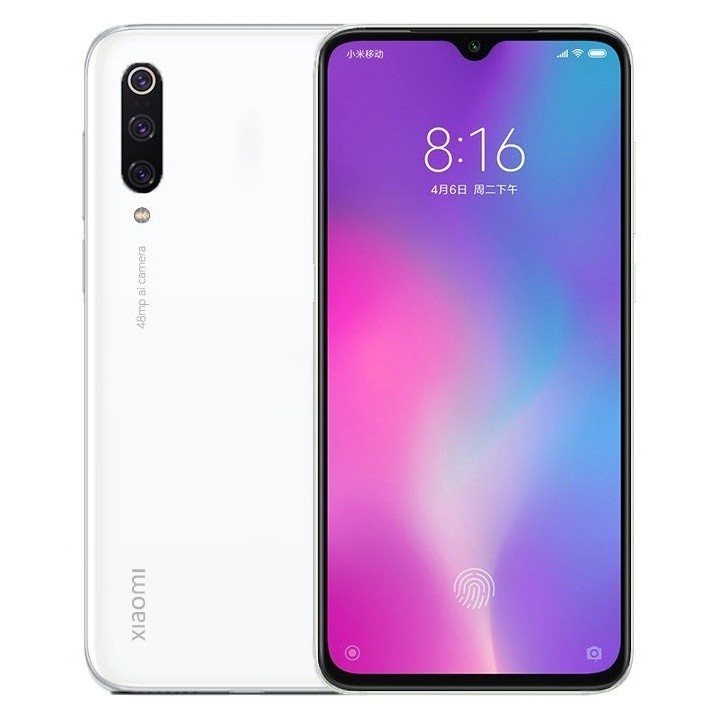
The new Mi CC series by Xiaomi which just replaced the Mi Max and the Mi Note line-up is ready to conquer the hearts of young people and money savers. The Xiaomi Mi CC9e is the entry-level device of the new line-up but it has some high-end features that you would not expect on such an affordable phone. Are they enough to prefer the Xiaomi’s new-entry to the best-selling Redmi Note 7 and its new rivals Realme X by Oppo’s sub-brand? Look at this comparison like a value for money battle and discover which device is the most balanced and performing with a price tag under $200 by going ahead reading this article.
Xiaomi Mi CC9e vs Redmi Note 7 vs Realme X
Xiaomi Mi CC9e
Xiaomi Redmi Note 7
Realme X
DIMENSIONS AND WEIGHT
153.5 x 71.9 x 8.5 mm, 173.8 grams
159.2 x 75.2 x 8.1 mm, 186 grams
161.2 x 76 x 8.6 mm, 191 grams
DISPLAY
6.01 inches, 720 x 1560p (HD+), 286 ppi, Super AMOLED
Triple 24 + 8 + 2 MP f/1.8, f/2.2 and f/2.4
32 MP f/2.0 front camera
Dual 48 + 5 MP f/1.8 and f/2.4
13 MP front camera
Dual 48 + 5 MP f/1.7 and f/2.4
16 MP f/2.0 front camera
BATTERY
4030 mAh, fast charging 10W
4000 mAh, fast charging
3765 mAh, fast charging 20W
ADDITIONAL FEATURES
Hybrid Dual SIM slot
Hybrid Dual SIM slot
Dual SIM slot
Design
At a first glance, Realme X may look like the device with the most stunning design due to its pop-up camera and its very narrow bezels. But if you hold all of these smarpthones in your hands, you will notice that Xiaomi Mi CC9e gives the most premium feel. While Realme X has a plastic body, Xiaomi Mi CC9e is composed of a glass back with suggestive light effects changing depending on the reflection, and a metal texture on the frame. The Mi CC9e is also a more compact device thanks to its smaller display.
Display
Realme X largely wins the display comparison because it simply comes with a better panel. It is an AMOLED display with a Full HD+ resolution. Redmi Note 7 is Full HD+ as well, but it has a less impressive LCD panel and no under-display fingerprint reader. Xiaomi Mi CC9e comes with an AMOLED panel, but the resolution is just 720p so it has a lower definition. That is why there is no challenge and Realme X wins the comparison. Its display is even protected by Gorilla Glass 5.
Specs & Software
Each device of this trio is equipped with a different processor, but all the chipset are by Qualcomm and belong to the midrange segment. However, the Snapdragon 710 found on the Realme X is better than Snapdragon 660 and 665 you can find on both the Redmi Note 7 and the Xiaomi Mi CC9e. Realme X even comes with up to 8 GB of RAM, while its rivals stop at 6 GB. The second place goes to the Xiaomi Mi CC9e.
Camera
The best camera department belongs to the Xiaomi Mi CC9e: it is the only with a triple camera including an ultrawide sensor, as well as an amazing 32 MP selfie camera with a very advanced AI portrait mode. Realme X comes right after, while Redmi Note 7 comes in two variants with different cameras: the Chinese one is more disappointing as it has a 12 MP f/2.2 main sensor, while the global version is better and delivers a similar photo quality to the Realme X thanks to a 48 MP main sensor.
Battery
Realme X has the smallest battery and the shortest battery life, but it charges faster thanks to a faster charging technology and the smaller battery capacity (and its battery life is still great, one day with most of the usages). Xiaomi Mi CC9e and Redmi Note 7 have an almost identical battery capacity (4030 mAh vs 4000 mAh) but the Mi CC9e wins because it has to manage a more efficient display which comes with a lower resolution and the AMOLED technology. And even its Snapdragon 665 chipset is more efficient with its 11 nm production process.
Price
Xiaomi Mi CC9e’s listing price starts from €170/$190, Realme X starts from €160/$180 and Redmi Note 7 starts from €180/$200, so price is definitely not the element which will make you decide. At the end of the day, I personally believe that the Xiaomi Mi CC9e is the most interesting one due to its premium build quality, great cameras, and bigger battery. But a lot of people may prefer the Realme X for its better (and bigger) display as well as higher performance.
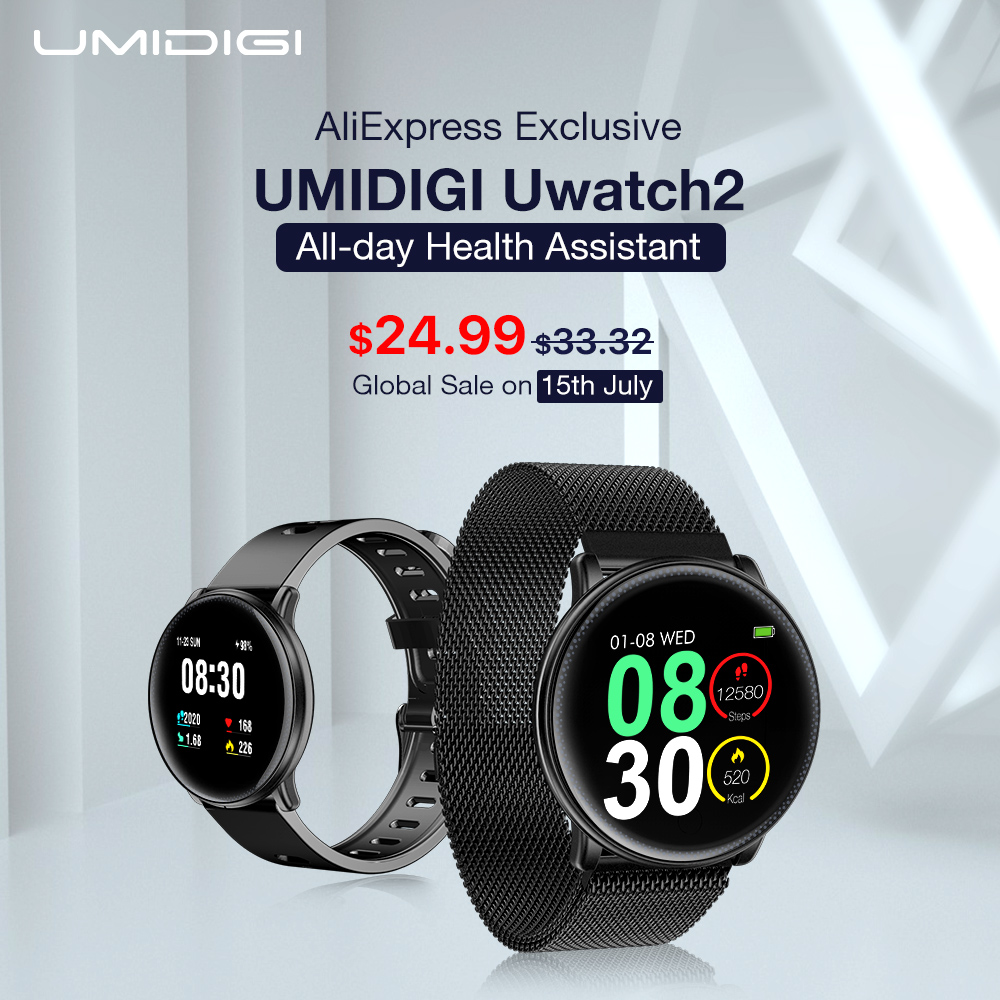
UMIDIGI Ubeats that was announced recently is the first product that marks the company’s new Ecosystem era and now UMIDIGI just launched another product, the UMIDIGI Uwatch2 smartwatch. It is the successor to last year’s Uwatch and comes with an enhanced full touch LCD screen design and other improved features.
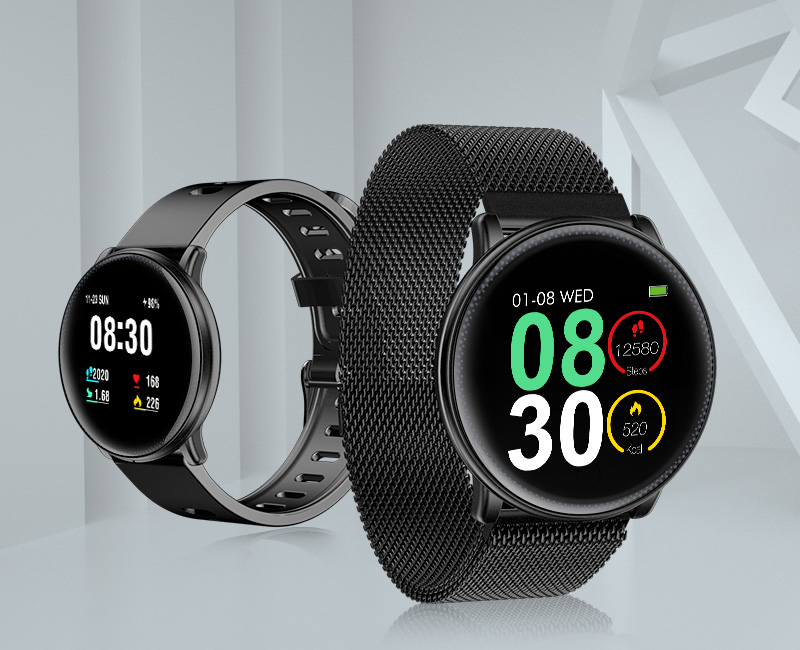
The top upgraded feature in the new generation is the improved full touch AMOLED display that offers better readability than before and is more convenient to use. The 1.3″ AMOLED color full touch display offers a 240×240 resolution and is protected with a layer of 2.5D curved glass on top. The Uwatch2 has a similar round face design and aluminum alloy unibody with the previous generation, looking premium and elegant.
1 of 2
In the box, you will find 2 free bands, one metal and one silicon, helping you easily switch depending on the occasion. So, that’s a plus, as you don’t need to buy another band.
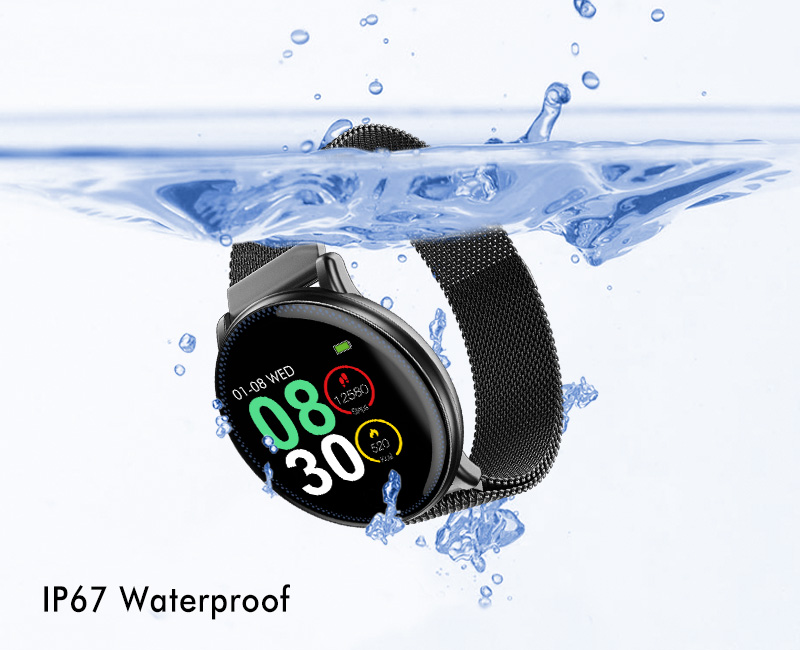
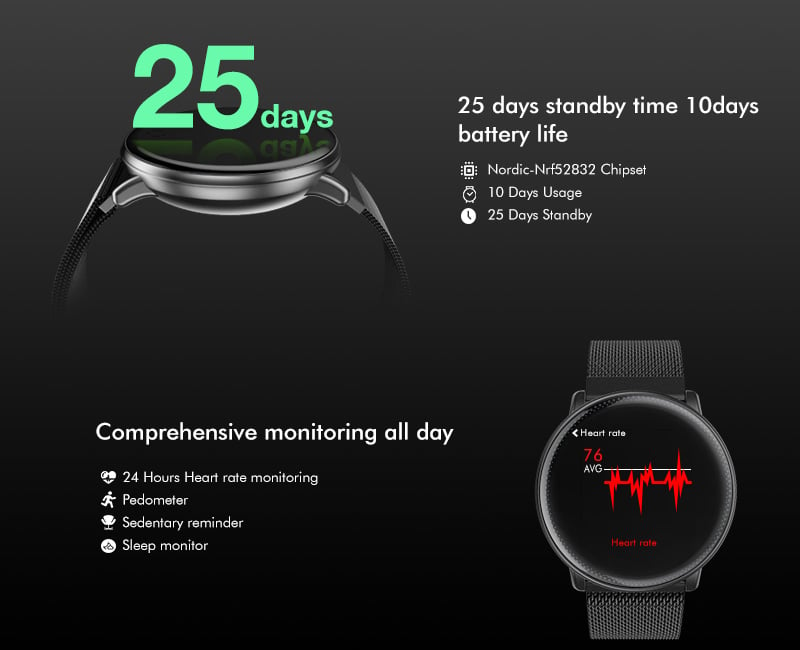
The Uwatch2 comes with IP67 water-resistant rating, along with several fitness tracking features, like running, jogging, cycling, besides the step counter. Also, compared to the first generation, the Uwatch2 now supports continuous heart rate monitoring to improve your exercise efficiency. In terms of battery life, with the help of the Nordic-Nrf52832 chipset, you can get up to 25 days of standby and 10 days of continuous use.
The UMIDIGI Uwatch2 is expected to go on global sale at $24.99 on July 15th. If you’re on the hunt for an affordable LCD smartwatch, you should consider giving it a chance. The Uwatch2 is already listed on the company’s official store on Aliexpress and you can add it to your cart to make sure that you don’t miss the global open sale. And as usual, UMIDIGI is globally recruiting 10 users to test it and help in its improvement. Learn more and join the Giveaway here.
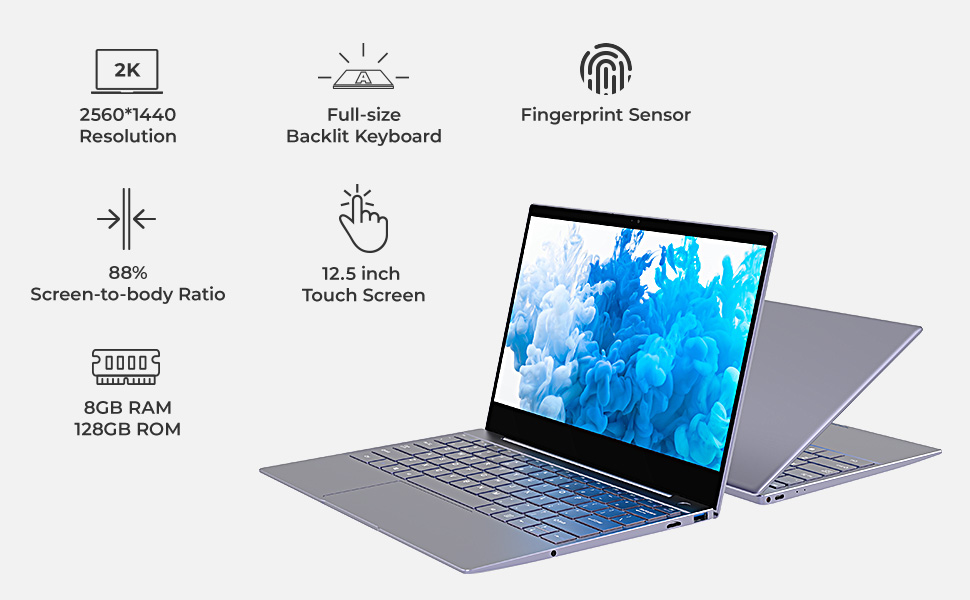
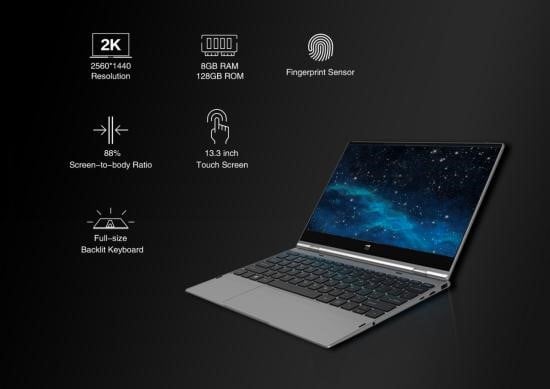
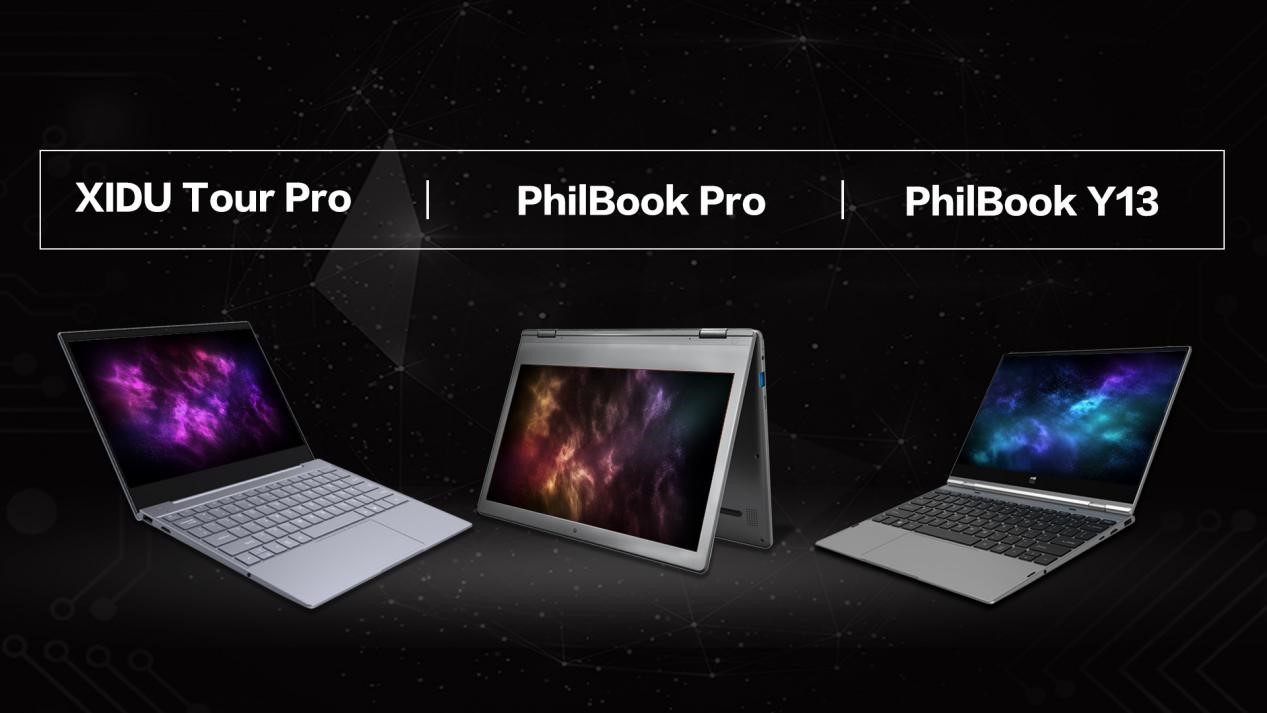
The emerging Chinese laptop manufacturer XIDU is getting ready for the launch of 3 new models next month. The new models are XIDU Tour Pro, PhilBook Y13, and PhilBook Pro. Aiming at not becoming just another mediocre Chinese manufacturer, XIDU provides various products of high quality that are well-received in the industry. To thank all supporters, the company decided to host a Giveaway competition during which you are to guess their price and the ones who are closer will receive one of the 3 models for free!
XIDU Tour Pro
The Tour Pro is a 12.5″ laptop that sports a 180° flexible hinge and touch support. The screen can lie flat on the desk, which enables users to share the screen face to face with their partners. The multi-touch display allows users to use Windows 10 without the need for a keyboard or mouse. It’s worth mentioning that the IPS display comes with 2560*1440 resolution and provides a colorful watching experience with ultra-narrow screen borders. Game and movie lovers are going to love this model considering the fact that it comes with Kaby Lake R 8th Gen CPU and high resolution.
XIDU PhilBook Y13
The Philbook Y13 is another model from XIDU that features a flexible hinge system that allows for 360° rotating of the display. This means that you can easily turn the 13.3″ laptop into a 13.3″ tablet thanks to the touch support of the display. Besides 180° and 360° rotation, you can also use tent mode in case you want to watch a movie or online video when relaxing on the couch. This model comes with the Kaby Lake R 8th Gen CPU as well with burst frequency up to 1.8GHz. The system is backed by 8GB of LPDDR4 RAM and 128GB or 256 GB SSD, which enables the users to run smoothly common office software, large picture and video processing apps, and even some heavy games.
XIDU PhilBook Pro
Lastly, the Philbook Pro is a pretty compact device with a display measuring 11.1″ display and is powered by the Intel Apollo Lake J3355 and Intel HD Graphics 500 chip. Colors are realistic and performance during HD video playback is stellar. This too comes with a 360° flexible hinge system while the full-bodied 4000mAh battery provides 4-5 hours of use easily.
These are the general features of each model and you can participate in the “Guess the Price” campaign to get one for free. All you need to do is take a guess and leave a comment. The company will choose the one who gets closer and if there are more than one correct answers, the winner will be the one that commented first. The activity will end on the day each product hits the market. For more details, visit their Facebook Page.
Huawei phone users in Singapore are in for a treat for the next two weekends. The Chinese giant is partnering with Partea, Singapore’s beverage company, to give out free drinks to Huawei users. Huawei says this is a way to thank its customers for their support.
According to Huawei, all you have to do is walk into any Partea outlet across the island nation this weekend i.e. July 5 to July 7 and next weekend July 12 to July 14 between 11 am and 2 pm and show your Huawei phone at the counter. You don’t have to own a prior Partea membership to enjoy the free drinks but you will be required to register as a member at no extra charge.
You can only claim one drink per day and you also have to be among the first 300 customers at any outlet per day. This means if you are lucky, you can get six free drinks in total. You will also be able to choose any drink you want.
The best way is here to stay! Every Huawei phone is a joy to behold. 😉 Partea with us to enjoy a free cup of your choice. Simply flash your Huawei phone over the counter to redeem this offer. Limited to one drink per customer, while stocks last.•Terms & Conditions apply:1. Promotion will be available at all Partea outlets, except Orchard Plaza, excluding Downtown Gallery and Clifford Centre on Saturdays and Sundays.2. Promotion is valid for two weekends in the month of July: 5 – 7 July and 12 -14 July, from 11am – 2pm, applicable for Huawei users who show their Huawei phones over the counter.3. All Huawei mobile phone users who are non-Partea members, can instantly join the free membership at any outlet to enjoy the deal.4. Complimentary drinks are limited to the first 300 customers in each participating outlet per day.5. Customers are entitled to any drink on the menu, limited to 1 redemption per customer, per day.•For more info on promotion -> https://bit.ly/2xsGaoq•#wearehuawei #parteawithhuawei #parteasg #keepcelebrating
The Partea outlet at Orchard Plaza is exempted. You will also not be able to get a free drink at the Downtown Gallery and Clifford Centre on Saturdays and Sundays.
Big Battery phones are a bit misunderstood as most people think that their main and most important feature is their battery life. But now that hardware has surpassed software’s capabilities, big battery phones are pretty capable of doing anything you want. The Ulefone Power 6 is a perfect example of this as, besides the big battery, it comes with pretty solid features as well. This is showcased in the following video that shows the performance of Power 6. Let’s have a closer look.
As you can see, the Power 6 scored 82,117 on AnTuTu Benchmark while the single core score on Geekbench 4 is 906 points and the multi-core score is 3,725 points. That’s about the same as the Qualcomm Snapdragon 632. This performance is the result of using Helio P35 octa-core SoC clocked at up to 2.3GHz.
Besides the benchmarks, the user tested real-world performance using Twitter, Instagram, Youtube, and played PUBG and Arena of Valor. Thanks to the snappy Helio P35 apps load faster and the device delivers a smooth gaming experience without stutters. Helio P35 uses ARM’s A53 codes and is manufactured using the 12nm FinFET process from TSMC and that helps with good performance and low power consumption.
Besides the excellent battery life, the device also comes with a large 6.3″ waterdrop display as well as 4GB of RAM and 64GB of internal storage. There is a dual rear camera with 16MP/2MP sensors and a front 16MP one that supports Face unlock combined with Fingerprint unlock for ultimate protection. Lastly, there is GPS/Glonass/Beidou/Galileo navigation system, global network support, NFC, and Android 9 Pie.
To sum up, if you are looking for an affordable and practical smartphone with a large battery and balanced configuration, Power 6 should definitely be among your choices. It is currently on promotion right now on Banggood and you can get it for just $159.99 with the offer expiring on July 7th. Apart from that, the phone has already arrived at distributors and deliveries should begin soon.
There are just a couple of 5G phones launched already but we don’t expect 5G phones to be a rave this year. Demands may be low since carriers are still testing their 5G networks. So far, the 5G-enabled phones that are available to buy are just a handful such as the Galaxy S10 5G, LG V50 ThinQ, OnePlus 7 Pro, Oppo Reno 5G and Motorola’s Moto Z4 with the 5G Moto mod. Next year may see a surge in the number of 5G phones in the market but according to a research firm, the new platform which will bring big upgrade in data speed will only become a norm in the next four years.
Canalys projects that 5G phones will sell way more than 4G smartphones by 2023. In other words, between now and the next four years, more carriers would definitely deploy their 5G infrastructures and also more OEMs will launch 5G phones on the flagship and even mid-range tier. The research outfit also projects that most of the 5G adoption will take place in China. This projection is hinged on the Chinese government’s effort and support as well as the efforts of tech companies.
Globally, Canalys estimates sales of 5G phones will peak at an estimated 800 million units, making up 51.4% market share. China will account for 34% while North America will make up approximately 18.8%.
In a statement released today, Nicole Peng, vice president of mobility at Canalys said; “China is also home to many major 5G equipment suppliers and smartphone vendors, which will be responsible for an aggressive marketing push over the next few years.” He also added; “But mass market adoption of 5G smartphones does not necessarily mean a successful 5G deployment. The full 5G deployment will take much longer, and be much more complex than the previous network generation, in order to realize the benefits of 5G beyond eMBB (enhanced Mobile Broadband).”
A new Nubia phone is coming and thanks to photos shared on Weibo, we know it will launch as the Nubia Z20. Yes, it appears Nubia is skipping the number 19 and jumping straight to 20. But seeing as we are in the year 2019, doesn’t it make sense that the name follows the year?
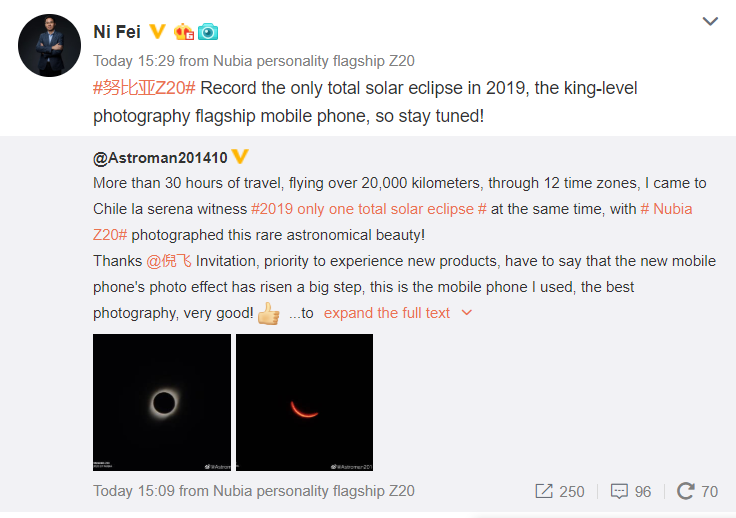
The Nubia Z20 will succeed the Nubia Z18 which launched last September. To show off the phone, Nubia has partnered with Dr. Deng Licai of the Chinese Academy of Sciences who goes by @Astroman201410 on Weibo.
The scientist was able to capture the solar eclipse which occurred in Chile yesterday with the Nubia Z20. In his Weibo post which includes photos taken by the phone, he praised the camera prowess of the device and says it has greatly improved over its predecessor.
Nubia’s President and co-founder, Ni Fei, retweeted the post and added that the Nubia Z20 is a flagship camera phone. Weibo also shows that he made the post with the Nubia Z20 which hints that the phone is close to launching.
The Nubia Z20’s specs and design are unknown at the moment but we expect it will come with a Snapdragon 855 processor. It should also launch with Android Pie out of the box. It will be nice to get a bigger battery but Nubia may also decide to add a bigger display.
We expect more details of the phone will surface in the coming weeks.
Samsung Electronics once enjoyed a robust market in India but that has changed drastically in the last few years, thanks to Chinese phone makers. In order to cut cost, the South Korean tech giant is reportedly planning to lay off 1000 of its employees. The tech giant will also be cutting the prices of its smartphones and televisions.
The tech giant has reportedly sacked about 150 employees at its telecom networks division with more to go as it set an October deadline to wrap up the process of manpower rationalisation. The lay off will hit workers in all departments including sales, marketing, R&D and manufacturing, finance, human resources and corporate relations. The company has already mandated business heads to report all under-performers as well as those who fail to deliver targeted results in their team.
Samsung has an estimated 20,000 workforce in India and Samsung’s headquarters has reportedly sanctioned the move. The company now wants to focus on generating profit growth instead of revenue from India.
BusinessToday.In quotes a spokesperson for Samsung India to have hinted that Samsung is committed to India and will continue to invest significantly across its businesses in the country.
“In the past one(sic) year, we have generated 2,000 new jobs at Samsung. Samsung India’s business continues to grow and expand, hence we will hire more talent across businesses through(out) the year. As we contribute to job creation, we continuously realign resources as per business priorities to make our business more robust and efficient for long term success,” the spokesperson said.
“As regards business, with new products across categories, we have been able to consolidate our market share further, and 2019 will be a record year for the company,” he added.
Yesterday, it was officially confirmed that the Honor 9X will be announced on July 23. Prior to the announcement of the release date, alleged specs of the phone already leaked. Now a new set of leaks have surfaced. One shows what the phone will look like and another is a new set of specifications while a third mentions a new feature.
According to the newly leaked specs by Sudhanshu Ambhore, the Honor 9X will have a 6.15-inch AMOLED display with a 2240 x 1080 resolution. The display is smaller than that of the Honor 8X but fans of the series will be excited to see that Honor is switching to AMOLED. However, that may also mean the phone will be priced higher.
It is a bit unusual that Honor will use an AMOLED display on its mid-range phones when its latest flagships, the Honor 20 and Honor 20 Pro have LCD displays. But it is understandable as the Honor 20 phones had to settle for punch hole LCD displays since Samsung is the only manufacturer with phones that have punch hole AMOLED displays.
The leak says the phone will have an octa-core processor but doesn’t specify which one it is. Previous leaks have revealed it will be powered by the new 7nm Kirin 810 chipset that launched with the Nova 5. The SoC will be paired with 6GB of RAM and 128GB of storage.
The Honor 9X will have a 20MP selfie camera and dual rear cameras (20MP + 16MP). It will also have support for 10W charging via a USB-C port. That seems slow for a phone that packs an AMOLED display and a 7nm chipset.
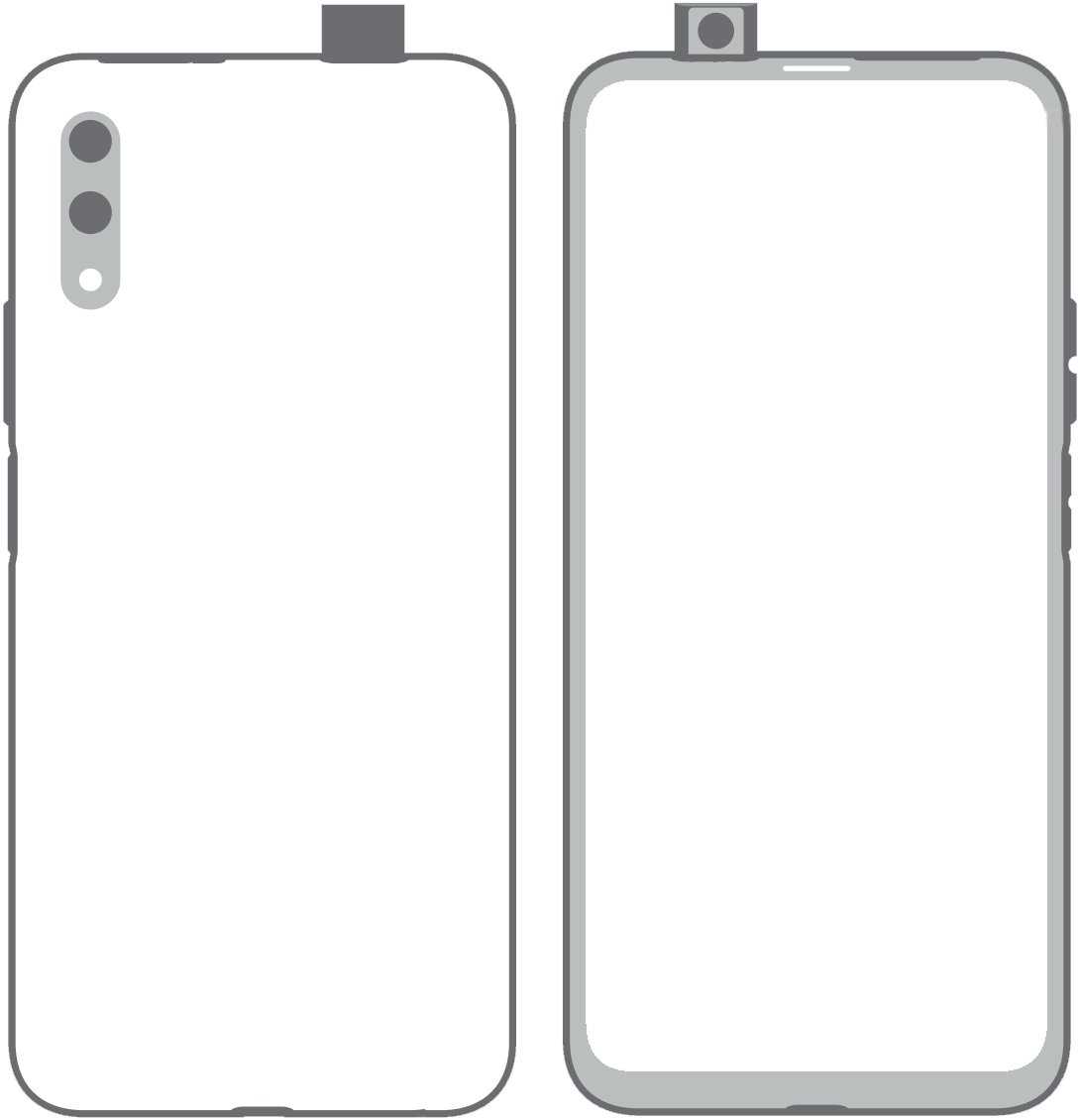
The source of the second leak is Evan Blass (@evleaks) who tweeted a diagram of the phone with the caption “Honor 9X”. The image is said to be from the phone’s user manual.
The image shows the Honor 9X will have a display that nearly covers the entire front of the phone. The bezels have been trimmed down but the chin is slightly thicker than the rest.
The phone doesn’t have a punch hole or notch too. Instead, it rocks a pop-up selfie camera just like the Huawei P Smart Z and Huawei Y9 Prime 2019. Going by the leaked specs above, the selfie camera is a 20MP sensor.
The image also shows the rear of the phone which is home to dual rear cameras. The cameras and the LED flash share the same housing and are positioned on the left side of the phone. The first leaked specs actually said the phone will have triple rear cameras but this image shows otherwise. The new leaked specs also states the phone will have dual rear cameras.
There is no fingerprint scanner on the rear of the Honor 9X but seeing as the phone will be coming with an AMOLED display, that means there should be one under the panel.
The phone’s retail box also surfaced in a video shared by @RODENT950. The box is white at the top with blue sides and there is “9X” and “Honor” inscribed on it.
In another tweet, he says the Honor 9X will support a new gamepad shown below. The gamepad a directional keys and a joystick on one side and action buttons and another joystick on the opposite side. There are some extra buttons too on each side.
Honor 9X have USB C connection features and support this new gamepad, so Honor not release Honor Play successor this year or ever because X series takes its place🤔 #Honor9Xpic.twitter.com/zi56d78Zf4
He adds that the Honor Play will not be getting a successor this year or ever, so the X-series will be taking its place which explains why it is getting a gaming accessory.
The Honor 9X should run EMUI 9 based on Android Pie out of the box. It is also expected to come along with a Pro model.
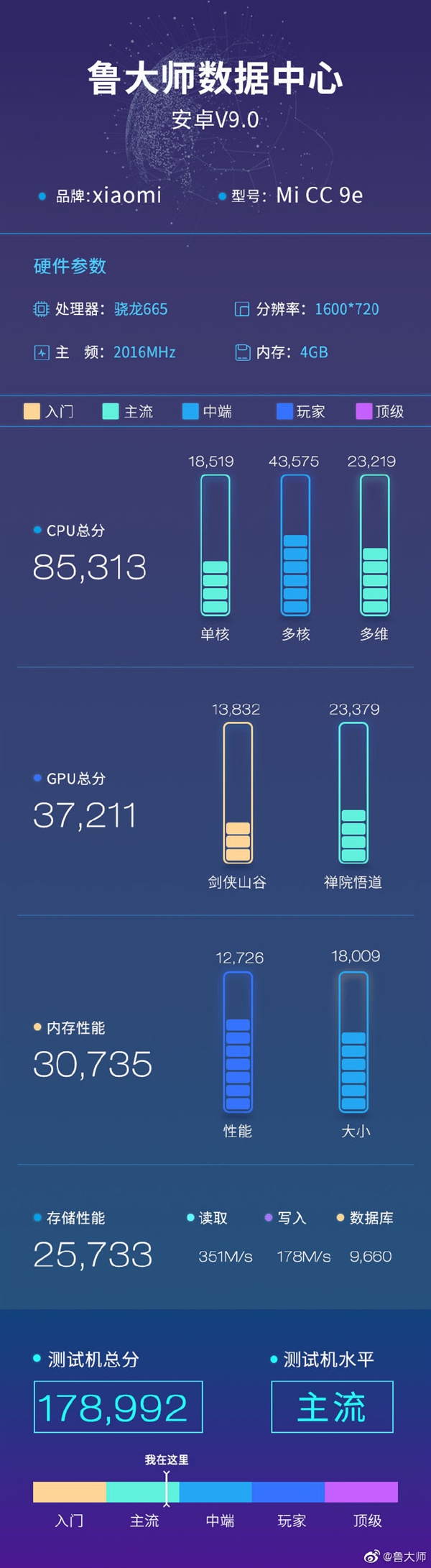
Master Lu benchmark is quite popular in China just like GeekBench is in other markets. The benchmark app recently benchmarked the Snapdragon 665 SoC aboard the new Xiaomi Mi CC9e. Qualcomm first announced the Snapdragon 665 chipset alongside the Snapdragon 730 in April this year.
Xiaomi Mi CC9e render
The Mi CC9e is perhaps the first device that is going official with the new chipset onboard. In terms of performance, the chipset scored 178,992 points. This score is similar to that of the Snapdragon 660 with very little improvement. The Snapdragon 660 Master Lu’s benchmark score as benchmarked on the Redmi Note 7 is 165,683 points. However, the Snapdragon 665 puts AI at the forefront thanks to the Adreno 610 AIE GPU. Qualcomm claims the new AI features onboard the SD665 is twice faster than that of the Snapdragon 660.
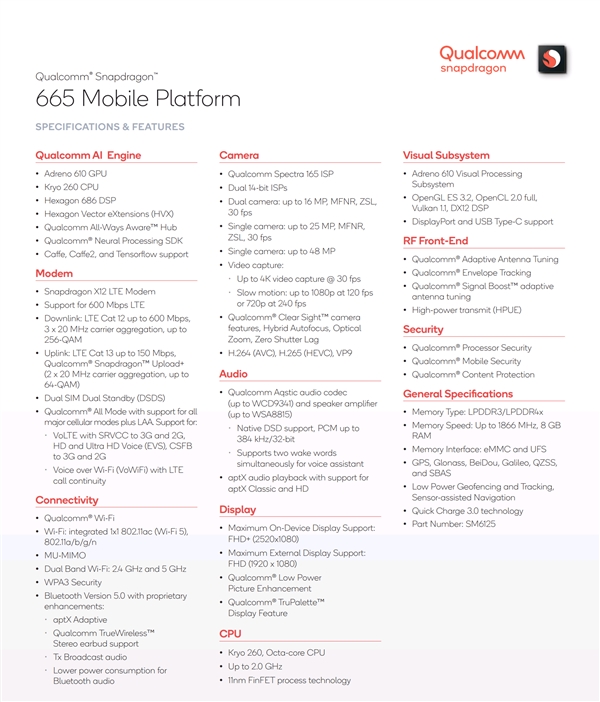
The Snapdragon 665 is an 11nm octa-core chipset made up of eight Kryo 260 cores in a 4+4 arrangement clocked at 2.0GHz. The smaller node ensures there better power efficiency. The third-generation AI on-board works with the new Hexagon 686 DSP and Qualcomm Spectra 165 ISP for better low-light photography, better portraits, and better ways to interact with your environment. The onboard AI engine also provides better security with support for 3D Face Unlock.
The Snapdragon 665 supports Bluetooth 5.0 LPE, USB 3.1, up to 16MP dual camera and 48MP single camera, 4K at 30fps, and slow-motion recording up to 120fps at 1080p. Maximum display support is 2520 x 1080 (FHD+). It also supports Quick Charge 3.0.
Xiaomi and its sub-brands are on a roll this year. After Redmi launched a brand new K20 series a month ago, Xiaomi revealed its new CC series yesterday. With the sheer amount of Xiaomi phones in the market, readers are often confused about how they all differ from each other. In fact, on first glance, the new Xiaomi Mi CC9 looks identical to the Xiaomi Mi 9. But don’t be deceived, they differ in more ways than you can imagine. So, in this article, let’s take a deeper look at Xiaomi Mi 9 vs CC9 comparison and why they differ quite significantly.
In order to understand how both the phones differ and why they are priced differently, let’s take a look at them in detail down below.
Xiaomi Mi 9 vs CC9: Design
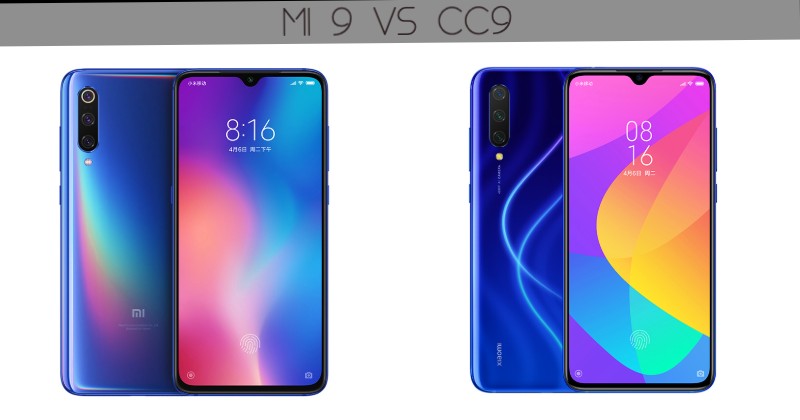
This is one department where both the phones are the most similar. They both share a similar form factor mainly due to the fact that their displays are identical. Both the phones feature a 6.39-inch Super AMOLED 2340 x 1080p display up front with a waterdrop notch. The notch sizes are also very similar. Coming to the back, both the phones feature a triple camera setup in an identical vertical arrangement. All these factors contribute to their similar looks.
Mi 9
CC9
However, their similarities end here, even in their design. To make things simple, I’ll list down the differences in the design below.
Dimensions: Mi 9 – 157.5 x 74.67 x 7.61mm vs CC9 – 156.8 x 74.5 x 8.67mm
Weight:Mi 9 – 173g vs CC9 – 179g
Mi 9 – Special AI button vs CC9 – No AI button
Mi 9 – No headphone jack vs CC9 – 3.5mm Headphone Jack
Mi 9 – Special highlight on the first camera lens vs CC9 – No highlight on any camera lens
Mi 9 – Horizontal Mi logo on the back vs CC9 – Vertical Xiaomi logo on the back
Mi 9 – Piano Black, Ocean Blue, Lavender Violet vs CC9 – White Lovers, Dark Blue, and Black
Thanks to CC9’s colors, the phone looks more vibrant and colorful than the Mi 9. And that’s exactly what Xiaomi wants. It’s aiming to portray the Mi CC9 as the smartphone for the youth, while the Mi 9 is placed as the true flagship at a bargain price. The similarities in their looks mean Xiaomi didn’t have to worry too much about coming up with a revamped design. This also makes mass production of these new models much easier.
802.11ac dual-band Wi-Fi,BL 5.0, USB Type-C, No headphone jack
Extended Worldwide LTE Bands support
802.11ac dual-band Wi-Fi,BL 5.0, USB Type-C, 3.5mm headphone jack
Regular LTE Bands support
BATTERY
3300mAh battery @ 27W fast charging
Wireless Charging
4030mAh battery with 18W fast charging
SOFT.
MIUI 10 based on Android 9
MIUI 10 based on Android 9
COLORS
Piano Black, Ocean Blue, Lavender Violet
White Lovers, Dark Blue, and Black
PRICE
6 GB RAM + 128 GB storage – 2,999 Yuan (~$436)
8 GB RAM + 128 GB storage – 3,299 Yuan (~$480)
6 GB RAM + 64 GB storage – 1,799 Yuan (~$260)
6 GB RAM + 128 GB storage – 1,999 Yuan (~$290)
The Xiaomi Mi 9 is a true flagship with Snapdragon 855 on board, while the Mi CC9 is a mid-ranger at best with Snapdragon 710 on board. Further, the Mi 9 has a better rear camera setup with a set of telephoto lens for optical zoom. The Ultrawide mode should also be better on the Mi 9, thanks to a larger 16MP sensor. Unlike the Mi 9, CC9 also doesn’t support 4K 60fps video recording or 960fps slo-mo recording at 1080p. The Mi 9 flagship has an advantage in the number of LTE bands supported, adding worldwide LTE support as well.
But the Xiaomi CC9 isn’t without its own set of unique features. For example, the phone has a larger 4030mAh battery to keep you going for an entire day. It also features a seventh-generation screen fingerprint sensor as opposed to the fifth-gen. one on the Mi 9. Another major difference is the presence of the headphone jack on the CC9. The Xiaomi Mi 9 had to ditch this port to make room for better specs.
CC9 White
Xiaomi Mi 9 vs CC9: Conclusion
As you can see, the Xiaomi Mi 9 and CC9 are different in more ways than you would have imagined. The Mi 9 is targeted at users who are looking for an affordable flagship smartphone with top-end specs. On the other hand, the Xiaomi CC9 is targeted at a younger crowd who don’t want to spend a lot but are looking for a better value for money. That explains why Xiaomi decided to retain a headphone jack on the CC9 (wired headphones are cheaper) and add a better 32MP selfie camera on the front.
Mi 9
So if you were confused about the differences between the two models, I hope this article helps in clearing your doubts.
We use cookies on our website to give you the most relevant experience by remembering your preferences and repeat visits. By clicking “Accept”, you consent to the use of ALL the cookies.
This website uses cookies to improve your experience while you navigate through the website. Out of these, the cookies that are categorized as necessary are stored on your browser as they are essential for the working of basic functionalities of the website. We also use third-party cookies that help us analyze and understand how you use this website. These cookies will be stored in your browser only with your consent. You also have the option to opt-out of these cookies. But opting out of some of these cookies may affect your browsing experience.
Necessary cookies are absolutely essential for the website to function properly. This category only includes cookies that ensures basic functionalities and security features of the website. These cookies do not store any personal information.
Any cookies that may not be particularly necessary for the website to function and is used specifically to collect user personal data via analytics, ads, other embedded contents are termed as non-necessary cookies. It is mandatory to procure user consent prior to running these cookies on your website.