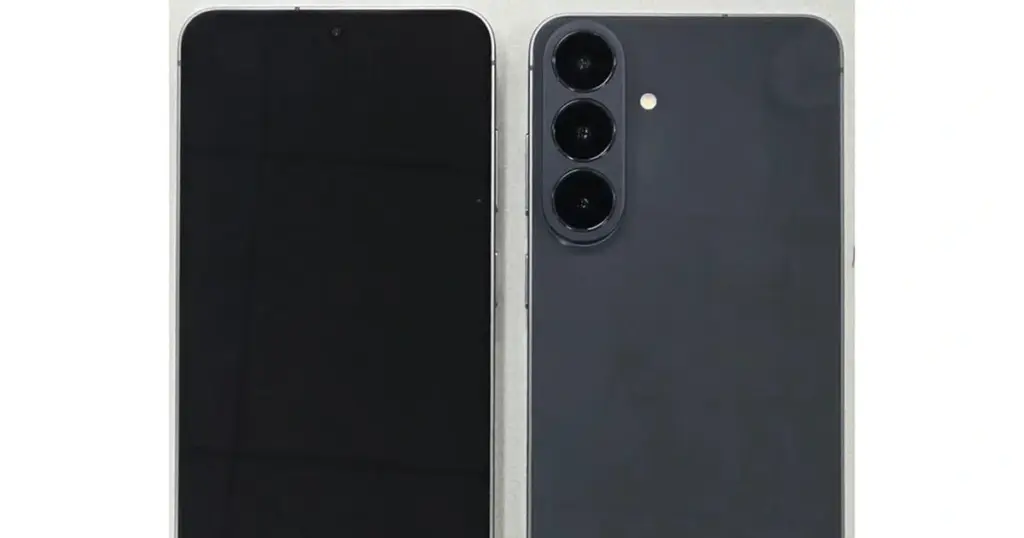
A set of new leaked images paired with a fresh FCC filing show more of what the Galaxy S26 FE looks like, and how close it is to launch.
The smartphone appeared in high-resolution images, confirming three colors: Black, Green, and Purple. Design-wise, it follows the standard Galaxy S26, with a single rear camera island housing all three lenses, the LED flash sitting beside it.
Up front, the phone has a flat display, thin bezels, and a centered punch-hole selfie camera. The bottom bezel looks slightly thicker than the rest, though the difference is small.
Galaxy S26 FE FCC listing
Separately, the phone has cleared FCC certification in the US, usually one of the last regulatory steps before a phone goes on sale. The filing doesn’t confirm the chipset, but it mentions that Samsung is using a Qualcomm chip for Wi-Fi, unlike Exynos on S25 FE.
The main chip powering the phone will still be in-house, likely the Exynos 2500, as shown in earlier Geekbench listings. However, Qualcomm for WiFi is a change from all-Exynos S25 FE.
The paperwork also confirms the same 45W wired charging as the outgoing model, along with wireless charging, NFC, Wi-Fi 6, and satellite connectivity. It may also retain the 4,900mAh battery with 45W wired charging, and feature a 6.7-inch Dynamic AMOLED 2X display with a 120Hz refresh rate.
Between these renders, the test firmware that surfaced a few months back, and now the FCC approval, testing on the phone appears to be in its final stages. We are expecting launch in September, and the phone is likely to ship running One UI 9 on top of Android 17 out of the box.
The Galaxy S26 FE looks set to pick up one of the more useful camera upgrades introduced this year. A practical software feature that keeps video footage level is showing clear signs of making its way to the device.
Leaked firmware for the Galaxy S26 FE, uncovered by SammyGuru, includes a flag labeled SUPPORT_SUPER_STEADY_HORIZONTAL_LOCK set to true. That’s a pretty strong signal that Samsung is actively testing Horizontal Lock on the device. The feature first showed up on the Galaxy S26 series and was later rolled out to the Galaxy Z Fold 8, Z Fold 8 Ultra, and Z Flip 8.
Horizontal Lock works alongside Samsung’s existing Super Steady stabilization. It keeps the video frame level even when the phone rotates or tilts in your hand, using the gyroscope and accelerometer to make real-time corrections. The result is smoother, more professional-looking footage without needing a separate gimbal, especially handy for walking shots, action clips, or casual vlogging.
Instead of relying on new hardware, the feature fixes a common everyday annoyance through software, which helps explain why Samsung is spreading it across more of its lineup. Reports also suggest older Galaxy S25 devices will get Horizontal Lock later through a One UI 9 update, which further points to the company’s plan to make it a standard camera tool.
The same firmware dig turned up another early clue: a software update banner prepared for One UI 9.5. That doesn’t mean the S26 FE will launch with that version, but it does confirm Samsung is already building assets for the future interface well ahead of any public release.
Samsung is expected to introduce the Galaxy S26 FE in early September, likely timed around IFA 2026 in Berlin. If Horizontal Lock ships as the firmware suggests, it would give the Fan Edition a real video advantage over previous mid-range models and bring it closer to the flagship experience in one of the areas users notice most.
Redmi has shared a closer look at the K100 Pro Max ahead of its launch, revealing official camera samples along with additional details about its imaging hardware. The company is positioning the phone as its most capable camera-focused flagship yet, with a versatile triple-camera system designed to cover a wide range of shooting scenarios.
Redmi K100 Pro Max camera system officially detailed
The Redmi K100 Pro Max features a 200-megapixel primary camera capable of producing images with a native resolution of 16,384 x 12,288 pixels. It is accompanied by a 5x periscope telephoto camera that supports up to 100x digital zoom and a 50-megapixel ultra-wide camera with a 17mm equivalent focal length. According to Redmi, the combination delivers coverage across five focal lengths, allowing users to capture everything from expansive landscapes to distant subjects using a single device.
The company also released a series of sample images captured at 17mm, 24mm, 48mm, 120mm, and 240mm. Redmi says the high-resolution main camera enables lossless-quality in-sensor cropping at 2x and 3x zoom, while the periscope camera, combined with OIS, handles long-distance photography with improved stability and detail. The phone also adopts a flat camera module with an integrated design that gives the rear panel a cleaner appearance.
Redmi has also confirmed a Bose-tuned 2.1-channel speaker system featuring dual 1115D full-range drivers and a dedicated 1620 subwoofer, along with a large X-axis linear motor.
The K100 Pro Max is equipped with a 6.9-inch OLED display featuring the new M11 emissive material, a 185Hz LTPO adaptive refresh rate, a peak local brightness of 4,500 nits, and 90 percent BT.2020 color gamut coverage. It also includes a 480Hz instant touch sampling rate and an ultrasonic in-display fingerprint scanner.
Powering the device is Snapdragon 8 Elite Gen 5 V-series chipset, paired with the AI Display Chip D2. The phone packs a 9,070mAh battery with support for 100W wired charging, 50W wireless charging, 27W wired reverse charging, and 22.5W wireless reverse charging. The phone will be available in Cabernet Red, Flowing Gold White, and Black finishes.
For more daily updates, please visit our News Section.
Several reports have claimed that iQOO will unveil a new Neo-series phone in China. Rumors claimed that it could be a minor upgrade over the existing Neo 11, which is why it was tentatively dubbed the iQOO Neo 11S. Today, the brand officially confirmed that the upcoming device will be called the iQOO Neo 11 Ultra.
The iQOO Neo 11 Ultra is set to be officially unveiled on Aug. 10 in China. However, the brand hasn’t confirmed anything else about the device.
Back in June, the alleged iQOO Neo 11 Ultra was spotted on the Geekbench benchmarking platform with the model number V2545A. The listing revealed that it is equipped with a Dimensity 9500 chip. However, reports suggest that it could be powered by a modified version of the chip.
The listing also revealed 16GB of RAM and Android 16. The same device has also been spotted on China’s 3C certification platform with support for a 100W charger.
According to other reports, the iQOO Neo 11 Ultra will feature a 6.83-inch flat OLED panel offering a 2K resolution and an ultrasonic in-screen fingerprint sensor.
The device is also said to house a 9,000mAh battery, the largest ever on an iQOO Neo-series phone. In terms of durability, it may feature a metal frame and an IP68 rating for dust and water resistance.
A recent report claimed that it will be available in multiple configurations, including 12GB+256GB, 12GB+512GB, 16GB+256GB, and 16GB+512GB. It is also expected to come in Light White, Shadow Black, and Wind Chaser color options.
Samsung has taken the wraps off the ISOCELL HPC, its latest 200-megapixel smartphone camera sensor. The new sensor focuses on improving the way smartphones capture light, introducing a new pixel architecture called DeepPix alongside several imaging upgrades aimed at HDR, zoom photography, and video recording.
Samsung’s ISOCELL HPC introduces DeepPix for better light capture
Samsung ISOCELL HPC
The ISOCELL HPC is built on Samsung’s ISOCELL architecture but introduces the company’s first DeepPix technology. The new pixel structure increases Full Well Capacity by 60 percent compared to the previous generation through Front Deep Trench Isolation technology, which expands both the photodiode capacity and shared floating diffusion. The result is improved light collection, lower image noise, brighter highlights, deeper shadows, and a wider dynamic range in HDR photos.
Samsung also says the sensor supports single-frame 16-bit HDR, allowing up to four times richer color expression than conventional HDR imaging. Instead of relying on multiple exposures, the sensor captures HDR information in a single frame, helping preserve natural colors and fine details in challenging scenes such as bright daylight or strong backlighting. The ISOCELL HPC can also record 8K video at 30fps and 4K video at up to 180fps, while Full HD recording reaches 360fps without autofocus.
One of the standout additions is HDR support across multiple in-sensor zoom levels. Unlike many existing smartphone sensors that limit HDR to specific zoom ratios, the ISOCELL HPC extends single-frame HDR to 1x, 1.5x, 2x, 3x, and 4x zoom. Intelligent in-sensor downscaling helps maintain image quality and dynamic range throughout the zoom range, making images more consistent regardless of the focal length.
The sensor features a 1/1.3-inch optical format with 0.6μm pixels and an effective resolution of 16,384 × 12,288 pixels. It uses Samsung’s Tetra²pixel color filter, Super QPD autofocus, Smart-ISO Pro HDR, and supports RAW10, RAW12, RAW14, and RAW16 output formats. Samsung has also incorporated High Precision Microlens and High Transmittance ARL technologies to direct more light toward each photodiode while reducing reflections, improving image clarity and color accuracy in different lighting conditions.
Several new flagship smartphones are expected to launch in China in September. It remains to be seen whether the new sensor will debut in the Oppo Find X10 series or the Vivo X500 series.
For more daily updates, please visit our News Section.
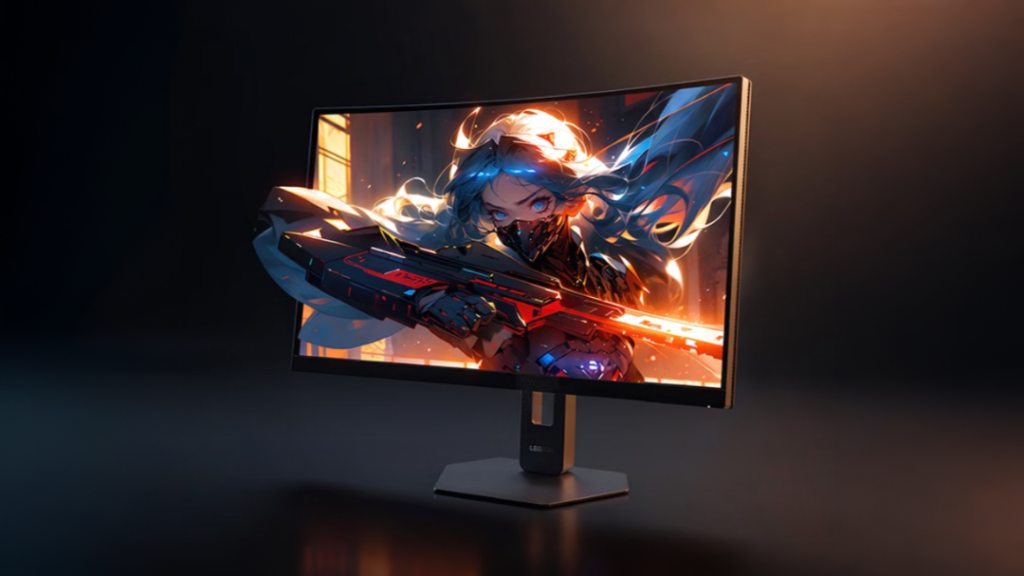
Lenovo has released the Legion 27Q-2c, a 27-inch curved gaming monitor, in the Chinese market. The display is currently listed on JD.com with a price of 1,279 yuan ($190).
The monitor features a 27-inch 1500R curved VA panel with a 2560 x 1440 (QHD) resolution and a 16:9 aspect ratio. It delivers a 109 PPI pixel density and offers 178-degree viewing angles for consistent image quality.
For colors, it supports 10-bit color (8-bit + FRC), covers 99% of the sRGB and 95% of the DCI-P3 color gamuts, and is VESA DisplayHDR 400 certified. It also delivers a 3000:1 contrast ratio and a typical brightness of 400 nits.
For gaming, the Legion 27Q-2c operates at a native 240Hz refresh rate. It has a 0.5ms MPRT response time, and the gray-to-gray response time is adjustable via overdrive settings ranging from 1ms to 6ms. The monitor supports AMD FreeSync and VESA Adaptive-Sync to prevent screen tearing.
It also includes a Dark Boost mode to improve visibility in dark scenes, along with hardware-based low blue light technology, DC dimming, and an anti-glare coating for enhanced viewing comfort.
For connectivity, the 27Q-2c features one DisplayPort 1.4, two HDMI 2.1 (TMDS) ports, and a 3.5mm audio jack. The DisplayPort connection is required to achieve the full 2560 x 1440 resolution at 240Hz with 10-bit color, while the HDMI ports are limited to 1440p at 144Hz with 8-bit color.
The monitor comes with an ergonomic stand that supports 135mm height adjustment, tilt, swivel, and pivot, while 100 x 100mm VESA mounting is also supported.
Timex has launched the 1976 Lexington Reissue Inspired watch in the US, priced at $149. The watch revives the brand’s 1970s rectangular dress watch design with a battery-powered quartz movement and classic analog styling.
Design Details
The Lexington Reissue Inspired features a polished 21mm stainless steel case with a 36mm lug-to-lug length and an 8.5mm thickness. Its compact, vintage-inspired proportions sit comfortably on the wrist and reflect the growing trend toward smaller watch case sizes.
For the dial, Timex uses a silver-tone finish with a vertically brushed texture, elongated Roman numerals, metallic blue hands, and a slightly domed mineral crystal for a vintage look and basic scratch resistance. Because it uses a standard quartz movement, the watch is relatively low-maintenance compared to mechanical alternatives, keeping the price down and allowing for the slimmer case profile.
The watch is paired with an 18mm brown leather strap featuring a crocodile-grain pattern. The strap is made from natural leather, and it includes quick-release spring bars. This allows you to change the band without needing specialized tools. It is designed to fit wrist circumferences between 135mm and 190mm.
Regarding durability, the Lexington Reissue has a water resistance rating of 30 meters. This is a baseline rating for watches, meaning it can survive hand-washing or light splashes, but it should not be worn while swimming or in the shower.
The Timex 1976 Lexington Reissue is listed on the company’s US website for pre-order.
Timex has expanded its US lineup with the release of two new Weekender New England Chronograph models. Priced at $189, the new watches are available directly through the company’s website and offer a straightforward, functional update to the long-running Weekender series.
The two new models, identified by product numbers TW2Y85000 and TW2Y85200, are identical in their hardware and differ only in dial color. Buyers have the option of either a cream or black dial. Both feature full stick markers instead of numerals, alongside luminescent hands for basic visibility in the dark.
In terms of dimensions, Timex is using a 40mm brushed and polished silver-tone stainless steel case. It measures 11.5mm thick with a 48.5mm lug-to-lug distance, which falls into the standard sizing for modern casual watches. The dial is protected by mineral crystal, which provides standard scratch resistance for this price bracket.
Internally, the watch runs on a standard quartz analog movement powered by a replaceable SR920SW battery. As the name suggests, it includes a chronograph complication. Two pushers on the right side of the case allow users to start, stop, and reset the stopwatch function.
The case is rated for 50 meters of water resistance, meaning it can handle rain and light swimming, though Timex explicitly warns against using the pushers underwater or taking the watch diving.
Both versions come equipped with a 20mm brown leather strap featuring contrast side stitching and a standard buckle. The inclusion of quick-release spring bars is a practical touch, allowing owners to swap out the 20mm band without needing a specialized spring bar tool. According to the spec sheet, the stock band fits wrist circumferences between 5.9 and 8.1 inches.
Bose has updated its standard QuietComfort headphones for the first time in three years. The QuietComfort Headphones (2nd Gen) now come in a redesigned fit, have spatial audio, wired lossless playback, and a revised noise cancellation system — features that were previously limited to the pricier QuietComfort Ultra line.
The new QuietComfort headphones bring Bose TrueSpatial technology down from the QuietComfort Ultra series for the first time. It brings modes like Still, Motion, and Cinema that users can choose depending on the surroundings.
True to its name, the Still mode keeps audio in one place even if you move your head; the Motion mode moves the soundstage naturally with you, and Cinema mode broadens the soundstage while pinning dialogue firmly to the center.
If you’d rather skip Bluetooth, plugging in over USB-C gives you wired lossless audio at up to 24-bit/48kHz. The USB-C port also handles audio in both directions, which should improve microphone pickup on video calls. The headphones can be used while charging as well.
Moreover, the updated algorithm on Aware Mode now responds to sudden noise spikes — a passing siren, a door slamming — more smoothly when transparency mode is on. Likewise, Bose’s six-microphone ANC setup has been adjusted to account for the small gaps glasses wearers often get around the earcups.
On the design side, the earcup has softer padding, and the headband’s clamping force has been optimized for a closer fit. Beyond the standard black and white, Bose is offering the QuietComfort Headphones (2nd Gen) in a few limited-edition colors: Eucalyptus Green, Dewdrop Mint, and Rosewood Mauve.
The Bose QuietComfort Headphones (2nd Gen) open for pre-order on August 8 for $359, with shipping starting August 13.
Caviar, a company known for adding precious metals to consumer electronics, has released a customized version of the Ray-Ban Wayfarer II smart glasses. The new collection, called Odyssey, takes the standard wearable device and adds materials like 24-karat gold, sterling silver, and crocodile leather.
Design Details
The collection consists of two specific models. The standard Odyssey version features decorative plaques plated in 24-karat gold, while the Odyssey Silver model uses 22-karat sterling silver inserts. Both designs are built onto the standard black Wayfarer frames. According to Caviar, the metal accents are forged, engraved, and polished by hand. The engravings incorporate Greek motifs, and the temples include star-shaped black enamel details.
Production for both models is strictly capped. Caviar is manufacturing 24 units of each version, a number chosen to match the 24 books of Homer’s Odyssey. The customization also applies to the charging case included with the glasses. Caviar has wrapped the standard Ray-Ban charging case in black crocodile leather and added its own emblem to the clasp.
Underneath the custom exterior, the internal hardware remains unchanged. The glasses retain all the original features of the Ray-Ban Wayfarer II. You can still use the built-in camera to take photos and record video, listen to audio through the open-ear speakers, and use the touch controls and AI voice assistant. The internal battery, camera sensors, and processors are identical to the standard retail version.
From a practical standpoint, Caviar has not specified how much weight these metal additions add to the frames. Weight is generally a key factor in the daily comfort of smart glasses.
Pricing and Availability
The 24K gold Odyssey model is priced at $6,130, and the 22K sterling silver Odyssey Silver is listed at $6,840. Both versions are currently available to order through the company’s website.
Honor is reportedly preparing the next-generation Win series flagship smartphones, following the launch of the original lineup last year. The upcoming Honor Win 2 series is expected to focus on extreme performance and battery life, combining a next-generation 2nm chipset with a massive battery pack. A new leak, courtesy of tipster Digital Chat Station, suggests that it will be unveiled much earlier than the first generation.
Honor Win 2 series could bring 2nm chip and huge battery
Honor Win
According to the tipster, the Honor Win 2 series may arrive as soon as October. This is around two months earlier than the first-generation Honor Win launch, which took place in December 2025.
The device is expected to feature a 10,000mAh battery, continuing the brand’s push towards larger battery capacities that started with the first Honor Win model.
The upcoming phone is also tipped to become one of the first smartphones powered by the upcoming Snapdragon 8 Elite Gen 6 series platform based on a 2nm manufacturing process. To handle the higher performance output from the next-generation Snapdragon chip, the Honor Win 2 series could include an active cooling fan. The system is designed to improve heat dissipation during demanding tasks such as gaming and video rendering, helping maintain stable performance for longer periods.
The active cooling solution could allow the phone to reduce thermal throttling during extended gaming sessions while keeping surface temperatures under control. Combined with the large battery capacity, the device is expected to target users who want long-lasting performance without frequent charging.
The Honor Win 2 series is also expected to feature a 6.89-inch OLED panel offering a 2K+ resolution and a 185Hz refresh rate. There is a possibility that the Snapdragon 8 Elite Gen 6-powered model could be called the Honor Win 2 Pro Max, while the variant with the Snapdragon 8 Elite Gen 5 could be named the Honor Win 2 Pro.
The advanced hardware of the Honor Win 2 series suggests that it may carry a higher price tag compared to its predecessor due to the increased cost of next-generation components, including the 2nm chipset.
Ayaneo has unveiled the Konkr Pocket Advance, a new Android-based retro handheld under its new Konkr sub-brand. It borrows heavily from the classic Game Boy Advance form factor while packing enough modern hardware to handle PlayStation 2 titles.
Ayaneo has officially opened pre-orders for the device on its website. During the early-bird period, the 3GB RAM model is priced at $89, while the 4GB variant costs $109. Following this period, the retail prices will increase to $109 and $129, respectively.
Ayaneo Konkr Pocket Advance Specs
The Pocket Advance comes with a 3.5-inch LCD display featuring a 3:2 aspect ratio and a 960 × 640 resolution, enabling 4× integer scaling for older handheld titles to deliver sharp, distortion-free visuals during emulation.
Internally, the handheld is powered by a MediaTek Helio G90T processor. To manage heat during extended use, the system includes an active cooling fan. For power, it features a 4,000mAh battery. The device measures 151.3mm x 82.4mm x 22mm and weighs 224 grams, placing it in the same size category as many standard pocketable emulation devices currently on the market.
For inputs, the Pocket Advance uses a standard retro layout. It includes a D-pad, ABXY face buttons, and dedicated L1/R1 and L2/R2 shoulder buttons. For connectivity and expansion options, it includes a USB 2.0 Type-C port with support for Power Delivery fast charging, a microSD card slot for game storage, Wi-Fi 5, and Bluetooth 5.0. It also features a standard 3.5mm headphone jack and a physical volume rocker.
The device runs on the Android operating system and uses Ayaneo’s proprietary software suite, including AYASpace, AYAHome, and AYASetting, to manage game libraries and adjust system settings.
You can choose from three color options: Navy Blue, Coral Orange, and Heritage Gray. Ayaneo is also selling a few basic accessories separately, such as a carrying case and screen protectors.
According to the company, the initial production batch is limited, and shipments are projected to commence before the end of August.
In related news, Ayaneo has recently launched the Pocket Micro 2 retro handheld with a 3.5-inch LCD display and a 3,950mAh battery.
For more daily updates, please visit our News Section.
The Snapdragon 4 Gen 4 is designed to push premium, battery-efficient 4nm technology and high-speed 5G connectivity into highly affordable smartphones like the POCO M8 Power and Honor 600 Smart.
In contrast, the Dimensity 7400 targets mid-range devices with a focus on achieving peak performance. It’s quite popular in the segment, but with Snapdragon 4 Gen 4 phones now starting to arrive in the market, people are wondering if the new Snapdragon chip would be a smart choice. Take a look at the benchmark scores and key differences to find out the right upgrade for your needs.
Quick answer – Choose Snapdragon 4 Gen 4 if you prioritize excellent power efficiency and everyday reliability over peak performance. – Choose Dimensity 7400 if you prioritize gaming performance and modern connectivity features.
Shoppers torn between efficiency and raw speed can weigh both against the rest of the field in our guide to Snapdragon chipset rankings.
Qualcomm Spectra Dual ISP (12-bit) up to 108MP single camera up to 36MP single camera at 30fps with zero shutter lag up to 16MP + 16MP dual cameras at 30fps with zero shutter lag up to 1080p video recording hardware-based noise reduction (MFNR)
MediaTek Imagiq 950 ISP (12-bit) up to 200MP single camera up to 4K video recording at 30fps Google Ultra HDR support hardware-based noise reduction (MCNR)
Connectivity
Snapdragon X61 modem download speed: up to 2.5 Gbps upload speed: up to 0.9 Gbps Wi-Fi 5 Bluetooth 5.1 sub-6 GHz only
MediaTek 5G modem download speed: up to 3.27 Gbps (cellular) Wi-Fi 6E Bluetooth 5.4 sub-6 GHz only
Snapdragon 4 Gen 4 vs Dimensity 7400: Benchmark scores
Note: The benchmark tests were performed on the POCO M8 Power 5G (powered by the Snapdragon 4 Gen 4) and the iQOO Z10R (powered by the Dimensity 7400).
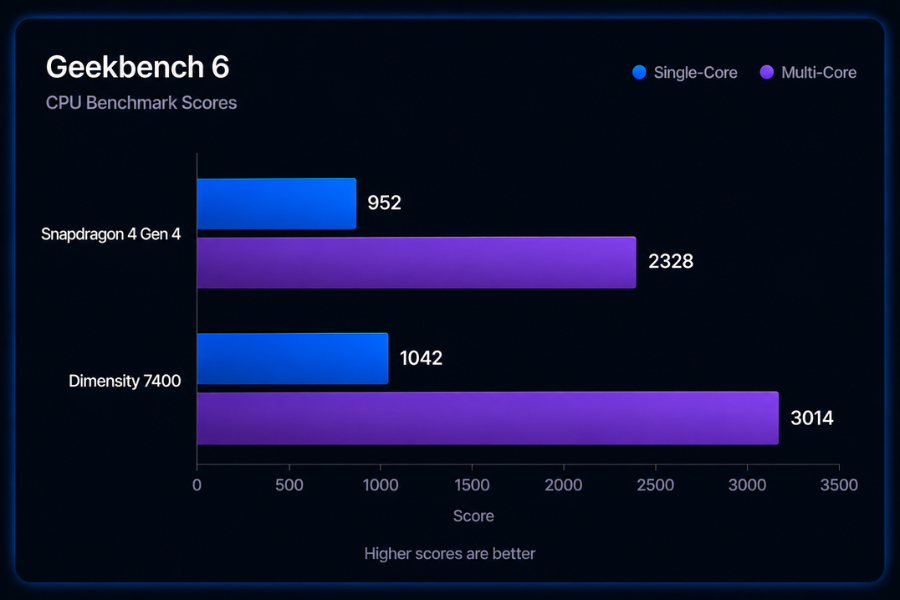
Geekbench score
The Dimensity 7400 achieves higher scores in both single-core and multi-core performance tests. The single-core performance is up by 9%, while the lead in the multi-core test jumps to 29%.
The spec sheet tells why there’s a significant difference between multi-core scores. The Snapdragon 4 Gen 4 has two performance cores, while the Dimensity 7400 has four, and all of them run at higher speeds.
Snapdragon 4 Gen 4
Dimensity 7400
Single core
952
1042
Multi core
2328
3014
AnTuTu score
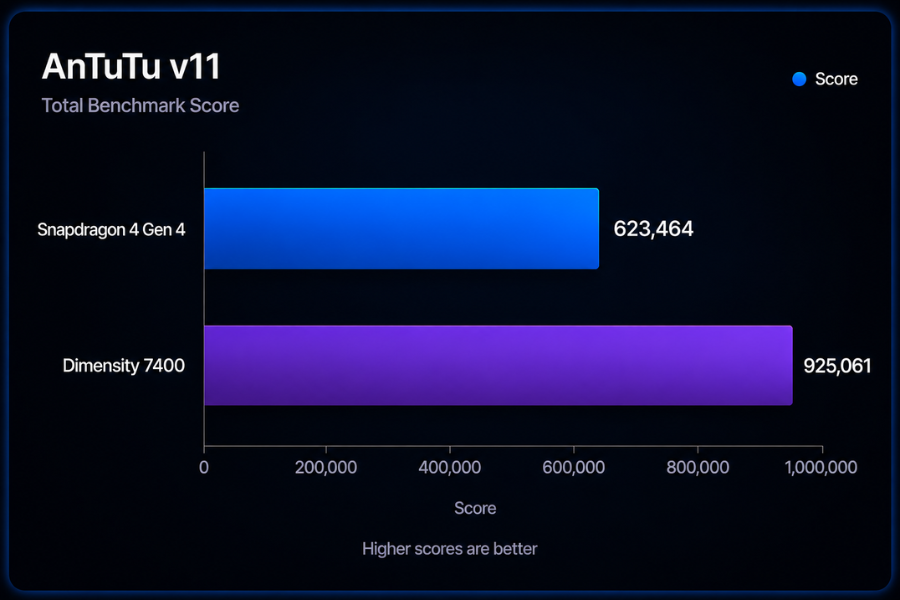
On the AnTuTu v11 benchmark, the Dimensity 7400 achieves over 900K, whereas the Snapdragon 4 Gen 4 just crosses 600K. That’s a solid 48% boost in total score for the Dimensity chip. The picture becomes much clearer once you look at the breakdown.
The Dimensity 7400 gets about a 35% higher CPU score, but the lead in GPU score is a massive 300%. That’s not a glitch, but the Dimensity 7400 has a much more powerful GPU and better gaming optimizations. Memory performance, as per AnTuTu, is nearly the same for both chips, but the UX score is up 55% for the Dimensity chip.
Snapdragon 4 Gen 4
Dimensity 7400
AnTuTu score
623,464
925,061
CPU
251,733
340,697
GPU
36,348
145,500
Memory
154,338
157,129
UX
181,045
281,735
3DMark score
Wild Life Extreme Stress Test
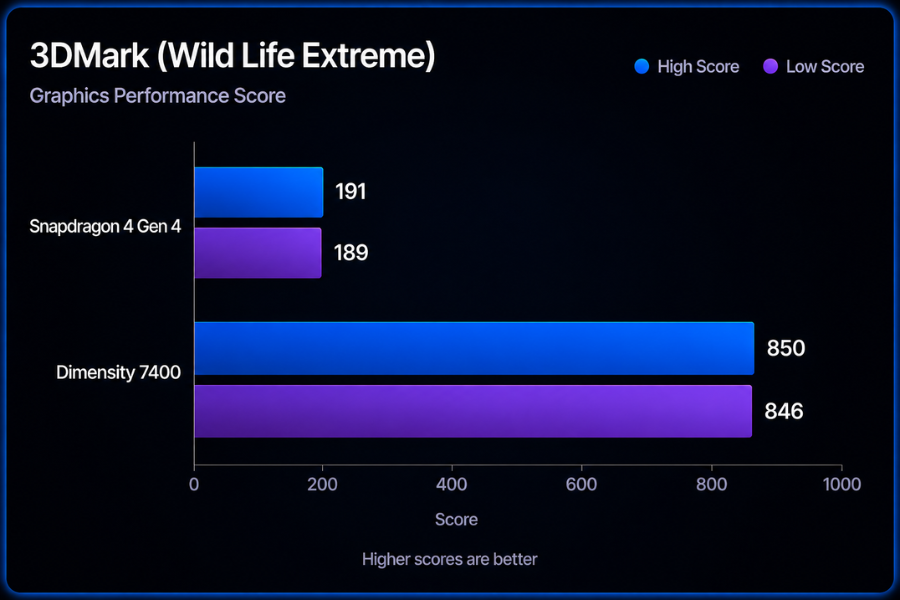
To better evaluate the gaming performance, we put both chips through the Wild Life Extreme Stress test. It’s designed to evaluate sustained GPU performance and thermal throttling under heavy graphical loads.
At the peak, the Dimensity 7400 delivers more than 4x faster gaming performance compared to the Snapdragon 4 Gen 4. Even the low/base performance of the Dimensity 7400 is over 4x higher.
Snapdragon 4 Gen 4
Dimensity 7400
High score
191
850
Low score
189
846
Stability
99%
99.5%
Across every benchmark test we ran them through, the Dimensity 7400 completely outclasses the Snapdragon 4 Gen 4. However, there are additional factors to consider before reaching a conclusion, such as camera capabilities and connectivity standards. Let’s look at them in the following section.
Snapdragon 4 Gen 4 vs Dimensity 7400: Key differences
While both are 4nm chips, the Dimensity 7400 has been manufactured at TSMC’s facilities, which usually deliver slightly better performance and power efficiency than Samsung’s. The latter has been used to manufacture the Snapdragon 4 Gen 4.
The CPU architecture makes a big difference here. The Snapdragon 4 Gen 4 uses a ‘2+6’ setup, featuring two performance cores and six efficiency cores. In contrast, the Dimensity 7400 uses a ‘4+4’ configuration, bringing in two additional performance cores. The Dimensity 7400 also reaches a higher peak clock speed of 2.6 GHz (vs. 2.3 GHz on the SD 4 Gen 4).
For gaming and other graphics-related work, the Snapdragon 4 Gen 4 has an Adreno 613 GPU. On the other hand, the Dimensity 7400 is equipped with a more powerful dual-core Mali-G615 GPU, featuring a higher peak frequency and better computational capabilities.
Furthermore, the Dimensity chip includes a suite of gaming enhancements to optimize visual quality, performance, and network connectivity. The Snapdragon 4 Gen 4 lacks Snapdragon Elite Gaming features, which are typically found on mid-range and flagship chips.
The Dimensity 7400 also excels in camera capabilities, supporting up to 200MP single-camera and 4K video recording, while the Snapdragon 4 Gen 4 is limited to 108MP single-camera and 1080p video recording. Additionally, the Dimensity chip supports the Google Ultra HDR format.
On the connectivity side, the Dimensity 7400 delivers a higher peak speed over 5G (3.27 vs 2.5 Gbps) and supports newer Bluetooth and Wi-Fi standards. That means devices powered by Dimensity 7400 should achieve better Wi-Fi stability in crowded places, as well as more stable Bluetooth connections and better audio transmission.
Snapdragon 4 Gen 4 vs Dimensity 7400: Which one should you choose?
Choosing between Snapdragon 4 Gen 4 and Dimensity 7400 isn’t difficult if you know your performance needs and usage style. The Snapdragon chip prioritizes overall battery efficiency, reliable everyday performance, and affordable 5G connectivity. It’s best suited for standard tasks like browsing, media consumption, and basic multitasking.
On the other hand, the Dimensity 7400 delivers superior raw performance and a significantly better gaming experience. It also offers a higher-resolution camera, higher-resolution video recording, and modern connectivity features such as Wi-Fi 6E and Bluetooth 5.4.
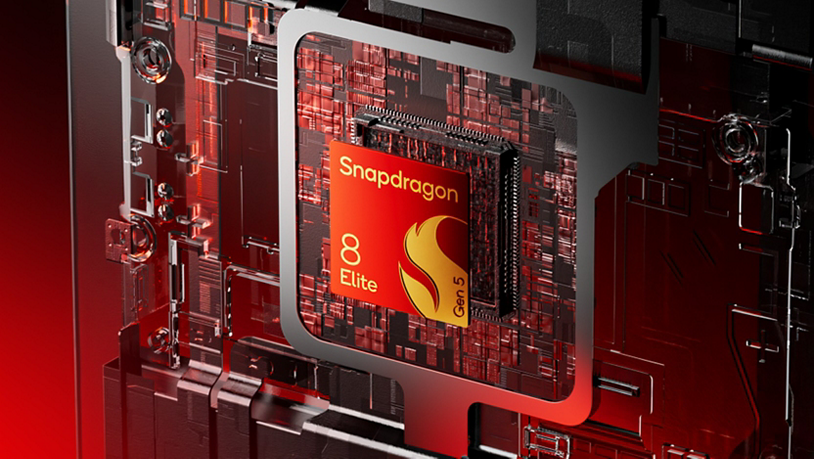
If you’ve been shopping for a flagship Android phone this year, you’re probably going to get a device powered by Snapdragon 8 Elite Gen 5. Sounds simple enough, right? Except it isn’t quite that simple.
Qualcomm has quietly split its top-end 2026 processor into four different versions, each with its own small tweaks under the hood. That means two phones carrying the same Snapdragon 8 Elite Gen 5 branding on the box may perform differently in games or benchmarks. So let’s break down every variant that exists right now, what actually separates them, and where the brand-new “V Series” fits into all of this.
The SM8850-AC is the full Snapdragon 8 Elite Gen 5 variant from Qualcomm. The models after this are cut down in aspects here and there. It’s the version running in the majority of 2026 flagships, from the Oppo Find X9 Ultra to the Xiaomi 17 Ultra.
You get two Oryon Prime cores running up to 4.6GHz, six performance cores up to 3.62GHz, and an Adreno GPU clocked at 1.2GHz with three GPU slices and 18MB of high-performance memory for graphics.
The SM8550-AC sets the bar for Qualcomm and rivals chips from 2026’s flagship chip from MediaTek and Samsung in most benchmarks this year. Simply, it’s what most reviewers like us talk about when we praise this generation’s speed.
For those unaware, Samsung doesn’t just license Qualcomm’s standard chip for its flagship S and Z series phones. It works directly with Qualcomm to get its own tuned version, and this year that’s the SM8850-1-AD, which powers the Galaxy S26 lineup and the new Galaxy Fold8. The CPU cores here run a bit hotter, with the Oryon Prime cores hitting 4.74GHz instead of 4.6GHz, and the GPU also gets a bump to 1.3GHz instead of 1.2GHz.
The difference isn’t massive in daily use, but it shows up in benchmark charts, which is why the Galaxy S26 Ultra tends to edge out other Snapdragon 8 Elite Gen 5 phones in raw scores. It’s also part of why, when this chip goes head-to-head with the Dimensity 9500 and Exynos 2600, Samsung’s own version consistently comes out ahead of the standard variant in the numbers.
For a wider view of how these variants rank against Qualcomm’s other silicon, see our guide to best Snapdragon chipsets in 2026.
3. The Seven-Core Version: SM8850-5-AC
The SM8850-5-AC is the seven-core 8 Elite Gen 5, especially made for foldables. Instead of the usual two Prime cores plus six Performance cores, this variant drops one Performance core for a total of seven.
The chip is currently used in the Oppo Find N6 foldable, and it isn’t the first time Qualcomm has done this. The same trick appeared with a seven-core version of the original Snapdragon 8 Elite last year, and it performed well enough that Oppo’s foldable still posted excellent benchmark and battery-life numbers.
Why would Qualcomm sell a chip with a missing core? Mostly cost and yield. Not every chip that comes off the manufacturing line is perfect, and rather than throwing away the ones with a faulty core, Qualcomm disables it and sells the chip as a slightly cheaper variant. For a foldable phone, where thermal headroom and battery life often matter more than squeezing out the last bit of CPU power, this trade-off makes sense.
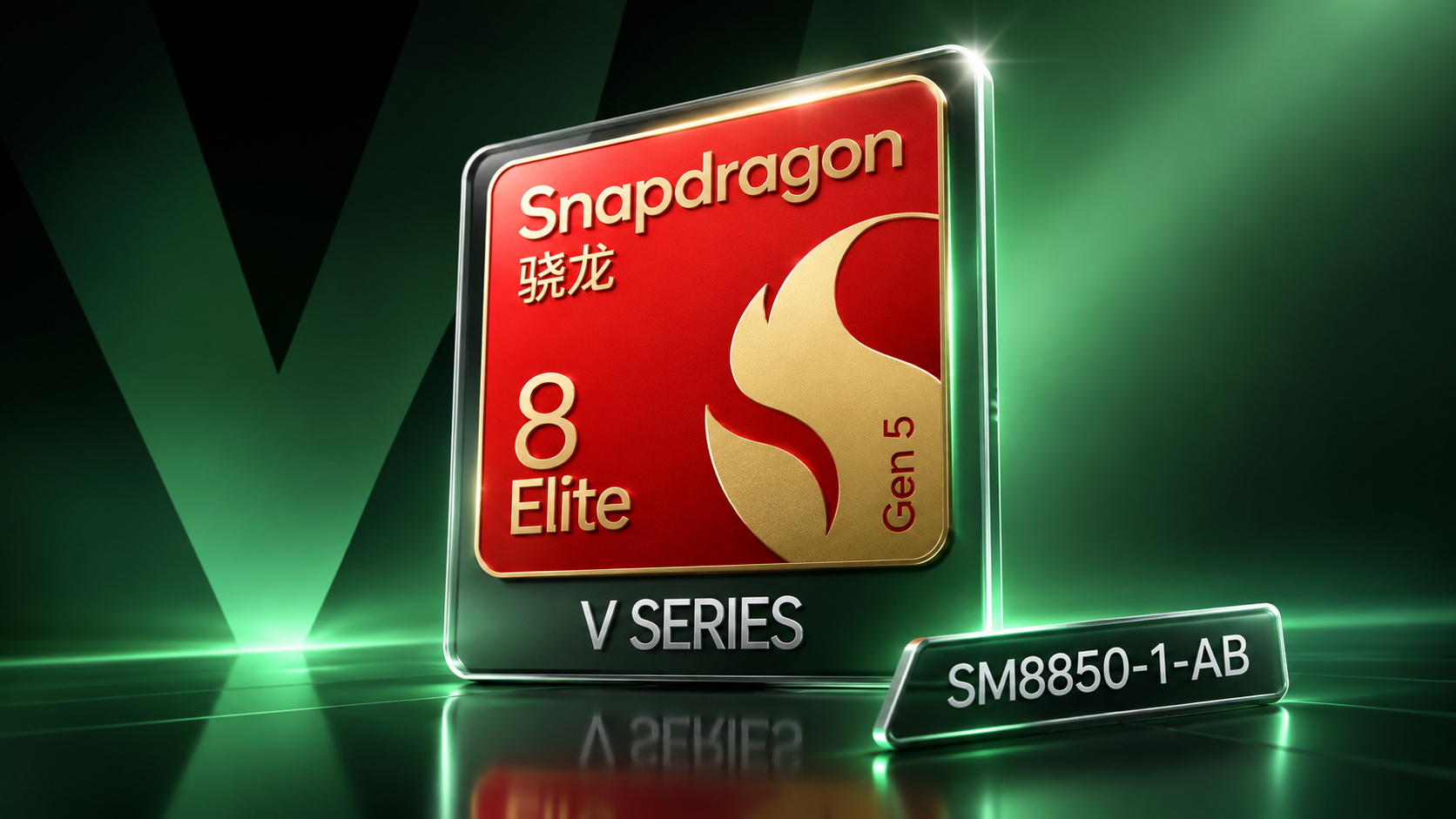
4. The New V Series: SM8850-1-AB
Snapdragon 8 Elite Gen 5 V-series
This is the newest and most confusing addition to the lineup. Qualcomm quietly listed it on the official spec sheet under model number SM8850-1-AB, and it’s set to debut inside the Redmi K100 Pro series launching in China on August 11.
Qualcomm is marketing this chip with a gaming-focused tagline, “Game smarter, not harder,” which makes it sound like an upgrade aimed at gamers. But look at the actual spec sheet, and it isn’t actually better than the full model.
The CPU retains the same 4.6GHz Oryon Prime cores and 3.62GHz performance cores as the standard chip. The GPU clock speed also stays at 1.2GHz. What changes is the GPU’s internal structure: instead of three Adreno GPU slices, the V Series only has two, and its high-performance graphics memory drops from 18MB to 12MB.
In plain terms, that’s a scaled-back GPU wearing a gaming-branded label. This actually tracks with earlier reports from a few weeks ago, which predicted a fourth, cheaper version of this chip aimed at phones priced under 4,000 yuan (roughly $590). The V Series still supports the same gaming features as the standard chip, including hardware-accelerated ray tracing, mesh shading, and Unreal Engine 5 optimizations, so it isn’t a downgrade across the board. But with one fewer GPU slice, its graphics performance realistically lands closer to the non-Elite Snapdragon 8 Gen 5 than to the flagship chip it’s named after.
For more daily updates, please visit our News Section.
HP has started selling the OmniPad 12 in India, bringing its latest tablet experience to consumers after launching the device in the country earlier this year. Designed as a 2-in-1 device, the tablet combines a large display, Snapdragon-powered performance, and a detachable keyboard for users looking for a laptop-style experience.
The HP OmniPad 12 is priced starting at Rs 48,999 (~$515) in India. The company has not revealed detailed variant information but has confirmed that the tablet is available in Denim Blue and Meteor Silver color options.
The tablet can be purchased through the HP Online Store, Amazon, Flipkart, Reliance Digital, Croma, Vijay Sales, and HP World stores. As part of the launch offers, buyers can get an instant cashback of Rs 5,000 on eligible SBI and HDFC Bank credit cards until August 20. HP is also offering a one-year subscription to multiple AI services worth Rs 96,000, including access to platforms such as GPT-5, Claude 4, Gemini 2.5, Perplexity, Grok 4, and DeepSeek.
HP OmniPad 12 specifications and features
HP OomniPad 12
The HP OmniPad 12 features a 12-inch 2K multi-touch display with a 16:10 aspect ratio, 90Hz refresh rate, and up to 400 nits brightness. The tablet is powered by the Snapdragon 6 Gen 3 chipset, and it comes with 8GB of LPDDR5 RAM and 128GB of built-in UFS storage, with support for up to 1TB expandable storage through a microSD card.
Running Android 16 out of the box, the OmniPad 12 is designed as a convertible device with a detachable keyboard included in the package. Users can switch between tablet and laptop modes depending on their requirements. It weighs 600 grams in tablet mode and comes preloaded with educational and productivity-focused applications such as iPrep, Lexillion, and Brands.live.
For entertainment, the tablet includes quad speakers tuned with DTS Ultra and dual high signal-to-noise ratio microphones. The camera setup includes an 8-megapixel front camera and a 13-megapixel rear camera. Connectivity options include Wi-Fi 6E, Bluetooth 5.2, and a USB Type-C port. The device packs a 31Wh dual-cell lithium-polymer battery, with HP claiming up to 18 hours of usage on a single charge. Measuring 283 x 178.1 x 7.3mm, the tablet offers a slim profile for a large-screen 2-in-1 device.
For more daily updates, please visit our News Section.
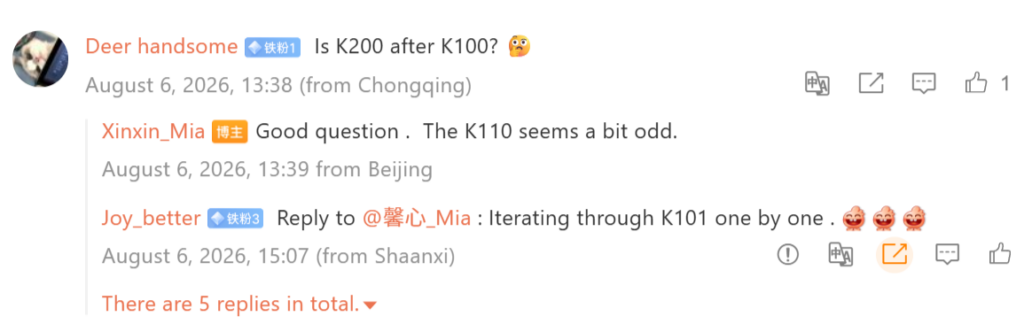
Redmi is preparing to launch the K100 series flagship smartphones in China, but discussions around the brand’s future naming strategy have already started. A Redmi product manager, Mia Xinxin, has hinted that the company could move directly to the K200 series for its next-generation flagship lineup instead of following a K110 name.
Redmi K200 name teased after K100 series launch plans
The naming discussion began after fans suggested that Redmi should call its future flagship series K200 once the K100 lineup completes its cycle. Responding to the suggestion, Redmi product manager Mia said that the K110 name feels “a bit strange,” hinting that the company may consider a different approach for upcoming models.
Several smartphone brands have adopted a similar strategy after crossing the 100 mark in their naming schemes. Honor’s number series and Vivo’s X series, for example, have continued with larger jumps instead of moving through every number. Redmi could follow a similar pattern by introducing the K200 series as the successor to the K100 lineup.
The upcoming Redmi K100 series is scheduled to launch on Aug. 11 and will arrive with a different release strategy compared to previous generations. The company is expected to first introduce the K100 Pro and K100 Pro Max, while the standard K100 model will reportedly arrive later.
The Redmi K100 Pro series will debut with the Snapdragon 8 Elite Gen 5 V Series flagship platform, while the K100 Pro Max will feature the standard Snapdragon 8 Elite Gen 5 chipset. Both models are expected to focus heavily on gaming, with features such as a 185Hz gaming display mode, dedicated gaming antenna technology, and enhanced audio tuning.
For more daily updates, please visit our News Section.
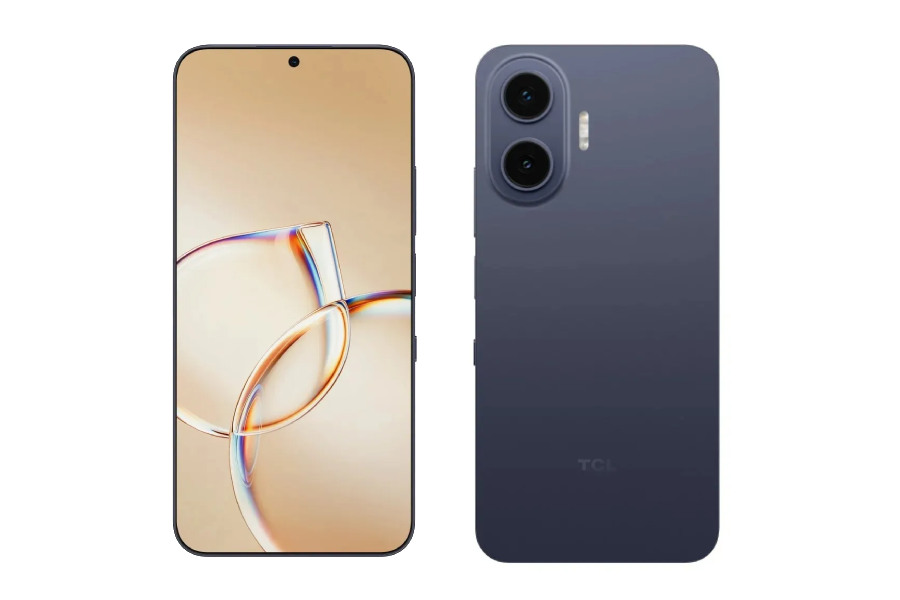
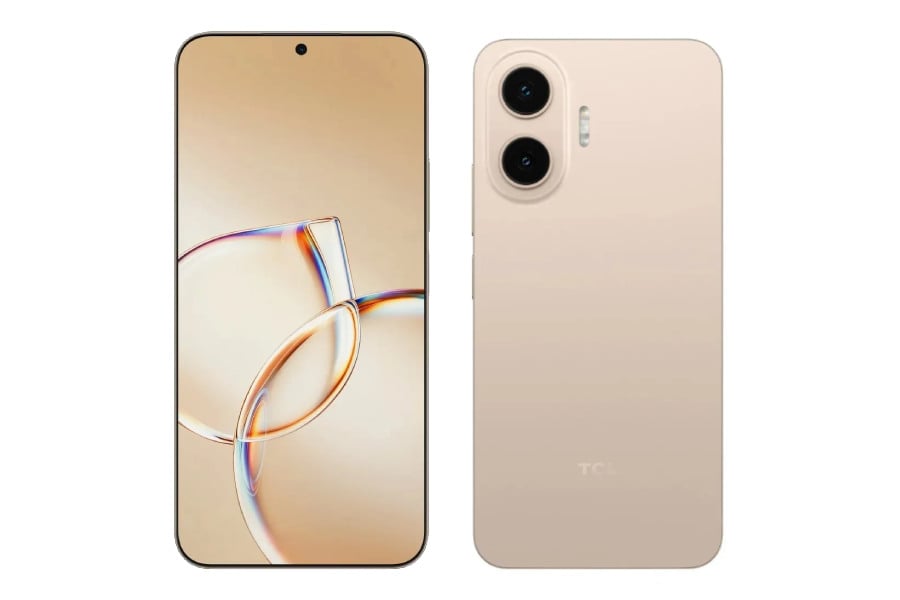
TCL’s upcoming phones, the P80 and P80 Pro, have surfaced in the rumor mill before launch. The standout detail here isn’t the chipset or the cameras — it’s how thin the screen bezels are. You’re looking at borders so slim they’d look at home on a phone costing two or three times as much.
TCL P80 and P80 Pro Specifications
Start with the P80 Pro, it packs a 6.83-inch OLED NXTPAPER display running at 2766 x 1280 resolution, and TCL is pairing it with a MediaTek Dimensity 7400 Elite chipset, 8GB of RAM, and 256GB of storage.
TCL P80 Pro
On the back, you get a 50MP main camera with OIS alongside an 8MP ultrawide, while a 32MP front camera handles selfies. The phone is powered by a 5,800mAh battery, which should be enough for more than a day of regular use.
The standard P80 trims a few things to hit a lower price. It swaps in a MediaTek Dimensity 7300 Elite, drops storage to 128GB, and settles for a smaller 5,000mAh battery. Everything else — the display, the camera setup, the RAM — carries over from the Pro. That’s a smart way to differentiate the two without making the cheaper model feel gutted.
TCL P80
The renders show the P80 Pro in a muted gray-blue shade with a distinctive pill-shaped dual-camera module, while the standard P80 comes in a warmer cream tone.
Both designs echo the TCL NXTPAPER 70 Pro that TCL showed off at CES 2026, though these new phones ditch that model’s matte finish for a glossier look and noticeably tighter bezels.
As for pricing, the TCL P80 is said to cost around €300 and the P80 Pro at roughly €350,
For more daily updates, please visit our News Section.
A couple of days ago, Asus unveiled the Asus Pad in India, marking the company’s return to the tablet segment in the country after several years. The new tablet brings a premium design, a high-refresh-rate OLED display, powerful hardware, and a large battery. The Asus Pad is now available for purchase in India, bringing its flagship tablet experience to consumers.
The Asus Pad is available in two configurations in India. The 8GB + 128GB variant is priced at Rs 45,990 (~$485), while the 8GB+256GB model costs Rs 49,990 (~$525). The tablet is available through Flipkart, Asus eShop, Asus and ROG Stores, Reliance Digital, and authorized ASUS retail partners.
Buyers can also take advantage of Asus Easy Pay financing options, including up to 12 months of no-cost EMI starting at Rs 3,833 per month. The tablet comes in a premium design with a fiberglass rear panel and includes a protective folio case in the box.
Asus Pad specifications and features
Asus Pad
The Asus Pad features a 12.2-inch 2.8K dual-layer OLED display with a 3:2 aspect ratio and a 144Hz refresh rate. The panel offers up to 2,000 nits peak brightness, covers 100 percent of the DCI-P3 color gamut, and carries TÜV certifications for low flicker and low blue light. It also supports ASUS Pen 2.0 and newer styluses for note-taking and creative tasks.
Under the hood, the tablet is powered by the MediaTek D8300 octa-core processor with a peak clock speed of 3.35GHz. It comes with 8GB of LPDDR5X RAM and up to 256GB of UFS 3.1 storage. Additional storage expansion is supported through a microSD card slot with up to 1TB capacity.
The Asus Pad runs Android 16 and packs a 9,000mAh battery with support for 45W fast charging. Asus claims the tablet can reach 50 percent battery capacity in around 30 minutes of charging.
Asus Pad
Other features include quad speakers with Dolby Atmos support, Wi-Fi 6E, Bluetooth 5.3, a USB Type-C port with DisplayPort 1.4 support, a 13-megapixel rear camera, a 5-megapixel front camera, and face unlock support. Measuring 6.5mm in thickness and weighing 523 grams, the tablet is designed for portability while offering a large-screen experience.
Last month, Oppo confirmed that eligible OnePlus and Realme smartphones will transition to ColorOS beginning with Android 17, replacing OxygenOS and Realme UI in future releases. The company has now expanded the ColorOS 17 beta program to additional devices, giving more users an opportunity to experience the next major software update before its public rollout.
ColorOS 17 beta expands to more devices
ColorOS Closed Beta Testing begins
In China, Oppo has opened ColorOS 17 Beta registrations for the following devices:
– Oppo Pad 5 Pro. Each device is limited to 300 participants, with beta builds scheduled to roll out in batches on Aug. 11 and Aug. 13.
The same beta recruitment has also been extended to OnePlus and Realme phones:
– OnePlus 15
– OnePlus 15T
– OnePlus Pad 3 Pro
– Realme GT 8 Pro and GT 8 Pro Aston Martin F1 Limited Edition
Meanwhile, in India, the ColorOS 17 Closed Beta is already open for these devices:
– Oppo Find X9 Pro
– Oppo Reno 15 Pro
– Oppo Reno 15 Pro Mini
– OnePlus 15
– OnePlus 15R
– Realme GT 8 Pro
Interested users must submit their applications before the announced deadline, complete a qualification quiz, and may also be required to sign a non-disclosure agreement before receiving the beta firmware.
Since this is an early log build, Oppo advises against installing it on a primary device because the software is expected to contain bugs and stability issues. Users who rely on a single smartphone are better off waiting for a newer beta build or the public beta release.
The move also reflects Oppo’s plan to unify software development across Oppo, OnePlus, and Realme, which could lead to faster updates, quicker bug fixes, and a more consistent software experience across the three brands.
While Oppo has yet to officially detail all of ColorOS 17’s features, early beta information suggests the update will introduce a refreshed visual design with new lighting animations, illuminated edge effects, enhanced blur elements, redesigned rounded UI components, and smoother transition animations throughout the interface. The update is also expected to debut the next-generation Xiaobu Next AI assistant, alongside Android 17’s core enhancements and system optimizations.
Which upcoming ColorOS 17 feature are you most looking forward to? Let us know in the comments below.
For more daily updates, please visit our News Section.
Redmi has officially launched the Redmi Note 17 in India, bringing one of the biggest batteries ever seen on a Redmi smartphone. Alongside its large battery, the device combines a high refresh rate AMOLED display, Qualcomm’s entry-level Snapdragon 5G chipset, and an extended software update policy. Here’s everything you need to know about the new Note 17.
Redmi Note 17 specifications and features
Redmi Note 17 5G
The Redmi Note 17 sports a 6.9-inch TrueColor AMOLED display with a 120Hz AdaptiveSync refresh rate, 100 percent DCI-P3 color gamut, and up to 1,800 nits of peak brightness. The panel is protected by Corning Gorilla Glass 7i and supports HydroTouch 2.0 for improved touch responsiveness with wet or oily fingers.
At the heart of the device is Snapdragon 4 Gen 4 mobile platform, built on a 4nm process. The chipset is paired with up to 8GB of RAM and supports an additional 8GB of virtual RAM expansion, while storage can be expanded by up to 2TB using a microSD card.
Redmi has also equipped the phone with a 10,416mm² graphite cooling system and says it is optimized to deliver smooth performance for up to 48 months. The phone is backed by an 8,000mAh silicon-carbon battery, which Redmi claims can deliver up to three days of typical use. It supports 45W wired fast charging with a compatible charger included in the box, along with 22.5W wired reverse charging for powering other devices.
Redmi Note 17
The handset features a 50-megapixel main camera with 2x in-sensor zoom on the back and an 8-megapixel front-facing camera. It runs Android 16 with HyperOS 3 and is promised four Android OS upgrades and six years of security updates. Additional features include an IP65-rated chassis, an in-screen fingerprint sensor, dual speakers capable of delivering up to 200 percent volume, and a reinforced internal frame.
Redmi Note 17 price and availability
Redmi Note 17 5G
The Redmi Note 17 comes in Dark Night, Arctic Blue, and Starlight Purple color options. The 6GB + 128GB model carries an MRP of Rs 27,999 (~$300) but will be available at an introductory price of Rs 24,999, while the 8GB + 128GB variant is priced at Rs 30,999 (~$325) and will retail for Rs 27,999 during the introductory offer.
The launch offer includes an instant Rs 3,000 discount on SBI Card, Axis Bank, and Kotak Bank credit card and EMI transactions. Buyers will also receive 5TB of JioAI Cloud storage, three months of YouTube Premium Lite, and six months of Google One (200GB). Sales begin at 12 PM IST on Aug. 13 through Xiaomi’s official website, Amazon India, and authorized retail stores.
We use cookies on our website to give you the most relevant experience by remembering your preferences and repeat visits. By clicking “Accept”, you consent to the use of ALL the cookies.
This website uses cookies to improve your experience while you navigate through the website. Out of these, the cookies that are categorized as necessary are stored on your browser as they are essential for the working of basic functionalities of the website. We also use third-party cookies that help us analyze and understand how you use this website. These cookies will be stored in your browser only with your consent. You also have the option to opt-out of these cookies. But opting out of some of these cookies may affect your browsing experience.
Necessary cookies are absolutely essential for the website to function properly. This category only includes cookies that ensures basic functionalities and security features of the website. These cookies do not store any personal information.
Any cookies that may not be particularly necessary for the website to function and is used specifically to collect user personal data via analytics, ads, other embedded contents are termed as non-necessary cookies. It is mandatory to procure user consent prior to running these cookies on your website.