Dell has kept its India lineup moving this month, launching the lightweight Dell 14S laptop just two weeks ago after a new 32-inch UltraSharp monitor last month. The company is now turning to business audio, adding a fresh family of Pro headsets for desk, hybrid, and on-the-go work. Four models are on sale in India today, with a flagship set to follow early next year.
Every model uses an AI-based noise-cancelling microphone trained on more than 500 million voice samples, building on Dell’s earlier Pro headsets and last year’s Pro Plus Earbuds. Active Noise Cancellation now covers the entire wireless range, including the Pro 3 for the first time, while the Pro 5 and Pro 7 wireless models add Adaptive ANC that retunes more than 1,000 times per second. The wired Pro 5 gets Hybrid ANC, and the Pro 7 adds AI Conversation Focus, Hi-Res Audio, and a 10-microphone array.
Dell Pro 5 Wired ANC Headset
Wireless battery life reaches up to 75 hours on the Pro 3, 95 hours on the Pro 5, and 115 hours on the Pro 7, and every wireless model has a user-replaceable battery. All five have replaceable ear cushions, an adjustable leatherette headband, and memory-foam padding. The wireless models use Bluetooth 6.0 and a USB-C receiver, pair with up to eight devices, and keep two connections active, while the wired models use plug-and-play USB-C and include a USB-A adapter.
All five headsets are certified for Microsoft Teams, including the Open Office specification, and Zoom, and the wired models also carry Works with Chromebook certification. IT teams can deploy, configure, and update them through Dell Device Management Console, the same console used for supported Dell PCs and docks. Every model includes a 3-year Limited Hardware Warranty with Advanced Exchange.
Dell Pro headsets price and availability
Dell Pro headsets
The lineup spans five models. The Dell Pro 3 Wired Headset (WH327) starts at Rs 5,141, the Dell Pro 5 Wired ANC Headset (WH527) is Rs 8,827, the Dell Pro 3 Wireless ANC Headset (WL327) is Rs 10,888, and the Dell Pro 5 Wireless ANC Headset (WL527) is Rs 14,427, all available today. The flagship Dell Pro 7 Wireless ANC Headset (WL727) follows in February.
Motorola already has several Edge 70 models in India, including the Edge 70, Edge 70 Fusion, Edge 70 Pro, Edge 70 Pro+, and Edge 70 Max. Recently, the brand unveiled the Signature 27 flagship globally, and that phone is also expected to launch in India soon, probably in December. But before that, an official teaser suggests a Neo-branded phone, probably the Edge 70 Neo, could be launching this month.
Motorola Edge 70 Neo landing page goes live
Motorola Edge 70 Neo Flipkart teaser
Motorola has put up a Flipkart coming soon page for a new phone with the tagline “Your feed is about to enter a new neo era,” with “new” crossed out and replaced by “neo.” The teasers focus on the camera and show a dark green phone with a square rear module and a flat display with a centered punch-hole. The page does not list a launch date, but the “nov26” in its URL could be a giveaway that the phone will launch on November 26.
Motorola has not published a specification sheet, but a Geekbench listing already points to a Snapdragon 7s Gen 3 chip, 6GB of RAM, and Android 16. Leaks also point to a 6.78-inch 1.5K 144Hz display with Gorilla Glass 7i, a 50-megapixel Sony LYTIA 710 main camera, a 2-megapixel macro lens, and a 32-megapixel front camera.
The official Flipkart teaser also shows 50-megapixel LYTIA, OIS, and Ultra HDR markings on the camera ring. Reports further point to a 7,000mAh battery with 45W charging, an IP64 rating, and 6GB or 8GB of RAM with 128GB or 256GB of UFS 3.1 storage. The phone is tipped to arrive in four Pantone colors: Mountain View, Milky Blue, Sage, and Gray Lilac.
Software support is expected to include four major Android updates and five years of security patches, though Motorola has not confirmed these figures yet.
Motorola has not revealed the price either, but the Neo branding and the Snapdragon 7s Gen 3 chip suggest it will sit below the Edge 70 Fusion, which starts at Rs 26,999 in India. That positioning could put the Edge 70 Neo somewhere in the Rs 20,000 to Rs 25,000 range, where it would take on budget-friendly mid-rangers with its big battery and camera-focused pitch.
When I first got the Magic Pro 13, I did not start by checking the specifications. My first impression was simple: the build felt solid, and the screen looked comfortable to use. What really made me pay attention was drawing a few lines with the pen.
This does not feel like a regular Android tablet with a stylus added to it. The screen ratio, the surface texture and the feedback from the pen all make it clear that drawing is the main focus here. XPPen has already released products such as the Magic Drawing Pad and the Magic Note Pad, so the Magic Pro 13 is not the company’s first attempt at a creative tablet. The more interesting question is whether this larger format can make mobile drawing feel more comfortable and more complete.
Design and portability
The design itself feels more refined than I expected. The body feels solid, the edges are carefully finished, and the whole device looks more like a mature premium tablet than a traditional pen display running Android. Once the screen is on, the overall presentation is just as convincing: the image looks clear and detailed, and the front has a clean, unified appearance.
The tablet is 6.65 millimeters thick and weighs 655 grams. For a device with a screen close to 13 inches and a battery of about 39.3 watt-hours, that is not especially heavy. Holding it for a short sketching session or while checking reference images is comfortable. For longer drawing sessions, though, I still prefer putting it on a desk or a stand.
There are two USB-C ports. One can connect to a computer for Drawing Display Mode, while the other can handle charging, storage or an external monitor. There is also a microSD card slot with support for up to 2TB. If you regularly work with large canvases and reference files, those ports and the extra storage are genuinely useful.
The display
The display is probably the most important part of this tablet. It is a 12.95-inch 3:2 LCD panel with a resolution of 3096 by 2064. It supports 120Hz, 90Hz and 60Hz refresh rates. The 3:2 ratio works well for drawing. In landscape mode, there is still enough room for toolbars without making the canvas feel cramped. In portrait mode, it feels quite natural for character sketches, comic layouts and reference images.
The panel is rated for 100 percent sRGB and 96 percent DCI-P3 coverage, with a peak brightness of 650 nits. In daily use, I care more about how it feels than the numbers alone. The AG anti-glare and AF anti-fingerprint coating give the surface a little more resistance than a normal glossy tablet. The pen does not simply slide across the glass, and reflections are reduced under indoor lighting. The image still looks clear, and small text and thin lines do not look noticeably soft.
The included X4 smart chip stylus supports 16,384 levels of pressure, 60-degree tilt detection, a 2-gram initial activation force, 0.2-millimeter center accuracy and 5080 LPI resolution. Those specifications provide a strong hardware foundation, but they do not automatically tell you how the pen feels.
In practice, the pen starts lightly. I can draw a thin line or a rough sketch without pressing hard. As I increase the pressure, the line becomes thicker in a fairly smooth way. When drawing a quick, long stroke, what matters more than the pressure-level number is whether the line keeps up with the pen and whether the cursor remains accurate near the edges of the display. For everyday illustration, those details are much easier to notice.
The 16,384 pressure levels themselves are not the main story. Most people will not be able to distinguish 8,192 from 16,384 levels in a quick test. The pressure curve, pen travel, latency, palm rejection and software support matter more. When you are drawing close to the edge of the screen, keeping the pen tip and cursor aligned is especially important.
One of my favorite features is Drawing Display Mode. Connect the tablet to a computer with a full-function USB-C cable and you can use desktop software such as Photoshop, Clip Studio Paint and Blender directly on the tablet. That makes the workflow very straightforward. I can sketch on the tablet when I am away from my desk, then connect it to a computer and continue with a more complex project later.
That is probably the best way to think about this device. Android handles quick sketches, notes and reference images. The computer handles large canvases, plug-ins and heavier projects. I do not have to switch to a completely different input method halfway through the process.
Performance, software and battery
The Magic Pro 13 uses a MediaTek Dimensity 8300 processor, 8GB of RAM and 256GB of storage, running Android 16. Opening a drawing app, changing brushes and working on a normal canvas all feel fairly smooth. The difference becomes clearer as the canvas and layer count grow. Large watercolor brushes, blur tools and complex filters can introduce more waiting.
For sketches, line art and medium-sized illustrations, the performance is good enough. But if you want to use it as a complete replacement for a desktop computer, the limits of mobile software and 8GB of memory will eventually become noticeable.
The built-in battery is about 39.3Wh and supports 45W charging. The capacity is reassuring when taking the tablet outside, although the 3K display, high brightness and 120Hz refresh rate also consume more power. Using 90Hz or 60Hz is a more balanced choice for everyday work. The four speakers, dual microphones, front and rear cameras and Wi-Fi 6E also make it perfectly usable for classes, meetings and video playback.
What could be better
There are still a few limitations. The LCD panel cannot deliver the same black levels and HDR impact as a high-end OLED display. Android drawing apps also cannot match every feature of their desktop versions. Waiting a few extra seconds for an occasional filter is not a major problem. It is more frustrating when the pen has already moved but the line appears a moment later.
The keyboard, stand case, magnetic screen cover and 45W charger are optional accessories. If you want to build a complete mobile creative setup, the final cost will be higher than the tablet alone. Drawing Display Mode helps compensate for some of Android’s software limitations, but it is most valuable if you actually plan to connect the tablet to a computer.
Final thoughts
My first impression of the XPPen Magic Pro 13 is that XPPen is taking the idea of a creator-focused tablet seriously. The build quality is good, the screen is comfortable to look at, and the pen feels natural once you start drawing. This is not simply an Android tablet with a stylus added on top. The screen ratio, surface texture, ports and computer connection all seem to have been considered around the same goal: making the drawing workflow easier.
The XPPen Magic Pro 13 makes the most sense for creators who want a mobile device for sketches and line art, but still need to connect to a computer for more demanding work. The specifications are impressive, but what makes me want to keep using it is much simpler: the apps open quickly, the pen feels predictable, and I can continue on a computer when the project becomes more complex.
If you’re familiar with the vivo V series, you’ll probably know what it has always been about: better design, selfies, portrait photography, and an improved everyday user experience. That philosophy remains unchanged with the V80. A 7200mAh battery, a 144Hz display, a ZEISS telephoto camera, and the all-new OriginOS 7 all promise to take its everyday experience to the next level. But are these upgrades worth paying more for? By the end of this article, you should have your answer.
Design
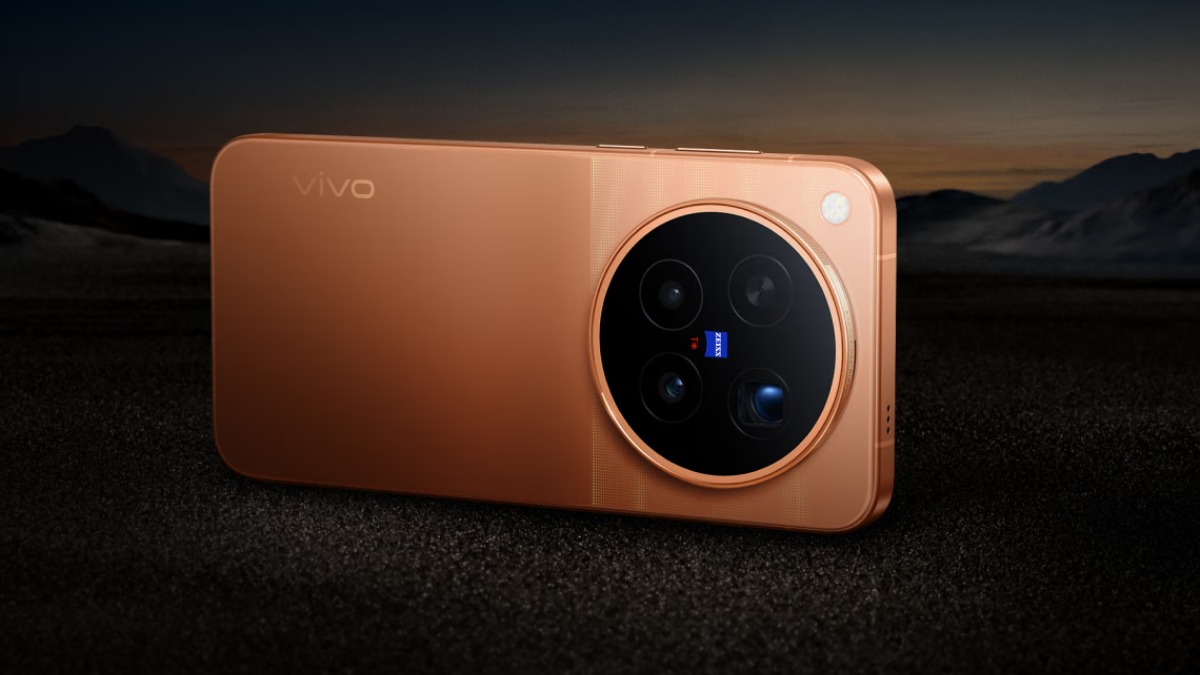
Let’s start with the design. The vivo V80 features a brand-new floating camera design, paired with a cold-carved glass back and a metal frame. Overall, it feels noticeably more premium than a traditional mid-range phone. We received the Horizon Blue version, which is ideal for those who prefer something understated without being too subtle. Honestly, vivo’s mid-range phone designs have always been a step ahead of the competition.
The phone is just 7.69mm thick and weighs around 203g. Considering that it packs a 7200mAh battery and a metal frame, vivo deserves credit for keeping the weight and thickness under control. After all, nobody wants to carry around a brick every day just to get better battery life.
Weight with screen protector
Meanwhile, IP68 and IP69 dust and water resistance ratings are also present. At least in terms of durability, the vivo V80 hasn’t made any obvious compromises due to its mid-range positioning.
Display
On the front, we have a 6.59-inch AMOLED display with a 1.5K resolution and a maximum refresh rate of 144Hz. Based on the specifications alone, it already meets the needs of most smartphone users. However, the resolution is still set to 1080p by default. You’ll have to manually enable the corresponding option to take advantage of the full 1.5K resolution.
The smoothness brought by the high refresh rate speaks for itself, while the AMOLED panel also delivers excellent contrast and deep blacks. Whether you’re scrolling through social media, watching videos, or reading, this display should leave you satisfied.
In terms of performance, the vivo V80 is powered by the Snapdragon 7 Gen 4, which remains unchanged from the previous generation. While this isn’t a flagship chipset, it can easily handle TikTok, social media browsing, navigation, and casual gaming. If all you want is a phone that runs everyday apps smoothly, this chipset should be more than adequate. However, if you regularly play demanding games like Genshin Impact or Zenless Zone Zero, I wouldn’t recommend getting your hopes up too high. You’ll probably need to lower the graphics settings to get a smooth experience.
Of course, OriginOS 7 is also an important part of this upgrade. The refreshed interface, extensive customization options, and AI features all contribute to a more complete software experience.
Camera
Without a doubt, the camera system remains one of the most interesting aspects of the vivo V80.
It features a triple-camera setup consisting of a 50MP main camera, a 50MP ZEISS telephoto camera, and an ultrawide camera. The telephoto camera supports 3x optical zoom and comes with OIS.
Even as smartphone manufacturing costs continue to rise, vivo has decided to keep the telephoto camera. Personally, I prefer this approach over replacing a dedicated telephoto camera with a 200MP main sensor. After all, a dedicated telephoto camera can also deliver better image quality in night photography and clearer video recordings.
The telephoto camera also offers a completely different perspective, especially for portrait photography, where a 3x focal length is often more practical than cropping in from the main camera. vivo also offers 85mm and 100mm ZEISS portrait modes, along with an Aura Light. Combined with different color styles and bokeh effects, it’s clear that vivo wants to make professional-looking portraits accessible to everyday users.
The V80’s main camera is as impressive as ever. However, the ultrawide camera remains the weakest part of the imaging system. For those who frequently photograph architecture, landscapes, or travel scenes, its daytime performance should still be acceptable. But once night falls, you shouldn’t expect too much from this camera.
The 7200mAh battery is undoubtedly one of the most significant upgrades to the vivo V80.
With smartphone battery capacities continuing to grow, vivo is finally taking battery life seriously. This battery can provide up to 14 hours of navigation or nearly 39.5 hours of local video playback. For people who spend long hours using their phones away from home, the peace of mind that comes with a large battery is far more valuable than some flashy features.
Meanwhile, 90W wired fast charging is also here. It takes just 30 minutes to charge the V80 from 0% to 30%. While this isn’t the fastest charging solution on the market, it’s still acceptable considering the battery capacity has reached 7200mAh.
Overall, the vivo V80 is a very typical vivo smartphone. It delivers solid improvements in design, display, photography, and battery life. If you care more about the phone’s appearance, portrait photography, and everyday user experience, the V80 is still a product worth considering.
It’s 2026, and our wrists are more crowded than ever. Between ultra-premium smartwatches demanding daily charges and fitness trackers buzzing with every notification, the simple joy of just wearing a watch can feel like a lost art. But if there’s one company that consistently understands the assignment, it’s Casio.
This year, the Japanese watchmaker has dropped an absolute masterclass in budget-friendly wristwear. They’ve managed to blend their iconic, decades-old design language with surprisingly modern tech, like Bluetooth connectivity and step tracking, without breaking the $100 barrier. Whether you’re looking for a stealthy fitness tracker disguised as a retro digital classic, or a sophisticated steel dress watch that looks like it costs ten times its actual price, Casio’s 2026 lineup has you covered.
Here are the 10 best budget Casio watches launched this year for under $100.
The A158 is arguably one of Casio’s most recognizable digital watches, and the new A158WEMG-9 gives the familiar design a noticeably more premium appearance.
This gold-colored variant replaces the traditional link bracelet with a finely woven stainless steel mesh band. The bracelet undergoes a specialized pressing process that creates a three-dimensional, wavy texture, making it visually distinctive while remaining flexible around the wrist.
The watch retains the compact proportions of the original, measuring 36.8 x 33.2 x 8.5mm and weighing 52 grams. Despite its dressier appearance, it still offers the practical features that made the A158 popular, including a 1/100-second stopwatch, daily alarm, hourly chime, and green LED light.
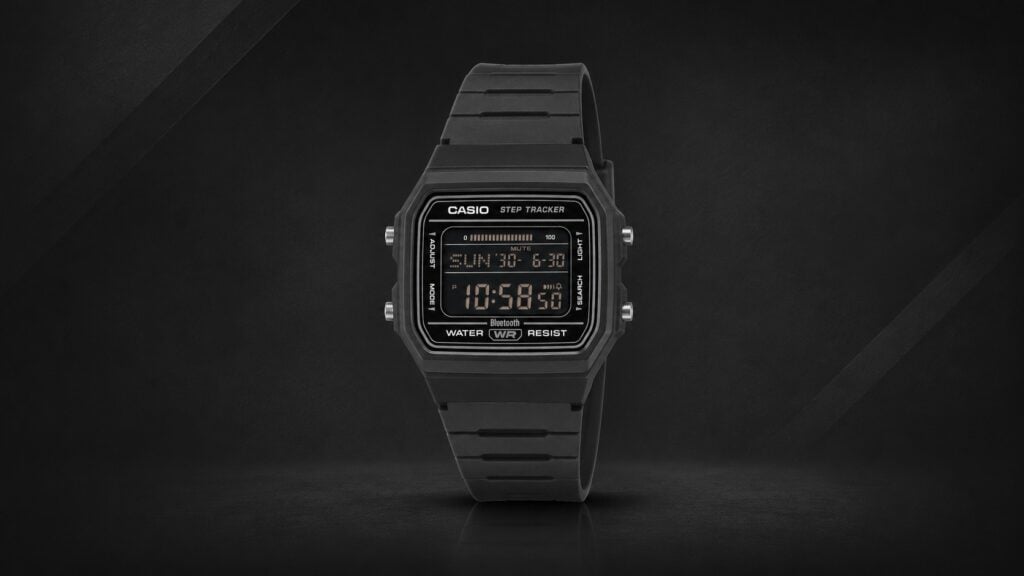
The Casio F-B100W-1B is an updated take on the traditional digital watch, featuring a few built-in smartwatch functions.
This lightweight digital watch comes equipped with Bluetooth connectivity and a built-in step-counting sensor. It pairs with the Casio Watches smartphone app, allowing you to synchronize the time automatically, configure watch settings, and review your daily activity data.
The step tracker supports customizable goals ranging from 1,000 to 50,000 steps, alongside reminders to get moving. There’s also support for approximately 300 world time cities through the companion app, a phone finder, five daily alarms, and a stopwatch capable of storing 200 lap and split-time records.
Perhaps the most impressive part is its size. The resin case measures just 8.8mm thick, while the entire watch weighs only 26 grams. Its ventilated bio-based resin strap should also make it a comfortable option for everyday wear.
Not everyone wants a digital display or a feature-heavy watch. Sometimes, a clean dial and an elegant case are enough.
The Casio LTP-B150D-7B takes a more traditional approach with its rectangular stainless steel case, silver sunburst dial, and Roman numeral hour markers. Its design draws inspiration from classic rectangular dress watches, giving it a sophisticated appearance without the premium price tag.
Measuring 31 x 22 x 7.5mm, this is one of the smallest watches on the list. The compact proportions make it particularly suitable for smaller wrists, while the matching three-link stainless steel bracelet adds a refined finishing touch.
Unlike many affordable watches that rely on resin glass, the LTP-B150D-7B features mineral glass. It also provides everyday water resistance, three-hand analog timekeeping, and approximately three years of battery life.
The AQ-230 series has long been popular among fans of compact analog-digital watches. The recently introduced AQ-230GA-3A builds on the familiar design with a distinctive new color combination.
The watch features a deep green sunray dial that pairs well with its gold-colored case and stainless steel bracelet. The dial displays different shades of green depending on the lighting, adding a touch of depth to the otherwise simple design.
The AQ-230GA-3A measures 38.8 x 29.8 x 8.1mm and weighs just 47 grams, making it comfortable for daily wear.
Like other models in the AQ-230 series, the watch features a combination of traditional analog hands and a small digital display. It also comes with several useful functions, including dual time, a 1/100-second stopwatch, a daily alarm, an hourly time signal, and an automatic calendar that sets February to 28 days.
The watch offers a battery life of approximately three years and comes with an adjustable bracelet for a comfortable fit.
The AQ-240E-2A offers a slightly different interpretation of Casio’s vintage analog-digital formula, replacing the sharp rectangular edges of the AQ-230 with a softer, more rounded design.
Its light blue sunray dial is the main attraction, complemented by slim hour markers, minimalist hands, and a small LCD display positioned near the bottom.
The silver-colored case measures 40.9 x 35.8 x 8.1mm, while the stainless steel bracelet features an adjustable clasp. At 51 grams, it remains lightweight enough for comfortable everyday wear.
The watch offers several useful features, including dual time, a 1/100-second stopwatch, a daily alarm, an hourly time signal, and a digital display with 12/24-hour time formats. Casio also claims a battery life of approximately three years.
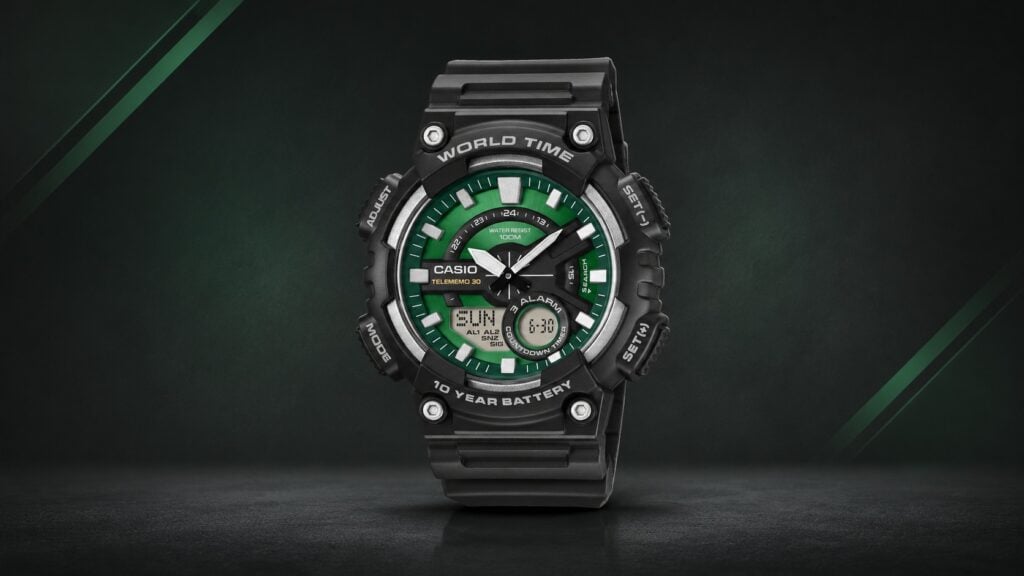
The AEQ-110W-3A2V is for anyone who prefers a bigger, sportier watch with plenty of functionality.
Part of Casio’s green-themed 2026 releases, this analog-digital model features a large resin case measuring 52.2 x 48.2 x 16.7mm. Despite its substantial dimensions, it weighs only 49 grams.
The watch offers 100-meter water resistance and an impressive 10-year battery life, making it particularly appealing for those who value durability and low maintenance.
Its feature set is equally generous. You get world time across 30 cities, a 24-hour countdown timer, a 1/100-second stopwatch, three daily alarms, and a full automatic calendar extending to 2099.
There’s even a Telememo function capable of storing up to 30 contact records, which feels delightfully old-school in an age of smartphones.
The ABL-100WE-2A takes the familiar Casio vintage aesthetic and adds modern connectivity features, making it one of the most interesting digital watches in this price range.
The 2026 color variant features a dark blue dial area, silver-toned case, and multi-row stainless steel bracelet. The result is a watch that looks distinctly retro despite hiding some relatively modern hardware underneath.
Like the F-B100W, it includes a built-in step counter and Bluetooth connectivity. You can pair it with the Casio Watches app for automatic time synchronization, activity logging, and easier access to various settings.
The watch also supports dual time, five daily alarms, a countdown timer, and a stopwatch capable of storing up to 200 lap and split-time records.
Its case measures 41.6 x 37.9 x 8.2mm, making it surprisingly slim for a Bluetooth-enabled digital watch. At 60 grams, it’s heavier than the resin-bodied F-B100W but offers the added appeal of a stainless steel bracelet.
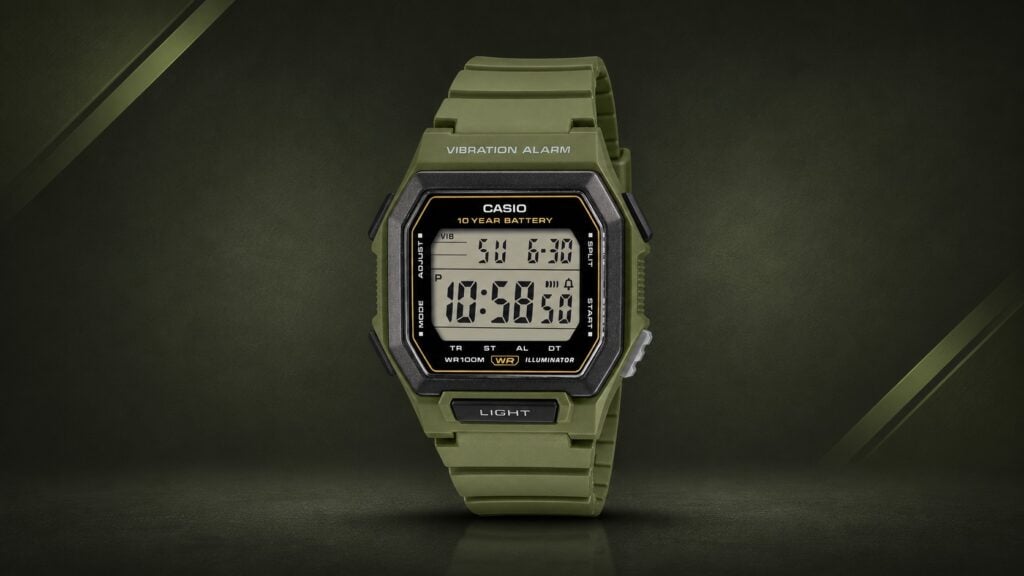
The W-738H-3AV stands out for one particularly useful feature: a vibration alarm.
Instead of relying exclusively on audible alerts, the watch can vibrate to notify you about alarms, hourly signals, and timer events. That makes it useful in situations where a traditional alarm might be distracting or difficult to hear.
The watch features a square resin case measuring 47 x 42.8 x 13.5mm, paired with a resin strap designed for comfortable adjustment. It weighs just 43 grams.
The 3AV features a large digital display with an amber LED backlight, 100-meter water resistance, and a battery life of approximately 10 years.
It also comes with several useful functions, including dual time, a 1/100-second stopwatch with an automatic countdown start, a 24-hour countdown timer, and a full auto-calendar through 2099.
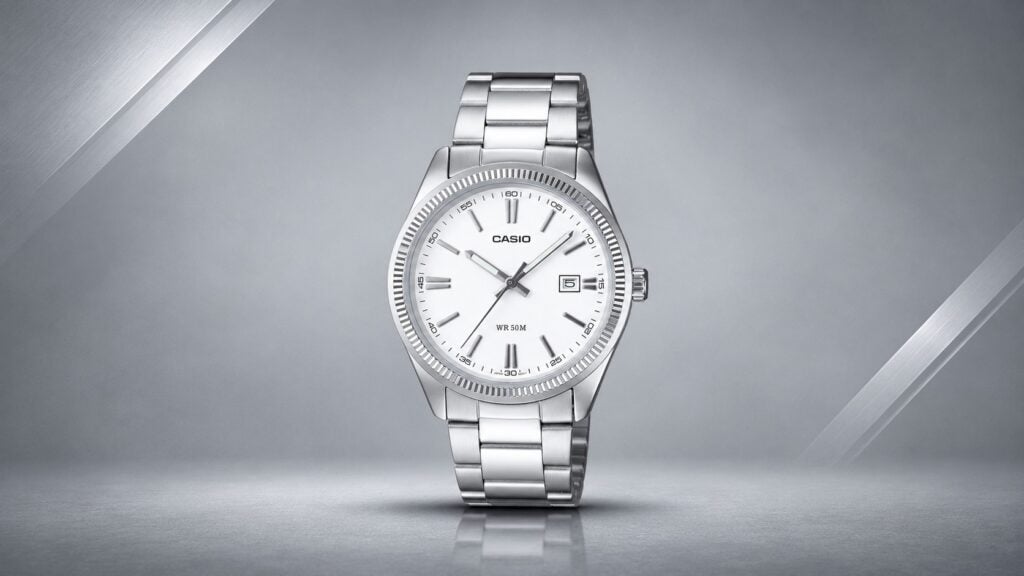
If you prefer a traditional analog watch, the MTP-1302PD-7A1V remains an appealing alternative to Casio’s digital-heavy offerings.
The design features a clean, light-colored dial, a silver-tone case, and a stainless steel bracelet with a triple-fold clasp. Its conventional round silhouette makes it suitable for both casual and more formal settings.
The case measures 44.2 x 38.5 x 9.2mm, while the watch weighs 105 grams, giving it a more substantial wrist presence than the smaller dress models featured here.
It also benefits from mineral glass, 50-meter water resistance, and a practical date window.
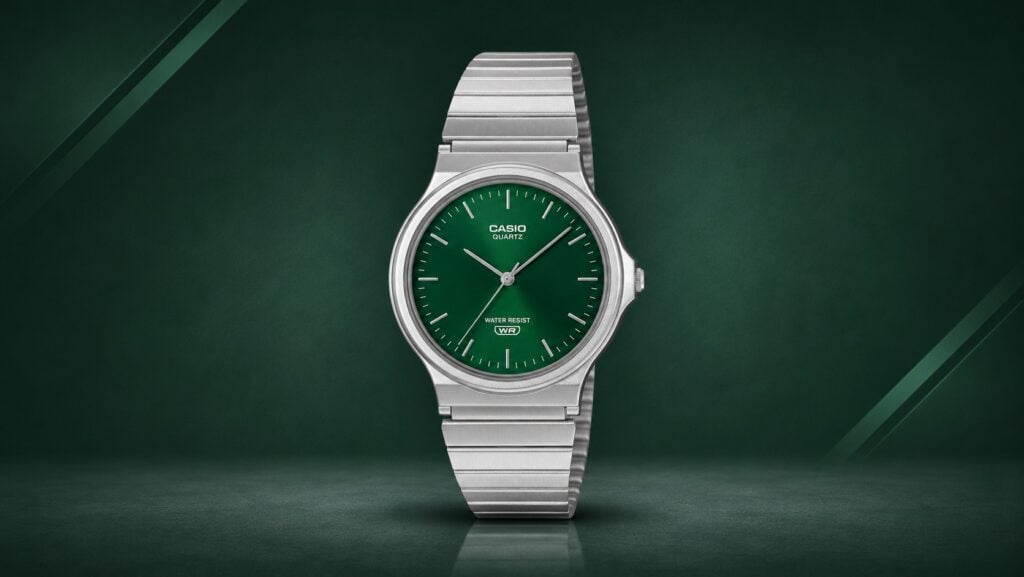
The MQ-24 has long been associated with simple, affordable timekeeping. The MQ-24DA-3A, launched in 2026, gives that minimalist formula a stylish metal-band upgrade.
Instead of the familiar resin strap, this version features a stainless steel bracelet with an adjustable clasp. The metallic green sunray dial and raised hour markers also give it a more refined appearance than the standard MQ-24.
The case measures 38.8 x 34.9 x 7.8mm, while the watch weighs only 45 grams, making it a comfortable option for smaller wrists and daily wear.
The watch keeps things simple with a three-hand quartz movement, basic water resistance, and a battery life of approximately three years. Casio rates its accuracy at ±20 seconds per month, which should be more than adequate for everyday use.
Earlier this month, iQOO cleared a key India certification for the upcoming 16R, even as the more powerful iQOO 16, already launched in China, is still being lined up for a local debut. The brand has also been preparing a new Lite model in its Z-series, and the iQOO Z12 Lite has now turned up in a fresh database listing.
iQOO Z12 Lite 5G spotted on Google Play Console
iQOO Z12 Lite 5G
The iQOO Z12 Lite 5G has appeared on the Google Play Console, as spotted by XpertPick, and listings of this kind often show up shortly before a phone is introduced. The page is titled iQOO Z12 Lite 5G under the product code I2510, and XpertPick identifies this variant by the model number I2516.
There appear to be at least two 5G models using the same name. Earlier this month, a Z12 Lite with model number I2603 was spotted in the Bluetooth SIG database, and that same code had already shown up in the IMEI database after EEC certification in July. XpertPick notes that no specifications have surfaced for the I2603 variant, and that it could be sold as the iQOO Z12 SE in some markets.
iQOO Z12 Lite 5G
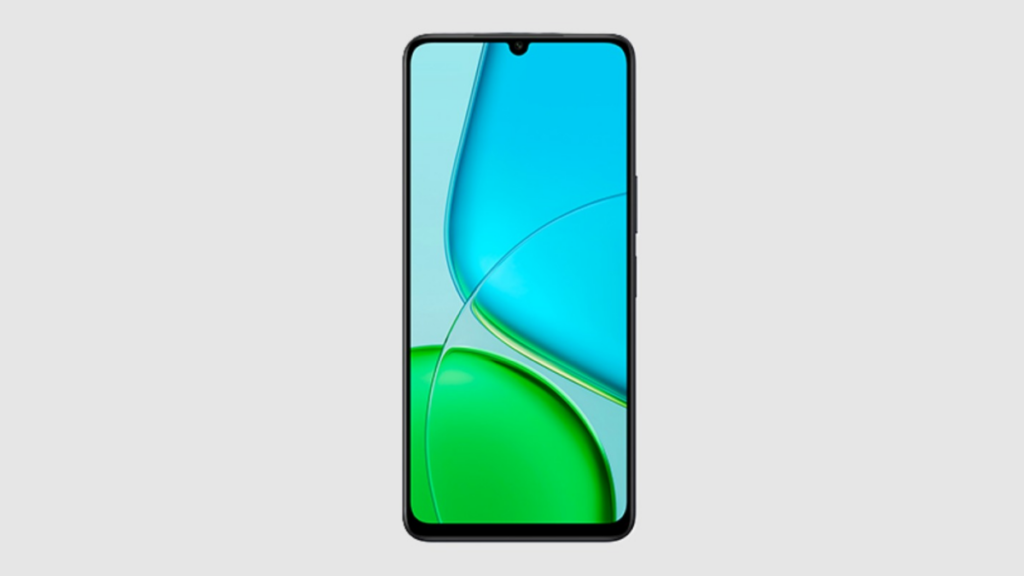
The Play Console entry for the I2516 model is more revealing. The device image shows a waterdrop notch display, a layout iQOO has used on its more affordable 5G phones. The listing also names a MediaTek Dimensity 6300 chipset, recorded as MT6835, along with 4GB and 6GB RAM options, an HD+ screen of 720 x 1600 pixels, and Android 16.
At the bottom of the same page, the iQOO Z11 Lite 44W 5G is listed as a variant, and both phones share the I2510 codename. That overlap is why this Z12 Lite 5G could be a rebranded version of the existing Z11 Lite. That phone arrived in India earlier this year as the successor to the Z10 Lite and uses the same Dimensity 6300 chip, a 6.74-inch HD+ panel, and 4GB and 6GB memory options.
The I2516 model has also been certified by India’s BIS authority, according to XpertPick, so a local launch could come this month or in December. iQOO has not confirmed the name, a full specification sheet, pricing, or a release date.
Yesterday, Huawei confirmed that November 24 will see the arrival of the Mate X8 foldable phone in China. Now the brand has taken the covers off the OSTA O1 Pro, which is available for pre-order through the company’s online store, Vmall. For those unaware, OSTA is Huawei’s new sub-brand, known in China as Xingmang, and this wide-screen phone is its first official listing.
Huawei OSTA O1 Pro variants, color options
Huawei OSTA O1 Pro
The official Vmall listing shows three colors: Starry Black, Nebula White, and Starburst Purple. Starry Black and Nebula White come in 12GB+256GB and 12GB+512GB, while Starburst Purple is reserved for the 16GB+512GB and 16GB+1TB configurations, leaving the 16GB memory options exclusive to the purple model.
Pre-orders are now open on Huawei’s official online store, Vmall, and the company has set an official launch for November 20 at 2:30 p.m. China time. The product page still shows no price and no sale start time, so those details are expected to arrive with the event.
Huawei OSTA O1 Pro specifications
Huawei has not published a full specification sheet yet, but tipster Digital Chat Station has outlined a 6.39-inch 1.5K LTPS flat display with a 16:9.5 aspect ratio and 1.05mm bezels on all four sides. He also lists a Kirin 9030S chip, a 200-megapixel 1/1.28-inch RYYB main camera, a 50-megapixel 3.7x RYYB periscope telephoto, a Red Maple lens, a 7,000mAh battery with 66W wired charging and wireless charging, a side fingerprint sensor, and a 6.68mm-thick body that weighs 200 grams.
Those figures sit very close to the Huawei Pura X View, which uses the same Kirin 9030S, a 6.39-inch 16:9.5 panel with 1.05mm bezels, a matching 200-megapixel main camera and 50-megapixel 3.7x periscope, a Red Maple sensor, a 7,000mAh battery, and the same 6.68mm thickness. The OSTA model appears to drop the Pura X View’s ultra-wide camera, adds 16GB memory options, and is about a gram lighter, so this looks like a closely related wide-screen design rather than a confirmed rebadge.
AOC has introduced a new portable monitor to its lineup in China. The AOC Q16T36 is currently listed on JD.com for 999 yuan ($140), offering a 16-inch external display for users looking to add a second screen to their existing hardware setup.
The monitor is built around a 16-inch IPS LCD panel with a 2.5K resolution of 2560 x 1600. This configuration gives the display a 16:10 aspect ratio, which provides about 11% more vertical screen space compared to standard 16:9 monitors.
For motion handling, the Q16T36 features a 120Hz refresh rate and a 4ms gray-to-gray (GtG) response time. It also includes Adaptive-Sync technology, with support for AMD FreeSync, to prevent screen tearing when running games or other high-frame-rate applications.
Regarding image output, the panel reaches a peak brightness of 350 nits and has a static contrast ratio of 1200:1. It is a native 8-bit panel that covers 99% of the sRGB color space. The monitor has an average color accuracy of Delta E < 2, making it viable for standard photo editing and color-matching work within the sRGB space. The display supports HDR10 and includes a low blue light mode for extended reading or working sessions.
The AOC Q16T36 comes with two full-featured USB-C ports, an HDMI 2.0 port, and a 3.5mm audio jack. It supports single-cable USB-C connectivity for video and power with compatible devices, along with up to 45W reverse charging when connected to an external power adapter. HDMI connections require a separate power source through USB-C.
The hardware measures just 14mm in thickness and features a matte exterior finish. It comes with a built-in adjustable kickstand for desktop use and supports 75 x 75mm VESA mounting for additional setup options. The monitor also includes two built-in 1W speakers and is compatible with Windows, macOS, Android, iOS, and HarmonyOS devices.
Xiaomi has updated its Mijia Multifunctional Portable Flashlight with a new Sand Gold color option. The device retains its highly accessible price point of 99 yuan (~$14) and continues to focus on practical utility, packing several lighting modes into a compact, weather-resistant aluminum chassis.
From a design standpoint, the flashlight is built for portability. It measures 130 x 30 x 30mm and weighs just 125 grams. The slim 3cm diameter makes it easy to slide into a pocket, a glovebox, or the side pouch of a backpack.
Xiaomi has also integrated a hidden hanging hook into the base of the device. This lets you hang the flashlight inside a tent or attach it to an overhead fixture, turning it from a standard directional beam into a stationary lantern.
The primary LED outputs a maximum of 1,000 lumens, which the company says can throw a beam over 150 meters. To manage battery life and accommodate different environments, the main light is divided into three brightness tiers. You can select the full 1,000-lumen high mode for distance viewing, a 350-lumen medium mode for general walking and navigation, or a 50-lumen low mode for close-up tasks like reading.
The multifunctional aspect of the device comes from its secondary lighting features. The flashlight includes an ambient lighting mode with three adjustable color temperatures: a 4000K natural white, a 3300K warm white, and a 2700K warm light. There is also a candlelight mode that simulates a gentle flicker for a softer environmental light, alongside standard SOS and strobe settings for emergency situations.
The flashlight packs a 3,100mAh lithium-ion battery that offers up to 30 hours of runtime at the lowest 50-lumen setting. It supports 5V/1.5A charging and takes approximately three hours to fully recharge. It also features an IP65 dust and water resistance rating, with a rubber cover protecting the charging port against dust and water.
In related news, Xiaomi has recently launched the Mijia Ergonomic Cushion with lumbar heating and smart sitting reminders, along with the Mijia Smart Waist Massager 2, which features dual-sided heating and up to 110 minutes of battery life.
Some of the most interesting Android phones arriving this fall won’t be available in the US. Oppo already sells its latest Find X10 flagship in Europe, Vivo is preparing to bring its X500 series to India, and Xiaomi will introduce its latest Pro models to global markets on November 17. Yet none of these launches come with a confirmed US release.
That’s not particularly unusual for these three Chinese phone makers. Oppo, Vivo, and Xiaomi are among the world’s biggest smartphone brands, but their flagship phones rarely make it to the US. Meanwhile, OnePlus, which has had a meaningful presence, decided to call it quits on the entire Western market.
As a result, American buyers are limited to a handful of Android brands to choose from. We see you Motorola, Samsung, and Google. Here’s what US buyers are missing and how they can actually get hands-on with one.
Xiaomi, Oppo, and Vivo have established themselves in markets across Asia and Europe, but none has built a meaningful retail presence in the US. And the American market itself has a lot to do with it.
Unlike many other regions, where people can walk into a store or buy a phone directly from a manufacturer, the US smartphone market is heavily controlled by carriers. Getting a phone in front of American buyers often means securing carrier partnerships, something these three Chinese brands have never managed to do on a meaningful scale.
That doesn’t mean Americans cannot own their phones. Import retailers sell both Chinese and global versions, although buyers need to check network band compatibility, software support, and warranty coverage before placing an order. A global version is generally the safer option, but even that doesn’t guarantee full compatibility with every US carrier.
OnePlus’ situation is a little different. It already had an established US and European presence, including retail stores and carrier partnerships. However, in July, the company confirmed it would conclude new product rollouts in North America and Europe. It hasn’t announced an end to support for existing devices, and its customer service channels remain open under the company’s existing warranty obligations.
For now, that makes the following three flagship lineups particularly interesting for anyone willing to import a phone.
2. Oppo Find X10 Pro Max
The Oppo Find X10 Pro Max is the only phone in this group that already has a global version on sale. Oppo unveiled it in China in September before bringing the Find X10 series to international markets on October 21. Its biggest talking point is the camera system, which puts three 200MP sensors on the back of a single phone.
The cameras cover the main, ultra-wide, and telephoto focal lengths, all developed with Hasselblad. The main camera also gets a claimed 17-stop dynamic range through Oppo’s DeepPix sensor technology.
The 6.78-inch LTPO display supports a refresh rate of up to 144Hz in compatible games and reaches a claimed 3,600 nits of local peak brightness. Powering the phone is MediaTek’s 2nm Dimensity 9600 Pro, paired with ColorOS 17. It also carries IP66, IP68, and IP69 ratings.
The battery is where US buyers need to pay attention to the regional differences. The Chinese model packs an 8,000mAh battery with 80W wired and 50W wireless charging. European buyers get a smaller 7,150mAh battery, although the charging speeds remain the same.
It starts at €1,799 (£1,499) for the 12GB RAM and 512GB storage configuration.
3. Vivo X500 Pro Max
The Vivo X500 Pro Max starts at 6,999 yuan (~ $1050) in China, and unlike Oppo’s flagship, which spreads its 200MP sensors across three cameras, Vivo is using the big sensor for its periscope telephoto system.
The phone has a 200MP ZEISS APO periscope camera with an 85mm-equivalent focal length and a large 1/1.4-inch sensor. Vivo also sells an optional ZEISS Telephoto Extender Gen 2 Ultra, which adds a 400mm-equivalent focal length. It’s a clip-on accessory sold separately, but it gives the phone considerably more reach for distant subjects.
The remaining cameras include a 50MP main sensor with gimbal-grade stabilization and a 50MP ultra-wide camera. Likewise, it comes with a 144Hz AMOLED display and an 8,000mAh battery, with 90W wired and 40W wireless charging.
The X500 Pro Max uses the same Dimensity 9600 Pro as the Find X10 Pro Max and runs OriginOS 7 based on Android 17.
For buyers outside China, Vivo confirmed that the X500 series will launch in India on November 26. We can expect a European launch as well.
4. Xiaomi 18 Pro and Xiaomi 18 Pro Max
Xiaomi is the next manufacturer preparing to take its latest flagship phones outside China. The Xiaomi 18 Pro and Xiaomi 18 Pro Max launched in China in September, and the company has now confirmed a global launch event in Paris for November 17.
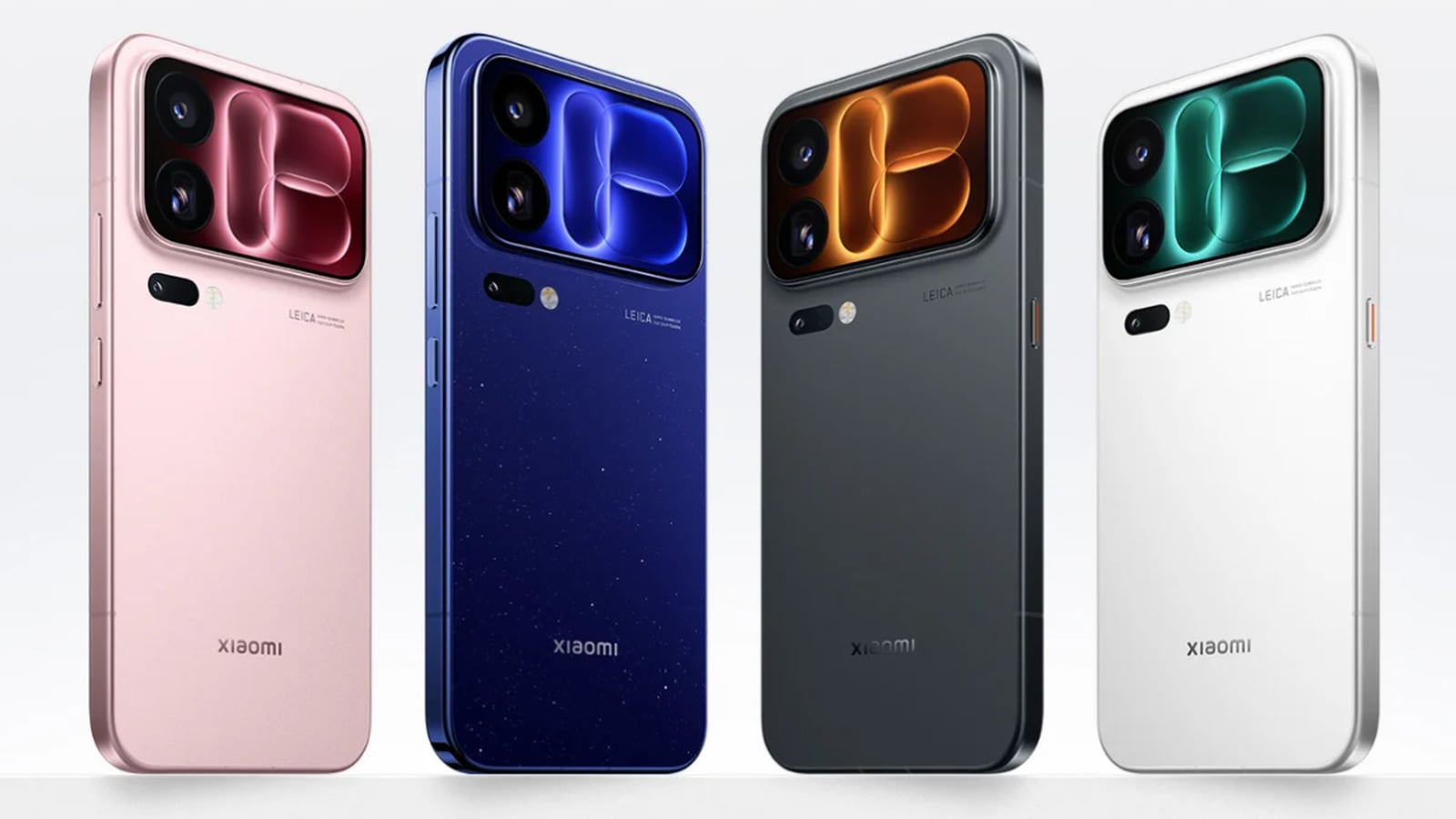
Both phones carry dual 200MP Leica cameras and a secondary display on the back. The rear screen allows users to access information and take selfies using the main cameras.
The two models also differ in their processors and battery capacities. The Xiaomi 18 Pro runs on the Snapdragon 8 Elite Gen 6 and packs a 7,000mAh battery. The Pro Max moves up to the Snapdragon 8 Elite Extreme Gen 6, built on a 2nm process, alongside a larger 8,500mAh battery.
The global versions could be quite different in one important area. Per European energy-label listings, the 18 Pro will have a 6,000mAh battery, while the Pro Max could get a 7,050mAh cell.
Likewise, European retailer listings suggest the Xiaomi 18 Pro could start at around €1,400, with the Pro Max costing close to €1,850. These aren’t official prices, though.
There’s also some history behind this launch. Xiaomi kept the previous-generation Xiaomi 17 Pro and 17 Pro Max exclusive to China, while the standard Xiaomi 17 and Xiaomi 17 Ultra made it to global markets earlier this year.
Bringing the new Pro models to international markets would therefore be a notable change. However, Xiaomi hasn’t announced a US release, so American buyers shouldn’t assume the Paris event changes that.
5. Getting one from the US
None of these phones is officially sold through US carriers or the brands’ US stores. That leaves import retailers as the main option for anyone interested in buying one.
The global Oppo Find X10 Pro Max is listed at Giztop from $1,599. It is currently the easiest of the three to get in a global version, although buyers should still check the supported network bands and warranty terms before ordering.
The Vivo X500 Pro Max is another possibility, but buyers may have to wait for its international availability or import the Chinese version. Xiaomi’s situation should become clearer after the November 17 launch, although a global announcement alone doesn’t guarantee US retail availability.
There are a few things worth checking before importing any of these phones. Make sure the exact model supports your carrier’s LTE and 5G bands, confirm VoLTE compatibility, and check whether the seller provides a usable warranty in the US. Chinese versions can also come with region-specific software and services, making a global model a better choice when one is available.
OnePlus’ withdrawal adds another wrinkle to the US Android market. The company will continue supporting existing phones, but its decision to stop new launches in North America and Europe means buyers have one fewer established brand to consider when shopping for their next flagship.
And there are more Chinese launches coming before the month ends. The Honor 700 series is scheduled to arrive in China on November 23, followed by Huawei’s Mate X8 foldable on November 24. Neither has a confirmed US launch. Honor is not subject to the same US restrictions as Huawei, however, so their situations shouldn’t be treated as identical.
A good office chair can make long working hours much more comfortable, but quality ergonomic chairs often come with a hefty price tag. Black Friday is a good time to change that. Sihoo’s 2026 Black Friday sale brings discounts on three ergonomic office chairs, with savings of up to $290 and prices starting at $239.99. The offers are available on the Sihoo US store until November 28, with the Doro C300, Doro C300 Pro V2 and B300 Pro among the featured deals.
Sihoo Doro C300 Gets a $290 Black Friday Discount
The biggest Black Friday discount is on the Sihoo Doro C300 Standard, which now costs $269.99, down from $559.99. That is a $290 saving, making it an attractive option for buyers looking for an ergonomic chair at a lower price.
The chair comes with self-adaptive dynamic lumbar support, a flexible backrest, a 3D mechanical headrest and 4D coordinated armrests. It also features a weight-sensing recline mechanism. This is the standard version without a footrest, so buyers should not confuse it with the footrest-equipped models.
Sihoo Doro C300 Pro V2 with Footrest Drops to $459.99
For buyers looking for a more premium setup, the Sihoo Doro C300 Pro V2 with Footrestis available for $459.99 instead of $549.99, saving $90. The discounted configuration comes in white and includes a built-in footrest.
Its features include DynaCore synchronized full-body support, a SyncroFlex backrest with a dual-track, dual-spring mechanism and Self-Adaptive Dynamic Lumbar Support 2.0. It also has 8D bionic armrests and three recline positions at 105°, 120° and 135°.
A hands-on review highlighted the flexibility of its 8D armrests and effective lumbar support when reclining with the backrest unlocked. The relatively firm mesh offers a supportive seating feel, while taller buyers can check the available seat-height adjustment to see if it suits them.
Sihoo B300 Pro Is the Cheapest Deal at $239.99
The Sihoo B300 Pro Standard is the most affordable option in this sale, dropping from $329.99 to $239.99. This gives buyers a $90 discount and makes it the cheapest of the three featured ergonomic chairs.
Despite its lower price, the B300 Pro offers several adjustment features, including 4D Micro-Fit lumbar support, a height-adjustable backrest, 6D armrests and a 3D headrest. It also provides approximately 5 cm of seat-depth adjustment. Like the standard C300, this deal covers the version without a footrest.
More Discounts and Multi-Chair Offers
Apart from these three featured deals, Sihoo is giving discounts of up to 65% on selected products across its US store. The company is also offering additional savings for customers purchasing multiple chairs.
Customers buying two chairs can get $30 off, while orders containing three chairs qualify for $50 off. Those purchasing five chairs can receive a 10% discount. However, shoppers should check the checkout page to confirm whether these offers can be combined with existing Black Friday discounts. The 65% maximum discount does not apply to the three featured chair deals.
Sihoo’s 2026 Black Friday sale runs from November 6 to November 28 on its US store. The Doro C300 Standard offers the biggest dollar savings, while the B300 Pro is the cheapest option for shoppers looking to upgrade their home or office seating.
The clip shows a physical, transparent front cover glass on a stand, not a finished phone. It curves on all four edges, with an extremely thin, even black border and a pill-and-circle cutout at the top center that matches a Dynamic Island. There are no buttons and no back, because this is only the front glass.
Ice Universe presented the clip as a first look at a milestone design for the iPhone 20 Pro. Later in the video, the footage cuts to a Chinese social media post from the account 数码大叔, titled “iPhone 20周年款四曲面玻璃,” or iPhone 20th anniversary model quad-curved glass. That appears to be the source, though the authenticity of the panel has not been verified.
The shape lines up with reports that have been building for months. Tipsters have already said Apple is working with Samsung on a custom quad-curved display for the anniversary model, and earlier concept renders collected those rumors, including reporting from analysts such as Mark Gurman, into an all-glass, nearly borderless design.
That front layout is still unsettled. Some reports say Apple is still testing under-display Face ID, and even an under-display camera, while a September leak described a punch-hole on early test units. The glass in this video still uses a Dynamic Island-style pill and circle, which would leave a visible cutout if this sample is close to production.
This is still only a loose cover glass, not a working display or a full prototype, and Apple has not confirmed the design, the name, or a 2027 launch plan. Until official details arrive, the quad-curved front and the thin, even bezels should be treated as an early look that can still change before production.
Xiaomi is lining up the standard Xiaomi 18 for a December China debut, with blind orders already open at China retailers, after the Xiaomi 18 Pro series officially goes global on November 17 in Paris. Now, tipster Digital Chat Station has flagged a very different Xiaomi phone for next year.
Xiaomi’s compact wide-screen bar phone enters display testing
Xiaomi wide-screen phone
Digital Chat Station did not name a brand in the new post, though the tip is expected to point to Xiaomi. The early plan is a compact 6.3-6.4-inch wide-screen bar phone with a 16:9 aspect ratio, roughly 1mm equal bezels on all four sides, BT.2020 color gamut support, and a high-spec wide-screen panel, and the tipster says that display has already been powered on.
A 16:9 panel would be a clear break from the tall 20:9-class screens used on most phones today. That classic video ratio would let standard 16:9 footage fill the display with fewer black bars, while the 6.3-6.4-inch diagonal would keep the phone relatively compact. The closest model already on sale is the Huawei Pura X View, which launched with a 6.39-inch 16:9.5 OLED and 1.05mm bezels on all four sides.
Xiaomi has already tried a wide-screen approach with the Xiaomi 18 Fold, which launched in September with a 5.38-inch outer display and a 7.58-inch inner screen, both using a paper-like ratio. Last month, Digital Chat Station also said a brand’s sub-brand was evaluating a wide bar phone for 2027, which could point to Redmi.
The tip also fits a wider Android push already mapped out this fall. Oppo has been tipped with a 16:9 wide-screen prototype and roughly 1mm even bezels, while Honor and Vivo have also been linked to compact wide candybar phones for 2027. Digital Chat Station previously said Oppo and Honor would lead that wave after the Pura X View, with other brands following later.
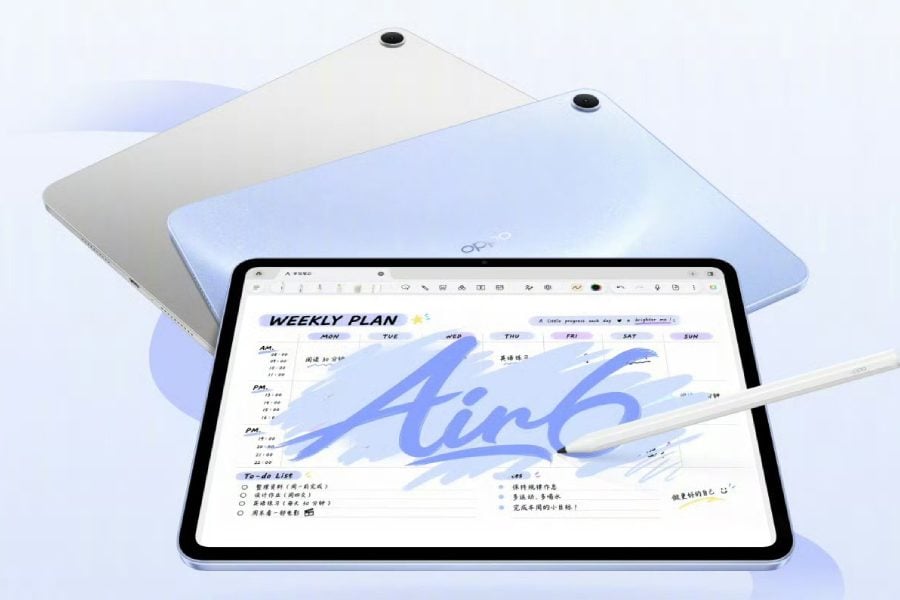
Oppo has launched the Pad Air 6 in China, with a 12.1-inch display, a 10,050mAh battery, and a set of study tools built around its new Oppo Notes app. The tablet starts at 2,599 yuan or about $382, and here’s what you get for it.
The Pad Air 6 has a 12.1-inch LCD screen and measures just 6.89mm thick. It weighs 603g and comes in Encounter Blue and Starlight Silver colors. There’s also a Soft Light screen version that gets the same Bright Eye Soft Light treatment as Oppo’s flagship models.
It is also the first tablet to receive TÜV Rheinland’s Smart Eye Protection 6.0 certification. Oppo says the technology can reduce 97% of ambient light interference.
Powering the device is MediaTek’s Dimensity 7360 chip, paired with LPDDR5X RAM and UFS 3.1 storage. Likewise, the tablet runs on a 10,050mAh battery and has an 8MP rear and an 8MP front camera.
The bigger addition is Oppo Notes, helpful especially for students. You can take a picture of the blackboard with your phone and then tap the top of the phone against the tablet’s screen to transfer the content into your notes. Oppo says the system can accurately capture the board regardless of where it appears in the camera frame.
The app also handles PDF course materials and test papers, letting students sort them into categories. If a page runs out of writing space, they can expand the canvas with one tap and continue adding notes or solving exercises without switching to a separate sheet of paper.
The Pad Air 6 also supports 5G communication sharing, so it can connect to the internet through a nearby phone without requiring users to switch on a traditional mobile hotspot. Oppo claims this method consumes 30% less power than a regular hotspot connection.
Redmi launched the Note 17 in China in July and brought the Note 17 5G to India in August, with a large battery as the main talking point. A certification listing that emerged last week revealed that the Redmi Note 18 series could be in the works for China. Now, a new leak has surfaced the battery and charging details of the Note 18 5G’s Chinese and global editions.
Redmi Note 18 5G’s key details leaked
I remember my password! The Redmi Note 18 5G is a rebrand of the Note 17 5G, it just has a different battery: 8888mAh + 45W for China 8100mAh + 45W for global pic.twitter.com/mPyVFHbqaD
Tipster PaperKing13 says the Redmi Note 18 5G is a rebrand of the Note 17 5G, with the battery as the only change. Screenshots shared alongside the claim show build properties for the China variant, codenamed “mist” with the model number M077CE, and a market name list that includes the Redmi Note 18, the Redmi Note 18 5G, and the Poco M8 Power 5G.
According to the tip, the China model would move from the BM79 8,000mAh battery to a BN84 8,888mAh pack, while the global model would go from the BM7A 7,700mAh cell to a BN85 8,100mAh unit. Wired charging would stay at 45W in both regions, matching the current Note 17 5G.
The current Redmi Note 17 5G is built around a Snapdragon 4 Gen 4 chipset, a 6.99-inch FHD+ 120Hz AMOLED display, and a 50-megapixel main camera. Those parts are expected to carry over to the new model. The Poco M8 Power, which launched in August as a larger-battery version of the Redmi Note 17 5G, has no direct Redmi twin so far. That suggests the Redmi Note 18 5G heading to global markets could effectively be a rebranded Poco M8 Power.
That would leave the standard Note 18 5G as a modest battery bump rather than a full redesign. The earlier certification pointed to three Note 18 models in the works, with the Pro Max expected to pack a battery in the 10,000mAh range.
Redmi has not confirmed any of these details yet. However, there is a possibility that the Redmi Note 18 series may debut in China by the end of this year or in early January 2027.
The Oppo Watch 5 is a square aluminum watch that is 9.2mm thick and weighs about 25 grams without the strap. It is offered in five colors: Adventure Purple, Moonlight White, Fairyland Green, Wish Orange, and Starry Black. A 1.85-inch 390 x 450 AMOLED display is protected by Gorilla Glass 5 and reaches 600 nits typically, 1,500 nits in sunlight, and 3,000 nits in Oppo’s own sports modes.
The watch runs ColorOS Watch 17 on a BES2710IBP processor and includes Bluetooth 5.2, NFC for transit cards, access control, and some car keys, plus single-band GPS, BeiDou, Galileo, GLONASS, and QZSS. It does not include eSIM or Wi-Fi. A 351mAh battery is rated for 7 days of regular use, up to 10 days in its longest mode, and 3 days with the always-on display, and a full charge takes about 90 minutes.
Health tracking covers heart rate, blood oxygen, skin temperature, stress, and 13 sleep metrics, including a sleep score and a sleep apnea risk assessment, plus temperature-based period prediction. More than 100 workout modes are available, including a FatMax mode that shows a fat-burn heart rate zone and an estimate of grams burned. The case is rated 5ATM, IP69, and IP69K for swimming.
Custom watch faces can be built from photos and shared with a code, and Fluid Cloud can show flight, ride-hailing, and high-speed rail alerts on the wrist. The watch also supports Alipay, WeChat Pay, and Oppo’s Xiaobu assistant.
The Watch 5 starts at 899 yuan (~$132) in Moonlight White, Fairyland Green, Wish Orange, and Starry Black, while Adventure Purple is 999 yuan (~$147). Sales begin in China on November 20, and a 15% government subsidy in some regions can lower the starting price to 764.15 yuan (~$112), below the Watch 4 Pro‘s 2,299 yuan launch price in 2023.
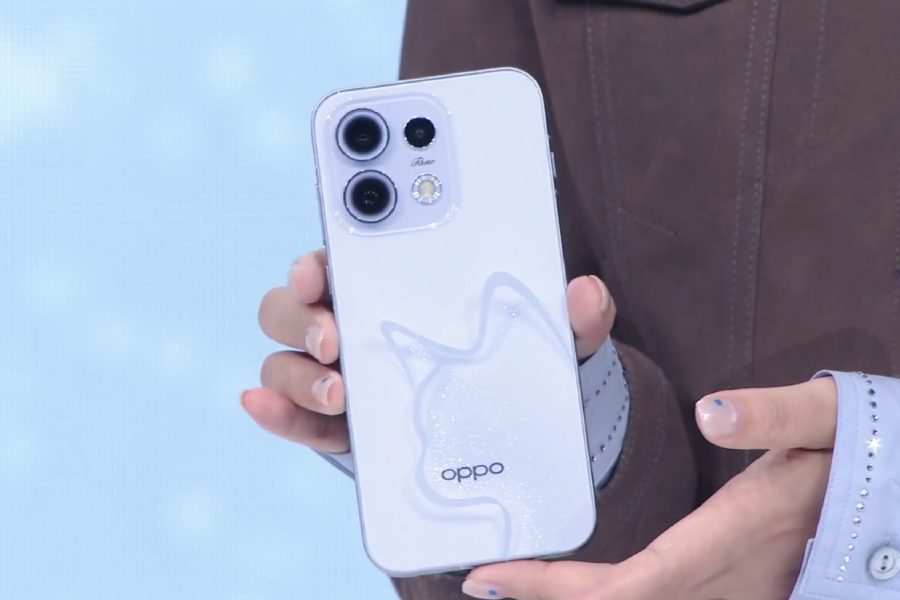
Oppo has launched the Oppo Reno 17 and Oppo Reno 17 Pro in China. The Oppo Reno 17 has an 8,000mAh battery. The Oppo Reno 17 Pro has a 200MP main camera. Both phones go on sale on November 20. The series arrives about six months after the Oppo Reno 16 series launched in China in May.
The two phones differ in size and chip, and it may not seem like it, but the Reno 17 Pro is actually the smaller of the two. It has a 6.32-inch 1.5K LTPS display and a MediaTek Dimensity 8550 Super chip. The regular Reno 17 has a 6.56-inch 1.5K LTPS screen and Qualcomm’s Snapdragon 7 Gen 4. Both have flat displays, metal frames, optical fingerprint sensors, and IP69K certification.
Oppo Reno 17Oppo Reno 17 Pro
The regular Reno 17 has an 8,000mAh battery, compared to 7,200mAh on the Pro. Both support 80W wired charging.
The Pro’s 200MP main camera is the biggest difference in the imaging department. The standard Reno 17 settles for a 50MP main sensor, although it keeps the same 50MP ultrawide and periscope cameras. Both phones also have 50MP selfie cameras.
Coming to the design, it actually has a gimmick. The Encounter Cat colorway has a three-dimensional cat embedded inside the glass back, using what Oppo calls its 3D Ice Transparent Suspension Process 2.0.
The cat’s outline and shadow shift as the phone moves, while a star-studded coating adds a subtle shine. Oppo says the camera module on this version is also cut from a single piece of glass. The other three colors are Ice Moon White, Cocoa Brown, and First Snow White.
Oppo is also selling a Luo Tianyi co-branded edition for the Reno 17 series. It comes with a gift box for buyers who select it when ordering. The box includes a limited-edition standee, a crystal ball, a keychain, and collectible cards.
A matching theme will arrive on November 20, with four exclusive lock screens and wallpapers, including three new Luo Tianyi looks and a Q-version design. It also adds clock, to-do list, and step-count widgets, along with interactive effects featuring particles, snow, and charging animations.
Bmax has introduced the B12 Power, its latest mini PC powered by Intel’s high-end Core Ultra 9 185H processor. The new desktop packs powerful hardware into a compact chassis that weighs just 390 grams.
Bmax B12 Power Specifications
The Core Ultra 9 185H is a 16-core, 22-thread processor built on the Intel 4 process, capable of reaching a maximum turbo frequency of 5.1GHz. Because it belongs to Intel’s newer Meteor Lake lineup, the chip includes an integrated neural processing unit (NPU) designated as Intel AI Boost, aimed at handling local AI workloads.
For graphics, the Bmax B12 Power relies on integrated Intel Arc Graphics. According to Bmax’s performance estimates, the mini PC can deliver over 202 fps in League of Legends, 105 fps in Valorant, and 73 fps in Horizon Zero Dawn. However, since it uses integrated graphics, the system is better suited for everyday productivity, media consumption, and casual gaming rather than demanding 3D rendering workloads or modern AAA games.
For memory, the Bmax B12 Power comes with 24GB of onboard LPDDR5 RAM (4400MHz–5600MHz). Since the memory is soldered to the motherboard, you cannot upgrade it later. The mini PC also includes a 1TB M.2 2280 PCIe NVMe SSD for storage. If you need additional space, you can install a 2.5-inch SATA HDD or SSD through a dedicated internal bay that uses a proprietary FPC cable.
To manage the thermal output of the Core Ultra 9 in a 126 x 112 x 52mm plastic and acrylic enclosure, Bmax is using an active cooling system consisting of a smart fan and dual copper heat pipes.
For connectivity, the Bmax B12 Power comes with two USB 3.2 ports, two USB 2.0 ports, a full-featured USB Type-C port, a 3.5mm audio jack, and a 2.5Gbps Ethernet port. Wireless connectivity options include Wi-Fi 6 and Bluetooth 5.2. The mini PC also supports up to three 4K monitors at 60Hz simultaneously through its HDMI 2.1, DisplayPort 2.1, and USB-C ports.
Pricing and Availability
The Bmax B12 Power comes with Windows 11 Pro pre-installed and activated. It also supports Linux distributions such as Ubuntu. The mini PC is available in a Starry Sky Blue finish, with a regular retail price of $999.99. However, Bmax is currently offering it at a discounted launch price of $799.99 on the official Bmax website.
In related news, Thunderobot has recently launched the Mix Neo mini PC with an Intel Core Ultra 7 256V processor and 115 TOPS of AI performance, alongside Gigabyte’s new 1-liter AI mini PC powered by Nvidia’s RTX Spark chip and offering up to 4TB of SSD storage.
After news of Honor testing a 15,000 mAh battery surfaced earlier this month, a new leak suggests the company has started trial production of a 13,300 mAh cell instead. Tipster Digital Chat Station shared the details and says the typical capacity should land around 13,500mAh.
The tipster does not expect this battery to go into a flagship. It is said to be meant for an upcoming 7-inch Honor phone in the mid-range. You would get a large screen and a very large battery in the same device.
How Honor got here
The Honor Power launched in April 2025 with an 8,000mAh battery. Then, the Honor Power2 arrived in January 2026 with a 10,080mAh battery, 2,080mAh more than the original. What’s noteworthy is that Honor managed to retain the body thickness at 7.98mm. It supports 80W wired charging and 27W reverse wired charging.
The Power line is not the only place Honor has pushed capacity. The Honor WIN series carries a 10,000mAh battery with 100W wired charging. Honor built those phones for gaming.
In June, Honor launched the Honor X80 Pro Max with an 11,000mAh battery. Across three different series, you can now see the jump from 8,000mAh to 10,000mAh and then to 11,000mAh. A 13,500mAh cell seems like a natural succession at this point.
However, keep in mind that this is an early leak. The charging speed, weight, and release date are also unknown. A cell this large will need to fit in a phone you can still hold comfortably. It also needs to charge in a reasonable time.
Furthermore, the tipster hints that this is not the limit. He says an even larger battery is planned for 2027.
iPad Mini 8 and Xiaomi Pad 7 Pro take two very different approaches to the tablet experience. One packs flagship performance and an OLED display into a compact body, while the other offers a much larger 144Hz screen, powerful speakers and a bigger battery at a lower price. But which tablet deserves your money? Let’s find out.
The iPad Mini 8 and Xiaomi Pad 7 Pro take noticeably different approaches to tablet design. Apple’s compact tablet features a glass front, aluminum back and aluminum frame, giving it a premium construction in a remarkably portable 255g body. At just 5.4mm thick, it is considerably slimmer and lighter than the Xiaomi Pad 7 Pro, which measures 6.2mm and weighs 500g. The iPad also offers IP67 dust and water resistance, an advantage for users who want additional protection during everyday use.
The Xiaomi Pad 7 Pro, meanwhile, features a glass front, aluminum back and aluminum frame. Its larger dimensions make it better suited to desk use, entertainment and productivity rather than extended one-handed handling.
Display & Multimedia
The iPad Mini 8 features an 8.5-inch Super Retina XDR OLED display with a 120Hz refresh rate, 1512 x 2316 resolution and up to 1200 nits of peak brightness. Its OLED technology promises deeper blacks, richer contrast and an excellent viewing experience. Anti-reflective coating further improves visibility, while optional nano-texture glass is available on the 512GB model.
The Xiaomi Pad 7 Pro counters with a larger 11.2-inch 144Hz IPS LCD panel, 2136 x 3200 resolution, HDR10, Dolby Vision and 800 nits peak brightness.
Verdict
The Xiaomi offers substantially more screen space and a higher refresh rate, but Apple’s OLED panel delivers superior display technology, brightness and contrast. The iPad Mini 8 is the better choice for display quality and portability, while Xiaomi wins for immersive viewing.
2. Performance and Software
Processor & UI Smoothness
The iPad Mini 8 is powered by Apple’s A20 Pro chipset, built on a 2nm process. Its penta-core CPU configuration on the 128GB and 256GB models combines two super cores with three efficiency cores, while the 512GB version gets an additional efficiency core. Combined with 12GB RAM across all storage configurations, the tablet is designed to deliver powerful performance for demanding applications, gaming and creative workloads.
The Xiaomi Pad 7 Pro uses Qualcomm’s Snapdragon 8s Gen 3, manufactured on a 4nm process. Its octa-core CPU pairs a Cortex-X4 prime core with four Cortex-A720 performance cores and three Cortex-A520 efficiency cores, alongside an Adreno 735 GPU. Although it remains a capable chipset, Apple’s newer processor architecture gives the iPad a considerable advantage in processing potential.
Productivity & Multitasking
The iPad Mini 8 runs iPadOS 27.2, offering Apple’s optimized application ecosystem and productivity tools. The Xiaomi Pad 7 Pro runs Android 15 with HyperOS 2, providing a more flexible Android experience and multitasking features suited to its larger screen.
Verdict
The iPad Mini 8 takes the performance lead with its newer 2nm processor and 12GB RAM. However, Xiaomi’s larger display provides more comfortable workspace for multitasking. Apple is the stronger choice for processing power, while Xiaomi offers a more practical screen for productivity.
3. Battery and Accessories
Battery Life
The iPad Mini 8 houses a 4900mAh battery, which is relatively modest considering its OLED display and powerful chipset. However, its compact design and Apple’s hardware-software optimization should help deliver respectable everyday battery endurance. Wired charging supports reaching 50% in approximately 30 minutes, although a specific maximum charging wattage is not provided.
The Xiaomi Pad 7 Pro features a considerably larger 8850mAh battery, giving it a clear capacity advantage. It also supports 67W wired charging with PD 3.0 and QC 3+ compatibility, reaching approximately 40% charge in 20 minutes. Its larger battery makes it better equipped for extended entertainment sessions, productivity and general usage without frequent charging.
Stylus, Keyboard & Ecosystem
Both tablets support stylus input, but their intended usage differs. The iPad Mini 8 benefits from Apple’s established iPadOS application ecosystem, making it attractive for digital note-taking, drawing and creative applications. Xiaomi offers magnetic stylus support and a larger display that provides more room for writing and sketching. Its accessory ecosystem also makes it a practical option for users who want a tablet-based productivity setup.
Verdict
The Xiaomi Pad 7 Pro is the clear winner in battery capacity and charging speed. Its larger screen also makes stylus-based work more comfortable. The iPad Mini 8 remains appealing for portable note-taking and Apple’s application ecosystem, but Xiaomi offers the more versatile battery and accessory package.
4. Camera & Media
Rear and Front Camera
The iPad Mini 8 features a 12MP rear camera with an f/1.8 aperture and autofocus. It supports HDR, panorama and multi-focus LED flash, making it suitable for document scanning, everyday photography and capturing occasional moments. Its front camera is another 12MP sensor with an f/2.0 aperture and a 122-degree ultrawide field of view. This configuration is particularly useful for video calls, allowing more people to fit into the frame.
The Xiaomi Pad 7 Pro takes a different approach with a dual rear camera system featuring a 50MP primary sensor with an f/1.8 aperture and PDAF, accompanied by an auxiliary lens. Its 32MP front camera offers a higher resolution than Apple’s selfie camera, making it an attractive option for video calls and selfies.
Video & Audio Quality
The iPad Mini 8 supports 4K video recording at up to 60fps, along with gyro-EIS for stabilization. Xiaomi also supports 4K recording at 60fps, while its front camera records at 1080p. Both tablets feature stereo audio, but Xiaomi takes the lead with four speakers and Hi-Res audio support.
Verdict
Xiaomi wins on paper with its higher-resolution cameras, while Apple offers a capable camera experience with strong video recording capabilities. For multimedia consumption, Xiaomi’s four-speaker arrangement is particularly appealing. However, both tablets are better suited to occasional photography and video calls than dedicated camera use.
5. Pricing
Pricing is one of the biggest differences between these two tablets. The iPad Mini 8 carries an approximate price of $700 or ₹83,000, positioning it firmly in the premium compact tablet segment. Its higher price reflects Apple’s newer A20 Pro processor, OLED display, compact aluminum construction, IP67 protection and established iPadOS ecosystem. The 12GB RAM configuration across all storage options also makes it an interesting proposition for users who want powerful hardware in a smaller form factor.
The Xiaomi Pad 7 Pro is considerably more affordable, with an approximate price of $500 or ₹54,000. Despite costing around $200 or ₹29,000 less, it offers an 11.2-inch 144Hz display, Snapdragon 8s Gen 3 processor, 8850mAh battery, 67W charging and a four-speaker audio system.
The Xiaomi Pad 7 Pro clearly offers more screen space, battery capacity and charging convenience for the money. However, the iPad Mini 8 justifies its premium positioning through its OLED panel, newer processor, portability and water resistance.
Verdict: The Xiaomi Pad 7 Pro delivers better overall hardware value, while the iPad Mini 8 is worth considering for buyers who specifically want a premium compact tablet.
The iPad Mini 8 and Xiaomi Pad 7 Pro cater to two distinctly different tablet audiences. Apple’s biggest advantage is its compact form factor, measuring just 5.4mm thick and weighing 255g. Its 8.5-inch OLED display, A20 Pro chipset, 12GB RAM, IP67 protection and iPadOS ecosystem make it an appealing premium tablet for users who prioritize portability without compromising on performance.
The Xiaomi Pad 7 Pro focuses on delivering a more complete large-screen experience. Its 11.2-inch 144Hz display, 8850mAh battery, 67W charging, four speakers and 50MP rear camera provide a versatile package at a considerably lower price. It is particularly attractive for entertainment, studying, multitasking and productivity.
Verdict
The Xiaomi Pad 7 Pro is the more sensible purchase for most users, offering a larger display, better battery capacity, faster charging and a lower price. Its hardware package makes it a strong all-round tablet without demanding a premium investment.
However, the iPad Mini 8 is in a category of its own. Its compact dimensions, OLED technology, newer processor and IP67 rating make it a compelling choice for users who prefer a powerful tablet that is genuinely easy to carry around.
Ultimately, the Xiaomi Pad 7 Pro wins on overall value and versatility, while the iPad Mini 8 is the better premium compact tablet. The decision comes down to whether a larger workspace or a smaller, more portable design matters more.
Disclaimer: Prices, specifications, and availability may vary by region and retailer. Recommendations in this article are based on editorial opinion, feature-based value, and market positioning at the time of writing. Readers are advised to do their own research before making a purchase.
We use cookies on our website to give you the most relevant experience by remembering your preferences and repeat visits. By clicking “Accept”, you consent to the use of ALL the cookies.
This website uses cookies to improve your experience while you navigate through the website. Out of these, the cookies that are categorized as necessary are stored on your browser as they are essential for the working of basic functionalities of the website. We also use third-party cookies that help us analyze and understand how you use this website. These cookies will be stored in your browser only with your consent. You also have the option to opt-out of these cookies. But opting out of some of these cookies may affect your browsing experience.
Necessary cookies are absolutely essential for the website to function properly. This category only includes cookies that ensures basic functionalities and security features of the website. These cookies do not store any personal information.
Any cookies that may not be particularly necessary for the website to function and is used specifically to collect user personal data via analytics, ads, other embedded contents are termed as non-necessary cookies. It is mandatory to procure user consent prior to running these cookies on your website.