
As an Amazon Associate, Gizmochina earns from qualifying purchases. Links on this page may earn us a commission at no extra cost to you.
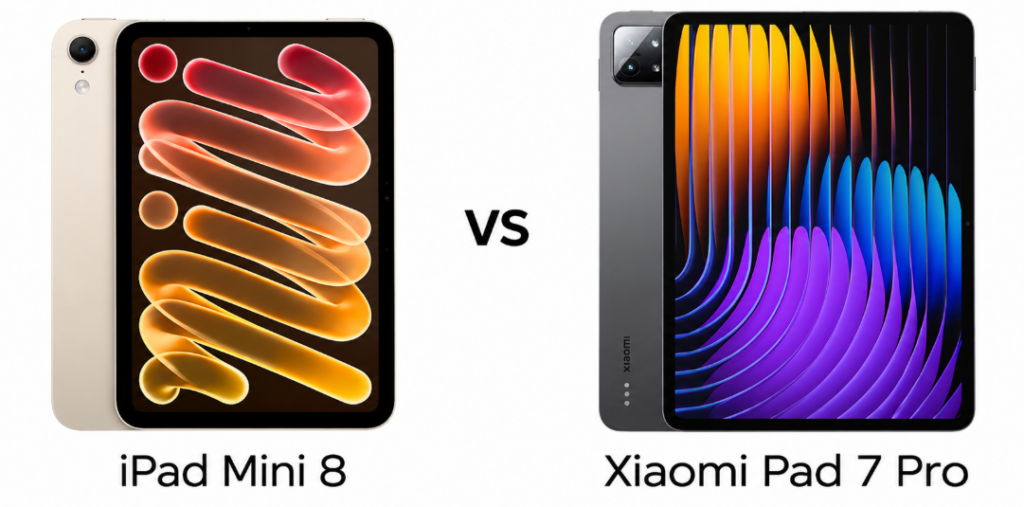
iPad Mini 8 and Xiaomi Pad 7 Pro take two very different approaches to the tablet experience. One packs flagship performance and an OLED display into a compact body, while the other offers a much larger 144Hz screen, powerful speakers and a bigger battery at a lower price. But which tablet deserves your money? Let’s find out.
1. Design and Display
Build Quality
The iPad Mini 8 and Xiaomi Pad 7 Pro take noticeably different approaches to tablet design. Apple’s compact tablet features a glass front, aluminum back and aluminum frame, giving it a premium construction in a remarkably portable 255g body. At just 5.4mm thick, it is considerably slimmer and lighter than the Xiaomi Pad 7 Pro, which measures 6.2mm and weighs 500g. The iPad also offers IP67 dust and water resistance, an advantage for users who want additional protection during everyday use.
The Xiaomi Pad 7 Pro, meanwhile, features a glass front, aluminum back and aluminum frame. Its larger dimensions make it better suited to desk use, entertainment and productivity rather than extended one-handed handling.
Display & Multimedia
The iPad Mini 8 features an 8.5-inch Super Retina XDR OLED display with a 120Hz refresh rate, 1512 x 2316 resolution and up to 1200 nits of peak brightness. Its OLED technology promises deeper blacks, richer contrast and an excellent viewing experience. Anti-reflective coating further improves visibility, while optional nano-texture glass is available on the 512GB model.
The Xiaomi Pad 7 Pro counters with a larger 11.2-inch 144Hz IPS LCD panel, 2136 x 3200 resolution, HDR10, Dolby Vision and 800 nits peak brightness.
Verdict
The Xiaomi offers substantially more screen space and a higher refresh rate, but Apple’s OLED panel delivers superior display technology, brightness and contrast. The iPad Mini 8 is the better choice for display quality and portability, while Xiaomi wins for immersive viewing.
2. Performance and Software
Processor & UI Smoothness
The iPad Mini 8 is powered by Apple’s A20 Pro chipset, built on a 2nm process. Its penta-core CPU configuration on the 128GB and 256GB models combines two super cores with three efficiency cores, while the 512GB version gets an additional efficiency core. Combined with 12GB RAM across all storage configurations, the tablet is designed to deliver powerful performance for demanding applications, gaming and creative workloads.
The Xiaomi Pad 7 Pro uses Qualcomm’s Snapdragon 8s Gen 3, manufactured on a 4nm process. Its octa-core CPU pairs a Cortex-X4 prime core with four Cortex-A720 performance cores and three Cortex-A520 efficiency cores, alongside an Adreno 735 GPU. Although it remains a capable chipset, Apple’s newer processor architecture gives the iPad a considerable advantage in processing potential.
Productivity & Multitasking
The iPad Mini 8 runs iPadOS 27.2, offering Apple’s optimized application ecosystem and productivity tools. The Xiaomi Pad 7 Pro runs Android 15 with HyperOS 2, providing a more flexible Android experience and multitasking features suited to its larger screen.
Verdict
The iPad Mini 8 takes the performance lead with its newer 2nm processor and 12GB RAM. However, Xiaomi’s larger display provides more comfortable workspace for multitasking. Apple is the stronger choice for processing power, while Xiaomi offers a more practical screen for productivity.
3. Battery and Accessories
Battery Life
The iPad Mini 8 houses a 4900mAh battery, which is relatively modest considering its OLED display and powerful chipset. However, its compact design and Apple’s hardware-software optimization should help deliver respectable everyday battery endurance. Wired charging supports reaching 50% in approximately 30 minutes, although a specific maximum charging wattage is not provided.
The Xiaomi Pad 7 Pro features a considerably larger 8850mAh battery, giving it a clear capacity advantage. It also supports 67W wired charging with PD 3.0 and QC 3+ compatibility, reaching approximately 40% charge in 20 minutes. Its larger battery makes it better equipped for extended entertainment sessions, productivity and general usage without frequent charging.
Stylus, Keyboard & Ecosystem
Both tablets support stylus input, but their intended usage differs. The iPad Mini 8 benefits from Apple’s established iPadOS application ecosystem, making it attractive for digital note-taking, drawing and creative applications. Xiaomi offers magnetic stylus support and a larger display that provides more room for writing and sketching. Its accessory ecosystem also makes it a practical option for users who want a tablet-based productivity setup.
Verdict
The Xiaomi Pad 7 Pro is the clear winner in battery capacity and charging speed. Its larger screen also makes stylus-based work more comfortable. The iPad Mini 8 remains appealing for portable note-taking and Apple’s application ecosystem, but Xiaomi offers the more versatile battery and accessory package.
4. Camera & Media
Rear and Front Camera
The iPad Mini 8 features a 12MP rear camera with an f/1.8 aperture and autofocus. It supports HDR, panorama and multi-focus LED flash, making it suitable for document scanning, everyday photography and capturing occasional moments. Its front camera is another 12MP sensor with an f/2.0 aperture and a 122-degree ultrawide field of view. This configuration is particularly useful for video calls, allowing more people to fit into the frame.
The Xiaomi Pad 7 Pro takes a different approach with a dual rear camera system featuring a 50MP primary sensor with an f/1.8 aperture and PDAF, accompanied by an auxiliary lens. Its 32MP front camera offers a higher resolution than Apple’s selfie camera, making it an attractive option for video calls and selfies.
Video & Audio Quality
The iPad Mini 8 supports 4K video recording at up to 60fps, along with gyro-EIS for stabilization. Xiaomi also supports 4K recording at 60fps, while its front camera records at 1080p. Both tablets feature stereo audio, but Xiaomi takes the lead with four speakers and Hi-Res audio support.
Verdict
Xiaomi wins on paper with its higher-resolution cameras, while Apple offers a capable camera experience with strong video recording capabilities. For multimedia consumption, Xiaomi’s four-speaker arrangement is particularly appealing. However, both tablets are better suited to occasional photography and video calls than dedicated camera use.
5. Pricing
Pricing is one of the biggest differences between these two tablets. The iPad Mini 8 carries an approximate price of $700 or ₹83,000, positioning it firmly in the premium compact tablet segment. Its higher price reflects Apple’s newer A20 Pro processor, OLED display, compact aluminum construction, IP67 protection and established iPadOS ecosystem. The 12GB RAM configuration across all storage options also makes it an interesting proposition for users who want powerful hardware in a smaller form factor.
The Xiaomi Pad 7 Pro is considerably more affordable, with an approximate price of $500 or ₹54,000. Despite costing around $200 or ₹29,000 less, it offers an 11.2-inch 144Hz display, Snapdragon 8s Gen 3 processor, 8850mAh battery, 67W charging and a four-speaker audio system.
The Xiaomi Pad 7 Pro clearly offers more screen space, battery capacity and charging convenience for the money. However, the iPad Mini 8 justifies its premium positioning through its OLED panel, newer processor, portability and water resistance.
Verdict: The Xiaomi Pad 7 Pro delivers better overall hardware value, while the iPad Mini 8 is worth considering for buyers who specifically want a premium compact tablet.
6. Conclusion
The iPad Mini 8 and Xiaomi Pad 7 Pro cater to two distinctly different tablet audiences. Apple’s biggest advantage is its compact form factor, measuring just 5.4mm thick and weighing 255g. Its 8.5-inch OLED display, A20 Pro chipset, 12GB RAM, IP67 protection and iPadOS ecosystem make it an appealing premium tablet for users who prioritize portability without compromising on performance.
The Xiaomi Pad 7 Pro focuses on delivering a more complete large-screen experience. Its 11.2-inch 144Hz display, 8850mAh battery, 67W charging, four speakers and 50MP rear camera provide a versatile package at a considerably lower price. It is particularly attractive for entertainment, studying, multitasking and productivity.
Verdict
The Xiaomi Pad 7 Pro is the more sensible purchase for most users, offering a larger display, better battery capacity, faster charging and a lower price. Its hardware package makes it a strong all-round tablet without demanding a premium investment.
However, the iPad Mini 8 is in a category of its own. Its compact dimensions, OLED technology, newer processor and IP67 rating make it a compelling choice for users who prefer a powerful tablet that is genuinely easy to carry around.
Ultimately, the Xiaomi Pad 7 Pro wins on overall value and versatility, while the iPad Mini 8 is the better premium compact tablet. The decision comes down to whether a larger workspace or a smaller, more portable design matters more.
Disclaimer: Prices, specifications, and availability may vary by region and retailer. Recommendations in this article are based on editorial opinion, feature-based value, and market positioning at the time of writing. Readers are advised to do their own research before making a purchase.
Read More;
- Redmi Band 4 vs Huawei Band 11: Which Fitness Band Is Better?
- Vivo Buds Clip vs Vivo TWS 4: Which Wireless Earbuds Should You Buy?
- OnePlus Turbo 6V vs Turbo 6: Is the More Expensive Model Really Worth It?
FREE DAILY NEWSLETTER
Joel Explains
What matters in phones and gadgets, before it reaches you. From Gizmochina’s editor-in-chief, every morning.
Join 1,500+ readers. One email a day, unsubscribe in one click.



Comments